OECD INVESTMENT POLICY
REVIEW OF MYANMAR
Mike Pfister
Investment Policy Reviews, OECD
4 March 2014, Yangon
Supported by the AANZFTA Economic Cooperation Support Program
Investment Policy Review of Myanmar
INVESTMENT PROMOTION &
FACILITATION AND OTHER AREAS
OF THE PFI
• Strong reform momentum, very quick
reforms
• Pushing up against capacity of MIC and
other agencies in charge of “investment
promotion”
• This calls for eventual de-regulation: but
not all cost – need accompanying capacity
• Attractiveness of SEZ models: careful!
Context
• Effective investment promotion a function of sound policy
environment
• Need for clear demarcation of Promotion and Facilitation
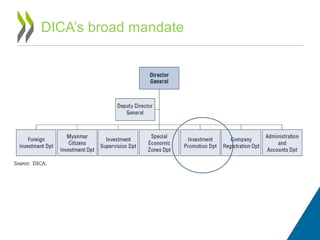
– DICA mandate broad
• Focus should be on:
– Transparency (criteria based system, reducing discretion)
– Accountability (feedback from private sector, UMFCCI etc...)
– Efficiency (streamlining, cutting down red tape, 1-stop shop)
– Monitoring policy effectiveness (DICA to develop KPIs, objectives)
• Need to improve data for better policy development
Investment Promotion & Facilitation
DICA’s broad mandate
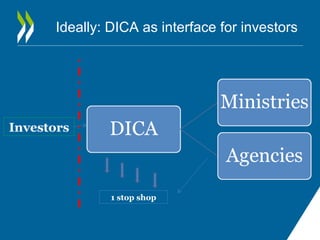
Ideally: DICA as interface for investors
Investors
1 stop shop
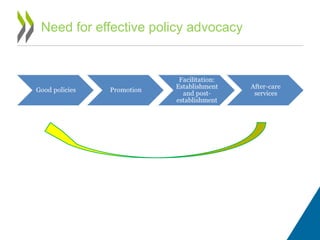
Need for effective policy advocacy
Policy Advocacy
investor feedback to
policies: surveys, public-
private committees for
business climate reforms...
Main recommendations
• Investment promotion is perhaps less important for
Myanmar at present than investment facilitation.
• Continue to streamline procedures (ease of doing
business)
• Ensure that one-stop shops include single-point
authority.
• DICA should take responsibility for addressing investor
grievances and serve as a policy advocate within
government for the private sector.
• Keeping existing investors happy is the best form of
promotion.
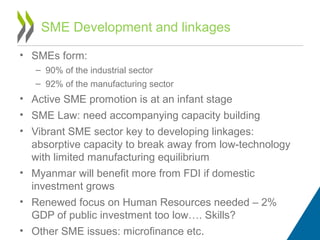
• SMEs form:
– 90% of the industrial sector
– 92% of the manufacturing sector
• Active SME promotion is at an infant stage
• SME Law: need accompanying capacity building
• Vibrant SME sector key to developing linkages:
absorptive capacity to break away from low-technology
with limited manufacturing equilibrium
• Myanmar will benefit more from FDI if domestic
investment grows
• Renewed focus on Human Resources needed – 2%
GDP of public investment too low…. Skills?
• Other SME issues: microfinance etc.
SME Development and linkages
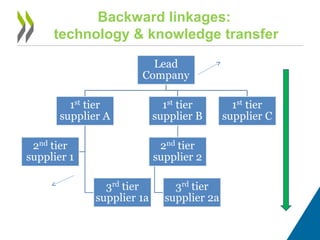
Backward linkages:
technology & knowledge transfer
Technology, know-
how, management and
product standards
Domestic
market,
Export,
GVC
TECH&KNOWLEDGE
TRANSFER
Role of
policy:
SME policy,
financing,
vocational
training
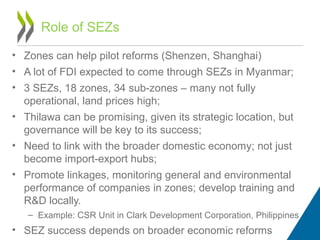
• Zones can help pilot reforms (Shenzen, Shanghai)
• A lot of FDI expected to come through SEZs in Myanmar;
• 3 SEZs, 18 zones, 34 sub-zones – many not fully
operational, land prices high;
• Thilawa can be promising, given its strategic location, but
governance will be key to its success;
• Need to link with the broader domestic economy; not just
become import-export hubs;
• Promote linkages, monitoring general and environmental
performance of companies in zones; develop training and
R&D locally.
– Example: CSR Unit in Clark Development Corporation, Philippines
• SEZ success depends on broader economic reforms
Role of SEZs
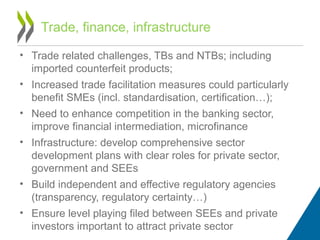
• Trade related challenges, TBs and NTBs; including
imported counterfeit products;
• Increased trade facilitation measures could particularly
benefit SMEs (incl. standardisation, certification…);
• Need to enhance competition in the banking sector,
improve financial intermediation, microfinance
• Infrastructure: develop comprehensive sector
development plans with clear roles for private sector,
government and SEEs
• Build independent and effective regulatory agencies
(transparency, regulatory certainty…)
• Ensure level playing filed between SEEs and private
investors important to attract private sector
Trade, finance, infrastructure
Investment Policy Review of Myanmar
PROMOTING SUSTAINABLE
INVESTMENT IN AGRICULTURE
IN MYANMAR
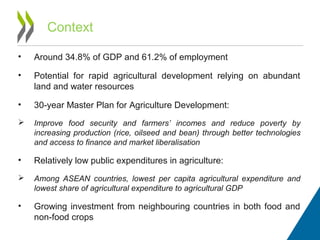
Context
• Around 34.8% of GDP and 61.2% of employment
• Potential for rapid agricultural development relying on abundant
land and water resources
• 30-year Master Plan for Agriculture Development:
 Improve food security and farmers’ incomes and reduce poverty by
increasing production (rice, oilseed and bean) through better technologies
and access to finance and market liberalisation
• Relatively low public expenditures in agriculture:
 Among ASEAN countries, lowest per capita agricultural expenditure and
lowest share of agricultural expenditure to agricultural GDP
• Growing investment from neighbouring countries in both food and
non-food crops
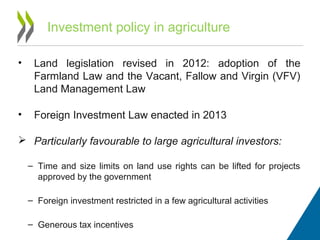
Investment policy in agriculture
• Land legislation revised in 2012: adoption of the
Farmland Law and the Vacant, Fallow and Virgin (VFV)
Land Management Law
• Foreign Investment Law enacted in 2013
 Particularly favourable to large agricultural investors:
– Time and size limits on land use rights can be lifted for projects
approved by the government
– Foreign investment restricted in a few agricultural activities
– Generous tax incentives
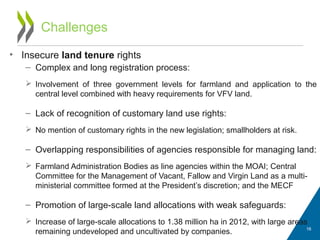
Challenges
• Insecure land tenure rights
– Complex and long registration process:
 Involvement of three government levels for farmland and application to the
central level combined with heavy requirements for VFV land.
– Lack of recognition of customary land use rights:
 No mention of customary rights in the new legislation; smallholders at risk.
– Overlapping responsibilities of agencies responsible for managing land:
 Farmland Administration Bodies as line agencies within the MOAI; Central
Committee for the Management of Vacant, Fallow and Virgin Land as a multi-
ministerial committee formed at the President’s discretion; and the MECF
– Promotion of large-scale land allocations with weak safeguards:
 Increase of large-scale allocations to 1.38 million ha in 2012, with large areas
remaining undeveloped and uncultivated by companies. 16
Challenges
• Limited access to finance
– Small short-term loans from the MADB
– High interest rates from informal lenders
• Limited access to and low quality of agricultural inputs
• Weak extension services and R&D
17
Recommendations
Securing land tenure rights
• Harmonise the land legislation
 Develop a unique comprehensive land law;
 Enhance the co-ordination across the Ministries responsible for land.
• Accelerate land registration
 Set up an efficient institutional structure at national and local level for land titling
and land surveys;
 Establish a one-window service.
• Recognise customary rights
 Protect customary rights, including collective rights and rights on land used for
shifting cultivation;
 Consider the diversity of customary law across different ethnic groups and
geographic areas.
18
Recommendations
Attracting investment
• Develop clear selection criteria before granting investment incentives
• Establish independent and accessible procedures to address grievances
• Promote the free choice of crops
• Reform the MADB to expand its coverage
• Strengthen extension services and increase public funding on R&D
 Myanmar could recover its place as a major agricultural producer
and exporter in Southeast Asia
19
Recommendations
Promoting responsible investment
•Develop adequate safeguards for large-scale land acquisitions:
 Promote transparent and inclusive consultations
 Protect existing land tenure rights
•Establish transparent and fair expropriation and compensation
mechanisms
•Set up a regulatory framework to support inclusive business
partnerships
•Impose Environmental and Social Impact Assessments, especially for
large-scale investments.
Policy Framework for Investment (and User’s Toolkit)
www.oecd.org/investment/pfi.htm
www.oecd.org/investment/toolkit/
FDI Index
www.oecd.org/investment/fdiindex.htm
Investment Policy Reviews
www.oecd.org/investment/countryreviews.htm
ASEAN-OECD Investment Programme
www.oecd.org/daf/inv/mne/seasia.htm
ASEAN Investment website
www.investasean.asean.org
For further information

Investment promotion and investment in agriculture - Mike Pfister - OECD Investment Policy Review of Myanmar

  • 1.
    OECD INVESTMENT POLICY REVIEWOF MYANMAR Mike Pfister Investment Policy Reviews, OECD 4 March 2014, Yangon Supported by the AANZFTA Economic Cooperation Support Program
  • 2.
    Investment Policy Reviewof Myanmar INVESTMENT PROMOTION & FACILITATION AND OTHER AREAS OF THE PFI
  • 3.
    • Strong reformmomentum, very quick reforms • Pushing up against capacity of MIC and other agencies in charge of “investment promotion” • This calls for eventual de-regulation: but not all cost – need accompanying capacity • Attractiveness of SEZ models: careful! Context
  • 4.
    • Effective investmentpromotion a function of sound policy environment • Need for clear demarcation of Promotion and Facilitation – DICA mandate broad • Focus should be on: – Transparency (criteria based system, reducing discretion) – Accountability (feedback from private sector, UMFCCI etc...) – Efficiency (streamlining, cutting down red tape, 1-stop shop) – Monitoring policy effectiveness (DICA to develop KPIs, objectives) • Need to improve data for better policy development Investment Promotion & Facilitation
  • 5.
  • 6.
    Ideally: DICA asinterface for investors Investors 1 stop shop
  • 7.
    Need for effectivepolicy advocacy Policy Advocacy investor feedback to policies: surveys, public- private committees for business climate reforms...
  • 8.
    Main recommendations • Investmentpromotion is perhaps less important for Myanmar at present than investment facilitation. • Continue to streamline procedures (ease of doing business) • Ensure that one-stop shops include single-point authority. • DICA should take responsibility for addressing investor grievances and serve as a policy advocate within government for the private sector. • Keeping existing investors happy is the best form of promotion.
  • 9.
    • SMEs form: –90% of the industrial sector – 92% of the manufacturing sector • Active SME promotion is at an infant stage • SME Law: need accompanying capacity building • Vibrant SME sector key to developing linkages: absorptive capacity to break away from low-technology with limited manufacturing equilibrium • Myanmar will benefit more from FDI if domestic investment grows • Renewed focus on Human Resources needed – 2% GDP of public investment too low…. Skills? • Other SME issues: microfinance etc. SME Development and linkages
  • 10.
    Backward linkages: technology &knowledge transfer Technology, know- how, management and product standards Domestic market, Export, GVC TECH&KNOWLEDGE TRANSFER Role of policy: SME policy, financing, vocational training
  • 11.
    • Zones canhelp pilot reforms (Shenzen, Shanghai) • A lot of FDI expected to come through SEZs in Myanmar; • 3 SEZs, 18 zones, 34 sub-zones – many not fully operational, land prices high; • Thilawa can be promising, given its strategic location, but governance will be key to its success; • Need to link with the broader domestic economy; not just become import-export hubs; • Promote linkages, monitoring general and environmental performance of companies in zones; develop training and R&D locally. – Example: CSR Unit in Clark Development Corporation, Philippines • SEZ success depends on broader economic reforms Role of SEZs
  • 12.
    • Trade relatedchallenges, TBs and NTBs; including imported counterfeit products; • Increased trade facilitation measures could particularly benefit SMEs (incl. standardisation, certification…); • Need to enhance competition in the banking sector, improve financial intermediation, microfinance • Infrastructure: develop comprehensive sector development plans with clear roles for private sector, government and SEEs • Build independent and effective regulatory agencies (transparency, regulatory certainty…) • Ensure level playing filed between SEEs and private investors important to attract private sector Trade, finance, infrastructure
  • 13.
    Investment Policy Reviewof Myanmar PROMOTING SUSTAINABLE INVESTMENT IN AGRICULTURE IN MYANMAR
  • 14.
    Context • Around 34.8%of GDP and 61.2% of employment • Potential for rapid agricultural development relying on abundant land and water resources • 30-year Master Plan for Agriculture Development:  Improve food security and farmers’ incomes and reduce poverty by increasing production (rice, oilseed and bean) through better technologies and access to finance and market liberalisation • Relatively low public expenditures in agriculture:  Among ASEAN countries, lowest per capita agricultural expenditure and lowest share of agricultural expenditure to agricultural GDP • Growing investment from neighbouring countries in both food and non-food crops
  • 15.
    Investment policy inagriculture • Land legislation revised in 2012: adoption of the Farmland Law and the Vacant, Fallow and Virgin (VFV) Land Management Law • Foreign Investment Law enacted in 2013  Particularly favourable to large agricultural investors: – Time and size limits on land use rights can be lifted for projects approved by the government – Foreign investment restricted in a few agricultural activities – Generous tax incentives
  • 16.
    Challenges • Insecure landtenure rights – Complex and long registration process:  Involvement of three government levels for farmland and application to the central level combined with heavy requirements for VFV land. – Lack of recognition of customary land use rights:  No mention of customary rights in the new legislation; smallholders at risk. – Overlapping responsibilities of agencies responsible for managing land:  Farmland Administration Bodies as line agencies within the MOAI; Central Committee for the Management of Vacant, Fallow and Virgin Land as a multi- ministerial committee formed at the President’s discretion; and the MECF – Promotion of large-scale land allocations with weak safeguards:  Increase of large-scale allocations to 1.38 million ha in 2012, with large areas remaining undeveloped and uncultivated by companies. 16
  • 17.
    Challenges • Limited accessto finance – Small short-term loans from the MADB – High interest rates from informal lenders • Limited access to and low quality of agricultural inputs • Weak extension services and R&D 17
  • 18.
    Recommendations Securing land tenurerights • Harmonise the land legislation  Develop a unique comprehensive land law;  Enhance the co-ordination across the Ministries responsible for land. • Accelerate land registration  Set up an efficient institutional structure at national and local level for land titling and land surveys;  Establish a one-window service. • Recognise customary rights  Protect customary rights, including collective rights and rights on land used for shifting cultivation;  Consider the diversity of customary law across different ethnic groups and geographic areas. 18
  • 19.
    Recommendations Attracting investment • Developclear selection criteria before granting investment incentives • Establish independent and accessible procedures to address grievances • Promote the free choice of crops • Reform the MADB to expand its coverage • Strengthen extension services and increase public funding on R&D  Myanmar could recover its place as a major agricultural producer and exporter in Southeast Asia 19
  • 20.
    Recommendations Promoting responsible investment •Developadequate safeguards for large-scale land acquisitions:  Promote transparent and inclusive consultations  Protect existing land tenure rights •Establish transparent and fair expropriation and compensation mechanisms •Set up a regulatory framework to support inclusive business partnerships •Impose Environmental and Social Impact Assessments, especially for large-scale investments.
  • 21.
    Policy Framework forInvestment (and User’s Toolkit) www.oecd.org/investment/pfi.htm www.oecd.org/investment/toolkit/ FDI Index www.oecd.org/investment/fdiindex.htm Investment Policy Reviews www.oecd.org/investment/countryreviews.htm ASEAN-OECD Investment Programme www.oecd.org/daf/inv/mne/seasia.htm ASEAN Investment website www.investasean.asean.org For further information