S. L. Pandharipade, Yogesh Moharkar, Raj Thakur / International Journal of Engineering
             Research and Applications (IJERA) ISSN: 2248-9622 www.ijera.com
                        Vol. 2, Issue4, July-August 2012, pp.1337-1341
Synthesis Of Adsorbents From Waste Materials Such As Ziziphus
                 Jujube Seed & Mango Kernel
            S. L. Pandharipade*, Yogesh Moharkar**, Raj Thakur***
                               *Associate Professor, ** M.Tech, *** B. Tech,
  Laxminarayan Institute of Technology, Rashtrasant Tukadoji Maharaj Nagpur University, Nagpur-33, India


ABSTRACT
         Adsorption has been used as physico-              attractive force between the molecules. There is wide
chemical process for many years & is developing            variety of activated carbons which exhibit different
as a major industrial separation technique.                characteristics depending upon the raw materials and
Activated carbon has been quite successful for             the activation techniques used in their synthesis.
removal of impurities from exhaust gas and waste           Agricultural waste materials like straw, leaves, stem,
water streams. The special feature of the present          seeds and husk can effectively be converted in to
research work is to utilise the commonly available         activated carbon. The objective of the present work is
waste materials such as mango kernel and seed of           to utilize waste materials like Ziziphus Jujube and
ziziphus jujube. These materials have been                 Mango Kernel.
converted into the activated carbon with thermal           Most industrial adsorbents fall into one of three
treatment & is further utilised for the adsorption         classes:
of colour from the aqueous solution of methyl red.         Oxygen-containing       compounds,      Carbon-based
Various amounts of adsorbent samples were taken            compounds & Polymer-based compounds.
for the present work. It is observed that as the
amount of sample increases the percentage                  1.1 Conventional adsorbents
adsorption also increases. The percentage                            The industrial adsorbents include silica gel,
adsorption is also function of mesh size of the             zeolites & activated carbon. Silica gel is a chemically
adsorbent sample & the best result is obtained for          inert, nontoxic, polar and dimensionally stable (<
adsorbent made from ziziphus jujube 14 mesh                 400 °C or 750 °F) amorphous form of SiO2.Zeolites
size. It is concluded that the prepared activated           are natural or synthetic crystalline alumina silicates
carbon can be used effectively to adsorb coloured           which have a repeating pore network and release
solute & other impurities from industrial effluent.         water at high temperature. Zeolites are polar in
There is a tremendous potential in these materials          nature. They are manufactured by hydrothermal
to be explored further as industrial low cost               synthesis of sodium alumina silicate or another silica
effective adsorbents.                                       source in an autoclave followed by ion exchange with
                                                            certain cations (Na+, Li+, Ca2+, K+, NH4+). Activated
Keywords – adsorption, activated cabon, mango               carbon is a highly porous, amorphous solid consisting
kernel, methyl red, ziziphus jujube,                        of micro crystallites with a graphite lattice, usually
                                                            prepared in small pellets or a powder. It is non-polar
1. INTRODUCTION                                             and cheap. One of its main drawbacks is that it is
          Adsorption has been used as physico-              reacts with oxygen at moderate temperatures (over
chemical process for many years; it is only over the        300 °C).
last four decades that the process has developed to a
stage where it is now a major industrial separation             1.2 Adsorption equilibrium
technique. In adsorption molecules distribute                         Adsorption equilibrium is a dynamic concept
themselves between two phases, one of which is a           achieved where the rate at which the molecule adsorb
solid while the other may be liquid or gas. Unlike         on to a surface is equal to the rate at which they
absorption, in which solute molecule diffuse from the      desorbs. Most of the work related to adsorption is
bulk of gas phase to the bulk of liquid phase, in          devoted to explain the equilibrium through isotherms,
adsorption molecules diffuse through the bulk of fluid     that is, the amount of adsorbate on the adsorbent as a
to the surface of the solid adsorbent forming a distinct   function of its pressure (if gas) or concentration (if
adsorbent phase.                                           liquid) at constant temperature. The combination of
          Activated carbon has been quite successful       adsorbents & adsorbates exhibit different types of
for removal of impurities from exhaust gas and waste       adsorbtion isotherms which are, Freudlich isotherm,
water streams. The highly porous nature of the carbon      Langmuir isotherm BET isotherm and many more are
provides a large surface area for contaminants to get      reported in literature.
deposited. The adsorption takes place because of the

                                                                                                  1337 | P a g e
S. L. Pandharipade, Yogesh Moharkar, Raj Thakur / International Journal of Engineering
              Research and Applications (IJERA) ISSN: 2248-9622 www.ijera.com
                         Vol. 2, Issue4, July-August 2012, pp.1337-1341
1.3 Synthesis of activated carbon                          undersize 14 mesh, 14 mesh and 10 mesh. The
         Activated carbon is carbon produced from          samples are stored in air tight bottles.
carbonaceous source materials like nutshells, peat,
wood, coir, lignite, coal and petroleum pitch. It can be
produced by physical reactivation involving
Carbonization carried at temperatures in the range
600–900 °C, in absence of oxygen or Oxidation by
exposing the carbonised material to oxidising
atmospheres at temperatures above 250 °C. The other
method of chemical activation involves pre treatment
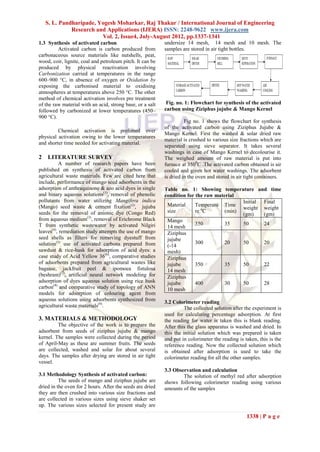
of the raw material with an acid, strong base, or a salt    Fig. no. 1: Flowchart for synthesis of the activated
followed by carbonized at lower temperatures (450–         carbon using Ziziphus jujube & Mango Kernel
900 °C).
                                                                     Fig no. 1 shows the flowchart for synthesis
                                                           of the activated carbon using Ziziphus Jujube &
         Chemical activation is preferred over
                                                           Mango Kernel. First the washed & solar dried raw
physical activation owing to the lower temperatures
                                                           material is crushed to various size fractions which are
and shorter time needed for activating material.
                                                           separated using sieve separator. It takes several
                                                           washings in case of Mango Kernel to decolourise it.
2   LITERATURE SURVEY                                      The weighed amount of raw material is put into
          A number of research papers have been            furnace at 3500C .The activated carbon obtained is air
published on synthesis of activated carbon from            cooled and given hot water washings. The adsorbent
agricultural waste materials. Few are cited here that      is dried in the oven and stored in air tight containers.
include, performance of mango seed adsorbents in the
adsorption of anthraquinone & azo acid dyes in single      Table no. 1: Showing temperature and time
and binary aqueous solutions(1), removal of phenolic       condition for the raw material
pollutants from water utilizing Mangifera indica                                           Initial Final
(Mango) seed waste & cement fixation(2), jujuba             Material     Temperatu Time
                                                                           o               weight weight
seeds for the removal of anionic dye (Congo Red)            size         re C        (min)
                                                                                           (gm)    (gm)
from aqueous medium(3), removal of Erichrome Black          Mango
T from synthetic wastewater by activated Nilgiri                         350         35    50      24
                                                            14 mesh
leaves(4), remediation study attempts the use of mango      Ziziphus
seed shells as filters for removing dyestuff from           jujube
solution(5), use of activated carbons prepared from                      300         20    50      20
                                                            (-14
sawdust & rice-husk for adsorption of acid dyes: a          mesh)
case study of Acid Yellow 36(6), comparative studies        Ziziphus
of adsorbents prepared from agricultural wastes like        jujube       350         35    50      22
bagasse, jackfruit peel & ipomoea fistulosa                 14 mesh
(beshram)(7), artificial neural network modeling for        Ziziphus
adsorption of dyes aqueous solution using rice husk         jujube       400         30    50      28
carbon(8) and comparative study of topology of ANN          10 mesh
models for adsorption of colouring agent from
aqueous solutions using adsorbents synthesized from        3.2 Colorimeter reading
agricultural waste materials(9).                                     The collected solution after the experiment is
                                                           used for calculating percentage adsorption. At first
3. MATERIALS & METHODOLOGY                                 the reading for water is taken this is blank reading.
         The objective of the work is to prepare the       After this the glass apparatus is washed and dried. In
adsorbent from seeds of ziziphus jujube & mango            this the initial solution which was prepared is taken
kernel. The samples were collected during the period       and put in colorimeter the reading is taken, this is the
of April-May as these are summer fruits. The seeds         reference reading. Now the collected solution which
are collected, washed and solar for about several          is obtained after adsorption is used to take the
days. The samples after drying are stored in air tight     colorimeter reading for all the other samples.
vessel.
                                                           3.3 Observation and calculation
3.1 Methodology Synthesis of activated carbon:                     The solution of methyl red after adsorption
          The seeds of mango and ziziphus jujube are       shows following colorimeter reading using various
dried in the oven for 2 hours. After the seeds are dried   amounts of the samples
they are then crushed into various size fractions and
are collected in various sizes using sieve shaker set
up. The various sizes selected for present study are

                                                                                                  1338 | P a g e
S. L. Pandharipade, Yogesh Moharkar, Raj Thakur / International Journal of Engineering
               Research and Applications (IJERA) ISSN: 2248-9622 www.ijera.com
                          Vol. 2, Issue4, July-August 2012, pp.1337-1341
3.3.1. Observation                                           03 0.00213       0.01446 4          96.4
Pure water reading 0.00                                      03 0.00          0.012     5        100
Methyl red solution initial colorimeter reading 1.2          04 0.0342        0.0258    1        43
Table no.2: Details of Colorimeter readings
                                                             04 0.032         0.01396 2          46.5
                  Colorimeter reading                        04 0.0299        0.010     3        50
        Quantit
  Sr.             Type      Type     Type      Type          04 0.024         0.0088    4        58.66
        y of
  No              of        of       of        of
        Sample                                               04 0.0192        0.00814 5          67.83
  .               Sampl     Sampl    Sampl     Sampl
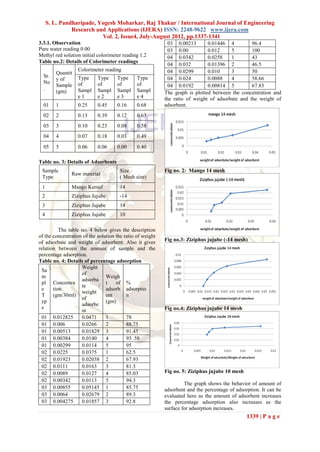
        (gm)                                               The graph is plotted between the concentration and
                  e1        e2       e3        e4          the ratio of weight of adsorbate and the weight of
  01    1         0.25      0.45     0.16      0.68        adsorbent.
  02    2         0.13      0.39     0.12      0.63
  03    3         0.10      0.23     0.08      0.58
  04    4         0.07      0.18     0.03      0.49
  05    5         0.06      0.06     0.00      0.40

Table no. 3: Details of Adsorbents
 Sample                               Size                 Fig no. 2: Mango 14 mesh
               Raw material
 Type                                 ( Mesh size)
 1             Mango Kernel           14
 2             Ziziphus Jujube        -14
 3             Ziziphus Jujube        14
 4             Ziziphus Jujube        10

          The table no. 4 below gives the description
of the concentration of the solution the ratio of weight
of adsorbate and weight of adsorbent. Also it gives        Fig no.3: Ziziphus jujube (-14 mesh)
relation between the amount of sample and the
percentage adsorption.
Table no. 4: Details of percentage adsorption
                    Weight
 Sa
                    of
 m                              Weigh
                    adsorba
 pl Concentra                   t    of %
                    te       /
 e     tion                     adsorb adsorptio
                    weight
 T     (gm/30ml)                ent       n
                    of
 yp                             (gm)
                    adsorbe
 e                                                         Fig no.4: Ziziphus jujube 14 mesh
                    nt
 01 0.012825        0.0471      1         78
 01 0.006           0.0266      2         88.75
 01 0.00513         0.01829 3             91.45
 01 0.00384         0.0140      4         93 .58
 01 0.00299         0.0114      5         95
 02 0.0225          0.0375      1         62.5
 02 0.01923         0.02038 2             67.93
 02 0.0111          0.0163      3         81.3
 02 0.0089          0.0127      4         85.03            Fig no. 5: Ziziphus jujube 10 mesh
 02 0.00342         0.0113      5         94.3
                                                                    The graph shows the behavior of amount of
 03 0.00855         0.05145 1             85.75            adsorbent and the percentage of adsorption. It can be
 03 0.0064          0.02679 2             89.3             evaluated here as the amount of adsorbent increases
 03 0.004275        0.01857 3             92.8             the percentage adsorption also increases as the
                                                           surface for adsorption increases.
                                                                                                1339 | P a g e
S. L. Pandharipade, Yogesh Moharkar, Raj Thakur / International Journal of Engineering
            Research and Applications (IJERA) ISSN: 2248-9622 www.ijera.com
                       Vol. 2, Issue4, July-August 2012, pp.1337-1341

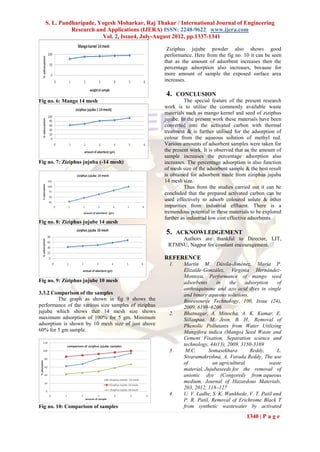
                                                       Ziziphus jujube powder also shows good
                                                      performance. Here from the fig no. 10 it can be seen
                                                      that as the amount of adsorbent increases then the
                                                      percentage adsorption also increases, because for
                                                      more amount of sample the exposed surface area
                                                      increases.

                                                      4.     CONCLUSION
Fig no. 6: Mango 14 mesh                                        The special feature of the present research
                                                      work is to utilise the commonly available waste
                                                      materials such as mango kernel and seed of ziziphus
                                                      jujube. In the present work these materials have been
                                                      converted into the activated carbon with thermal
                                                      treatment & is further utilised for the adsorption of
                                                      colour from the aqueous solution of methyl red.
                                                      Various amounts of adsorbent samples were taken for
                                                      the present work. It is observed that as the amount of
                                                      sample increases the percentage adsorption also
Fig no. 7: Ziziphus jujuba (-14 mesh)                 increases. The percentage adsorption is also function
                                                      of mesh size of the adsorbent sample & the best result
                                                      is obtained for adsorbent made from ziziphus jujuba
                                                      14 mesh size.
                                                                Thus from the studies carried out it can be
                                                      concluded that the prepared activated carbon can be
                                                      used effectively to adsorb coloured solute & other
                                                      impurities from industrial effluent. There is a
                                                      tremendous potential in these materials to be explored
                                                      further as industrial low cost effective adsorbents.
Fig no. 8: Ziziphus jujube 14 mesh
                                                      5.     ACKNOWLEDGEMENT
                                                           Authors are thankful to Director, LIT,
                                                       RTMNU, Nagpur for constant encouragement.

                                                      REFERENCE
                                                        1.    Martín M. Dávila-Jiménez, María P.
                                                              Elizalde-González, Virginia Hernández-
                                                              Montoya, Performance of mango seed
Fig no. 9: Ziziphus jujube 10 mesh                            adsorbents     in    the    adsorption    of
                                                              anthraquinone and azo acid dyes in single
3.3.2 Comparison of the samples                               and binary aqueous solutions,
         The graph as shown in fig 9 shows the                Bioresource Technology, 100, Issue (24),
performance of the various size samples of ziziphus           2009, 6199–6206
jujuba which shows that 14 mesh size shows              2.    Bhatnagar, A. Minocha, A. K. Kumar, E.
maximum adsorption of 100% for 5 gm. Minimum                  Sillanpaa, M. Jeon, B. H., Removal of
adsorption is shown by 10 mesh size of just above             Phenolic Pollutants from Water Utilizing
60% for 5 gm sample.                                          Mangifera indica (Mango) Seed Waste and
                                                              Cement Fixation, Separation science and
                                                              technology, 44(13), 2009, 3150-3169
                                                        3.     M.C.      Somasekhara        Reddy,      L.
                                                              Sivaramakrishna, A. Varada Reddy, The use
                                                              of           an agricultural           waste
                                                              material, Jujubaseeds for the removal of
                                                              anionic dye (Congored) from aqueous
                                                              medium, Journal of Hazardous Materials,
                                                              203, 2012, 118–127
                                                        4.    U. V. Ladhe, S. K. Wankhede, V. T. Patil and
                                                              P. R. Patil, Removal of Erichrome Black T
Fig no. 10: Comparison of samples                             from synthetic wastewater by activated
                                                                                           1340 | P a g e
S. L. Pandharipade, Yogesh Moharkar, Raj Thakur / International Journal of Engineering
          Research and Applications (IJERA) ISSN: 2248-9622 www.ijera.com
                     Vol. 2, Issue4, July-August 2012, pp.1337-1341
     Nilgiri leaves, Journal of Chemical and
     Pharmaceutical Research, 3(2), 2011, 670-
     675
5.   A.U.Itodo1,      H.U.Itodo2,      F.A.Atiku1,
     R.A.Koko1 and A.A.Kwaido, Dyes uptake
     onto Processed and Raw Mango seed Back,
     Asian Journal of Plant Science and
     Research, , 1 (1), 2011,57-66
6.   Malik, P.K., Use of activated carbons
     prepared from sawdust and rice-husk for
     adsorption of acid dyes: a case study of Acid
     Yellow 36, Dyes and Pigments , 56 (3) 2003,
     239-249
7.   S L Pandharipande, Umesh Dhomane,
     Pradip Suryawanshi, Nitin Dorlikar,
     Comparative studies of adsorbents prepared
     from agricultural wastes like bagasse,
     jackfruit peel & ipomoea fistulosa
     (beshram), IJAERS, I(III), 2012, 214-216
8.   R. D. Khonde, S. L. Pandharipande,
     Artificial neural network modeling for
     adsorption of dyes aqueous solution using
     rice husk carbon, IJCA, 41 (4), 2012
9.   S.L. Pandharipande, Y. D. Urunkar, Ankit
     Singh, Comparative study of topology of
     ANN models for adsorption of colouring
     agent from aqueous solutions using
     adsorbents synthesized from agricultural
     waste material, IJCA,Volume 45(11), 2012


                                                                           1341 | P a g e

Hn2413371341

  • 1.
    S. L. Pandharipade,Yogesh Moharkar, Raj Thakur / International Journal of Engineering Research and Applications (IJERA) ISSN: 2248-9622 www.ijera.com Vol. 2, Issue4, July-August 2012, pp.1337-1341 Synthesis Of Adsorbents From Waste Materials Such As Ziziphus Jujube Seed & Mango Kernel S. L. Pandharipade*, Yogesh Moharkar**, Raj Thakur*** *Associate Professor, ** M.Tech, *** B. Tech, Laxminarayan Institute of Technology, Rashtrasant Tukadoji Maharaj Nagpur University, Nagpur-33, India ABSTRACT Adsorption has been used as physico- attractive force between the molecules. There is wide chemical process for many years & is developing variety of activated carbons which exhibit different as a major industrial separation technique. characteristics depending upon the raw materials and Activated carbon has been quite successful for the activation techniques used in their synthesis. removal of impurities from exhaust gas and waste Agricultural waste materials like straw, leaves, stem, water streams. The special feature of the present seeds and husk can effectively be converted in to research work is to utilise the commonly available activated carbon. The objective of the present work is waste materials such as mango kernel and seed of to utilize waste materials like Ziziphus Jujube and ziziphus jujube. These materials have been Mango Kernel. converted into the activated carbon with thermal Most industrial adsorbents fall into one of three treatment & is further utilised for the adsorption classes: of colour from the aqueous solution of methyl red. Oxygen-containing compounds, Carbon-based Various amounts of adsorbent samples were taken compounds & Polymer-based compounds. for the present work. It is observed that as the amount of sample increases the percentage 1.1 Conventional adsorbents adsorption also increases. The percentage The industrial adsorbents include silica gel, adsorption is also function of mesh size of the zeolites & activated carbon. Silica gel is a chemically adsorbent sample & the best result is obtained for inert, nontoxic, polar and dimensionally stable (< adsorbent made from ziziphus jujube 14 mesh 400 °C or 750 °F) amorphous form of SiO2.Zeolites size. It is concluded that the prepared activated are natural or synthetic crystalline alumina silicates carbon can be used effectively to adsorb coloured which have a repeating pore network and release solute & other impurities from industrial effluent. water at high temperature. Zeolites are polar in There is a tremendous potential in these materials nature. They are manufactured by hydrothermal to be explored further as industrial low cost synthesis of sodium alumina silicate or another silica effective adsorbents. source in an autoclave followed by ion exchange with certain cations (Na+, Li+, Ca2+, K+, NH4+). Activated Keywords – adsorption, activated cabon, mango carbon is a highly porous, amorphous solid consisting kernel, methyl red, ziziphus jujube, of micro crystallites with a graphite lattice, usually prepared in small pellets or a powder. It is non-polar 1. INTRODUCTION and cheap. One of its main drawbacks is that it is Adsorption has been used as physico- reacts with oxygen at moderate temperatures (over chemical process for many years; it is only over the 300 °C). last four decades that the process has developed to a stage where it is now a major industrial separation 1.2 Adsorption equilibrium technique. In adsorption molecules distribute Adsorption equilibrium is a dynamic concept themselves between two phases, one of which is a achieved where the rate at which the molecule adsorb solid while the other may be liquid or gas. Unlike on to a surface is equal to the rate at which they absorption, in which solute molecule diffuse from the desorbs. Most of the work related to adsorption is bulk of gas phase to the bulk of liquid phase, in devoted to explain the equilibrium through isotherms, adsorption molecules diffuse through the bulk of fluid that is, the amount of adsorbate on the adsorbent as a to the surface of the solid adsorbent forming a distinct function of its pressure (if gas) or concentration (if adsorbent phase. liquid) at constant temperature. The combination of Activated carbon has been quite successful adsorbents & adsorbates exhibit different types of for removal of impurities from exhaust gas and waste adsorbtion isotherms which are, Freudlich isotherm, water streams. The highly porous nature of the carbon Langmuir isotherm BET isotherm and many more are provides a large surface area for contaminants to get reported in literature. deposited. The adsorption takes place because of the 1337 | P a g e
  • 2.
    S. L. Pandharipade,Yogesh Moharkar, Raj Thakur / International Journal of Engineering Research and Applications (IJERA) ISSN: 2248-9622 www.ijera.com Vol. 2, Issue4, July-August 2012, pp.1337-1341 1.3 Synthesis of activated carbon undersize 14 mesh, 14 mesh and 10 mesh. The Activated carbon is carbon produced from samples are stored in air tight bottles. carbonaceous source materials like nutshells, peat, wood, coir, lignite, coal and petroleum pitch. It can be produced by physical reactivation involving Carbonization carried at temperatures in the range 600–900 °C, in absence of oxygen or Oxidation by exposing the carbonised material to oxidising atmospheres at temperatures above 250 °C. The other method of chemical activation involves pre treatment of the raw material with an acid, strong base, or a salt Fig. no. 1: Flowchart for synthesis of the activated followed by carbonized at lower temperatures (450– carbon using Ziziphus jujube & Mango Kernel 900 °C). Fig no. 1 shows the flowchart for synthesis of the activated carbon using Ziziphus Jujube & Chemical activation is preferred over Mango Kernel. First the washed & solar dried raw physical activation owing to the lower temperatures material is crushed to various size fractions which are and shorter time needed for activating material. separated using sieve separator. It takes several washings in case of Mango Kernel to decolourise it. 2 LITERATURE SURVEY The weighed amount of raw material is put into A number of research papers have been furnace at 3500C .The activated carbon obtained is air published on synthesis of activated carbon from cooled and given hot water washings. The adsorbent agricultural waste materials. Few are cited here that is dried in the oven and stored in air tight containers. include, performance of mango seed adsorbents in the adsorption of anthraquinone & azo acid dyes in single Table no. 1: Showing temperature and time and binary aqueous solutions(1), removal of phenolic condition for the raw material pollutants from water utilizing Mangifera indica Initial Final (Mango) seed waste & cement fixation(2), jujuba Material Temperatu Time o weight weight seeds for the removal of anionic dye (Congo Red) size re C (min) (gm) (gm) from aqueous medium(3), removal of Erichrome Black Mango T from synthetic wastewater by activated Nilgiri 350 35 50 24 14 mesh leaves(4), remediation study attempts the use of mango Ziziphus seed shells as filters for removing dyestuff from jujube solution(5), use of activated carbons prepared from 300 20 50 20 (-14 sawdust & rice-husk for adsorption of acid dyes: a mesh) case study of Acid Yellow 36(6), comparative studies Ziziphus of adsorbents prepared from agricultural wastes like jujube 350 35 50 22 bagasse, jackfruit peel & ipomoea fistulosa 14 mesh (beshram)(7), artificial neural network modeling for Ziziphus adsorption of dyes aqueous solution using rice husk jujube 400 30 50 28 carbon(8) and comparative study of topology of ANN 10 mesh models for adsorption of colouring agent from aqueous solutions using adsorbents synthesized from 3.2 Colorimeter reading agricultural waste materials(9). The collected solution after the experiment is used for calculating percentage adsorption. At first 3. MATERIALS & METHODOLOGY the reading for water is taken this is blank reading. The objective of the work is to prepare the After this the glass apparatus is washed and dried. In adsorbent from seeds of ziziphus jujube & mango this the initial solution which was prepared is taken kernel. The samples were collected during the period and put in colorimeter the reading is taken, this is the of April-May as these are summer fruits. The seeds reference reading. Now the collected solution which are collected, washed and solar for about several is obtained after adsorption is used to take the days. The samples after drying are stored in air tight colorimeter reading for all the other samples. vessel. 3.3 Observation and calculation 3.1 Methodology Synthesis of activated carbon: The solution of methyl red after adsorption The seeds of mango and ziziphus jujube are shows following colorimeter reading using various dried in the oven for 2 hours. After the seeds are dried amounts of the samples they are then crushed into various size fractions and are collected in various sizes using sieve shaker set up. The various sizes selected for present study are 1338 | P a g e
  • 3.
    S. L. Pandharipade,Yogesh Moharkar, Raj Thakur / International Journal of Engineering Research and Applications (IJERA) ISSN: 2248-9622 www.ijera.com Vol. 2, Issue4, July-August 2012, pp.1337-1341 3.3.1. Observation 03 0.00213 0.01446 4 96.4 Pure water reading 0.00 03 0.00 0.012 5 100 Methyl red solution initial colorimeter reading 1.2 04 0.0342 0.0258 1 43 Table no.2: Details of Colorimeter readings 04 0.032 0.01396 2 46.5 Colorimeter reading 04 0.0299 0.010 3 50 Quantit Sr. Type Type Type Type 04 0.024 0.0088 4 58.66 y of No of of of of Sample 04 0.0192 0.00814 5 67.83 . Sampl Sampl Sampl Sampl (gm) The graph is plotted between the concentration and e1 e2 e3 e4 the ratio of weight of adsorbate and the weight of 01 1 0.25 0.45 0.16 0.68 adsorbent. 02 2 0.13 0.39 0.12 0.63 03 3 0.10 0.23 0.08 0.58 04 4 0.07 0.18 0.03 0.49 05 5 0.06 0.06 0.00 0.40 Table no. 3: Details of Adsorbents Sample Size Fig no. 2: Mango 14 mesh Raw material Type ( Mesh size) 1 Mango Kernel 14 2 Ziziphus Jujube -14 3 Ziziphus Jujube 14 4 Ziziphus Jujube 10 The table no. 4 below gives the description of the concentration of the solution the ratio of weight of adsorbate and weight of adsorbent. Also it gives Fig no.3: Ziziphus jujube (-14 mesh) relation between the amount of sample and the percentage adsorption. Table no. 4: Details of percentage adsorption Weight Sa of m Weigh adsorba pl Concentra t of % te / e tion adsorb adsorptio weight T (gm/30ml) ent n of yp (gm) adsorbe e Fig no.4: Ziziphus jujube 14 mesh nt 01 0.012825 0.0471 1 78 01 0.006 0.0266 2 88.75 01 0.00513 0.01829 3 91.45 01 0.00384 0.0140 4 93 .58 01 0.00299 0.0114 5 95 02 0.0225 0.0375 1 62.5 02 0.01923 0.02038 2 67.93 02 0.0111 0.0163 3 81.3 02 0.0089 0.0127 4 85.03 Fig no. 5: Ziziphus jujube 10 mesh 02 0.00342 0.0113 5 94.3 The graph shows the behavior of amount of 03 0.00855 0.05145 1 85.75 adsorbent and the percentage of adsorption. It can be 03 0.0064 0.02679 2 89.3 evaluated here as the amount of adsorbent increases 03 0.004275 0.01857 3 92.8 the percentage adsorption also increases as the surface for adsorption increases. 1339 | P a g e
  • 4.
    S. L. Pandharipade,Yogesh Moharkar, Raj Thakur / International Journal of Engineering Research and Applications (IJERA) ISSN: 2248-9622 www.ijera.com Vol. 2, Issue4, July-August 2012, pp.1337-1341 Ziziphus jujube powder also shows good performance. Here from the fig no. 10 it can be seen that as the amount of adsorbent increases then the percentage adsorption also increases, because for more amount of sample the exposed surface area increases. 4. CONCLUSION Fig no. 6: Mango 14 mesh The special feature of the present research work is to utilise the commonly available waste materials such as mango kernel and seed of ziziphus jujube. In the present work these materials have been converted into the activated carbon with thermal treatment & is further utilised for the adsorption of colour from the aqueous solution of methyl red. Various amounts of adsorbent samples were taken for the present work. It is observed that as the amount of sample increases the percentage adsorption also Fig no. 7: Ziziphus jujuba (-14 mesh) increases. The percentage adsorption is also function of mesh size of the adsorbent sample & the best result is obtained for adsorbent made from ziziphus jujuba 14 mesh size. Thus from the studies carried out it can be concluded that the prepared activated carbon can be used effectively to adsorb coloured solute & other impurities from industrial effluent. There is a tremendous potential in these materials to be explored further as industrial low cost effective adsorbents. Fig no. 8: Ziziphus jujube 14 mesh 5. ACKNOWLEDGEMENT Authors are thankful to Director, LIT, RTMNU, Nagpur for constant encouragement. REFERENCE 1. Martín M. Dávila-Jiménez, María P. Elizalde-González, Virginia Hernández- Montoya, Performance of mango seed Fig no. 9: Ziziphus jujube 10 mesh adsorbents in the adsorption of anthraquinone and azo acid dyes in single 3.3.2 Comparison of the samples and binary aqueous solutions, The graph as shown in fig 9 shows the Bioresource Technology, 100, Issue (24), performance of the various size samples of ziziphus 2009, 6199–6206 jujuba which shows that 14 mesh size shows 2. Bhatnagar, A. Minocha, A. K. Kumar, E. maximum adsorption of 100% for 5 gm. Minimum Sillanpaa, M. Jeon, B. H., Removal of adsorption is shown by 10 mesh size of just above Phenolic Pollutants from Water Utilizing 60% for 5 gm sample. Mangifera indica (Mango) Seed Waste and Cement Fixation, Separation science and technology, 44(13), 2009, 3150-3169 3. M.C. Somasekhara Reddy, L. Sivaramakrishna, A. Varada Reddy, The use of an agricultural waste material, Jujubaseeds for the removal of anionic dye (Congored) from aqueous medium, Journal of Hazardous Materials, 203, 2012, 118–127 4. U. V. Ladhe, S. K. Wankhede, V. T. Patil and P. R. Patil, Removal of Erichrome Black T Fig no. 10: Comparison of samples from synthetic wastewater by activated 1340 | P a g e
  • 5.
    S. L. Pandharipade,Yogesh Moharkar, Raj Thakur / International Journal of Engineering Research and Applications (IJERA) ISSN: 2248-9622 www.ijera.com Vol. 2, Issue4, July-August 2012, pp.1337-1341 Nilgiri leaves, Journal of Chemical and Pharmaceutical Research, 3(2), 2011, 670- 675 5. A.U.Itodo1, H.U.Itodo2, F.A.Atiku1, R.A.Koko1 and A.A.Kwaido, Dyes uptake onto Processed and Raw Mango seed Back, Asian Journal of Plant Science and Research, , 1 (1), 2011,57-66 6. Malik, P.K., Use of activated carbons prepared from sawdust and rice-husk for adsorption of acid dyes: a case study of Acid Yellow 36, Dyes and Pigments , 56 (3) 2003, 239-249 7. S L Pandharipande, Umesh Dhomane, Pradip Suryawanshi, Nitin Dorlikar, Comparative studies of adsorbents prepared from agricultural wastes like bagasse, jackfruit peel & ipomoea fistulosa (beshram), IJAERS, I(III), 2012, 214-216 8. R. D. Khonde, S. L. Pandharipande, Artificial neural network modeling for adsorption of dyes aqueous solution using rice husk carbon, IJCA, 41 (4), 2012 9. S.L. Pandharipande, Y. D. Urunkar, Ankit Singh, Comparative study of topology of ANN models for adsorption of colouring agent from aqueous solutions using adsorbents synthesized from agricultural waste material, IJCA,Volume 45(11), 2012 1341 | P a g e