Abdelazim Makki Ibrahim, Ibrahim Malik, Omar Ataj Omar / International Journal of
            Engineering Research and Applications (IJERA)    ISSN: 2248-9622
             www.ijera.com Vol. 2, Issue 4, July-August 2012, pp.1243-1253
    Assessment of load-carrying capacity of bored pile in clay soil
                      using different methods
Abdelazim Makki Ibrahim 1                         Ibrahim Malik2                    Omar Ataj Omar2
Geotechnical Institute                            Al Neelain University             Al Neelain University
Freiberg University-Germany                       Sudan                             Sudan
& Al Neelain University-Sudan


Abstract
         It is very difficult to predict the load           the method proposed by Reese and O'Neill(1994),
carrying capacity of bored piles because of the             mainly used in USA, almost ignore the strength of
Complications that may arise such as difficult              the soil as long as the soil can be characterized as
ground conditions , presence of ground water,               being frictional soil (Krabbenhoft. 2008).
method of boring, method of concreting, quality
of concrete, expertise of the construction staff,           Geological setting
the ground conditions and the pile geometry.                          The study area is the part of Khartoum
Therefore the Pile design must be accompanied               basin, which is the one of the major central Sudan
by in situ load testing. Many geotechnical codes            rift basin. The sedimentary sub-basin is elongated in
emphasizes that pile design must be based on                NW_SE trend, where the Pan-African Basement
static load tests or on calculations that have been         complex bounds it on the northeast and southwest,
validated by three tests.                                   and forms its bottom limit at a depth 500m. The sub-
                                                            surface geology belongs to three Formations, which
This paper describe the simulation of four piles            are regionally interconnected. These Formations are
with different lengths carrying different loads             the (upper recent) superficial deposits and river
embedded in the clay soil in Khartoum town-                 alluvium, which rest unconformable on the Gezira
Sudan using BS 8004, Monte Carlo simulation                 Formation (quaternary-tertiary) and the upper part
using Matlab software and Finite Element Code               of Omdurman Formation (upper cretaceous) (Awad
-Plaxis software. The results from these methods            , 1994). Most of the surface is cover by clay soils,
were compared together and recommendation                   which varies in thickness. consists of unconsolidated
are made to estimate the pile capacity in these             clay, silts, sand and gravel. Its rests unconformable
soils. The design parameters of pile are                    on the Cretaceous sandstone formation and is
estimated, and back calculation of safety factors           overlain by blown sand and other superficial. Awad
are made.                                                   (1994) suggested that it comprise the area between
Keyword: BS code, Monte Carlo simulation, Finite            white and blue Nile. Abdelsalam (1966) divided
element method                                              Gezira formation into three members lower
                                                            Mungata Member, Lower sandy Member and upper
Introduction                                                clay Member. Awad (1994) considered Wad Medani
         Bored pile is type of reinforced concrete          Member as part of Gezira formation.
pile which is used to support high building that has
heavy vertical load. Normally bored piling has be to        Engineering properties of subsurface soil
carried on those tall buildings or massive industrial                 The boreholes revealed existence of
complexes, which require foundations which can              alternating layers of very stiff low to high plasticity
bear the load of thousands of tons, most probably in        silty clays (CL to CH) and very stiff low to high
unstable or difficult soil conditions.                      plasticity silts (ML to MH) in the upper 10 meters.
Bored piles resist the uplift load by skin friction         This is underlain by medium dense sand ( SM or
forces, and the formulae used to determine the              SP-SM) layer extended down to 20 meter and this
magnitude of these forces seems to be an area where         layer overlain a very dense sand layer extend 25
various codes and standards produce completely              depth . The alternating layers of weak mud-stone
different results, the German code DIN 1054 (DIN            and weak sand stone extended down to the bottom
1996), which is widely used in Germany and other            of the boreholes at about 35 meters. These weak
European countries, the uplift capacities strongly          mud-stone and weak sandstone are belong to
depends on the strength of the soil, i.e., the angle of     Omdurman formation which are extended to deepest
friction normally depend determined by indirect             depth. Data from the various exploration methods
methods such as standard penetration tests                  were used as a basis for typical sections            to
(Krabbenhoft et al. 2008); whereas the methods              illustrate the more significant geological conditions.
proposed by Fleming et al.(1992), mainly used in            The objectives is to illustrate clearly the problems of
UK, take strength of the soil into account. whereas         the geologic environment influencing design and


                                                                                                 1243 | P a g e
Abdelazim Makki Ibrahim, Ibrahim Malik, Omar Ataj Omar / International Journal of
            Engineering Research and Applications (IJERA)    ISSN: 2248-9622
             www.ijera.com Vol. 2, Issue 4, July-August 2012, pp.1243-1253
construction. Three dimensional sections and fence         complex            geology,            Fig           1.
diagram were also plotted to help for sites with


Fig 1 Three dimension and fence diagram models for the subsurface soil in the study area

Axial response of deep foundation                                  The settlement of a single rigid pile in
          The axial load-displacement response of          homogeneous elastic half space can be determined
driven piles and drilled shafts may be expressed in        based on theory of elasticity (Randolph & Worth
terms of elastic continuum theory. Solutions have          1978) (in(El-Mossallary & Lutz 2006) as follows:
been     developed     using    boundary element
formulations (Poulos and Davis, 1980; Poulos,              𝑄/ 𝐺 𝑟0 𝑆 𝑠𝑖𝑛𝑔𝑙𝑒 = 4/ 𝐸(1 − 𝜐) + 2𝜋 𝐿/𝜉 𝑟 o
1994), finite elements (Jardine et al. 1986), and           (8. 30)
approximate closed form solutions by Randolph (            𝜉 = 𝑙𝑖(𝑟m/𝑟𝑜)
1979). The generalized method characterizes the soil       where:
by two elastic parameters: soil modulus (Es) and
Poisson’s ratio (υs). Soil modulus may be either           Q = Applied load
uniform with depth (constant Es) or a Gibson-profile       S single= Settlement of single pile
(linearly increasing Es with depth). The pile may          G       = shear modulus of the soil
either be a floating-type or end-bearing type where         r0 = pile radius
the tip is underlain by a stratum of stiffer material.     L = length of the pile
The elastic theory solution for the vertical               rm          = influence radius at which shear stresses
displacement (δ) of a pile foundation subjected to         become negligible. Randolph (1977) has suggested
axial compression loading is expressed by                  r0
                                                            = 2.5 L(1-υ) based on a parametric study using an
Pile axial settlement                             𝛿 =      axi-symmetrical finite element analysis.
 𝑄 ∗ 𝐼p /𝐸𝑠L ∗ 𝑑                                           The above-mentioned equation may be modified to
                                                           consider approximately the pile stiffens, the soil in
where Q = applied axial load at the top of the shaft,      homogeneity in vertical direction , the thickness of
EsL = soil modulus at the top the pile tip or              the compressible layer (El-Mossallamy et. al 2006)
foundation base, d = foundation diameter, and I p =        and nonlinear soil stress/strain behavior adjacent to
influence factor. Solution for Ip depend on the pile       the pile shaft (Randolph 1977 and Randolph &
slenderness ratio (L/d), pile modulus, and soil            Worth 1978). Another possibility to determine the
modulus (Randolph & Wroth, 1979; Poulos &                  settlement of a single pile is to use the chart of Pouls
Davis, 1980; Poulos, 1989). The modified form of           (Poulos & Davis 1980) or to apply the
the expression to account for nonlinear modulus            recommendation values as give by standards (DIN
degradation is:                                            1054-100)

  𝛿 = 𝑄 ∗ 𝐼p /𝐸𝑚𝑎𝑥 ∗ 𝑑 ∗ (1 − 𝑄/𝑄𝑢)0.3
Settlement of a single pile                                Pile Design Parameters


                                                                                                 1244 | P a g e
Abdelazim Makki Ibrahim, Ibrahim Malik, Omar Ataj Omar / International Journal of
           Engineering Research and Applications (IJERA)    ISSN: 2248-9622
            www.ijera.com Vol. 2, Issue 4, July-August 2012, pp.1243-1253
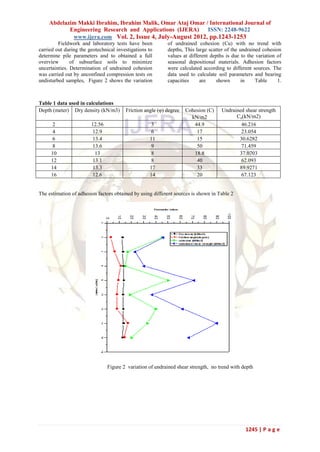
         Fieldwork and laboratory tests have been          of undrained cohesion (Cu) with no trend with
carried out during the geotechnical investigations to      depths, This large scatter of the undrained cohesion
determine pile parameters and to obtained a full           values at different depths is due to the variation of
overview       of subsurface soils to minimize             seasonal depositional materials. Adhesion factors
uncertainties. Determination of undrained cohesion         were calculated according to different sources. The
was carried out by unconfined compression tests on         data used to calculate soil parameters and bearing
undisturbed samples, Figure 2 shows the variation          capacities     are    shown        in    Table     1.


Table 1 data used in calculations
Depth (meter) Dry density (kN/m3)       Friction angle (φ) degree   Cohesion (C)    Undrained shear strength
                                                                      kN/m2               Cu(kN/m2)
      2                 12.56                       3                  44.9                 46.216
      4                  12.9                       6                   17                  23.054
      6                  13.4                      11                   15                 30.6282
      8                  13.6                       9                   50                  71.459
     10                   13                        8                  18.8                37.0703
     12                  13.1                       8                   40                  62.093
     14                  13.3                      17                   33                 89.9271
     16                  12.6                      14                   20                  67.123


The estimation of adhesion factors obtained by using different sources is shown in Table 2


                                Figure 2 variation of undrained shear strength, no trend with depth


                                                                                               1245 | P a g e
Abdelazim Makki Ibrahim, Ibrahim Malik, Omar Ataj Omar / International Journal of
           Engineering Research and Applications (IJERA)    ISSN: 2248-9622
            www.ijera.com Vol. 2, Issue 4, July-August 2012, pp.1243-1253
 Table 2 Calculating of adhesion factor for different sources (α)

   Depth (meter)     Undrained shear    Adhesion factor        Peck et al.     Adhesion factor
                     strength kN/m2        (Bowel)              (1974)          (EM 1110-2-        (Das 1995)
                                                                                   2906)
        2                 46.216              0.98                  0.93            0.82               0.97
        4                 23.054              1.05                   1.0             1.1               0.98
        6                30.6282              1.07                  0.98            0.95               0.91
        8                 71.459              0.85                  0.89            0.83               0.68
        10               37.0703               1                    0.96            0.87               0.87
        12                62.093              0.92                  0.92            0.65               0.75
        14               89.9271              0.78                  0.85             0.5                0.6
        16                67.123              0.89                   0.9            0.66                0.7

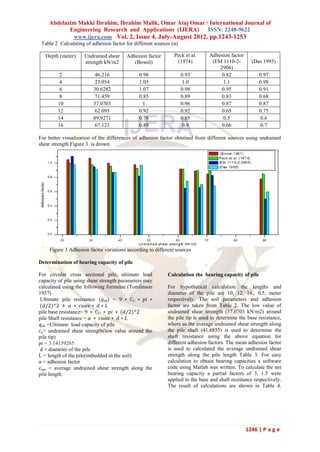
For better visualization of the differences of adhesion factor obtained from different sources using undrained
shear strength Figure 3 is drown.


    Figure 3 Adhesion factor variations according to different sources

Determination of bearing capacity of pile

For circular cross sectional pile, ultimate load            Calculation the bearing capacity of pile
capacity of pile using shear strength parameters may
calculated using the following formulae (Tomlinson          For hypothetical calculation the lengths and
1957)                                                       diameter of the pile are 10, 12, 14,, 0.5, meter
 Ultimate pile resistance (𝑞ult) = 9 ∗ 𝐶U ∗ 𝑝𝑖 ∗            respectively. The soil parameters and adhesion
(𝑑/2)^2 + 𝛼 ∗ 𝑐𝑢𝑎𝑣 ∗ 𝑑 ∗ 𝐿                                  factor are taken from Table 2. The low value of
pile base resistance= 9 ∗ 𝐶U ∗ 𝑝𝑖 ∗ (𝑑/2)^2                 undrained shear strength (37.0703 kN/m2) around
pile Shaft resistance = 𝛼 ∗ 𝑐𝑢𝑎𝑣 ∗ 𝑑 ∗ 𝐿                    the pile tip is used to determine the base resistance,
 𝑞ult =Ultimate load capacity of pile                       where as the average undrained shear strength along
 𝑐u= undrained shear strength(low value around the          the pile shaft (41.6855) is used to determine the
pile tip)                                                   shaft resistance using the above equation for
pi = 3.14159265                                             different adhesion factors. The mean adhesion factor
 d = diameter of the pile                                   is used to calculated the average undrained shear
L = length of the pile(imbedded in the soil)                strength along the pile length Table 3. For easy
α = adhesion factor                                         calculation to obtain bearing capacities a software
cuav = average undrained shear strength along the           code using Matlab was written. To calculate the net
pile length                                                 bearing capacity a partial factors of 3, 1.5 were
                                                            applied to the base and shaft resistance respectively.
                                                            The result of calculations are shown in Table 4.


                                                                                                 1246 | P a g e
Abdelazim Makki Ibrahim, Ibrahim Malik, Omar Ataj Omar / International Journal of
            Engineering Research and Applications (IJERA)    ISSN: 2248-9622
             www.ijera.com Vol. 2, Issue 4, July-August 2012, pp.1243-1253

         Table 3. The result of mean adhesion factors
          Mean         adhesion Mean            adhesion Mean             adhesion Mean           adhesion
          factor (Bowel 1987)      factor Peck et al. factor (EM 1110-2- factor
                                   (1974)                    2906)                    (Das 1995)
          0.99                     0.952                     0.914                    0.882
Table 4: Results of bearing capacities for bore pile with different pile lengths and adhesion factors
Pile        Pile              α       Base               Shaft              Ultimate bearing Design        strength
length      diameter(m)               resistance         resistance         capacity kN/m2      value    of     pile
(m)                                   kN/m2              kN/m2                                  kN/m2
10          0.5               0.99    65.51              1297               1362                886.3
                             0.952    65.51             1247              1312                  853.1
                             0.914    65.51             1197              1262.6                819.9
                             0.885    65.51             1159              1225                  794.6
12          0.5              0.99     109.7             1683              1793                  1159
                             0.952    109.7             1619              1728                  1116
                             0.914    109.7             1554              1664                  1073
                             0.885    109.7             1505              1614.7                1040
14          0.5              0.99     158.9             2242              2401                  1548
                             0.952    158.9             2156              2315                  1491
                             0.914    158.9             2070              2229                  1433
                             0.885    158.9             2005              2164                  1390
16          0.5              0.99     124.2             2662              2787                  1816
                             0.952    124.2             2560              2684                  1748
                             0.914    124.2             2480              2582                  1680
                             0.885    124.2             2380              2504                  1628

Result
         The above analysis of bearing capacity of piles using BS code indicates that the net allowable load
capacity of 0.5 diameter piles, with a length of about 10 m embedded into clay soil is estimated about 886.3
kN and 794.6 kN, respectively using different adhesion factors, where as for the pile with, 12 meter in length
and 0.5 meter diameter is 1159 kN/m2 and 1040 kN/m2, and for 14 meter length the results show that the
bearing capacity is 1548 to 1390. The bearing capacity for 16 meter length pile it around 1816 kN/m2 and 2628
kN/m2 Even the estimation of the ultimate pile capacity by various sources seems to be close to each other,
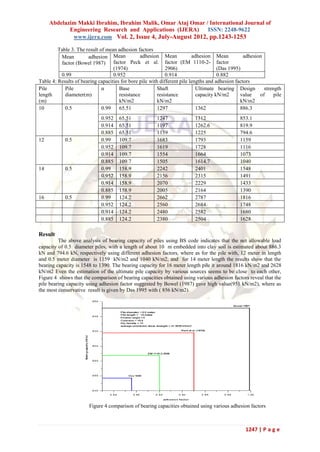
Figure 4 shows that the comparison of bearing capacities obtained using various adhesion factors reveal that the
pile bearing capacity using adhesion factor suggested by Bowel (1987) gave high value(951 kN/m2), where as
the most conservative result is given by Das 1995 with ( 856 kN/m2).


                        Figure 4 comparison of bearing capacities obtained using various adhesion factors


                                                                                                  1247 | P a g e
Abdelazim Makki Ibrahim, Ibrahim Malik, Omar Ataj Omar / International Journal of
           Engineering Research and Applications (IJERA)    ISSN: 2248-9622
            www.ijera.com Vol. 2, Issue 4, July-August 2012, pp.1243-1253
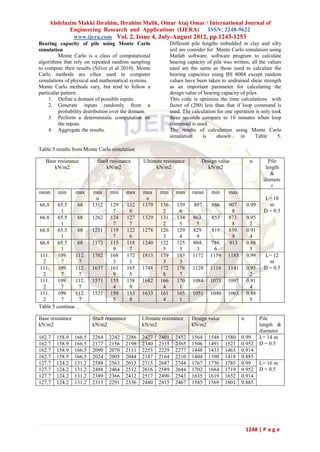
Bearing capacity of pile using Monte Carlo                       Different pile lengths imbedded in clay and silty
simulation                                                       soil are consider for Monte Carlo simulation using
         Monte Carlo is a class of computational                 Matlab software. software program to calculate
algorithms that rely on repeated random sampling                 bearing capacity of pile was written, all the values
to compute their results (Silver et al 2010). Monte              used are the same as those used to calculate the
Carlo methods are often used in computer                         bearing capacities using BS 8004 except random
simulations of physical and mathematical systems.                values have been taken to undrained shear strength
Monte Carlo methods vary, but tend to follow a                   as an important parameter for calculating the
particular pattern:                                              design value of bearing capacity of piles.
     1. Define a domain of possible inputs.                      This code is optimize the time calculations with
     2. Generate inputs randomly from a                          factor of (200) less than that if loop command is
         probability distribution over the domain.               used. The calculation for one operation is only took
     3. Perform a deterministic computation on                   three seconds compare to 10 minutes when loop
         the inputs.                                             command is used.
     4. Aggregate the results.                                   The results of calculation using Monte Carlo
                                                                 simulation      is    shown      in     Table      5.

Table 5 results from Monte Carlo simulation

   Base resistance          Shaft resistance       Ultimate resistance          Design value            α        Pile
      kN/m2                     kN/m2                   kN/m2                     kN/m2                         length
                                                                                                                  &
                                                                                                               diamete
                                                                                                                   r
mean    min       max     mea     min        max   mea     min      max    mean     min      max
                            n                       n                                                          L= 10
66.8     65.5     68      1312    129        132   1379    136      139     897     886     907.       0.99      m
          1                        7          0             2        6                       8                 D = 0.5
66.8     65.5     68      1262    124        127   1329    131      134    863.     853     873.       0.95
          1                        7          7             2        5      5                8          2
66.8     65.5     68      1211    119        122   1278    126      129    829.     819     839.       0.91
          1                        7          6             3        4      9                9          4
66.8     65.5     68      1173    115        118   1240    122      125    804.     794.    813        0.88
          1                        9          7             5        5      3        6                  5
111.     109.    112.     1702    168        172   1813    179      183    1172     1159    1185       0.99    L= 12
  2       7       7                3          1             3        3                                           m
111.     109.    112.     1637    161        165   1748    172      176    1128     1116    1141       0.95    D = 0.5
  2       7       7                9          5             8        7                                  2
111.     109.    112.     1571    155        158   1682    166      170    1084     1073    1097       0.91
  2       7       7                4          9             4        1                                  4
111.     109.    112.     1521    150        153   1633    161      165    1051     1040    1063       0.88
  2       7       7                5          8             4        1                                  5
Table 5 continue

Base resistance           Shaft resistance         Ultimate resistance     Design value            α          Pile
kN/m2                     kN/m2                    kN/m2                   kN/m2                              length &
                                                                                                              diameter
162.7   158.9     166.5   2264   2242    2286      2427   2401     2452    1564    1548    1580    0.99       L= 14 m
162.7   158.9     166.5   2177   2156    2198      2340   2315     2365    1506    1491    1521    0.952      D = 0.5
162.7   158.9     166.5   2090   2070    2111      2253   2229     2277    1448    1433    1463    0.914
162.7   158.9     166.5   2024   2005    2044      2187   2164     2210    1404    1390    1418    0.885
127.7   124.2     131.2   2588   2563    2613      2715   2687     2744    1767    1750    1785    0.99       L= 16 m
127.7   124.2     131.2   2488   2464    2512      2616   2589     2644    1702    1684    1719    0.952      D = 0.5
127.7   124.2     131.2   2389   2366    2412      2517   2490     2543    1635    1619    1652    0.914
127.7   124.2     131.2   2313   2291    2336      2440   2415     2467    1585    1569    1601    0.885


                                                                                                       1248 | P a g e
Abdelazim Makki Ibrahim, Ibrahim Malik, Omar Ataj Omar / International Journal of
           Engineering Research and Applications (IJERA)    ISSN: 2248-9622
            www.ijera.com Vol. 2, Issue 4, July-August 2012, pp.1243-1253
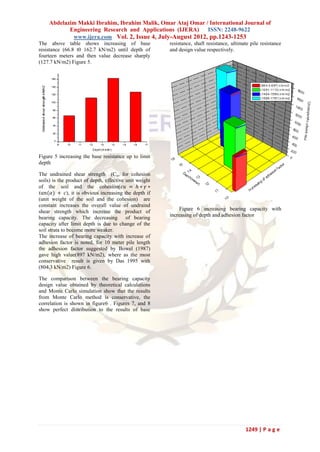
The above table shows increasing of base                resistance, shaft resistance, ultimate pile resistance
resistance (66.8 t0 162.7 kN/m2) until depth of         and design value respectively.
fourteen meters and then value decrease sharply
(127.7 kN/m2) Figure 5.


Figure 5 increasing the base resistance up to limit
depth

The undrained shear strength (Cu, for cohesion
soils) is the product of depth, effective unit weight
of the soil and the cohesion(𝑐𝑢 = ℎ ∗ 𝛾 ∗
 𝑡𝑎𝑛(𝛼) + 𝑐), it is obvious increasing the depth if
(unit weight of the soil and the cohesion) are
constant increases the overall value of undraind
                                                            Figure 6 increasing bearing capacity with
shear strength which increase the product of
bearing capacity. The decreasing          of bearing    increasing of depth and adhesion factor
capacity after limit depth is due to change of the
soil strata to become more weaker.
The increase of bearing capacity with increase of
adhesion factor is noted, for 10 meter pile length
the adhesion factor suggested by Bowel (1987)
gave high value(897 kN/m2), where as the most
conservative result is given by Das 1995 with
(804.3 kN/m2) Figure 6.

The comparison between the bearing capacity
design value obtained by theoretical calculations
and Monte Carlo simulation show that the results
from Monte Carlo method is conservative, the
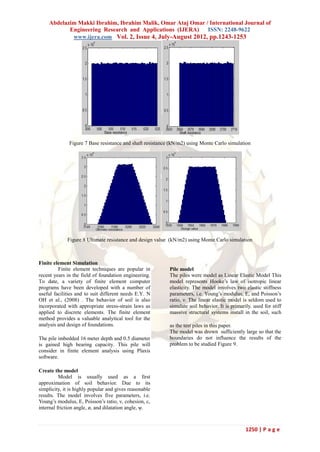
correlation is shown in figure6 . Figures 7, and 8
show perfect distribution to the results of base


                                                                                            1249 | P a g e
Abdelazim Makki Ibrahim, Ibrahim Malik, Omar Ataj Omar / International Journal of
           Engineering Research and Applications (IJERA)    ISSN: 2248-9622
            www.ijera.com Vol. 2, Issue 4, July-August 2012, pp.1243-1253


              Figure 7 Base resistance and shaft resistance (kN/m2) using Monte Carlo simulation


             Figure 8 Ultimate resistance and design value (kN/m2) using Monte Carlo simulation


Finite element Simulation
         Finite element techniques are popular in          Pile model
recent years in the field of foundation engineering.       The piles were model as Linear Elastic Model This
To date, a variety of finite element computer              model represents Hooke’s law of isotropic linear
programs have been developed with a number of              elasticity. The model involves two elastic stiffness
useful facilities and to suit different needs E.Y. N       parameters, i.e. Young’s modulus, E, and Poisson’s
OH et al., (2008) . The behavior of soil is also           ratio, ν. The linear elastic model is seldom used to
incorporated with appropriate stress-strain laws as        simulate soil behavior. It is primarily. used for stiff
applied to discrete elements. The finite element           massive structural systems install in the soil, such
method provides a valuable analytical tool for the
analysis and design of foundations.                        as the test piles in this paper.
                                                           The model was drown sufficiently large so that the
The pile imbedded 16 meter depth and 0.5 diameter          boundaries do not influence the results of the
is gained high bearing capacity. This pile will            problem to be studied Figure 9.
consider in finite element analysis using Plaxis
software.

Create the model
          Model is usually used as a first
approximation of soil behavior. Due to its
simplicity, it is highly popular and gives reasonable
results. The model involves five parameters, i.e.
Young’s modulus, E, Poisson’s ratio, ν, cohesion, c,
internal friction angle, ø, and dilatation angle, ψ.


                                                                                                1250 | P a g e
Abdelazim Makki Ibrahim, Ibrahim Malik, Omar Ataj Omar / International Journal of
           Engineering Research and Applications (IJERA)    ISSN: 2248-9622
            www.ijera.com Vol. 2, Issue 4, July-August 2012, pp.1243-1253
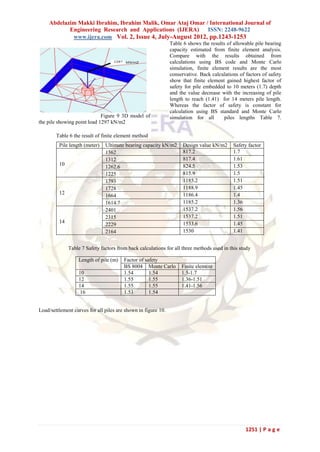
                                                               Table 6 shows the results of allowable pile bearing
                                                               capacity estimated from finite element analysis.
                                                               Compare with the results obtained from
                                                               calculations using BS code and Monte Carlo
                                                               simulation, finite element results are the most
                                                               conservative. Back calculations of factors of safety
                                                               show that finite element gained highest factor of
                                                               safety for pile embedded to 10 meters (1.7) depth
                                                               and the value decrease with the increasing of pile
                                                               length to reach (1.41) for 14 meters pile length.
                                                               Whereas the factor of safety is constant for
                                                               calculation using BS standard and Monte Carlo
                             Figure 9 3D model of              simulation for all       piles lengths Table 7.
the pile showing point load 1297 kN/m2

        Table 6 the result of finite element method
         Pile length (meter)   Ultimate bearing capacity kN/m2       Design value kN/m2     Safety factor
                               1362                                  817.2                  1.7
                               1312                                  817.4                  1.61
         10                                                          824.5                  1.53
                               1262.6
                               1225                                  815.9                  1.5
                               1793                                  1185.2                 1.51
                               1728                                  1188.9                 1.45
         12                                                          1186.4                 1.4
                               1664
                               1614.7                                1185.2                 1.36
                               2401                                  1537.2                 1.56
                               2315                                  1537.2                 1.51
         14                                                          1533.6                 1.45
                               2229
                               2164                                  1530                   1.41


              Table 7 Safety factors from back calculations for all three methods used in this study

                  Length of pile (m)    Factor of safety
                                        BS 8004 Monte Carlo         Finite element
                  10                    1.54        1.54            1.5-1.7
                  12                    1.55        1.55            1.36-1.51
                  14                    1.55        1.55            1.41-1.56
                   16                   1.53        1.54


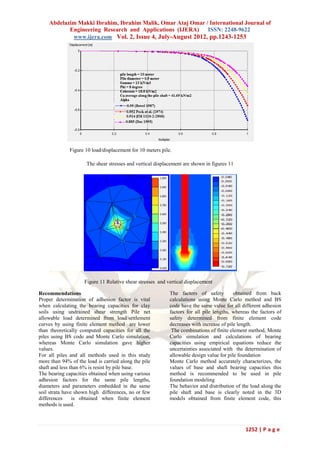
Load/settlement curves for all piles are shown in figure 10.


                                                                                                  1251 | P a g e
Abdelazim Makki Ibrahim, Ibrahim Malik, Omar Ataj Omar / International Journal of
           Engineering Research and Applications (IJERA)    ISSN: 2248-9622
            www.ijera.com Vol. 2, Issue 4, July-August 2012, pp.1243-1253


              Figure 10 load/displacement for 10 meters pile.

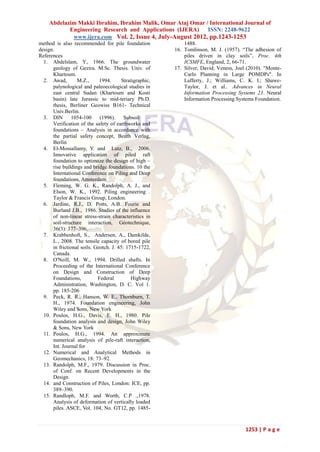
                     The shear stresses and vertical displacement are shown in figures 11


                    Figure 11 Relative shear stresses and vertical displacement

Recommendations                                             The factors of safety         obtained from back
Proper determination of adhesion factor is vital            calculations using Monte Carlo method and BS
when calculating the bearing capacities for clay            code have the same value for all different adhesion
soils using undrained shear strength Pile net               factors for all pile lengths, whereas the factors of
allowable load determined from load/settlement              safety determined from finite element code
curves by using finite element method are lower             decreases with increase of pile length.
than theoretically computed capacities for all the           The combinations of finite element method, Monte
piles using BS code and Monte Carlo simulation,             Carlo simulation and calculations of bearing
whereas Monte Carlo simulation gave higher                  capacities using empirical equations reduce the
values.                                                     uncertainties associated with the determination of
For all piles and all methods used in this study            allowable design value for pile foundation
more than 94% of the load is carried along the pile         Monte Carlo method accurately characterizes, the
shaft and less than 6% is resist by pile base.              values of base and shaft bearing capacities this
The bearing capacities obtained when using various          method is recommended to be used in pile
adhesion factors for the same pile lengths,                 foundation modeling
diameters and parameters embedded in the same               The behavior and distribution of the load along the
soil strata have shown high differences, no or few          pile shaft and base is clearly noted in the 3D
differences     is obtained when finite element             models obtained from finite element code, this
methods is used.


                                                                                               1252 | P a g e
Abdelazim Makki Ibrahim, Ibrahim Malik, Omar Ataj Omar / International Journal of
            Engineering Research and Applications (IJERA)    ISSN: 2248-9622
             www.ijera.com Vol. 2, Issue 4, July-August 2012, pp.1243-1253
method is also recommended for pile foundation               1488.
design.                                                  16. Tomlinson, M. J. (1957). “The adhesion of
References                                                   piles driven in clay soils”, Proc. 4th
  1. Abdelslam, Y., 1966. The groundwater                    ICSMFE, England, 2, 66-71.
      geology of Gezira. M.Sc. Thesis. Univ. of          17. Silver, David; Veness, Joel (2010). "Monte-
      Khartoum.                                              Carlo Planning in Large POMDPs". In
  2. Awad,        M.Z.,      1994.      Stratigraphic,       Lafferty, J.; Williams, C. K. I.; Shawe-
      palynological and paleoecological studies in           Taylor, J. et al.. Advances in Neural
      east central Sudan (Khartoum and Kosti                 Information Processing Systems 23. Neural
      basin) late Jurassic to mid-teriary Ph.D.              Information Processing Systems Foundation.
      thesis, Berliner Geowiss B161- Technical
      Univ.Berlin.
  3. DIN        1054-100     (1996).     Subsoil    –
      Verification of the safety of earthworks and
      foundations – Analysis in accordance with
      the partial safety concept, Beuth Verlag,
      Berlin
  4. El-Mossallamy, Y. and Lutz, B., 2006.
      Innovative application of piled raft
      foundation to optimaze the design of high –
      rise buildings and bridge foundations. 10 the
      International Conference on Piling and Deep
      foundations, Amsterdam.
  5. Fleming, W. G. K., Randolph, A. J., and
      Elson, W. K., 1992. Piling engineering .
      Taylor & Francis Group, London.
  6. Jardine, R.J., D. Potts, A.B. Fourie and
      Burland J.B., 1986. Studies of the influence
      of non-linear stress-strain characteristics in
      soil-structure interaction, Géotechnique,
      36(3): 377–396.
  7. Krabbenhoft, S., Andersen, A., Damkilde,
      L., 2008. The tensile capacity of bored pile
      in frictional soils. Geotch. J. 45: 1715-1722,
      Canada.
  8. O'Neill, M. W., 1994. Drilled shafts. In
      Proceeding of the International Conference
      on Design and Construction of Deep
      Foundations,          Federal          Highway
      Administration, Washington, D. C. Vol 1.
      pp. 185-206
  9. Peck, R. R., Hanson, W. E., Thornburn, T.
      H., 1974. Foundation engineering, John
      Wiley and Sons, New York
  10. Poulos, H.G., Davis, E. H., 1980. Pile
      foundation analysis and design, John Wiley
      & Sons, New York
  11. Poulos, H.G., 1994. An approximate
      numerical analysis of pile-raft interaction,
      Int. Journal for
  12. Numerical and Analytical Methods in
      Geomechanics, 18: 73–92.
  13. Randolph, M.F., 1979. Discussion in Proc.
      of Conf. on Recent Developments in the
      Design
  14. and Construction of Piles, London: ICE, pp.
      389–390.
  15. Randloph, M.F. and Worth, C.P .,1978.
      Analysis of deformation of vertically loaded
      piles. ASCE, Vol. 104, No. GT12, pp. 1485-


                                                                                        1253 | P a g e

Gz2412431253

  • 1.
    Abdelazim Makki Ibrahim,Ibrahim Malik, Omar Ataj Omar / International Journal of Engineering Research and Applications (IJERA) ISSN: 2248-9622 www.ijera.com Vol. 2, Issue 4, July-August 2012, pp.1243-1253 Assessment of load-carrying capacity of bored pile in clay soil using different methods Abdelazim Makki Ibrahim 1 Ibrahim Malik2 Omar Ataj Omar2 Geotechnical Institute Al Neelain University Al Neelain University Freiberg University-Germany Sudan Sudan & Al Neelain University-Sudan Abstract It is very difficult to predict the load the method proposed by Reese and O'Neill(1994), carrying capacity of bored piles because of the mainly used in USA, almost ignore the strength of Complications that may arise such as difficult the soil as long as the soil can be characterized as ground conditions , presence of ground water, being frictional soil (Krabbenhoft. 2008). method of boring, method of concreting, quality of concrete, expertise of the construction staff, Geological setting the ground conditions and the pile geometry. The study area is the part of Khartoum Therefore the Pile design must be accompanied basin, which is the one of the major central Sudan by in situ load testing. Many geotechnical codes rift basin. The sedimentary sub-basin is elongated in emphasizes that pile design must be based on NW_SE trend, where the Pan-African Basement static load tests or on calculations that have been complex bounds it on the northeast and southwest, validated by three tests. and forms its bottom limit at a depth 500m. The sub- surface geology belongs to three Formations, which This paper describe the simulation of four piles are regionally interconnected. These Formations are with different lengths carrying different loads the (upper recent) superficial deposits and river embedded in the clay soil in Khartoum town- alluvium, which rest unconformable on the Gezira Sudan using BS 8004, Monte Carlo simulation Formation (quaternary-tertiary) and the upper part using Matlab software and Finite Element Code of Omdurman Formation (upper cretaceous) (Awad -Plaxis software. The results from these methods , 1994). Most of the surface is cover by clay soils, were compared together and recommendation which varies in thickness. consists of unconsolidated are made to estimate the pile capacity in these clay, silts, sand and gravel. Its rests unconformable soils. The design parameters of pile are on the Cretaceous sandstone formation and is estimated, and back calculation of safety factors overlain by blown sand and other superficial. Awad are made. (1994) suggested that it comprise the area between Keyword: BS code, Monte Carlo simulation, Finite white and blue Nile. Abdelsalam (1966) divided element method Gezira formation into three members lower Mungata Member, Lower sandy Member and upper Introduction clay Member. Awad (1994) considered Wad Medani Bored pile is type of reinforced concrete Member as part of Gezira formation. pile which is used to support high building that has heavy vertical load. Normally bored piling has be to Engineering properties of subsurface soil carried on those tall buildings or massive industrial The boreholes revealed existence of complexes, which require foundations which can alternating layers of very stiff low to high plasticity bear the load of thousands of tons, most probably in silty clays (CL to CH) and very stiff low to high unstable or difficult soil conditions. plasticity silts (ML to MH) in the upper 10 meters. Bored piles resist the uplift load by skin friction This is underlain by medium dense sand ( SM or forces, and the formulae used to determine the SP-SM) layer extended down to 20 meter and this magnitude of these forces seems to be an area where layer overlain a very dense sand layer extend 25 various codes and standards produce completely depth . The alternating layers of weak mud-stone different results, the German code DIN 1054 (DIN and weak sand stone extended down to the bottom 1996), which is widely used in Germany and other of the boreholes at about 35 meters. These weak European countries, the uplift capacities strongly mud-stone and weak sandstone are belong to depends on the strength of the soil, i.e., the angle of Omdurman formation which are extended to deepest friction normally depend determined by indirect depth. Data from the various exploration methods methods such as standard penetration tests were used as a basis for typical sections to (Krabbenhoft et al. 2008); whereas the methods illustrate the more significant geological conditions. proposed by Fleming et al.(1992), mainly used in The objectives is to illustrate clearly the problems of UK, take strength of the soil into account. whereas the geologic environment influencing design and 1243 | P a g e
  • 2.
    Abdelazim Makki Ibrahim,Ibrahim Malik, Omar Ataj Omar / International Journal of Engineering Research and Applications (IJERA) ISSN: 2248-9622 www.ijera.com Vol. 2, Issue 4, July-August 2012, pp.1243-1253 construction. Three dimensional sections and fence complex geology, Fig 1. diagram were also plotted to help for sites with Fig 1 Three dimension and fence diagram models for the subsurface soil in the study area Axial response of deep foundation The settlement of a single rigid pile in The axial load-displacement response of homogeneous elastic half space can be determined driven piles and drilled shafts may be expressed in based on theory of elasticity (Randolph & Worth terms of elastic continuum theory. Solutions have 1978) (in(El-Mossallary & Lutz 2006) as follows: been developed using boundary element formulations (Poulos and Davis, 1980; Poulos, 𝑄/ 𝐺 𝑟0 𝑆 𝑠𝑖𝑛𝑔𝑙𝑒 = 4/ 𝐸(1 − 𝜐) + 2𝜋 𝐿/𝜉 𝑟 o 1994), finite elements (Jardine et al. 1986), and (8. 30) approximate closed form solutions by Randolph ( 𝜉 = 𝑙𝑖(𝑟m/𝑟𝑜) 1979). The generalized method characterizes the soil where: by two elastic parameters: soil modulus (Es) and Poisson’s ratio (υs). Soil modulus may be either Q = Applied load uniform with depth (constant Es) or a Gibson-profile S single= Settlement of single pile (linearly increasing Es with depth). The pile may G = shear modulus of the soil either be a floating-type or end-bearing type where r0 = pile radius the tip is underlain by a stratum of stiffer material. L = length of the pile The elastic theory solution for the vertical rm = influence radius at which shear stresses displacement (δ) of a pile foundation subjected to become negligible. Randolph (1977) has suggested axial compression loading is expressed by r0 = 2.5 L(1-υ) based on a parametric study using an Pile axial settlement 𝛿 = axi-symmetrical finite element analysis. 𝑄 ∗ 𝐼p /𝐸𝑠L ∗ 𝑑 The above-mentioned equation may be modified to consider approximately the pile stiffens, the soil in where Q = applied axial load at the top of the shaft, homogeneity in vertical direction , the thickness of EsL = soil modulus at the top the pile tip or the compressible layer (El-Mossallamy et. al 2006) foundation base, d = foundation diameter, and I p = and nonlinear soil stress/strain behavior adjacent to influence factor. Solution for Ip depend on the pile the pile shaft (Randolph 1977 and Randolph & slenderness ratio (L/d), pile modulus, and soil Worth 1978). Another possibility to determine the modulus (Randolph & Wroth, 1979; Poulos & settlement of a single pile is to use the chart of Pouls Davis, 1980; Poulos, 1989). The modified form of (Poulos & Davis 1980) or to apply the the expression to account for nonlinear modulus recommendation values as give by standards (DIN degradation is: 1054-100) 𝛿 = 𝑄 ∗ 𝐼p /𝐸𝑚𝑎𝑥 ∗ 𝑑 ∗ (1 − 𝑄/𝑄𝑢)0.3 Settlement of a single pile Pile Design Parameters 1244 | P a g e
  • 3.
    Abdelazim Makki Ibrahim,Ibrahim Malik, Omar Ataj Omar / International Journal of Engineering Research and Applications (IJERA) ISSN: 2248-9622 www.ijera.com Vol. 2, Issue 4, July-August 2012, pp.1243-1253 Fieldwork and laboratory tests have been of undrained cohesion (Cu) with no trend with carried out during the geotechnical investigations to depths, This large scatter of the undrained cohesion determine pile parameters and to obtained a full values at different depths is due to the variation of overview of subsurface soils to minimize seasonal depositional materials. Adhesion factors uncertainties. Determination of undrained cohesion were calculated according to different sources. The was carried out by unconfined compression tests on data used to calculate soil parameters and bearing undisturbed samples, Figure 2 shows the variation capacities are shown in Table 1. Table 1 data used in calculations Depth (meter) Dry density (kN/m3) Friction angle (φ) degree Cohesion (C) Undrained shear strength kN/m2 Cu(kN/m2) 2 12.56 3 44.9 46.216 4 12.9 6 17 23.054 6 13.4 11 15 30.6282 8 13.6 9 50 71.459 10 13 8 18.8 37.0703 12 13.1 8 40 62.093 14 13.3 17 33 89.9271 16 12.6 14 20 67.123 The estimation of adhesion factors obtained by using different sources is shown in Table 2 Figure 2 variation of undrained shear strength, no trend with depth 1245 | P a g e
  • 4.
    Abdelazim Makki Ibrahim,Ibrahim Malik, Omar Ataj Omar / International Journal of Engineering Research and Applications (IJERA) ISSN: 2248-9622 www.ijera.com Vol. 2, Issue 4, July-August 2012, pp.1243-1253 Table 2 Calculating of adhesion factor for different sources (α) Depth (meter) Undrained shear Adhesion factor Peck et al. Adhesion factor strength kN/m2 (Bowel) (1974) (EM 1110-2- (Das 1995) 2906) 2 46.216 0.98 0.93 0.82 0.97 4 23.054 1.05 1.0 1.1 0.98 6 30.6282 1.07 0.98 0.95 0.91 8 71.459 0.85 0.89 0.83 0.68 10 37.0703 1 0.96 0.87 0.87 12 62.093 0.92 0.92 0.65 0.75 14 89.9271 0.78 0.85 0.5 0.6 16 67.123 0.89 0.9 0.66 0.7 For better visualization of the differences of adhesion factor obtained from different sources using undrained shear strength Figure 3 is drown. Figure 3 Adhesion factor variations according to different sources Determination of bearing capacity of pile For circular cross sectional pile, ultimate load Calculation the bearing capacity of pile capacity of pile using shear strength parameters may calculated using the following formulae (Tomlinson For hypothetical calculation the lengths and 1957) diameter of the pile are 10, 12, 14,, 0.5, meter Ultimate pile resistance (𝑞ult) = 9 ∗ 𝐶U ∗ 𝑝𝑖 ∗ respectively. The soil parameters and adhesion (𝑑/2)^2 + 𝛼 ∗ 𝑐𝑢𝑎𝑣 ∗ 𝑑 ∗ 𝐿 factor are taken from Table 2. The low value of pile base resistance= 9 ∗ 𝐶U ∗ 𝑝𝑖 ∗ (𝑑/2)^2 undrained shear strength (37.0703 kN/m2) around pile Shaft resistance = 𝛼 ∗ 𝑐𝑢𝑎𝑣 ∗ 𝑑 ∗ 𝐿 the pile tip is used to determine the base resistance, 𝑞ult =Ultimate load capacity of pile where as the average undrained shear strength along 𝑐u= undrained shear strength(low value around the the pile shaft (41.6855) is used to determine the pile tip) shaft resistance using the above equation for pi = 3.14159265 different adhesion factors. The mean adhesion factor d = diameter of the pile is used to calculated the average undrained shear L = length of the pile(imbedded in the soil) strength along the pile length Table 3. For easy α = adhesion factor calculation to obtain bearing capacities a software cuav = average undrained shear strength along the code using Matlab was written. To calculate the net pile length bearing capacity a partial factors of 3, 1.5 were applied to the base and shaft resistance respectively. The result of calculations are shown in Table 4. 1246 | P a g e
  • 5.
    Abdelazim Makki Ibrahim,Ibrahim Malik, Omar Ataj Omar / International Journal of Engineering Research and Applications (IJERA) ISSN: 2248-9622 www.ijera.com Vol. 2, Issue 4, July-August 2012, pp.1243-1253 Table 3. The result of mean adhesion factors Mean adhesion Mean adhesion Mean adhesion Mean adhesion factor (Bowel 1987) factor Peck et al. factor (EM 1110-2- factor (1974) 2906) (Das 1995) 0.99 0.952 0.914 0.882 Table 4: Results of bearing capacities for bore pile with different pile lengths and adhesion factors Pile Pile α Base Shaft Ultimate bearing Design strength length diameter(m) resistance resistance capacity kN/m2 value of pile (m) kN/m2 kN/m2 kN/m2 10 0.5 0.99 65.51 1297 1362 886.3 0.952 65.51 1247 1312 853.1 0.914 65.51 1197 1262.6 819.9 0.885 65.51 1159 1225 794.6 12 0.5 0.99 109.7 1683 1793 1159 0.952 109.7 1619 1728 1116 0.914 109.7 1554 1664 1073 0.885 109.7 1505 1614.7 1040 14 0.5 0.99 158.9 2242 2401 1548 0.952 158.9 2156 2315 1491 0.914 158.9 2070 2229 1433 0.885 158.9 2005 2164 1390 16 0.5 0.99 124.2 2662 2787 1816 0.952 124.2 2560 2684 1748 0.914 124.2 2480 2582 1680 0.885 124.2 2380 2504 1628 Result The above analysis of bearing capacity of piles using BS code indicates that the net allowable load capacity of 0.5 diameter piles, with a length of about 10 m embedded into clay soil is estimated about 886.3 kN and 794.6 kN, respectively using different adhesion factors, where as for the pile with, 12 meter in length and 0.5 meter diameter is 1159 kN/m2 and 1040 kN/m2, and for 14 meter length the results show that the bearing capacity is 1548 to 1390. The bearing capacity for 16 meter length pile it around 1816 kN/m2 and 2628 kN/m2 Even the estimation of the ultimate pile capacity by various sources seems to be close to each other, Figure 4 shows that the comparison of bearing capacities obtained using various adhesion factors reveal that the pile bearing capacity using adhesion factor suggested by Bowel (1987) gave high value(951 kN/m2), where as the most conservative result is given by Das 1995 with ( 856 kN/m2). Figure 4 comparison of bearing capacities obtained using various adhesion factors 1247 | P a g e
  • 6.
    Abdelazim Makki Ibrahim,Ibrahim Malik, Omar Ataj Omar / International Journal of Engineering Research and Applications (IJERA) ISSN: 2248-9622 www.ijera.com Vol. 2, Issue 4, July-August 2012, pp.1243-1253 Bearing capacity of pile using Monte Carlo Different pile lengths imbedded in clay and silty simulation soil are consider for Monte Carlo simulation using Monte Carlo is a class of computational Matlab software. software program to calculate algorithms that rely on repeated random sampling bearing capacity of pile was written, all the values to compute their results (Silver et al 2010). Monte used are the same as those used to calculate the Carlo methods are often used in computer bearing capacities using BS 8004 except random simulations of physical and mathematical systems. values have been taken to undrained shear strength Monte Carlo methods vary, but tend to follow a as an important parameter for calculating the particular pattern: design value of bearing capacity of piles. 1. Define a domain of possible inputs. This code is optimize the time calculations with 2. Generate inputs randomly from a factor of (200) less than that if loop command is probability distribution over the domain. used. The calculation for one operation is only took 3. Perform a deterministic computation on three seconds compare to 10 minutes when loop the inputs. command is used. 4. Aggregate the results. The results of calculation using Monte Carlo simulation is shown in Table 5. Table 5 results from Monte Carlo simulation Base resistance Shaft resistance Ultimate resistance Design value α Pile kN/m2 kN/m2 kN/m2 kN/m2 length & diamete r mean min max mea min max mea min max mean min max n n L= 10 66.8 65.5 68 1312 129 132 1379 136 139 897 886 907. 0.99 m 1 7 0 2 6 8 D = 0.5 66.8 65.5 68 1262 124 127 1329 131 134 863. 853 873. 0.95 1 7 7 2 5 5 8 2 66.8 65.5 68 1211 119 122 1278 126 129 829. 819 839. 0.91 1 7 6 3 4 9 9 4 66.8 65.5 68 1173 115 118 1240 122 125 804. 794. 813 0.88 1 9 7 5 5 3 6 5 111. 109. 112. 1702 168 172 1813 179 183 1172 1159 1185 0.99 L= 12 2 7 7 3 1 3 3 m 111. 109. 112. 1637 161 165 1748 172 176 1128 1116 1141 0.95 D = 0.5 2 7 7 9 5 8 7 2 111. 109. 112. 1571 155 158 1682 166 170 1084 1073 1097 0.91 2 7 7 4 9 4 1 4 111. 109. 112. 1521 150 153 1633 161 165 1051 1040 1063 0.88 2 7 7 5 8 4 1 5 Table 5 continue Base resistance Shaft resistance Ultimate resistance Design value α Pile kN/m2 kN/m2 kN/m2 kN/m2 length & diameter 162.7 158.9 166.5 2264 2242 2286 2427 2401 2452 1564 1548 1580 0.99 L= 14 m 162.7 158.9 166.5 2177 2156 2198 2340 2315 2365 1506 1491 1521 0.952 D = 0.5 162.7 158.9 166.5 2090 2070 2111 2253 2229 2277 1448 1433 1463 0.914 162.7 158.9 166.5 2024 2005 2044 2187 2164 2210 1404 1390 1418 0.885 127.7 124.2 131.2 2588 2563 2613 2715 2687 2744 1767 1750 1785 0.99 L= 16 m 127.7 124.2 131.2 2488 2464 2512 2616 2589 2644 1702 1684 1719 0.952 D = 0.5 127.7 124.2 131.2 2389 2366 2412 2517 2490 2543 1635 1619 1652 0.914 127.7 124.2 131.2 2313 2291 2336 2440 2415 2467 1585 1569 1601 0.885 1248 | P a g e
  • 7.
    Abdelazim Makki Ibrahim,Ibrahim Malik, Omar Ataj Omar / International Journal of Engineering Research and Applications (IJERA) ISSN: 2248-9622 www.ijera.com Vol. 2, Issue 4, July-August 2012, pp.1243-1253 The above table shows increasing of base resistance, shaft resistance, ultimate pile resistance resistance (66.8 t0 162.7 kN/m2) until depth of and design value respectively. fourteen meters and then value decrease sharply (127.7 kN/m2) Figure 5. Figure 5 increasing the base resistance up to limit depth The undrained shear strength (Cu, for cohesion soils) is the product of depth, effective unit weight of the soil and the cohesion(𝑐𝑢 = ℎ ∗ 𝛾 ∗ 𝑡𝑎𝑛(𝛼) + 𝑐), it is obvious increasing the depth if (unit weight of the soil and the cohesion) are constant increases the overall value of undraind Figure 6 increasing bearing capacity with shear strength which increase the product of bearing capacity. The decreasing of bearing increasing of depth and adhesion factor capacity after limit depth is due to change of the soil strata to become more weaker. The increase of bearing capacity with increase of adhesion factor is noted, for 10 meter pile length the adhesion factor suggested by Bowel (1987) gave high value(897 kN/m2), where as the most conservative result is given by Das 1995 with (804.3 kN/m2) Figure 6. The comparison between the bearing capacity design value obtained by theoretical calculations and Monte Carlo simulation show that the results from Monte Carlo method is conservative, the correlation is shown in figure6 . Figures 7, and 8 show perfect distribution to the results of base 1249 | P a g e
  • 8.
    Abdelazim Makki Ibrahim,Ibrahim Malik, Omar Ataj Omar / International Journal of Engineering Research and Applications (IJERA) ISSN: 2248-9622 www.ijera.com Vol. 2, Issue 4, July-August 2012, pp.1243-1253 Figure 7 Base resistance and shaft resistance (kN/m2) using Monte Carlo simulation Figure 8 Ultimate resistance and design value (kN/m2) using Monte Carlo simulation Finite element Simulation Finite element techniques are popular in Pile model recent years in the field of foundation engineering. The piles were model as Linear Elastic Model This To date, a variety of finite element computer model represents Hooke’s law of isotropic linear programs have been developed with a number of elasticity. The model involves two elastic stiffness useful facilities and to suit different needs E.Y. N parameters, i.e. Young’s modulus, E, and Poisson’s OH et al., (2008) . The behavior of soil is also ratio, ν. The linear elastic model is seldom used to incorporated with appropriate stress-strain laws as simulate soil behavior. It is primarily. used for stiff applied to discrete elements. The finite element massive structural systems install in the soil, such method provides a valuable analytical tool for the analysis and design of foundations. as the test piles in this paper. The model was drown sufficiently large so that the The pile imbedded 16 meter depth and 0.5 diameter boundaries do not influence the results of the is gained high bearing capacity. This pile will problem to be studied Figure 9. consider in finite element analysis using Plaxis software. Create the model Model is usually used as a first approximation of soil behavior. Due to its simplicity, it is highly popular and gives reasonable results. The model involves five parameters, i.e. Young’s modulus, E, Poisson’s ratio, ν, cohesion, c, internal friction angle, ø, and dilatation angle, ψ. 1250 | P a g e
  • 9.
    Abdelazim Makki Ibrahim,Ibrahim Malik, Omar Ataj Omar / International Journal of Engineering Research and Applications (IJERA) ISSN: 2248-9622 www.ijera.com Vol. 2, Issue 4, July-August 2012, pp.1243-1253 Table 6 shows the results of allowable pile bearing capacity estimated from finite element analysis. Compare with the results obtained from calculations using BS code and Monte Carlo simulation, finite element results are the most conservative. Back calculations of factors of safety show that finite element gained highest factor of safety for pile embedded to 10 meters (1.7) depth and the value decrease with the increasing of pile length to reach (1.41) for 14 meters pile length. Whereas the factor of safety is constant for calculation using BS standard and Monte Carlo Figure 9 3D model of simulation for all piles lengths Table 7. the pile showing point load 1297 kN/m2 Table 6 the result of finite element method Pile length (meter) Ultimate bearing capacity kN/m2 Design value kN/m2 Safety factor 1362 817.2 1.7 1312 817.4 1.61 10 824.5 1.53 1262.6 1225 815.9 1.5 1793 1185.2 1.51 1728 1188.9 1.45 12 1186.4 1.4 1664 1614.7 1185.2 1.36 2401 1537.2 1.56 2315 1537.2 1.51 14 1533.6 1.45 2229 2164 1530 1.41 Table 7 Safety factors from back calculations for all three methods used in this study Length of pile (m) Factor of safety BS 8004 Monte Carlo Finite element 10 1.54 1.54 1.5-1.7 12 1.55 1.55 1.36-1.51 14 1.55 1.55 1.41-1.56 16 1.53 1.54 Load/settlement curves for all piles are shown in figure 10. 1251 | P a g e
  • 10.
    Abdelazim Makki Ibrahim,Ibrahim Malik, Omar Ataj Omar / International Journal of Engineering Research and Applications (IJERA) ISSN: 2248-9622 www.ijera.com Vol. 2, Issue 4, July-August 2012, pp.1243-1253 Figure 10 load/displacement for 10 meters pile. The shear stresses and vertical displacement are shown in figures 11 Figure 11 Relative shear stresses and vertical displacement Recommendations The factors of safety obtained from back Proper determination of adhesion factor is vital calculations using Monte Carlo method and BS when calculating the bearing capacities for clay code have the same value for all different adhesion soils using undrained shear strength Pile net factors for all pile lengths, whereas the factors of allowable load determined from load/settlement safety determined from finite element code curves by using finite element method are lower decreases with increase of pile length. than theoretically computed capacities for all the The combinations of finite element method, Monte piles using BS code and Monte Carlo simulation, Carlo simulation and calculations of bearing whereas Monte Carlo simulation gave higher capacities using empirical equations reduce the values. uncertainties associated with the determination of For all piles and all methods used in this study allowable design value for pile foundation more than 94% of the load is carried along the pile Monte Carlo method accurately characterizes, the shaft and less than 6% is resist by pile base. values of base and shaft bearing capacities this The bearing capacities obtained when using various method is recommended to be used in pile adhesion factors for the same pile lengths, foundation modeling diameters and parameters embedded in the same The behavior and distribution of the load along the soil strata have shown high differences, no or few pile shaft and base is clearly noted in the 3D differences is obtained when finite element models obtained from finite element code, this methods is used. 1252 | P a g e
  • 11.
    Abdelazim Makki Ibrahim,Ibrahim Malik, Omar Ataj Omar / International Journal of Engineering Research and Applications (IJERA) ISSN: 2248-9622 www.ijera.com Vol. 2, Issue 4, July-August 2012, pp.1243-1253 method is also recommended for pile foundation 1488. design. 16. Tomlinson, M. J. (1957). “The adhesion of References piles driven in clay soils”, Proc. 4th 1. Abdelslam, Y., 1966. The groundwater ICSMFE, England, 2, 66-71. geology of Gezira. M.Sc. Thesis. Univ. of 17. Silver, David; Veness, Joel (2010). "Monte- Khartoum. Carlo Planning in Large POMDPs". In 2. Awad, M.Z., 1994. Stratigraphic, Lafferty, J.; Williams, C. K. I.; Shawe- palynological and paleoecological studies in Taylor, J. et al.. Advances in Neural east central Sudan (Khartoum and Kosti Information Processing Systems 23. Neural basin) late Jurassic to mid-teriary Ph.D. Information Processing Systems Foundation. thesis, Berliner Geowiss B161- Technical Univ.Berlin. 3. DIN 1054-100 (1996). Subsoil – Verification of the safety of earthworks and foundations – Analysis in accordance with the partial safety concept, Beuth Verlag, Berlin 4. El-Mossallamy, Y. and Lutz, B., 2006. Innovative application of piled raft foundation to optimaze the design of high – rise buildings and bridge foundations. 10 the International Conference on Piling and Deep foundations, Amsterdam. 5. Fleming, W. G. K., Randolph, A. J., and Elson, W. K., 1992. Piling engineering . Taylor & Francis Group, London. 6. Jardine, R.J., D. Potts, A.B. Fourie and Burland J.B., 1986. Studies of the influence of non-linear stress-strain characteristics in soil-structure interaction, Géotechnique, 36(3): 377–396. 7. Krabbenhoft, S., Andersen, A., Damkilde, L., 2008. The tensile capacity of bored pile in frictional soils. Geotch. J. 45: 1715-1722, Canada. 8. O'Neill, M. W., 1994. Drilled shafts. In Proceeding of the International Conference on Design and Construction of Deep Foundations, Federal Highway Administration, Washington, D. C. Vol 1. pp. 185-206 9. Peck, R. R., Hanson, W. E., Thornburn, T. H., 1974. Foundation engineering, John Wiley and Sons, New York 10. Poulos, H.G., Davis, E. H., 1980. Pile foundation analysis and design, John Wiley & Sons, New York 11. Poulos, H.G., 1994. An approximate numerical analysis of pile-raft interaction, Int. Journal for 12. Numerical and Analytical Methods in Geomechanics, 18: 73–92. 13. Randolph, M.F., 1979. Discussion in Proc. of Conf. on Recent Developments in the Design 14. and Construction of Piles, London: ICE, pp. 389–390. 15. Randloph, M.F. and Worth, C.P .,1978. Analysis of deformation of vertically loaded piles. ASCE, Vol. 104, No. GT12, pp. 1485- 1253 | P a g e