HKG18-402: Secure Key Services in
OP-TEE
Etienne Carrière, STMicroelectronics
Agenda
● Overview of Secure Key Services
● What is OP-TEE?
● Which Client Interface?
● Implementation: the SKS
● What’s next?
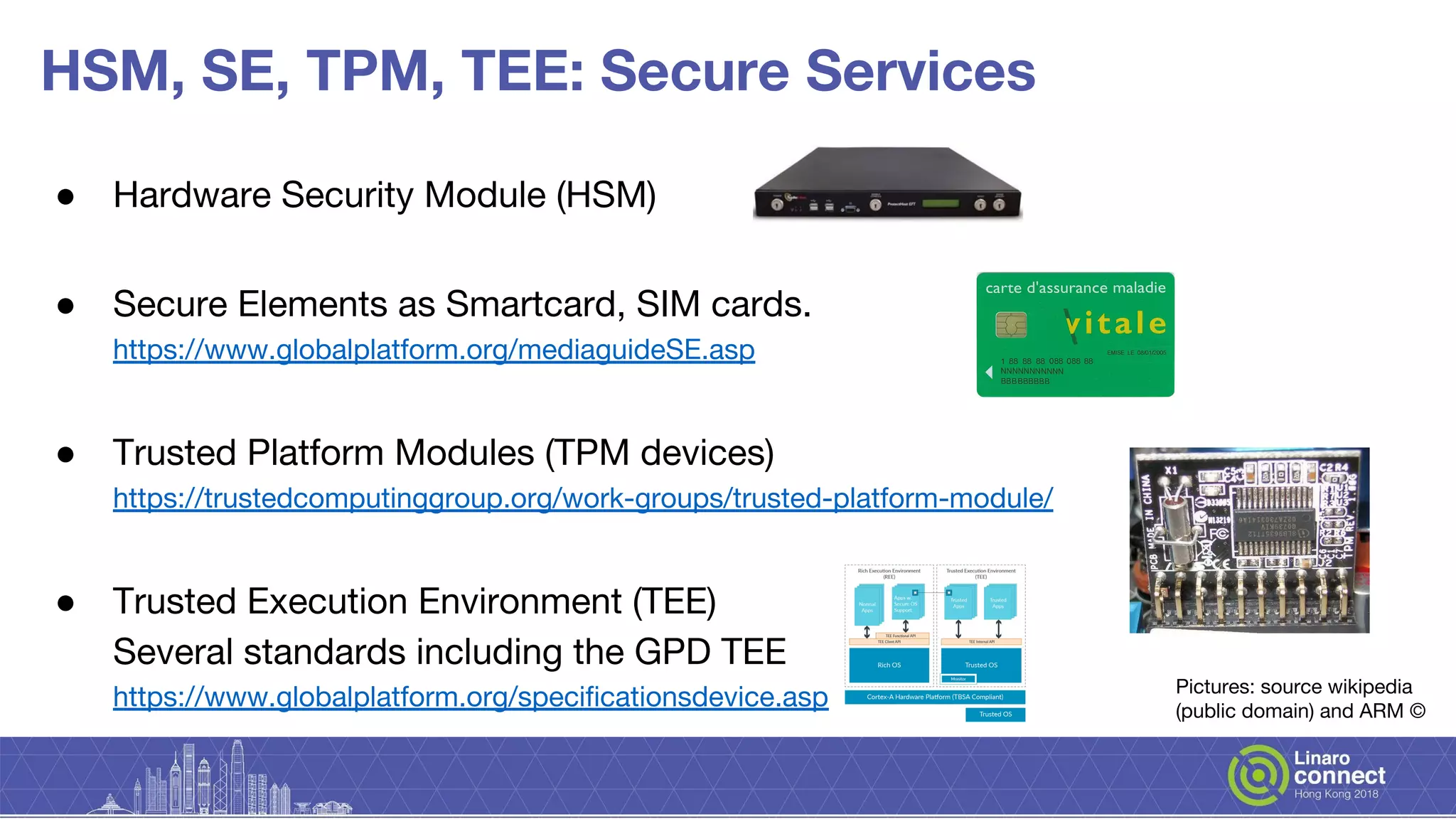
HSM, SE, TPM, TEE: Secure Services
● Hardware Security Module (HSM)
● Secure Elements as Smartcard, SIM cards.
https://www.globalplatform.org/mediaguideSE.asp
● Trusted Platform Modules (TPM devices)
https://trustedcomputinggroup.org/work-groups/trusted-platform-module/
● Trusted Execution Environment (TEE)
Several standards including the GPD TEE
https://www.globalplatform.org/specificationsdevice.asp Pictures: source wikipedia
(public domain) and ARM ©
HSM, SE, TPM, TEE: Secure Keys
HSMs, SEs, TPMs provide secure key management services:
● Key materials and cryptographic operations are very hard to tamper with.
● Client can import, generate, derive keys and cipher, sign, authenticate data.
● Secure keys have usage constraints.
● Use of secure keys may require user authentication.
How can the open source help in secure key management services?
TEEs as OP-TEE are suitable to propose such HSM services.
Sadly there is no uniform interface on which OP-TEE could build such a service.
Agenda
● Overview of Secure Key Services
● What is OP-TEE?
● Which Client Interface?
● Implementation: the SKS
● What’s next?
● Open source Trusted Execution Environment for Armv7/Armv8-A platforms.
● OP-TEE relies on the GPD TEE Client API specifications
● OP-TEE relies on the GPD TEE Internal Core API specifications.
What is OP-TEE?
https://www.globalplatform.org/specificationsdevice.asp
What is OP-TEE?
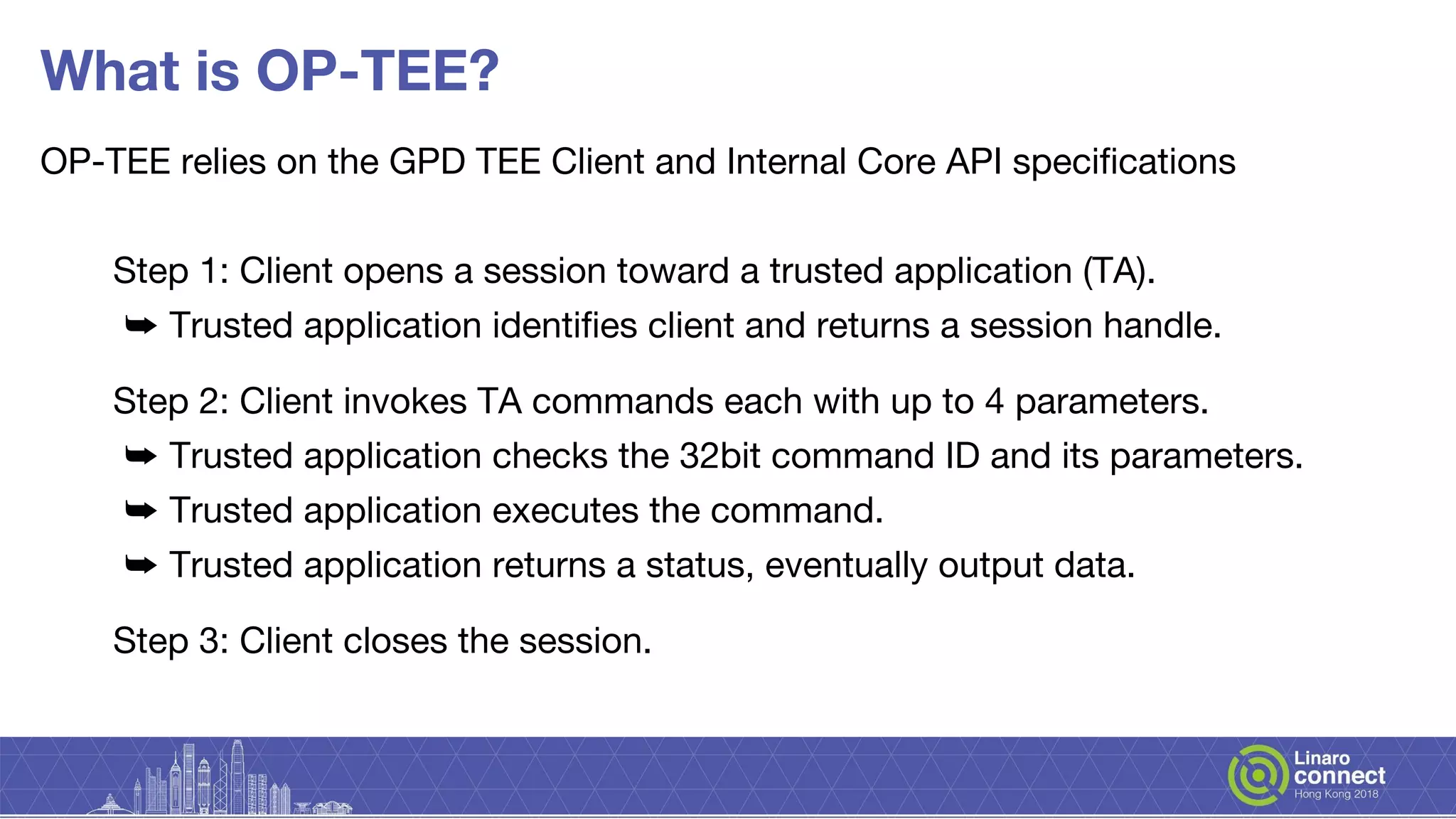
OP-TEE relies on the GPD TEE Client and Internal Core API specifications
Step 1: Client opens a session toward a trusted application (TA).
➥ Trusted application identifies client and returns a session handle.
Step 2: Client invokes TA commands each with up to 4 parameters.
➥ Trusted application checks the 32bit command ID and its parameters.
➥ Trusted application executes the command.
➥ Trusted application returns a status, eventually output data.
Step 3: Client closes the session.
What is OP-TEE?
GPD TEE Internal Core API functions for secure storage and cryptography:
● Secure Storage relates functions
TEE_CreatePersistentObject(), TEE_OpenPersistentObject(),
TEE_CloseAndDeletePersistentObject1(), TEE_ReadObjectData(),
TEE_WriteObjectData(), TEE_TruncateObjectData(), TEE_SeekObjectData().
● Cryptographic operations functions
TEE_DigestInit/Update/DoFinal(), TEE_CipherInit/Update/DoFinal(),
TEE_MACInit/Update/ComputeFinal/CompareFinal(), TEE_DeriveKey(),
TEE_AEInit/AEUpdateAAD/AEUpdateAAD/AEEncryptFinal/AEDecryptFinal(),
TEE_AsymmetricEncrypt/Decrypt/SignDigest/VerifyDigest(), TEE_GenerateKey().
Agenda
● Overview of Secure Key Services
● What is OP-TEE?
● Which Client Interface?
● Implementation: the SKS
● What’s next?
Secure Key Services: Which Client Interface?
Userland Applications Bootloader
… also for Trusted Applications?
Kernel crypto
services
Secure Key Services: Which Client Interface?
Linux kernel services:
● OP-TEE could register transformation providers to the Linux kernel Crypto API.
https://www.kernel.org/doc/html/v4.15/crypto/index.html
● Requires integration of the kernel client API in OP-TEE Linux driver.
Bootloader clients
● An OP-TEE portable client library to leverage TEE from bootloaders?
● OP-TEE secure storage currently relies on physical media access through
REE. Secure key service at boot implies TEE supplicant services in the
bootloader.
Secure Key Services: Which Client Interface?
Userland clients: which API?
● Mainly proprietary libraries and interfaces in vendor solutions.
● TPM Interface (https://trustedcomputinggroup.org/tpm-library-specification)
○ TPM already comes with an integration framework (TSS).
○ TPM lacks secure time to bound object time validity.
● Android Keystore (https://developer.android.com/.../keystore.html)
○ Very rich featured API but requires some of the Android support.
● PKCS #11/Cryptoki (https://www.oasis-open.org/committees/pkcs11)
○ Quite rich and extendable interface.
● Others libraries or APIs defined in the open source community?
Secure Key Services: Which Client Interface?
Lot of convergence of Android Keystore and PKCS #11 APIs:
● Crypto algorithms, operations atomicity, objects generic attributes.
PKCS #11:
● Referenced in many frameworks (i.e simalliance, amazon-freertos, linuxonibm).
● User authentication is restricted to a Security Officer and a single user.
● Flexible for extensions of object attributes and crypto schemes.
Android Keystore (far not exhaustive):
● More key attributes and rich binding with client application identity.
● Attestation of keys and device information using certificates.
Agenda
● Overview of Secure Key Services
● What is OP-TEE?
● Which Client Interface?
● Implementation: the SKS
● What’s next?
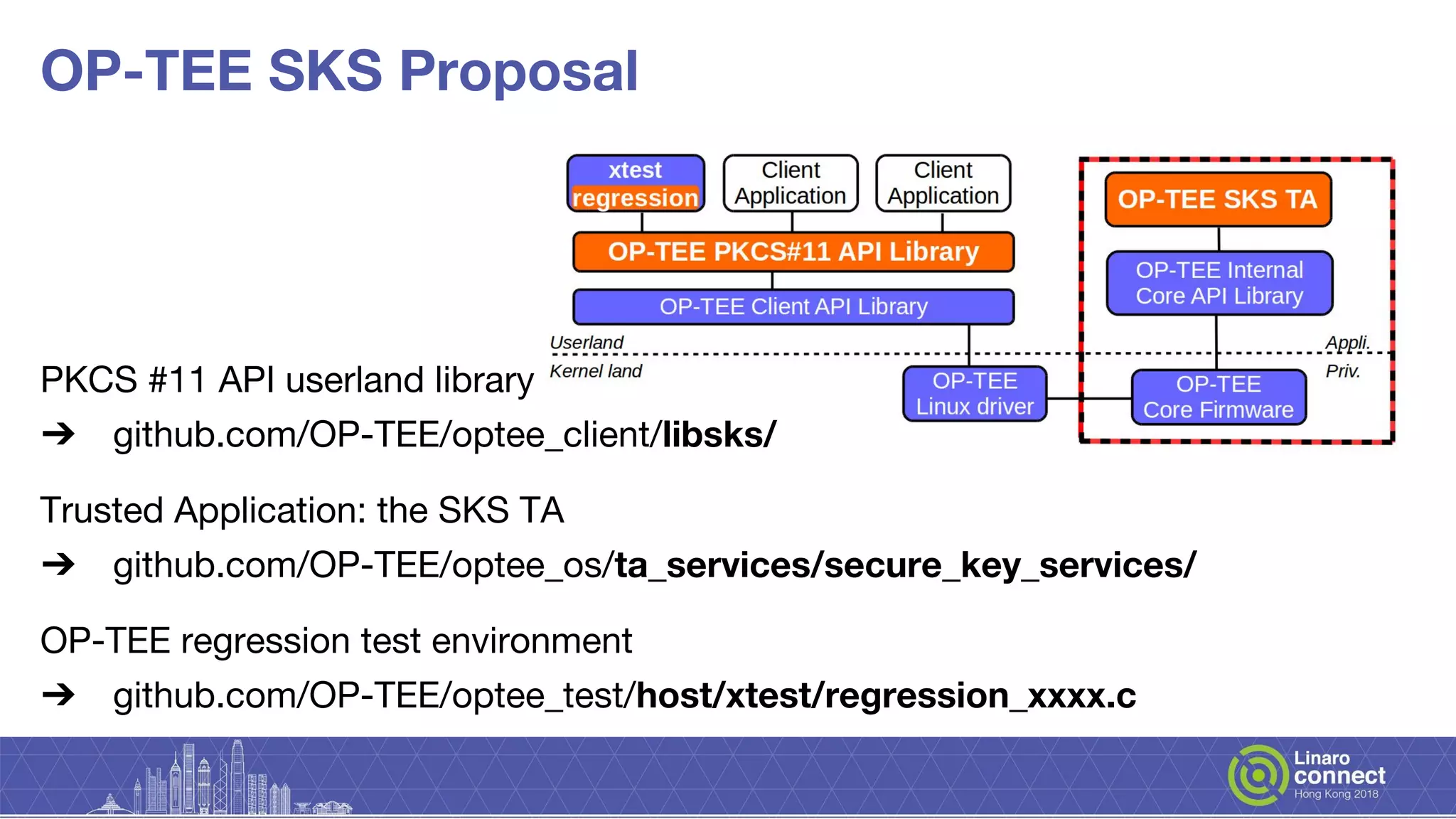
PKCS #11 API userland library
➔ github.com/OP-TEE/optee_client/libsks/
Trusted Application: the SKS TA
➔ github.com/OP-TEE/optee_os/ta_services/secure_key_services/
OP-TEE regression test environment
➔ github.com/OP-TEE/optee_test/host/xtest/regression_xxxx.c
OP-TEE SKS Proposal
OP-TEE SKS Proposal
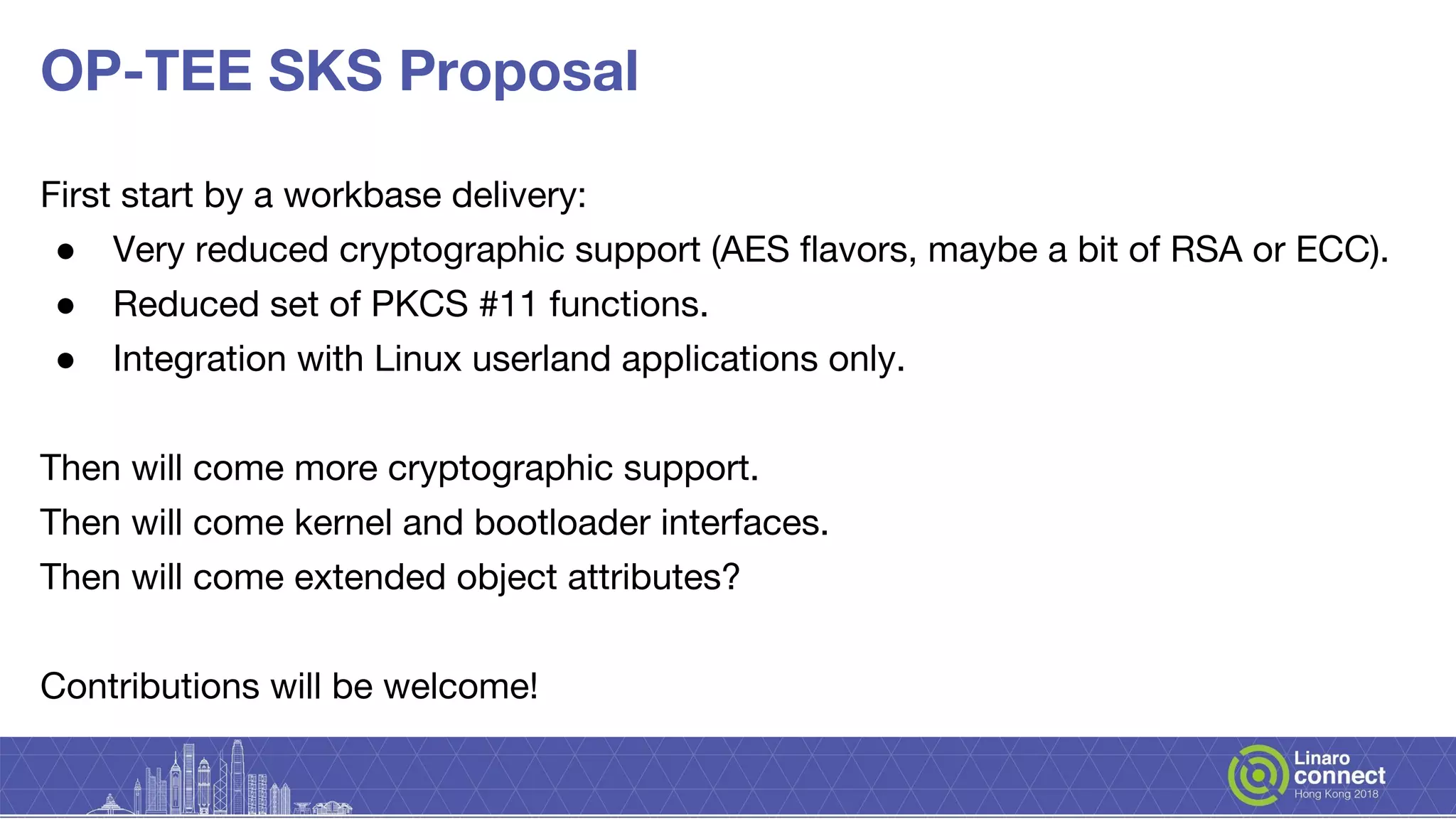
First start by a workbase delivery:
● Very reduced cryptographic support (AES flavors, maybe a bit of RSA or ECC).
● Reduced set of PKCS #11 functions.
● Integration with Linux userland applications only.
Then will come more cryptographic support.
Then will come kernel and bootloader interfaces.
Then will come extended object attributes?
Contributions will be welcome!
OP-TEE SKS Proposal
PKCS #11 Cryptographic Token - https://www.oasis-open.org/committees/pkcs11/
Latest as of today (March 2018) is the Specifications Version 2.40 Plus Errata 01:
● The Interface Base Specification defines the functions and most ABI.
● The Current Mechanisms Specification lists mechanisms and their parameters.
● The Interface Historical Mechanisms lists historical mechanisms (i.e DES).
● Three C/C++ code header files:
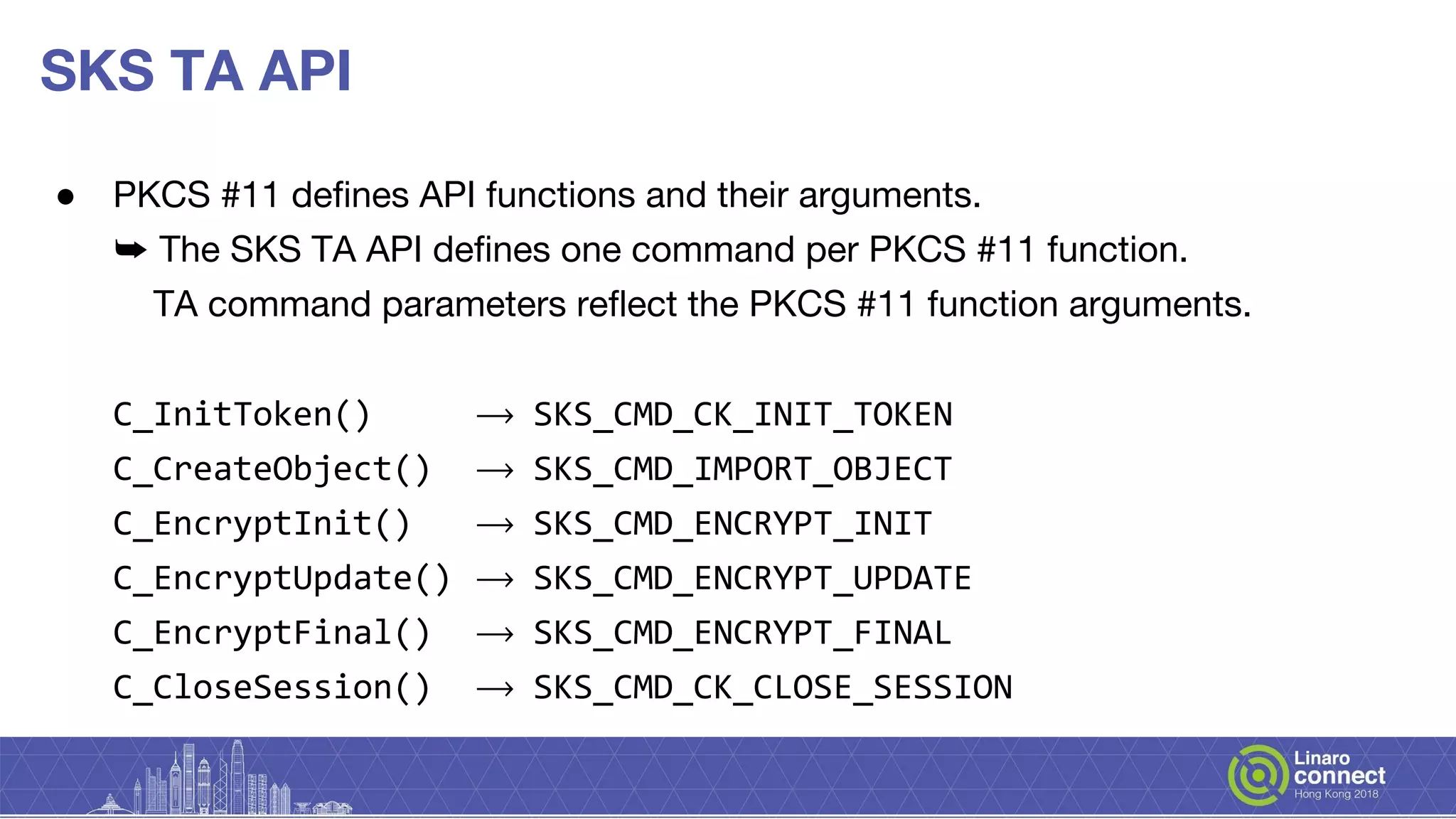
SKS TA API
● PKCS #11 defines API functions and their arguments.
➥ The SKS TA API defines one command per PKCS #11 function.
TA command parameters reflect the PKCS #11 function arguments.
C_InitToken() ⟶ SKS_CMD_CK_INIT_TOKEN
C_CreateObject() ⟶ SKS_CMD_IMPORT_OBJECT
C_EncryptInit() ⟶ SKS_CMD_ENCRYPT_INIT
C_EncryptUpdate() ⟶ SKS_CMD_ENCRYPT_UPDATE
C_EncryptFinal() ⟶ SKS_CMD_ENCRYPT_FINAL
C_CloseSession() ⟶ SKS_CMD_CK_CLOSE_SESSION
SKS TA API
Objects: An object is a collection of attributes
● Class and type in class, i.e a symmetric key for an AES processing.
● Secret object secret value(s), i.e an AES key value.
● Identification means: label, ID, and very few others.
● Storage attributes: persistent, non modifiable, etc...
● Use constraints: allowed operations, time validity, user authentication, etc...
CKA_CLASS, CKA_KEY_TYPE, CKA_VALUE, CKA_LABEL, CKA_ID, CKA_START_DATE, CKA_END_DATE,
CKA_TOKEN, CKA_PRIVATE, CKA_ENCRYPT, CKA_DECRYPT, CKA_DERIVE, CKA_SIGN, CKA_VERIFY,
CKA_EXTRACTABLE, CKA_SENSITIVE, CKA_MODIFIABLE, CKA_COPYABLE, CKA_DESTROYABLE,
CKA_MECHANISM_TYPE, CKA_ALLOWED_MECHANISMS, CKA_UNWRAP_TEMPLATE, etc...
Objects: An object is a collection of attributes.
An attribute is a triplet attribute-ID/value-byte-size/value-data.
SKS TA API
Representation of an object in the PKCS#11 ABI
Representation of an object in the SKS TA ABI
SKS TA API
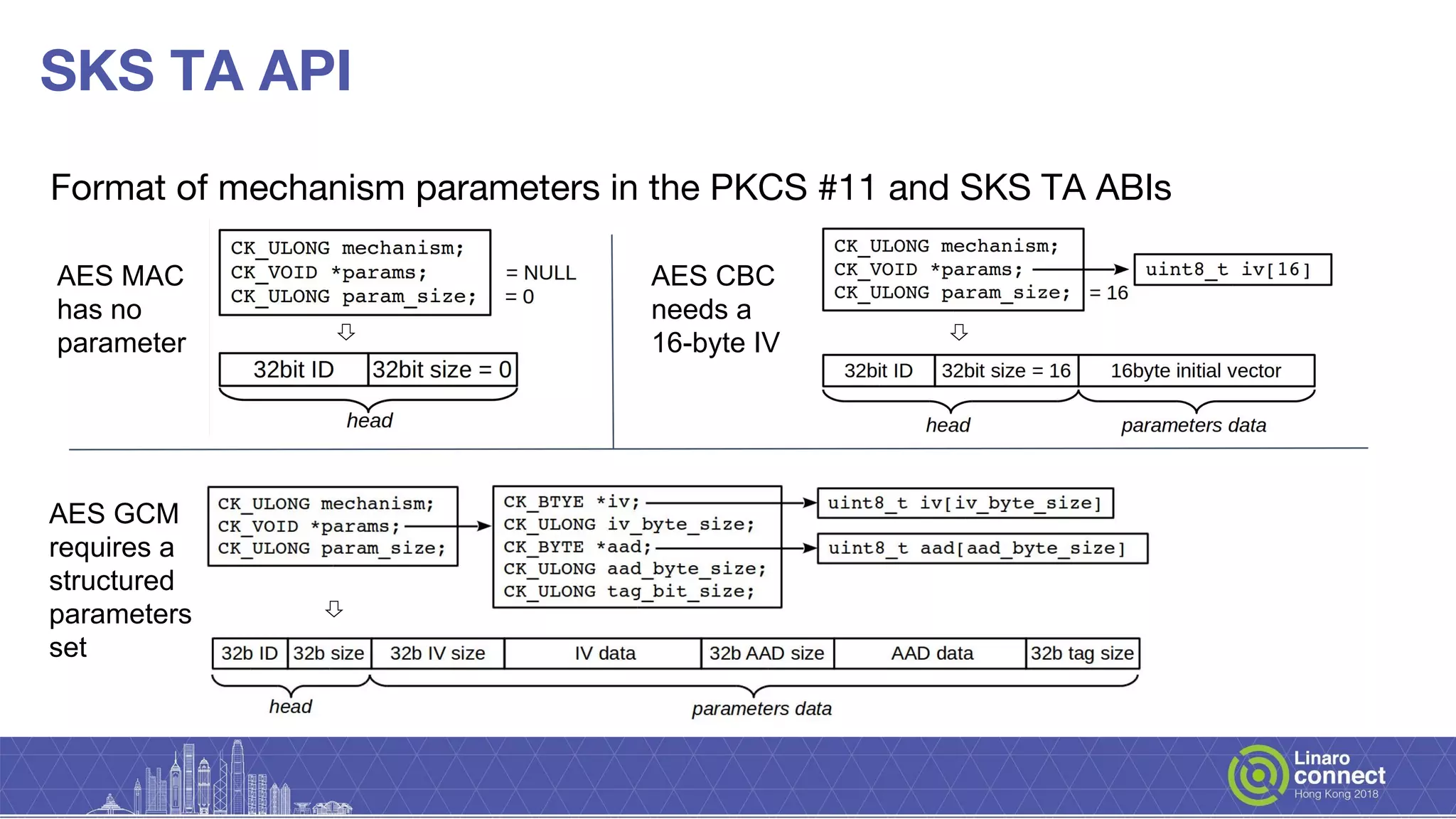
Mechanisms are cryptographic operation schemes defined by:
● An identification number;
● Formatted parameters required to initialize a crypto operation;
● Ability to execute processing modes or functions (i.e encrypt, sign, derive).
Examples of PKCS #11 mechanisms:
● AES MAC: CKM_AES_MAC, no parameter, supports sign and verify.
● AES CBC: CKM_AES_CBC, requires an IV, supports encryption and decryption.
● AES GCM: CKM_AES_GCM, requires an IV, an AAD and a tag size, can be used
to encrypt and decrypt Authenticated Encryption (AE) messages.
Format of mechanism parameters in the PKCS #11 and SKS TA ABIs
SKS TA API
⇩
AES MAC
has no
parameter
AES CBC
needs a
16-byte IV⇩
⇩
AES GCM
requires a
structured
parameters
set
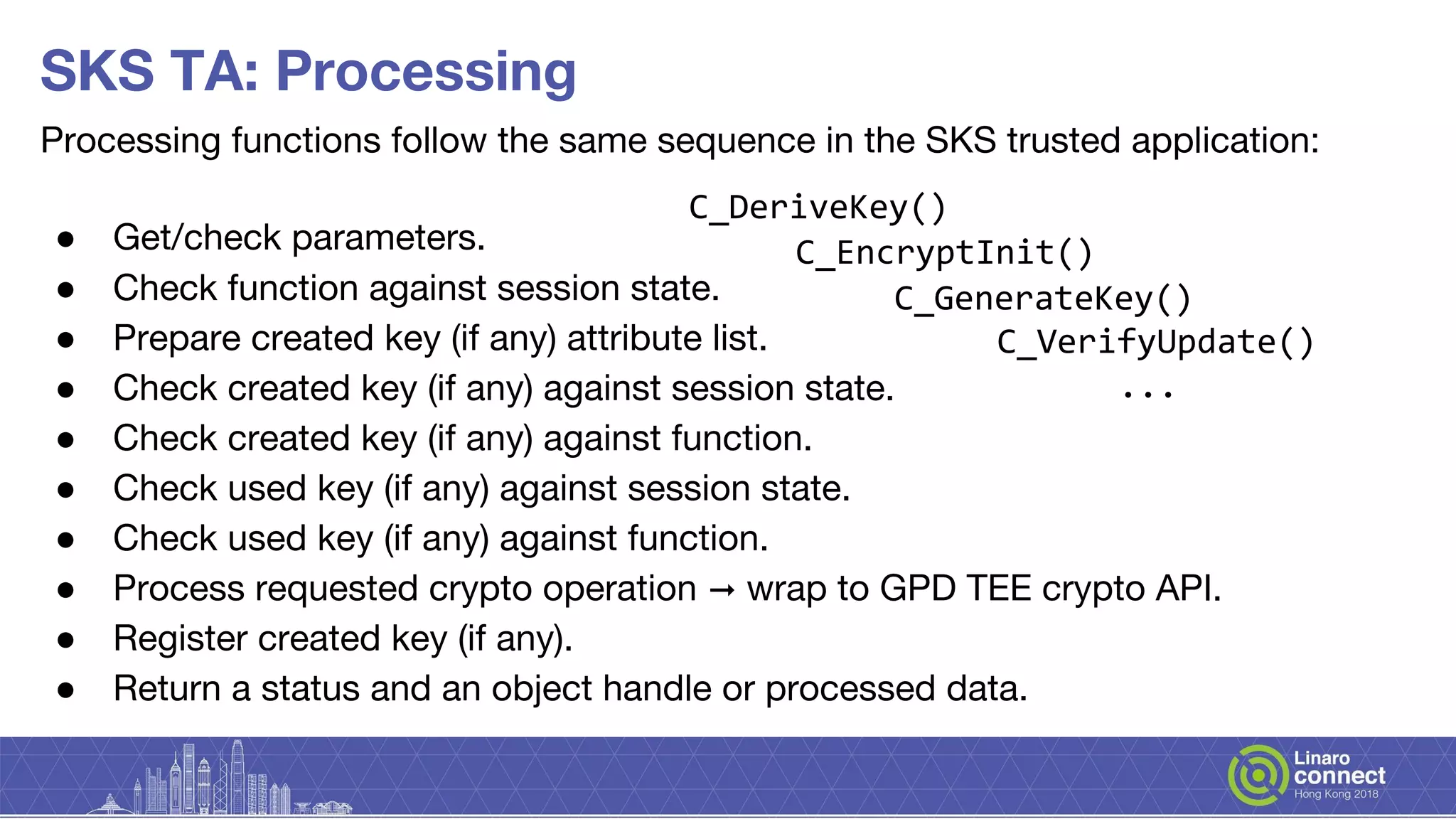
Processing functions follow the same sequence in the SKS trusted application:
● Get/check parameters.
● Check function against session state.
● Prepare created key (if any) attribute list.
● Check created key (if any) against session state.
● Check created key (if any) against function.
● Check used key (if any) against session state.
● Check used key (if any) against function.
● Process requested crypto operation ➞ wrap to GPD TEE crypto API.
● Register created key (if any).
● Return a status and an object handle or processed data.
SKS TA: Processing
C_GenerateKey()
C_DeriveKey()
C_EncryptInit()
C_VerifyUpdate()
...
Agenda
● Overview of Secure Key Services
● What is OP-TEE?
● Which Client Interface?
● Implementation: the SKS
● What’s next?
Current Status
As of March 2018:
● Proposed an API for the TA that reflects the PKCS #11 API.
● Supports token info retrieve and sessions functions.
● Supports persistent storage of keys and token state.
● Import and generation of generic secrets and AES keys.
● AES in modes ECB, CBC, CTS, CTR, GCM and CCM.
● SHAxxx HMACs, AES CMAC, AES CBC MAC.
● Several token management and set/get attributes functions are not supported.
● Test environment still weak.
What’s Next - Short Term
● Enhance the tests and constraints on client parameters.
Existing PKCS #11 test frameworks?
● Consider delivery in OP-TEE 3.1.0 if mature enough.
● Contributions will be welcome to enhance the set of
crypto algorithms and mature the implementation.
What’s Next - Long Term
● Issue #1: certificate support
○ Current OP-TEE does not provide any certificate support.
○ Secure parsing of X.509 certificates is known to be touchy.
● How to provision the SKS key database with platform secrets (i.e OTP fuses)?
● Interface keys and operations deported in a more secure backend HSM/SE?
● Consider convergences with an Android keystore solution.
● Looking forward PKCS #11 Version 3.0 (cryptsoft.com).
What’s Next
● Integrate in a filesystem encryption setup
○ May requires SKS TA services at boot stage (on going work by Igor
Opaniuk for a portable OP-TEE client library).
○ Requires the OP-TEE kernel client API in the Linux optee driver.
○ SKS TA can be a transformation providers in the Linux Crypto API.
What’s Next - Short Term
Provisioning and token ownership
● Clarify the provisioning sequences.
● How should we handle several PKCS #11 tokens?
● Can we create on request provisioned tokens with
delegated ownership?
Release the SKS TA during long lasting operations
● An OP-TEE TA is not reentrant.
● Could the SKS TA delegate a crypto processing to a TA
instance?
Thank You
etienne.carriere@linaro.org [github: @etienne-lms]
#HKG18
HKG18 keynotes and videos on: connect.linaro.org
For further information: www.linaro.org
Some extra slides...
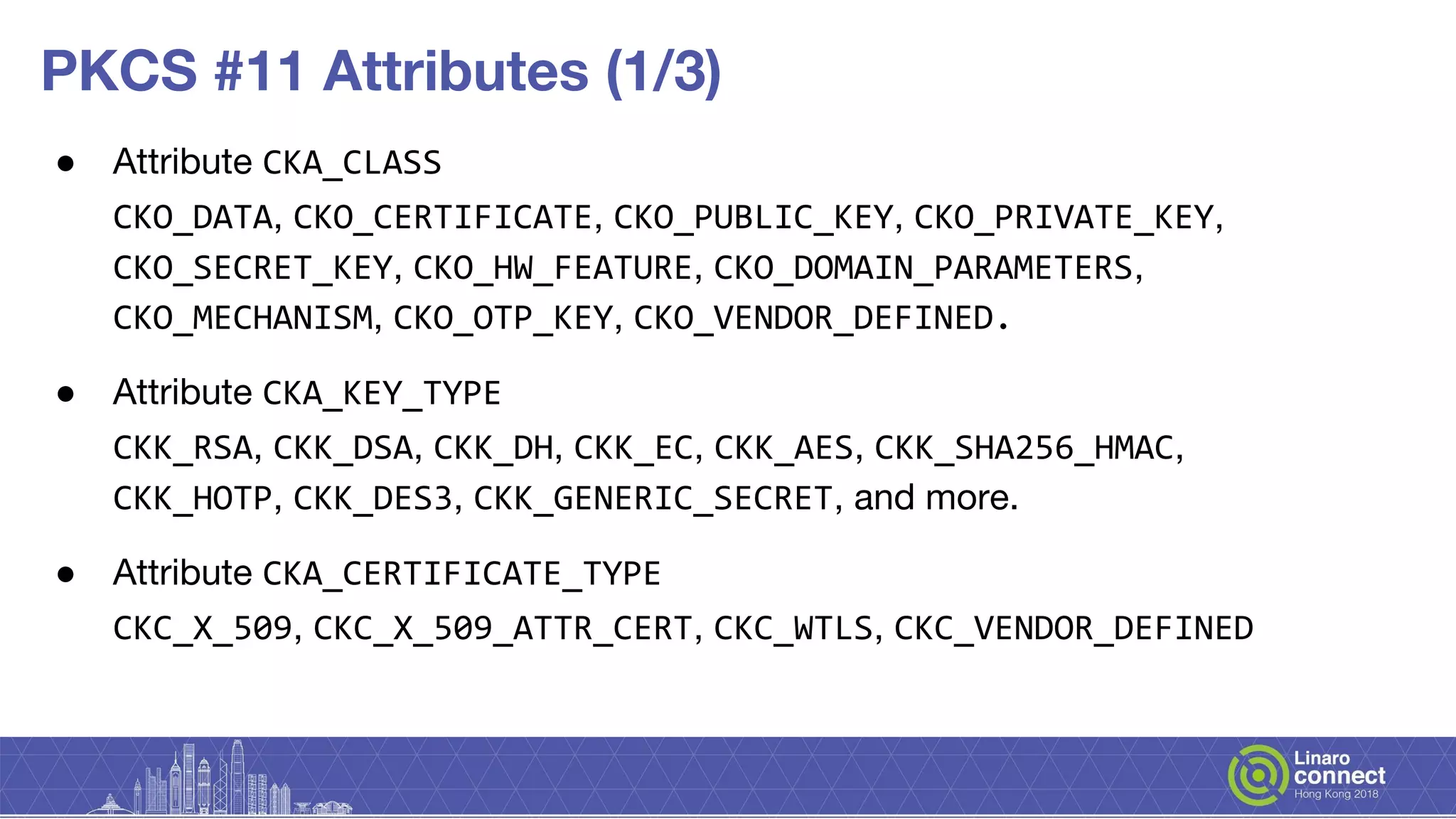
● Attribute CKA_CLASS
CKO_DATA, CKO_CERTIFICATE, CKO_PUBLIC_KEY, CKO_PRIVATE_KEY,
CKO_SECRET_KEY, CKO_HW_FEATURE, CKO_DOMAIN_PARAMETERS,
CKO_MECHANISM, CKO_OTP_KEY, CKO_VENDOR_DEFINED.
● Attribute CKA_KEY_TYPE
CKK_RSA, CKK_DSA, CKK_DH, CKK_EC, CKK_AES, CKK_SHA256_HMAC,
CKK_HOTP, CKK_DES3, CKK_GENERIC_SECRET, and more.
● Attribute CKA_CERTIFICATE_TYPE
CKC_X_509, CKC_X_509_ATTR_CERT, CKC_WTLS, CKC_VENDOR_DEFINED
PKCS #11 Attributes (1/3)
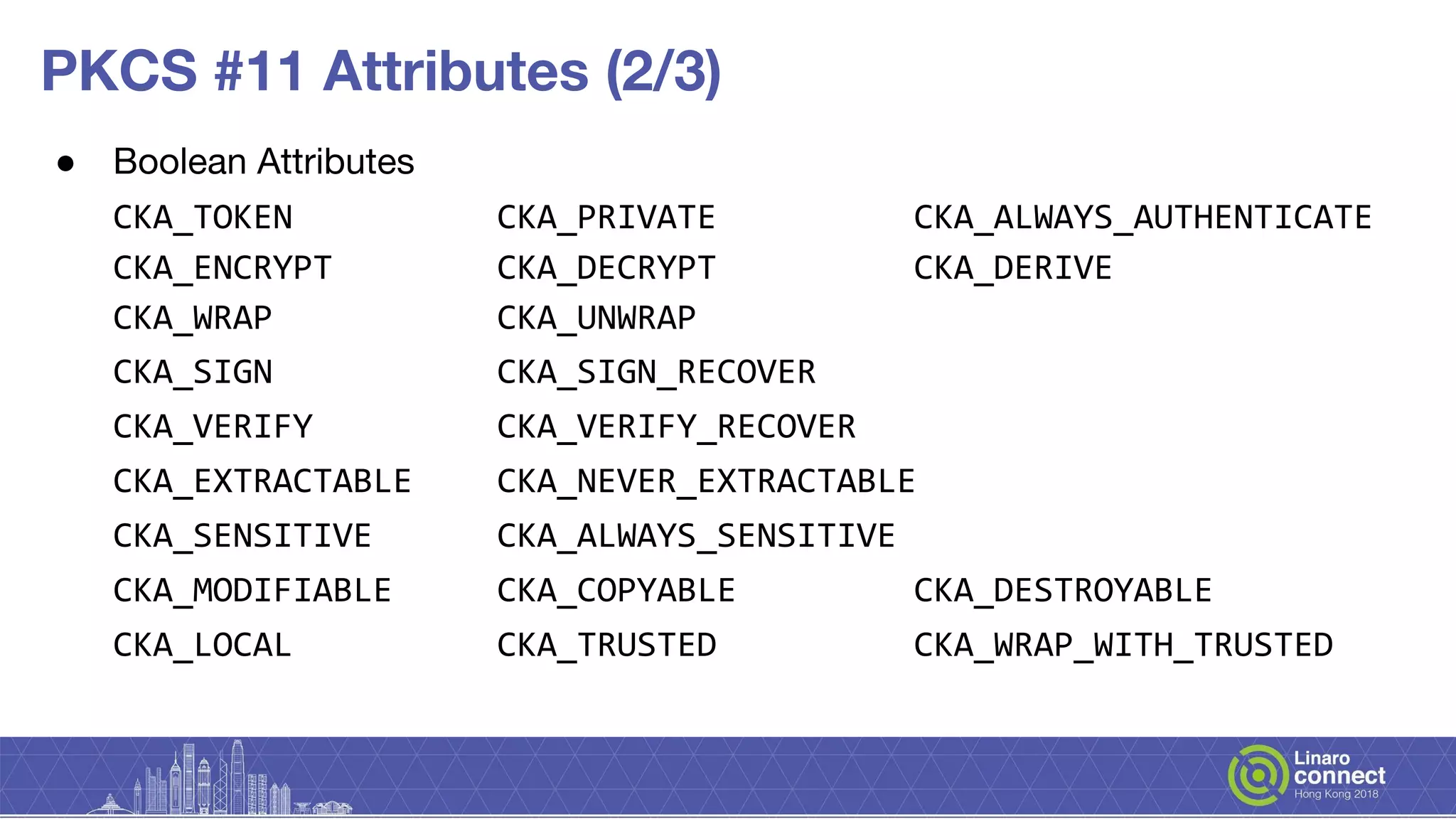
PKCS #11 Attributes (2/3)
● Boolean Attributes
CKA_TOKEN CKA_PRIVATE CKA_ALWAYS_AUTHENTICATE
CKA_ENCRYPT CKA_DECRYPT CKA_DERIVE
CKA_WRAP CKA_UNWRAP
CKA_SIGN CKA_SIGN_RECOVER
CKA_VERIFY CKA_VERIFY_RECOVER
CKA_EXTRACTABLE CKA_NEVER_EXTRACTABLE
CKA_SENSITIVE CKA_ALWAYS_SENSITIVE
CKA_MODIFIABLE CKA_COPYABLE CKA_DESTROYABLE
CKA_LOCAL CKA_TRUSTED CKA_WRAP_WITH_TRUSTED
PKCS #11 Attributes (3/3)
● Other Attributes
CKA_VALUE, CKA_VALUE_LEN,
CKA_LABEL, CKA_OBJECT_ID, CKA_APPLICATION, CKA_ID,
CKA_START_DATE, CKA_END_DATE,
CKA_WRAP_TEMPLATE, CKA_UNWRAP_TEMPLATE, CKA_DERIVE_TEMPLATE,
CKA_MODULUS, CKA_PRIVATE_EXPONENT, CKA_PRIME, CKA_EC_PARAMS, etc…,
CKA_CERTIFICATE_CATEGORY, CKA_ISSUER, CKA_SERIAL_NUMBER, etc…,
CKA_OTP_FORMAT, CKA_OTP_LENGTHCKA_OTP_TIME_INTERVAL,
CKA_KEY_GEN_MECHANISM, CKA_LOCAL,
CKA_MECHANISM_TYPE, CKA_ALLOWED_MECHANISMS,
CKA_VENDOR_DEFINED
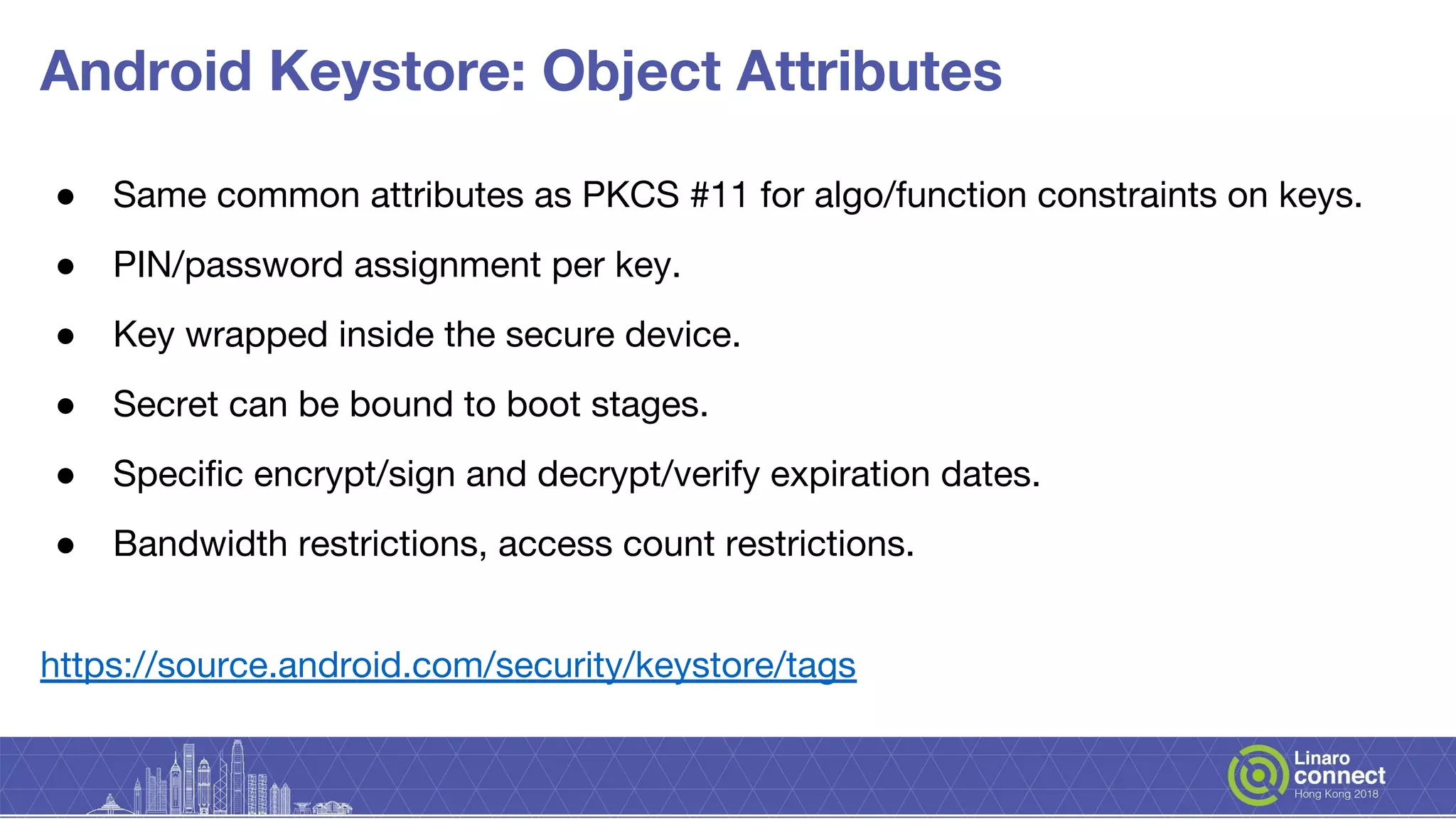
Android Keystore: Object Attributes
● Same common attributes as PKCS #11 for algo/function constraints on keys.
● PIN/password assignment per key.
● Key wrapped inside the secure device.
● Secret can be bound to boot stages.
● Specific encrypt/sign and decrypt/verify expiration dates.
● Bandwidth restrictions, access count restrictions.
https://source.android.com/security/keystore/tags
Android Keystore: Object Attributes
Tag::PURPOSE Tag::ALGORITHM Tag::KEY_SIZE
Tag::UNIQUE_ID Tag::APPLICATION_DATA Tag::APPLICATION_ID
Tag::BLOB_USAGE_REQUIREMENTS Tag::BOOTLOADER_ONLY
Tag::MAX_USES_PER_BOOT Tag::MIN_SECONDS_BETWEEN_OPS
Tag::USER_SECURE_ID Tag::USER_AUTH_TYPE Tag::NO_AUTH_REQUIRED
Tag::ORIGINATION_EXPIRE_DATETIME Tag::USAGE_EXPIRE_DATETIME
…
https://source.android.com/security/keystore/tags
Android Keystore: API Functions
● Import/export raw symmetric keys and formated asymmetric keys.
● Generate and derive keys and usual ciphering and/or authentication algo.
● Attest a key: export a certificate for a given key.
● Attest a device hardware information in a certificate.
addRngEntropy(), getHardwareFeatures(),
generateKey(), importKey(), getKeyCharacteristics(),
exportKey(), deleteKey(), deleteAllKeys(), destroyAttestationIds(),
begin(), update(), finish(), abort().
https://source.android.com/security/keystore/implementer-ref
End of extras
etienne.carriere@linaro.org
#HKG18
HKG18 keynotes and videos on: connect.linaro.org
For further information: www.linaro.org

HKG18-402 - Build secure key management services in OP-TEE

  • 1.
    HKG18-402: Secure KeyServices in OP-TEE Etienne Carrière, STMicroelectronics
  • 2.
    Agenda ● Overview ofSecure Key Services ● What is OP-TEE? ● Which Client Interface? ● Implementation: the SKS ● What’s next?
  • 3.
    HSM, SE, TPM,TEE: Secure Services ● Hardware Security Module (HSM) ● Secure Elements as Smartcard, SIM cards. https://www.globalplatform.org/mediaguideSE.asp ● Trusted Platform Modules (TPM devices) https://trustedcomputinggroup.org/work-groups/trusted-platform-module/ ● Trusted Execution Environment (TEE) Several standards including the GPD TEE https://www.globalplatform.org/specificationsdevice.asp Pictures: source wikipedia (public domain) and ARM ©
  • 4.
    HSM, SE, TPM,TEE: Secure Keys HSMs, SEs, TPMs provide secure key management services: ● Key materials and cryptographic operations are very hard to tamper with. ● Client can import, generate, derive keys and cipher, sign, authenticate data. ● Secure keys have usage constraints. ● Use of secure keys may require user authentication. How can the open source help in secure key management services? TEEs as OP-TEE are suitable to propose such HSM services. Sadly there is no uniform interface on which OP-TEE could build such a service.
  • 5.
    Agenda ● Overview ofSecure Key Services ● What is OP-TEE? ● Which Client Interface? ● Implementation: the SKS ● What’s next?
  • 6.
    ● Open sourceTrusted Execution Environment for Armv7/Armv8-A platforms. ● OP-TEE relies on the GPD TEE Client API specifications ● OP-TEE relies on the GPD TEE Internal Core API specifications. What is OP-TEE? https://www.globalplatform.org/specificationsdevice.asp
  • 7.
    What is OP-TEE? OP-TEErelies on the GPD TEE Client and Internal Core API specifications Step 1: Client opens a session toward a trusted application (TA). ➥ Trusted application identifies client and returns a session handle. Step 2: Client invokes TA commands each with up to 4 parameters. ➥ Trusted application checks the 32bit command ID and its parameters. ➥ Trusted application executes the command. ➥ Trusted application returns a status, eventually output data. Step 3: Client closes the session.
  • 8.
    What is OP-TEE? GPDTEE Internal Core API functions for secure storage and cryptography: ● Secure Storage relates functions TEE_CreatePersistentObject(), TEE_OpenPersistentObject(), TEE_CloseAndDeletePersistentObject1(), TEE_ReadObjectData(), TEE_WriteObjectData(), TEE_TruncateObjectData(), TEE_SeekObjectData(). ● Cryptographic operations functions TEE_DigestInit/Update/DoFinal(), TEE_CipherInit/Update/DoFinal(), TEE_MACInit/Update/ComputeFinal/CompareFinal(), TEE_DeriveKey(), TEE_AEInit/AEUpdateAAD/AEUpdateAAD/AEEncryptFinal/AEDecryptFinal(), TEE_AsymmetricEncrypt/Decrypt/SignDigest/VerifyDigest(), TEE_GenerateKey().
  • 9.
    Agenda ● Overview ofSecure Key Services ● What is OP-TEE? ● Which Client Interface? ● Implementation: the SKS ● What’s next?
  • 10.
    Secure Key Services:Which Client Interface? Userland Applications Bootloader … also for Trusted Applications? Kernel crypto services
  • 11.
    Secure Key Services:Which Client Interface? Linux kernel services: ● OP-TEE could register transformation providers to the Linux kernel Crypto API. https://www.kernel.org/doc/html/v4.15/crypto/index.html ● Requires integration of the kernel client API in OP-TEE Linux driver. Bootloader clients ● An OP-TEE portable client library to leverage TEE from bootloaders? ● OP-TEE secure storage currently relies on physical media access through REE. Secure key service at boot implies TEE supplicant services in the bootloader.
  • 12.
    Secure Key Services:Which Client Interface? Userland clients: which API? ● Mainly proprietary libraries and interfaces in vendor solutions. ● TPM Interface (https://trustedcomputinggroup.org/tpm-library-specification) ○ TPM already comes with an integration framework (TSS). ○ TPM lacks secure time to bound object time validity. ● Android Keystore (https://developer.android.com/.../keystore.html) ○ Very rich featured API but requires some of the Android support. ● PKCS #11/Cryptoki (https://www.oasis-open.org/committees/pkcs11) ○ Quite rich and extendable interface. ● Others libraries or APIs defined in the open source community?
  • 13.
    Secure Key Services:Which Client Interface? Lot of convergence of Android Keystore and PKCS #11 APIs: ● Crypto algorithms, operations atomicity, objects generic attributes. PKCS #11: ● Referenced in many frameworks (i.e simalliance, amazon-freertos, linuxonibm). ● User authentication is restricted to a Security Officer and a single user. ● Flexible for extensions of object attributes and crypto schemes. Android Keystore (far not exhaustive): ● More key attributes and rich binding with client application identity. ● Attestation of keys and device information using certificates.
  • 14.
    Agenda ● Overview ofSecure Key Services ● What is OP-TEE? ● Which Client Interface? ● Implementation: the SKS ● What’s next?
  • 15.
    PKCS #11 APIuserland library ➔ github.com/OP-TEE/optee_client/libsks/ Trusted Application: the SKS TA ➔ github.com/OP-TEE/optee_os/ta_services/secure_key_services/ OP-TEE regression test environment ➔ github.com/OP-TEE/optee_test/host/xtest/regression_xxxx.c OP-TEE SKS Proposal
  • 16.
    OP-TEE SKS Proposal Firststart by a workbase delivery: ● Very reduced cryptographic support (AES flavors, maybe a bit of RSA or ECC). ● Reduced set of PKCS #11 functions. ● Integration with Linux userland applications only. Then will come more cryptographic support. Then will come kernel and bootloader interfaces. Then will come extended object attributes? Contributions will be welcome!
  • 17.
    OP-TEE SKS Proposal PKCS#11 Cryptographic Token - https://www.oasis-open.org/committees/pkcs11/ Latest as of today (March 2018) is the Specifications Version 2.40 Plus Errata 01: ● The Interface Base Specification defines the functions and most ABI. ● The Current Mechanisms Specification lists mechanisms and their parameters. ● The Interface Historical Mechanisms lists historical mechanisms (i.e DES). ● Three C/C++ code header files:
  • 18.
    SKS TA API ●PKCS #11 defines API functions and their arguments. ➥ The SKS TA API defines one command per PKCS #11 function. TA command parameters reflect the PKCS #11 function arguments. C_InitToken() ⟶ SKS_CMD_CK_INIT_TOKEN C_CreateObject() ⟶ SKS_CMD_IMPORT_OBJECT C_EncryptInit() ⟶ SKS_CMD_ENCRYPT_INIT C_EncryptUpdate() ⟶ SKS_CMD_ENCRYPT_UPDATE C_EncryptFinal() ⟶ SKS_CMD_ENCRYPT_FINAL C_CloseSession() ⟶ SKS_CMD_CK_CLOSE_SESSION
  • 19.
    SKS TA API Objects:An object is a collection of attributes ● Class and type in class, i.e a symmetric key for an AES processing. ● Secret object secret value(s), i.e an AES key value. ● Identification means: label, ID, and very few others. ● Storage attributes: persistent, non modifiable, etc... ● Use constraints: allowed operations, time validity, user authentication, etc... CKA_CLASS, CKA_KEY_TYPE, CKA_VALUE, CKA_LABEL, CKA_ID, CKA_START_DATE, CKA_END_DATE, CKA_TOKEN, CKA_PRIVATE, CKA_ENCRYPT, CKA_DECRYPT, CKA_DERIVE, CKA_SIGN, CKA_VERIFY, CKA_EXTRACTABLE, CKA_SENSITIVE, CKA_MODIFIABLE, CKA_COPYABLE, CKA_DESTROYABLE, CKA_MECHANISM_TYPE, CKA_ALLOWED_MECHANISMS, CKA_UNWRAP_TEMPLATE, etc...
  • 20.
    Objects: An objectis a collection of attributes. An attribute is a triplet attribute-ID/value-byte-size/value-data. SKS TA API Representation of an object in the PKCS#11 ABI Representation of an object in the SKS TA ABI
  • 21.
    SKS TA API Mechanismsare cryptographic operation schemes defined by: ● An identification number; ● Formatted parameters required to initialize a crypto operation; ● Ability to execute processing modes or functions (i.e encrypt, sign, derive). Examples of PKCS #11 mechanisms: ● AES MAC: CKM_AES_MAC, no parameter, supports sign and verify. ● AES CBC: CKM_AES_CBC, requires an IV, supports encryption and decryption. ● AES GCM: CKM_AES_GCM, requires an IV, an AAD and a tag size, can be used to encrypt and decrypt Authenticated Encryption (AE) messages.
  • 22.
    Format of mechanismparameters in the PKCS #11 and SKS TA ABIs SKS TA API ⇩ AES MAC has no parameter AES CBC needs a 16-byte IV⇩ ⇩ AES GCM requires a structured parameters set
  • 23.
    Processing functions followthe same sequence in the SKS trusted application: ● Get/check parameters. ● Check function against session state. ● Prepare created key (if any) attribute list. ● Check created key (if any) against session state. ● Check created key (if any) against function. ● Check used key (if any) against session state. ● Check used key (if any) against function. ● Process requested crypto operation ➞ wrap to GPD TEE crypto API. ● Register created key (if any). ● Return a status and an object handle or processed data. SKS TA: Processing C_GenerateKey() C_DeriveKey() C_EncryptInit() C_VerifyUpdate() ...
  • 24.
    Agenda ● Overview ofSecure Key Services ● What is OP-TEE? ● Which Client Interface? ● Implementation: the SKS ● What’s next?
  • 25.
    Current Status As ofMarch 2018: ● Proposed an API for the TA that reflects the PKCS #11 API. ● Supports token info retrieve and sessions functions. ● Supports persistent storage of keys and token state. ● Import and generation of generic secrets and AES keys. ● AES in modes ECB, CBC, CTS, CTR, GCM and CCM. ● SHAxxx HMACs, AES CMAC, AES CBC MAC. ● Several token management and set/get attributes functions are not supported. ● Test environment still weak.
  • 26.
    What’s Next -Short Term ● Enhance the tests and constraints on client parameters. Existing PKCS #11 test frameworks? ● Consider delivery in OP-TEE 3.1.0 if mature enough. ● Contributions will be welcome to enhance the set of crypto algorithms and mature the implementation.
  • 27.
    What’s Next -Long Term ● Issue #1: certificate support ○ Current OP-TEE does not provide any certificate support. ○ Secure parsing of X.509 certificates is known to be touchy. ● How to provision the SKS key database with platform secrets (i.e OTP fuses)? ● Interface keys and operations deported in a more secure backend HSM/SE? ● Consider convergences with an Android keystore solution. ● Looking forward PKCS #11 Version 3.0 (cryptsoft.com).
  • 28.
    What’s Next ● Integratein a filesystem encryption setup ○ May requires SKS TA services at boot stage (on going work by Igor Opaniuk for a portable OP-TEE client library). ○ Requires the OP-TEE kernel client API in the Linux optee driver. ○ SKS TA can be a transformation providers in the Linux Crypto API.
  • 29.
    What’s Next -Short Term Provisioning and token ownership ● Clarify the provisioning sequences. ● How should we handle several PKCS #11 tokens? ● Can we create on request provisioned tokens with delegated ownership? Release the SKS TA during long lasting operations ● An OP-TEE TA is not reentrant. ● Could the SKS TA delegate a crypto processing to a TA instance?
  • 30.
    Thank You etienne.carriere@linaro.org [github:@etienne-lms] #HKG18 HKG18 keynotes and videos on: connect.linaro.org For further information: www.linaro.org
  • 31.
  • 32.
    ● Attribute CKA_CLASS CKO_DATA,CKO_CERTIFICATE, CKO_PUBLIC_KEY, CKO_PRIVATE_KEY, CKO_SECRET_KEY, CKO_HW_FEATURE, CKO_DOMAIN_PARAMETERS, CKO_MECHANISM, CKO_OTP_KEY, CKO_VENDOR_DEFINED. ● Attribute CKA_KEY_TYPE CKK_RSA, CKK_DSA, CKK_DH, CKK_EC, CKK_AES, CKK_SHA256_HMAC, CKK_HOTP, CKK_DES3, CKK_GENERIC_SECRET, and more. ● Attribute CKA_CERTIFICATE_TYPE CKC_X_509, CKC_X_509_ATTR_CERT, CKC_WTLS, CKC_VENDOR_DEFINED PKCS #11 Attributes (1/3)
  • 33.
    PKCS #11 Attributes(2/3) ● Boolean Attributes CKA_TOKEN CKA_PRIVATE CKA_ALWAYS_AUTHENTICATE CKA_ENCRYPT CKA_DECRYPT CKA_DERIVE CKA_WRAP CKA_UNWRAP CKA_SIGN CKA_SIGN_RECOVER CKA_VERIFY CKA_VERIFY_RECOVER CKA_EXTRACTABLE CKA_NEVER_EXTRACTABLE CKA_SENSITIVE CKA_ALWAYS_SENSITIVE CKA_MODIFIABLE CKA_COPYABLE CKA_DESTROYABLE CKA_LOCAL CKA_TRUSTED CKA_WRAP_WITH_TRUSTED
  • 34.
    PKCS #11 Attributes(3/3) ● Other Attributes CKA_VALUE, CKA_VALUE_LEN, CKA_LABEL, CKA_OBJECT_ID, CKA_APPLICATION, CKA_ID, CKA_START_DATE, CKA_END_DATE, CKA_WRAP_TEMPLATE, CKA_UNWRAP_TEMPLATE, CKA_DERIVE_TEMPLATE, CKA_MODULUS, CKA_PRIVATE_EXPONENT, CKA_PRIME, CKA_EC_PARAMS, etc…, CKA_CERTIFICATE_CATEGORY, CKA_ISSUER, CKA_SERIAL_NUMBER, etc…, CKA_OTP_FORMAT, CKA_OTP_LENGTHCKA_OTP_TIME_INTERVAL, CKA_KEY_GEN_MECHANISM, CKA_LOCAL, CKA_MECHANISM_TYPE, CKA_ALLOWED_MECHANISMS, CKA_VENDOR_DEFINED
  • 35.
    Android Keystore: ObjectAttributes ● Same common attributes as PKCS #11 for algo/function constraints on keys. ● PIN/password assignment per key. ● Key wrapped inside the secure device. ● Secret can be bound to boot stages. ● Specific encrypt/sign and decrypt/verify expiration dates. ● Bandwidth restrictions, access count restrictions. https://source.android.com/security/keystore/tags
  • 36.
    Android Keystore: ObjectAttributes Tag::PURPOSE Tag::ALGORITHM Tag::KEY_SIZE Tag::UNIQUE_ID Tag::APPLICATION_DATA Tag::APPLICATION_ID Tag::BLOB_USAGE_REQUIREMENTS Tag::BOOTLOADER_ONLY Tag::MAX_USES_PER_BOOT Tag::MIN_SECONDS_BETWEEN_OPS Tag::USER_SECURE_ID Tag::USER_AUTH_TYPE Tag::NO_AUTH_REQUIRED Tag::ORIGINATION_EXPIRE_DATETIME Tag::USAGE_EXPIRE_DATETIME … https://source.android.com/security/keystore/tags
  • 37.
    Android Keystore: APIFunctions ● Import/export raw symmetric keys and formated asymmetric keys. ● Generate and derive keys and usual ciphering and/or authentication algo. ● Attest a key: export a certificate for a given key. ● Attest a device hardware information in a certificate. addRngEntropy(), getHardwareFeatures(), generateKey(), importKey(), getKeyCharacteristics(), exportKey(), deleteKey(), deleteAllKeys(), destroyAttestationIds(), begin(), update(), finish(), abort(). https://source.android.com/security/keystore/implementer-ref
  • 38.
    End of extras etienne.carriere@linaro.org #HKG18 HKG18keynotes and videos on: connect.linaro.org For further information: www.linaro.org