AIDS/HIV
Mohammed Aamir
By
University Of Anbar College Of
Dentistry
General Pathology
Afrah A. Kh. Aldelaimi
B.D.S., C.D.I., M.Sc., Ph.D.
(Oral & Maxillofacial Pathology)
What is HIV/AIDS?
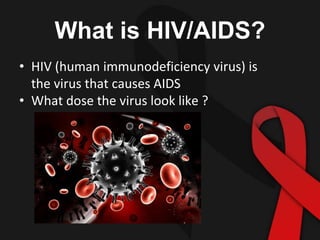
• HIV (human immunodeficiency virus) is
the virus that causes AIDS
• What dose the virus look like ?
When dose AIDS occur?
• AIDS (acquired immunodeficiency
syndrome) occurs when the HIV
infection has weakened one's immune
system to the point that it has difficulty
fighting off certain illnesses and
infections
• "Opportunistic" infections also occur,
taking the opportunity of a weakened
immune system to cause illness.
What dose the HIV do?
• Attacks the Immune system
particularly T-helper cells or CD4
These cells help suppress or regulate
immune responses
• Destroys the body’s defenses against
diseases
• The body becomes susceptible to
infections and cancers that do not
normally develop in healthy people
Transmission of the HIV
• This virus is passed from one person to
another through blood-to-blood contact
(blood transfusions, HIV-infected
needles, blades, surgical tools)
• sexual contact.
• In addition, an infected pregnant
woman can pass HIV to her baby during
pregnancy or delivery, as well as
through breast-feeding.
How did the HIV first
invade humans ?
• Scientists detected a very similar
virus in monkeys and in
chimpanzees and other great apes.
It’s called SIV, which stands for
simian immunodeficiency virus.
• Researchers believe a chimp
somehow passed the virus on to a
person.
How did the HIV first
invade humans ?
• Some scientists suspect that a hunter
killed an infected chimp for food
• In the process, the hunter could have
come into contact with the animal’s
infected blood. Perhaps the hunter
had a cut or open sore. the virus then
likely simmered for decades in
nearby villages and slowly spread
from one villager to another
How is HIV diagnosed?
• The only way to determine whether
the one is infected is to be tested
for HIV infection
• You also cannot rely on symptoms
to know whether or not the one is
infected with HIV. Many people who
are infected with HIV do not have
any symptoms at all for many years
HOW DOES HIV AFFECT
THE MOUTH?
• The mouth may be the first part of
the body to be affected when
infected with HIV. Because
infection with HIV will weakened
the immune system, this means the
one will be susceptible to infections
and other problems.
Mouth signs of HIV
infected patient
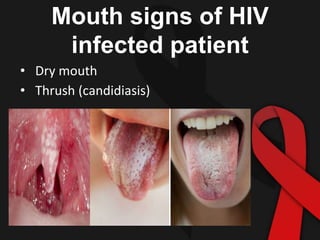
• Dry mouth
• Thrush (candidiasis)
Mouth signs of HIV
infected patient
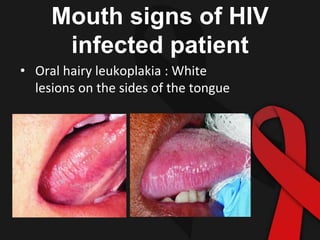
• Oral hairy leukoplakia : White
lesions on the sides of the tongue
Mouth signs of HIV
infected patient
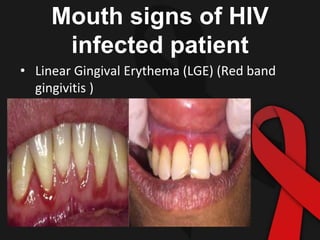
• Linear Gingival Erythema (LGE) (Red band
gingivitis )
Mouth signs of HIV
infected patient
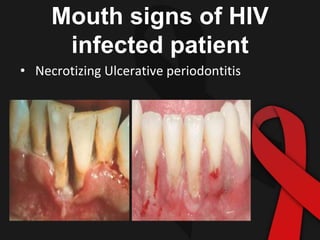
• Necrotizing Ulcerative periodontitis
Mouth signs of HIV
infected patient
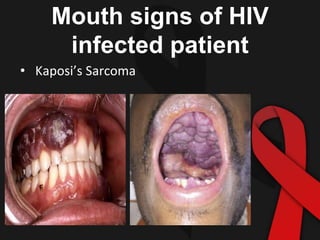
• Kaposi’s Sarcoma
Mouth signs of HIV
infected patient
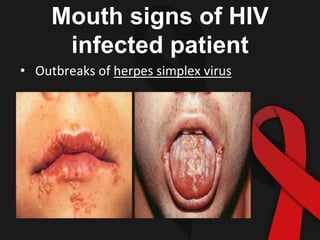
• Outbreaks of herpes simplex virus
Mouth signs of HIV
infected patient
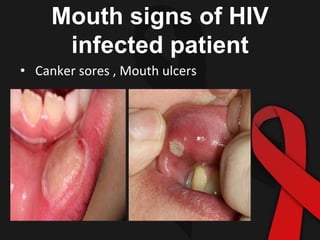
• Canker sores , Mouth ulcers
How Do People Die from
AIDS
• Most people who die from HIV/AIDS do
not die from the virus itself but rather
from these so-called "opportunistic
infections" which take advantage of a
weak immune system.
• For example, people with AIDS can
become sick from the fungus ,(which is
common in the environment and does not
sicken most people ) can cause
pneumonia in people with AIDS,
How is HIV treated?
• There is no cure for HIV/AIDS, but
there is a treatment, called
antiretroviral therapy, which can
suppress the HIV virus and prolong
the lives of people with HIV/AIDS.
• If people start taking antiretroviral
therapy before the disease has
advanced, they can live nearly as long
as people without HIV
Precautions for Dentistry
• Blood, saliva, and gingival fluid from
ALL dental patients should be
considered infective
• Wearing gloves for contact with oral
mucous membranes of all patients
• Wearing surgical masks and protective
eyewear or chin-length plastic face
shields
Precautions for Dentistry
• Rubber dams, high-speed evacuation
and proper patient positioning
• Handpieces and other dental
instruments should be sterilized after
use with each patient
• Blood and saliva should be carefully
cleaned from material that has been
used in the mouth (e.g., impression
materials, bite registration)
Precautions for Dentistry
• Dental equipment and surfaces that
are difficult to disinfect (e.g., light
handles or X-ray-unit heads) and that
may become contaminated should be
wrapped with impervious-backed
paper, aluminum foil, or clear plastic
wrap
Aids for dental students

Aids for dental students

  • 1.
    AIDS/HIV Mohammed Aamir By University OfAnbar College Of Dentistry General Pathology Afrah A. Kh. Aldelaimi B.D.S., C.D.I., M.Sc., Ph.D. (Oral & Maxillofacial Pathology)
  • 2.
    What is HIV/AIDS? •HIV (human immunodeficiency virus) is the virus that causes AIDS • What dose the virus look like ?
  • 3.
    When dose AIDSoccur? • AIDS (acquired immunodeficiency syndrome) occurs when the HIV infection has weakened one's immune system to the point that it has difficulty fighting off certain illnesses and infections • "Opportunistic" infections also occur, taking the opportunity of a weakened immune system to cause illness.
  • 4.
    What dose theHIV do? • Attacks the Immune system particularly T-helper cells or CD4 These cells help suppress or regulate immune responses • Destroys the body’s defenses against diseases • The body becomes susceptible to infections and cancers that do not normally develop in healthy people
  • 5.
    Transmission of theHIV • This virus is passed from one person to another through blood-to-blood contact (blood transfusions, HIV-infected needles, blades, surgical tools) • sexual contact. • In addition, an infected pregnant woman can pass HIV to her baby during pregnancy or delivery, as well as through breast-feeding.
  • 6.
    How did theHIV first invade humans ? • Scientists detected a very similar virus in monkeys and in chimpanzees and other great apes. It’s called SIV, which stands for simian immunodeficiency virus. • Researchers believe a chimp somehow passed the virus on to a person.
  • 7.
    How did theHIV first invade humans ? • Some scientists suspect that a hunter killed an infected chimp for food • In the process, the hunter could have come into contact with the animal’s infected blood. Perhaps the hunter had a cut or open sore. the virus then likely simmered for decades in nearby villages and slowly spread from one villager to another
  • 8.
    How is HIVdiagnosed? • The only way to determine whether the one is infected is to be tested for HIV infection • You also cannot rely on symptoms to know whether or not the one is infected with HIV. Many people who are infected with HIV do not have any symptoms at all for many years
  • 9.
    HOW DOES HIVAFFECT THE MOUTH? • The mouth may be the first part of the body to be affected when infected with HIV. Because infection with HIV will weakened the immune system, this means the one will be susceptible to infections and other problems.
  • 10.
    Mouth signs ofHIV infected patient • Dry mouth • Thrush (candidiasis)
  • 11.
    Mouth signs ofHIV infected patient • Oral hairy leukoplakia : White lesions on the sides of the tongue
  • 12.
    Mouth signs ofHIV infected patient • Linear Gingival Erythema (LGE) (Red band gingivitis )
  • 13.
    Mouth signs ofHIV infected patient • Necrotizing Ulcerative periodontitis
  • 14.
    Mouth signs ofHIV infected patient • Kaposi’s Sarcoma
  • 15.
    Mouth signs ofHIV infected patient • Outbreaks of herpes simplex virus
  • 16.
    Mouth signs ofHIV infected patient • Canker sores , Mouth ulcers
  • 17.
    How Do PeopleDie from AIDS • Most people who die from HIV/AIDS do not die from the virus itself but rather from these so-called "opportunistic infections" which take advantage of a weak immune system. • For example, people with AIDS can become sick from the fungus ,(which is common in the environment and does not sicken most people ) can cause pneumonia in people with AIDS,
  • 18.
    How is HIVtreated? • There is no cure for HIV/AIDS, but there is a treatment, called antiretroviral therapy, which can suppress the HIV virus and prolong the lives of people with HIV/AIDS. • If people start taking antiretroviral therapy before the disease has advanced, they can live nearly as long as people without HIV
  • 19.
    Precautions for Dentistry •Blood, saliva, and gingival fluid from ALL dental patients should be considered infective • Wearing gloves for contact with oral mucous membranes of all patients • Wearing surgical masks and protective eyewear or chin-length plastic face shields
  • 20.
    Precautions for Dentistry •Rubber dams, high-speed evacuation and proper patient positioning • Handpieces and other dental instruments should be sterilized after use with each patient • Blood and saliva should be carefully cleaned from material that has been used in the mouth (e.g., impression materials, bite registration)
  • 21.
    Precautions for Dentistry •Dental equipment and surfaces that are difficult to disinfect (e.g., light handles or X-ray-unit heads) and that may become contaminated should be wrapped with impervious-backed paper, aluminum foil, or clear plastic wrap