UTERINE PROLAPSE
NAZNEEN VAHORA
CLINICAL INSTRUCTOR,
MTIN,CHARUSAT
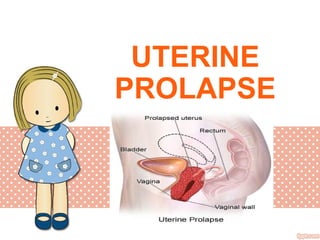
UTERINE
PROLAPSE
INTRODUCTION:
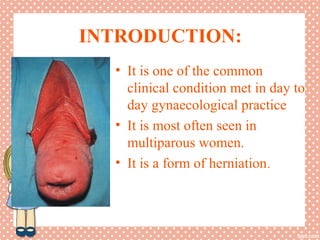
• It is one of the common
clinical condition met in day to
day gynaecological practice
• It is most often seen in
multiparous women.
• It is a form of herniation.
Supports of uterus:
• Round ligaments
• Broad ligaments
• Pubocervical ligaments
• Pelvic floor muscles
• Utero sacral ligaments
ETIOLOGY:
• It includes pre-disposing & aggravating factors
1.Pre-disposing factors:(acquired & congenital):
a)Acquired:
• Overstretching of utero-sacral ligaments:
premature bearing down, forceful traction by
forceps or ventouse, prolonged 2nd
stage of labour,
etc
• Overstretching of perineum
• Imperfect repair of perineal injuries
• Neuromuscular damage during childbirth
• Repeated childbirths.
b) Congenital:
• Congenital weakness of supporting
structures is responsible for prolapse in
nulliparous women.
2. Aggravating factors:
• Post menstrual atrophy
• Increased intra-abdominal pressure
• Undernutrition/over nutrition
• Fiboid uterus
TYPES OF UTERINE PROLAPSE:
1. Uterovaginal prolapse:
• It is the prolapse of uterus, Cx & upper vagina.
• Commonest type
• It is accompanied by Cystocele.
2. Congenital prolapse:
• No cystocele
• Often seen in nulliparous, so called as
nulliparous prolapse.
• Cause-congenital weakness of supports of Us.
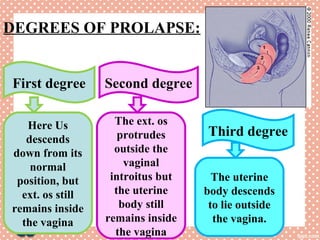
DEGREES OF PROLAPSE:
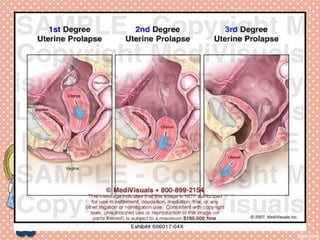
First degree Second degree
Third degreeHere Us
descends
down from its
normal
position, but
ext. os still
remains inside
the vagina
The ext. os
protrudes
outside the
vaginal
introitus but
the uterine
body still
remains inside
the vagina
The uterine
body descends
to lie outside
the vagina.
PATHOLOGICAL CHANGES:
• Vagina: mucosa gets stretched, & dry,
infection leads to purulent discharge.
• Decubitus ulcer: cracks infection sloughing
ulceration
• Bladder: incomplete emptying due to sharp
angulation of urethra, cystitis.
• Ureters: they are pulled downwards, pyelitis
• Carcinoma: rarely develops on decubitis ulcer
SYMPTOMS:
• feeling of something coming down per vag
• Backache or pelvic pain
• Menstrual irregularities
• Dyspareunia
• Difficulty in urination, incomplete
evacuation, urgency, frequency, dysuria.
• Bowel symptoms: difficulty in
defeacation,
DIAGNOSIS:
• H.C
• Rectal exam
• Pelvic exam palpation of bulge
• Vaginal exam
• USG
• X-ray
• MRI
MANAGEMENT:
• Preservative, Conservative & Surgical
1.PRESERVATIVE:
• Adequate ANC & INC: avoid injury, slow
delivery, avoid forceful forceps/ventouse.
• Adequate PNC:early ambulance, exercises
• General measures: avoid straineous
activities, chronic Cough, constipation,
repeated pregnancies at short intervals.
• Manipulation in emergency cases.
2. CONSERVATIVE:
PESSARY TREATMENT:
• Indications are:
– Early pregnancy(placed till 18 wks)
– Puerperium- to facilitate involution
– Pts absolutely unfit for surgery
– Pts unwilling for operation
• Disadvantage: the pt may feel so comfortable
that she may refuse for surgery
3. SURGICAL:
• Indications:Failure of conservative treatment
• Types: a) Restorative: correction/ using grafts
b) Extirpative: removal
c) Obliterative: closing the vagina
• Colporrhaphy: if cystocele/urethrocele is present
• Pelvic floor repair
• Fothergill’s or Manchester operation: it is
done when one desires to preserve the
reproductive system
• Hysterectomy
Complication of surgery:
• Haemorrhage
• Trauma
• Shock
• Infection
• Urinary complications:
incontinence/retention
• Recurrence of prolapse
• VVF following bladder injury
• RVF following rectal injury
Thank you..!!

Uterine prolapse

  • 1.
  • 2.
  • 3.
    INTRODUCTION: • It isone of the common clinical condition met in day to day gynaecological practice • It is most often seen in multiparous women. • It is a form of herniation.
  • 4.
    Supports of uterus: •Round ligaments • Broad ligaments • Pubocervical ligaments • Pelvic floor muscles • Utero sacral ligaments
  • 5.
    ETIOLOGY: • It includespre-disposing & aggravating factors 1.Pre-disposing factors:(acquired & congenital): a)Acquired: • Overstretching of utero-sacral ligaments: premature bearing down, forceful traction by forceps or ventouse, prolonged 2nd stage of labour, etc • Overstretching of perineum • Imperfect repair of perineal injuries • Neuromuscular damage during childbirth • Repeated childbirths.
  • 6.
    b) Congenital: • Congenitalweakness of supporting structures is responsible for prolapse in nulliparous women. 2. Aggravating factors: • Post menstrual atrophy • Increased intra-abdominal pressure • Undernutrition/over nutrition • Fiboid uterus
  • 7.
    TYPES OF UTERINEPROLAPSE: 1. Uterovaginal prolapse: • It is the prolapse of uterus, Cx & upper vagina. • Commonest type • It is accompanied by Cystocele. 2. Congenital prolapse: • No cystocele • Often seen in nulliparous, so called as nulliparous prolapse. • Cause-congenital weakness of supports of Us.
  • 8.
    DEGREES OF PROLAPSE: Firstdegree Second degree Third degreeHere Us descends down from its normal position, but ext. os still remains inside the vagina The ext. os protrudes outside the vaginal introitus but the uterine body still remains inside the vagina The uterine body descends to lie outside the vagina.
  • 10.
    PATHOLOGICAL CHANGES: • Vagina:mucosa gets stretched, & dry, infection leads to purulent discharge. • Decubitus ulcer: cracks infection sloughing ulceration • Bladder: incomplete emptying due to sharp angulation of urethra, cystitis. • Ureters: they are pulled downwards, pyelitis • Carcinoma: rarely develops on decubitis ulcer
  • 11.
    SYMPTOMS: • feeling ofsomething coming down per vag • Backache or pelvic pain • Menstrual irregularities • Dyspareunia • Difficulty in urination, incomplete evacuation, urgency, frequency, dysuria. • Bowel symptoms: difficulty in defeacation,
  • 12.
    DIAGNOSIS: • H.C • Rectalexam • Pelvic exam palpation of bulge • Vaginal exam • USG • X-ray • MRI
  • 13.
    MANAGEMENT: • Preservative, Conservative& Surgical 1.PRESERVATIVE: • Adequate ANC & INC: avoid injury, slow delivery, avoid forceful forceps/ventouse. • Adequate PNC:early ambulance, exercises • General measures: avoid straineous activities, chronic Cough, constipation, repeated pregnancies at short intervals. • Manipulation in emergency cases.
  • 14.
    2. CONSERVATIVE: PESSARY TREATMENT: •Indications are: – Early pregnancy(placed till 18 wks) – Puerperium- to facilitate involution – Pts absolutely unfit for surgery – Pts unwilling for operation • Disadvantage: the pt may feel so comfortable that she may refuse for surgery
  • 15.
    3. SURGICAL: • Indications:Failureof conservative treatment • Types: a) Restorative: correction/ using grafts b) Extirpative: removal c) Obliterative: closing the vagina • Colporrhaphy: if cystocele/urethrocele is present • Pelvic floor repair • Fothergill’s or Manchester operation: it is done when one desires to preserve the reproductive system • Hysterectomy
  • 16.
    Complication of surgery: •Haemorrhage • Trauma • Shock • Infection • Urinary complications: incontinence/retention • Recurrence of prolapse • VVF following bladder injury • RVF following rectal injury
  • 17.