Persia
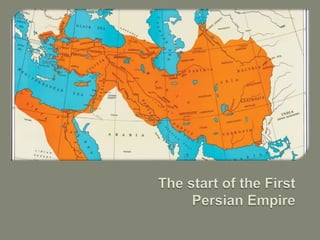
Was an empire based in Western Asia
 There are three who are closely
associated:
1. Aryan (went Eastward and settled down
and built the Indian Civilization)
(While these two, went westward and
encountered the Elamites.)
2. Media
3.Persia
When they absorbed the Elamite culture,
They were still on the long road on
becoming civilized.
According to Herodotus, the nomadic
Persians only have three goals in teaching
their sons:
To ride a horse, to draw a bow, to speak the
truth.
Media joined forces with the Babylonians so
they could overthrown the Assyrians
during 612 BCE.
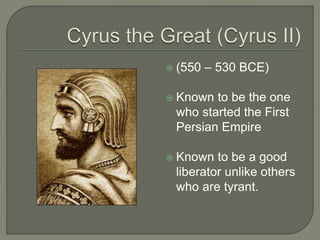
 (550 – 530 BCE)
 Known to be the one
who started the First
Persian Empire
 Known to be a good
liberator unlike others
who are tyrant.
Almost killed by his Grandfather(Astyages)
but Harpagus spared him.
Married Cassandae and had 5 children:
Boys: Cambyses II , Bardiya
Girls: Atossa, Artystone, Roxane
During 550 BC he conquered the Median
Kingdom led by his Grandfather, so his
dreams became true afterall.
539 BC starts the conquest of Babylon
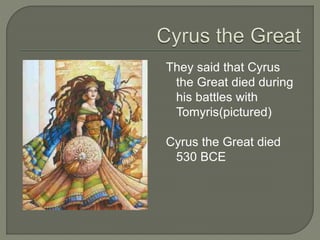
They said that Cyrus
the Great died during
his battles with
Tomyris(pictured)
Cyrus the Great died
530 BCE
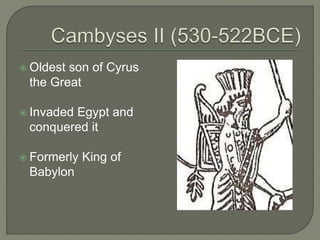
 Oldest son of Cyrus
the Great
 Invaded Egypt and
conquered it
 Formerly King of
Babylon
Managed to capture the major Egyptian
cities of Memphies and Heliopolis after a
decisive victory at the Battle of Pelusium,
and soon all Egypt fell.
The people didn’t like Cambyses II that
much
While he is on Egypt, an impostor named
Gaumata, tricked the people in believing
he is Bardiya(Cambyses II brother).
Cambyses died before he could stop
Gaumata
When some of the officials realized that
Gaumata is an impostor,
They assissanated him afterwards.
Seven men where the ones who planned
and assassinated the impostor
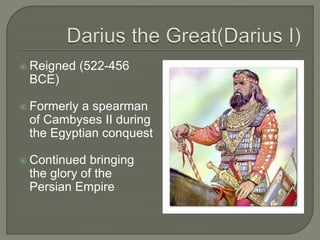
One of the seven men was Darius the
Great
 Reigned (522-456
BCE)
 Formerly a spearman
of Cambyses II during
the Egyptian conquest
 Continued bringing
the glory of the
Persian Empire
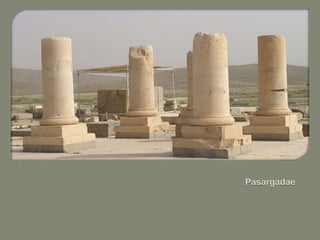
After his coronoation in Pasargadae, there
were already revolts in other places.
This is because some preferred the rule of
the previous ruler(Gaumata which he
faked)
Some well known revolts during Darius’
reign:
1. The Babylon Revolt
Led by Nebuchadnezzar III
They didn’t let Darius and his men to enter
the place unless the follow their condition.
 The condition was to let a mule bear a foal.
 It took them almost a year and a half to solve
the problem, until Zopyrus’(one of the six
Darius nobles) mule bear a foal.
 Following this, a plan was hatched
for Zopyrus to pretend to be a deserter, enter
the Babylonian camp, and gain the trust of
the Babylonians. The plan was successful
and Darius's army eventually surrounded the
city and overcame the rebels
2. European Scythian Campaign
The Scythians took advantage of the
revolts when they invaded Persia.
Darius handled the revolts first in Elam,
Assyria and Babylon before heading to the
Scythian.
He asked the Scythian ruler Idanthyrsus to
surrender but the ruler has a condition.
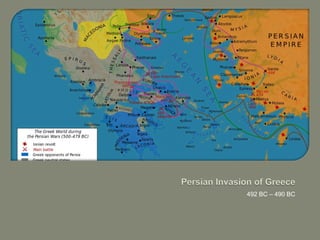
492 BC – 490 BC
First Persian Invasion in Greece
The invasion, consisting of two campaigns,
was ordered by Darius I in order to punish
the city states of Athens and Eretria.
The first campaign(492 BCE) which was led
by Mardonius who wanted to gain control of
Thrace and force Macedon to become a fully
subordinate of Persia.
First Persian Invasion of Greece
When Mardonius fleet got destroyed by a
storm, Darius sent ambassador in all parts f
Greece for submission. Athens and Sparta
declined and executed the ambassadors.
Because of the response of the two places,
Darius wanted a war with them.
Taking advantage of the chaos in Sparta,
which effectively left Athens isolated, Darius
decided to launch an expedition to finally
punish Athens and Eretria
They headed to the Lindos but was
unsuccessful.
They went to Naxos and Karystos where
they burn and destroyed the city.
In Eretria, the Persians enslaved the
remaining townspeople.
 Battle of Marathon(Athens,Plateans vs. Persian)
 Even though the Persians were high in number,
they didn’t win the battle. Plus, the Spartans were
unwilling to provide timely help for the Athenians
and they still won by encircling the Persian forces.
 This was a momentous event since it was the first
Greek victory in the Persian Wars. Then the
Greeks prevented a surprise Persian attack on
Athens by a quick march back to the city to warn
the inhabitants.
Death
He died during 486 BCE of October where
his body was emblamed in his tomb.
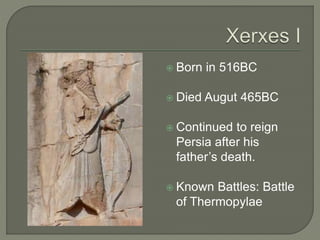
 Born in 516BC
 Died Augut 465BC
 Continued to reign
Persia after his
father’s death.
 Known Battles: Battle
of Thermopylae
Artaxerxes I – third son of Xerxes
Had a fight with the Egyptians(with the
help of Athens), where they lost, but
eventually gained victory afterwards.
Xerxes II – after a reign of 45 days, he was
assassinated by his brother Sogdianus
during 424 B.C., who in turned murdered
by Darius II
 Darius II – didn’t meddle muchwith the
Greeks, focused on other Persian state.
 Artaxerxes II- Artaxerxes II betrayed his allies
and came to an arrangement with Sparta, and
in the Treaty of Antalcidas he forced his
erstwhile allies to come to terms. This treaty
restored control of the Greek cities of Ionia
and Aeolis on the Anatolian coast to the
Persians, while giving Sparta dominance on
the Greek mainland. In 385 BC he
campaigned against the Cadusians.
Artaxerxes III – continued to rule other
Persian states
Artaxerxes IV- youngest son of Ataxerxes
III. Reigned for 338-336 BC.
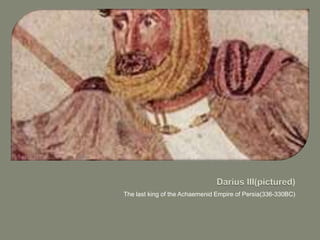
Darius III
The last king of the Achaemenid Empire of Persia(336-330BC)
During his reign, there were a lot of
unreliable satraps. The empire is already
unstable.
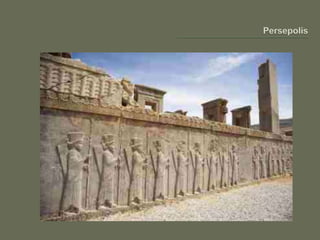
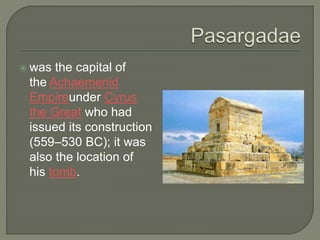
 was the capital of
the Achaemenid
Empireunder Cyrus
the Great who had
issued its construction
(559–530 BC); it was
also the location of
his tomb.
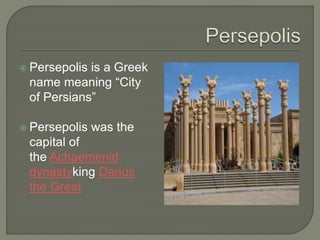
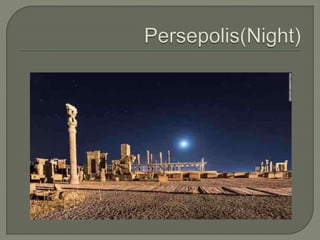
 Persepolis is a Greek
name meaning “City
of Persians”
 Persepolis was the
capital of
the Achaemenid
dynastyking Darius
the Great
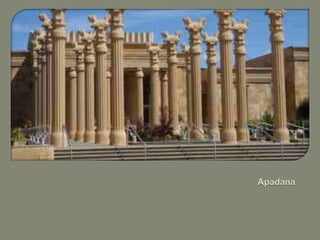
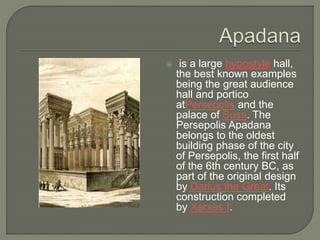
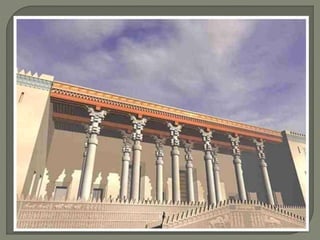
 is a large hypostyle hall,
the best known examples
being the great audience
hall and portico
atPersepolis and the
palace of Susa. The
Persepolis Apadana
belongs to the oldest
building phase of the city
of Persepolis, the first half
of the 6th century BC, as
part of the original design
by Darius the Great. Its
construction completed
by Xerxes I.
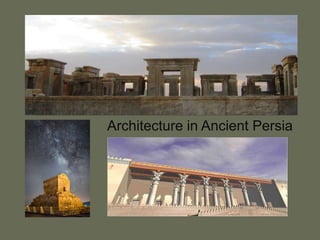
Architecture in Ancient Persia
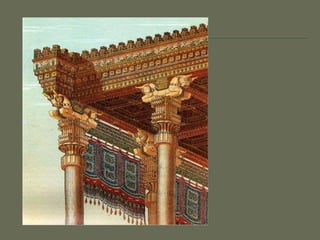
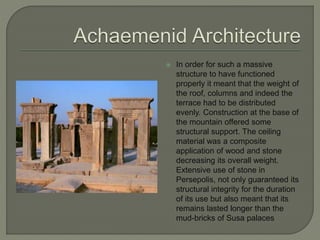
 In order for such a massive
structure to have functioned
properly it meant that the weight of
the roof, columns and indeed the
terrace had to be distributed
evenly. Construction at the base of
the mountain offered some
structural support. The ceiling
material was a composite
application of wood and stone
decreasing its overall weight.
Extensive use of stone in
Persepolis, not only guaranteed its
structural integrity for the duration
of its use but also meant that its
remains lasted longer than the
mud-bricks of Susa palaces
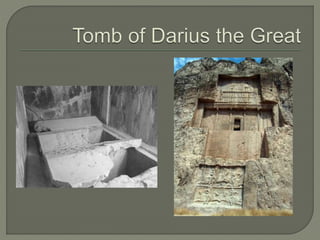
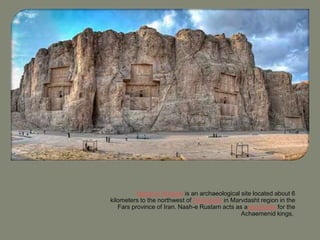
Naqsh-e Rustam is an archaeological site located about 6
kilometers to the northwest of Persepolis in Marvdasht region in the
Fars province of Iran. Nash-e Rustam acts as anecropolis for the
Achaemenid kings,
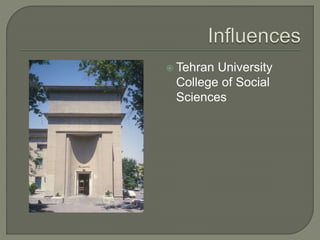
 Tehran University
College of Social
Sciences
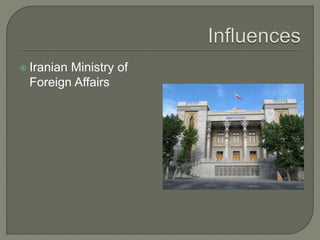
 Iranian Ministry of
Foreign Affairs
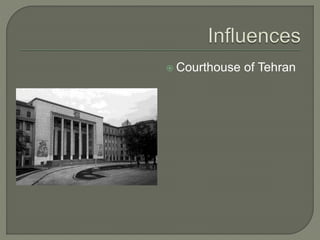
 Courthouse of Tehran
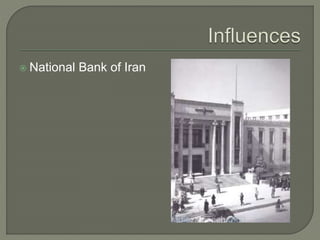
 National Bank of Iran
http://www.ancientgreece.co.uk/war/story/s
to_set.html
http://archaeology.about.com/od/pethrough
pg/qt/persepolis.htm
Wikipedia.com
History of Architecture by Bannister
Fletcher 20th Edition

HISTORY: Persian Empire & Architecture

  • 1.
  • 2.
    Was an empirebased in Western Asia
  • 3.
     There arethree who are closely associated: 1. Aryan (went Eastward and settled down and built the Indian Civilization) (While these two, went westward and encountered the Elamites.) 2. Media 3.Persia
  • 4.
    When they absorbedthe Elamite culture, They were still on the long road on becoming civilized. According to Herodotus, the nomadic Persians only have three goals in teaching their sons: To ride a horse, to draw a bow, to speak the truth.
  • 5.
    Media joined forceswith the Babylonians so they could overthrown the Assyrians during 612 BCE.
  • 7.
     (550 –530 BCE)  Known to be the one who started the First Persian Empire  Known to be a good liberator unlike others who are tyrant.
  • 8.
    Almost killed byhis Grandfather(Astyages) but Harpagus spared him. Married Cassandae and had 5 children: Boys: Cambyses II , Bardiya Girls: Atossa, Artystone, Roxane
  • 9.
    During 550 BChe conquered the Median Kingdom led by his Grandfather, so his dreams became true afterall. 539 BC starts the conquest of Babylon
  • 10.
    They said thatCyrus the Great died during his battles with Tomyris(pictured) Cyrus the Great died 530 BCE
  • 11.
     Oldest sonof Cyrus the Great  Invaded Egypt and conquered it  Formerly King of Babylon
  • 14.
    Managed to capturethe major Egyptian cities of Memphies and Heliopolis after a decisive victory at the Battle of Pelusium, and soon all Egypt fell. The people didn’t like Cambyses II that much
  • 15.
    While he ison Egypt, an impostor named Gaumata, tricked the people in believing he is Bardiya(Cambyses II brother). Cambyses died before he could stop Gaumata
  • 16.
    When some ofthe officials realized that Gaumata is an impostor, They assissanated him afterwards. Seven men where the ones who planned and assassinated the impostor One of the seven men was Darius the Great
  • 17.
     Reigned (522-456 BCE) Formerly a spearman of Cambyses II during the Egyptian conquest  Continued bringing the glory of the Persian Empire
  • 18.
    After his coronoationin Pasargadae, there were already revolts in other places. This is because some preferred the rule of the previous ruler(Gaumata which he faked)
  • 19.
    Some well knownrevolts during Darius’ reign: 1. The Babylon Revolt Led by Nebuchadnezzar III They didn’t let Darius and his men to enter the place unless the follow their condition.
  • 20.
     The conditionwas to let a mule bear a foal.  It took them almost a year and a half to solve the problem, until Zopyrus’(one of the six Darius nobles) mule bear a foal.  Following this, a plan was hatched for Zopyrus to pretend to be a deserter, enter the Babylonian camp, and gain the trust of the Babylonians. The plan was successful and Darius's army eventually surrounded the city and overcame the rebels
  • 21.
    2. European ScythianCampaign The Scythians took advantage of the revolts when they invaded Persia. Darius handled the revolts first in Elam, Assyria and Babylon before heading to the Scythian. He asked the Scythian ruler Idanthyrsus to surrender but the ruler has a condition.
  • 22.
    492 BC –490 BC
  • 23.
    First Persian Invasionin Greece The invasion, consisting of two campaigns, was ordered by Darius I in order to punish the city states of Athens and Eretria. The first campaign(492 BCE) which was led by Mardonius who wanted to gain control of Thrace and force Macedon to become a fully subordinate of Persia.
  • 24.
    First Persian Invasionof Greece When Mardonius fleet got destroyed by a storm, Darius sent ambassador in all parts f Greece for submission. Athens and Sparta declined and executed the ambassadors. Because of the response of the two places, Darius wanted a war with them.
  • 25.
    Taking advantage ofthe chaos in Sparta, which effectively left Athens isolated, Darius decided to launch an expedition to finally punish Athens and Eretria
  • 26.
    They headed tothe Lindos but was unsuccessful. They went to Naxos and Karystos where they burn and destroyed the city. In Eretria, the Persians enslaved the remaining townspeople.
  • 27.
     Battle ofMarathon(Athens,Plateans vs. Persian)  Even though the Persians were high in number, they didn’t win the battle. Plus, the Spartans were unwilling to provide timely help for the Athenians and they still won by encircling the Persian forces.  This was a momentous event since it was the first Greek victory in the Persian Wars. Then the Greeks prevented a surprise Persian attack on Athens by a quick march back to the city to warn the inhabitants.
  • 28.
    Death He died during486 BCE of October where his body was emblamed in his tomb.
  • 30.
     Born in516BC  Died Augut 465BC  Continued to reign Persia after his father’s death.  Known Battles: Battle of Thermopylae
  • 31.
    Artaxerxes I –third son of Xerxes Had a fight with the Egyptians(with the help of Athens), where they lost, but eventually gained victory afterwards. Xerxes II – after a reign of 45 days, he was assassinated by his brother Sogdianus during 424 B.C., who in turned murdered by Darius II
  • 32.
     Darius II– didn’t meddle muchwith the Greeks, focused on other Persian state.  Artaxerxes II- Artaxerxes II betrayed his allies and came to an arrangement with Sparta, and in the Treaty of Antalcidas he forced his erstwhile allies to come to terms. This treaty restored control of the Greek cities of Ionia and Aeolis on the Anatolian coast to the Persians, while giving Sparta dominance on the Greek mainland. In 385 BC he campaigned against the Cadusians.
  • 33.
    Artaxerxes III –continued to rule other Persian states Artaxerxes IV- youngest son of Ataxerxes III. Reigned for 338-336 BC. Darius III
  • 34.
    The last kingof the Achaemenid Empire of Persia(336-330BC)
  • 35.
    During his reign,there were a lot of unreliable satraps. The empire is already unstable.
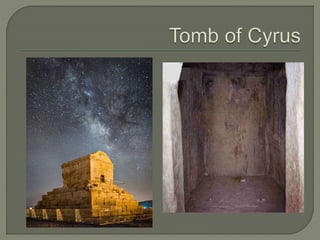
  • 37.
     was thecapital of the Achaemenid Empireunder Cyrus the Great who had issued its construction (559–530 BC); it was also the location of his tomb.
  • 40.
     Persepolis isa Greek name meaning “City of Persians”  Persepolis was the capital of the Achaemenid dynastyking Darius the Great
  • 43.
     is alarge hypostyle hall, the best known examples being the great audience hall and portico atPersepolis and the palace of Susa. The Persepolis Apadana belongs to the oldest building phase of the city of Persepolis, the first half of the 6th century BC, as part of the original design by Darius the Great. Its construction completed by Xerxes I.
  • 46.
  • 47.
     In orderfor such a massive structure to have functioned properly it meant that the weight of the roof, columns and indeed the terrace had to be distributed evenly. Construction at the base of the mountain offered some structural support. The ceiling material was a composite application of wood and stone decreasing its overall weight. Extensive use of stone in Persepolis, not only guaranteed its structural integrity for the duration of its use but also meant that its remains lasted longer than the mud-bricks of Susa palaces
  • 48.
    Naqsh-e Rustam isan archaeological site located about 6 kilometers to the northwest of Persepolis in Marvdasht region in the Fars province of Iran. Nash-e Rustam acts as anecropolis for the Achaemenid kings,
  • 50.
  • 51.
     Iranian Ministryof Foreign Affairs
  • 52.
  • 53.
  • 54.