Darius I
and the
Persian Empire
By: Aaron Bernhardt
But First!
What was the Persian Empire?
Persian Empire Overview
 The Persian Empire was a series of Imperial dynasties based in Persia
-Modern day Iran
 Founded by Cyrus the Great around 550 BCE
-After conquering Media, Lydia, and Babylonia
 The Empire lasted from 550 BCE until 330 BCE
-Conquered by Alexander the Great
 Considered one of the Ancient worlds greatest empires
 Survived through the power of the Persian “Great” trilogy
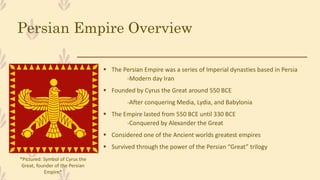
*Pictured: Symbol of Cyrus the
Great, founder of the Persian
Empire*
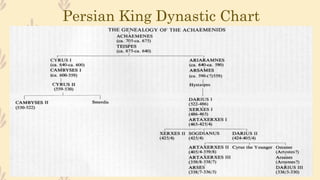
Persian King Dynastic Chart
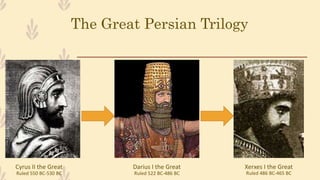
The Great Persian Trilogy
Cyrus II the Great Darius I the Great Xerxes I the Great
Ruled 550 BC-530 BC Ruled 522 BC-486 BC Ruled 486 BC-465 BC
Darius I
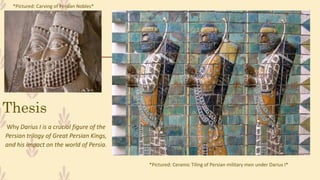
Thesis
Why Darius I is a crucial figure of the
Persian trilogy of Great Persian Kings,
and his impact on the world of Persia.
*Pictured: Ceramic Tiling of Persian military men under Darius I*
*Pictured: Carving of Persian Nobles*
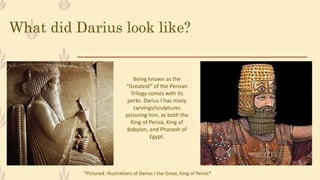
What did Darius look like?
Being known as the
“Greatest” of the Persian
Trilogy comes with its
perks. Darius I has many
carvings/sculptures
picturing him, as both the
King of Persia, King of
Babylon, and Pharaoh of
Egypt.
*Pictured: Illustrations of Darius I the Great, King of Persia*
His Early Life/Adolescence
 Born around 550 BCE.
 The oldest of five sons, to his father Hystapses and mother Rhodugune.
 His father was the Satrap of Bactria, meaning he was the governor of the
Bactria province in Persia. (Around 522 BCE).
 During Early Adulthood/Adolescence Darius served as a spearman in Cambyses
II army, where he took part in the Egyptian campaign.
 Darius’s father served in Cyrus the Great’s army, and for his service became a
noble of Cyrus’s court.
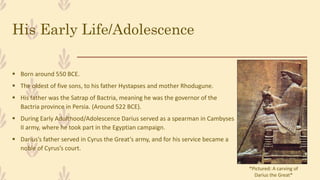
*Pictured: A carving of
Darius the Great*
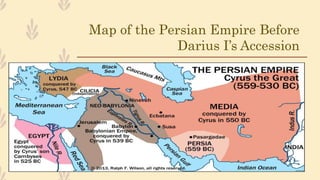
Map of the Persian Empire Before
Darius I’s Accession
Darius’s Accession
 Two different accounts of Darius’s Accession.
-Darius’s account
-Darius’s predecessor (Cambyses II) killed his own brother Bardiya
-Greek historians version
-Their version stated that Darius himself killed Bardiya during a revolt.
 Due to the people rebelling against Cambyses II’s rule, Darius’s predecessor Gaumata (Bardiya) was placed on
the throne.
 In 522 BCE, Darius led a revolt against Gaumata with many others and succeeded in killing Gaumata, in the
fortress of Sikayauvati.
 The following day, after Gaumata’s death, Darius was named King of the Persians.
The Struggles of the Early Reign
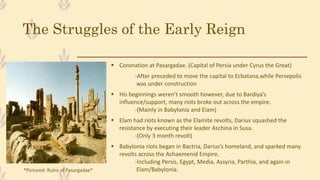
 Coronation at Pasargadae. (Capital of Persia under Cyrus the Great)
-After preceded to move the capital to Ecbatana,while Persepolis
was under construction
 His beginnings weren’t smooth however, due to Bardiya’s
influence/support, many riots broke out across the empire.
-(Mainly in Babylonia and Elam)
 Elam had riots known as the Elamite revolts, Darius squashed the
resistance by executing their leader Aschina in Susa.
-(Only 3 month revolt)
 Babylonia riots began in Bactria, Darius’s homeland, and sparked many
revolts across the Achaemenid Empire.
-Including Persis, Egypt, Media, Assyria, Parthia, and again in
Elam/Babylonia.*Pictured: Ruins of Pasargadae*
Early Reign Cont.
 Most of Achaemenid Empire in turmoil.
-(Around 523 BCE)
 Darius had little support from common population, but major support
from the army and nobles.
-With their help he managed to quell at revolts against his reign.
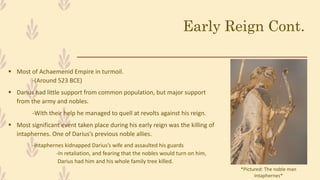
 Most significant event taken place during his early reign was the killing of
intaphernes. One of Darius’s previous noble allies.
-Intaphernes kidnapped Darius’s wife and assaulted his guards
-In retaliation, and fearing that the nobles would turn on him,
Darius had him and his whole family tree killed.
*Pictured: The noble man
Intaphernes*
Reign Conquests and Expansion
 After securing Empire, and squashing
rebellions he focused on Egypt.
-Defeated the current Pharaoh and
reconquered land previously
controlled by Cambyses II
(Pictured on next slide)
 Incorporated most of Egypt into
Achaemenid Empire
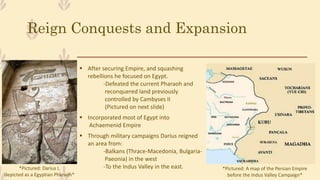
 Through military campaigns Darius reigned
an area from:
-Balkans (Thrace-Macedonia, Bulgaria-
Paeonia) in the west
-To the Indus Valley in the east.*Pictured: Darius I,
depicted as a Egyptian Pharaoh*
*Pictured: A map of the Persian Empire
before the Indus Valley Campaign*
Reign
Conquests
Cont.
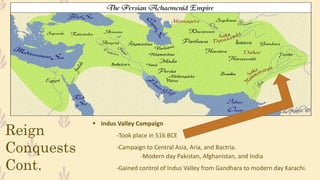
 Indus Valley Campaign
-Took place in 516 BCE
-Campaign to Central Asia, Aria, and Bactria.
-Modern day Pakistan, Afghanistan, and India
-Gained control of Indus Valley from Gandhara to modern day Karachi.
Reign
Conquests
Cont.
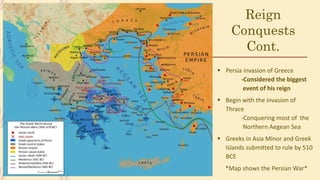
 Persia invasion of Greece
-Considered the biggest
event of his reign
 Begin with the invasion of
Thrace
-Conquering most of the
Northern Aegean Sea
 Greeks in Asia Minor and Greek
Islands submitted to rule by 510
BCE
*Map shows the Persian War*
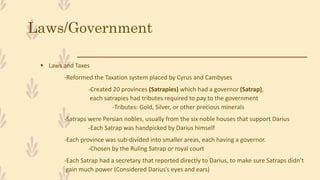
Laws/Government
 Laws and Taxes
-Reformed the Taxation system placed by Cyrus and Cambyses
-Created 20 provinces (Satrapies) which had a governor (Satrap),
each satrapies had tributes required to pay to the government
-Tributes: Gold, Silver, or other precious minerals
-Satraps were Persian nobles, usually from the six noble houses that support Darius
-Each Satrap was handpicked by Darius himself
-Each province was sub-divided into smaller areas, each having a governor.
-Chosen by the Ruling Satrap or royal court
-Each Satrap had a secretary that reported directly to Darius, to make sure Satraps didn’t
gain much power (Considered Darius’s eyes and ears)
Economics and Trade
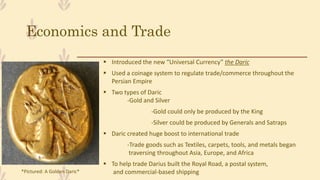
 Introduced the new “Universal Currency” the Daric
 Used a coinage system to regulate trade/commerce throughout the
Persian Empire
 Two types of Daric
-Gold and Silver
-Gold could only be produced by the King
-Silver could be produced by Generals and Satraps
 Daric created huge boost to international trade
-Trade goods such as Textiles, carpets, tools, and metals began
traversing throughout Asia, Europe, and Africa
 To help trade Darius built the Royal Road, a postal system,
and commercial-based shipping*Pictured: A Golden Daric*
Religion and Tolerance
 Before Darius, there was no empirical religion
 Darius made the Empire’s main religion Zoroastrianism
-Ahura Mazda (Creater/God of Zoroastrainism religion)
 Darius believed Ahura appointed him to rule the empire
 Believed he had divine right to conquer enemy/rebelling lands
due to his faith
 Followed same Achaemenid tolerance as Cyrus
-Allowing conquered lands to worship their own religions.
-As long as they paid taxes and didn’t rebel
 Built temples for many religions, including Egyptian temples,
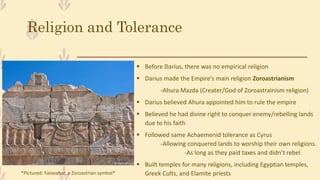
Greek Cults, and Elamite priests*Pictured: Faravahar, a Zoroastrian symbol*
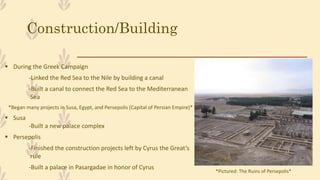
Construction/Building
 During the Greek Campaign
-Linked the Red Sea to the Nile by building a canal
-Built a canal to connect the Red Sea to the Mediterranean
Sea
*Began many projects in Susa, Egypt, and Persepolis (Capital of Persian Empire)*
 Susa
-Built a new palace complex
 Persepolis
-Finished the construction projects left by Cyrus the Great’s
rule
-Built a palace in Pasargadae in honor of Cyrus
*Pictured: The Ruins of Persepolis*
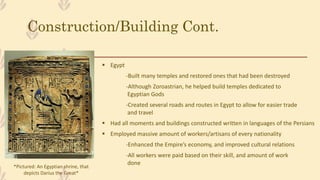
Construction/Building Cont.
 Egypt
-Built many temples and restored ones that had been destroyed
-Although Zoroastrian, he helped build temples dedicated to
Egyptian Gods
-Created several roads and routes in Egypt to allow for easier trade
and travel
 Had all moments and buildings constructed written in languages of the Persians
 Employed massive amount of workers/artisans of every nationality
-Enhanced the Empire’s economy, and improved cultural relations
-All workers were paid based on their skill, and amount of work
done
*Pictured: An Egyptian shrine, that
depicts Darius the Great*
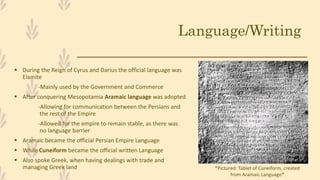
Language/Writing
 During the Reign of Cyrus and Darius the official language was
Elamite
-Mainly used by the Government and Commerce
 After conquering Mesopotamia Aramaic language was adopted
-Allowing for communication between the Persians and
the rest of the Empire
-Allowed for the empire to remain stable, as there was
no language barrier
 Aramaic became the official Persian Empire Language
 While Cuneiform became the official written Language
 Also spoke Greek, when having dealings with trade and
managing Greek land *Pictured: Tablet of Cuneiform, created
from Aramaic Language*
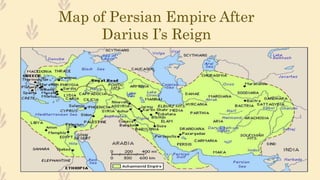
Map of Persian Empire After
Darius I’s Reign
Death
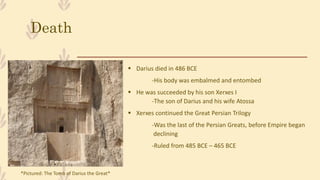
 Darius died in 486 BCE
-His body was embalmed and entombed
 He was succeeded by his son Xerxes I
-The son of Darius and his wife Atossa
 Xerxes continued the Great Persian Trilogy
-Was the last of the Persian Greats, before Empire began
declining
-Ruled from 485 BCE – 465 BCE
*Pictured: The Tomb of Darius the Great*
Online/Hard Text Sources
 Abott, Jacob. "History of Darius the Great." Google Books. Harvard College Library,
n.d. Web. 11 Dec. 2016
 Boardman, John. "The Cambridge Ancient History." Google Books. Ed. N.G.L.
Hammond, D.M. Lewis, and M. Ostwald. Cambridge University Press, n.d.
Web. 11 Dec. 2016.
 Duchesne-Guillemin, Jacques. "Zoroastrianism." Encyclopedia Britannica Online.
Encyclopedia Britannica, 28 Jan. 2009. Web. 11 Dec. 2016.
 Fife, Steven. "Darius I." Ancient History Encyclopedia. Ancient History
Encyclopedia, 02 Sept. 2009. Web. 11 Dec. 2016.
 Grote, George. "Persians, Darius The Great." Persians, Darius The Great. History-
world.org, n.d. Web. 11 Dec. 2016.
Online/Hard Text Sources Cont.
 Wikipedia. "Ahura Mazda." Wikipedia. Wikimedia Foundation, n.d. Web. 11
Dec. 2016.
 Wikipedia. "Achaemenid Empire." Wikipedia. Wikimedia Foundation, n.d. Web.
11 Dec. 2016.
 Wikipedia. "Aramaic Alphabet." Wikipedia. Wikimedia Foundation, n.d. Web. 11
Dec. 2016.
 Wikipedia. "Darius I." Wikipedia. Wikimedia Foundation, n.d.
Web. 11 Dec. 2016.
Visual Sources
 Google Images
-Slide 3 (Cyrus’s Symbol)
-Slide 7 (Persian Noble Carving)
-Slide 9 (Darius I Carving)
-Slide 10 (Map of Cyrus’s Empire)
-Slide 12 (Ruins of Pasargadae)
-Slide 15 (Map of Indus Valley Campaign)
-Slide 16 (Map of Persian War)
-Slide 20 (Ruins of Persepolis)
-Slide 21 (Egyptian Shrine)
-Slide 22 (Cuneiform Tablet)
 Bing Images
-Slide 4 (Dynastic Chart)
-Slide 5 (All Portraits)
-Slide 7 (Persian Ceramic Tiling)
-Slide 8 (Carving and Illustration)
-Slide 13 (Carving of Intaphernes)
-Slide 14 (Carving and Map)
-Slide 18 (Image of Daric)
-Slide 19 (Image of Faravahar)
-Slide 23 (Map after Reign)
-Slide 24 (Tomb of Darius I)
*Labeled by Slide which they appear*

Aaron Bernhardt WestCiv HIST-131-03

  • 1.
    Darius I and the PersianEmpire By: Aaron Bernhardt
  • 2.
    But First! What wasthe Persian Empire?
  • 3.
    Persian Empire Overview The Persian Empire was a series of Imperial dynasties based in Persia -Modern day Iran  Founded by Cyrus the Great around 550 BCE -After conquering Media, Lydia, and Babylonia  The Empire lasted from 550 BCE until 330 BCE -Conquered by Alexander the Great  Considered one of the Ancient worlds greatest empires  Survived through the power of the Persian “Great” trilogy *Pictured: Symbol of Cyrus the Great, founder of the Persian Empire*
  • 4.
  • 5.
    The Great PersianTrilogy Cyrus II the Great Darius I the Great Xerxes I the Great Ruled 550 BC-530 BC Ruled 522 BC-486 BC Ruled 486 BC-465 BC
  • 6.
  • 7.
    Thesis Why Darius Iis a crucial figure of the Persian trilogy of Great Persian Kings, and his impact on the world of Persia. *Pictured: Ceramic Tiling of Persian military men under Darius I* *Pictured: Carving of Persian Nobles*
  • 8.
    What did Dariuslook like? Being known as the “Greatest” of the Persian Trilogy comes with its perks. Darius I has many carvings/sculptures picturing him, as both the King of Persia, King of Babylon, and Pharaoh of Egypt. *Pictured: Illustrations of Darius I the Great, King of Persia*
  • 9.
    His Early Life/Adolescence Born around 550 BCE.  The oldest of five sons, to his father Hystapses and mother Rhodugune.  His father was the Satrap of Bactria, meaning he was the governor of the Bactria province in Persia. (Around 522 BCE).  During Early Adulthood/Adolescence Darius served as a spearman in Cambyses II army, where he took part in the Egyptian campaign.  Darius’s father served in Cyrus the Great’s army, and for his service became a noble of Cyrus’s court. *Pictured: A carving of Darius the Great*
  • 10.
    Map of thePersian Empire Before Darius I’s Accession
  • 11.
    Darius’s Accession  Twodifferent accounts of Darius’s Accession. -Darius’s account -Darius’s predecessor (Cambyses II) killed his own brother Bardiya -Greek historians version -Their version stated that Darius himself killed Bardiya during a revolt.  Due to the people rebelling against Cambyses II’s rule, Darius’s predecessor Gaumata (Bardiya) was placed on the throne.  In 522 BCE, Darius led a revolt against Gaumata with many others and succeeded in killing Gaumata, in the fortress of Sikayauvati.  The following day, after Gaumata’s death, Darius was named King of the Persians.
  • 12.
    The Struggles ofthe Early Reign  Coronation at Pasargadae. (Capital of Persia under Cyrus the Great) -After preceded to move the capital to Ecbatana,while Persepolis was under construction  His beginnings weren’t smooth however, due to Bardiya’s influence/support, many riots broke out across the empire. -(Mainly in Babylonia and Elam)  Elam had riots known as the Elamite revolts, Darius squashed the resistance by executing their leader Aschina in Susa. -(Only 3 month revolt)  Babylonia riots began in Bactria, Darius’s homeland, and sparked many revolts across the Achaemenid Empire. -Including Persis, Egypt, Media, Assyria, Parthia, and again in Elam/Babylonia.*Pictured: Ruins of Pasargadae*
  • 13.
    Early Reign Cont. Most of Achaemenid Empire in turmoil. -(Around 523 BCE)  Darius had little support from common population, but major support from the army and nobles. -With their help he managed to quell at revolts against his reign.  Most significant event taken place during his early reign was the killing of intaphernes. One of Darius’s previous noble allies. -Intaphernes kidnapped Darius’s wife and assaulted his guards -In retaliation, and fearing that the nobles would turn on him, Darius had him and his whole family tree killed. *Pictured: The noble man Intaphernes*
  • 14.
    Reign Conquests andExpansion  After securing Empire, and squashing rebellions he focused on Egypt. -Defeated the current Pharaoh and reconquered land previously controlled by Cambyses II (Pictured on next slide)  Incorporated most of Egypt into Achaemenid Empire  Through military campaigns Darius reigned an area from: -Balkans (Thrace-Macedonia, Bulgaria- Paeonia) in the west -To the Indus Valley in the east.*Pictured: Darius I, depicted as a Egyptian Pharaoh* *Pictured: A map of the Persian Empire before the Indus Valley Campaign*
  • 15.
    Reign Conquests Cont.  Indus ValleyCampaign -Took place in 516 BCE -Campaign to Central Asia, Aria, and Bactria. -Modern day Pakistan, Afghanistan, and India -Gained control of Indus Valley from Gandhara to modern day Karachi.
  • 16.
    Reign Conquests Cont.  Persia invasionof Greece -Considered the biggest event of his reign  Begin with the invasion of Thrace -Conquering most of the Northern Aegean Sea  Greeks in Asia Minor and Greek Islands submitted to rule by 510 BCE *Map shows the Persian War*
  • 17.
    Laws/Government  Laws andTaxes -Reformed the Taxation system placed by Cyrus and Cambyses -Created 20 provinces (Satrapies) which had a governor (Satrap), each satrapies had tributes required to pay to the government -Tributes: Gold, Silver, or other precious minerals -Satraps were Persian nobles, usually from the six noble houses that support Darius -Each Satrap was handpicked by Darius himself -Each province was sub-divided into smaller areas, each having a governor. -Chosen by the Ruling Satrap or royal court -Each Satrap had a secretary that reported directly to Darius, to make sure Satraps didn’t gain much power (Considered Darius’s eyes and ears)
  • 18.
    Economics and Trade Introduced the new “Universal Currency” the Daric  Used a coinage system to regulate trade/commerce throughout the Persian Empire  Two types of Daric -Gold and Silver -Gold could only be produced by the King -Silver could be produced by Generals and Satraps  Daric created huge boost to international trade -Trade goods such as Textiles, carpets, tools, and metals began traversing throughout Asia, Europe, and Africa  To help trade Darius built the Royal Road, a postal system, and commercial-based shipping*Pictured: A Golden Daric*
  • 19.
    Religion and Tolerance Before Darius, there was no empirical religion  Darius made the Empire’s main religion Zoroastrianism -Ahura Mazda (Creater/God of Zoroastrainism religion)  Darius believed Ahura appointed him to rule the empire  Believed he had divine right to conquer enemy/rebelling lands due to his faith  Followed same Achaemenid tolerance as Cyrus -Allowing conquered lands to worship their own religions. -As long as they paid taxes and didn’t rebel  Built temples for many religions, including Egyptian temples, Greek Cults, and Elamite priests*Pictured: Faravahar, a Zoroastrian symbol*
  • 20.
    Construction/Building  During theGreek Campaign -Linked the Red Sea to the Nile by building a canal -Built a canal to connect the Red Sea to the Mediterranean Sea *Began many projects in Susa, Egypt, and Persepolis (Capital of Persian Empire)*  Susa -Built a new palace complex  Persepolis -Finished the construction projects left by Cyrus the Great’s rule -Built a palace in Pasargadae in honor of Cyrus *Pictured: The Ruins of Persepolis*
  • 21.
    Construction/Building Cont.  Egypt -Builtmany temples and restored ones that had been destroyed -Although Zoroastrian, he helped build temples dedicated to Egyptian Gods -Created several roads and routes in Egypt to allow for easier trade and travel  Had all moments and buildings constructed written in languages of the Persians  Employed massive amount of workers/artisans of every nationality -Enhanced the Empire’s economy, and improved cultural relations -All workers were paid based on their skill, and amount of work done *Pictured: An Egyptian shrine, that depicts Darius the Great*
  • 22.
    Language/Writing  During theReign of Cyrus and Darius the official language was Elamite -Mainly used by the Government and Commerce  After conquering Mesopotamia Aramaic language was adopted -Allowing for communication between the Persians and the rest of the Empire -Allowed for the empire to remain stable, as there was no language barrier  Aramaic became the official Persian Empire Language  While Cuneiform became the official written Language  Also spoke Greek, when having dealings with trade and managing Greek land *Pictured: Tablet of Cuneiform, created from Aramaic Language*
  • 23.
    Map of PersianEmpire After Darius I’s Reign
  • 24.
    Death  Darius diedin 486 BCE -His body was embalmed and entombed  He was succeeded by his son Xerxes I -The son of Darius and his wife Atossa  Xerxes continued the Great Persian Trilogy -Was the last of the Persian Greats, before Empire began declining -Ruled from 485 BCE – 465 BCE *Pictured: The Tomb of Darius the Great*
  • 25.
    Online/Hard Text Sources Abott, Jacob. "History of Darius the Great." Google Books. Harvard College Library, n.d. Web. 11 Dec. 2016  Boardman, John. "The Cambridge Ancient History." Google Books. Ed. N.G.L. Hammond, D.M. Lewis, and M. Ostwald. Cambridge University Press, n.d. Web. 11 Dec. 2016.  Duchesne-Guillemin, Jacques. "Zoroastrianism." Encyclopedia Britannica Online. Encyclopedia Britannica, 28 Jan. 2009. Web. 11 Dec. 2016.  Fife, Steven. "Darius I." Ancient History Encyclopedia. Ancient History Encyclopedia, 02 Sept. 2009. Web. 11 Dec. 2016.  Grote, George. "Persians, Darius The Great." Persians, Darius The Great. History- world.org, n.d. Web. 11 Dec. 2016.
  • 26.
    Online/Hard Text SourcesCont.  Wikipedia. "Ahura Mazda." Wikipedia. Wikimedia Foundation, n.d. Web. 11 Dec. 2016.  Wikipedia. "Achaemenid Empire." Wikipedia. Wikimedia Foundation, n.d. Web. 11 Dec. 2016.  Wikipedia. "Aramaic Alphabet." Wikipedia. Wikimedia Foundation, n.d. Web. 11 Dec. 2016.  Wikipedia. "Darius I." Wikipedia. Wikimedia Foundation, n.d. Web. 11 Dec. 2016.
  • 27.
    Visual Sources  GoogleImages -Slide 3 (Cyrus’s Symbol) -Slide 7 (Persian Noble Carving) -Slide 9 (Darius I Carving) -Slide 10 (Map of Cyrus’s Empire) -Slide 12 (Ruins of Pasargadae) -Slide 15 (Map of Indus Valley Campaign) -Slide 16 (Map of Persian War) -Slide 20 (Ruins of Persepolis) -Slide 21 (Egyptian Shrine) -Slide 22 (Cuneiform Tablet)  Bing Images -Slide 4 (Dynastic Chart) -Slide 5 (All Portraits) -Slide 7 (Persian Ceramic Tiling) -Slide 8 (Carving and Illustration) -Slide 13 (Carving of Intaphernes) -Slide 14 (Carving and Map) -Slide 18 (Image of Daric) -Slide 19 (Image of Faravahar) -Slide 23 (Map after Reign) -Slide 24 (Tomb of Darius I) *Labeled by Slide which they appear*