The Persian Empire
TRIVIA
On the day of the Persian New Year, March
21 1935, Reza Shah Pahlavi, requested
foreign delegates to use the term Iran, instead
of Persia, in a conscious reference to the
ancient ancestry of the Iranians.
TRIVIA
• Producing, selling, and consuming alcohol
is strictly forbidden in Iran – with some
exceptions for religious minorities – and
those caught with it face the punishment of
flogging
• Pork is not available. When it comes to
meat most Iranians tend to eat chicken, beef
or lamb, all of which are widely available
The Rise of Persia
• The Persians based their empire on
tolerance and diplomacy. They relied on a
strong military to back up their policies.
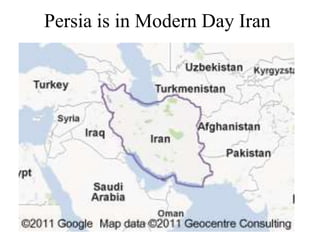
Ancient Persia is where Iran is today.
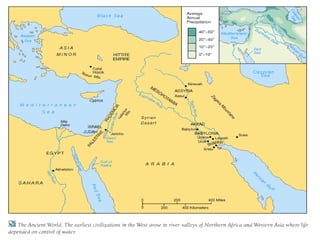
Persia is in Modern Day Iran
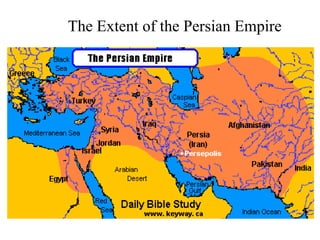
The Extent of the Persian Empire
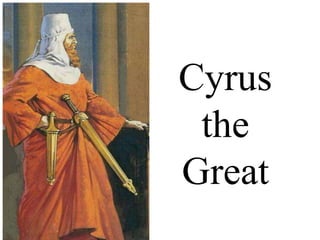
Cyrus
the
Great
Cyrus’s Empire
• 550 BC – Conquered several neighboring
kingdoms
• Military genius
• Controlled an empire spanning 2000 miles
• Kindness toward conquered people
• Honored local customs and religions
• 538 BC - Allowed the Jews to return to their
homeland, Jerusalem
• Considered by the Jews to be one of God’s
anointed ones
Tolerance !!!
• Cyrus use the idea of tolerance to keep the
peace and to seem like a liberator.
• He allowed people to keep their local
customs and religions.
• He showed kindness toward conquered
peoples
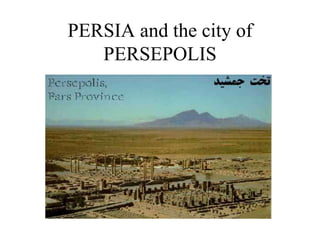
PERSIA and the city of
PERSEPOLIS
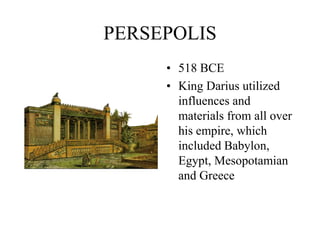
PERSEPOLIS
• 518 BCE
• King Darius utilized
influences and
materials from all over
his empire, which
included Babylon,
Egypt, Mesopotamian
and Greece
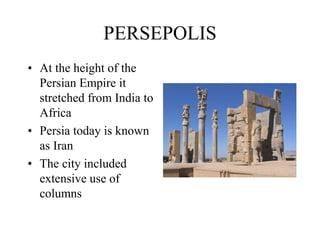
PERSEPOLIS
• At the height of the
Persian Empire it
stretched from India to
Africa
• Persia today is known
as Iran
• The city included
extensive use of
columns
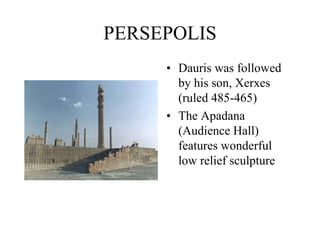
PERSEPOLIS
• Dauris was followed
by his son, Xerxes
(ruled 485-465)
• The Apadana
(Audience Hall)
features wonderful
low relief sculpture
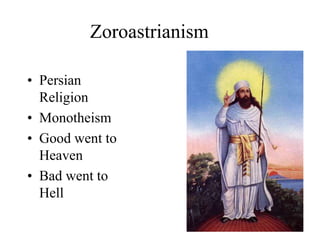
Zoroastrianism
• Persian
Religion
• Monotheism
• Good went to
Heaven
• Bad went to
Hell
How did Cyrus and Darius keep
control of such a vast empire?
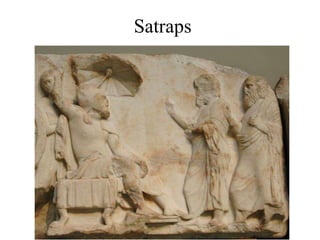
• Broke Empire down into provinces
• Royal Governors = Satraps
• They were loyal to the Emperor and did his
bidding.
Satraps
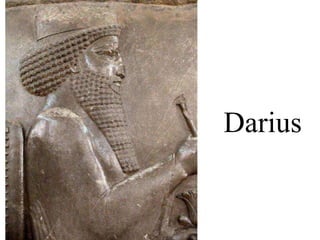
Darius
Darius the Great
• Member of the king’s body guard
• Overthrew the king in 522 BC
• Took power and created a well-organized
efficient government
• Brought peace and stability
• Expanded the empire by 500 miles
• But could not conquer Greece
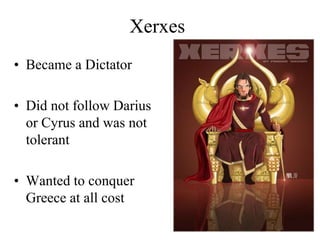
Xerxes
• Became a Dictator
• Did not follow Darius
or Cyrus and was not
tolerant
• Wanted to conquer
Greece at all cost
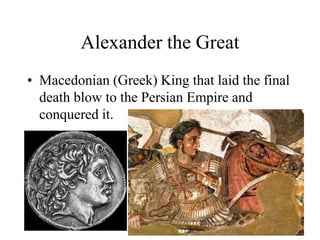
Alexander the Great
• Macedonian (Greek) King that laid the final
death blow to the Persian Empire and
conquered it.
Persian Empire: Rise and Fall, Economy, and
Contributions
CONTRIBUTIONS:
• Encourages taxation, trading, and farming
• Persian carpet
• Used clay to make pottery
• Employs measurement method
• Constructs a cave for irrigation
• Has a gold-based payment mechanism
•Zoroastrianism
• Creates new things with the use of silver
RISE AND FALL:
• They were successful because they
made the most of their system across
the entire empire. They have capable,
devoted, fair, and trustworthy leaders.
• Because the succeeding rulers were
not as powerful as Xerxes, the empire
fell.
Decline of the Empire
• Military Problems…
– Was conquered by Alexander the Great in 330 BC
– Persia’s defenses were smashed by Alexander’s army
– Even though Persian soldiers outnumbered them,
Alexander’s army was able to take them by surprise
and break through a weak point in Persian lines.
• Leader Darius fled for fear of being killed
• Darius tried to negotiate a peace settlement, but
Alexander did not accept and went on to conquer
the remainder of Persia’s empire.
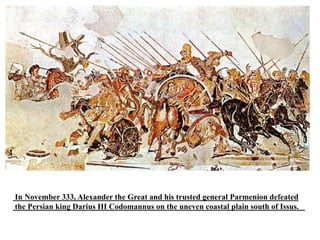
In November 333, Alexander the Great and his trusted general Parmenion defeated
the Persian king Darius III Codomannus on the uneven coastal plain south of Issus.
Decline of the Empire
• Social Problems…
– For the most part, they were very tolerant of their
citizen’s religions, languages, laws and ideas.
However, when faced with rebellion, they did not
hesitate to take extreme military measures.
• People revolted over heavy tax burdens
• Social structure started to break down when there
was no longer a strong leader. The people below
the upper class started organizing riots and revolt.
Decline of the Empire
• Leadership Problems…
– Persia was ruled successfully for many years under
leaders like Cyrus the Great and Darius I.
• After the death of Darius, his son Xerxes ruled.
He was a cruel and weak King. The empire
weakened gradually under his rule due to
conspiracies, assassinations, and revolts by the
people who were burdened with heavy taxes
• Kings became greedy and began stealing from
the supply of riches rather than giving it to the
people.
Decline of the Empire
• Economic Problems…
– Persian taxes became heavier and more oppressive
– This led to economic depression and revolts
• Persian kings started hoarding gold and silver
rather than recirculating it.
– This meant not enough gold and silver for business and
made the economy even worse
• When local leaders (Satraps) decided to become
more independent and rule their section like they
were kings themselves instead of subjects of the
king, this caused economic problems.

3.9_Persian_Empire_PPT_2019.ppt

  • 1.
  • 3.
    TRIVIA On the dayof the Persian New Year, March 21 1935, Reza Shah Pahlavi, requested foreign delegates to use the term Iran, instead of Persia, in a conscious reference to the ancient ancestry of the Iranians.
  • 4.
    TRIVIA • Producing, selling,and consuming alcohol is strictly forbidden in Iran – with some exceptions for religious minorities – and those caught with it face the punishment of flogging • Pork is not available. When it comes to meat most Iranians tend to eat chicken, beef or lamb, all of which are widely available
  • 5.
    The Rise ofPersia • The Persians based their empire on tolerance and diplomacy. They relied on a strong military to back up their policies. Ancient Persia is where Iran is today.
  • 6.
    Persia is inModern Day Iran
  • 7.
    The Extent ofthe Persian Empire
  • 8.
  • 9.
    Cyrus’s Empire • 550BC – Conquered several neighboring kingdoms • Military genius • Controlled an empire spanning 2000 miles • Kindness toward conquered people • Honored local customs and religions • 538 BC - Allowed the Jews to return to their homeland, Jerusalem • Considered by the Jews to be one of God’s anointed ones
  • 10.
    Tolerance !!! • Cyrususe the idea of tolerance to keep the peace and to seem like a liberator. • He allowed people to keep their local customs and religions. • He showed kindness toward conquered peoples
  • 11.
    PERSIA and thecity of PERSEPOLIS
  • 12.
    PERSEPOLIS • 518 BCE •King Darius utilized influences and materials from all over his empire, which included Babylon, Egypt, Mesopotamian and Greece
  • 13.
    PERSEPOLIS • At theheight of the Persian Empire it stretched from India to Africa • Persia today is known as Iran • The city included extensive use of columns
  • 14.
    PERSEPOLIS • Dauris wasfollowed by his son, Xerxes (ruled 485-465) • The Apadana (Audience Hall) features wonderful low relief sculpture
  • 15.
    Zoroastrianism • Persian Religion • Monotheism •Good went to Heaven • Bad went to Hell
  • 16.
    How did Cyrusand Darius keep control of such a vast empire? • Broke Empire down into provinces • Royal Governors = Satraps • They were loyal to the Emperor and did his bidding.
  • 17.
  • 18.
  • 19.
    Darius the Great •Member of the king’s body guard • Overthrew the king in 522 BC • Took power and created a well-organized efficient government • Brought peace and stability • Expanded the empire by 500 miles • But could not conquer Greece
  • 20.
    Xerxes • Became aDictator • Did not follow Darius or Cyrus and was not tolerant • Wanted to conquer Greece at all cost
  • 21.
    Alexander the Great •Macedonian (Greek) King that laid the final death blow to the Persian Empire and conquered it.
  • 22.
    Persian Empire: Riseand Fall, Economy, and Contributions CONTRIBUTIONS: • Encourages taxation, trading, and farming • Persian carpet • Used clay to make pottery • Employs measurement method • Constructs a cave for irrigation • Has a gold-based payment mechanism •Zoroastrianism • Creates new things with the use of silver
  • 23.
    RISE AND FALL: •They were successful because they made the most of their system across the entire empire. They have capable, devoted, fair, and trustworthy leaders. • Because the succeeding rulers were not as powerful as Xerxes, the empire fell.
  • 24.
    Decline of theEmpire • Military Problems… – Was conquered by Alexander the Great in 330 BC – Persia’s defenses were smashed by Alexander’s army – Even though Persian soldiers outnumbered them, Alexander’s army was able to take them by surprise and break through a weak point in Persian lines. • Leader Darius fled for fear of being killed • Darius tried to negotiate a peace settlement, but Alexander did not accept and went on to conquer the remainder of Persia’s empire.
  • 25.
    In November 333,Alexander the Great and his trusted general Parmenion defeated the Persian king Darius III Codomannus on the uneven coastal plain south of Issus.
  • 26.
    Decline of theEmpire • Social Problems… – For the most part, they were very tolerant of their citizen’s religions, languages, laws and ideas. However, when faced with rebellion, they did not hesitate to take extreme military measures. • People revolted over heavy tax burdens • Social structure started to break down when there was no longer a strong leader. The people below the upper class started organizing riots and revolt.
  • 27.
    Decline of theEmpire • Leadership Problems… – Persia was ruled successfully for many years under leaders like Cyrus the Great and Darius I. • After the death of Darius, his son Xerxes ruled. He was a cruel and weak King. The empire weakened gradually under his rule due to conspiracies, assassinations, and revolts by the people who were burdened with heavy taxes • Kings became greedy and began stealing from the supply of riches rather than giving it to the people.
  • 28.
    Decline of theEmpire • Economic Problems… – Persian taxes became heavier and more oppressive – This led to economic depression and revolts • Persian kings started hoarding gold and silver rather than recirculating it. – This meant not enough gold and silver for business and made the economy even worse • When local leaders (Satraps) decided to become more independent and rule their section like they were kings themselves instead of subjects of the king, this caused economic problems.