Persian Architecture
Prepared by : Marwa Rizgar
Zahra Sirwan
Aysha Asaad
Historical view
The Persians settled on the Iranian plateau, and their country was of ancient
civilization. In 651 AD, the Arabs conquered Persia, spread Islam among its sons,
established a great Islamic empire, and flourished Persian Islamic civilization. It
has become known as Persian Islamic art. This art is characterized by
decoration, which remained the dominant motive of the Persian artists.
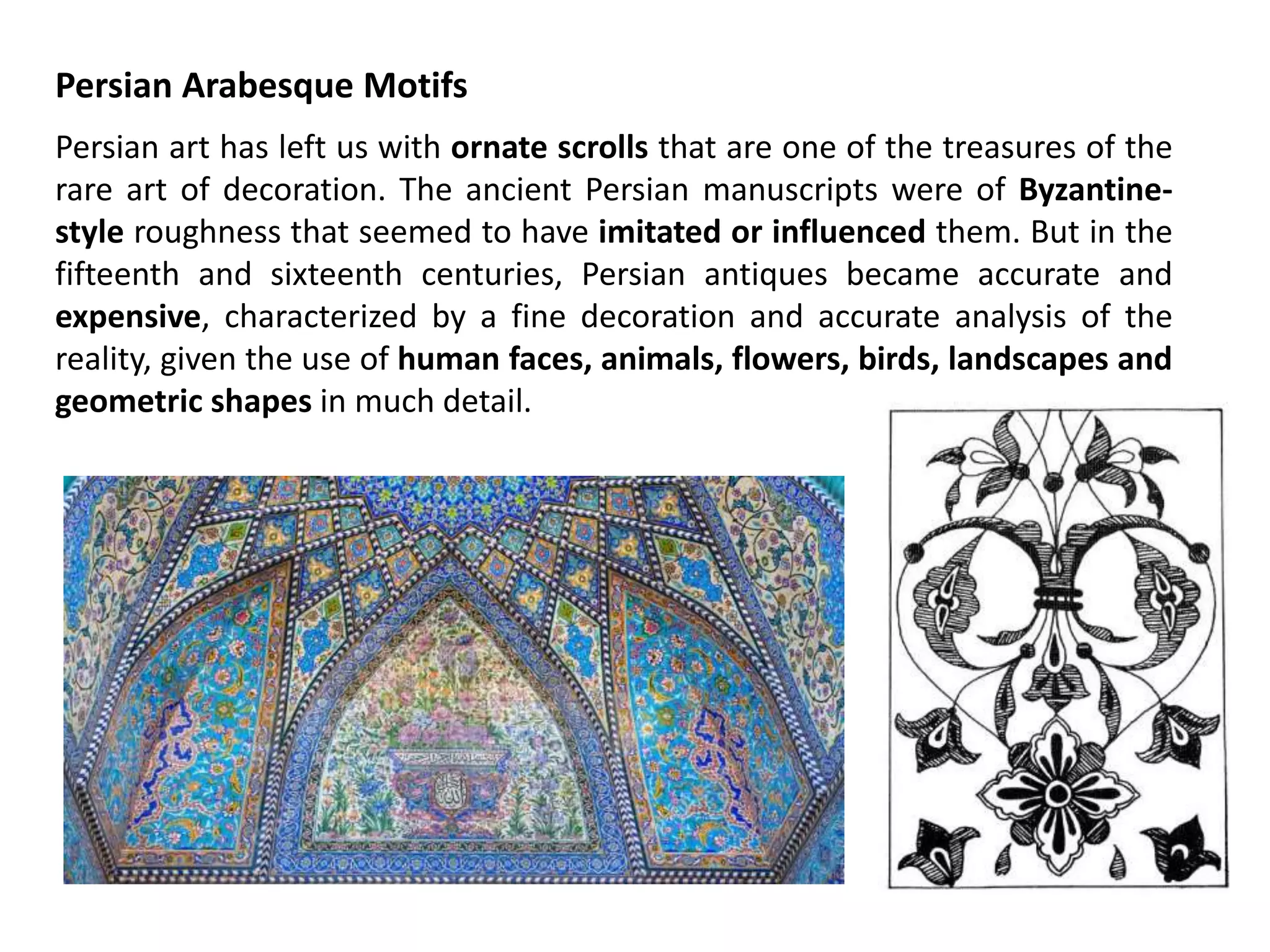
Persian art has left us with ornate scrolls that are one of the treasures of the
rare art of decoration. The ancient Persian manuscripts were of Byzantine-
style roughness that seemed to have imitated or influenced them. But in the
fifteenth and sixteenth centuries, Persian antiques became accurate and
expensive, characterized by a fine decoration and accurate analysis of the
reality, given the use of human faces, animals, flowers, birds, landscapes and
geometric shapes in much detail.
Persian Arabesque Motifs
Their decorations came to the drawings and the walls were thin, their lines
were intricate and they painted regular and consistent shapes, while the colors
were bright and shiny . Persian art also characterized the freedom of thought.
but the Persian artist depicted his subjects inspired by nature. the Persians
created in the field of illustration of wonderful illustrations of poetic poems
and parables, as well as in the field of Arabic writing in Persian script . The art
of Persian pottery was known for its great connection to the original artistic
tradition, and the mosaic was the most important material in the Persians.
Features Persian arabesque
Persian expressions and units
The Persians used expressions and decorative units including:
-They decorated the middle branch of the plant with a flower that binds its half
together.
-They made a lot of floral and synthetic flowers from several overlapping vases
on top of each other.
-The Persians from decorative units also used human faces, animals, flowers,
birds, landscapes and geometric shapes.
Persian Arabesque
The Persian used arabesque motifs a lot in the mosque, specially on the domes ,
the surfaces of the domes are mostly mosaic faced, and create a magical view.
Carpets
One of the most practical forms of Persian Islamic art was the carpet. While
carpets were used in everyday life as floor coverings, prayer mats, wall
hangings, and cushions, they were also beautiful pieces of art. These
carpets often used colorful repeating geometric designs or arabesque
patterns.
Carvings
Elaborate carvings were another popular form of art. They incorporated the
same arabesque and geometric patterns used in other forms of Islamic art.
Carvings were often made using wood, but could also be made from ivory,
stone, or plaster. They were used to decorate important buildings, like
mosques, including the ceiling, doors, and wall panels. Stands for the Islamic
holy book, the Quran, were often pieces of art carved from wood.
whats iran persian column symbols?
The Faravahar (Persian: ‫فروهر‬ ), also known as Farr-e Kiyani ( ‫کیانی‬ ‫فر‬), is one of the
best-known symbols ofIran. It symbolizes Zoroastrianism, the first religion
ofIran before the Arab invasion of Iran, and Iraniannationalism.
What animal represents Iran?
lion
National Animal of Iran is the Persian/Asiatic lion. Though they consider Asiatic cheetah,
Persian leopard, Persian cat, and Persian fallow deer as their national animal too.
What does the emblem of Iran mean?
The Emblem of Iran (Persian: ‫نشان‬‫رسمی‬‫ایران‬ , neshān-e rasmi-ye Irān) since the
1979 Iranian Revolution features the Arabic word Allah ("God"), rendered in stylized
characters. The logo consists of four crescents and a sword. The four crescents are
meant to stand for the word Allah.
Armiger: Islamic Republic of Iran
Adopted: 9 May 1980
Blazon: Name of Allah
The meaning of tulips is generally perfect love. Like many flowers, different colors
of tulips also often carry their own significance. Red tulips are most strongly associated
with true love, while purple symbolizes royalty. ... White tulips are used to claim worthiness
or to send a message of forgiveness.
Yellow tulips now represent happiness, cheerfulness, and hope. ... And if you're looking to
add a bit of luck to your home, it's believed that planting yellow tulips in your front yard
will bring good luck and prosperity.
tulip flower
Coat of Arms of Iran. The Emblem of Iran was made after the Islamic
Revolution in that country, in 1979. ... It looks like a tulip, which is an
old symbol for Iran.
Coat of Arms of Iran
The Lion and Sun (Persian: ‫خورشید‬ ‫و‬ ‫شیر‬ ,Shir o Khorshid) is one of the main emblems of Iran,
and formerly was an element in Iran's national flag. ... During the Safavid era, the lion and
sun stood for the two pillars of society, the state and the Islamic religion. It became a
nationalemblem during the Qajar era.
Lion and Sun Emblem
Ancient Greek art was influenced by the philosophy of the time and that shaped the way they
produced art forms. ... This might be because the Ancient Greeks did not have a concept
of art. They used the word techne, which translates as 'skill', to describe painting or any skilful
act.
greek art influence meaning
What is the meaning of the crescent moon and star in iran?
By the mid 20th century, the symbol came to be re-interpreted as the symbol ofIslam or
the Muslim community. ... "Moon") states that "in the language of conventional symbols,
the crescent and star have become the symbols of Islam as much as the cross is the symbol of
Christianity."
What does red symbolize in iran?
Red may represent fire and so may symbolize the presence of God. In Christianity,red is the
liturgical colour for Pentecost. Also, in the Catholic Church red is the colour of a martyr. ...
In Islam and iran, red is the colour for sacrifice and courage.
Persian Calligraphy
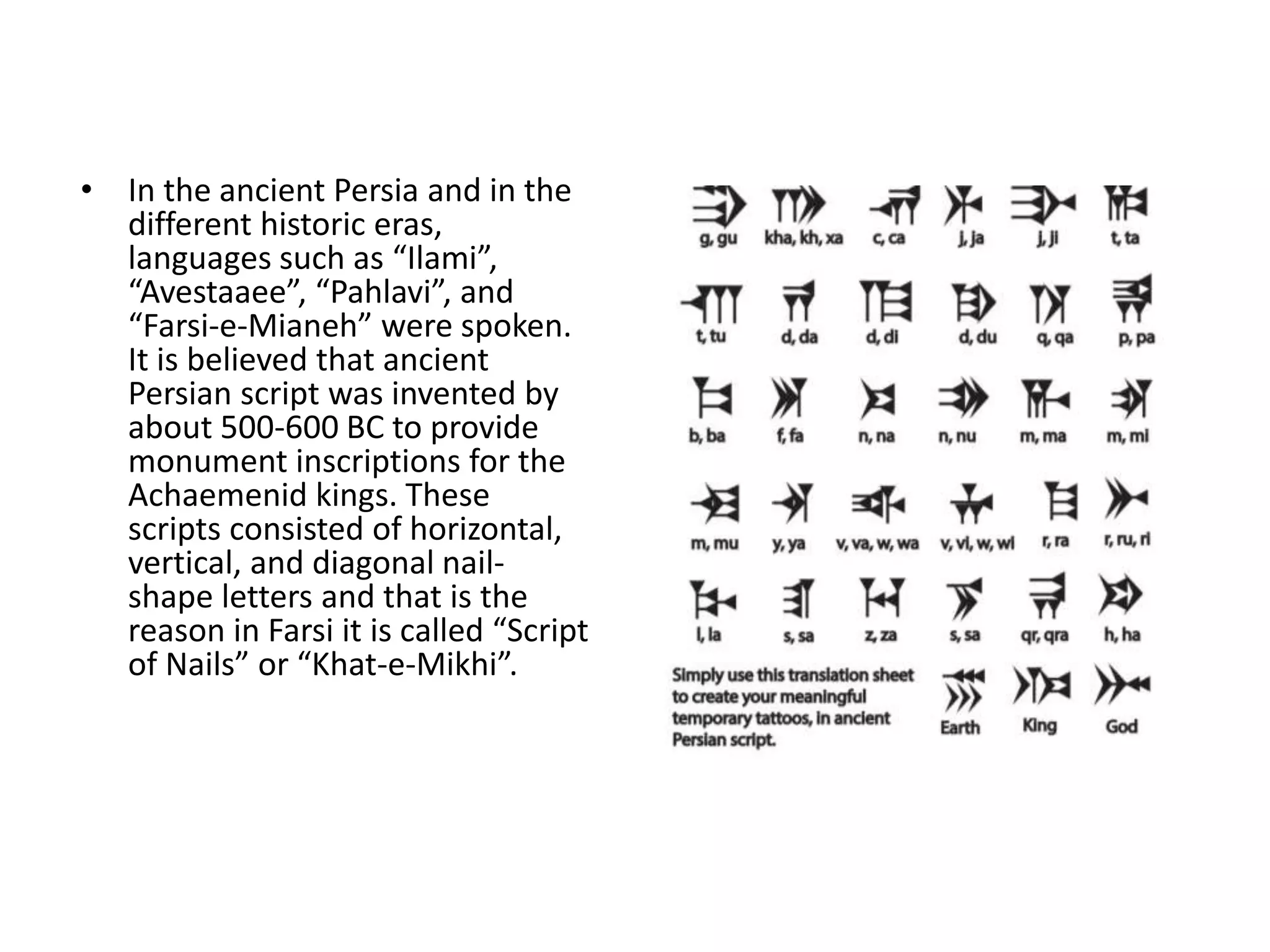
• In the ancient Persia and in the
different historic eras,
languages such as “Ilami”,
“Avestaaee”, “Pahlavi”, and
“Farsi-e-Mianeh” were spoken.
It is believed that ancient
Persian script was invented by
about 500-600 BC to provide
monument inscriptions for the
Achaemenid kings. These
scripts consisted of horizontal,
vertical, and diagonal nail-
shape letters and that is the
reason in Farsi it is called “Script
of Nails” or “Khat-e-Mikhi”.
• After initiation of Islam in the
7 th century, Persians adapted
Arabic alphabet to Farsi
language and developed
contemporary Farsi alphabet.
Arabic alphabet has 28
characters and Iranians added
another four letters in it to
arrive at existing 32 Persian
(Farsi) letters.
• After Islam, calligraphy was one of
the most important sources of
Islamic art in Islam and one of the
important features of Islamic
culture. First, the calligraphy had
no cultural meaning and was only
for decoration and beautification, it
had the same meaning only in the
inscriptions; however, over time, it
became meaningful and each
indicates something certain.
Major Contemporary Classical Persian Calligraphy Scripts:
• Nas’taliq” is the most popular contemporary style among classical
Persian calligraphy scripts. It is known as “Bride of the Calligraphy
Scripts”. This calligraphy style has been based on such a strong
structure that it has changed little since that time
Cursive Nas'taliq
• "Cursive Nas'taliq" or "Shekasteh
Nas'taliq" was invented in the 17
th century. This calligraphy style is
based on the same rules as
Nas’taliq but it provides more
flexible movements. It is a little
more stretched and curved. Some
believe “Moteza-Qoli Shamloo” is
the inventor of this style while
others believe it was “Mohammad
Shafee Heravi” who introduced
Cursive Nas’taliq first.
The growth of the calligraphy of the Iranian Kufic line
proceeds vigorously, which during the Seljuk period
reaches a certain point. The script that they wrote in
Iran in the 1st century AD was Arabic, which was
common to two ways and square Kufic was one of
them. In the same era, we can see Tazhib (gilding)
between alphabets and lines. Gilding was to draw
beautiful patterns of plants or geometrical shapes in the
margins of books.

Persian Architecture

  • 1.
    Persian Architecture Prepared by: Marwa Rizgar Zahra Sirwan Aysha Asaad
  • 2.
    Historical view The Persianssettled on the Iranian plateau, and their country was of ancient civilization. In 651 AD, the Arabs conquered Persia, spread Islam among its sons, established a great Islamic empire, and flourished Persian Islamic civilization. It has become known as Persian Islamic art. This art is characterized by decoration, which remained the dominant motive of the Persian artists.
  • 3.
    Persian art hasleft us with ornate scrolls that are one of the treasures of the rare art of decoration. The ancient Persian manuscripts were of Byzantine- style roughness that seemed to have imitated or influenced them. But in the fifteenth and sixteenth centuries, Persian antiques became accurate and expensive, characterized by a fine decoration and accurate analysis of the reality, given the use of human faces, animals, flowers, birds, landscapes and geometric shapes in much detail. Persian Arabesque Motifs
  • 4.
    Their decorations cameto the drawings and the walls were thin, their lines were intricate and they painted regular and consistent shapes, while the colors were bright and shiny . Persian art also characterized the freedom of thought. but the Persian artist depicted his subjects inspired by nature. the Persians created in the field of illustration of wonderful illustrations of poetic poems and parables, as well as in the field of Arabic writing in Persian script . The art of Persian pottery was known for its great connection to the original artistic tradition, and the mosaic was the most important material in the Persians. Features Persian arabesque
  • 5.
    Persian expressions andunits The Persians used expressions and decorative units including: -They decorated the middle branch of the plant with a flower that binds its half together. -They made a lot of floral and synthetic flowers from several overlapping vases on top of each other. -The Persians from decorative units also used human faces, animals, flowers, birds, landscapes and geometric shapes.
  • 6.
    Persian Arabesque The Persianused arabesque motifs a lot in the mosque, specially on the domes , the surfaces of the domes are mostly mosaic faced, and create a magical view.
  • 7.
    Carpets One of themost practical forms of Persian Islamic art was the carpet. While carpets were used in everyday life as floor coverings, prayer mats, wall hangings, and cushions, they were also beautiful pieces of art. These carpets often used colorful repeating geometric designs or arabesque patterns.
  • 8.
    Carvings Elaborate carvings wereanother popular form of art. They incorporated the same arabesque and geometric patterns used in other forms of Islamic art. Carvings were often made using wood, but could also be made from ivory, stone, or plaster. They were used to decorate important buildings, like mosques, including the ceiling, doors, and wall panels. Stands for the Islamic holy book, the Quran, were often pieces of art carved from wood.
  • 9.
    whats iran persiancolumn symbols? The Faravahar (Persian: ‫فروهر‬ ), also known as Farr-e Kiyani ( ‫کیانی‬ ‫فر‬), is one of the best-known symbols ofIran. It symbolizes Zoroastrianism, the first religion ofIran before the Arab invasion of Iran, and Iraniannationalism.
  • 10.
    What animal representsIran? lion National Animal of Iran is the Persian/Asiatic lion. Though they consider Asiatic cheetah, Persian leopard, Persian cat, and Persian fallow deer as their national animal too.
  • 11.
    What does theemblem of Iran mean? The Emblem of Iran (Persian: ‫نشان‬‫رسمی‬‫ایران‬ , neshān-e rasmi-ye Irān) since the 1979 Iranian Revolution features the Arabic word Allah ("God"), rendered in stylized characters. The logo consists of four crescents and a sword. The four crescents are meant to stand for the word Allah. Armiger: Islamic Republic of Iran Adopted: 9 May 1980 Blazon: Name of Allah
  • 12.
    The meaning oftulips is generally perfect love. Like many flowers, different colors of tulips also often carry their own significance. Red tulips are most strongly associated with true love, while purple symbolizes royalty. ... White tulips are used to claim worthiness or to send a message of forgiveness. Yellow tulips now represent happiness, cheerfulness, and hope. ... And if you're looking to add a bit of luck to your home, it's believed that planting yellow tulips in your front yard will bring good luck and prosperity. tulip flower
  • 13.
    Coat of Armsof Iran. The Emblem of Iran was made after the Islamic Revolution in that country, in 1979. ... It looks like a tulip, which is an old symbol for Iran. Coat of Arms of Iran
  • 14.
    The Lion andSun (Persian: ‫خورشید‬ ‫و‬ ‫شیر‬ ,Shir o Khorshid) is one of the main emblems of Iran, and formerly was an element in Iran's national flag. ... During the Safavid era, the lion and sun stood for the two pillars of society, the state and the Islamic religion. It became a nationalemblem during the Qajar era. Lion and Sun Emblem
  • 15.
    Ancient Greek artwas influenced by the philosophy of the time and that shaped the way they produced art forms. ... This might be because the Ancient Greeks did not have a concept of art. They used the word techne, which translates as 'skill', to describe painting or any skilful act. greek art influence meaning
  • 16.
    What is themeaning of the crescent moon and star in iran? By the mid 20th century, the symbol came to be re-interpreted as the symbol ofIslam or the Muslim community. ... "Moon") states that "in the language of conventional symbols, the crescent and star have become the symbols of Islam as much as the cross is the symbol of Christianity."
  • 17.
    What does redsymbolize in iran? Red may represent fire and so may symbolize the presence of God. In Christianity,red is the liturgical colour for Pentecost. Also, in the Catholic Church red is the colour of a martyr. ... In Islam and iran, red is the colour for sacrifice and courage.
  • 18.
  • 19.
    • In theancient Persia and in the different historic eras, languages such as “Ilami”, “Avestaaee”, “Pahlavi”, and “Farsi-e-Mianeh” were spoken. It is believed that ancient Persian script was invented by about 500-600 BC to provide monument inscriptions for the Achaemenid kings. These scripts consisted of horizontal, vertical, and diagonal nail- shape letters and that is the reason in Farsi it is called “Script of Nails” or “Khat-e-Mikhi”.
  • 20.
    • After initiationof Islam in the 7 th century, Persians adapted Arabic alphabet to Farsi language and developed contemporary Farsi alphabet. Arabic alphabet has 28 characters and Iranians added another four letters in it to arrive at existing 32 Persian (Farsi) letters.
  • 21.
    • After Islam,calligraphy was one of the most important sources of Islamic art in Islam and one of the important features of Islamic culture. First, the calligraphy had no cultural meaning and was only for decoration and beautification, it had the same meaning only in the inscriptions; however, over time, it became meaningful and each indicates something certain.
  • 22.
    Major Contemporary ClassicalPersian Calligraphy Scripts: • Nas’taliq” is the most popular contemporary style among classical Persian calligraphy scripts. It is known as “Bride of the Calligraphy Scripts”. This calligraphy style has been based on such a strong structure that it has changed little since that time
  • 23.
    Cursive Nas'taliq • "CursiveNas'taliq" or "Shekasteh Nas'taliq" was invented in the 17 th century. This calligraphy style is based on the same rules as Nas’taliq but it provides more flexible movements. It is a little more stretched and curved. Some believe “Moteza-Qoli Shamloo” is the inventor of this style while others believe it was “Mohammad Shafee Heravi” who introduced Cursive Nas’taliq first.
  • 24.
    The growth ofthe calligraphy of the Iranian Kufic line proceeds vigorously, which during the Seljuk period reaches a certain point. The script that they wrote in Iran in the 1st century AD was Arabic, which was common to two ways and square Kufic was one of them. In the same era, we can see Tazhib (gilding) between alphabets and lines. Gilding was to draw beautiful patterns of plants or geometrical shapes in the margins of books.