The History of Spain
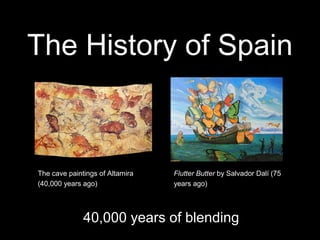
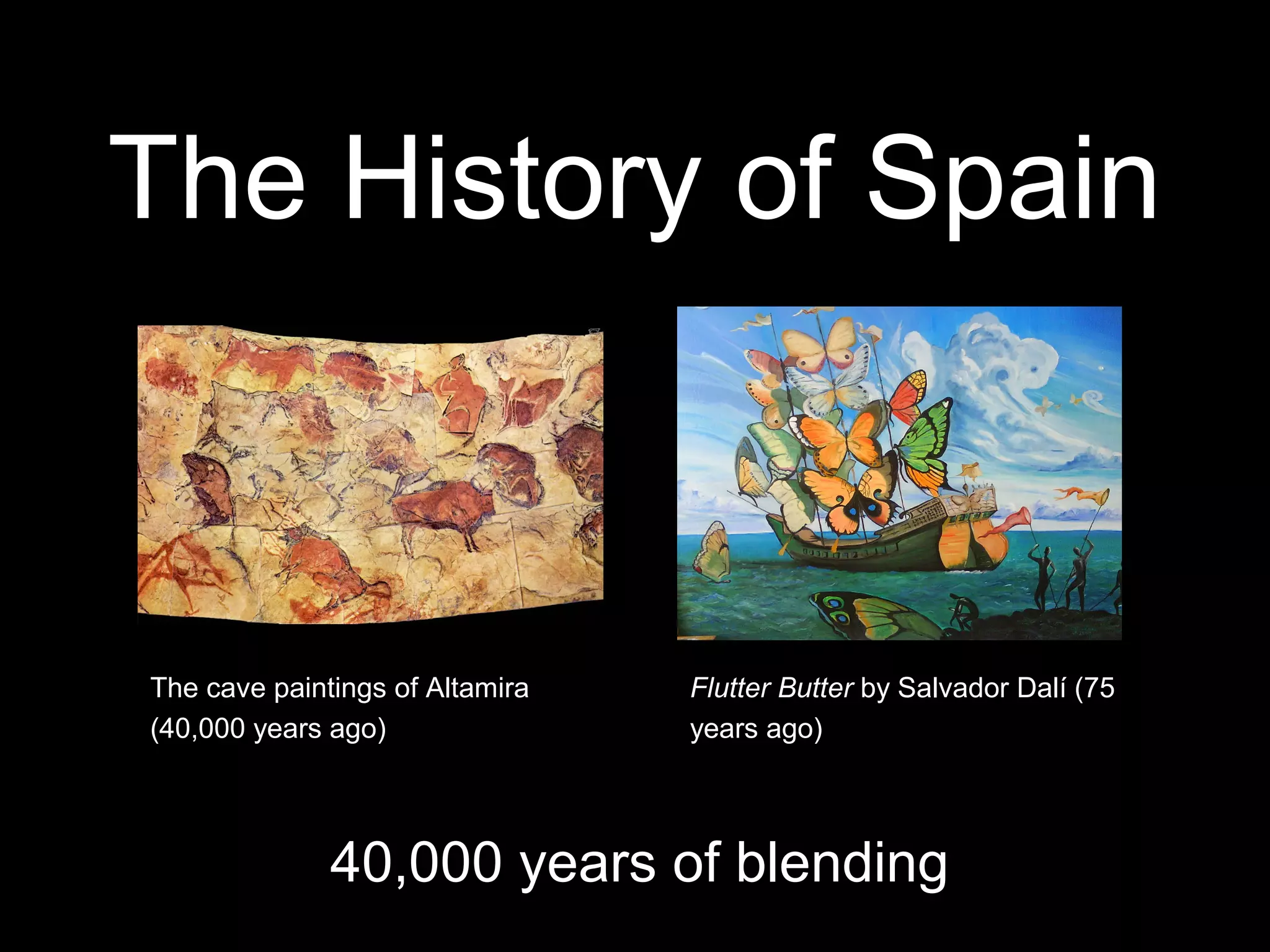
40,000 years of blending
The cave paintings of Altamira
(40,000 years ago)
Flutter Butter by Salvador Dalí (75
years ago)
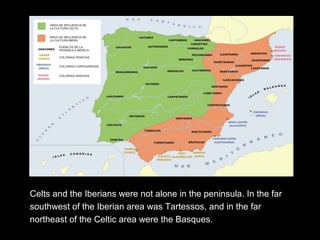
Celts and the Iberians were not alone in the peninsula. In the far
southwest of the Iberian area was Tartessos, and in the far
northeast of the Celtic area were the Basques.
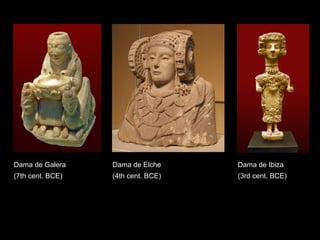
Dama de Galera
(7th cent. BCE)
Dama de Elche
(4th cent. BCE)
Dama de Ibiza
(3rd cent. BCE)
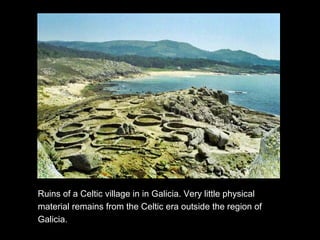
Ruins of a Celtic village in in Galicia. Very little physical
material remains from the Celtic era outside the region of
Galicia.
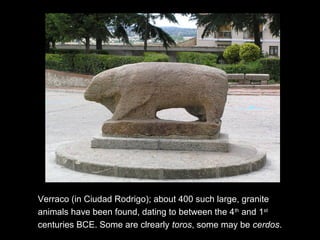
Verraco (in Ciudad Rodrigo); about 400 such large, granite
animals have been found, dating to between the 4th
and 1st
centuries BCE. Some are clrearly toros, some may be cerdos.
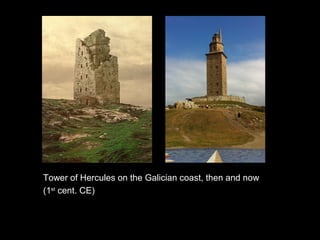
Tower of Hercules on the Galician coast, then and now
(1st
cent. CE)
The amphitheater of Italica was the third largest in the Roman Empire.
Because Italica was abandoned for the current site of Sevilla, the
city was not altered or built over in later times, making it one of
the best examples of a Roman-era city in existence today.
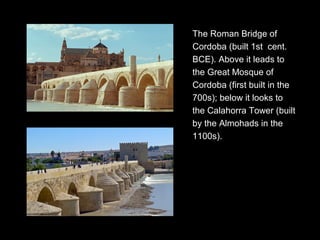
The Roman Bridge of
Cordoba (built 1st cent.
BCE). Above it leads to
the Great Mosque of
Cordoba (first built in the
700s); below it looks to
the Calahorra Tower (built
by the Almohads in the
1100s).
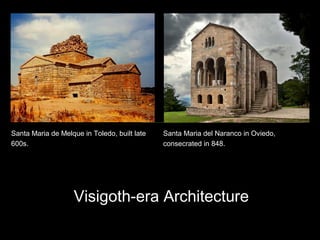
Visigoth-era Architecture
Santa Maria de Melque in Toledo, built late
600s.
Santa Maria del Naranco in Oviedo,
consecrated in 848.
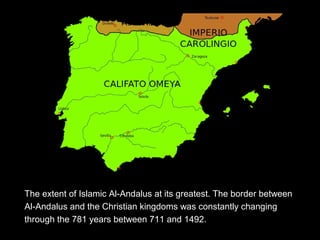
The extent of Islamic Al-Andalus at its greatest. The border between
Al-Andalus and the Christian kingdoms was constantly changing
through the 781 years between 711 and 1492.
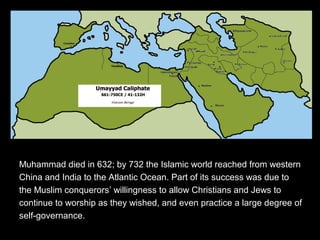
Muhammad died in 632; by 732 the Islamic world reached from western
China and India to the Atlantic Ocean. Part of its success was due to
the Muslim conquerors’ willingness to allow Christians and Jews to
continue to worship as they wished, and even practice a large degree of
self-governance.
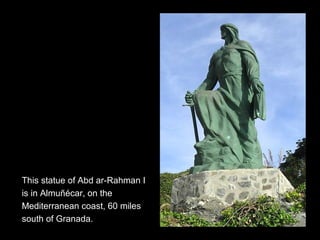
This statue of Abd ar-Rahman I
is in Almuñécar, on the
Mediterranean coast, 60 miles
south of Granada.
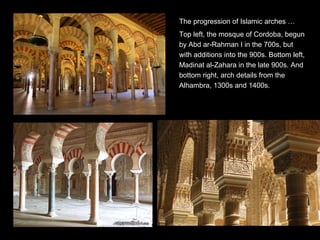
The progression of Islamic arches …
Top left, the mosque of Cordoba, begun
by Abd ar-Rahman I in the 700s, but
with additions into the 900s. Bottom left,
Madinat al-Zahara in the late 900s. And
bottom right, arch details from the
Alhambra, 1300s and 1400s.
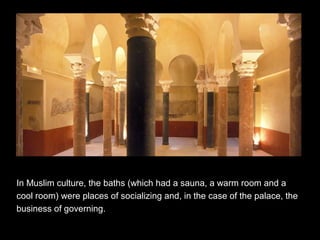
In Muslim culture, the baths (which had a sauna, a warm room and a
cool room) were places of socializing and, in the case of the palace, the
business of governing.
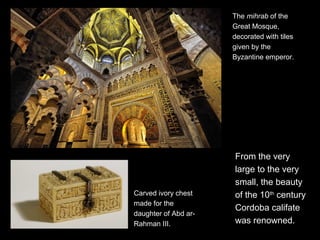
From the very
large to the very
small, the beauty
of the 10th
century
Cordoba califate
was renowned.
Carved ivory chest
made for the
daughter of Abd ar-
Rahman III.
The mihrab of the
Great Mosque,
decorated with tiles
given by the
Byzantine emperor.
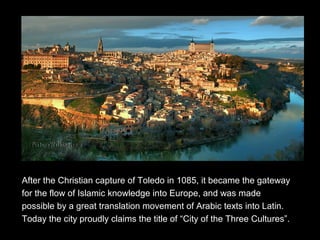
After the Christian capture of Toledo in 1085, it became the gateway
for the flow of Islamic knowledge into Europe, and was made
possible by a great translation movement of Arabic texts into Latin.
Today the city proudly claims the title of “City of the Three Cultures”.
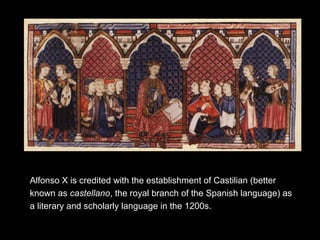
Alfonso X is credited with the establishment of Castilian (better
known as castellano, the royal branch of the Spanish language) as
a literary and scholarly language in the 1200s.
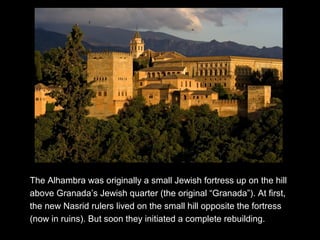
The Alhambra was originally a small Jewish fortress up on the hill
above Granada’s Jewish quarter (the original “Granada”). At first,
the new Nasrid rulers lived on the small hill opposite the fortress
(now in ruins). But soon they initiated a complete rebuilding.
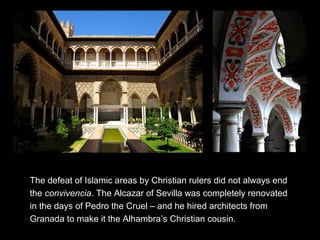
The defeat of Islamic areas by Christian rulers did not always end
the convivencia. The Alcazar of Sevilla was completely renovated
in the days of Pedro the Cruel – and he hired architects from
Granada to make it the Alhambra’s Christian cousin.
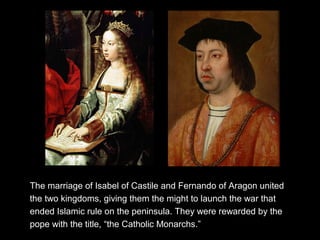
The marriage of Isabel of Castile and Fernando of Aragon united
the two kingdoms, giving them the might to launch the war that
ended Islamic rule on the peninsula. They were rewarded by the
pope with the title, “the Catholic Monarchs.”
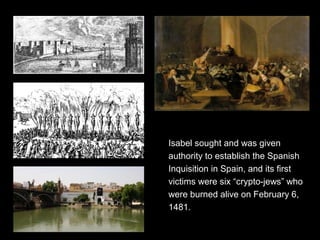
Isabel sought and was given
authority to establish the Spanish
Inquisition in Spain, and its first
victims were six “crypto-jews” who
were burned alive on February 6,
1481.
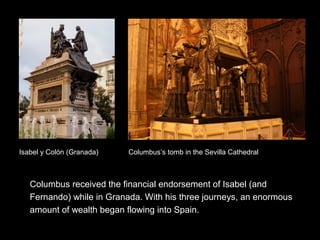
Columbus received the financial endorsement of Isabel (and
Fernando) while in Granada. With his three journeys, an enormous
amount of wealth began flowing into Spain.
Columbus’s tomb in the Sevilla CathedralIsabel y Colón (Granada)
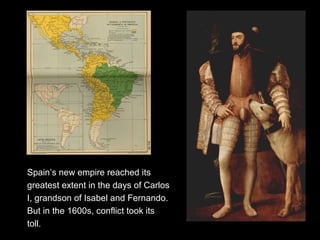
Spain’s new empire reached its
greatest extent in the days of Carlos
I, grandson of Isabel and Fernando.
But in the 1600s, conflict took its
toll.
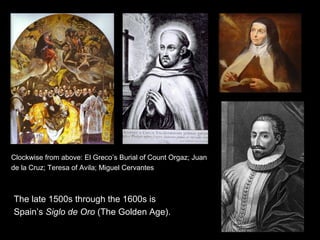
The late 1500s through the 1600s is
Spain’s Siglo de Oro (The Golden Age).
Clockwise from above: El Greco’s Burial of Count Orgaz; Juan
de la Cruz; Teresa of Avila; Miguel Cervantes
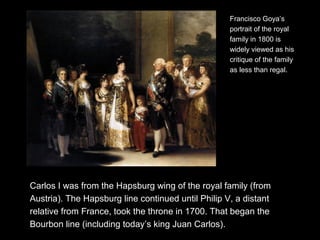
Carlos I was from the Hapsburg wing of the royal family (from
Austria). The Hapsburg line continued until Philip V, a distant
relative from France, took the throne in 1700. That began the
Bourbon line (including today’s king Juan Carlos).
Francisco Goya’s
portrait of the royal
family in 1800 is
widely viewed as his
critique of the family
as less than regal.
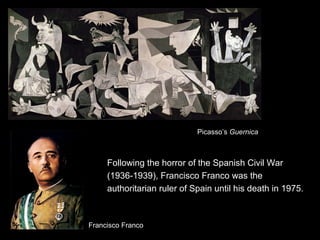
Following the horror of the Spanish Civil War
(1936-1939), Francisco Franco was the
authoritarian ruler of Spain until his death in 1975.
Francisco Franco
Picasso’s Guernica
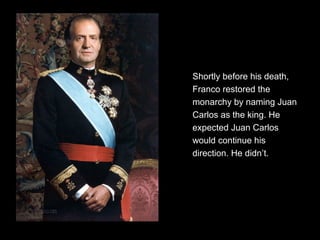
Shortly before his death,
Franco restored the
monarchy by naming Juan
Carlos as the king. He
expected Juan Carlos
would continue his
direction. He didn’t.
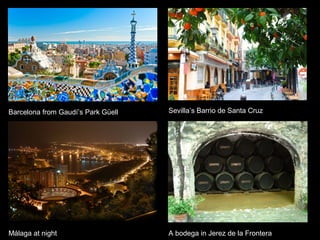
Barcelona from Gaudí’s Park Güell Sevilla’s Barrio de Santa Cruz
Málaga at night A bodega in Jerez de la Frontera
A Brief History of Spain

A Brief History of Spain

  • 1.
    The History ofSpain 40,000 years of blending The cave paintings of Altamira (40,000 years ago) Flutter Butter by Salvador Dalí (75 years ago)
  • 2.
    Celts and theIberians were not alone in the peninsula. In the far southwest of the Iberian area was Tartessos, and in the far northeast of the Celtic area were the Basques.
  • 3.
    Dama de Galera (7thcent. BCE) Dama de Elche (4th cent. BCE) Dama de Ibiza (3rd cent. BCE)
  • 4.
    Ruins of aCeltic village in in Galicia. Very little physical material remains from the Celtic era outside the region of Galicia.
  • 5.
    Verraco (in CiudadRodrigo); about 400 such large, granite animals have been found, dating to between the 4th and 1st centuries BCE. Some are clrearly toros, some may be cerdos.
  • 6.
    Tower of Herculeson the Galician coast, then and now (1st cent. CE)
  • 7.
    The amphitheater ofItalica was the third largest in the Roman Empire. Because Italica was abandoned for the current site of Sevilla, the city was not altered or built over in later times, making it one of the best examples of a Roman-era city in existence today.
  • 8.
    The Roman Bridgeof Cordoba (built 1st cent. BCE). Above it leads to the Great Mosque of Cordoba (first built in the 700s); below it looks to the Calahorra Tower (built by the Almohads in the 1100s).
  • 10.
    Visigoth-era Architecture Santa Mariade Melque in Toledo, built late 600s. Santa Maria del Naranco in Oviedo, consecrated in 848.
  • 11.
    The extent ofIslamic Al-Andalus at its greatest. The border between Al-Andalus and the Christian kingdoms was constantly changing through the 781 years between 711 and 1492.
  • 12.
    Muhammad died in632; by 732 the Islamic world reached from western China and India to the Atlantic Ocean. Part of its success was due to the Muslim conquerors’ willingness to allow Christians and Jews to continue to worship as they wished, and even practice a large degree of self-governance.
  • 13.
    This statue ofAbd ar-Rahman I is in Almuñécar, on the Mediterranean coast, 60 miles south of Granada.
  • 14.
    The progression ofIslamic arches … Top left, the mosque of Cordoba, begun by Abd ar-Rahman I in the 700s, but with additions into the 900s. Bottom left, Madinat al-Zahara in the late 900s. And bottom right, arch details from the Alhambra, 1300s and 1400s.
  • 15.
    In Muslim culture,the baths (which had a sauna, a warm room and a cool room) were places of socializing and, in the case of the palace, the business of governing.
  • 16.
    From the very largeto the very small, the beauty of the 10th century Cordoba califate was renowned. Carved ivory chest made for the daughter of Abd ar- Rahman III. The mihrab of the Great Mosque, decorated with tiles given by the Byzantine emperor.
  • 17.
    After the Christiancapture of Toledo in 1085, it became the gateway for the flow of Islamic knowledge into Europe, and was made possible by a great translation movement of Arabic texts into Latin. Today the city proudly claims the title of “City of the Three Cultures”.
  • 18.
    Alfonso X iscredited with the establishment of Castilian (better known as castellano, the royal branch of the Spanish language) as a literary and scholarly language in the 1200s.
  • 19.
    The Alhambra wasoriginally a small Jewish fortress up on the hill above Granada’s Jewish quarter (the original “Granada”). At first, the new Nasrid rulers lived on the small hill opposite the fortress (now in ruins). But soon they initiated a complete rebuilding.
  • 20.
    The defeat ofIslamic areas by Christian rulers did not always end the convivencia. The Alcazar of Sevilla was completely renovated in the days of Pedro the Cruel – and he hired architects from Granada to make it the Alhambra’s Christian cousin.
  • 21.
    The marriage ofIsabel of Castile and Fernando of Aragon united the two kingdoms, giving them the might to launch the war that ended Islamic rule on the peninsula. They were rewarded by the pope with the title, “the Catholic Monarchs.”
  • 22.
    Isabel sought andwas given authority to establish the Spanish Inquisition in Spain, and its first victims were six “crypto-jews” who were burned alive on February 6, 1481.
  • 23.
    Columbus received thefinancial endorsement of Isabel (and Fernando) while in Granada. With his three journeys, an enormous amount of wealth began flowing into Spain. Columbus’s tomb in the Sevilla CathedralIsabel y Colón (Granada)
  • 24.
    Spain’s new empirereached its greatest extent in the days of Carlos I, grandson of Isabel and Fernando. But in the 1600s, conflict took its toll.
  • 25.
    The late 1500sthrough the 1600s is Spain’s Siglo de Oro (The Golden Age). Clockwise from above: El Greco’s Burial of Count Orgaz; Juan de la Cruz; Teresa of Avila; Miguel Cervantes
  • 26.
    Carlos I wasfrom the Hapsburg wing of the royal family (from Austria). The Hapsburg line continued until Philip V, a distant relative from France, took the throne in 1700. That began the Bourbon line (including today’s king Juan Carlos). Francisco Goya’s portrait of the royal family in 1800 is widely viewed as his critique of the family as less than regal.
  • 27.
    Following the horrorof the Spanish Civil War (1936-1939), Francisco Franco was the authoritarian ruler of Spain until his death in 1975. Francisco Franco Picasso’s Guernica
  • 28.
    Shortly before hisdeath, Franco restored the monarchy by naming Juan Carlos as the king. He expected Juan Carlos would continue his direction. He didn’t.
  • 29.
    Barcelona from Gaudí’sPark Güell Sevilla’s Barrio de Santa Cruz Málaga at night A bodega in Jerez de la Frontera