The Hindu Pantheon
While Hinduism maintains the existence of only one
Ultimate Reality (Brahman), it also maintains that one
Ultimate Reality is experienced in a multiplicity of
forms – 330 million gods.
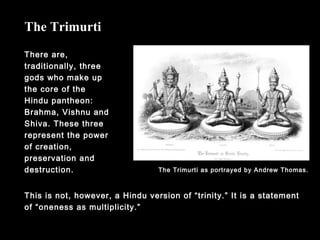
There are,
traditionally, three
gods who make up
the core of the
Hindu pantheon:
Brahma, Vishnu and
Shiva. These three
represent the power
of creation,
preservation and
destruction.
The Trimurti
The Trimurti as portrayed by Andrew Thomas.
This is not, however, a Hindu version of “trinity.” It is a statement
of “oneness as multiplicity.”
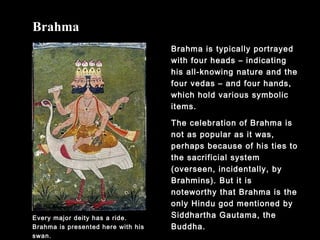
Brahma is typically portrayed
with four heads – indicating
his all-knowing nature and the
four vedas – and four hands,
which hold various symbolic
items.
The celebration of Brahma is
not as popular as it was,
perhaps because of his ties to
the sacrificial system
(overseen, incidentally, by
Brahmins). But it is
noteworthy that Brahma is the
only Hindu god mentioned by
Siddhartha Gautama, the
Buddha.
Brahma
Every major deity has a ride.
Brahma is presented here with his
swan.
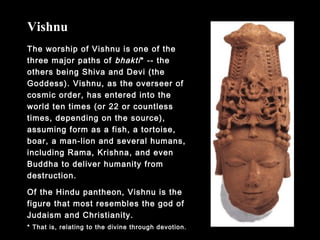
The worship of Vishnu is one of the
three major paths of bhakti* -- the
others being Shiva and Devi (the
Goddess). Vishnu, as the overseer of
cosmic order, has entered into the
world ten times (or 22 or countless
times, depending on the source),
assuming form as a fish, a tortoise,
boar, a man-lion and several humans,
including Rama, Krishna, and even
Buddha to deliver humanity from
destruction.
Of the Hindu pantheon, Vishnu is the
figure that most resembles the god of
Judaism and Christianity.
Vishnu
* That is, relating to the divine through devotion.
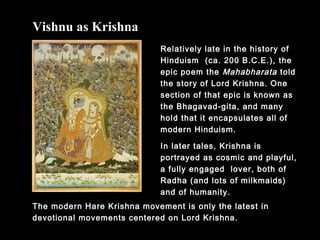
Relatively late in the history of
Hinduism (ca. 200 B.C.E.), the
epic poem the Mahabharata told
the story of Lord Krishna. One
section of that epic is known as
the Bhagavad-gita, and many
hold that it encapsulates all of
modern Hinduism.
In later tales, Krishna is
portrayed as cosmic and playful,
a fully engaged lover, both of
Radha (and lots of milkmaids)
and of humanity.
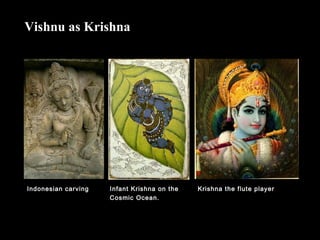
Vishnu as Krishna
The modern Hare Krishna movement is only the latest in
devotional movements centered on Lord Krishna.
Vishnu as Krishna
Infant Krishna on the
Cosmic Ocean.
Krishna the flute playerIndonesian carving
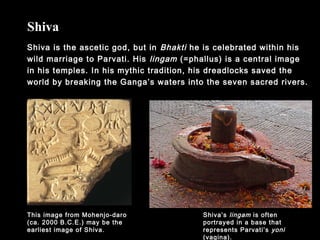
Shiva is the ascetic god, but in Bhakti he is celebrated within his
wild marriage to Parvati. His lingam (=phallus) is a central image
in his temples. In his mythic tradition, his dreadlocks saved the
world by breaking the Ganga’s waters into the seven sacred rivers.
Shiva
Shiva’s lingam is often
portrayed in a base that
represents Parvati’s yoni
(vagina).
This image from Mohenjo-daro
(ca. 2000 B.C.E.) may be the
earliest image of Shiva.
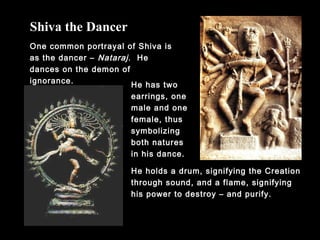
One common portrayal of Shiva is
as the dancer – Nataraj. He
dances on the demon of
ignorance.
Shiva the Dancer
He has two
earrings, one
male and one
female, thus
symbolizing
both natures
in his dance.
He holds a drum, signifying the Creation
through sound, and a flame, signifying
his power to destroy – and purify.
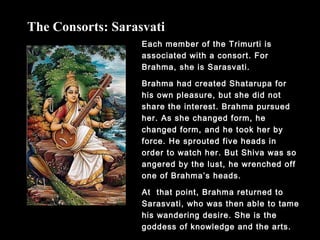
Each member of the Trimurti is
associated with a consort. For
Brahma, she is Sarasvati.
Brahma had created Shatarupa for
his own pleasure, but she did not
share the interest. Brahma pursued
her. As she changed form, he
changed form, and he took her by
force. He sprouted five heads in
order to watch her. But Shiva was so
angered by the lust, he wrenched off
one of Brahma’s heads.
At that point, Brahma returned to
Sarasvati, who was then able to tame
his wandering desire. She is the
goddess of knowledge and the arts.
The Consorts: Sarasvati
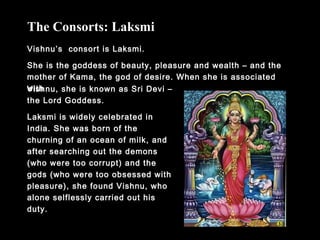
Vishnu’s consort is Laksmi.
She is the goddess of beauty, pleasure and wealth – and the
mother of Kama, the god of desire. When she is associated
with
The Consorts: Laksmi
Vishnu, she is known as Sri Devi –
the Lord Goddess.
Laksmi is widely celebrated in
India. She was born of the
churning of an ocean of milk, and
after searching out the demons
(who were too corrupt) and the
gods (who were too obsessed with
pleasure), she found Vishnu, who
alone selflessly carried out his
duty.
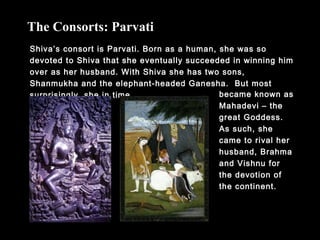
Shiva’s consort is Parvati. Born as a human, she was so
devoted to Shiva that she eventually succeeded in winning him
over as her husband. With Shiva she has two sons,
Shanmukha and the elephant-headed Ganesha. But most
surprisingly, she in time
The Consorts: Parvati
became known as
Mahadevi – the
great Goddess.
As such, she
came to rival her
husband, Brahma
and Vishnu for
the devotion of
the continent.
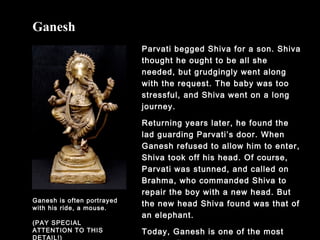
Parvati begged Shiva for a son. Shiva
thought he ought to be all she
needed, but grudgingly went along
with the request. The baby was too
stressful, and Shiva went on a long
journey.
Returning years later, he found the
lad guarding Parvati’s door. When
Ganesh refused to allow him to enter,
Shiva took off his head. Of course,
Parvati was stunned, and called on
Brahma, who commanded Shiva to
repair the boy with a new head. But
the new head Shiva found was that of
an elephant.
Today, Ganesh is one of the most
Ganesh
Ganesh is often portrayed
with his ride, a mouse.
(PAY SPECIAL
ATTENTION TO THIS
DETAIL!)
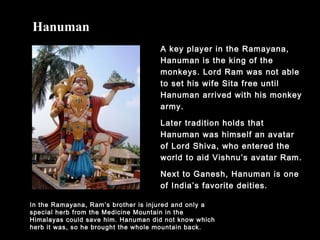
A key player in the Ramayana,
Hanuman is the king of the
monkeys. Lord Ram was not able
to set his wife Sita free until
Hanuman arrived with his monkey
army.
Later tradition holds that
Hanuman was himself an avatar
of Lord Shiva, who entered the
world to aid Vishnu’s avatar Ram.
Next to Ganesh, Hanuman is one
of India’s favorite deities.
Hanuman
In the Ramayana, Ram’s brother is injured and only a
special herb from the Medicine Mountain in the
Himalayas could save him. Hanuman did not know which
herb it was, so he brought the whole mountain back.
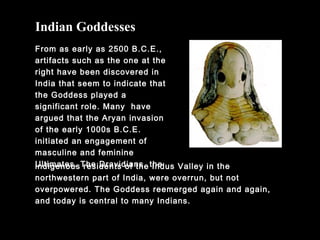
From as early as 2500 B.C.E.,
artifacts such as the one at the
right have been discovered in
India that seem to indicate that
the Goddess played a
significant role. Many have
argued that the Aryan invasion
of the early 1000s B.C.E.
initiated an engagement of
masculine and feminine
Ultimates. The Dravidians, the
Indian Goddesses
indigenous residents of the Indus Valley in the
northwestern part of India, were overrun, but not
overpowered. The Goddess reemerged again and again,
and today is central to many Indians.
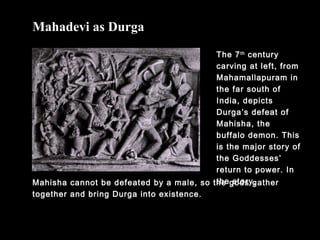
The 7th
century
carving at left, from
Mahamallapuram in
the far south of
India, depicts
Durga’s defeat of
Mahisha, the
buffalo demon. This
is the major story of
the Goddesses’
return to power. In
the story,
Mahadevi as Durga
Mahisha cannot be defeated by a male, so the gods gather
together and bring Durga into existence.
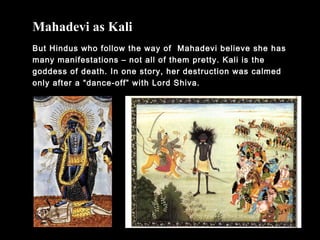
But Hindus who follow the way of Mahadevi believe she has
many manifestations – not all of them pretty. Kali is the
goddess of death. In one story, her destruction was calmed
only after a “dance-off” with Lord Shiva.
Mahadevi as Kali
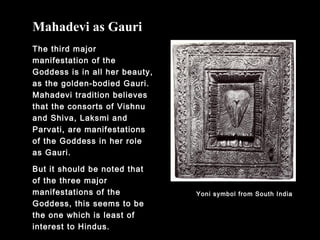
The third major
manifestation of the
Goddess is in all her beauty,
as the golden-bodied Gauri.
Mahadevi tradition believes
that the consorts of Vishnu
and Shiva, Laksmi and
Parvati, are manifestations
of the Goddess in her role
as Gauri.
But it should be noted that
of the three major
manifestations of the
Goddess, this seems to be
the one which is least of
interest to Hindus.
Mahadevi as Gauri
Yoni symbol from South India
Indra
Rudra
Agni
Kama
Yama
Varuna
Surya
Chandra
Usha
Rama
Krishna
Vayu
Soma
Ghandarva
Kartikeya
Ganga
and more …
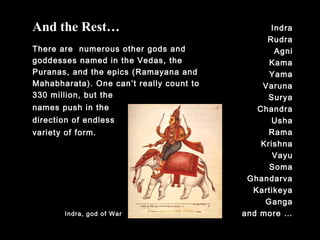
And the Rest…
There are numerous other gods and
goddesses named in the Vedas, the
Puranas, and the epics (Ramayana and
Mahabharata). One can’t really count to
330 million, but the
names push in the
direction of endless
variety of form.
Indra, god of War
The Puja
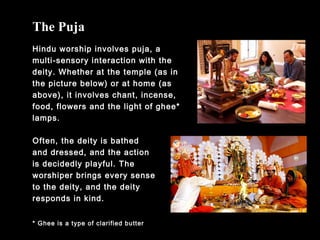
Hindu worship involves puja, a
multi-sensory interaction with the
deity. Whether at the temple (as in
the picture below) or at home (as
above), it involves chant, incense,
food, flowers and the light of ghee*
lamps.
* Ghee is a type of clarified butter
Often, the deity is bathed
and dressed, and the action
is decidedly playful. The
worshiper brings every sense
to the deity, and the deity
responds in kind.
The Puja
Hinduism does not have a
particular day of the week for
worship, such as Sunday for
Christians or Sabbath for Jews.
There is a daily cycle of care for
the deities, and special days to
celebrate birthdays (theirs and
ours) and special events (in their
own time on earth and in ours).
* Ghee is a type of clarified butter
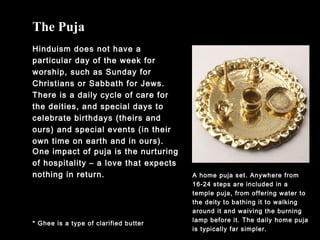
One impact of puja is the nurturing
of hospitality – a love that expects
nothing in return. A home puja set. Anywhere from
16-24 steps are included in a
temple puja, from offering water to
the deity to bathing it to walking
around it and waiving the burning
lamp before it. The daily home puja
is typically far simpler.
The Hindu Pantheon

The Hindu Pantheon

  • 1.
    The Hindu Pantheon WhileHinduism maintains the existence of only one Ultimate Reality (Brahman), it also maintains that one Ultimate Reality is experienced in a multiplicity of forms – 330 million gods.
  • 2.
    There are, traditionally, three godswho make up the core of the Hindu pantheon: Brahma, Vishnu and Shiva. These three represent the power of creation, preservation and destruction. The Trimurti The Trimurti as portrayed by Andrew Thomas. This is not, however, a Hindu version of “trinity.” It is a statement of “oneness as multiplicity.”
  • 3.
    Brahma is typicallyportrayed with four heads – indicating his all-knowing nature and the four vedas – and four hands, which hold various symbolic items. The celebration of Brahma is not as popular as it was, perhaps because of his ties to the sacrificial system (overseen, incidentally, by Brahmins). But it is noteworthy that Brahma is the only Hindu god mentioned by Siddhartha Gautama, the Buddha. Brahma Every major deity has a ride. Brahma is presented here with his swan.
  • 4.
    The worship ofVishnu is one of the three major paths of bhakti* -- the others being Shiva and Devi (the Goddess). Vishnu, as the overseer of cosmic order, has entered into the world ten times (or 22 or countless times, depending on the source), assuming form as a fish, a tortoise, boar, a man-lion and several humans, including Rama, Krishna, and even Buddha to deliver humanity from destruction. Of the Hindu pantheon, Vishnu is the figure that most resembles the god of Judaism and Christianity. Vishnu * That is, relating to the divine through devotion.
  • 5.
    Relatively late inthe history of Hinduism (ca. 200 B.C.E.), the epic poem the Mahabharata told the story of Lord Krishna. One section of that epic is known as the Bhagavad-gita, and many hold that it encapsulates all of modern Hinduism. In later tales, Krishna is portrayed as cosmic and playful, a fully engaged lover, both of Radha (and lots of milkmaids) and of humanity. Vishnu as Krishna The modern Hare Krishna movement is only the latest in devotional movements centered on Lord Krishna.
  • 6.
    Vishnu as Krishna InfantKrishna on the Cosmic Ocean. Krishna the flute playerIndonesian carving
  • 7.
    Shiva is theascetic god, but in Bhakti he is celebrated within his wild marriage to Parvati. His lingam (=phallus) is a central image in his temples. In his mythic tradition, his dreadlocks saved the world by breaking the Ganga’s waters into the seven sacred rivers. Shiva Shiva’s lingam is often portrayed in a base that represents Parvati’s yoni (vagina). This image from Mohenjo-daro (ca. 2000 B.C.E.) may be the earliest image of Shiva.
  • 8.
    One common portrayalof Shiva is as the dancer – Nataraj. He dances on the demon of ignorance. Shiva the Dancer He has two earrings, one male and one female, thus symbolizing both natures in his dance. He holds a drum, signifying the Creation through sound, and a flame, signifying his power to destroy – and purify.
  • 9.
    Each member ofthe Trimurti is associated with a consort. For Brahma, she is Sarasvati. Brahma had created Shatarupa for his own pleasure, but she did not share the interest. Brahma pursued her. As she changed form, he changed form, and he took her by force. He sprouted five heads in order to watch her. But Shiva was so angered by the lust, he wrenched off one of Brahma’s heads. At that point, Brahma returned to Sarasvati, who was then able to tame his wandering desire. She is the goddess of knowledge and the arts. The Consorts: Sarasvati
  • 10.
    Vishnu’s consort isLaksmi. She is the goddess of beauty, pleasure and wealth – and the mother of Kama, the god of desire. When she is associated with The Consorts: Laksmi Vishnu, she is known as Sri Devi – the Lord Goddess. Laksmi is widely celebrated in India. She was born of the churning of an ocean of milk, and after searching out the demons (who were too corrupt) and the gods (who were too obsessed with pleasure), she found Vishnu, who alone selflessly carried out his duty.
  • 11.
    Shiva’s consort isParvati. Born as a human, she was so devoted to Shiva that she eventually succeeded in winning him over as her husband. With Shiva she has two sons, Shanmukha and the elephant-headed Ganesha. But most surprisingly, she in time The Consorts: Parvati became known as Mahadevi – the great Goddess. As such, she came to rival her husband, Brahma and Vishnu for the devotion of the continent.
  • 12.
    Parvati begged Shivafor a son. Shiva thought he ought to be all she needed, but grudgingly went along with the request. The baby was too stressful, and Shiva went on a long journey. Returning years later, he found the lad guarding Parvati’s door. When Ganesh refused to allow him to enter, Shiva took off his head. Of course, Parvati was stunned, and called on Brahma, who commanded Shiva to repair the boy with a new head. But the new head Shiva found was that of an elephant. Today, Ganesh is one of the most Ganesh Ganesh is often portrayed with his ride, a mouse. (PAY SPECIAL ATTENTION TO THIS DETAIL!)
  • 13.
    A key playerin the Ramayana, Hanuman is the king of the monkeys. Lord Ram was not able to set his wife Sita free until Hanuman arrived with his monkey army. Later tradition holds that Hanuman was himself an avatar of Lord Shiva, who entered the world to aid Vishnu’s avatar Ram. Next to Ganesh, Hanuman is one of India’s favorite deities. Hanuman In the Ramayana, Ram’s brother is injured and only a special herb from the Medicine Mountain in the Himalayas could save him. Hanuman did not know which herb it was, so he brought the whole mountain back.
  • 14.
    From as earlyas 2500 B.C.E., artifacts such as the one at the right have been discovered in India that seem to indicate that the Goddess played a significant role. Many have argued that the Aryan invasion of the early 1000s B.C.E. initiated an engagement of masculine and feminine Ultimates. The Dravidians, the Indian Goddesses indigenous residents of the Indus Valley in the northwestern part of India, were overrun, but not overpowered. The Goddess reemerged again and again, and today is central to many Indians.
  • 15.
    The 7th century carving atleft, from Mahamallapuram in the far south of India, depicts Durga’s defeat of Mahisha, the buffalo demon. This is the major story of the Goddesses’ return to power. In the story, Mahadevi as Durga Mahisha cannot be defeated by a male, so the gods gather together and bring Durga into existence.
  • 16.
    But Hindus whofollow the way of Mahadevi believe she has many manifestations – not all of them pretty. Kali is the goddess of death. In one story, her destruction was calmed only after a “dance-off” with Lord Shiva. Mahadevi as Kali
  • 17.
    The third major manifestationof the Goddess is in all her beauty, as the golden-bodied Gauri. Mahadevi tradition believes that the consorts of Vishnu and Shiva, Laksmi and Parvati, are manifestations of the Goddess in her role as Gauri. But it should be noted that of the three major manifestations of the Goddess, this seems to be the one which is least of interest to Hindus. Mahadevi as Gauri Yoni symbol from South India
  • 18.
    Indra Rudra Agni Kama Yama Varuna Surya Chandra Usha Rama Krishna Vayu Soma Ghandarva Kartikeya Ganga and more … Andthe Rest… There are numerous other gods and goddesses named in the Vedas, the Puranas, and the epics (Ramayana and Mahabharata). One can’t really count to 330 million, but the names push in the direction of endless variety of form. Indra, god of War
  • 19.
    The Puja Hindu worshipinvolves puja, a multi-sensory interaction with the deity. Whether at the temple (as in the picture below) or at home (as above), it involves chant, incense, food, flowers and the light of ghee* lamps. * Ghee is a type of clarified butter Often, the deity is bathed and dressed, and the action is decidedly playful. The worshiper brings every sense to the deity, and the deity responds in kind.
  • 20.
    The Puja Hinduism doesnot have a particular day of the week for worship, such as Sunday for Christians or Sabbath for Jews. There is a daily cycle of care for the deities, and special days to celebrate birthdays (theirs and ours) and special events (in their own time on earth and in ours). * Ghee is a type of clarified butter One impact of puja is the nurturing of hospitality – a love that expects nothing in return. A home puja set. Anywhere from 16-24 steps are included in a temple puja, from offering water to the deity to bathing it to walking around it and waiving the burning lamp before it. The daily home puja is typically far simpler.