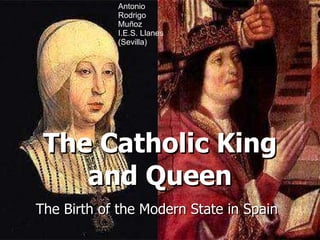
The Catholic King and Queen The Birth of the Modern State in Spain Antonio Rodrigo Muñoz I.E.S. Llanes (Sevilla)
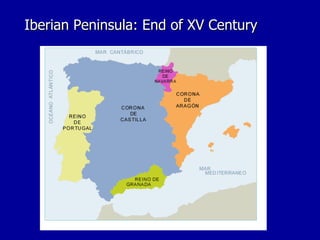
Iberian Peninsula: End of XV Century
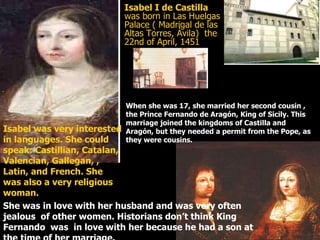
Isabel I de Castilla  was born in Las Huelgas Palace ( Madrigal de las Altas Torres, Ávila)  the 22nd of April, 1451 Isabel was very interested in languages. She could speak: Castillian, Catalan, Valencian, Gallegan, , Latin, and French. She was also a very religious woman.  When she was 17, she married her second cousin , the Prince Fernando de Aragón, King of Sicily. This marriage joined the kingdoms of Castilla and  Aragón, but they needed a permit from the Pope, as they were cousins. She was in love with her husband and was very often jealous  of other women. Historians don’t think King Fernando  was  in love with her because he had a son at the time of her marriage.
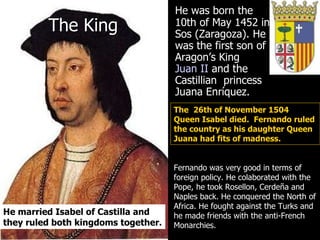
The King He was born the 10th of May 1452 in Sos (Zaragoza). He was the first son of Aragon’s King  Juan II  and the Castillian  princess Juana Enríquez. Fernando was very good in terms of foreign policy. He colaborated with the Pope, he took Rosellon, Cerdeña and Naples back. He conquered the North of Africa. He fought against the Turks and he made friends with the anti-French Monarchies.  He married Isabel of Castilla and they ruled both kingdoms together.  The  26th of November 1504  Queen Isabel died.  Fernando ruled the country as his daughter Queen Juana had fits of madness.
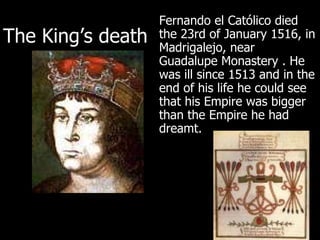
Fernando el Católico died the 23rd of January 1516, in Madrigalejo, near Guadalupe Monastery . He was ill since 1513 and in the end of his life he could see that his Empire was bigger than the Empire he had dreamt. The King’s death
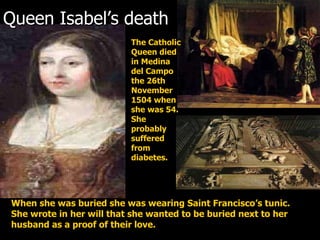
Queen Isabel’s death  The Catholic Queen died in Medina del Campo the 26th November 1504 when she was 54. She probably suffered from diabetes.   When she was buried she was wearing Saint Francisco’s tunic. She wrote in her will that she wanted to be buried next to her husband as a proof of their love.
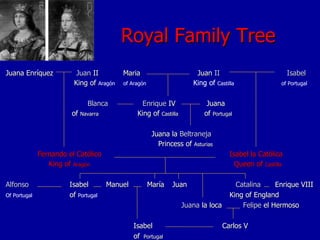
Royal Family Tree  Juana Enríquez   Juan  II  Maria    Juan  II   Isabel     King of  Aragón  of Aragón   King of  Castilla   of Portugal   Blanca     Enrique  IV   Juana   of  Navarra   King of  Castilla   of  Portugal   Juana la  Beltraneja   Princess of  Asturias Fernando el Católico Isabel la Católica   King of  Aragón   Queen of  Castilla Alfonso Isabel   Manuel   María   Juan   Catalina   Enrique VIII Of Portugal   of  Portugal         King of England    Juana  la loca   Felipe  el Hermoso Isabel   Carlos V of  Portugal
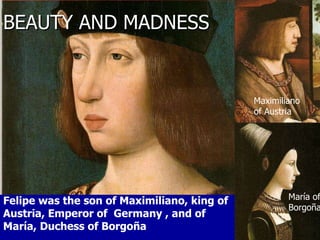
BEAUTY AND MADNESS Felipe was the son of Maximiliano, king of Austria, Emperor of  Germany , and of María, Duchess of Borgoña  Maximiliano of Austria María of Borgoña
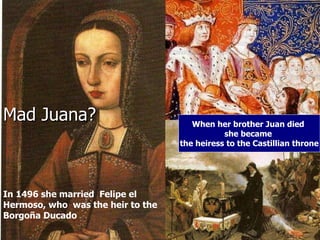
Mad Juana?  When her brother Juan died  she became  the heiress to the Castillian throne In 1496 she married  Felipe el Hermoso, who  was the heir to the Borgoña Ducado
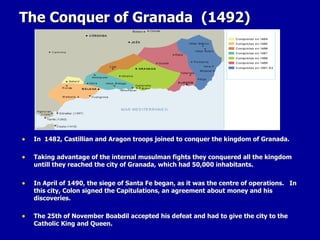
The Conquer of Granada  (1492) In  1482, Castillian and Aragon troops joined to conquer the kingdom of Granada. Taking advantage of the internal musulman fights they conquered all the kingdom untill they reached the city of Granada, which had 50,000 inhabitants. In April of 1490, the siege of Santa Fe began, as it was the centre of operations.  In this city, Colon signed the Capitulations, an agreement about money and his discoveries. The 25th of November Boabdil accepted his defeat and had to give the city to the Catholic King and Queen.
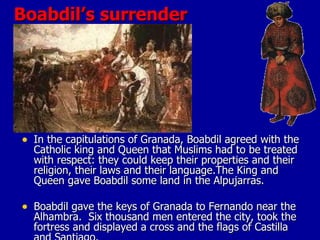
Boabdil’s surrender In the capitulations of Granada, Boabdil agreed with the Catholic king and Queen that Muslims had to be treated with respect: they could keep their properties and their religion, their laws and their language.The King and Queen gave Boabdil some land in the Alpujarras.  Boabdil gave the keys of Granada to Fernando near the Alhambra.  Six thousand men entered the city, took the fortress and displayed a cross and the flags of Castilla and Santiago.
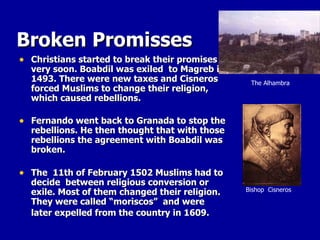
Broken Promisses Christians started to break their promises very soon. Boabdil was exiled  to Magreb in 1493. There were new taxes and Cisneros forced Muslims to change their religion, which caused rebellions.  Fernando went back to Granada to stop the rebellions. He then thought that with those rebellions the agreement with Boabdil was broken.  The  11th of February 1502 Muslims had to decide  between religious conversion or exile. Most of them changed their religion. They were called “moriscos”  and were later expelled from the country in 1609.   Bishop  Cisneros The Alhambra
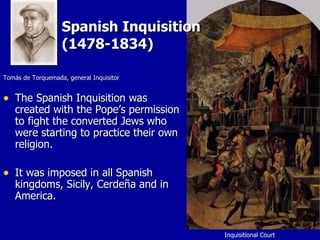
Spanish Inquisition  (1478-1834) Tomás de Torquemada, general Inquisitor The Spanish Inquisition was created with the Pope’s permission to fight the converted Jews who were starting to practice their own religion. It was imposed in all Spanish kingdoms, Sicily, Cerdeña and in America. Inquisitional Court
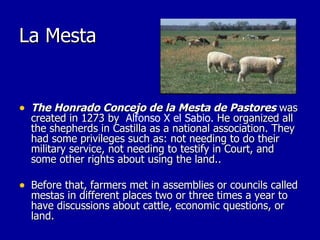
La Mesta The Honrado Concejo de la Mesta de Pastores  was created in 1273 by  Alfonso X el Sabio.  He organized all the shepherds in Castilla as a national association. They had some privileges such as: not needing to do their military service, not needing to testify in Court, and  some other rights about using the land.. Before that, farmers met in assemblies or councils called mestas in different places two or three times a year to have discussions about cattle, economic questions, or land.
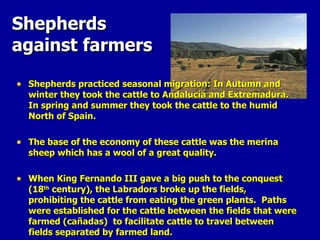
Shepherds against farmers  Shepherds practiced seasonal migration: In Autumn and winter they took the cattle to Andalucía and Extremadura. In spring and summer they took the cattle to the humid North of Spain. The base of the economy of these cattle was the merina sheep which has a wool of a great quality. When King Fernando III gave a big push to the conquest (18 th  century), the Labradors broke up the fields, prohibiting the cattle from eating the green plants.  Paths were established for the cattle between the fields that were farmed (cañadas)  to facilitate cattle to travel between fields separated by farmed land.
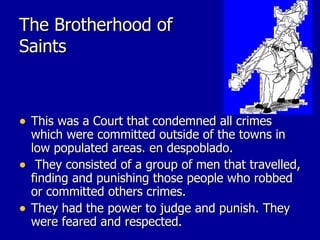
The Brotherhood of Saints This was a Court that condemned all crimes which were committed outside of the towns in low populated areas. en despoblado. They consisted of a group of men that travelled, finding and punishing those people who robbed or committed others crimes.  They had the power to judge and punish. They were feared and respected.
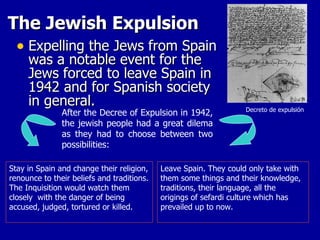
The Jewish Expulsion Expelling the Jews from Spain was a notable event for the Jews forced to leave Spain in 1942 and for Spanish society in general.  After the Decree of Expulsion in 1942, the jewish people had a great dilema as they had to choose between two possibilities:  Stay in Spain and change their religion, renounce to their beliefs and traditions. The Inquisition would watch them closely  with the danger of being accused, judged, tortured or killed.  Leave Spain. They could only take with them some things and their knowledge, traditions, their language, all the origings of sefardi culture which has prevailed up to now.  Decreto de expulsión
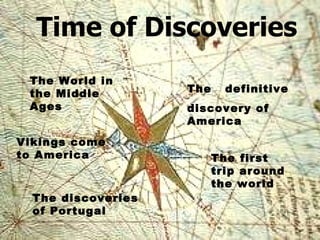
Time of Discoveries The World in the Middle Ages Vikings come to America The discoveries  of Portugal The  definitive discovery of America The first trip around the world
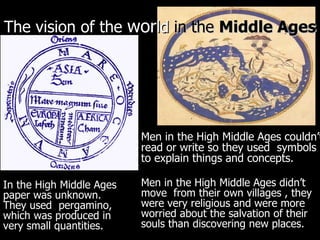
The vision of the  wor ld  in   the  Middle Ages Men in the High Middle Ages couldn’t read or write so they used  symbols to explain things and concepts.   Men in the High Middle Ages didn’t move  from their own villages , they were very religious and were more worried about the salvation of their souls than discovering new places. In the High Middle Ages paper was unknown. They used  pergamino, which was produced in very small quantities.
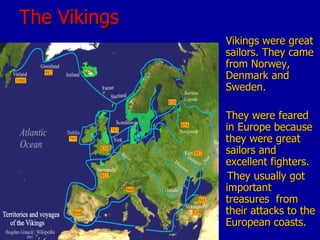
The Vikings Vikings were great sailors. They came from Norwey, Denmark and Sweden. They were feared in Europe because they were great sailors and excellent fighters. They usually got important treasures  from their attacks to the European coasts.
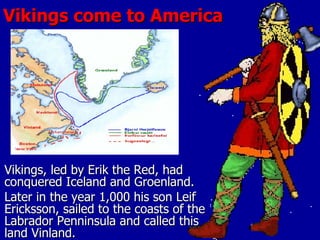
Vikings come to America Vikings, led by Erik the Red, had conquered Iceland and Groenland. Later in the year 1,000 his son Leif Ericksson, sailed to the coasts of the Labrador Penninsula and called this land Vinland.
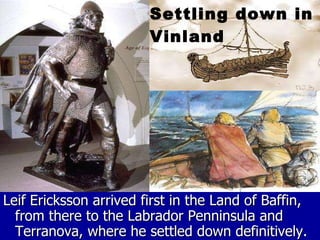
Leif Ericksson arrived first in the Land of Baffin, from there to the Labrador Penninsula and Terranova, where he settled down definitively. Settling down in Vinland
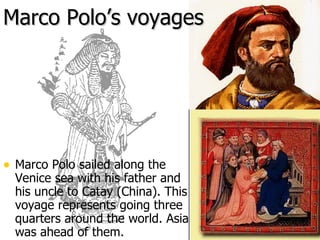
Marco Polo’s voyages Marco Polo sailed along the Venice sea with his father and his uncle to Catay (China). This voyage represents going three quarters around the world. Asia was ahead of them.
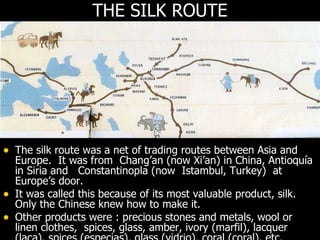
THE SILK ROUTE  The silk route was a net of trading routes between Asia and Europe.  It was from  Chang’an (now Xi’an) in China, Antioquía in Siria and  Constantinopla (now  Istambul, Turkey)  at Europe’s door. It was called this because of its most valuable product, silk. Only the Chinese knew how to make it. Other products were : precious stones and metals, wool or linen clothes,  spices, glass, amber, ivory (marfil), lacquer (laca), spices (especias), glass (vidrio), coral (coral), etc.
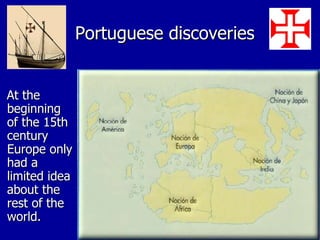
Portuguese discoveries At the beginning of the 15th century Europe only had a limited idea about the rest of the world.
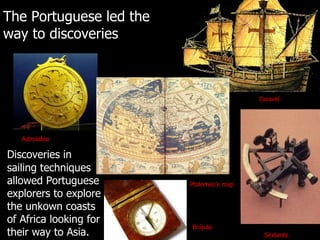
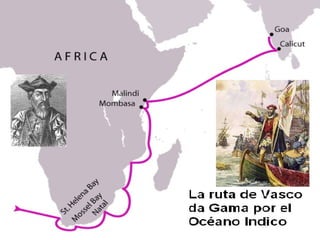
The Portuguese led the way to discoveries Discoveries in sailing techniques allowed Portuguese explorers to explore the unkown coasts of Africa looking for their way to Asia. Astrolabio Ptolomeo’s map Brújula Sextante Caravel
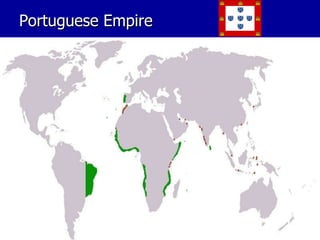
Portuguese Empire
El Imperio portugués 1427. Islas Azores 1488. Cabo de Buena Esperanza. Bartolomé Díaz 1535. Macao
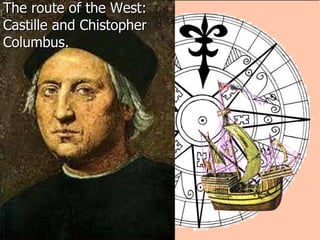
The route of the West: Castille and Chistopher Columbus.
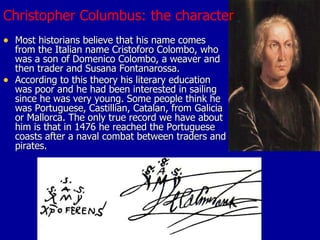
Christopher Columbus: the character Most historians believe that his name comes from the Italian name Cristoforo Colombo, who was a son of Domenico Colombo, a weaver and then trader and Susana Fontanarossa.  According to this theory his literary education  was poor and he had been interested in sailing since he was very young. Some people think he was Portuguese, Castillian, Catalan, from Galicia or Mallorca. The only true record we have about him is that in 1476 he reached the Portuguese coasts after a naval combat between traders and pirates.
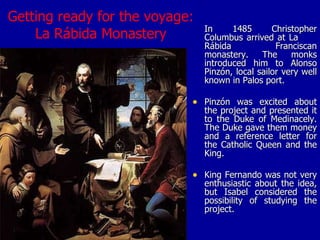
Getting ready for the voyage: La Rábida Monastery In 1485 Christopher Columbus arrived at La  Rábida Franciscan monastery. The monks introduced him to Alonso Pinzón, local sailor very well known in Palos port.  Pinzón was excited about the project and presented it to the Duke of Medinacely. The Duke gave them money and a reference letter for the Catholic Queen and the King.  King Fernando was not very enthusiastic about the idea, but Isabel considered the possibility of studying the project.
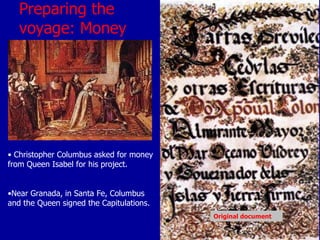
Preparing the voyage: Money Christopher Columbus asked for money from Queen Isabel for his project. Near Granada, in Santa Fe, Columbus and the Queen signed the Capitulations. Original document
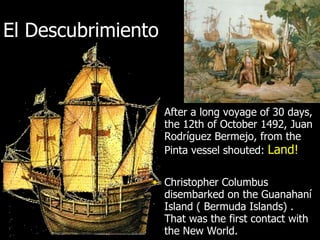
El Descubrimiento After a long voyage of 30 days, the 12th of October 1492, Juan Rodríguez Bermejo, from the Pinta vessel shouted:  Land! Christopher Columbus disembarked on the Guanahaní Island ( Bermuda Islands) . That was the first contact with  the New World.
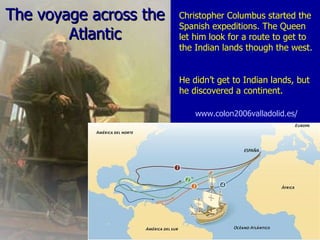
The voyage across the  Atlantic   Christopher Columbus started the Spanish expeditions. The Queen let him look for a route to get to the Indian lands though the west.  He didn’t get to Indian lands, but he discovered a continent. www.colon2006valladolid.es/
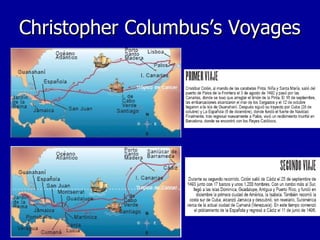
Christopher Columbus’s Voyages
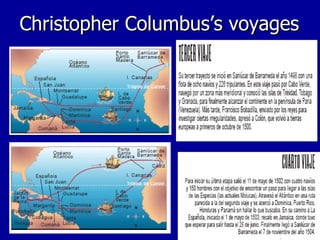
Christopher Columbus’s voyages
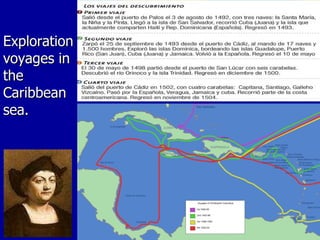
Exploration voyages in the Caribbean sea.
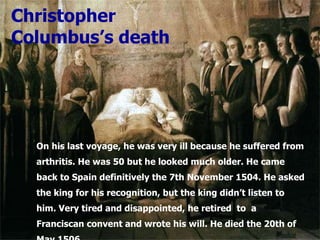
On his last voyage, he was very ill because he suffered from arthritis. He was 50 but he looked much older. He came back to Spain definitively the 7th November 1504. He asked the king for his recognition, but the king didn’t listen to him. Very tired and disappointed, he retired  to  a Franciscan convent and wrote his will. He died the 20th of May 1506. Christopher Columbus’s death
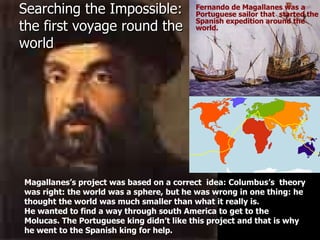
Searching the Impossible: the first voyage round the world Fernando de Magallanes was a Portuguese sailor that  started the Spanish expedition around the world.  Magallanes’s project was based on a correct  idea: Columbus’s  theory was right: the world was a sphere, but he was wrong in one thing: he thought the world was much smaller than what it really is. He wanted to find a way through south America to get to the Molucas. The Portuguese king didn’t like this project and that is why he went to the Spanish king for help.
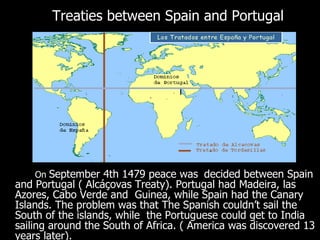
Treaties between Spain and Portugal On  September 4th 1479 peace was   decided between Spain and Portugal ( Alcáçovas Treaty). Portugal had Madeira, las Azores, Cabo Verde and  Guinea, while Spain had the Canary Islands. The problem was that The Spanish couldn’t sail the South of the islands, while  the Portuguese could get to India sailing around the South of Africa. ( America was discovered 13 years later).
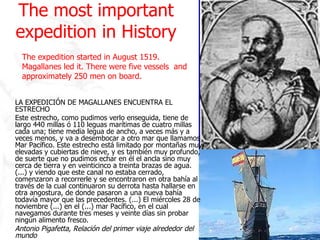
The most important expedition in History LA EXPEDICIÓN DE MAGALLANES ENCUENTRA EL ESTRECHO Este estrecho, como pudimos verlo enseguida, tiene de largo 440 millas ó 110 leguas marítimas de cuatro millas cada una; tiene media legua de ancho, a veces más y a veces menos, y va a desembocar a otro mar que llamamos Mar Pacífico. Este estrecho está limitado por montañas muy elevadas y cubiertas de nieve, y es también muy profundo, de suerte que no pudimos echar en él el ancla sino muy cerca de tierra y en veinticinco a treinta brazas de agua. (...) y viendo que este canal no estaba cerrado, comenzaron a recorrerle y se encontraron en otra bahía al través de la cual continuaron su derrota hasta hallarse en otra angostura, de donde pasaron a una nueva bahía todavía mayor que las precedentes. (...) El miércoles 28 de noviembre (...) en el (...) mar Pacífico, en el cual navegamos durante tres meses y veinte días sin probar ningún alimento fresco. Antonio Pigafetta, Relación del primer viaje alrededor del mundo The expedition started in August 1519. Magallanes led it. There were five vessels  and approximately 250 men on board.
The Voyage across the Pacific Ocean http:// olmo.pntic.mec.es/jtac0001/historia/exploradores/circunnavega.htm # The expedition continued. Elcano, a Spanish sailor,  led it: He reached Molucas Islands and then he sailed  back through the “Portuguese route” (dangerous for a Spanish expedition) across the Indian Ocean and the around Africa. Finally he reached Spain  in September.  Five vessels started the expedition and only one, The Victoria,  completed the voyage around the world. Only 18 men went back. When they were sailing the ocean  ( they named it Pacific) they thought the voyage to Asia was going to be short. The expedition travelled for three months across the Pacific in very difficult conditions as they had very little food and they never saw land.  Lots of the sailors fell ill because they didn’t eat fresh food and died. In desperate conditions the expedition reached the  Isle of Guam in January 1521 and later sailed towards Asia again.

The Catholic King and Queen

  • 1.
    The Catholic Kingand Queen The Birth of the Modern State in Spain Antonio Rodrigo Muñoz I.E.S. Llanes (Sevilla)
  • 2.
  • 3.
    Isabel I deCastilla was born in Las Huelgas Palace ( Madrigal de las Altas Torres, Ávila) the 22nd of April, 1451 Isabel was very interested in languages. She could speak: Castillian, Catalan, Valencian, Gallegan, , Latin, and French. She was also a very religious woman. When she was 17, she married her second cousin , the Prince Fernando de Aragón, King of Sicily. This marriage joined the kingdoms of Castilla and Aragón, but they needed a permit from the Pope, as they were cousins. She was in love with her husband and was very often jealous of other women. Historians don’t think King Fernando was in love with her because he had a son at the time of her marriage.
  • 4.
    The King Hewas born the 10th of May 1452 in Sos (Zaragoza). He was the first son of Aragon’s King Juan II and the Castillian princess Juana Enríquez. Fernando was very good in terms of foreign policy. He colaborated with the Pope, he took Rosellon, Cerdeña and Naples back. He conquered the North of Africa. He fought against the Turks and he made friends with the anti-French Monarchies. He married Isabel of Castilla and they ruled both kingdoms together. The 26th of November 1504 Queen Isabel died. Fernando ruled the country as his daughter Queen Juana had fits of madness.
  • 5.
    Fernando el Católicodied the 23rd of January 1516, in Madrigalejo, near Guadalupe Monastery . He was ill since 1513 and in the end of his life he could see that his Empire was bigger than the Empire he had dreamt. The King’s death
  • 6.
    Queen Isabel’s death The Catholic Queen died in Medina del Campo the 26th November 1504 when she was 54. She probably suffered from diabetes. When she was buried she was wearing Saint Francisco’s tunic. She wrote in her will that she wanted to be buried next to her husband as a proof of their love.
  • 7.
    Royal Family Tree Juana Enríquez Juan II Maria Juan II Isabel King of Aragón of Aragón King of Castilla of Portugal Blanca Enrique IV Juana of Navarra King of Castilla of Portugal Juana la Beltraneja Princess of Asturias Fernando el Católico Isabel la Católica King of Aragón Queen of Castilla Alfonso Isabel Manuel María Juan Catalina Enrique VIII Of Portugal of Portugal King of England Juana la loca Felipe el Hermoso Isabel Carlos V of Portugal
  • 8.
    BEAUTY AND MADNESSFelipe was the son of Maximiliano, king of Austria, Emperor of Germany , and of María, Duchess of Borgoña Maximiliano of Austria María of Borgoña
  • 9.
    Mad Juana? When her brother Juan died she became the heiress to the Castillian throne In 1496 she married Felipe el Hermoso, who was the heir to the Borgoña Ducado
  • 10.
    The Conquer ofGranada (1492) In 1482, Castillian and Aragon troops joined to conquer the kingdom of Granada. Taking advantage of the internal musulman fights they conquered all the kingdom untill they reached the city of Granada, which had 50,000 inhabitants. In April of 1490, the siege of Santa Fe began, as it was the centre of operations. In this city, Colon signed the Capitulations, an agreement about money and his discoveries. The 25th of November Boabdil accepted his defeat and had to give the city to the Catholic King and Queen.
  • 11.
    Boabdil’s surrender Inthe capitulations of Granada, Boabdil agreed with the Catholic king and Queen that Muslims had to be treated with respect: they could keep their properties and their religion, their laws and their language.The King and Queen gave Boabdil some land in the Alpujarras. Boabdil gave the keys of Granada to Fernando near the Alhambra. Six thousand men entered the city, took the fortress and displayed a cross and the flags of Castilla and Santiago.
  • 12.
    Broken Promisses Christiansstarted to break their promises very soon. Boabdil was exiled to Magreb in 1493. There were new taxes and Cisneros forced Muslims to change their religion, which caused rebellions. Fernando went back to Granada to stop the rebellions. He then thought that with those rebellions the agreement with Boabdil was broken. The 11th of February 1502 Muslims had to decide between religious conversion or exile. Most of them changed their religion. They were called “moriscos” and were later expelled from the country in 1609. Bishop Cisneros The Alhambra
  • 13.
    Spanish Inquisition (1478-1834) Tomás de Torquemada, general Inquisitor The Spanish Inquisition was created with the Pope’s permission to fight the converted Jews who were starting to practice their own religion. It was imposed in all Spanish kingdoms, Sicily, Cerdeña and in America. Inquisitional Court
  • 14.
    La Mesta TheHonrado Concejo de la Mesta de Pastores was created in 1273 by Alfonso X el Sabio. He organized all the shepherds in Castilla as a national association. They had some privileges such as: not needing to do their military service, not needing to testify in Court, and some other rights about using the land.. Before that, farmers met in assemblies or councils called mestas in different places two or three times a year to have discussions about cattle, economic questions, or land.
  • 15.
    Shepherds against farmers Shepherds practiced seasonal migration: In Autumn and winter they took the cattle to Andalucía and Extremadura. In spring and summer they took the cattle to the humid North of Spain. The base of the economy of these cattle was the merina sheep which has a wool of a great quality. When King Fernando III gave a big push to the conquest (18 th century), the Labradors broke up the fields, prohibiting the cattle from eating the green plants. Paths were established for the cattle between the fields that were farmed (cañadas) to facilitate cattle to travel between fields separated by farmed land.
  • 16.
    The Brotherhood ofSaints This was a Court that condemned all crimes which were committed outside of the towns in low populated areas. en despoblado. They consisted of a group of men that travelled, finding and punishing those people who robbed or committed others crimes. They had the power to judge and punish. They were feared and respected.
  • 17.
    The Jewish ExpulsionExpelling the Jews from Spain was a notable event for the Jews forced to leave Spain in 1942 and for Spanish society in general. After the Decree of Expulsion in 1942, the jewish people had a great dilema as they had to choose between two possibilities: Stay in Spain and change their religion, renounce to their beliefs and traditions. The Inquisition would watch them closely with the danger of being accused, judged, tortured or killed. Leave Spain. They could only take with them some things and their knowledge, traditions, their language, all the origings of sefardi culture which has prevailed up to now. Decreto de expulsión
  • 18.
    Time of DiscoveriesThe World in the Middle Ages Vikings come to America The discoveries of Portugal The definitive discovery of America The first trip around the world
  • 19.
    The vision ofthe wor ld in the Middle Ages Men in the High Middle Ages couldn’t read or write so they used symbols to explain things and concepts. Men in the High Middle Ages didn’t move from their own villages , they were very religious and were more worried about the salvation of their souls than discovering new places. In the High Middle Ages paper was unknown. They used pergamino, which was produced in very small quantities.
  • 20.
    The Vikings Vikingswere great sailors. They came from Norwey, Denmark and Sweden. They were feared in Europe because they were great sailors and excellent fighters. They usually got important treasures from their attacks to the European coasts.
  • 21.
    Vikings come toAmerica Vikings, led by Erik the Red, had conquered Iceland and Groenland. Later in the year 1,000 his son Leif Ericksson, sailed to the coasts of the Labrador Penninsula and called this land Vinland.
  • 22.
    Leif Ericksson arrivedfirst in the Land of Baffin, from there to the Labrador Penninsula and Terranova, where he settled down definitively. Settling down in Vinland
  • 23.
    Marco Polo’s voyagesMarco Polo sailed along the Venice sea with his father and his uncle to Catay (China). This voyage represents going three quarters around the world. Asia was ahead of them.
  • 24.
    THE SILK ROUTE The silk route was a net of trading routes between Asia and Europe. It was from Chang’an (now Xi’an) in China, Antioquía in Siria and Constantinopla (now Istambul, Turkey) at Europe’s door. It was called this because of its most valuable product, silk. Only the Chinese knew how to make it. Other products were : precious stones and metals, wool or linen clothes, spices, glass, amber, ivory (marfil), lacquer (laca), spices (especias), glass (vidrio), coral (coral), etc.
  • 25.
    Portuguese discoveries Atthe beginning of the 15th century Europe only had a limited idea about the rest of the world.
  • 26.
    The Portuguese ledthe way to discoveries Discoveries in sailing techniques allowed Portuguese explorers to explore the unkown coasts of Africa looking for their way to Asia. Astrolabio Ptolomeo’s map Brújula Sextante Caravel
  • 27.
  • 28.
    El Imperio portugués1427. Islas Azores 1488. Cabo de Buena Esperanza. Bartolomé Díaz 1535. Macao
  • 29.
    The route ofthe West: Castille and Chistopher Columbus.
  • 30.
    Christopher Columbus: thecharacter Most historians believe that his name comes from the Italian name Cristoforo Colombo, who was a son of Domenico Colombo, a weaver and then trader and Susana Fontanarossa. According to this theory his literary education was poor and he had been interested in sailing since he was very young. Some people think he was Portuguese, Castillian, Catalan, from Galicia or Mallorca. The only true record we have about him is that in 1476 he reached the Portuguese coasts after a naval combat between traders and pirates.
  • 31.
    Getting ready forthe voyage: La Rábida Monastery In 1485 Christopher Columbus arrived at La Rábida Franciscan monastery. The monks introduced him to Alonso Pinzón, local sailor very well known in Palos port. Pinzón was excited about the project and presented it to the Duke of Medinacely. The Duke gave them money and a reference letter for the Catholic Queen and the King. King Fernando was not very enthusiastic about the idea, but Isabel considered the possibility of studying the project.
  • 32.
    Preparing the voyage:Money Christopher Columbus asked for money from Queen Isabel for his project. Near Granada, in Santa Fe, Columbus and the Queen signed the Capitulations. Original document
  • 33.
    El Descubrimiento Aftera long voyage of 30 days, the 12th of October 1492, Juan Rodríguez Bermejo, from the Pinta vessel shouted: Land! Christopher Columbus disembarked on the Guanahaní Island ( Bermuda Islands) . That was the first contact with the New World.
  • 34.
    The voyage acrossthe Atlantic Christopher Columbus started the Spanish expeditions. The Queen let him look for a route to get to the Indian lands though the west. He didn’t get to Indian lands, but he discovered a continent. www.colon2006valladolid.es/
  • 35.
  • 36.
  • 37.
    Exploration voyages inthe Caribbean sea.
  • 38.
    On his lastvoyage, he was very ill because he suffered from arthritis. He was 50 but he looked much older. He came back to Spain definitively the 7th November 1504. He asked the king for his recognition, but the king didn’t listen to him. Very tired and disappointed, he retired to a Franciscan convent and wrote his will. He died the 20th of May 1506. Christopher Columbus’s death
  • 39.
    Searching the Impossible:the first voyage round the world Fernando de Magallanes was a Portuguese sailor that started the Spanish expedition around the world. Magallanes’s project was based on a correct idea: Columbus’s theory was right: the world was a sphere, but he was wrong in one thing: he thought the world was much smaller than what it really is. He wanted to find a way through south America to get to the Molucas. The Portuguese king didn’t like this project and that is why he went to the Spanish king for help.
  • 40.
    Treaties between Spainand Portugal On September 4th 1479 peace was decided between Spain and Portugal ( Alcáçovas Treaty). Portugal had Madeira, las Azores, Cabo Verde and Guinea, while Spain had the Canary Islands. The problem was that The Spanish couldn’t sail the South of the islands, while the Portuguese could get to India sailing around the South of Africa. ( America was discovered 13 years later).
  • 41.
    The most importantexpedition in History LA EXPEDICIÓN DE MAGALLANES ENCUENTRA EL ESTRECHO Este estrecho, como pudimos verlo enseguida, tiene de largo 440 millas ó 110 leguas marítimas de cuatro millas cada una; tiene media legua de ancho, a veces más y a veces menos, y va a desembocar a otro mar que llamamos Mar Pacífico. Este estrecho está limitado por montañas muy elevadas y cubiertas de nieve, y es también muy profundo, de suerte que no pudimos echar en él el ancla sino muy cerca de tierra y en veinticinco a treinta brazas de agua. (...) y viendo que este canal no estaba cerrado, comenzaron a recorrerle y se encontraron en otra bahía al través de la cual continuaron su derrota hasta hallarse en otra angostura, de donde pasaron a una nueva bahía todavía mayor que las precedentes. (...) El miércoles 28 de noviembre (...) en el (...) mar Pacífico, en el cual navegamos durante tres meses y veinte días sin probar ningún alimento fresco. Antonio Pigafetta, Relación del primer viaje alrededor del mundo The expedition started in August 1519. Magallanes led it. There were five vessels and approximately 250 men on board.
  • 42.
    The Voyage acrossthe Pacific Ocean http:// olmo.pntic.mec.es/jtac0001/historia/exploradores/circunnavega.htm # The expedition continued. Elcano, a Spanish sailor, led it: He reached Molucas Islands and then he sailed back through the “Portuguese route” (dangerous for a Spanish expedition) across the Indian Ocean and the around Africa. Finally he reached Spain in September. Five vessels started the expedition and only one, The Victoria, completed the voyage around the world. Only 18 men went back. When they were sailing the ocean ( they named it Pacific) they thought the voyage to Asia was going to be short. The expedition travelled for three months across the Pacific in very difficult conditions as they had very little food and they never saw land. Lots of the sailors fell ill because they didn’t eat fresh food and died. In desperate conditions the expedition reached the Isle of Guam in January 1521 and later sailed towards Asia again.