A. S. U. Dharmadasa
HISTORY OF FILM EDITING
A.S.U.Dharmadasa dharmadasaasu@gmail.com
Contents
Film Editing..............................................................................................................................................2
Beginners of the Editing..........................................................................................................................2
Lumiere Brothers ................................................................................................................................2
George Melies`s ..................................................................................................................................2
Edwin Porter .......................................................................................................................................2
D.W. Griffith........................................................................................................................................3
Vsevolod I. Pudovkin...........................................................................................................................3
Dziga Vertov........................................................................................................................................4
Erich von Stroheim..............................................................................................................................4
Film Editing Equipment...........................................................................................................................5
Splicers ................................................................................................................................................5
Movieola ............................................................................................................................................5
Flat Beds..............................................................................................................................................5
Non Linear Video Editing ....................................................................................................................5
References ..............................................................................................................................................6
A.S.U.Dharmadasa dharmadasaasu@gmail.com
Film Editing
Film editing is a technical part of the post-production process of filmmaking. In the beginning of
Films, Editing was not there. All films were black and white and all are less than a minute. The editing
process can involve correction, condensation, organization, and many other modifications
performed with an intention of producing a correct, consistent, accurate and complete work.
Beginners of the Editing
Lumiere Brothers were the first ever movie creators. They began to open theoters in
various states to show their films. Started the film industry in the world with 1895, the film
called l’Usine Lumie`re, Arrive`e d’un Train en Gare, The Kiss (1896) and George Melies
production of Cinderella.
George Melies`s Films grew to a length of 14 minutes when other
films were shorten to single shots. A trip to moon produced by George
Melies is more than a single shot. It tells a story. With this film Edwin
Porter started the editing and he discovered that shot is the basic
building block of the film.
Edwin Porter can be defined as the first film editor and his The Life of an American
Fireman is made up of 20 shots. It has been shooting in two different
locations. The film was about a fireman rescuing mother and child
from a burning building. It was 6 minutes long film and inside this 6
minutes he shows how the mother and son was saved from the fire by
help of fireman.
Then in 1903 The Great Train Robbery tells the story of train robbery and the consequent
fate of the robbers in 12 minutes with 14 shots. The films ends with a gunshot fired directly
to the audience and there are no match cutting but there are location changes and time
A.S.U.Dharmadasa dharmadasaasu@gmail.com
changes in the film with only straight cuts rather than dissolves and fades which are
developed later. The edits used were cutting by using a splicing machine.
The Edwin`s contribution to editing was the arrangement of shots to present a narrative
continuity.
D.W. Griffith is called as the father of film editing in modern
sense. He construct a variation of shots as, Extreme long shot,
Close up, Cutaway, tracking shot, Parallel editing and variations
in pace. Beginning of the time he attempt to move the camera
closer to action and in 1908 In The Greaser`s Gauntlet he cut
from a long shot of hanging tree to a full body shot of the man
thanking the woman. Through the match cutting of the two shots the audience admitted
the scene at an instant emotion. With Enoch Arden in 1908 Griffith demonstrated that a
scene could be fragmented into long, medium and close shots to allow audience to move
gradually into emotional heart of the scene. Finally Griffith experimented about film length.
With his experiments, first he begins with two-reelers (20 to 32 minutes) in 1912. And
succeed with 53 minute long film called La Reine Elizabeth in 1912.
Griffith`s most contributed films can be named as The Birth of Nation in 1915 and the Intole
rance in 1916. Both films last more than two hours. The Birth of Nation originally conceived
of as a 12 reel film with 1544 separate shots.
Vsevolod I. Pudovkin was experimented on the basic building blocks. They took a single
shot of actor Ivan Mosjukhim and place three of same shot in between
the follow up shots: a plate of soup, a shot of a coffin containing a
dead woman, and a child playing a toy. Audience responses to the
three sequences suggested a hungry person, a sad husband, and a
joyful adult, yet the first shot was always same.
A.S.U.Dharmadasa dharmadasaasu@gmail.com
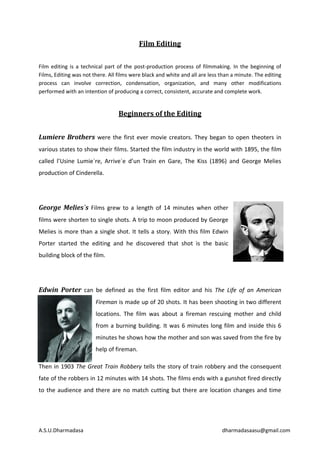
Sergei Eisenstein was the second of the key Russian
filmmakers. Beginning with the Strike (1924), Eisenstein
attempted to theorize about film editing as a clash of
images and ideas. The principles of the dialectic were
particularly suitable for subjects related to pre-
revolutionary and revolutionary issues and events. Sergei
is the person who makes the theories to practical in Montage films. He mainly focused in to
main five components of montages as, Metric montage, rhythmic montage, tonal montage,
over tonal montage, and intellectual montage.
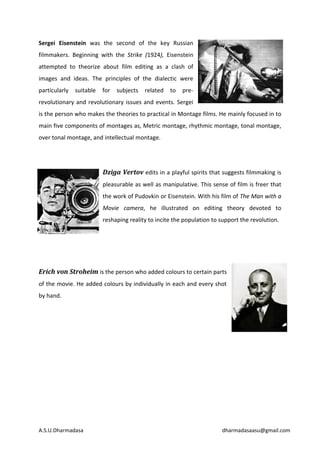
Dziga Vertov edits in a playful spirits that suggests filmmaking is
pleasurable as well as manipulative. This sense of film is freer that
the work of Pudovkin or Eisenstein. With his film of The Man with a
Movie camera, he illustrated on editing theory devoted to
reshaping reality to incite the population to support the revolution.
Erich von Stroheim is the person who added colours to certain parts
of the movie. He added colours by individually in each and every shot
by hand.
A.S.U.Dharmadasa dharmadasaasu@gmail.com
Film Editing Equipment
Splicers
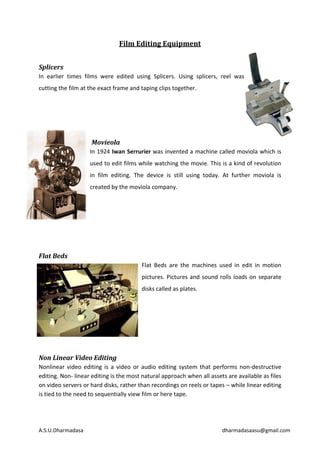
In earlier times films were edited using Splicers. Using splicers, reel was
cutting the film at the exact frame and taping clips together.
Movieola
In 1924 Iwan Serrurier was invented a machine called moviola which is
used to edit films while watching the movie. This is a kind of revolution
in film editing. The device is still using today. At further moviola is
created by the moviola company.
Flat Beds
Flat Beds are the machines used in edit in motion
pictures. Pictures and sound rolls loads on separate
disks called as plates.
Non Linear Video Editing
Nonlinear video editing is a video or audio editing system that performs non-destructive
editing. Non- linear editing is the most natural approach when all assets are available as files
on video servers or hard disks, rather than recordings on reels or tapes – while linear editing
is tied to the need to sequentially view film or here tape.
A.S.U.Dharmadasa dharmadasaasu@gmail.com
References
 Dancyger, K. (2011). The Technique of Film & Video Editing. 5th ed. Burlington: Focal
Press.