Television
Production
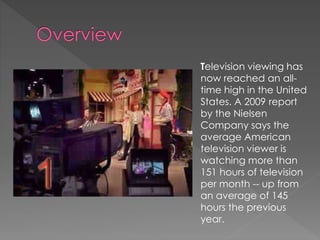
Television viewing has
now reached an all-
time high in the United
States. A 2009 report
by the Nielsen
Company says the
average American
television viewer is
watching more than
151 hours of television
per month -- up from
an average of 145
hours the previous
year.
Thousands of students around the world
are now using this course in television
production to meet serious personal and
professional goals
 Completing this course could mean an
exciting career in broadcast television,
Internet webcasting - institutional
videography, satellite programming,
mobile video, and other areas --
including the advertising and public
relations aspects of any of these. Video
production now includes feature films --
the kind you see at your local theater.
 For one thing, you may suddenly be
confronted with an internship or job
opportunity where this knowledge is
essential. Or, you could easily get asked
about some of these things in a job
interview.
Making of audio visual content to be telecasted or
showcased on TV aka small screen, the idiot box, the tube,
the boob tube, the box.
It can either be Recorded or ‘LIVE’ or delayed
transmission
Content can either be shot Indoors in a Studio or
Outdoors.
The person in charge of launching entire
production is generally the producer. He or
she comes up with the program concept,
lays out the budget for the production,
and makes the major decisions. This person
is the team leader, the one who works with
the writers, hires the director, decides on
the key talent, and guides the general
direction of the production.
In smaller productions, the producer may
also take charge of the more mundane
activities. And in small productions, the
director may handle the producer's
responsibilities. In this case, the combined
job title becomes producer-director.
Some productions may also have an
associate producer who sets up schedules
for the talent and crew and who generally
assists the producer.
On a major production, one of the
producer's first jobs is to hire a writer to
write the script (the document that tells
everyone what to do and say). The script is
like a written plan or blueprint for the
production.
The producer will next consider the key talent
for the production. In general, the talent
includes actors, reporters, hosts, guests, and
off-camera narrators -- anyone whose voice is
heard or who appears on camera.
Sometimes talent is broken down into three
sub-categories: actors (who portray other
people in dramatic productions), performers
(who appear on camera in nondramatic
roles), and announcers (who generally don't
appear on camera).
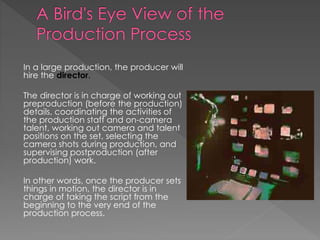
In a large production, the producer will
hire the director.
The director is in charge of working out
preproduction (before the production)
details, coordinating the activities of
the production staff and on-camera
talent, working out camera and talent
positions on the set, selecting the
camera shots during production, and
supervising postproduction (after
production) work.
In other words, once the producer sets
things in motion, the director is in
charge of taking the script from the
beginning to the very end of the
production process.
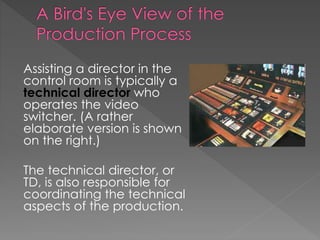
Assisting a director in the
control room is typically a
technical director who
operates the video
switcher. (A rather
elaborate version is shown
on the right.)
The technical director, or
TD, is also responsible for
coordinating the technical
aspects of the production.
One or more production assistants (PAs)
may be hired to help the producer and
director. Among other things, PAs keep
notes on ongoing production needs and
changes.
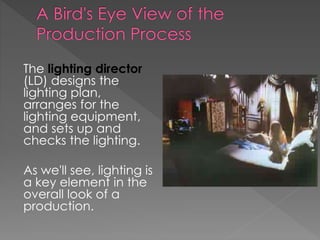
The lighting director
(LD) designs the
lighting plan,
arranges for the
lighting equipment,
and sets up and
checks the lighting.
As we'll see, lighting is
a key element in the
overall look of a
production.
Some productions have a set designer
who, along with the producer and
director, designs the set and supervises its
construction, painting, and installation.
The makeup person,
with the help of
cosmetics, hair
spray, etc., sees that
the talent look their
best -- or their worst,
if that's what the
script calls for.
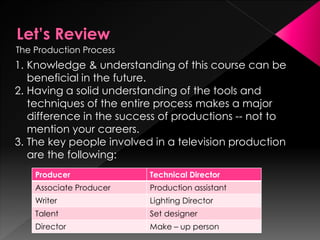
The Production Process
1. Knowledge & understanding of this course can be
beneficial in the future.
2. Having a solid understanding of the tools and
techniques of the entire process makes a major
difference in the success of productions -- not to
mention your careers.
3. The key people involved in a television production
are the following:
Producer Technical Director
Associate Producer Production assistant
Writer Lighting Director
Talent Set designer
Director Make – up person
 Find out how much time is spent by the
average Filipino in watching TV?
 Describe the development of Philippine
TV with regards to purpose, genre &
artistic style.
 How do these trends affect the viewer’s
behavior and preferences?
 Who dictates what the audience should
watch?
 How are we influenced by TV?
After viewing the documentary video
CHANNEL KULTURA, write a one-page
essay answering the question: “Where do
you want Philippine Television to take
you?”

Television production module 1 a

  • 1.
  • 2.
    Television viewing has nowreached an all- time high in the United States. A 2009 report by the Nielsen Company says the average American television viewer is watching more than 151 hours of television per month -- up from an average of 145 hours the previous year.
  • 3.
    Thousands of studentsaround the world are now using this course in television production to meet serious personal and professional goals
  • 4.
     Completing thiscourse could mean an exciting career in broadcast television, Internet webcasting - institutional videography, satellite programming, mobile video, and other areas -- including the advertising and public relations aspects of any of these. Video production now includes feature films -- the kind you see at your local theater.
  • 5.
     For onething, you may suddenly be confronted with an internship or job opportunity where this knowledge is essential. Or, you could easily get asked about some of these things in a job interview.
  • 6.
    Making of audiovisual content to be telecasted or showcased on TV aka small screen, the idiot box, the tube, the boob tube, the box. It can either be Recorded or ‘LIVE’ or delayed transmission Content can either be shot Indoors in a Studio or Outdoors.
  • 7.
    The person incharge of launching entire production is generally the producer. He or she comes up with the program concept, lays out the budget for the production, and makes the major decisions. This person is the team leader, the one who works with the writers, hires the director, decides on the key talent, and guides the general direction of the production.
  • 8.
    In smaller productions,the producer may also take charge of the more mundane activities. And in small productions, the director may handle the producer's responsibilities. In this case, the combined job title becomes producer-director.
  • 9.
    Some productions mayalso have an associate producer who sets up schedules for the talent and crew and who generally assists the producer.
  • 10.
    On a majorproduction, one of the producer's first jobs is to hire a writer to write the script (the document that tells everyone what to do and say). The script is like a written plan or blueprint for the production.
  • 11.
    The producer willnext consider the key talent for the production. In general, the talent includes actors, reporters, hosts, guests, and off-camera narrators -- anyone whose voice is heard or who appears on camera. Sometimes talent is broken down into three sub-categories: actors (who portray other people in dramatic productions), performers (who appear on camera in nondramatic roles), and announcers (who generally don't appear on camera).
  • 12.
    In a largeproduction, the producer will hire the director. The director is in charge of working out preproduction (before the production) details, coordinating the activities of the production staff and on-camera talent, working out camera and talent positions on the set, selecting the camera shots during production, and supervising postproduction (after production) work. In other words, once the producer sets things in motion, the director is in charge of taking the script from the beginning to the very end of the production process.
  • 13.
    Assisting a directorin the control room is typically a technical director who operates the video switcher. (A rather elaborate version is shown on the right.) The technical director, or TD, is also responsible for coordinating the technical aspects of the production.
  • 14.
    One or moreproduction assistants (PAs) may be hired to help the producer and director. Among other things, PAs keep notes on ongoing production needs and changes.
  • 15.
    The lighting director (LD)designs the lighting plan, arranges for the lighting equipment, and sets up and checks the lighting. As we'll see, lighting is a key element in the overall look of a production.
  • 16.
    Some productions havea set designer who, along with the producer and director, designs the set and supervises its construction, painting, and installation.
  • 17.
    The makeup person, withthe help of cosmetics, hair spray, etc., sees that the talent look their best -- or their worst, if that's what the script calls for.
  • 18.
    The Production Process 1.Knowledge & understanding of this course can be beneficial in the future. 2. Having a solid understanding of the tools and techniques of the entire process makes a major difference in the success of productions -- not to mention your careers. 3. The key people involved in a television production are the following: Producer Technical Director Associate Producer Production assistant Writer Lighting Director Talent Set designer Director Make – up person
  • 19.
     Find outhow much time is spent by the average Filipino in watching TV?  Describe the development of Philippine TV with regards to purpose, genre & artistic style.  How do these trends affect the viewer’s behavior and preferences?  Who dictates what the audience should watch?  How are we influenced by TV?
  • 20.
    After viewing thedocumentary video CHANNEL KULTURA, write a one-page essay answering the question: “Where do you want Philippine Television to take you?”