The Job Interview
Background
 Congratulations! You have been invited to a job interview. Based on
your job application and resume, your qualifications match those the
employer is seeking in a candidate.
 The next step is the interview, where you will have the opportunity to
convey to an employer the skills you could bring to the job.
 Remember that an interview is a two-way street. It is a chance for you
to get to know each other and to assess if this position and firm is a
good one.
 The interview allows you to gain insight into the job and the
organization, and it enables the employer to determine if you have
the skills and abilities needed to be an effective member of his or her
organization.
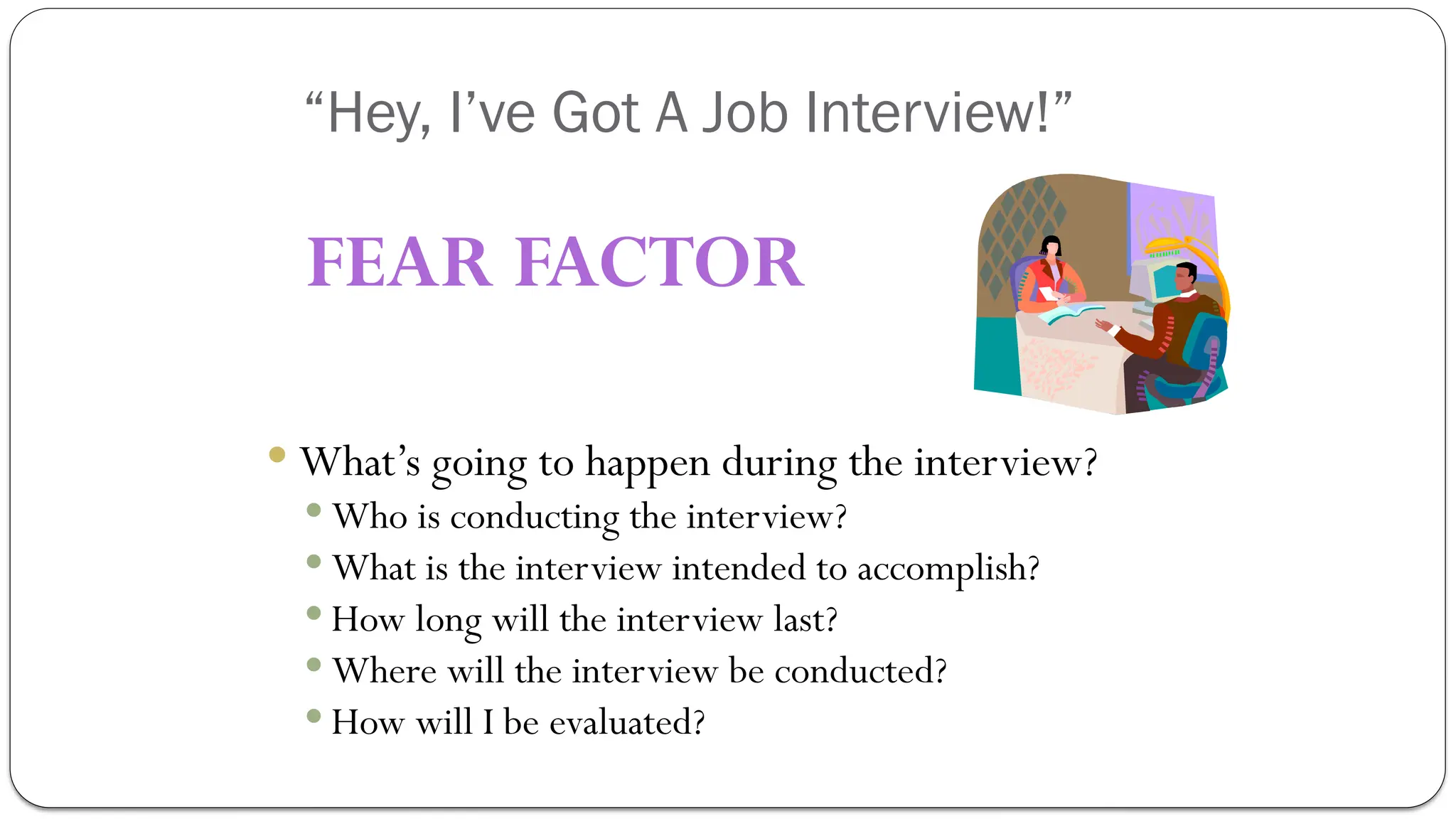
“Hey, I’ve Got A Job Interview!”
 What’s going to happen during the interview?
 Who is conducting the interview?
 What is the interview intended to accomplish?
 How long will the interview last?
 Where will the interview be conducted?
 How will I be evaluated?
FEAR FACTOR
Types of Interviews
One-on-one most often used
 Informal: Interviewer has a general idea of what will be asked, but after first
question, follows conversation trend.
 Structured: Questions will be written out based on job requirements, and will
be asked of every candidate.
 Unstructured:After one or two questions, the interviewer may sit back and
wait for you to make the next move.
Group you will meet with more than one person at a time
 Teamwork is important.They want to see how effective you are as part of a
group.
 Take it one question at a time
 Answer the person who asked the question.After finish look around & see if
anyone needs further clarification.
 Make eye contact with each member of the group.
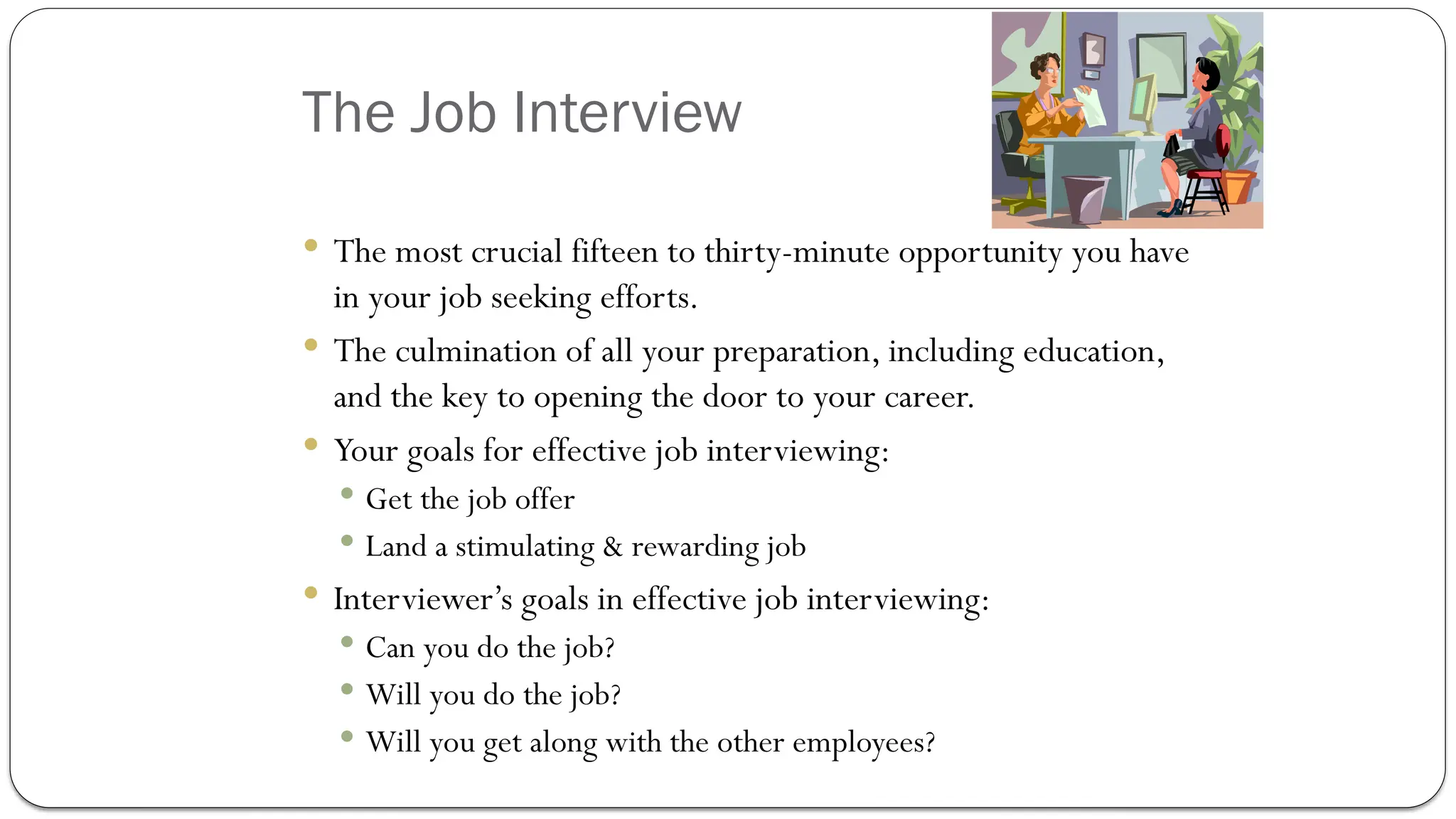
The Job Interview
 The most crucial fifteen to thirty-minute opportunity you have
in your job seeking efforts.
 The culmination of all your preparation, including education,
and the key to opening the door to your career.
 Your goals for effective job interviewing:
 Get the job offer
 Land a stimulating & rewarding job
 Interviewer’s goals in effective job interviewing:
 Can you do the job?
 Will you do the job?
 Will you get along with the other employees?
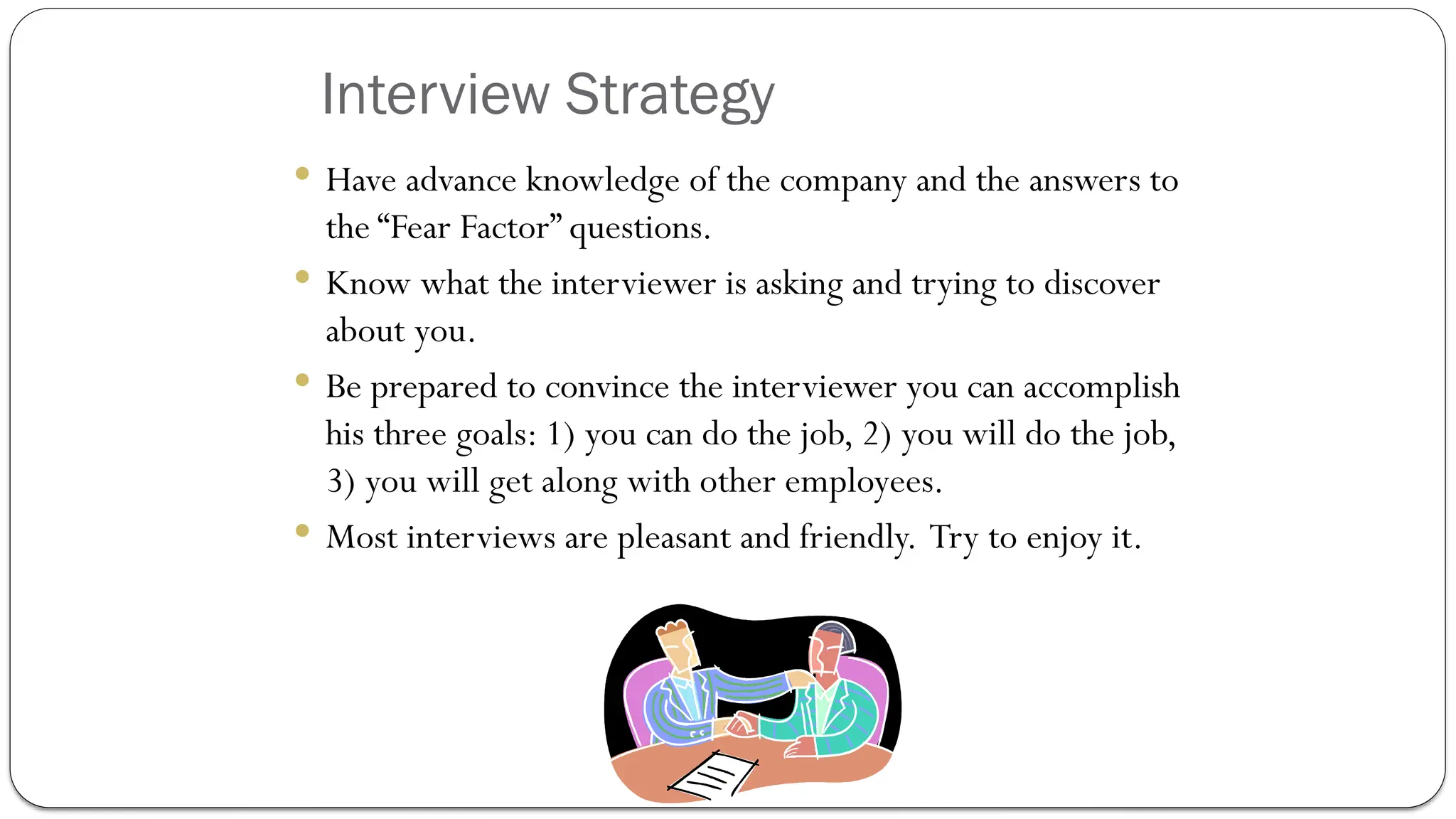
Interview Strategy
 Have advance knowledge of the company and the answers to
the “Fear Factor” questions.
 Know what the interviewer is asking and trying to discover
about you.
 Be prepared to convince the interviewer you can accomplish
his three goals: 1) you can do the job, 2) you will do the job,
3) you will get along with other employees.
 Most interviews are pleasant and friendly. Try to enjoy it.
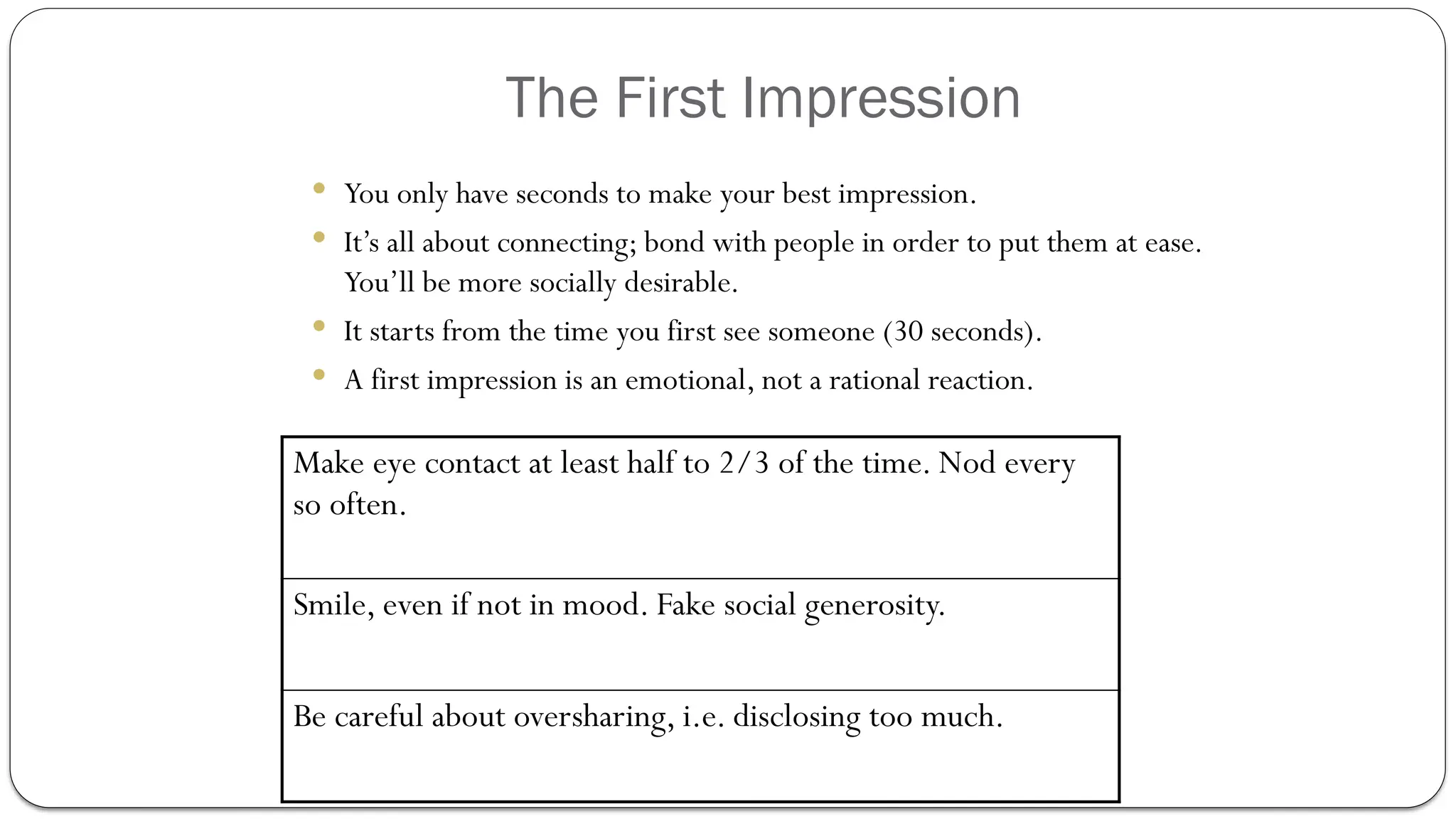
The First Impression
 You only have seconds to make your best impression.
 It’s all about connecting; bond with people in order to put them at ease.
You’ll be more socially desirable.
 It starts from the time you first see someone (30 seconds).
 A first impression is an emotional, not a rational reaction.
Make eye contact at least half to 2/3 of the time. Nod every
so often.
Smile, even if not in mood. Fake social generosity.
Be careful about oversharing, i.e. disclosing too much.
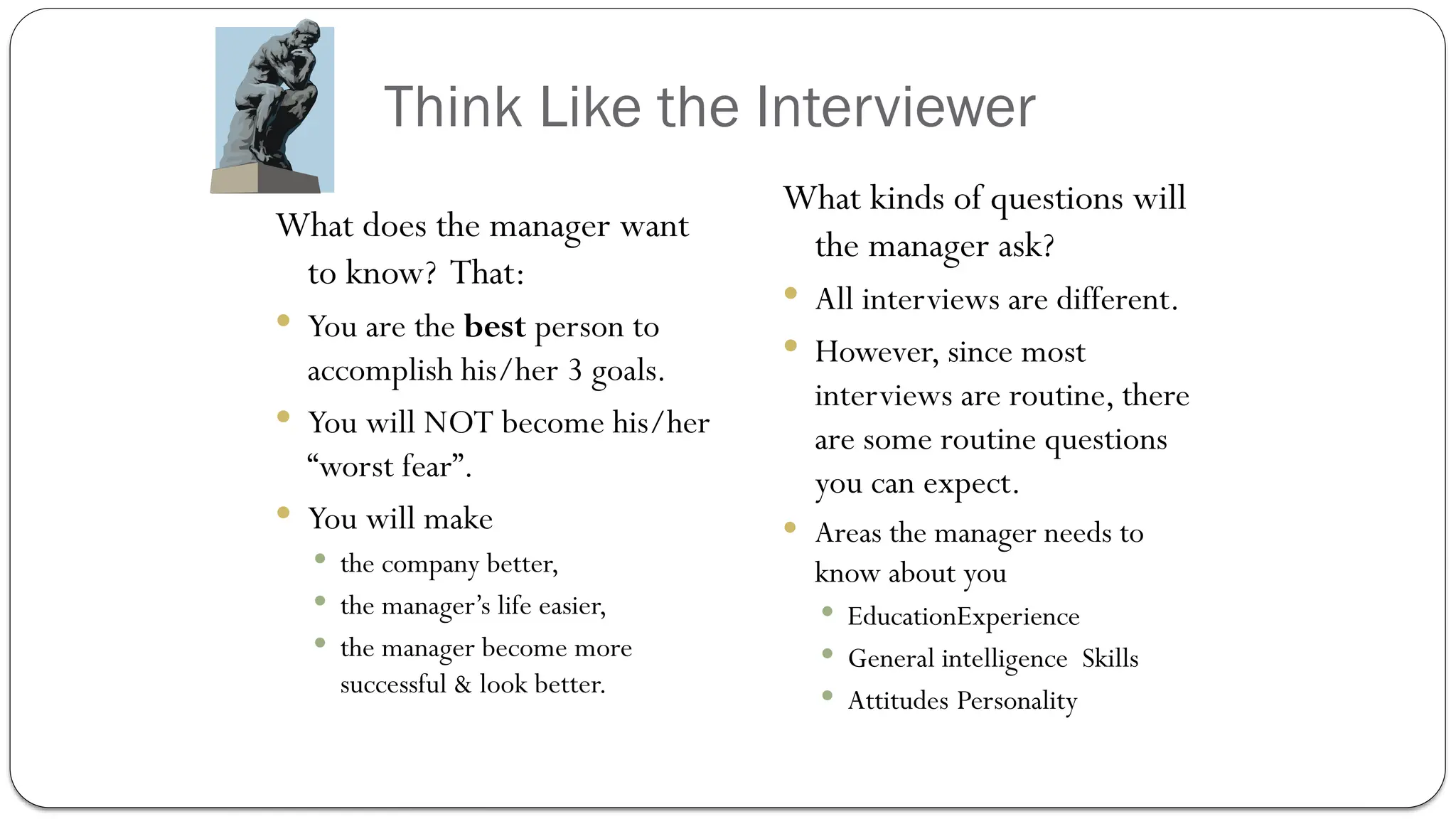
Think Like the Interviewer
What does the manager want
to know? That:
 You are the best person to
accomplish his/her 3 goals.
 You will NOT become his/her
“worst fear”.
 You will make
 the company better,
 the manager’s life easier,
 the manager become more
successful & look better.
What kinds of questions will
the manager ask?
 All interviews are different.
 However, since most
interviews are routine, there
are some routine questions
you can expect.
 Areas the manager needs to
know about you
 EducationExperience
 General intelligence Skills
 Attitudes Personality
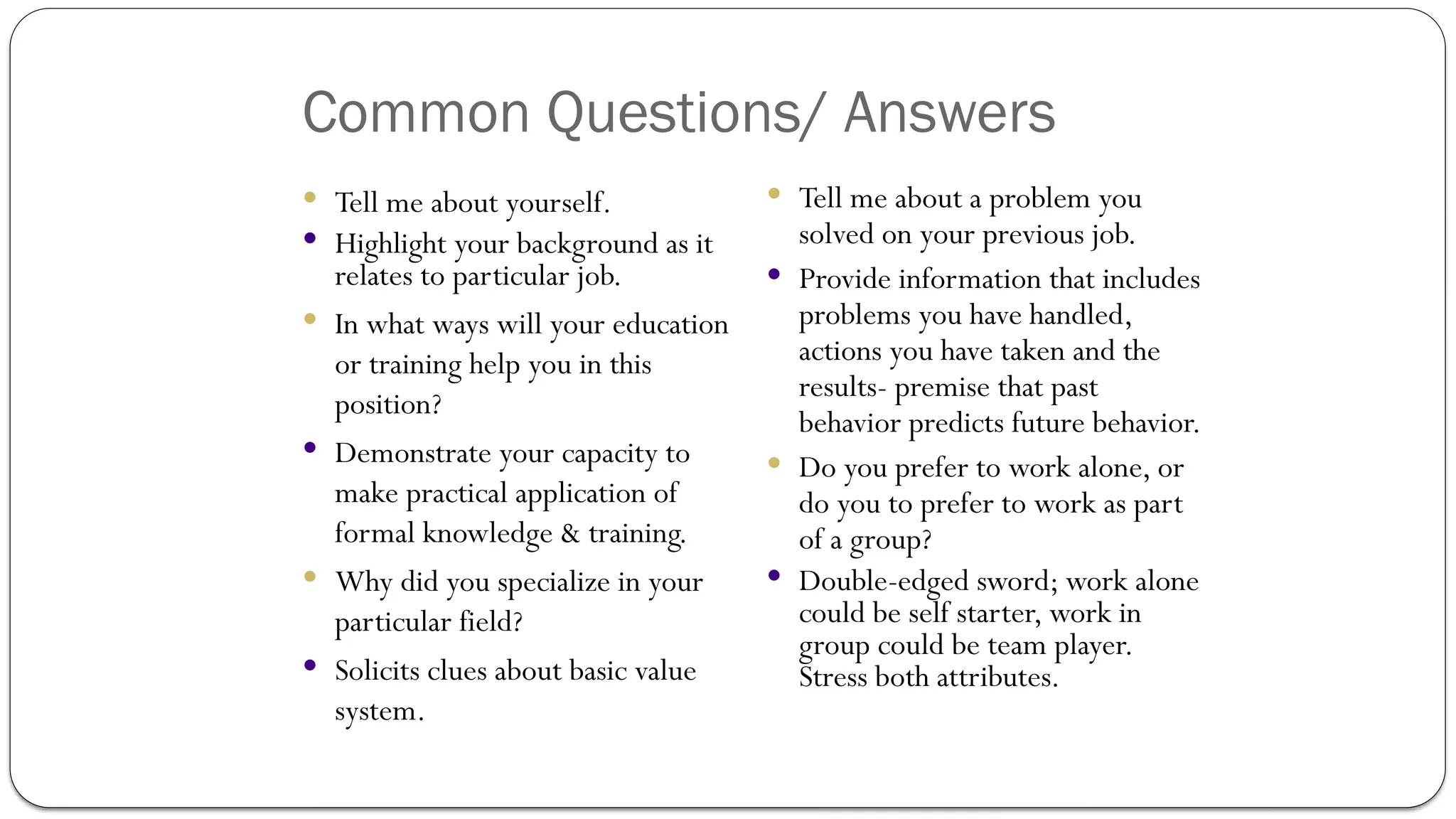
Common Questions/ Answers
 Tell me about yourself.
 Highlight your background as it
relates to particular job.
 In what ways will your education
or training help you in this
position?
 Demonstrate your capacity to
make practical application of
formal knowledge & training.
 Why did you specialize in your
particular field?
 Solicits clues about basic value
system.
 Tell me about a problem you
solved on your previous job.
 Provide information that includes
problems you have handled,
actions you have taken and the
results- premise that past
behavior predicts future behavior.
 Do you prefer to work alone, or
do you to prefer to work as part
of a group?
 Double-edged sword; work alone
could be self starter, work in
group could be team player.
Stress both attributes.
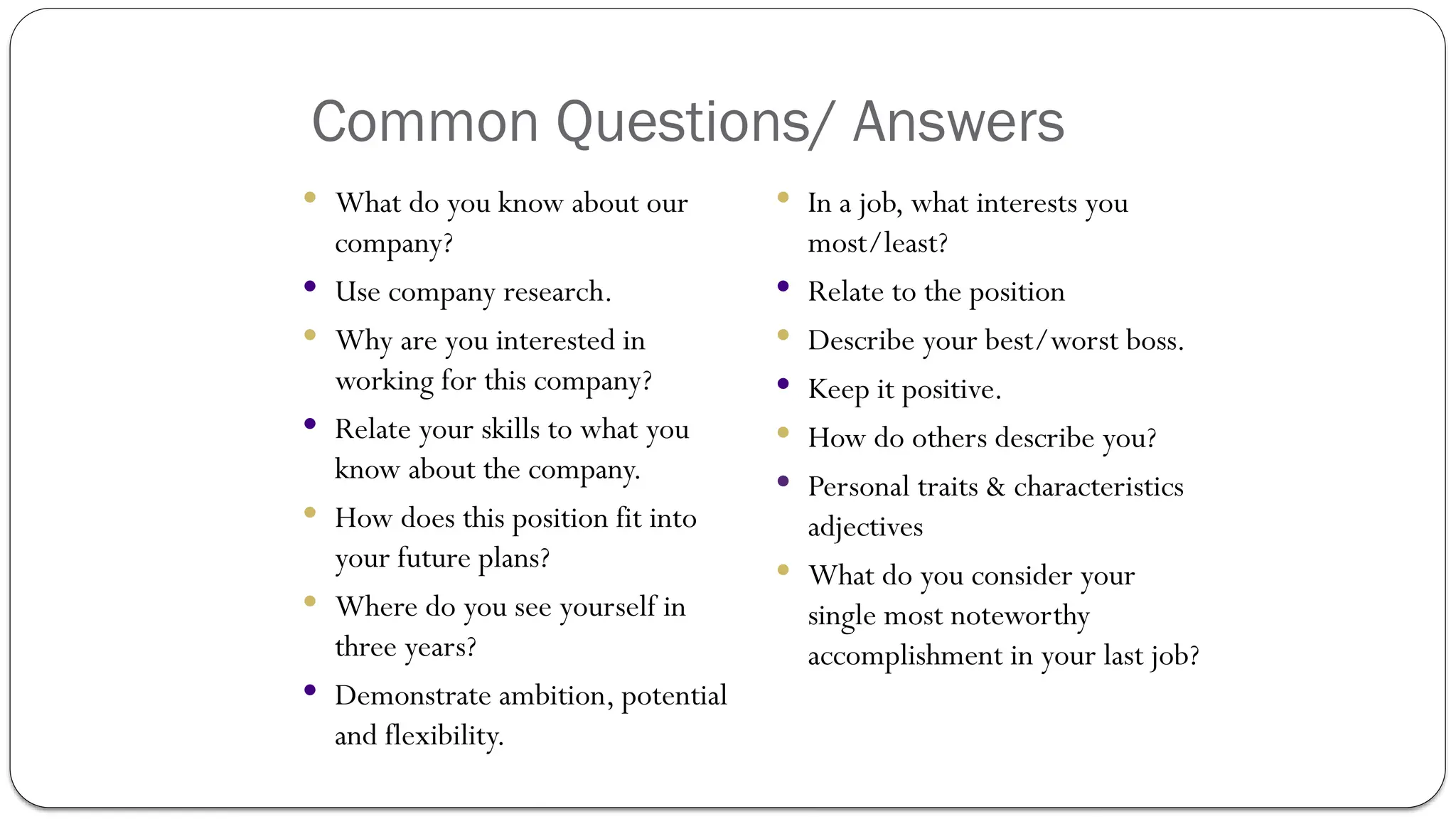
Common Questions/ Answers
 What do you know about our
company?
 Use company research.
 Why are you interested in
working for this company?
 Relate your skills to what you
know about the company.
 How does this position fit into
your future plans?
 Where do you see yourself in
three years?
 Demonstrate ambition, potential
and flexibility.
 In a job, what interests you
most/least?
 Relate to the position
 Describe your best/worst boss.
 Keep it positive.
 How do others describe you?
 Personal traits & characteristics
adjectives
 What do you consider your
single most noteworthy
accomplishment in your last job?
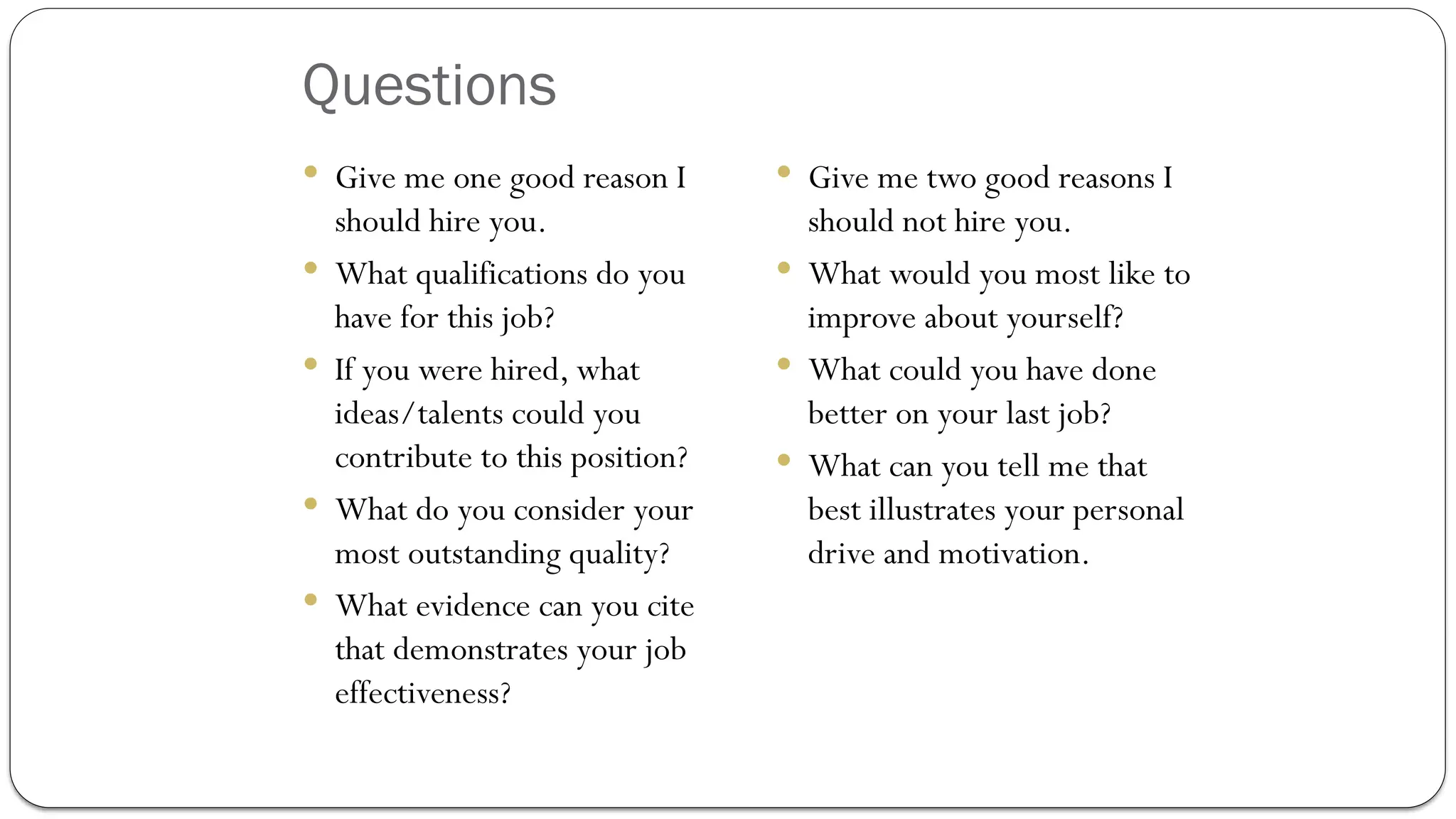
Questions
 Give me one good reason I
should hire you.
 What qualifications do you
have for this job?
 If you were hired, what
ideas/talents could you
contribute to this position?
 What do you consider your
most outstanding quality?
 What evidence can you cite
that demonstrates your job
effectiveness?
 Give me two good reasons I
should not hire you.
 What would you most like to
improve about yourself?
 What could you have done
better on your last job?
 What can you tell me that
best illustrates your personal
drive and motivation.
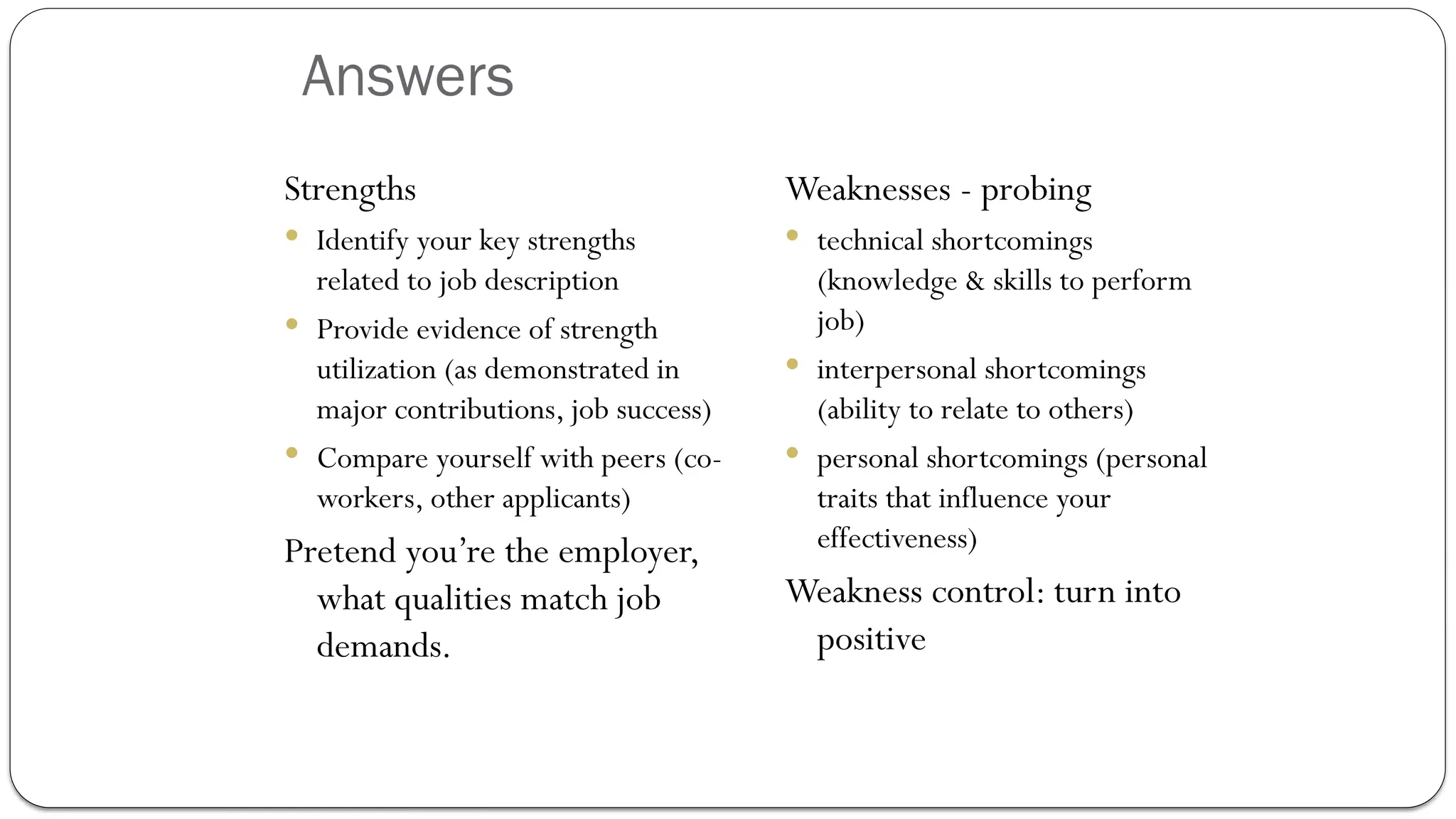
Answers
Strengths
 Identify your key strengths
related to job description
 Provide evidence of strength
utilization (as demonstrated in
major contributions, job success)
 Compare yourself with peers (co-
workers, other applicants)
Pretend you’re the employer,
what qualities match job
demands.
Weaknesses - probing
 technical shortcomings
(knowledge & skills to perform
job)
 interpersonal shortcomings
(ability to relate to others)
 personal shortcomings (personal
traits that influence your
effectiveness)
Weakness control: turn into
positive
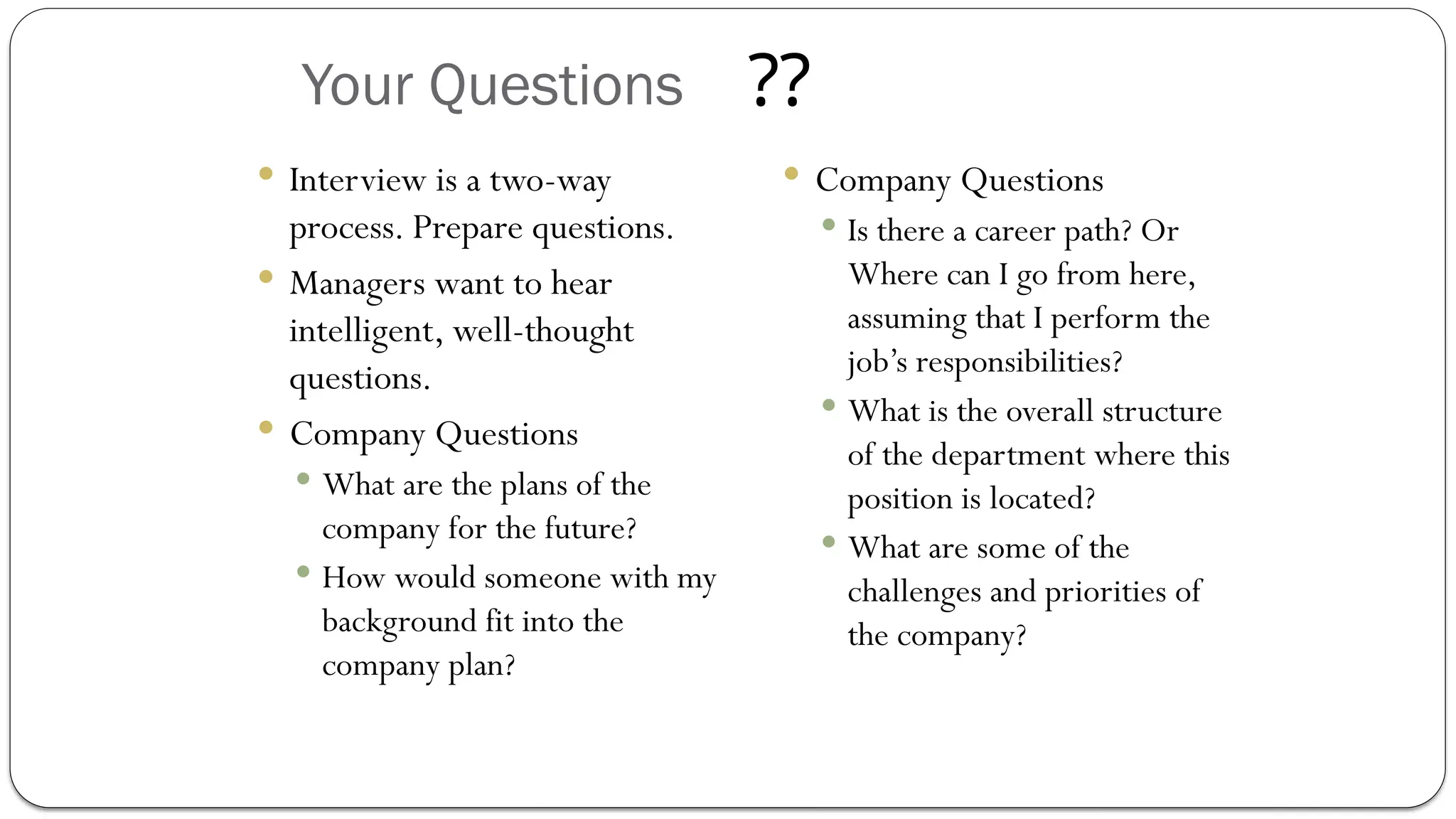
Your Questions
 Interview is a two-way
process. Prepare questions.
 Managers want to hear
intelligent, well-thought
questions.
 Company Questions
 What are the plans of the
company for the future?
 How would someone with my
background fit into the
company plan?
 Company Questions
 Is there a career path? Or
Where can I go from here,
assuming that I perform the
job’s responsibilities?
 What is the overall structure
of the department where this
position is located?
 What are some of the
challenges and priorities of
the company?
??
Your Questions
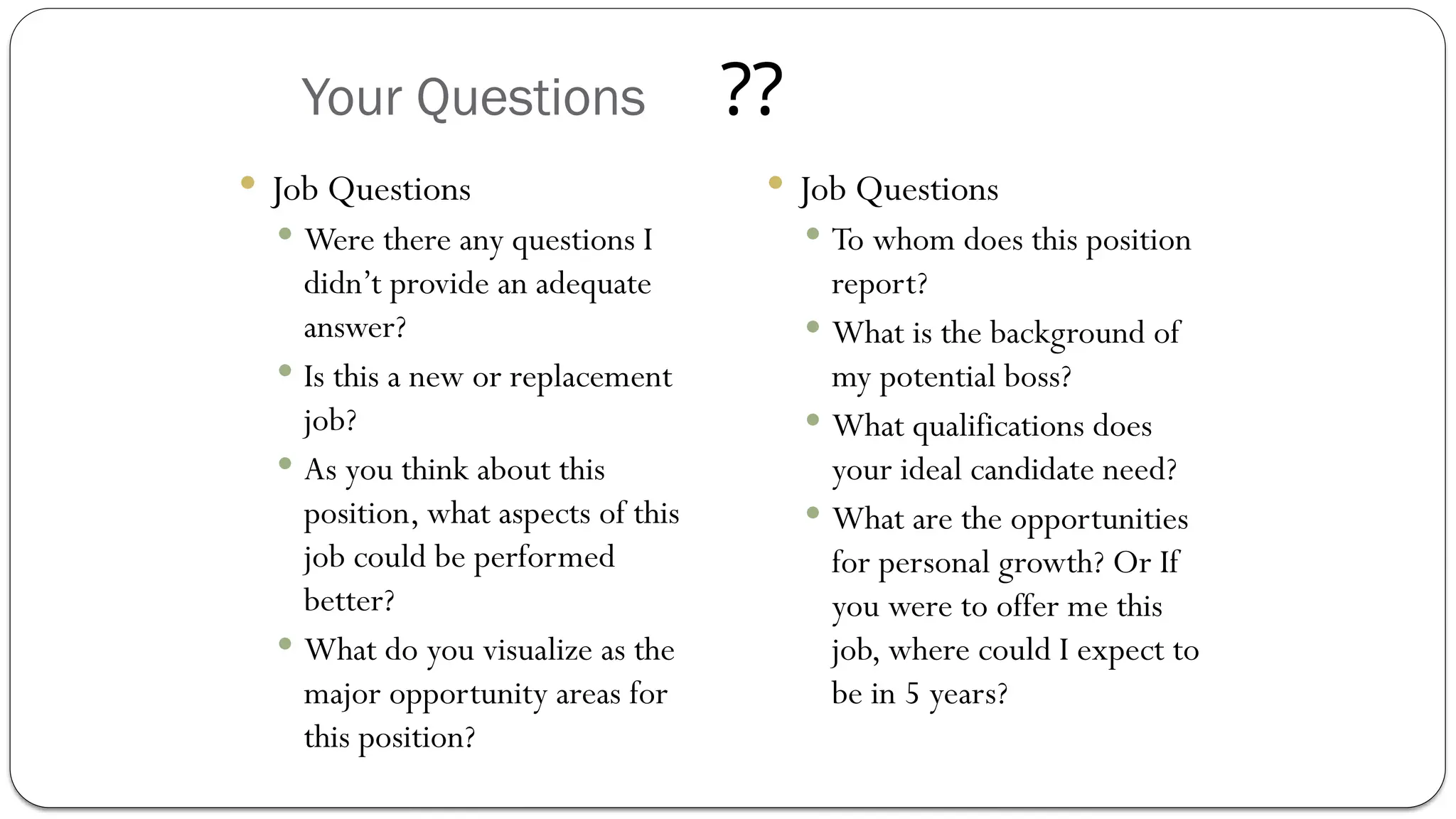
 Job Questions
 Were there any questions I
didn’t provide an adequate
answer?
 Is this a new or replacement
job?
 As you think about this
position, what aspects of this
job could be performed
better?
 What do you visualize as the
major opportunity areas for
this position?
 Job Questions
 To whom does this position
report?
 What is the background of
my potential boss?
 What qualifications does
your ideal candidate need?
 What are the opportunities
for personal growth? Or If
you were to offer me this
job, where could I expect to
be in 5 years?
??
Your Questions
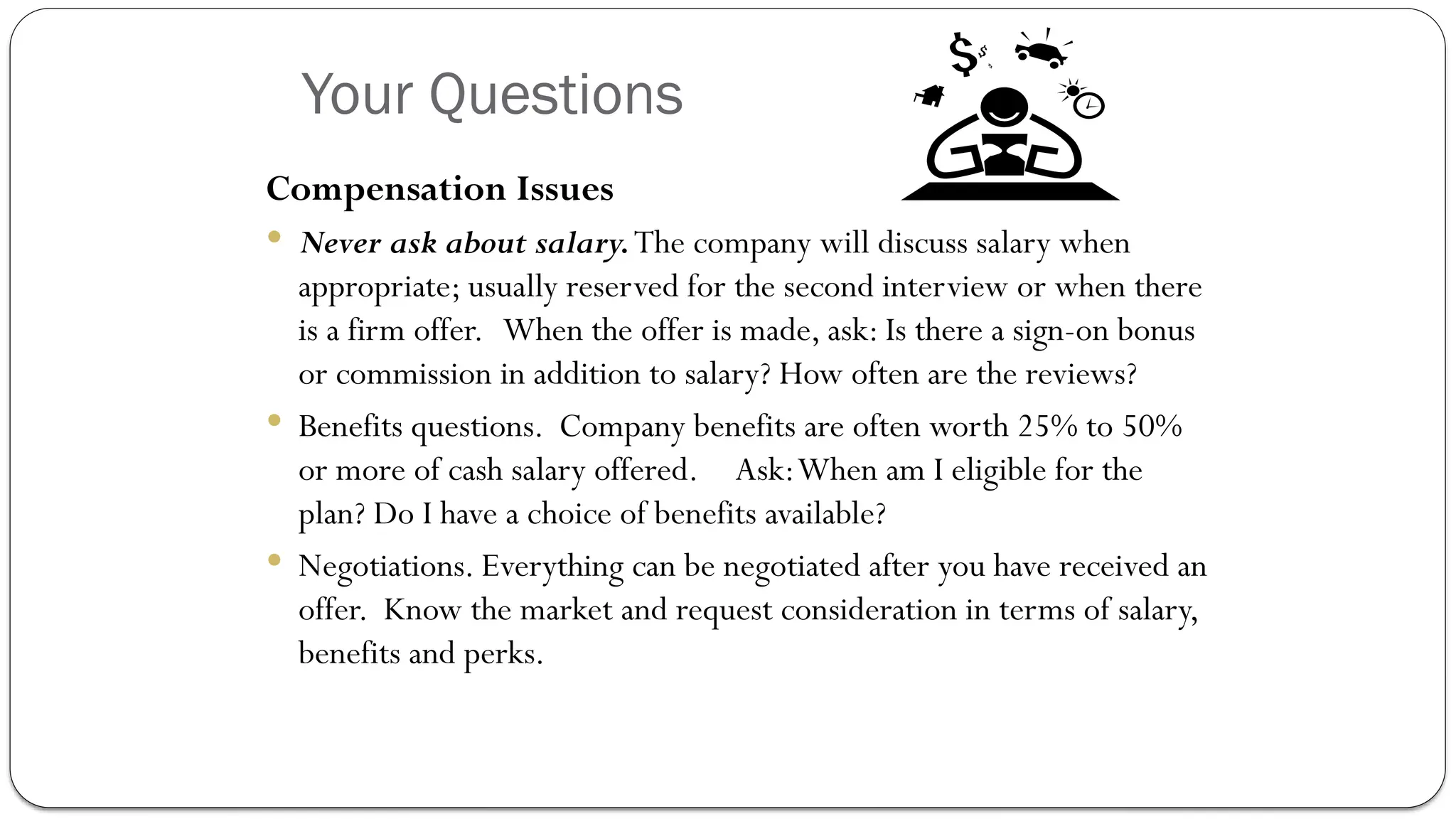
Compensation Issues
 Never ask about salary.The company will discuss salary when
appropriate; usually reserved for the second interview or when there
is a firm offer. When the offer is made, ask: Is there a sign-on bonus
or commission in addition to salary? How often are the reviews?
 Benefits questions. Company benefits are often worth 25% to 50%
or more of cash salary offered. Ask:When am I eligible for the
plan? Do I have a choice of benefits available?
 Negotiations. Everything can be negotiated after you have received an
offer. Know the market and request consideration in terms of salary,
benefits and perks.
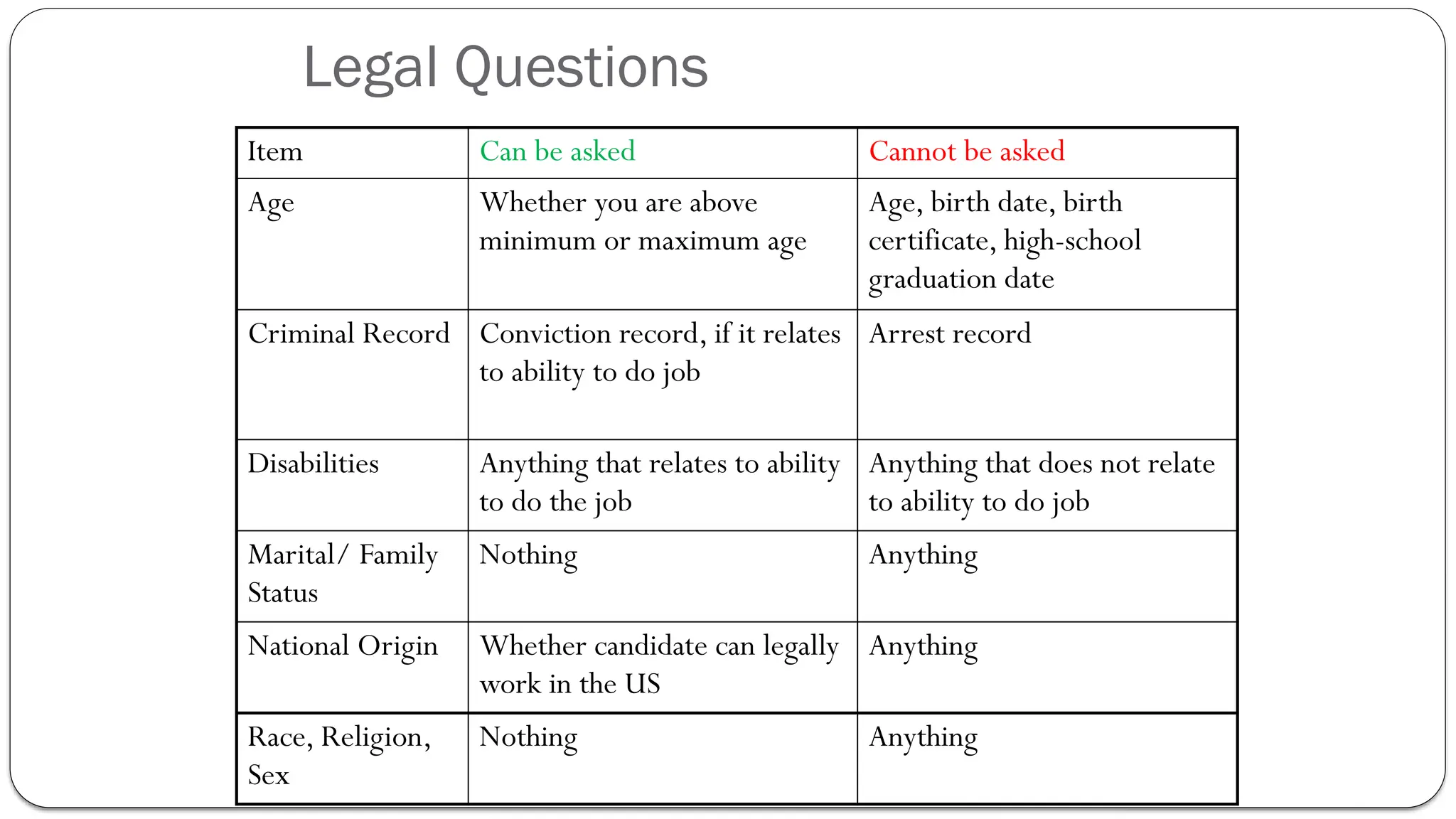
Legal Questions
Item Can be asked Cannot be asked
Age Whether you are above
minimum or maximum age
Age, birth date, birth
certificate, high-school
graduation date
Criminal Record Conviction record, if it relates
to ability to do job
Arrest record
Disabilities Anything that relates to ability
to do the job
Anything that does not relate
to ability to do job
Marital/ Family
Status
Nothing Anything
National Origin Whether candidate can legally
work in the US
Anything
Race, Religion,
Sex
Nothing Anything
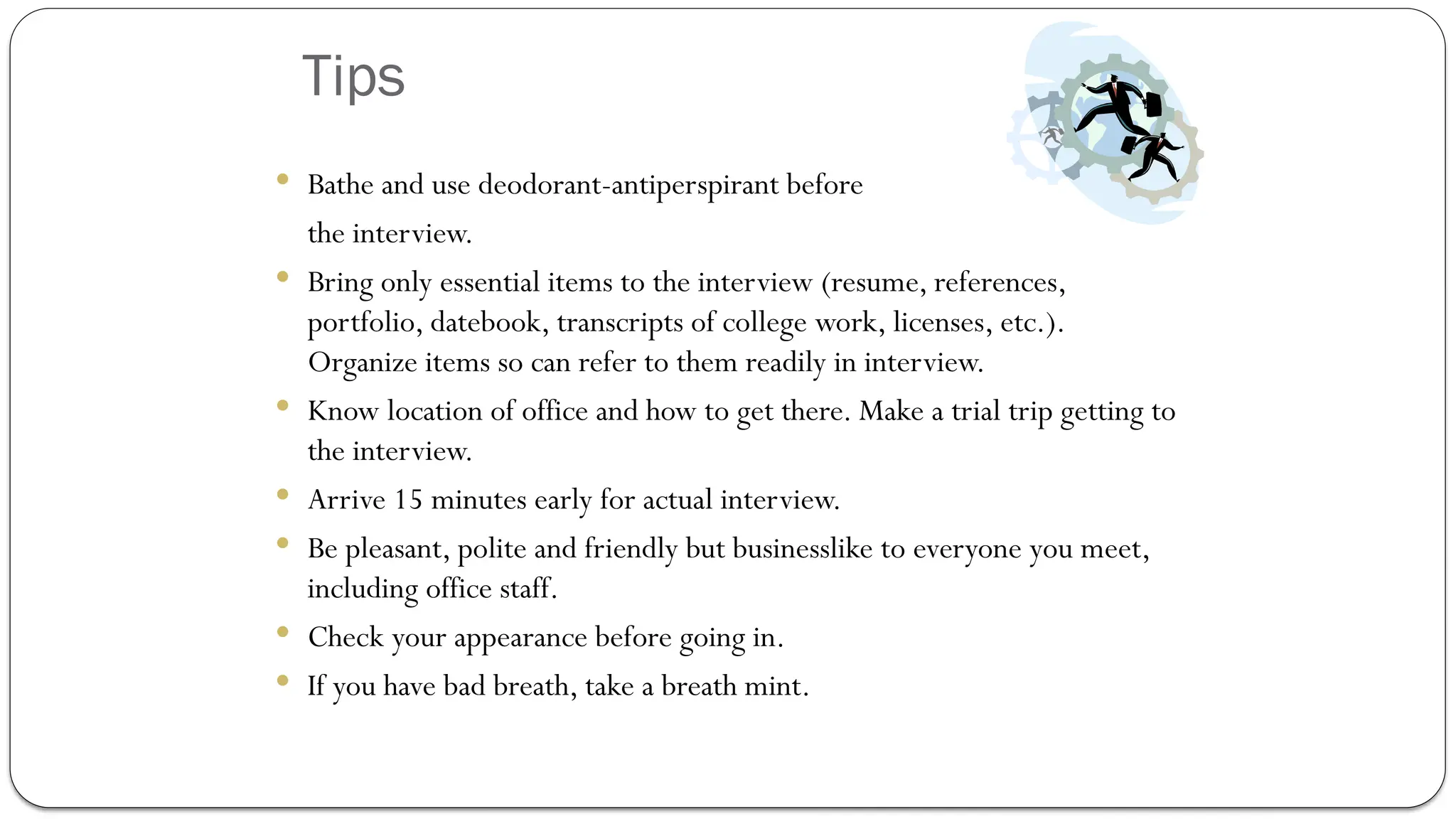
Tips
 Bathe and use deodorant-antiperspirant before
the interview.
 Bring only essential items to the interview (resume, references,
portfolio, datebook, transcripts of college work, licenses, etc.).
Organize items so can refer to them readily in interview.
 Know location of office and how to get there. Make a trial trip getting to
the interview.
 Arrive 15 minutes early for actual interview.
 Be pleasant, polite and friendly but businesslike to everyone you meet,
including office staff.
 Check your appearance before going in.
 If you have bad breath, take a breath mint.
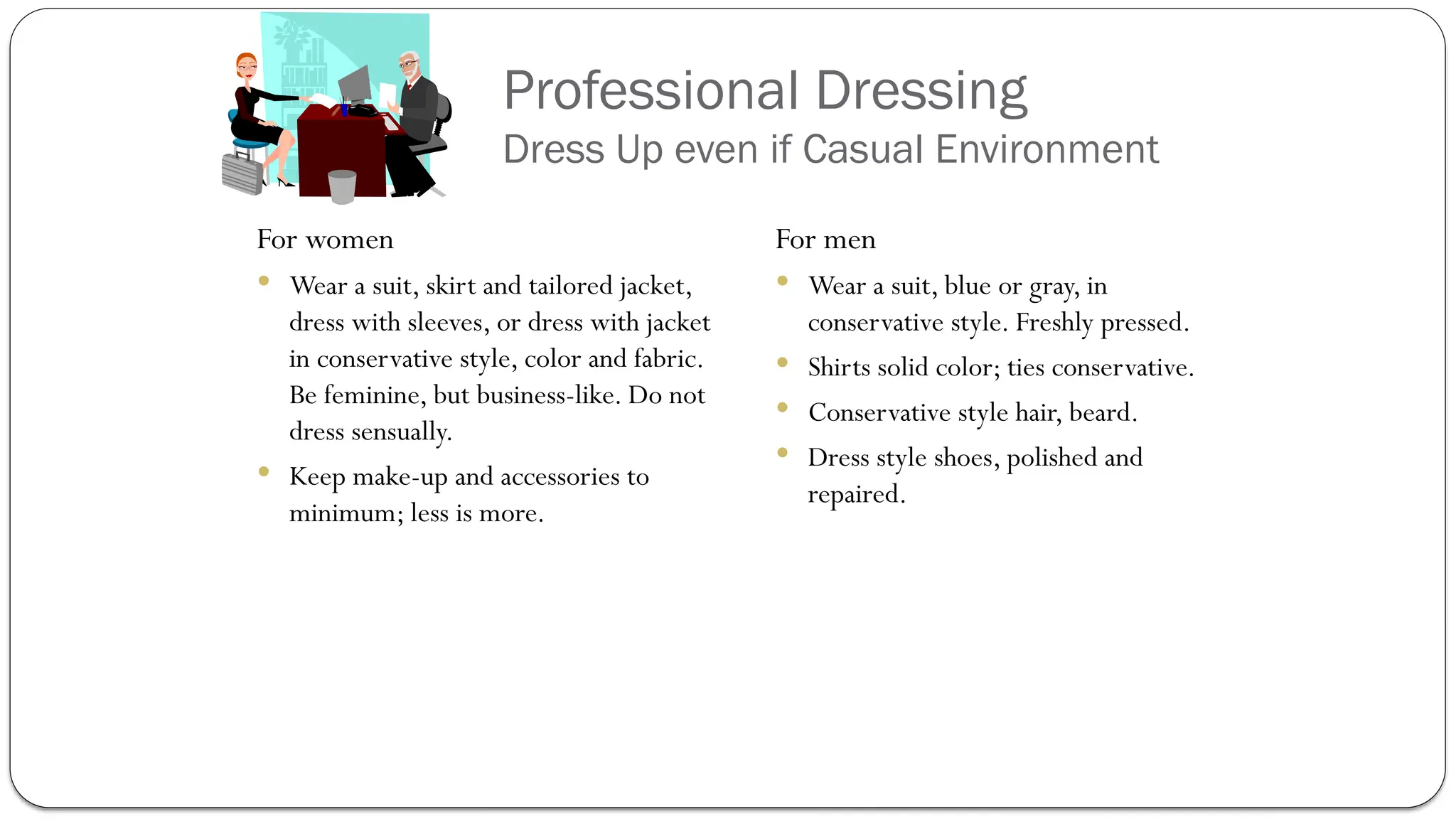
Professional Dressing
Dress Up even if Casual Environment
For women
 Wear a suit, skirt and tailored jacket,
dress with sleeves, or dress with jacket
in conservative style, color and fabric.
Be feminine, but business-like. Do not
dress sensually.
 Keep make-up and accessories to
minimum; less is more.
For men
 Wear a suit, blue or gray, in
conservative style. Freshly pressed.
 Shirts solid color; ties conservative.
 Conservative style hair, beard.
 Dress style shoes, polished and
repaired.
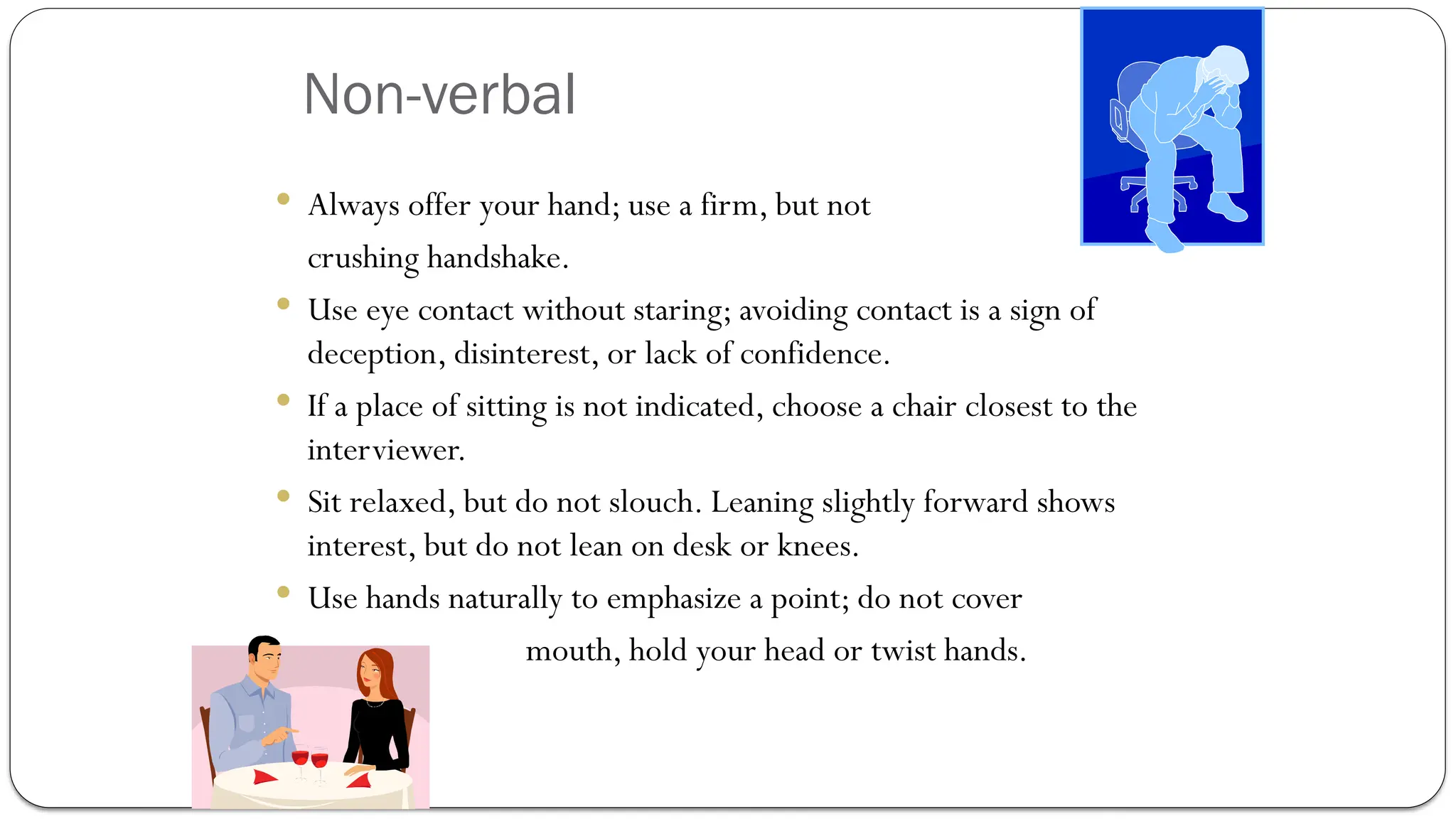
Non-verbal
 Always offer your hand; use a firm, but not
crushing handshake.
 Use eye contact without staring; avoiding contact is a sign of
deception, disinterest, or lack of confidence.
 If a place of sitting is not indicated, choose a chair closest to the
interviewer.
 Sit relaxed, but do not slouch. Leaning slightly forward shows
interest, but do not lean on desk or knees.
 Use hands naturally to emphasize a point; do not cover
mouth, hold your head or twist hands.
Job Interview L4.pptx - Career Counseling

  • 1.
  • 2.
    Background  Congratulations! Youhave been invited to a job interview. Based on your job application and resume, your qualifications match those the employer is seeking in a candidate.  The next step is the interview, where you will have the opportunity to convey to an employer the skills you could bring to the job.  Remember that an interview is a two-way street. It is a chance for you to get to know each other and to assess if this position and firm is a good one.  The interview allows you to gain insight into the job and the organization, and it enables the employer to determine if you have the skills and abilities needed to be an effective member of his or her organization.
  • 3.
    “Hey, I’ve GotA Job Interview!”  What’s going to happen during the interview?  Who is conducting the interview?  What is the interview intended to accomplish?  How long will the interview last?  Where will the interview be conducted?  How will I be evaluated? FEAR FACTOR
  • 4.
    Types of Interviews One-on-onemost often used  Informal: Interviewer has a general idea of what will be asked, but after first question, follows conversation trend.  Structured: Questions will be written out based on job requirements, and will be asked of every candidate.  Unstructured:After one or two questions, the interviewer may sit back and wait for you to make the next move. Group you will meet with more than one person at a time  Teamwork is important.They want to see how effective you are as part of a group.  Take it one question at a time  Answer the person who asked the question.After finish look around & see if anyone needs further clarification.  Make eye contact with each member of the group.
  • 5.
    The Job Interview The most crucial fifteen to thirty-minute opportunity you have in your job seeking efforts.  The culmination of all your preparation, including education, and the key to opening the door to your career.  Your goals for effective job interviewing:  Get the job offer  Land a stimulating & rewarding job  Interviewer’s goals in effective job interviewing:  Can you do the job?  Will you do the job?  Will you get along with the other employees?
  • 6.
    Interview Strategy  Haveadvance knowledge of the company and the answers to the “Fear Factor” questions.  Know what the interviewer is asking and trying to discover about you.  Be prepared to convince the interviewer you can accomplish his three goals: 1) you can do the job, 2) you will do the job, 3) you will get along with other employees.  Most interviews are pleasant and friendly. Try to enjoy it.
  • 7.
    The First Impression You only have seconds to make your best impression.  It’s all about connecting; bond with people in order to put them at ease. You’ll be more socially desirable.  It starts from the time you first see someone (30 seconds).  A first impression is an emotional, not a rational reaction. Make eye contact at least half to 2/3 of the time. Nod every so often. Smile, even if not in mood. Fake social generosity. Be careful about oversharing, i.e. disclosing too much.
  • 8.
    Think Like theInterviewer What does the manager want to know? That:  You are the best person to accomplish his/her 3 goals.  You will NOT become his/her “worst fear”.  You will make  the company better,  the manager’s life easier,  the manager become more successful & look better. What kinds of questions will the manager ask?  All interviews are different.  However, since most interviews are routine, there are some routine questions you can expect.  Areas the manager needs to know about you  EducationExperience  General intelligence Skills  Attitudes Personality
  • 9.
    Common Questions/ Answers Tell me about yourself.  Highlight your background as it relates to particular job.  In what ways will your education or training help you in this position?  Demonstrate your capacity to make practical application of formal knowledge & training.  Why did you specialize in your particular field?  Solicits clues about basic value system.  Tell me about a problem you solved on your previous job.  Provide information that includes problems you have handled, actions you have taken and the results- premise that past behavior predicts future behavior.  Do you prefer to work alone, or do you to prefer to work as part of a group?  Double-edged sword; work alone could be self starter, work in group could be team player. Stress both attributes.
  • 10.
    Common Questions/ Answers What do you know about our company?  Use company research.  Why are you interested in working for this company?  Relate your skills to what you know about the company.  How does this position fit into your future plans?  Where do you see yourself in three years?  Demonstrate ambition, potential and flexibility.  In a job, what interests you most/least?  Relate to the position  Describe your best/worst boss.  Keep it positive.  How do others describe you?  Personal traits & characteristics adjectives  What do you consider your single most noteworthy accomplishment in your last job?
  • 11.
    Questions  Give meone good reason I should hire you.  What qualifications do you have for this job?  If you were hired, what ideas/talents could you contribute to this position?  What do you consider your most outstanding quality?  What evidence can you cite that demonstrates your job effectiveness?  Give me two good reasons I should not hire you.  What would you most like to improve about yourself?  What could you have done better on your last job?  What can you tell me that best illustrates your personal drive and motivation.
  • 12.
    Answers Strengths  Identify yourkey strengths related to job description  Provide evidence of strength utilization (as demonstrated in major contributions, job success)  Compare yourself with peers (co- workers, other applicants) Pretend you’re the employer, what qualities match job demands. Weaknesses - probing  technical shortcomings (knowledge & skills to perform job)  interpersonal shortcomings (ability to relate to others)  personal shortcomings (personal traits that influence your effectiveness) Weakness control: turn into positive
  • 13.
    Your Questions  Interviewis a two-way process. Prepare questions.  Managers want to hear intelligent, well-thought questions.  Company Questions  What are the plans of the company for the future?  How would someone with my background fit into the company plan?  Company Questions  Is there a career path? Or Where can I go from here, assuming that I perform the job’s responsibilities?  What is the overall structure of the department where this position is located?  What are some of the challenges and priorities of the company? ??
  • 14.
    Your Questions  JobQuestions  Were there any questions I didn’t provide an adequate answer?  Is this a new or replacement job?  As you think about this position, what aspects of this job could be performed better?  What do you visualize as the major opportunity areas for this position?  Job Questions  To whom does this position report?  What is the background of my potential boss?  What qualifications does your ideal candidate need?  What are the opportunities for personal growth? Or If you were to offer me this job, where could I expect to be in 5 years? ??
  • 15.
    Your Questions Compensation Issues Never ask about salary.The company will discuss salary when appropriate; usually reserved for the second interview or when there is a firm offer. When the offer is made, ask: Is there a sign-on bonus or commission in addition to salary? How often are the reviews?  Benefits questions. Company benefits are often worth 25% to 50% or more of cash salary offered. Ask:When am I eligible for the plan? Do I have a choice of benefits available?  Negotiations. Everything can be negotiated after you have received an offer. Know the market and request consideration in terms of salary, benefits and perks.
  • 16.
    Legal Questions Item Canbe asked Cannot be asked Age Whether you are above minimum or maximum age Age, birth date, birth certificate, high-school graduation date Criminal Record Conviction record, if it relates to ability to do job Arrest record Disabilities Anything that relates to ability to do the job Anything that does not relate to ability to do job Marital/ Family Status Nothing Anything National Origin Whether candidate can legally work in the US Anything Race, Religion, Sex Nothing Anything
  • 17.
    Tips  Bathe anduse deodorant-antiperspirant before the interview.  Bring only essential items to the interview (resume, references, portfolio, datebook, transcripts of college work, licenses, etc.). Organize items so can refer to them readily in interview.  Know location of office and how to get there. Make a trial trip getting to the interview.  Arrive 15 minutes early for actual interview.  Be pleasant, polite and friendly but businesslike to everyone you meet, including office staff.  Check your appearance before going in.  If you have bad breath, take a breath mint.
  • 18.
    Professional Dressing Dress Upeven if Casual Environment For women  Wear a suit, skirt and tailored jacket, dress with sleeves, or dress with jacket in conservative style, color and fabric. Be feminine, but business-like. Do not dress sensually.  Keep make-up and accessories to minimum; less is more. For men  Wear a suit, blue or gray, in conservative style. Freshly pressed.  Shirts solid color; ties conservative.  Conservative style hair, beard.  Dress style shoes, polished and repaired.
  • 19.
    Non-verbal  Always offeryour hand; use a firm, but not crushing handshake.  Use eye contact without staring; avoiding contact is a sign of deception, disinterest, or lack of confidence.  If a place of sitting is not indicated, choose a chair closest to the interviewer.  Sit relaxed, but do not slouch. Leaning slightly forward shows interest, but do not lean on desk or knees.  Use hands naturally to emphasize a point; do not cover mouth, hold your head or twist hands.