


HIPAA
• In 1996 the Health Insurance Portability and
Accountability Act was passed by the federal
government.
• It’s aim, among other things, was to force
health care providers to protect the privacy
of patient health information (PHI).
Covered Entity
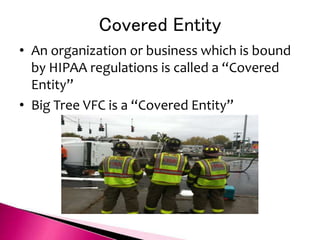
• An organization or business which is bound
by HIPAA regulations is called a “Covered
Entity”
• Big Tree VFC is a “Covered Entity”
What is PHI?
“Health information means any information,
whether oral or recorded in any form or medium,
that-
• (A) is created or received by a health care
provider, health plan, public health authority,
employer, life insurer, school or university, or
health care clearinghouse; and
• (B) relates to the past, present, or future
physical or mental health or condition of any
individual, the provision of health care to an
individual, or the past, present, or future
payment for the provision of health care to an
individual.”
What is PHI? (cont.)
“Individually identifiable health information is information
that is a subset of health information collected from an
individual, and:
• (1) Is created or received by a health care provider, health
plan, employer, or health care clearinghouse; and
• (2) Relates to the past, present, or future physical or
mental health or condition of an individual; the provision
of health care to an individual; or the past, present, or
future payment for the provision of health care to an
individual; and
• (i) That identifies the individual; or
• (ii) With respect to which there is a reasonable basis to
believe the information can be used to identify the
individual.”
To simplify, PHI is:
Any information that can identify or
potentially identify a patient and/or pertains to
the patients past, present or future health
status.
For us this is:
Name ,DOB, SS#, history, meds, chief
complaint, etc.
Restricted Use and Disclosure of PHI
• Patients can ask that health information not be
shared with certain people, groups, or
companies.
• In cases like this the EMT in charge of the
patient needs to make the chiefs aware of this
request as soon as possible without
compromising patient care or safety.
• For Example, a patient may ask that there
information not be shared or made known to a
certain member.
When is it okay to release PHI?
• Generally patients must give a “covered
entity” WRITTEN consent to release any PHI
• There are a few ways some PHI may be
released without written consent:
– A patients name may be used in a radio
transmission if a crew is having difficulty
locating said patient. For example – there are no
room numbers on an apartment list, but there
are resident names. Dispatch can radio the
name of the patient to the crew.
When is it okay to release PHI?
– An EMS crew may report the condition of a
patient to an immediate family member (spouse,
child, grandchild, or health care proxy) (IF
VERBAL PERMISSION IS GIVEN BY THE
PATIENT), but try to let the patient do it.
– If the patient is a victim of a crime, EMS may tell
law enforcement about the patient’s injuries and
condition. If the patient is NOT a victim of a
crime the patient may agree to speak to police
about their condition if they so choose.
When is it okay to release PHI?
– An EMS crew may report patient injuries to law
enforcement if the patient is possibly wanted in
relation to a crime.
– When EMS is delivering a report to a hospital or
receiving medical facility. This is to preserve the
continuity of care, providers NEED to pass on
pertinent medical information and history and
treatments given. EMS can disclose PHI to a triage
nurse or doctor at a receiving facility.
– EMS also has the right to open and review patient
records when being transferred from a facility.
When is it okay to release PHI?
– When EMS is reporting suspected abuse that is
covered under Mandated Reporting;
• Child abuse/ neglect
– 50 years following the date of death of the
individual
When is it NOT permissible to
disclose PHI?
Posting it on Social Media
• EMS providers may not post details about runs
on any electronic medium. This is true even
when a patient name is not used. If there is
enough information for someone to identify
the patient (for example the nature of the
injury, the time and location of an incident, etc.)
the provider will be in violation.
• Please also be aware that we do have a social
media policy that all members must adhere to.
When is it NOT permissible to
disclose PHI?
Discussions with colleagues/friends
• Just as with electronic mediums, discussing
patient encounters with colleagues who
were not part of the patient care team (face
to face, or in writing) is a definite no-no.
• This applies also to conversations outside of
work with the provider’s friends or family.
KEEP IN MIND: YOU NEVER KNOW WHO
KNOWS WHOM!
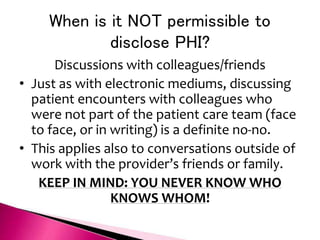
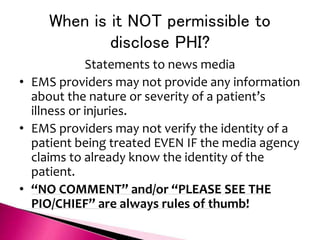
When is it NOT permissible to
disclose PHI?
Statements to news media
• EMS providers may not provide any information
about the nature or severity of a patient’s
illness or injuries.
• EMS providers may not verify the identity of a
patient being treated EVEN IF the media agency
claims to already know the identity of the
patient.
• “NO COMMENT” and/or “PLEASE SEE THE
PIO/CHIEF” are always rules of thumb!
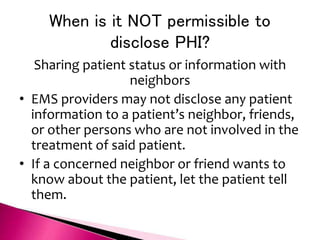
When is it NOT permissible to
disclose PHI?
Sharing patient status or information with
neighbors
• EMS providers may not disclose any patient
information to a patient’s neighbor, friends,
or other persons who are not involved in the
treatment of said patient.
• If a concerned neighbor or friend wants to
know about the patient, let the patient tell
them.
So in other words this is not good
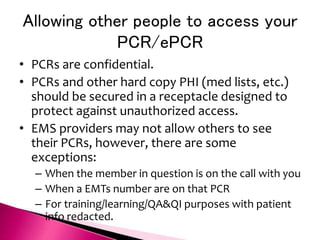
Allowing other people to access your
PCR/ePCR
• PCRs are confidential.
• PCRs and other hard copy PHI (med lists, etc.)
should be secured in a receptacle designed to
protect against unauthorized access.
• EMS providers may not allow others to see
their PCRs, however, there are some
exceptions:
– When the member in question is on the call with you
– When a EMTs number are on that PCR
– For training/learning/QA&QI purposes with patient
info redacted.
Why is HIPAA Important?
• Individuals and agencies who violate HIPAA
privacy can be fined and individuals can even
serve jail time if found guilty of violating
these statutes.
• It’s just the right thing to do – we are patient
advocates and should be protecting the
privacy of our patients.
HIPAA breach notification
• In the event that PHI is accidently or
deliberately disclosed in violation of HIPAA
regulations, the covered entity is required to
report the breach immediately.
• It is unlawful to hide or cover-up any
confirmed or potential breach.
• If you feel that a HIPAA breach has occurred,
report the situation to any Chief or EMS
officer immediately!
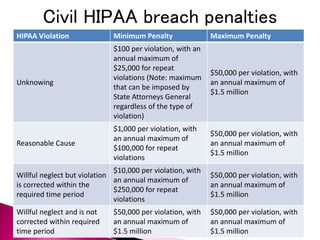
Civil HIPAA breach penalties
HIPAA Violation Minimum Penalty Maximum Penalty
Unknowing
$100 per violation, with an
annual maximum of
$25,000 for repeat
violations (Note: maximum
that can be imposed by
State Attorneys General
regardless of the type of
violation)
$50,000 per violation, with
an annual maximum of
$1.5 million
Reasonable Cause
$1,000 per violation, with
an annual maximum of
$100,000 for repeat
violations
$50,000 per violation, with
an annual maximum of
$1.5 million
Willful neglect but violation
is corrected within the
required time period
$10,000 per violation, with
an annual maximum of
$250,000 for repeat
violations
$50,000 per violation, with
an annual maximum of
$1.5 million
Willful neglect and is not
corrected within required
time period
$50,000 per violation, with
an annual maximum of
$1.5 million
$50,000 per violation, with
an annual maximum of
$1.5 million
Criminal HIPAA breach penalties
• Criminal violations of HIPAA are handled by the DOJ. As
with the HIPAA civil penalties, there are different levels
of severity for criminal violations.
• Covered entities and specified individuals, as explained
below, who "knowingly" obtain or disclose individually
identifiable health information, in violation of the
Administrative Simplification Regulations, face a fine of
up to $50,000, as well as imprisonment up to 1 year.
• Offenses committed under false pretenses allow
penalties to be increased to a $100,000 fine, with up to 5
years in prison.
• Finally, offenses committed with the intent to sell,
transfer or use individually identifiable health information
for commercial advantage, personal gain or malicious
harm permit fines of $250,000 and imprisonment up to 10
years.
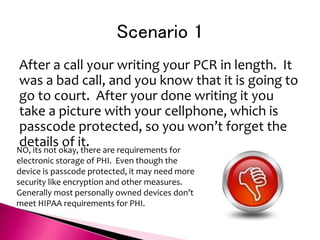
Scenario 1
After a call your writing your PCR in length. It
was a bad call, and you know that it is going to
go to court. After your done writing it you
take a picture with your cellphone, which is
passcode protected, so you won’t forget the
details of it.
NO, its not okay, there are requirements for
electronic storage of PHI. Even though the
device is passcode protected, it may need more
security like encryption and other measures.
Generally most personally owned devices don’t
meet HIPAA requirements for PHI.
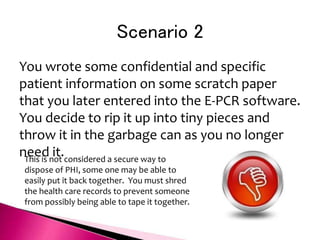
Scenario 2
You wrote some confidential and specific
patient information on some scratch paper
that you later entered into the E-PCR software.
You decide to rip it up into tiny pieces and
throw it in the garbage can as you no longer
need it.
This is not considered a secure way to
dispose of PHI, some one may be able to
easily put it back together. You must shred
the health care records to prevent someone
from possibly being able to tape it together.
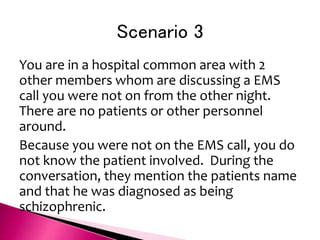
Scenario 3
You are in a hospital common area with 2
other members whom are discussing a EMS
call you were not on from the other night.
There are no patients or other personnel
around.
Because you were not on the EMS call, you do
not know the patient involved. During the
conversation, they mention the patients name
and that he was diagnosed as being
schizophrenic.
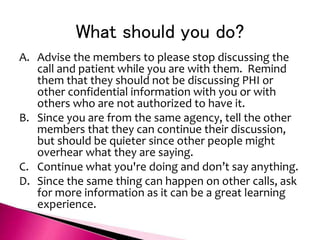
What should you do?
A. Advise the members to please stop discussing the
call and patient while you are with them. Remind
them that they should not be discussing PHI or
other confidential information with you or with
others who are not authorized to have it.
B. Since you are from the same agency, tell the other
members that they can continue their discussion,
but should be quieter since other people might
overhear what they are saying.
C. Continue what you're doing and don’t say anything.
D. Since the same thing can happen on other calls, ask
for more information as it can be a great learning
experience.
Reasoning
The correct option is A. When discussing PHI
or other confidential information with others
(in person or on the phone), this information
should be shared with only those people who
are authorized to receive the information and
have a “need to know” status.
Scenario 4
You find a portion of a patients record left on the
glass of a copy machine in a public area of the
hall. No one else is around.
What should you do?
A. Call the patient and notify them that their PHI
was left out in the open.
B. Shred the document.
C. Leave it by the copier. The person who left it
will most likely come back.
D. Secure the document by putting it in a folder
or envelope and report it to a chief.
Reasoning
The correct option is D. Securing the
document prevents further unintentional
disclosure, and a chief can make sure the
incident is properly documented. Be sure to
cover the information appropriately at all
times while delivering it.
Scenario 5
While you are leaving a patient at the hospital, a doctor is
talking quietly to another patient in another hospital bed in
the same room. You, your patient, and your patients family
overhear parts of the conversation.
What should you do?
A. Nothing.
B. Speak to the doctor after you both leave the room,
reminding him of his patients right to privacy.
C. Speak loudly while you are in the room so that your
patient and there visitors cannot overhear the
conversation.
D. Interrupt the doctor to remind him of his patients
protection under privacy laws.
Reasoning
The correct option is A. “Incidental”
disclosures are allowed, so as long as the
Covered Entity takes reasonable measures to
keep the disclosure to the minimum necessary.
Hippa 2021

Hippa 2021

  • 2.
    HIPAA • In 1996the Health Insurance Portability and Accountability Act was passed by the federal government. • It’s aim, among other things, was to force health care providers to protect the privacy of patient health information (PHI).
  • 3.
    Covered Entity • Anorganization or business which is bound by HIPAA regulations is called a “Covered Entity” • Big Tree VFC is a “Covered Entity”
  • 4.
    What is PHI? “Healthinformation means any information, whether oral or recorded in any form or medium, that- • (A) is created or received by a health care provider, health plan, public health authority, employer, life insurer, school or university, or health care clearinghouse; and • (B) relates to the past, present, or future physical or mental health or condition of any individual, the provision of health care to an individual, or the past, present, or future payment for the provision of health care to an individual.”
  • 5.
    What is PHI?(cont.) “Individually identifiable health information is information that is a subset of health information collected from an individual, and: • (1) Is created or received by a health care provider, health plan, employer, or health care clearinghouse; and • (2) Relates to the past, present, or future physical or mental health or condition of an individual; the provision of health care to an individual; or the past, present, or future payment for the provision of health care to an individual; and • (i) That identifies the individual; or • (ii) With respect to which there is a reasonable basis to believe the information can be used to identify the individual.”
  • 6.
    To simplify, PHIis: Any information that can identify or potentially identify a patient and/or pertains to the patients past, present or future health status. For us this is: Name ,DOB, SS#, history, meds, chief complaint, etc.
  • 7.
    Restricted Use andDisclosure of PHI • Patients can ask that health information not be shared with certain people, groups, or companies. • In cases like this the EMT in charge of the patient needs to make the chiefs aware of this request as soon as possible without compromising patient care or safety. • For Example, a patient may ask that there information not be shared or made known to a certain member.
  • 8.
    When is itokay to release PHI? • Generally patients must give a “covered entity” WRITTEN consent to release any PHI • There are a few ways some PHI may be released without written consent: – A patients name may be used in a radio transmission if a crew is having difficulty locating said patient. For example – there are no room numbers on an apartment list, but there are resident names. Dispatch can radio the name of the patient to the crew.
  • 9.
    When is itokay to release PHI? – An EMS crew may report the condition of a patient to an immediate family member (spouse, child, grandchild, or health care proxy) (IF VERBAL PERMISSION IS GIVEN BY THE PATIENT), but try to let the patient do it. – If the patient is a victim of a crime, EMS may tell law enforcement about the patient’s injuries and condition. If the patient is NOT a victim of a crime the patient may agree to speak to police about their condition if they so choose.
  • 10.
    When is itokay to release PHI? – An EMS crew may report patient injuries to law enforcement if the patient is possibly wanted in relation to a crime. – When EMS is delivering a report to a hospital or receiving medical facility. This is to preserve the continuity of care, providers NEED to pass on pertinent medical information and history and treatments given. EMS can disclose PHI to a triage nurse or doctor at a receiving facility. – EMS also has the right to open and review patient records when being transferred from a facility.
  • 11.
    When is itokay to release PHI? – When EMS is reporting suspected abuse that is covered under Mandated Reporting; • Child abuse/ neglect – 50 years following the date of death of the individual
  • 12.
    When is itNOT permissible to disclose PHI? Posting it on Social Media • EMS providers may not post details about runs on any electronic medium. This is true even when a patient name is not used. If there is enough information for someone to identify the patient (for example the nature of the injury, the time and location of an incident, etc.) the provider will be in violation. • Please also be aware that we do have a social media policy that all members must adhere to.
  • 13.
    When is itNOT permissible to disclose PHI? Discussions with colleagues/friends • Just as with electronic mediums, discussing patient encounters with colleagues who were not part of the patient care team (face to face, or in writing) is a definite no-no. • This applies also to conversations outside of work with the provider’s friends or family. KEEP IN MIND: YOU NEVER KNOW WHO KNOWS WHOM!
  • 14.
    When is itNOT permissible to disclose PHI? Statements to news media • EMS providers may not provide any information about the nature or severity of a patient’s illness or injuries. • EMS providers may not verify the identity of a patient being treated EVEN IF the media agency claims to already know the identity of the patient. • “NO COMMENT” and/or “PLEASE SEE THE PIO/CHIEF” are always rules of thumb!
  • 15.
    When is itNOT permissible to disclose PHI? Sharing patient status or information with neighbors • EMS providers may not disclose any patient information to a patient’s neighbor, friends, or other persons who are not involved in the treatment of said patient. • If a concerned neighbor or friend wants to know about the patient, let the patient tell them.
  • 16.
    So in otherwords this is not good
  • 17.
    Allowing other peopleto access your PCR/ePCR • PCRs are confidential. • PCRs and other hard copy PHI (med lists, etc.) should be secured in a receptacle designed to protect against unauthorized access. • EMS providers may not allow others to see their PCRs, however, there are some exceptions: – When the member in question is on the call with you – When a EMTs number are on that PCR – For training/learning/QA&QI purposes with patient info redacted.
  • 18.
    Why is HIPAAImportant? • Individuals and agencies who violate HIPAA privacy can be fined and individuals can even serve jail time if found guilty of violating these statutes. • It’s just the right thing to do – we are patient advocates and should be protecting the privacy of our patients.
  • 19.
    HIPAA breach notification •In the event that PHI is accidently or deliberately disclosed in violation of HIPAA regulations, the covered entity is required to report the breach immediately. • It is unlawful to hide or cover-up any confirmed or potential breach. • If you feel that a HIPAA breach has occurred, report the situation to any Chief or EMS officer immediately!
  • 20.
    Civil HIPAA breachpenalties HIPAA Violation Minimum Penalty Maximum Penalty Unknowing $100 per violation, with an annual maximum of $25,000 for repeat violations (Note: maximum that can be imposed by State Attorneys General regardless of the type of violation) $50,000 per violation, with an annual maximum of $1.5 million Reasonable Cause $1,000 per violation, with an annual maximum of $100,000 for repeat violations $50,000 per violation, with an annual maximum of $1.5 million Willful neglect but violation is corrected within the required time period $10,000 per violation, with an annual maximum of $250,000 for repeat violations $50,000 per violation, with an annual maximum of $1.5 million Willful neglect and is not corrected within required time period $50,000 per violation, with an annual maximum of $1.5 million $50,000 per violation, with an annual maximum of $1.5 million
  • 21.
    Criminal HIPAA breachpenalties • Criminal violations of HIPAA are handled by the DOJ. As with the HIPAA civil penalties, there are different levels of severity for criminal violations. • Covered entities and specified individuals, as explained below, who "knowingly" obtain or disclose individually identifiable health information, in violation of the Administrative Simplification Regulations, face a fine of up to $50,000, as well as imprisonment up to 1 year. • Offenses committed under false pretenses allow penalties to be increased to a $100,000 fine, with up to 5 years in prison. • Finally, offenses committed with the intent to sell, transfer or use individually identifiable health information for commercial advantage, personal gain or malicious harm permit fines of $250,000 and imprisonment up to 10 years.
  • 23.
    Scenario 1 After acall your writing your PCR in length. It was a bad call, and you know that it is going to go to court. After your done writing it you take a picture with your cellphone, which is passcode protected, so you won’t forget the details of it. NO, its not okay, there are requirements for electronic storage of PHI. Even though the device is passcode protected, it may need more security like encryption and other measures. Generally most personally owned devices don’t meet HIPAA requirements for PHI.
  • 24.
    Scenario 2 You wrotesome confidential and specific patient information on some scratch paper that you later entered into the E-PCR software. You decide to rip it up into tiny pieces and throw it in the garbage can as you no longer need it. This is not considered a secure way to dispose of PHI, some one may be able to easily put it back together. You must shred the health care records to prevent someone from possibly being able to tape it together.
  • 25.
    Scenario 3 You arein a hospital common area with 2 other members whom are discussing a EMS call you were not on from the other night. There are no patients or other personnel around. Because you were not on the EMS call, you do not know the patient involved. During the conversation, they mention the patients name and that he was diagnosed as being schizophrenic.
  • 26.
    What should youdo? A. Advise the members to please stop discussing the call and patient while you are with them. Remind them that they should not be discussing PHI or other confidential information with you or with others who are not authorized to have it. B. Since you are from the same agency, tell the other members that they can continue their discussion, but should be quieter since other people might overhear what they are saying. C. Continue what you're doing and don’t say anything. D. Since the same thing can happen on other calls, ask for more information as it can be a great learning experience.
  • 27.
    Reasoning The correct optionis A. When discussing PHI or other confidential information with others (in person or on the phone), this information should be shared with only those people who are authorized to receive the information and have a “need to know” status.
  • 28.
    Scenario 4 You finda portion of a patients record left on the glass of a copy machine in a public area of the hall. No one else is around. What should you do? A. Call the patient and notify them that their PHI was left out in the open. B. Shred the document. C. Leave it by the copier. The person who left it will most likely come back. D. Secure the document by putting it in a folder or envelope and report it to a chief.
  • 29.
    Reasoning The correct optionis D. Securing the document prevents further unintentional disclosure, and a chief can make sure the incident is properly documented. Be sure to cover the information appropriately at all times while delivering it.
  • 30.
    Scenario 5 While youare leaving a patient at the hospital, a doctor is talking quietly to another patient in another hospital bed in the same room. You, your patient, and your patients family overhear parts of the conversation. What should you do? A. Nothing. B. Speak to the doctor after you both leave the room, reminding him of his patients right to privacy. C. Speak loudly while you are in the room so that your patient and there visitors cannot overhear the conversation. D. Interrupt the doctor to remind him of his patients protection under privacy laws.
  • 31.
    Reasoning The correct optionis A. “Incidental” disclosures are allowed, so as long as the Covered Entity takes reasonable measures to keep the disclosure to the minimum necessary.

Editor's Notes

  • #2 NEXT SLIDE: HIPPA
  • #3 In 1996 HIPPA was passed by the federal government Aimed to force health care providers to protect PHI NEXT SLIDE: Covered Entity
  • #4 An organization or business which is bound by HIPPA is a Covered Entity NEXT SLIDE: What is PHI
  • #5 NEXT SLIDE: PHI Part 2
  • #6 NEXT SLIDE: Simplified PHI
  • #7 Any information that can identify a patient For us that’s name, dob, ss, history, meds, chief complaint NEXT SLIDE: Restricted use and Disclosure of PHI
  • #8 Slide about patients not wanting certain members to see there info NEXT SLIDE: When is it okay to release PHI 1 of 4
  • #9 Generally must have written consent Some ways PHI can be released with out written consent To locate a patient over the radio NEXT SLIDE: Ok to release PHI page 2 of 4
  • #10 To report the condition of a patient to immediate family If the patient is a victim of a crime NEXT SLIDE: When is it okay to release PHI 3 of 4
  • #11 When a patient is wanted in a crime When delivering the patient to a hospital We can review records when transferring a patient NEXT SLIDE: When is it okay to release PHI 4 of 4
  • #12 Anything under mandated reporting Children abuse neglect 50 years after death NEXT SLIDE: When is it not okay to release PHI 1 of 4
  • #13 Social media Posting details about any run NEXT SLIDE: When is it not okay to release PHI 2 of 4
  • #14 Discussions with colleagues/friends As with electronic mediums don’t discuss with people not part of the patient care team This also applies to conversations outside of work with friends and family Keep in mind you don’t know who knows who NEXT SLIDE: When is it not okay to release PHI 3 of 4
  • #15 Statements to news media My not provide them info on the patients injuries or illness Do not verify the identity even if they say they already know No comment and or please see the chief/poi are always rules of thumb NEXT SLIDE: When is it not okay to release PHI 4 of 4
  • #16 Sharing patients status or info with neighbors May not disclose info to neighbors, friends, or any one not involved in patients care If a neighbor or friend wants info let the patient tell them NEXT SLIDE: PHI Discloser Joke
  • #17 NEXT SLIDE: Allowing others to access your PCR
  • #18 They are confidential Pcrs and other hard copies should be secured in a receptacle designed to stop unauthorized access May not allow others to see their PCRs except When member was on the call with you When an emts numbers are on that pcr For training/learning/QAQI purposes NEXT SLIDE: Why is HIPAA Important
  • #19 Individuals and agencies why violate HIPAA can be fined an even serve jail time if not following The right thing to do. NEXT SLIDE: HIPAA breach
  • #20 If PHI is released the incident must be reported Its unlawful to hide or cover up any confirmed breach If you feel a breach has occurred you need to report to any chief or ems officer NEXT SLIDE: Civil Penalties
  • #21 NEXT SLIDE: Criminal Penalties
  • #22 You can get both Civil and Criminal penalties NEXT SLIDE: Lets see what we have learned
  • #23 NEXT SLIDE: Scenario 1
  • #24 False Scenario 1 of 5
  • #25 False Scenario 2 of 5
  • #26 Scenario 3 of 5
  • #27 A Scenario 3 of 5
  • #28 Scenario 3 of 5
  • #29 D Scenario 4 of 5
  • #30 Scenario 4 of 5
  • #31 A Scenario 5 of 5
  • #32 Scenario 5 of 5 LAST ONE LAST SLIDE