THE BASICS OF HIPAA
HIPAA: WHAT IS IT?


•  HIPAA does the following:
•  Creates standards for protecting the privacy of
   health information
•  Creates standards for the security of health
   information
•  Creates standards for electronic exchange of
   health information
WHAT IS COVERED BY HIPAA?

•  Protected Health Information
   The HIPAA privacy rule covers and sets standards for the
   collecting, sharing and storing of a person’s Protected Health
   Information, or PHI, for short. PHI is information that:
•  Relates to past, present or future physical or mental health or
   condition, payments and provisions about healthcare.
•  Identifies the individual in a personal way.
•  Provides a reasonable basis to be used to identify the
   individual.
•  Is created or received by a Covered Entity.
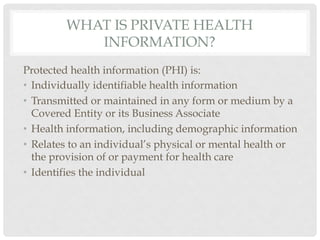
WHAT IS PRIVATE HEALTH
            INFORMATION?
Protected health information (PHI) is:
•  Individually identifiable health information
•  Transmitted or maintained in any form or medium by a
   Covered Entity or its Business Associate
•  Health information, including demographic information
•  Relates to an individual’s physical or mental health or
   the provision of or payment for health care
•  Identifies the individual
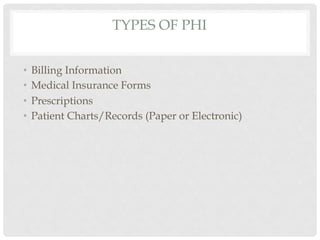
TYPES OF PHI


•  Billing Information
•  Medical Insurance Forms
•  Prescriptions
•  Patient Charts/Records (Paper or Electronic)
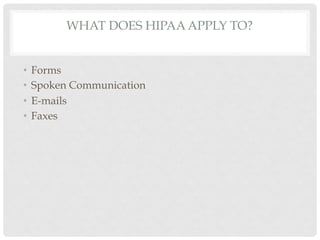
WHAT DOES HIPAA APPLY TO?


•  Forms
•  Spoken Communication
•  E-mails
•  Faxes
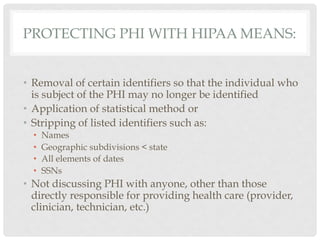
PROTECTING PHI WITH HIPAA MEANS:


•  Removal of certain identifiers so that the individual who
   is subject of the PHI may no longer be identified
•  Application of statistical method or
•  Stripping of listed identifiers such as:
  •    Names
  •    Geographic subdivisions < state
  •    All elements of dates
  •    SSNs
•  Not discussing PHI with anyone, other than those
   directly responsible for providing health care (provider,
   clinician, technician, etc.)
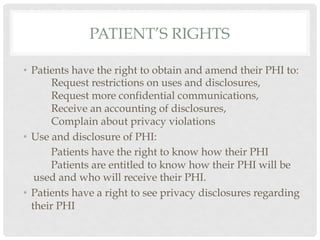
PATIENT’S RIGHTS

•  Patients have the right to obtain and amend their PHI to:
       Request restrictions on uses and disclosures,
       Request more confidential communications,
       Receive an accounting of disclosures,
       Complain about privacy violations
•  Use and disclosure of PHI:
       Patients have the right to know how their PHI
       Patients are entitled to know how their PHI will be
    used and who will receive their PHI.
•  Patients have a right to see privacy disclosures regarding
   their PHI
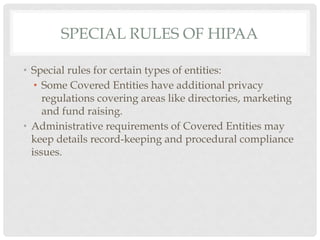
SPECIAL RULES OF HIPAA

•  Special rules for certain types of entities:
    •  Some Covered Entities have additional privacy
       regulations covering areas like directories, marketing
       and fund raising.
•  Administrative requirements of Covered Entities may
   keep details record-keeping and procedural compliance
   issues.
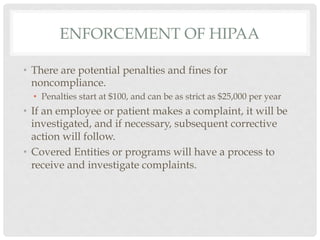
ENFORCEMENT OF HIPAA

•  There are potential penalties and fines for
   noncompliance.
  •  Penalties start at $100, and can be as strict as $25,000 per year
•  If an employee or patient makes a complaint, it will be
   investigated, and if necessary, subsequent corrective
   action will follow.
•  Covered Entities or programs will have a process to
   receive and investigate complaints.
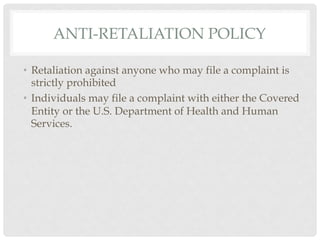
ANTI-RETALIATION POLICY

•  Retaliation against anyone who may file a complaint is
   strictly prohibited
•  Individuals may file a complaint with either the Covered
   Entity or the U.S. Department of Health and Human
   Services.
REASONABLE PHYSICAL AND
        TECHNOLOGICAL SAFEGUARDS


•  Telephones – How do you know the person you are
   talking to is authorized to receive an employee’s PHI?
•  Disposing of PHI – When you dispose of PHI (both hard
   copy and electronic) how can you be certain that it is
   appropriately destroyed?
•  E-mail – How can you be sure PHI is secure when it’s
   sent via e-mail?
•  Fax machines – When faxing PHI, how can you be sure
   the right person will read it on the other end?
•  Mail – Sending PHI through the mail may have
   restrictions.
•  Storing PHI – Safeguarding PHI on computer databases,
   file cabinets, even laptop computers will have to follow
   procedure.
WHAT DOES THIS MEAN TO YOU?


•  Do not let anyone use your username and password
•  Log off of your computer, when you walk away from it,
•  Do not use anyone else’s username and password
•  Do not discuss private health information of any patient outside of
   the care setting
•  Do not discuss private health information of any patient with
   someone other than a direct care giver
•  Do not look up any health records, unless it is a patient under your
   care and the information is for the purpose of providing patient care
•  Do not look up your own private health information

Hipaa basics.pp2

  • 1.
  • 2.
    HIPAA: WHAT ISIT? •  HIPAA does the following: •  Creates standards for protecting the privacy of health information •  Creates standards for the security of health information •  Creates standards for electronic exchange of health information
  • 3.
    WHAT IS COVEREDBY HIPAA? •  Protected Health Information The HIPAA privacy rule covers and sets standards for the collecting, sharing and storing of a person’s Protected Health Information, or PHI, for short. PHI is information that: •  Relates to past, present or future physical or mental health or condition, payments and provisions about healthcare. •  Identifies the individual in a personal way. •  Provides a reasonable basis to be used to identify the individual. •  Is created or received by a Covered Entity.
  • 4.
    WHAT IS PRIVATEHEALTH INFORMATION? Protected health information (PHI) is: •  Individually identifiable health information •  Transmitted or maintained in any form or medium by a Covered Entity or its Business Associate •  Health information, including demographic information •  Relates to an individual’s physical or mental health or the provision of or payment for health care •  Identifies the individual
  • 5.
    TYPES OF PHI • Billing Information •  Medical Insurance Forms •  Prescriptions •  Patient Charts/Records (Paper or Electronic)
  • 6.
    WHAT DOES HIPAAAPPLY TO? •  Forms •  Spoken Communication •  E-mails •  Faxes
  • 7.
    PROTECTING PHI WITHHIPAA MEANS: •  Removal of certain identifiers so that the individual who is subject of the PHI may no longer be identified •  Application of statistical method or •  Stripping of listed identifiers such as: •  Names •  Geographic subdivisions < state •  All elements of dates •  SSNs •  Not discussing PHI with anyone, other than those directly responsible for providing health care (provider, clinician, technician, etc.)
  • 8.
    PATIENT’S RIGHTS •  Patientshave the right to obtain and amend their PHI to: Request restrictions on uses and disclosures, Request more confidential communications, Receive an accounting of disclosures, Complain about privacy violations •  Use and disclosure of PHI: Patients have the right to know how their PHI Patients are entitled to know how their PHI will be used and who will receive their PHI. •  Patients have a right to see privacy disclosures regarding their PHI
  • 9.
    SPECIAL RULES OFHIPAA •  Special rules for certain types of entities: •  Some Covered Entities have additional privacy regulations covering areas like directories, marketing and fund raising. •  Administrative requirements of Covered Entities may keep details record-keeping and procedural compliance issues.
  • 10.
    ENFORCEMENT OF HIPAA • There are potential penalties and fines for noncompliance. •  Penalties start at $100, and can be as strict as $25,000 per year •  If an employee or patient makes a complaint, it will be investigated, and if necessary, subsequent corrective action will follow. •  Covered Entities or programs will have a process to receive and investigate complaints.
  • 11.
    ANTI-RETALIATION POLICY •  Retaliationagainst anyone who may file a complaint is strictly prohibited •  Individuals may file a complaint with either the Covered Entity or the U.S. Department of Health and Human Services.
  • 12.
    REASONABLE PHYSICAL AND TECHNOLOGICAL SAFEGUARDS •  Telephones – How do you know the person you are talking to is authorized to receive an employee’s PHI? •  Disposing of PHI – When you dispose of PHI (both hard copy and electronic) how can you be certain that it is appropriately destroyed? •  E-mail – How can you be sure PHI is secure when it’s sent via e-mail? •  Fax machines – When faxing PHI, how can you be sure the right person will read it on the other end? •  Mail – Sending PHI through the mail may have restrictions. •  Storing PHI – Safeguarding PHI on computer databases, file cabinets, even laptop computers will have to follow procedure.
  • 13.
    WHAT DOES THISMEAN TO YOU? •  Do not let anyone use your username and password •  Log off of your computer, when you walk away from it, •  Do not use anyone else’s username and password •  Do not discuss private health information of any patient outside of the care setting •  Do not discuss private health information of any patient with someone other than a direct care giver •  Do not look up any health records, unless it is a patient under your care and the information is for the purpose of providing patient care •  Do not look up your own private health information