CONFIDENTIALITY
Denise Milner
MHA 690-Capstone
Dr. Rockie McDaniel
January 25, 2016
PRIVACY VS CONFIDENTIALITY
Privacy is an individual’s
constitutional right to be left alone,
to be free from unwarranted
publicity, and to conduct his of her
life without its being made public.
In the health care environment,
privacy is the individual’s right to
limit access to his or her health
care information.
Confidentiality is the expectation
that information shared with a
health care provider during the
course of treatment will be used
only for its intended purpose and
not disclosed otherwise.
Confidentiality is based on trust.
 Wager, Lee, and Glaser (2013)
HIPAA
The Health Insurance portability and Accountability Act (HIPAA) Privacy
Rule is an important federal regulation. It is the first comprehensive
federal regulation that offers specific protection to private health
information (PHI). HIPAA Privacy Rule does permit the enforcement of
existing state laws that are more protective of the individuals privacy.
HIPAA allows healthcare workers to access a patient’s health information
for treatment, billing, payment, and general healthcare operations.
Information should be accessed only by those who have a need to know.
Utilizing private health information for personal access, gain, or disclosure
is a violation of the HIPAA rule.
(HHS.gov 2015)
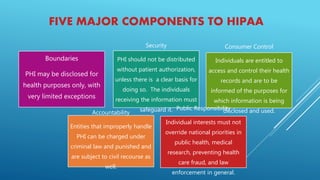
FIVE MAJOR COMPONENTS TO HIPAA
Boundaries
PHI may be disclosed for
health purposes only, with
very limited exceptions
Security
PHI should not be distributed
without patient authorization,
unless there is a clear basis for
doing so. The individuals
receiving the information must
safeguard it.
Consumer Control
Individuals are entitled to
access and control their health
records and are to be
informed of the purposes for
which information is being
disclosed and used.Accountability
Entities that improperly handle
PHI can be charged under
criminal law and punished and
are subject to civil recourse as
well.
Public Responsibility
Individual interests must not
override national priorities in
public health, medical
research, preventing health
care fraud, and law
enforcement in general.
PROTECTED HEALTH INFORMATION (PHI)
Protected Health Information is information that:
 Relates to a person’s physical or mental health, the
provision of health care, or the payment for health care
 Identifies the person who is the subject of the information
 Is created or received by a covered entity
 Is transmitted or maintained in any form
(Wager, Lee, and Glaser, 2013)
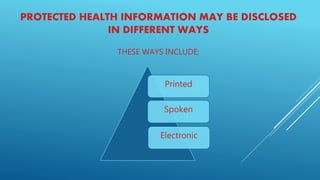
PROTECTED HEALTH INFORMATION MAY BE DISCLOSED
IN DIFFERENT WAYS
THESE WAYS INCLUDE;
Printed
Spoken
Electronic
BEST PRACTICE REMINDERS
 DO keep computer sign-on codes and passwords secret, and DO NOT allow
unauthorized persons access to your computer. Also, use locked screensavers
for added privacy.
 DO keep notes, files, memory sticks, and computers in a secure place, and be
careful NOT to leave them in open areas outside your workplace,such as a
library, cafeteria, or airport.
 DO NOT place PHI or PII on a mobile device without required approval. DO
use encryption when sending or storing PHI or PII on mobile devices,
including “thumb” or “flash” drives.
 DO hold discussions of PHI in private areas and for job-related reasons only.
Also, be aware of places where others might overhear conversations,such as in
reception areas.
BEST PRACTICE REMINDERS-CONTINUED
 DO make certain when mailing documents that no sensitive information is
shown on postcards or through envelope windows, and that envelopes are
closed securely.
 DO NOT use unsealed campus mail envelopes when sending sensitive
information to another employee.
 DO follow procedures for the proper disposal of sensitive information, such
as shredding documents or using locked recycling drop boxes. • When
sending an e-mail,
 DO NOT include PHI or other sensitive information such as Social Security
numbers, unless you have the proper written approval to store the
information and use encryption.
CONSEQUENCES
• Breaches in security and confidentiality must be reported.
• Breaches in patients confidentiality will lead to disciplinary
actions up to and including termination.
• Entities and individuals that improperly handle protected
health information can face criminal and civil recourse.
CONCLUSION
Breach of confidentiality of health care
information is a serious offense. Health care
workers should be familiar with and follow all
policies and regulations concerning patient
confidentiality and privacy. Patients have a right
to privacy and confidentiality and it must be
protected.
REFERENCES
HHS.gov (2015), The HIPAA Privacy Rule Retrieved from
http://www.hhs.gov/hipaa/for-professionals/privacy/indext.html
HIPAA, Privacy & Security Training Module (2013) Retrieved from
https://www.unc.edu/hipaa/Annual%20HIPAA%20Training%20curr
ent.pdf
Wager, K. A., Lee, F. W., & Glaser, J. P. (2013). Health Care Information
Systems A Practical Approach for Health Care Management (3rd
ed.). San Francisco, CA: Jossey-Bass.

Confidentiality

  • 1.
  • 2.
    PRIVACY VS CONFIDENTIALITY Privacyis an individual’s constitutional right to be left alone, to be free from unwarranted publicity, and to conduct his of her life without its being made public. In the health care environment, privacy is the individual’s right to limit access to his or her health care information. Confidentiality is the expectation that information shared with a health care provider during the course of treatment will be used only for its intended purpose and not disclosed otherwise. Confidentiality is based on trust.  Wager, Lee, and Glaser (2013)
  • 3.
    HIPAA The Health Insuranceportability and Accountability Act (HIPAA) Privacy Rule is an important federal regulation. It is the first comprehensive federal regulation that offers specific protection to private health information (PHI). HIPAA Privacy Rule does permit the enforcement of existing state laws that are more protective of the individuals privacy. HIPAA allows healthcare workers to access a patient’s health information for treatment, billing, payment, and general healthcare operations. Information should be accessed only by those who have a need to know. Utilizing private health information for personal access, gain, or disclosure is a violation of the HIPAA rule. (HHS.gov 2015)
  • 4.
    FIVE MAJOR COMPONENTSTO HIPAA Boundaries PHI may be disclosed for health purposes only, with very limited exceptions Security PHI should not be distributed without patient authorization, unless there is a clear basis for doing so. The individuals receiving the information must safeguard it. Consumer Control Individuals are entitled to access and control their health records and are to be informed of the purposes for which information is being disclosed and used.Accountability Entities that improperly handle PHI can be charged under criminal law and punished and are subject to civil recourse as well. Public Responsibility Individual interests must not override national priorities in public health, medical research, preventing health care fraud, and law enforcement in general.
  • 5.
    PROTECTED HEALTH INFORMATION(PHI) Protected Health Information is information that:  Relates to a person’s physical or mental health, the provision of health care, or the payment for health care  Identifies the person who is the subject of the information  Is created or received by a covered entity  Is transmitted or maintained in any form (Wager, Lee, and Glaser, 2013)
  • 6.
    PROTECTED HEALTH INFORMATIONMAY BE DISCLOSED IN DIFFERENT WAYS THESE WAYS INCLUDE; Printed Spoken Electronic
  • 7.
    BEST PRACTICE REMINDERS DO keep computer sign-on codes and passwords secret, and DO NOT allow unauthorized persons access to your computer. Also, use locked screensavers for added privacy.  DO keep notes, files, memory sticks, and computers in a secure place, and be careful NOT to leave them in open areas outside your workplace,such as a library, cafeteria, or airport.  DO NOT place PHI or PII on a mobile device without required approval. DO use encryption when sending or storing PHI or PII on mobile devices, including “thumb” or “flash” drives.  DO hold discussions of PHI in private areas and for job-related reasons only. Also, be aware of places where others might overhear conversations,such as in reception areas.
  • 8.
    BEST PRACTICE REMINDERS-CONTINUED DO make certain when mailing documents that no sensitive information is shown on postcards or through envelope windows, and that envelopes are closed securely.  DO NOT use unsealed campus mail envelopes when sending sensitive information to another employee.  DO follow procedures for the proper disposal of sensitive information, such as shredding documents or using locked recycling drop boxes. • When sending an e-mail,  DO NOT include PHI or other sensitive information such as Social Security numbers, unless you have the proper written approval to store the information and use encryption.
  • 9.
    CONSEQUENCES • Breaches insecurity and confidentiality must be reported. • Breaches in patients confidentiality will lead to disciplinary actions up to and including termination. • Entities and individuals that improperly handle protected health information can face criminal and civil recourse.
  • 10.
    CONCLUSION Breach of confidentialityof health care information is a serious offense. Health care workers should be familiar with and follow all policies and regulations concerning patient confidentiality and privacy. Patients have a right to privacy and confidentiality and it must be protected.
  • 11.
    REFERENCES HHS.gov (2015), TheHIPAA Privacy Rule Retrieved from http://www.hhs.gov/hipaa/for-professionals/privacy/indext.html HIPAA, Privacy & Security Training Module (2013) Retrieved from https://www.unc.edu/hipaa/Annual%20HIPAA%20Training%20curr ent.pdf Wager, K. A., Lee, F. W., & Glaser, J. P. (2013). Health Care Information Systems A Practical Approach for Health Care Management (3rd ed.). San Francisco, CA: Jossey-Bass.