
What is Ebola?
• According to the CDC, Ebola is an infectious
and generally fatal disease marked by fever
and severe internal bleeding, spread through
contact with infected body fluids by a
filovirus ( Ebola virus ), whose normal host
species is unknown.
Signs & Symptoms of Ebola
• Fever
• Severe headache
• Muscle pain
• Weakness
• Fatigue
• Diarrhea
• Vomiting
• Abdominal (stomach) pain
• Unexplained hemorrhage (bleeding or bruising)
Signs & Symptoms of Ebola
• Symptoms may appear anywhere from 2 to
21 days after exposure to Ebola, but the
average is 8 to 10 days.
• Recovery from Ebola depends on good
supportive clinical care and the patient’s
immune response. People who recover
from Ebola infection develop antibodies
that last for at least 10 years.
How is Ebola Spread?
• When an infection occurs in humans, the
virus can be spread to others through
direct contact (through broken skin or
mucous membranes in, for example, the
eyes, nose, or mouth) with;
• Blood or body fluids (including but not
limited to urine, saliva, sweat, feces, vomit,
breast milk, and semen) of a person who is
sick with or has died from Ebola.
How is Ebola Spread?
• Objects (like needles and syringes) that
have been contaminated with body fluids
from a person who is sick with Ebola or
the body of a person who has died from
Ebola.
• Infected fruit bats or primates (apes and
monkeys).
How is Ebola Spread?
• Possibly from contact with semen from
a man who has recovered from Ebola.
• Ebola is NOT spread through the air, by
water, or in general, by food.
What do we do for an Ebola call?
• First and foremost, as with anything else,
our safety and health come before
anything else.
• If Ebola case is suspected and we respond,
you must immediately notify myself as
soon as possible, without impacting
patient care.
What do we do for an Ebola call?
• No suspected Ebola case is to be
approached without proper PPE.
• As we do in firefighting with Ebola we will
use the 2 in 2 out rule. The second person
may in this case be a driver that is proficient
in Ebola safety.
Prepping to respond to the call.
• All the non-essential equipment for the call
will need to be removed from the
ambulance. I would only keep;
– The stretcher
– The Life Pak
– The Thermometer
Prepping to respond to the call.
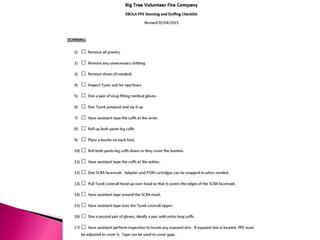
• Follow proper donning procedure for
putting on your PPE.
• After you’re done getting it on you and your
partner need to recheck your gear.
• You are now safe to respond.
After the call…
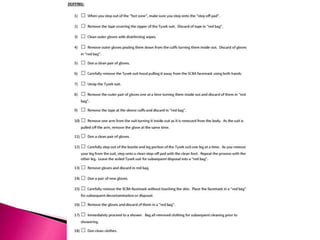
• Follow the proper doffing procedure for
removing your PPE.
• The ambulance will now be out of service.
• The ambulance must stay at the hospital and
be “sealed” with all equipment in/on it.
After the call…
• Follow up care for anyone that had any level
of contact with the patient, as deemed
necessary by the CDC at that time.
Ebola 2021
Ebola 2021
Ebola 2021
Ebola 2021

Ebola 2021

  • 2.
    What is Ebola? •According to the CDC, Ebola is an infectious and generally fatal disease marked by fever and severe internal bleeding, spread through contact with infected body fluids by a filovirus ( Ebola virus ), whose normal host species is unknown.
  • 3.
    Signs & Symptomsof Ebola • Fever • Severe headache • Muscle pain • Weakness • Fatigue • Diarrhea • Vomiting • Abdominal (stomach) pain • Unexplained hemorrhage (bleeding or bruising)
  • 4.
    Signs & Symptomsof Ebola • Symptoms may appear anywhere from 2 to 21 days after exposure to Ebola, but the average is 8 to 10 days. • Recovery from Ebola depends on good supportive clinical care and the patient’s immune response. People who recover from Ebola infection develop antibodies that last for at least 10 years.
  • 5.
    How is EbolaSpread? • When an infection occurs in humans, the virus can be spread to others through direct contact (through broken skin or mucous membranes in, for example, the eyes, nose, or mouth) with; • Blood or body fluids (including but not limited to urine, saliva, sweat, feces, vomit, breast milk, and semen) of a person who is sick with or has died from Ebola.
  • 6.
    How is EbolaSpread? • Objects (like needles and syringes) that have been contaminated with body fluids from a person who is sick with Ebola or the body of a person who has died from Ebola. • Infected fruit bats or primates (apes and monkeys).
  • 7.
    How is EbolaSpread? • Possibly from contact with semen from a man who has recovered from Ebola. • Ebola is NOT spread through the air, by water, or in general, by food.
  • 8.
    What do wedo for an Ebola call? • First and foremost, as with anything else, our safety and health come before anything else. • If Ebola case is suspected and we respond, you must immediately notify myself as soon as possible, without impacting patient care.
  • 9.
    What do wedo for an Ebola call? • No suspected Ebola case is to be approached without proper PPE. • As we do in firefighting with Ebola we will use the 2 in 2 out rule. The second person may in this case be a driver that is proficient in Ebola safety.
  • 10.
    Prepping to respondto the call. • All the non-essential equipment for the call will need to be removed from the ambulance. I would only keep; – The stretcher – The Life Pak – The Thermometer
  • 11.
    Prepping to respondto the call. • Follow proper donning procedure for putting on your PPE. • After you’re done getting it on you and your partner need to recheck your gear. • You are now safe to respond.
  • 12.
    After the call… •Follow the proper doffing procedure for removing your PPE. • The ambulance will now be out of service. • The ambulance must stay at the hospital and be “sealed” with all equipment in/on it.
  • 13.
    After the call… •Follow up care for anyone that had any level of contact with the patient, as deemed necessary by the CDC at that time.

Editor's Notes

  • #2 NEXT SLIDE: What is Ebola
  • #3 NEXT SLIDE: Signs and Symptoms 1
  • #4 NEXT SLIDE: Signs and Symptoms 2
  • #5 NEXT SLIDE: How it is Spread 1
  • #6 NEXT SLIDE: How it is Spread 2
  • #7 NEXT SLIDE: How it is Spread 3
  • #8 NEXT SLIDE: What we do for an Ebola Call 1
  • #9 NEXT SLIDE: What we do for an Ebola Call 2
  • #10 NEXT SLIDE: How we prep to answer the call 1
  • #11 NEXT SLIDE: How we prep to answer the call 2
  • #12 NEXT SLIDE: After the call 1
  • #13 NEXT SLIDE: After the call 2
  • #14 NEXT SLIDE: See how its done
  • #15 NEXT SLIDE: How to Don
  • #16 NEXT SLIDE: How to Dof
  • #17 NEXT SLIDE: HIPPA and PHI