ANNAMALAI UNIVERSITY
Grafting is the combination of two identical
formulation plants which grow as one plants.
Vegetable grafting is a modern technique used to
control soil pathogens in which vegetative growth
of weak root combination is grafted on selected
rootstocks of disease and pest resistance and
adaptive to environmental changes. Rootstock
Scion
Cultivated area using grafted seedlings, and the estimated number of grafted
vegetable seedlings in Korea and Japan. About 337 million grafted seedlings are
planted annually in Korea and »651 million in Japan (field and greenhouses). More
than 95% of the watermelons in both countries are grafted. The majority of
greenhouse cucumbers are grafted, but only »10% to 30% of cucumbers for growth in
the field are grafted. Most of the Oriental melons are grafted to squash (Cucurbita
spp.) rootstock (Ito, 1992; Jang et al., 1992)
 The raising of grafted plants of vegetables was first initiated in Japan and
Korea during late 1920’s with watermelon onto gourd rootstock.
 In the 1950’s, eggplant was grafted onto scarlet egg plant (Solanum
integrifolium ). At present, more than 95% of watermelon and oriental melon in
Japan, Korea and Taiwan are grafted on squash and gourd rootstock before
transplanting. In Greece, cucurbit grafting is very popular.
Current status
FAO statistics 2008
The main objectives of vegetable grafting is to eliminate soil borne pests that
infect vegetables and problems of salinity and soil acidity. Other objectives of
grafting are to increase productivity, to increase the grafted plant tolerance to
different temperature.
Vegetables objectives
Cucumber Tolerance to fusarium wilt, Phytophthora melonis, cold
hardiness, favourable sex ratio, bloomless fruits.
Egg plant Tolerance to bacterial wilt, verticillium wilt, fusarium wilt,
low temperature, nematodes, induced vigour and enhanced
yield.
Tomato Tolerance to corky root, better colour and greater lycopene
content, tolerance to nematode.
Melon Tolerance to fusarium wilt, physiological disorders,
Phytophthora diseases, cold hardiness, enhanced growth.
Watermelon Tolerance to fusarium wilt, Physiological disorders, cold
hardiness and drought tolerance.
Bittergourd Tolerance to fusarium wilt.
Objectives of grafting
Pandey and Rai, 2003
Cucurbitaceae: Muskmelon, Watermelon, Cucumber, Squash
Solanaceae: Brinjal, Pepper, Tomato
Intergeneric grafting is common in fruited vegetables, e.g. watermelon are
normally grafted on bottlegourd ( lagenaria siceraria ) or to interspecific hybrids.
In Japan, the muskmelon is generally grafted onto hybrid melon cv. Base and the wax
gourd ( Benincasa hispida ) cv. ‘partner’.
 Cucumbers are generally grafted onto figleaf gourd ( cucurbita ficifolia ) or inter-
specific hybrid ( Cucurbita maxima x C.moschata ).
 Rootstocks such as scarlet eggplant Solanum integrifolium , solanum torvum and
solanum nigrum are exploited for grafting of egg plant.
 Sponge gourd ( Luffa aegyptiaca ) is used as a resistant ( Fusarium wilt ) for
bittergourd.
 Tomato is usually grafted on egg plant, solanum torvum, intergeneric rootstocks and
KNVF hybrids.
Cont..
Scion Rootstocks
Cucumber Cucurbita moschata, Cucurbita ficifolia, Cucurbita maxima
Melons Cucurbita Spp, Cucumis melo, Cucurbita moschata x Cucurbita
maxima, Benincasa hispida
Watermelon Citrulus lanatus, Cucurbita maxima, Cucurbita moschata,
Cucurbita moschata x Cucurbita maxima, Lagenaria siceraria
Bittergourd Cucurbita moschata, Lagenaria siceraria, Luffa aegyptiaca
Tomato Lycopersicon pimpinellifolium, L.esculentum, Solanum nigrum
Egg plant Solanum torvum, Solanum integrifolium, Solanum melongena,
Solanum nigrum
Different rootstocks for grafting of vegetables
Pandey and Pandita, 2002
CROP ROOTSTOCK SPECIES DESIRABLE TRAITS
Tomato Lycopersicon pimpinellifolium(L.) Mill Nematode resistance
Lycopersicon hirsutum Nematode resistance
Solanum integrifolium Tomato sugar content increase
Solanum sisymbrifolium Tomato disease resistance
Solanum torvum Disease resistance, Nematode
tolerance
Solanum nigrum L. Fruit size and quality control
Brinjal Solanum torvum Disease resistance, nematode
tolerance
Solanum integrifolium Low temperature tolerance
DESIRABLE CHARACTERS OF ROOTSTOCKS
Water melon Lagenaria siceraria L. Vigorous root system, fusarium
tolerance, low temperature tolerance
Cucurbita moschata Vigorous root system, fusarium
tolerance, low temperature tolerance
Interspecific hybrid squash-
Cucurbita maxima x Cucurbita
moschata Duch.
Vigorous root system, fusarium
tolerance, low and high temperature
tolerance
Benincasa hispida Good disease resistance
Cucurbita pepo L. Vigorous root system, fusarium
tolerance, low temperature tolerance
Cucumis metuliferus E. Mey.ex Naud Fusarium tolerance, Nematode
tolerance
Cucumber Cucurbita ficifolia Bouche. Low temperature tolerance, good
disease resistance
Cucurita moschata Duch. Fusarium tolerance, fruit quality
modification
Cucurbita maxima Duch. X
C.moschata Duch.
Fusarium tolerance, Low
temperature tolerance
Cucumis metuliferus E. Mey.ex
Naud.
Fusarium tolerance. Nematode
tolerance
CONT…
In grafting, it is important to increase the chances for vascular bundles of the scion
and rootstocks to come into contact by maximizing the area of cut surface that are spliced
together. After grafting, a temperature of 30oC and 95% RH is maintained for fast healing
and better survival of graftage. Gradually, the relative humidity is then lowered and the light
intensity is increased.
The development of graft union is depended upon the formation of an isolation
layer and a parenchymatous callus to the occurrence of symplastic contact between the cells,
notably the sieve elements of the rootstock and scion.
Various methods of grafting are:
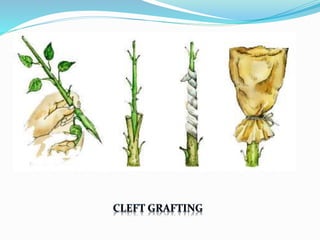
Cleft grafting
Whip and tongue grafting
Splice grafting
Flat grafting
Saddle grafting
Bud grafting
Hole insertion grafting
Tongue approach grafting.
 This method of grafting is practiced in tomato.
For successful union, seeds of rootstock are sown 5-7 days
earlier than those scion.
 The stem of scion ( at four leaf stage ) and the
rootstock ( at four to five leaf stage ) are cut at right angles,
each with 2-3 leaves keeping on the stem.
 The stem scion is cut in a wedge and the tapered
end is fitted into a cleft cut in the end of the rootstock. The
graft is held firm with a plastic clip.
 This method of grafting is very popular among Japanese seedling procedure to graft
small plants grown in plug tray 2-3 times faster than the convenient method.
 The optimum growth stage for grafting varies according to the kind of plug used.
 plants in small cells are grafted at earlier growth stage which require small size
tubes.
 First, the rootstock is given a slanting cut and the scion is also cut in the same
way.
 elastic tubes with side slit are put on the cut end of the root stock.
 The cut ends of the
scions are inserted into the tube,
splicing the cut surfaces of the
scions and rootstocks together.
 Tube grafting is practiced
in brinjal onto the rootstock of
Solanum torvum.
 This method is common in melons and other cucurbits.
 In such case, seeds are sown 10-13 days before grafting for
cucurbits and 7-10 days before grafting for pumpkin to ensure
uniformity in diameter.
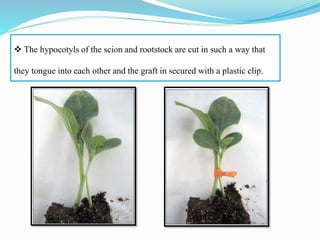
 The hypocotyls of the scion and rootstock are cut in such a way that
they tongue into each other and the graft in secured with a plastic clip.
The hypocotyl of the scion is left for 3-4
days and then The hypocotyls is cut off
with sharp blade 3 or 4 days after crushing.
 In this method, the first leaf and lateral buds are removed when a slanting cut is given to
a cotyledon of the rootstock.
Recently, grafting robots for plugs have been developed by combining
the adhesive and grafting plates which facilitates simultaneous grafting for eight
plugs of tomato, eggplant or pepper, nowadays, a fully automatic grafting system
has been designed for cucurbitaceous vegetables in which quality seedling plants
are produced by using fuzzy logic and neural network. In addition, a heating
chamber with controlled atmospheric conditions has been designed to enhance the
survival of the graftage.
Yoshioka, 2001
The main objective of grafting is to reduce soil borne diseases like Fusarium wilt in
cucurbitaceae( Cucumber, melon etc.) and bacteria wilt in solanaceae (Tomato, pepper). The
use of resistant rootstocks in combination with integrated pest management reduces the
requiring soil fumigation with methyl bromide in many crops and it is effective in organic
farming of vegetables.
Grafting fruiting vegetables to manage soilborne pathogens, foliar
pathogens,
Frank J. Louwsa,∗, Cary L. Rivarda,b, Chieri Kubotac
BACTERIAL WILT
BLIGHT
Sicyos angulatus and pumpkin have been found to be promising
rootstocks to avoid nematode infestation in cucumber. In tomato, nematex
rootstock gives complete resistance against nematode infection. Other rootstocks
used against nematode in tomato are KNVF and solanum nigrum.
Capsicum annuum rootstocks with N gene resistance offered effective
control of Mi when grafted to a popular commercial bell pepper (Kokalis-Burelle et
al., 2009).
Accessions C. annuum, C. frutescens, C. chinense, C. chacoense and C.
baccatum were moderately to highly resistant to Mj but susceptible to M (race 2)
(Oka et al., 2004). However, a C. annuum rootstock selection (AR-96023) and C.
frutescens accession had moderate and high resistance to Mi and Mj, respectively, and
the AR-96023 rootstock
Grafting fruiting vegetables to manage soilborne pathogens, foliar
pathogens, arthropods and weeds
Frank J. Louwsa,∗, Cary L. Rivarda,b, Chieri Kubotac
NEMATODE
Rivard et al. (2010) showed that under heavy natural Mi inoculum pressure and in hot
soils, non-grafted tomatoes were severely galled whereas ‘Maxifort’ and ‘Beaufort’ had a
low incidence of galling and ‘Big Power’ had trace amounts of galling in 2 consecutive
years.
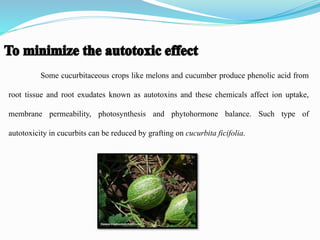
Some cucurbitaceous crops like melons and cucumber produce phenolic acid from
root tissue and root exudates known as autotoxins and these chemicals affect ion uptake,
membrane permeability, photosynthesis and phytohormone balance. Such type of
autotoxicity in cucurbits can be reduced by grafting on cucurbita ficifolia.
Grafting is effective to initiate the flowering and fruitset at low temperature
which saves the energy of polyhouse to maintain day/night temperature regime. In
cucumber, early yield is recorded by grafting on cucurbita ficifolia through the reduction of
temperature regime of polyhouse from 230 C/200C and grafted plants survive at very low
temperature at 100C.
Tomato (cv. Big Red) grafted onto cv. Heman [S. lycopersicum L.×L.
hirsutum (Vahl) Dunal] and Primavera (S. lycopersicum L.) produced more
fruits than the control in the greenhouse, however, under low-temperature
conditions in the field the positive effect almost disappeared (Khah et al.,
2006).
On the other hand Zijlstra and den Nijs (1987) demonstrated under
low day- and night-temperature conditions of 18/7 ◦C a high variability in the
contribution of 29 tomato rootstocks to earliness of flowering, fresh weight of
trusses and shoots, and fruit production.
Grafting as a tool to improve tolerance of vegetables to abiotic stresses:Thermal
stress, water stress and organic pollutants
Dietmar Schwarza,∗, Youssef Rouphael b, Giuseppe Collac, Jan Henk Venemad
For tomato, rootstocks of the high-altitude accession LA 1777 of S.
habrochaites (synonym L. hirsutum Dunal, Venema et al., 2008), ‘KNVF’ (the
interspecific hybrid of S. lycopersicum×S. habrochaites, Okimura et al., 1986)
and chill-tolerant lines from backcrossed progeny of S. habrochaites LA1778×S.
lycopersicum cv. T5 (Bloomet et al., 2004) were able to alleviate low root-
temperature stress for different scions.
For watermelon, grafting onto Shin-tosa-type (an interspecific squash
hybrid, Cucurbita maxima×C. moschata) rootstocks is used to advance the planting
date during cool periods (Davis et al., 2008).
CONT…
Intergeneric grafting increases flood tolerance in cucurbits eg., flood prone bitter melon
onto flood tolerant Luffa rootstock.
Grafting as a tool to improve tolerance of vegetables to abiotic stresses:
Thermal stress, water stress and organic pollutants
Dietmar Schwarza,∗, Youssef Rouphael b, Giuseppe Collac , Jan Henk Venemad
Grafting improved flooding tolerance of bittermelon (Momordia charanthia
L. cv.) when grafted onto luffa (Luffa cylindria Roem cv. Cylinder) (Liao and Lin,
1996).
The reduction of the chlorophyll content in cucumber leaves induced by
water logging was enhanced by grafting onto squash rootstocks (Kato et al., 2001).
In cucumber more number of commercially acceptable and shiny fruits are
obtained by grafting on squash hybrid kky. Enhanced sugar content in galia and haon melon
has been reported by grafting of rootstock of either of the melon cultivar ‘suiker’ or ‘841’. In
tomato grafted plants produce increased number of marketable fruits and decreased number
of malformed, under developed and gray mold infected fruits and had fruits with better
colour and highest lycopene content.
Fruit size resulted in higher yield since grafted plants are resistant to soilborne
disease, has strong root systems, and increased photosynthesis (Xu et al., 2005a; Qi et al.,
2006).
Salamet et al., (2002) demonstrated a 3.5 times higher yield in grafted
watermelon [Citrullus lanatus (Thunb.) Matsum and Nakai] due to larger fruit size, and
more fruit per plant.
PHYSICAL PARAMETERS
Impact of grafting on product quality of fruit vegetables
Youssef Rouphael et al.,
Yetisir and Sari (2003), and Yetisir et al. (2007) reported that
watermelon grafted on interspecific squash hybrid (C. maxima Duchesne×C.
moschata Duchesne) had increased fruit size by 52%.
Two squash interspecific hybrid rootstocks (‘Shintoza’ and
‘Tetsukabuto’) increased both watermelon yield and fruit size by an average
of 90% and 26%, respectively compared to ungrafted watermelon plants
(Miguel et al., 2004).
Colla et al. (2006a) reported that (redness/yellowness)
measured on the surface of the external pulp of melon were significantly
higher in grafted plants compared to ungrafted plants grown under
greenhouse conditions
CONT…
Watermelon fruits obtained fromplants grafted onto Lagenaria rootstocks
(Yetisir et al., 2003), and C. maxima×C. moschata (‘RS841’ and ‘Shintoza Camelforce’)
were firmer by 24% and 27%, respectively than the fruits from the ungrafted plants
(Huitrón-Ramírez et al., 2009)
Another study also reports a substantial increase in melon firmness from
grafted ‘Proteo’ plants onto ‘P360’ (C. maxima Duchesne×C. moschata Duchesne) by
19–32% (Colla et al., 2006a).
Similarly in cucumber, flesh firmness was higher with fruits from plants
grafted onto ‘Andong’ (Sicyos angulatus L.) rootstock as compared to those grown on
their own roots.
FIRMNESS
Proietti et al. (2008) demonstrated that mini-watermelon grafted onto the
commercial hybrid rootstock ‘PS 1313’ (C. maximaDuchesne×C.moschataDuchesne)
exhibited higher TSS.
Matsuzoe et al. (1996) evaluated fruit quality of ‘Momotaro’ tomatoes as
influenced by three different rootstocks of Solanum species, Solanum sisymbriifolium,
Solanum torvum and Solanum toxicarium. They concluded that the fruit quality of the
tomato plants grafted on other Solanum species was not different from that of tomato
on its own roots.
CONT…
Cucumber grafted onto cucurbita ficifolia produces faster and 200 per cent early
yield. This rootstock is also exploited for late crops. In summer cucumber, frequency of
harvesting fruits is increased y grafting on Hokushin or Aodai rootstocks. Highest early
yield of melon cv ‘ galia’ and ‘halon’ is obtained when grafted on rootstocks either ‘suiker’ or
‘841’.
Grafting effects growth and minerals content of the plant tissue especially the role
of roots and shoots in regulation of Fe efficiency in grafted cucumber. In cucumber grafting
on cucurbita ficifolia reduces the Mg deficiency. Cucumber cultivars producing fruits with
a heavy surface bloom are undesirable for marketing and such heavy blooming and such
heavy blooming can be depressed by grafting onto bloomless rootstocks.
Cucurbitaceae and linked with fig leaf gourd shown, that both uptake
(Masuda and Gomi, 1984; Tachibana, 1982, 1987) and transport (Choi et al.,
1995) of the macro-nutrients, particularly nitrate and phosphate, increased in
figleaf gourds compared with cucumber rootstocks in response to decreased
root-zone temperatures.
Among the micro-nutrients, Mn-, Cu-, and Zn-contents increased since
these are diminished strongly with decreasing temperature (Li and Yu, 2007).
Iron is not much affected by temperature and thus also not changed in cucumber
grafted onto fig leaf gourd.
Grafting as a tool to improve tolerance of vegetables to abiotic stresses
Thermal stress, water stress and organic pollutants
Dietmar Schwarza,∗, Youssef Rouphael b, Giuseppe Collac, Jan Henk Venemad
Grafting also influences flowering patterns. C. hardwickii grafted/gynoecious
cultivars of cucumber increases the expression of pistillate flowers.
Sicyos angulata a qualitatively short day wild species is induced to flower not only
by grafting it onto a flower induced plants of the same species but also by intergeneric
grafting on day neutral plants of cucumis or onto quantitatively short day plants of luffa
cylindrical under non-inductive long day conditions.
Besides it is found that S. angulata develops both staminate and pistillate
inflorescence with similar sex expressions even when one of the cucumber cultivars is
andromonecious.
CONT…
 Sacha Johnson, Patti Kreider, and Carol Miles, WSU Mount Vernon
Northwestern Washington Research & Extension Center
 Cushman,K.2006.Grafting Techniques for Watermelon. HS1075,
IFAS, University of Florida.
REFERENCE
 Friedlander, M., D. Atamon, and E. Galun. 1977. The effect of grafting
on sex expression in cucumber. Plant & Cell Physiol. 18:1343–1350
 Hartmann, H.T. and D.E. Kester. 1975. Plant propagation: Principles
and practices. 3rd ed. Prentice Hall, Englewood Cliffs, N.J
Handbook of Vegetable Crops L.C.De, S.K.Bhattacherjee
 Agrobios Vol x1, issue No.12, May 2013
Agrobios Vol x1, issue No.12, May 2013

Vegetable grafting

  • 1.
  • 2.
    Grafting is thecombination of two identical formulation plants which grow as one plants. Vegetable grafting is a modern technique used to control soil pathogens in which vegetative growth of weak root combination is grafted on selected rootstocks of disease and pest resistance and adaptive to environmental changes. Rootstock Scion
  • 3.
    Cultivated area usinggrafted seedlings, and the estimated number of grafted vegetable seedlings in Korea and Japan. About 337 million grafted seedlings are planted annually in Korea and »651 million in Japan (field and greenhouses). More than 95% of the watermelons in both countries are grafted. The majority of greenhouse cucumbers are grafted, but only »10% to 30% of cucumbers for growth in the field are grafted. Most of the Oriental melons are grafted to squash (Cucurbita spp.) rootstock (Ito, 1992; Jang et al., 1992)
  • 4.
     The raisingof grafted plants of vegetables was first initiated in Japan and Korea during late 1920’s with watermelon onto gourd rootstock.  In the 1950’s, eggplant was grafted onto scarlet egg plant (Solanum integrifolium ). At present, more than 95% of watermelon and oriental melon in Japan, Korea and Taiwan are grafted on squash and gourd rootstock before transplanting. In Greece, cucurbit grafting is very popular.
  • 5.
  • 6.
    The main objectivesof vegetable grafting is to eliminate soil borne pests that infect vegetables and problems of salinity and soil acidity. Other objectives of grafting are to increase productivity, to increase the grafted plant tolerance to different temperature.
  • 7.
    Vegetables objectives Cucumber Toleranceto fusarium wilt, Phytophthora melonis, cold hardiness, favourable sex ratio, bloomless fruits. Egg plant Tolerance to bacterial wilt, verticillium wilt, fusarium wilt, low temperature, nematodes, induced vigour and enhanced yield. Tomato Tolerance to corky root, better colour and greater lycopene content, tolerance to nematode. Melon Tolerance to fusarium wilt, physiological disorders, Phytophthora diseases, cold hardiness, enhanced growth. Watermelon Tolerance to fusarium wilt, Physiological disorders, cold hardiness and drought tolerance. Bittergourd Tolerance to fusarium wilt. Objectives of grafting Pandey and Rai, 2003
  • 8.
    Cucurbitaceae: Muskmelon, Watermelon,Cucumber, Squash Solanaceae: Brinjal, Pepper, Tomato
  • 9.
    Intergeneric grafting iscommon in fruited vegetables, e.g. watermelon are normally grafted on bottlegourd ( lagenaria siceraria ) or to interspecific hybrids. In Japan, the muskmelon is generally grafted onto hybrid melon cv. Base and the wax gourd ( Benincasa hispida ) cv. ‘partner’.
  • 10.
     Cucumbers aregenerally grafted onto figleaf gourd ( cucurbita ficifolia ) or inter- specific hybrid ( Cucurbita maxima x C.moschata ).  Rootstocks such as scarlet eggplant Solanum integrifolium , solanum torvum and solanum nigrum are exploited for grafting of egg plant.  Sponge gourd ( Luffa aegyptiaca ) is used as a resistant ( Fusarium wilt ) for bittergourd.  Tomato is usually grafted on egg plant, solanum torvum, intergeneric rootstocks and KNVF hybrids. Cont..
  • 11.
    Scion Rootstocks Cucumber Cucurbitamoschata, Cucurbita ficifolia, Cucurbita maxima Melons Cucurbita Spp, Cucumis melo, Cucurbita moschata x Cucurbita maxima, Benincasa hispida Watermelon Citrulus lanatus, Cucurbita maxima, Cucurbita moschata, Cucurbita moschata x Cucurbita maxima, Lagenaria siceraria Bittergourd Cucurbita moschata, Lagenaria siceraria, Luffa aegyptiaca Tomato Lycopersicon pimpinellifolium, L.esculentum, Solanum nigrum Egg plant Solanum torvum, Solanum integrifolium, Solanum melongena, Solanum nigrum Different rootstocks for grafting of vegetables Pandey and Pandita, 2002
  • 12.
    CROP ROOTSTOCK SPECIESDESIRABLE TRAITS Tomato Lycopersicon pimpinellifolium(L.) Mill Nematode resistance Lycopersicon hirsutum Nematode resistance Solanum integrifolium Tomato sugar content increase Solanum sisymbrifolium Tomato disease resistance Solanum torvum Disease resistance, Nematode tolerance Solanum nigrum L. Fruit size and quality control Brinjal Solanum torvum Disease resistance, nematode tolerance Solanum integrifolium Low temperature tolerance DESIRABLE CHARACTERS OF ROOTSTOCKS
  • 13.
    Water melon Lagenariasiceraria L. Vigorous root system, fusarium tolerance, low temperature tolerance Cucurbita moschata Vigorous root system, fusarium tolerance, low temperature tolerance Interspecific hybrid squash- Cucurbita maxima x Cucurbita moschata Duch. Vigorous root system, fusarium tolerance, low and high temperature tolerance Benincasa hispida Good disease resistance Cucurbita pepo L. Vigorous root system, fusarium tolerance, low temperature tolerance Cucumis metuliferus E. Mey.ex Naud Fusarium tolerance, Nematode tolerance Cucumber Cucurbita ficifolia Bouche. Low temperature tolerance, good disease resistance Cucurita moschata Duch. Fusarium tolerance, fruit quality modification Cucurbita maxima Duch. X C.moschata Duch. Fusarium tolerance, Low temperature tolerance Cucumis metuliferus E. Mey.ex Naud. Fusarium tolerance. Nematode tolerance CONT…
  • 14.
    In grafting, itis important to increase the chances for vascular bundles of the scion and rootstocks to come into contact by maximizing the area of cut surface that are spliced together. After grafting, a temperature of 30oC and 95% RH is maintained for fast healing and better survival of graftage. Gradually, the relative humidity is then lowered and the light intensity is increased. The development of graft union is depended upon the formation of an isolation layer and a parenchymatous callus to the occurrence of symplastic contact between the cells, notably the sieve elements of the rootstock and scion.
  • 15.
    Various methods ofgrafting are: Cleft grafting Whip and tongue grafting Splice grafting Flat grafting Saddle grafting Bud grafting Hole insertion grafting Tongue approach grafting.
  • 16.
     This methodof grafting is practiced in tomato. For successful union, seeds of rootstock are sown 5-7 days earlier than those scion.  The stem of scion ( at four leaf stage ) and the rootstock ( at four to five leaf stage ) are cut at right angles, each with 2-3 leaves keeping on the stem.  The stem scion is cut in a wedge and the tapered end is fitted into a cleft cut in the end of the rootstock. The graft is held firm with a plastic clip.
  • 18.
     This methodof grafting is very popular among Japanese seedling procedure to graft small plants grown in plug tray 2-3 times faster than the convenient method.  The optimum growth stage for grafting varies according to the kind of plug used.  plants in small cells are grafted at earlier growth stage which require small size tubes.
  • 19.
     First, therootstock is given a slanting cut and the scion is also cut in the same way.  elastic tubes with side slit are put on the cut end of the root stock.
  • 20.
     The cutends of the scions are inserted into the tube, splicing the cut surfaces of the scions and rootstocks together.  Tube grafting is practiced in brinjal onto the rootstock of Solanum torvum.
  • 21.
     This methodis common in melons and other cucurbits.  In such case, seeds are sown 10-13 days before grafting for cucurbits and 7-10 days before grafting for pumpkin to ensure uniformity in diameter.
  • 22.
     The hypocotylsof the scion and rootstock are cut in such a way that they tongue into each other and the graft in secured with a plastic clip.
  • 23.
    The hypocotyl ofthe scion is left for 3-4 days and then The hypocotyls is cut off with sharp blade 3 or 4 days after crushing.
  • 24.
     In thismethod, the first leaf and lateral buds are removed when a slanting cut is given to a cotyledon of the rootstock.
  • 25.
    Recently, grafting robotsfor plugs have been developed by combining the adhesive and grafting plates which facilitates simultaneous grafting for eight plugs of tomato, eggplant or pepper, nowadays, a fully automatic grafting system has been designed for cucurbitaceous vegetables in which quality seedling plants are produced by using fuzzy logic and neural network. In addition, a heating chamber with controlled atmospheric conditions has been designed to enhance the survival of the graftage.
  • 28.
  • 29.
    The main objectiveof grafting is to reduce soil borne diseases like Fusarium wilt in cucurbitaceae( Cucumber, melon etc.) and bacteria wilt in solanaceae (Tomato, pepper). The use of resistant rootstocks in combination with integrated pest management reduces the requiring soil fumigation with methyl bromide in many crops and it is effective in organic farming of vegetables.
  • 30.
    Grafting fruiting vegetablesto manage soilborne pathogens, foliar pathogens, Frank J. Louwsa,∗, Cary L. Rivarda,b, Chieri Kubotac
  • 31.
  • 32.
  • 33.
    Sicyos angulatus andpumpkin have been found to be promising rootstocks to avoid nematode infestation in cucumber. In tomato, nematex rootstock gives complete resistance against nematode infection. Other rootstocks used against nematode in tomato are KNVF and solanum nigrum.
  • 34.
    Capsicum annuum rootstockswith N gene resistance offered effective control of Mi when grafted to a popular commercial bell pepper (Kokalis-Burelle et al., 2009). Accessions C. annuum, C. frutescens, C. chinense, C. chacoense and C. baccatum were moderately to highly resistant to Mj but susceptible to M (race 2) (Oka et al., 2004). However, a C. annuum rootstock selection (AR-96023) and C. frutescens accession had moderate and high resistance to Mi and Mj, respectively, and the AR-96023 rootstock Grafting fruiting vegetables to manage soilborne pathogens, foliar pathogens, arthropods and weeds Frank J. Louwsa,∗, Cary L. Rivarda,b, Chieri Kubotac
  • 35.
    NEMATODE Rivard et al.(2010) showed that under heavy natural Mi inoculum pressure and in hot soils, non-grafted tomatoes were severely galled whereas ‘Maxifort’ and ‘Beaufort’ had a low incidence of galling and ‘Big Power’ had trace amounts of galling in 2 consecutive years.
  • 36.
    Some cucurbitaceous cropslike melons and cucumber produce phenolic acid from root tissue and root exudates known as autotoxins and these chemicals affect ion uptake, membrane permeability, photosynthesis and phytohormone balance. Such type of autotoxicity in cucurbits can be reduced by grafting on cucurbita ficifolia.
  • 37.
    Grafting is effectiveto initiate the flowering and fruitset at low temperature which saves the energy of polyhouse to maintain day/night temperature regime. In cucumber, early yield is recorded by grafting on cucurbita ficifolia through the reduction of temperature regime of polyhouse from 230 C/200C and grafted plants survive at very low temperature at 100C.
  • 38.
    Tomato (cv. BigRed) grafted onto cv. Heman [S. lycopersicum L.×L. hirsutum (Vahl) Dunal] and Primavera (S. lycopersicum L.) produced more fruits than the control in the greenhouse, however, under low-temperature conditions in the field the positive effect almost disappeared (Khah et al., 2006). On the other hand Zijlstra and den Nijs (1987) demonstrated under low day- and night-temperature conditions of 18/7 ◦C a high variability in the contribution of 29 tomato rootstocks to earliness of flowering, fresh weight of trusses and shoots, and fruit production. Grafting as a tool to improve tolerance of vegetables to abiotic stresses:Thermal stress, water stress and organic pollutants Dietmar Schwarza,∗, Youssef Rouphael b, Giuseppe Collac, Jan Henk Venemad
  • 39.
    For tomato, rootstocksof the high-altitude accession LA 1777 of S. habrochaites (synonym L. hirsutum Dunal, Venema et al., 2008), ‘KNVF’ (the interspecific hybrid of S. lycopersicum×S. habrochaites, Okimura et al., 1986) and chill-tolerant lines from backcrossed progeny of S. habrochaites LA1778×S. lycopersicum cv. T5 (Bloomet et al., 2004) were able to alleviate low root- temperature stress for different scions. For watermelon, grafting onto Shin-tosa-type (an interspecific squash hybrid, Cucurbita maxima×C. moschata) rootstocks is used to advance the planting date during cool periods (Davis et al., 2008). CONT…
  • 40.
    Intergeneric grafting increasesflood tolerance in cucurbits eg., flood prone bitter melon onto flood tolerant Luffa rootstock.
  • 41.
    Grafting as atool to improve tolerance of vegetables to abiotic stresses: Thermal stress, water stress and organic pollutants Dietmar Schwarza,∗, Youssef Rouphael b, Giuseppe Collac , Jan Henk Venemad Grafting improved flooding tolerance of bittermelon (Momordia charanthia L. cv.) when grafted onto luffa (Luffa cylindria Roem cv. Cylinder) (Liao and Lin, 1996). The reduction of the chlorophyll content in cucumber leaves induced by water logging was enhanced by grafting onto squash rootstocks (Kato et al., 2001).
  • 42.
    In cucumber morenumber of commercially acceptable and shiny fruits are obtained by grafting on squash hybrid kky. Enhanced sugar content in galia and haon melon has been reported by grafting of rootstock of either of the melon cultivar ‘suiker’ or ‘841’. In tomato grafted plants produce increased number of marketable fruits and decreased number of malformed, under developed and gray mold infected fruits and had fruits with better colour and highest lycopene content.
  • 43.
    Fruit size resultedin higher yield since grafted plants are resistant to soilborne disease, has strong root systems, and increased photosynthesis (Xu et al., 2005a; Qi et al., 2006). Salamet et al., (2002) demonstrated a 3.5 times higher yield in grafted watermelon [Citrullus lanatus (Thunb.) Matsum and Nakai] due to larger fruit size, and more fruit per plant. PHYSICAL PARAMETERS Impact of grafting on product quality of fruit vegetables Youssef Rouphael et al.,

  • 44.
    Yetisir and Sari(2003), and Yetisir et al. (2007) reported that watermelon grafted on interspecific squash hybrid (C. maxima Duchesne×C. moschata Duchesne) had increased fruit size by 52%. Two squash interspecific hybrid rootstocks (‘Shintoza’ and ‘Tetsukabuto’) increased both watermelon yield and fruit size by an average of 90% and 26%, respectively compared to ungrafted watermelon plants (Miguel et al., 2004). Colla et al. (2006a) reported that (redness/yellowness) measured on the surface of the external pulp of melon were significantly higher in grafted plants compared to ungrafted plants grown under greenhouse conditions CONT…
  • 45.
    Watermelon fruits obtainedfromplants grafted onto Lagenaria rootstocks (Yetisir et al., 2003), and C. maxima×C. moschata (‘RS841’ and ‘Shintoza Camelforce’) were firmer by 24% and 27%, respectively than the fruits from the ungrafted plants (Huitrón-Ramírez et al., 2009) Another study also reports a substantial increase in melon firmness from grafted ‘Proteo’ plants onto ‘P360’ (C. maxima Duchesne×C. moschata Duchesne) by 19–32% (Colla et al., 2006a). Similarly in cucumber, flesh firmness was higher with fruits from plants grafted onto ‘Andong’ (Sicyos angulatus L.) rootstock as compared to those grown on their own roots. FIRMNESS
  • 46.
    Proietti et al.(2008) demonstrated that mini-watermelon grafted onto the commercial hybrid rootstock ‘PS 1313’ (C. maximaDuchesne×C.moschataDuchesne) exhibited higher TSS. Matsuzoe et al. (1996) evaluated fruit quality of ‘Momotaro’ tomatoes as influenced by three different rootstocks of Solanum species, Solanum sisymbriifolium, Solanum torvum and Solanum toxicarium. They concluded that the fruit quality of the tomato plants grafted on other Solanum species was not different from that of tomato on its own roots. CONT…
  • 47.
    Cucumber grafted ontocucurbita ficifolia produces faster and 200 per cent early yield. This rootstock is also exploited for late crops. In summer cucumber, frequency of harvesting fruits is increased y grafting on Hokushin or Aodai rootstocks. Highest early yield of melon cv ‘ galia’ and ‘halon’ is obtained when grafted on rootstocks either ‘suiker’ or ‘841’.
  • 48.
    Grafting effects growthand minerals content of the plant tissue especially the role of roots and shoots in regulation of Fe efficiency in grafted cucumber. In cucumber grafting on cucurbita ficifolia reduces the Mg deficiency. Cucumber cultivars producing fruits with a heavy surface bloom are undesirable for marketing and such heavy blooming and such heavy blooming can be depressed by grafting onto bloomless rootstocks.
  • 49.
    Cucurbitaceae and linkedwith fig leaf gourd shown, that both uptake (Masuda and Gomi, 1984; Tachibana, 1982, 1987) and transport (Choi et al., 1995) of the macro-nutrients, particularly nitrate and phosphate, increased in figleaf gourds compared with cucumber rootstocks in response to decreased root-zone temperatures. Among the micro-nutrients, Mn-, Cu-, and Zn-contents increased since these are diminished strongly with decreasing temperature (Li and Yu, 2007). Iron is not much affected by temperature and thus also not changed in cucumber grafted onto fig leaf gourd. Grafting as a tool to improve tolerance of vegetables to abiotic stresses Thermal stress, water stress and organic pollutants Dietmar Schwarza,∗, Youssef Rouphael b, Giuseppe Collac, Jan Henk Venemad
  • 50.
    Grafting also influencesflowering patterns. C. hardwickii grafted/gynoecious cultivars of cucumber increases the expression of pistillate flowers.
  • 51.
    Sicyos angulata aqualitatively short day wild species is induced to flower not only by grafting it onto a flower induced plants of the same species but also by intergeneric grafting on day neutral plants of cucumis or onto quantitatively short day plants of luffa cylindrical under non-inductive long day conditions. Besides it is found that S. angulata develops both staminate and pistillate inflorescence with similar sex expressions even when one of the cucumber cultivars is andromonecious. CONT…
  • 52.
     Sacha Johnson,Patti Kreider, and Carol Miles, WSU Mount Vernon Northwestern Washington Research & Extension Center  Cushman,K.2006.Grafting Techniques for Watermelon. HS1075, IFAS, University of Florida. REFERENCE  Friedlander, M., D. Atamon, and E. Galun. 1977. The effect of grafting on sex expression in cucumber. Plant & Cell Physiol. 18:1343–1350  Hartmann, H.T. and D.E. Kester. 1975. Plant propagation: Principles and practices. 3rd ed. Prentice Hall, Englewood Cliffs, N.J Handbook of Vegetable Crops L.C.De, S.K.Bhattacherjee  Agrobios Vol x1, issue No.12, May 2013 Agrobios Vol x1, issue No.12, May 2013