

The average yield of corn in the U.S. and Canada has
tripled over the last half-century. Yield gains have result-
ed from improved hybrid genetics, more precise soil fertil-
ity practices, better weed control and advances in other
production methods. Among these factors, genetic im-
provements have contributed the most to yield gains,
adding from 1.0 to 1.5 bu/acre each year. To accomplish
these increases, corn breeders have selected for superior
tolerance to drought and other stresses, and yield stability
across diverse growing environments. A key result of en-
hanced stress tolerance is adaptability of hybrids to high-
er plant populations. Optimum economic returns often
require plant populations of 35,000 plants/acre or more,
depending on the hybrid and environment. Obtaining the-
se higher plant populations is essential, especially at
higher yield levels.
It is important to evaluate stands shortly after emergence.
Corn stands can be reduced by many issues such as cold
or wet soils, insect feeding, poor seedbed, and equipment
issues. Shortly after emergence is the best time to evalu-
ate stands and the effectiveness of planter equipment,
residue management, and seedbed preparation.
Stand counts. Take several sample counts to represent
the field or area under consideration. For ease of calcula-
tion, a sample size of 1/1000th of an acre is recommend-
ed (Table 1). Measure off the distance appropriate for
your row width, count the number of live plants and multi-
ply by 1000 to obtain a reasonable estimate of plants/
acre.
Stand uniformity. Evalu-
ate whether plants are
evenly distributed or if the
stand is uneven. Gaps and
doubles indicate an equip-
ment or seedbed problem
and reduce yield.
Identify Problems and
Plan for Solutions. After
you have evaluated stands
and uniformity, make every
effort to identify the causes
of any observed problems.
Were metering devices
working properly? Were row cleaners set properly and
working effectively? Was planting depth proper and con-
sistent? Was residue managed effectively? Were moni-
tors effective in identifying metering devices or other
equipment problems when they occurred? Was pre-plant
tillage uniform, and did it create a quality seedbed? Con-
tinuously improve your planting operation by making sure
to implement solutions to any problems observed.
(Values from www.pioneer.com, May 5 through June 3, 2013)
Location
GDU
since
May 5
Depar-
ture
from
Normal
Predicted
GDU’s to
6/17
(departure)
Alexandria, MN 274 +3 444 (-28)
Morris, MN 326 +22 515 (+7)
Montevideo, MN 312 +16 500 (-68)
Marshall, MN 317 +9 514 (-20)
Brookings, SD 294 +13 469 (-15)
Sioux Falls, SD 339 +7 539 (-29)
Source: www.pioneer.com GDU Calculator
Wade Gubrud
Product Agronomist
Curt Hoffbeck
Field Agronomist
Larry Osborne
Field Agronomist June 10, 2013 - Issue 3
WALKING YOUR FIELDS® newsletter is brought to you by your local account manager for DuPont Pioneer. It is sent to customers throughout the growing season,
courtesy of your Pioneer sales professional. The DuPont Oval Logo is a registered trademark of DuPont. PIONEER® brand products are provided subject to the
terms and conditions of purchase which are part of the labeling and purchase documents. ®, TM, SM Trademarks and service marks of Pioneer. © 2013 PHII.
Evaluate Corn Stands:
Identify Areas for Improvement
Photo:TomDoerge,DuPontPioneer
Table 1. Row lengths
equal to 0.001 acres
Row Width
(inches)
Row Length
(0.001 acre)
38 13 ft. 9 in.
36 14 ft. 6 in.
30 17 ft. 5 in.
22 23 ft. 9 in.
20 26 ft. 2 in.
15 34 ft. 10 in.
Growing Degree Unit Update for the Area
Application timing is everything when relying on glypho-
sate to control weeds in corn, as it has no soil residual
activity. The weeds need to be emerged, but not too large
that they compete with corn, potentially reducing yields.
Usually this control is accomplished with multiple applica-
tions of glyphosate, and/or by using glyphosate in combi-
nation with herbicides that provide residual weed control.
Critical Weed-Free Period
The critical period of weed control is the interval when
weed control is required to provide maximum yield. Weed
competition before this period will not affect yield, if
weeds are controlled by the start of the critical period.
Weed competition after the critical period will not affect
yield.
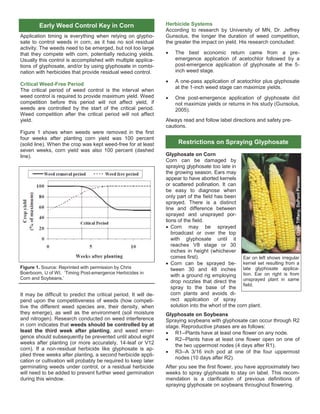
Figure 1 shows when weeds were removed in the first
four weeks after planting corn yield was 100 percent
(solid line). When the crop was kept weed-free for at least
seven weeks, corn yield was also 100 percent (dashed
line).
It may be difficult to predict the critical period. It will de-
pend upon the competitiveness of weeds (how competi-
tive the different weed species are, their density, when
they emerge), as well as the environment (soil moisture
and nitrogen). Research conducted on weed interference
in corn indicates that weeds should be controlled by at
least the third week after planting, and weed emer-
gence should subsequently be prevented until about eight
weeks after planting (or more accurately, 14-leaf or V12
corn). If a non-residual herbicide like glyphosate is ap-
plied three weeks after planting, a second herbicide appli-
cation or cultivation will probably be required to keep later
germinating weeds under control, or a residual herbicide
will need to be added to prevent further weed germination
during this window.
Herbicide Systems
According to research by University of MN, Dr. Jeffrey
Gunsolus, the longer the duration of weed competition,
the greater the impact on yield. His research concluded:
 The best economic return came from a pre-
emergence application of acetochlor followed by a
post-emergence application of glyphosate at the 5-
inch weed stage.
 A one-pass application of acetochlor plus glyphosate
at the 1-inch weed stage can maximize yields.
 One post-emergence application of glyphosate did
not maximize yields or returns in his study (Gunsolus,
2005).
Always read and follow label directions and safety pre-
cautions.
Glyphosate on Corn
Corn can be damaged by
spraying glyphosate too late in
the growing season. Ears may
appear to have aborted kernels
or scattered pollination. It can
be easy to diagnose when
only part of the field has been
sprayed. There is a distinct
line and difference between
sprayed and unsprayed por-
tions of the field.
 Corn may be sprayed
broadcast or over the top
with glyphosate until it
reaches V8 stage or 30
inches in height (whichever
comes first).
 Corn can be sprayed be-
tween 30 and 48 inches
with a ground rig employing
drop nozzles that direct the
spray to the base of the
corn plants and avoids di-
rect application of spray
solution into the whorl of the corn plant.
Glyphosate on Soybeans
Spraying soybeans with glyphosate can occur through R2
stage. Reproductive phases are as follows:
 R1--Plants have at least one flower on any node.
 R2--Plants have at least one flower open on one of
the two uppermost nodes (4 days after R1).
 R3--A 3/16 inch pod at one of the four uppermost
nodes (10 days after R2).
After you see the first flower, you have approximately two
weeks to spray glyphosate to stay on label. This recom-
mendation is a clarification of previous definitions of
spraying glyphosate on soybeans throughout flowering.
Early Weed Control Key in Corn
Figure 1. Source: Reprinted with permission by Chris
Boerboom, U of WI. ‘Timing Post-emergence Herbicides in
Corn and Soybeans.’
Restrictions on Spraying Glyphosate
Ear on left shows irregular
kernel set resulting from a
late glyphosate applica-
tion. Ear on right is from
unsprayed plant in same
field.
Photo:ClydeTiffany,DuPontPioneer
Heavy spring rainfall causes concerns about nitrogen (N)
losses in corn fields and raises questions about the need
for supplemental N applications. In general, leaching
losses are more likely on sandy soils where water can
move through the profile quickly. Denitrification is more
likely on medium and fine textured soils that are not well
drained. The precise extent of N losses through leaching
and/or denitrification following the heavy rains is difficult
to determine. Both of these processes occur when nitro-
gen is in the nitrate form, so the potential for significant
loss is determined by the amount of the crop N supply
that was in the nitrate form when the excess rainfall oc-
curred. Losses depend on many factors, including when
the N was applied, the forms of N applied or expected to
provide N for the crop, soil characteristics, and soil mois-
ture.
Where fertilizer N was applied before planting, the timing
of the application and the form of N used are important in
determining the risk of loss. Keeping in mind that losses
occur through the nitrate form of N, the timing of nitrate
formation is an important consideration in evaluating po-
tential losses. Fall-applied fertilizer N has a high risk for
loss following excess rainfall because most, or all, of the
N would be in the nitrate form by mid-May. For spring pre
-plant applications, ammonium forms of N such as anhy-
drous ammonia or urea are converted to nitrate-N in
about four to six weeks. Urea usually is converted to ni-
trate more rapidly than anhydrous ammonia. Nitrogen
solutions (28% UAN) contain half of the N as urea and
the remainder as ammonium nitrate. Essentially, when
this fertilizer is applied, it contains 75 percent of the N as
ammonium and 25 percent.
Denitrification losses can occur within a few days if the
soil remains saturated or flooded and nitrate-N is present.
Warm temperatures and extended periods of saturated
conditions favor high losses. Work in Illinois suggests that
four to five percent of the nitrate-N present can be lost
each day the soil remains saturated. Table 2 from the
University of Nebraska provides some estimates of deni-
trification losses at various temperatures and times of
saturated soil conditions.
Options for applying supplemental N when it is needed
include traditional side-dressing with anhydrous ammonia
or N solutions. Where the entire crop N requirement has
not yet been applied, side-dress or other post-emergence
applications should contain the balance of the crop N re-
quirement plus 25-50 percent of the N that was already
applied. Urea-ammonium nitrate solutions (28%) can also
be applied as a surface band or as a broadcast spray
over the growing crop. Dry N fertilizers such as urea or
ammonium nitrate can also be broadcast applied to the
crop. Leaf burning from solution or dry broadcast applica-
tions should be expected. Applying the dry materials
when foliage is dry will help to minimize burning. Basical-
ly, broadcast N rates should be limited to 90 lbs. N/acre
for corn with four to five leaves and to 60 lbs. N/ acre for
corn at the 8-leaf stage. Under N deficient conditions,
corn will respond to supplemental N applications through
the tassel stage of development if the N can be applied.
To help you assess potential fertilizer N losses, download
the simple and reliable Supplemental Fertilizer N Work-
sheet from the University of Minnesota. http://
bit.ly/17iNb9A. (Source: Schmitt and Randall, U of MN)
(Source: Portions of this article are from ‘Evaluating Nitrogen
Losses Following Excessive Rainfall,’ Dr. Larry G. Bundy, U of
WI Extension Service.)
N Losses Following Excessive Rainfall
Table 2. Estimated Denitrification N Losses as
Influenced by Soil Temp and Days Saturated.
Soil Temp
(°F)
Days
Saturated
N Loss
(% of applied)
55-60
5 10
10 25
3 60
75-80
5 75
7 85
9 95
Source: Shapiro, University of Nebraska.
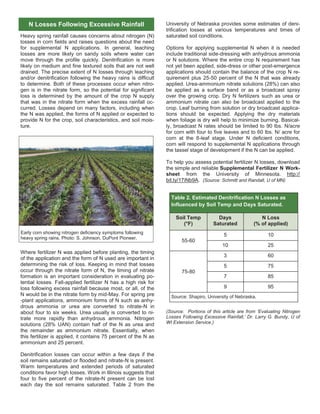
Early corn showing nitrogen deficiency symptoms following
heavy spring rains. Photo: S. Johnson, DuPont Pioneer.
WALKINGYOURFIELDS®
KJ Hoffbeck, Osborne, Gubrud
DuPont Pioneer
Sales & Marketing
PO Box 466
Johnston, IA 50131
ADDRESS SERVICE REQUESTED PRESORTED
FIRST-CLASS MAIL
U.S. POSTAGE PAID
PHI CUSTOMER INFO
Follow your Pioneer Agronomist @PioneerSDakota or @PioneerMN
Jeff Behrens
Account Manager
Kevin Branick
Account Manager
Mark Gibson
Account Manager
Ken Franzky
Account Manager
Tony Weis
Account Manager
Martin Johnson
Account Manager
Barry Peton
Account Manager
Matt Laubach
Dairy Specialist
John Skoglund
Account Manager
This Walking Your Fields® newsletter is brought
to you courtesy of your Pioneer Sales Representative
and DuPont Pioneer Account Manager.
In this issue:
 GDU Update
 Evaluate Corn Stands
 Herbicide Timing
 Glyphosate
Considerations
 Nitrogen Loss

Western MN and eastern SD Walking Your Fields newsletter for June

  • 1.
    The average yieldof corn in the U.S. and Canada has tripled over the last half-century. Yield gains have result- ed from improved hybrid genetics, more precise soil fertil- ity practices, better weed control and advances in other production methods. Among these factors, genetic im- provements have contributed the most to yield gains, adding from 1.0 to 1.5 bu/acre each year. To accomplish these increases, corn breeders have selected for superior tolerance to drought and other stresses, and yield stability across diverse growing environments. A key result of en- hanced stress tolerance is adaptability of hybrids to high- er plant populations. Optimum economic returns often require plant populations of 35,000 plants/acre or more, depending on the hybrid and environment. Obtaining the- se higher plant populations is essential, especially at higher yield levels. It is important to evaluate stands shortly after emergence. Corn stands can be reduced by many issues such as cold or wet soils, insect feeding, poor seedbed, and equipment issues. Shortly after emergence is the best time to evalu- ate stands and the effectiveness of planter equipment, residue management, and seedbed preparation. Stand counts. Take several sample counts to represent the field or area under consideration. For ease of calcula- tion, a sample size of 1/1000th of an acre is recommend- ed (Table 1). Measure off the distance appropriate for your row width, count the number of live plants and multi- ply by 1000 to obtain a reasonable estimate of plants/ acre. Stand uniformity. Evalu- ate whether plants are evenly distributed or if the stand is uneven. Gaps and doubles indicate an equip- ment or seedbed problem and reduce yield. Identify Problems and Plan for Solutions. After you have evaluated stands and uniformity, make every effort to identify the causes of any observed problems. Were metering devices working properly? Were row cleaners set properly and working effectively? Was planting depth proper and con- sistent? Was residue managed effectively? Were moni- tors effective in identifying metering devices or other equipment problems when they occurred? Was pre-plant tillage uniform, and did it create a quality seedbed? Con- tinuously improve your planting operation by making sure to implement solutions to any problems observed. (Values from www.pioneer.com, May 5 through June 3, 2013) Location GDU since May 5 Depar- ture from Normal Predicted GDU’s to 6/17 (departure) Alexandria, MN 274 +3 444 (-28) Morris, MN 326 +22 515 (+7) Montevideo, MN 312 +16 500 (-68) Marshall, MN 317 +9 514 (-20) Brookings, SD 294 +13 469 (-15) Sioux Falls, SD 339 +7 539 (-29) Source: www.pioneer.com GDU Calculator Wade Gubrud Product Agronomist Curt Hoffbeck Field Agronomist Larry Osborne Field Agronomist June 10, 2013 - Issue 3 WALKING YOUR FIELDS® newsletter is brought to you by your local account manager for DuPont Pioneer. It is sent to customers throughout the growing season, courtesy of your Pioneer sales professional. The DuPont Oval Logo is a registered trademark of DuPont. PIONEER® brand products are provided subject to the terms and conditions of purchase which are part of the labeling and purchase documents. ®, TM, SM Trademarks and service marks of Pioneer. © 2013 PHII. Evaluate Corn Stands: Identify Areas for Improvement Photo:TomDoerge,DuPontPioneer Table 1. Row lengths equal to 0.001 acres Row Width (inches) Row Length (0.001 acre) 38 13 ft. 9 in. 36 14 ft. 6 in. 30 17 ft. 5 in. 22 23 ft. 9 in. 20 26 ft. 2 in. 15 34 ft. 10 in. Growing Degree Unit Update for the Area
  • 2.
    Application timing iseverything when relying on glypho- sate to control weeds in corn, as it has no soil residual activity. The weeds need to be emerged, but not too large that they compete with corn, potentially reducing yields. Usually this control is accomplished with multiple applica- tions of glyphosate, and/or by using glyphosate in combi- nation with herbicides that provide residual weed control. Critical Weed-Free Period The critical period of weed control is the interval when weed control is required to provide maximum yield. Weed competition before this period will not affect yield, if weeds are controlled by the start of the critical period. Weed competition after the critical period will not affect yield. Figure 1 shows when weeds were removed in the first four weeks after planting corn yield was 100 percent (solid line). When the crop was kept weed-free for at least seven weeks, corn yield was also 100 percent (dashed line). It may be difficult to predict the critical period. It will de- pend upon the competitiveness of weeds (how competi- tive the different weed species are, their density, when they emerge), as well as the environment (soil moisture and nitrogen). Research conducted on weed interference in corn indicates that weeds should be controlled by at least the third week after planting, and weed emer- gence should subsequently be prevented until about eight weeks after planting (or more accurately, 14-leaf or V12 corn). If a non-residual herbicide like glyphosate is ap- plied three weeks after planting, a second herbicide appli- cation or cultivation will probably be required to keep later germinating weeds under control, or a residual herbicide will need to be added to prevent further weed germination during this window. Herbicide Systems According to research by University of MN, Dr. Jeffrey Gunsolus, the longer the duration of weed competition, the greater the impact on yield. His research concluded:  The best economic return came from a pre- emergence application of acetochlor followed by a post-emergence application of glyphosate at the 5- inch weed stage.  A one-pass application of acetochlor plus glyphosate at the 1-inch weed stage can maximize yields.  One post-emergence application of glyphosate did not maximize yields or returns in his study (Gunsolus, 2005). Always read and follow label directions and safety pre- cautions. Glyphosate on Corn Corn can be damaged by spraying glyphosate too late in the growing season. Ears may appear to have aborted kernels or scattered pollination. It can be easy to diagnose when only part of the field has been sprayed. There is a distinct line and difference between sprayed and unsprayed por- tions of the field.  Corn may be sprayed broadcast or over the top with glyphosate until it reaches V8 stage or 30 inches in height (whichever comes first).  Corn can be sprayed be- tween 30 and 48 inches with a ground rig employing drop nozzles that direct the spray to the base of the corn plants and avoids di- rect application of spray solution into the whorl of the corn plant. Glyphosate on Soybeans Spraying soybeans with glyphosate can occur through R2 stage. Reproductive phases are as follows:  R1--Plants have at least one flower on any node.  R2--Plants have at least one flower open on one of the two uppermost nodes (4 days after R1).  R3--A 3/16 inch pod at one of the four uppermost nodes (10 days after R2). After you see the first flower, you have approximately two weeks to spray glyphosate to stay on label. This recom- mendation is a clarification of previous definitions of spraying glyphosate on soybeans throughout flowering. Early Weed Control Key in Corn Figure 1. Source: Reprinted with permission by Chris Boerboom, U of WI. ‘Timing Post-emergence Herbicides in Corn and Soybeans.’ Restrictions on Spraying Glyphosate Ear on left shows irregular kernel set resulting from a late glyphosate applica- tion. Ear on right is from unsprayed plant in same field. Photo:ClydeTiffany,DuPontPioneer
  • 3.
    Heavy spring rainfallcauses concerns about nitrogen (N) losses in corn fields and raises questions about the need for supplemental N applications. In general, leaching losses are more likely on sandy soils where water can move through the profile quickly. Denitrification is more likely on medium and fine textured soils that are not well drained. The precise extent of N losses through leaching and/or denitrification following the heavy rains is difficult to determine. Both of these processes occur when nitro- gen is in the nitrate form, so the potential for significant loss is determined by the amount of the crop N supply that was in the nitrate form when the excess rainfall oc- curred. Losses depend on many factors, including when the N was applied, the forms of N applied or expected to provide N for the crop, soil characteristics, and soil mois- ture. Where fertilizer N was applied before planting, the timing of the application and the form of N used are important in determining the risk of loss. Keeping in mind that losses occur through the nitrate form of N, the timing of nitrate formation is an important consideration in evaluating po- tential losses. Fall-applied fertilizer N has a high risk for loss following excess rainfall because most, or all, of the N would be in the nitrate form by mid-May. For spring pre -plant applications, ammonium forms of N such as anhy- drous ammonia or urea are converted to nitrate-N in about four to six weeks. Urea usually is converted to ni- trate more rapidly than anhydrous ammonia. Nitrogen solutions (28% UAN) contain half of the N as urea and the remainder as ammonium nitrate. Essentially, when this fertilizer is applied, it contains 75 percent of the N as ammonium and 25 percent. Denitrification losses can occur within a few days if the soil remains saturated or flooded and nitrate-N is present. Warm temperatures and extended periods of saturated conditions favor high losses. Work in Illinois suggests that four to five percent of the nitrate-N present can be lost each day the soil remains saturated. Table 2 from the University of Nebraska provides some estimates of deni- trification losses at various temperatures and times of saturated soil conditions. Options for applying supplemental N when it is needed include traditional side-dressing with anhydrous ammonia or N solutions. Where the entire crop N requirement has not yet been applied, side-dress or other post-emergence applications should contain the balance of the crop N re- quirement plus 25-50 percent of the N that was already applied. Urea-ammonium nitrate solutions (28%) can also be applied as a surface band or as a broadcast spray over the growing crop. Dry N fertilizers such as urea or ammonium nitrate can also be broadcast applied to the crop. Leaf burning from solution or dry broadcast applica- tions should be expected. Applying the dry materials when foliage is dry will help to minimize burning. Basical- ly, broadcast N rates should be limited to 90 lbs. N/acre for corn with four to five leaves and to 60 lbs. N/ acre for corn at the 8-leaf stage. Under N deficient conditions, corn will respond to supplemental N applications through the tassel stage of development if the N can be applied. To help you assess potential fertilizer N losses, download the simple and reliable Supplemental Fertilizer N Work- sheet from the University of Minnesota. http:// bit.ly/17iNb9A. (Source: Schmitt and Randall, U of MN) (Source: Portions of this article are from ‘Evaluating Nitrogen Losses Following Excessive Rainfall,’ Dr. Larry G. Bundy, U of WI Extension Service.) N Losses Following Excessive Rainfall Table 2. Estimated Denitrification N Losses as Influenced by Soil Temp and Days Saturated. Soil Temp (°F) Days Saturated N Loss (% of applied) 55-60 5 10 10 25 3 60 75-80 5 75 7 85 9 95 Source: Shapiro, University of Nebraska. Early corn showing nitrogen deficiency symptoms following heavy spring rains. Photo: S. Johnson, DuPont Pioneer.
  • 4.
    WALKINGYOURFIELDS® KJ Hoffbeck, Osborne,Gubrud DuPont Pioneer Sales & Marketing PO Box 466 Johnston, IA 50131 ADDRESS SERVICE REQUESTED PRESORTED FIRST-CLASS MAIL U.S. POSTAGE PAID PHI CUSTOMER INFO Follow your Pioneer Agronomist @PioneerSDakota or @PioneerMN Jeff Behrens Account Manager Kevin Branick Account Manager Mark Gibson Account Manager Ken Franzky Account Manager Tony Weis Account Manager Martin Johnson Account Manager Barry Peton Account Manager Matt Laubach Dairy Specialist John Skoglund Account Manager This Walking Your Fields® newsletter is brought to you courtesy of your Pioneer Sales Representative and DuPont Pioneer Account Manager. In this issue:  GDU Update  Evaluate Corn Stands  Herbicide Timing  Glyphosate Considerations  Nitrogen Loss