Higher Order Thinking Skills in
The Classroom
BLOOM’S TAXONOMY
(H.O.T. Skills)
Copyright © 2021 Talent & Skills HuB
Objectives
To Understand the Concept of HOT
To Understand the Importance of HOT
To Understand the Six Levels of Bloom’s Taxonomy
To Understand the Meaning of Critical Thinking
To understand the Evidence of Critical Thinking
Copyright © 2021 Talent & Skills HuB
What is Higher Order Thinking?
Higher order thinking essentially means thinking that takes
place in the higher-levels of the hierarchy of cognitive
processing.
Copyright © 2021 Talent & Skills HuB
Why is Higher-Level Thinking
Important?
Thinking provides the software for the mind
Higher level thinking allows student’s memory to be used
effectively.
Copyright © 2021 Talent & Skills HuB
Need for Problem Solving Ability
Because the pace of societal change shows no signs of
slackening, citizens of the 21st century must become adept
problem solvers, able to wrestle with ill-defined problems and
win. Problem-solving ability is the cognitive passport of the
future.
(Martinez, 1998).
Copyright © 2021 Talent & Skills HuB
Need for Problem Solving Ability
Thinking analytically is a skill like carpentry or driving a car. It
can be taught, it can be learned, and it can improve with practice.
But like many other skills, such as riding a bike, it is not learned
by sitting in a classroom and being told how to do it.
Copyright © 2021 Talent & Skills HuB
Theory
Critical thinking theory finds its roots primarily in the works of
Benjamin Bloom as he classified learning behaviors in the
cognitive domain.
Bloom (1956) developed a taxonomy of learning objectives for
teachers which he clarified and expounded upon over the course
of approximately two decades.
His ideas continue to be widely accepted and taught in teacher
education programs throughout the United States.
Copyright © 2021 Talent & Skills HuB
The Six Levels of
Bloom’s Taxonomy
1. Knowledge
2. Comprehension
3. Application
4. Analysis
5. Evaluation
6. Synthesis
Copyright © 2021 Talent & Skills HuB
Applying Bloom’s Taxonomy
Knowledge Level
Materials/Situations: Events, people, newspapers, magazine
articles, definitions, videos, dramas, textbooks, films, television
programs, recordings, media presentations
Measurable Keywords: Define, describe memorize, label,
recognize, name, draw, state, identify, select, write, locate,
recite
Copyright © 2021 Talent & Skills HuB
Applying Bloom’s Taxonomy
Comprehension Level
Materials/Situations: Speech, story, drama, cartoon, diagram,
graph, summary, outline, analogy, poster, bulletin board
Measurable Keywords: Summarize, restate, paraphrase,
illustrate, match, explain, defend, relate, infer, compare, contrast,
generalise
Copyright © 2021 Talent & Skills HuB
Applying Bloom’s Taxonomy
Application Level
Materials/Situations: Diagram, sculpture, illustration,
dramatisation, forecast, problem, puzzle, organisations,
classifications, rules, systems, routines
Measurable Keywords: Apply, change, put together, construct,
discover, produce, make, report, sketch, solve, show, collect,
prepare
Copyright © 2021 Talent & Skills HuB
Applying Bloom’s Taxonomy
Analysis Level
Materials/Situations: Survey, questionnaire, an argument, a
model, displays, demonstrations, diagrams, systems,
conclusions, report, graphed information
Measurable Behaviors: Examine, classify, categorise,
research, contrast, compare, disassemble, differentiate,
separate, investigate, subdivide
Copyright © 2021 Talent & Skills HuB
Applying Bloom’s Taxonomy
Evaluation Level
Materials/Situations: Recommendations, self-evaluations,
group discussions, debate, court trial, standards, editorials,
values
Measurable Keywords: Compare, recommend, assess, value,
apprise, solve, criticize, weigh, consider, debate
Copyright © 2021 Talent & Skills HuB
Applying Bloom’s Taxonomy
Synthesis Level
Materials/Situations: Experiment, game, song, report, poem,
prose, speculation, creation, art, invention, drama, rules
Measurable Keywords: Combine, hypothesize, construct,
originate, create, design, formulate, role-play, develop
Copyright © 2021 Talent & Skills HuB
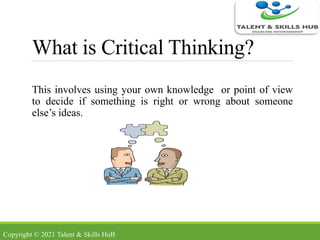
What is Critical Thinking?
This involves using your own knowledge or point of view
to decide if something is right or wrong about someone
else’s ideas.
Copyright © 2021 Talent & Skills HuB
Critical Thinking Skills
Inductive thinking (evidence base thinking)
Deductive thinking (linking one or more statements to
reach a logical conclusion)
Determining reality and fantasy
Determining benefits and drawbacks
Copyright © 2021 Talent & Skills HuB
Critical Thinking Skills
Identifying value statements
Identifying points of view
Determining bias
Identifying fact and opinion
Copyright © 2021 Talent & Skills HuB
Critical Thinking Skills
Determining the accuracy of presented information
Judging essential and incidental evidence
Determining relevance
Copyright © 2021 Talent & Skills HuB
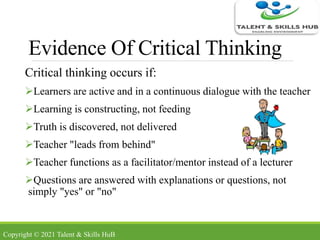
Evidence Of Critical Thinking
Critical thinking occurs if:
Learners are active and in a continuous dialogue with the teacher
Learning is constructing, not feeding
Truth is discovered, not delivered
Teacher "leads from behind"
Teacher functions as a facilitator/mentor instead of a lecturer
Questions are answered with explanations or questions, not
simply "yes" or "no"
Copyright © 2021 Talent & Skills HuB
Evidence of Critical Thinking Cont.
Pertinent discussions on related issues often break out
Debate is common
Peers exchange ideas
Learner and teacher satisfaction increases
"Rabbit chasing" becomes an art - explore related issues, yet
remain on task
Teachers often face questions for which they have no answers
Social interaction and acceptance in the class is generally high
Copyright © 2021 Talent & Skills HuB
Talent &
Skills HuB
T&S-HuB is an enabling environment that supports people in
the development of their talents and skills and in the
actualisation of their personal passions and ambitions.
We help learners and individuals sharpen and exhibit their
talents and skills while exploring relevant and life changing
opportunities that suit their passions.
You can be supported by our instructors, counsellors, and
mentors on employability skills and other personal and
professional development.
Book an appointment for one-to-one or group tutoring
through our website; ts-hub.com
You can also contact us via email: contactus@ts-
hub.com
Copyright © 2021 Talent & Skills HuB
Bibliography
Treffinger and Feldhusen (1998) Planning for Productive
Thinking and Learning, p.24
Sandra Kaplan, National/State Leadership Training Institute
Martinez, M. E. (1998) What is Problem Solving? Phi Delta
Kappan. 605-609.
Copyright © 2021 Talent & Skills HuB

How to Develop Higher Order Thinking Skills in the Classroom

  • 1.
    Higher Order ThinkingSkills in The Classroom BLOOM’S TAXONOMY (H.O.T. Skills) Copyright © 2021 Talent & Skills HuB
  • 2.
    Objectives To Understand theConcept of HOT To Understand the Importance of HOT To Understand the Six Levels of Bloom’s Taxonomy To Understand the Meaning of Critical Thinking To understand the Evidence of Critical Thinking Copyright © 2021 Talent & Skills HuB
  • 3.
    What is HigherOrder Thinking? Higher order thinking essentially means thinking that takes place in the higher-levels of the hierarchy of cognitive processing. Copyright © 2021 Talent & Skills HuB
  • 4.
    Why is Higher-LevelThinking Important? Thinking provides the software for the mind Higher level thinking allows student’s memory to be used effectively. Copyright © 2021 Talent & Skills HuB
  • 5.
    Need for ProblemSolving Ability Because the pace of societal change shows no signs of slackening, citizens of the 21st century must become adept problem solvers, able to wrestle with ill-defined problems and win. Problem-solving ability is the cognitive passport of the future. (Martinez, 1998). Copyright © 2021 Talent & Skills HuB
  • 6.
    Need for ProblemSolving Ability Thinking analytically is a skill like carpentry or driving a car. It can be taught, it can be learned, and it can improve with practice. But like many other skills, such as riding a bike, it is not learned by sitting in a classroom and being told how to do it. Copyright © 2021 Talent & Skills HuB
  • 7.
    Theory Critical thinking theoryfinds its roots primarily in the works of Benjamin Bloom as he classified learning behaviors in the cognitive domain. Bloom (1956) developed a taxonomy of learning objectives for teachers which he clarified and expounded upon over the course of approximately two decades. His ideas continue to be widely accepted and taught in teacher education programs throughout the United States. Copyright © 2021 Talent & Skills HuB
  • 8.
    The Six Levelsof Bloom’s Taxonomy 1. Knowledge 2. Comprehension 3. Application 4. Analysis 5. Evaluation 6. Synthesis Copyright © 2021 Talent & Skills HuB
  • 9.
    Applying Bloom’s Taxonomy KnowledgeLevel Materials/Situations: Events, people, newspapers, magazine articles, definitions, videos, dramas, textbooks, films, television programs, recordings, media presentations Measurable Keywords: Define, describe memorize, label, recognize, name, draw, state, identify, select, write, locate, recite Copyright © 2021 Talent & Skills HuB
  • 10.
    Applying Bloom’s Taxonomy ComprehensionLevel Materials/Situations: Speech, story, drama, cartoon, diagram, graph, summary, outline, analogy, poster, bulletin board Measurable Keywords: Summarize, restate, paraphrase, illustrate, match, explain, defend, relate, infer, compare, contrast, generalise Copyright © 2021 Talent & Skills HuB
  • 11.
    Applying Bloom’s Taxonomy ApplicationLevel Materials/Situations: Diagram, sculpture, illustration, dramatisation, forecast, problem, puzzle, organisations, classifications, rules, systems, routines Measurable Keywords: Apply, change, put together, construct, discover, produce, make, report, sketch, solve, show, collect, prepare Copyright © 2021 Talent & Skills HuB
  • 12.
    Applying Bloom’s Taxonomy AnalysisLevel Materials/Situations: Survey, questionnaire, an argument, a model, displays, demonstrations, diagrams, systems, conclusions, report, graphed information Measurable Behaviors: Examine, classify, categorise, research, contrast, compare, disassemble, differentiate, separate, investigate, subdivide Copyright © 2021 Talent & Skills HuB
  • 13.
    Applying Bloom’s Taxonomy EvaluationLevel Materials/Situations: Recommendations, self-evaluations, group discussions, debate, court trial, standards, editorials, values Measurable Keywords: Compare, recommend, assess, value, apprise, solve, criticize, weigh, consider, debate Copyright © 2021 Talent & Skills HuB
  • 14.
    Applying Bloom’s Taxonomy SynthesisLevel Materials/Situations: Experiment, game, song, report, poem, prose, speculation, creation, art, invention, drama, rules Measurable Keywords: Combine, hypothesize, construct, originate, create, design, formulate, role-play, develop Copyright © 2021 Talent & Skills HuB
  • 15.
    What is CriticalThinking? This involves using your own knowledge or point of view to decide if something is right or wrong about someone else’s ideas. Copyright © 2021 Talent & Skills HuB
  • 16.
    Critical Thinking Skills Inductivethinking (evidence base thinking) Deductive thinking (linking one or more statements to reach a logical conclusion) Determining reality and fantasy Determining benefits and drawbacks Copyright © 2021 Talent & Skills HuB
  • 17.
    Critical Thinking Skills Identifyingvalue statements Identifying points of view Determining bias Identifying fact and opinion Copyright © 2021 Talent & Skills HuB
  • 18.
    Critical Thinking Skills Determiningthe accuracy of presented information Judging essential and incidental evidence Determining relevance Copyright © 2021 Talent & Skills HuB
  • 19.
    Evidence Of CriticalThinking Critical thinking occurs if: Learners are active and in a continuous dialogue with the teacher Learning is constructing, not feeding Truth is discovered, not delivered Teacher "leads from behind" Teacher functions as a facilitator/mentor instead of a lecturer Questions are answered with explanations or questions, not simply "yes" or "no" Copyright © 2021 Talent & Skills HuB
  • 20.
    Evidence of CriticalThinking Cont. Pertinent discussions on related issues often break out Debate is common Peers exchange ideas Learner and teacher satisfaction increases "Rabbit chasing" becomes an art - explore related issues, yet remain on task Teachers often face questions for which they have no answers Social interaction and acceptance in the class is generally high Copyright © 2021 Talent & Skills HuB
  • 21.
    Talent & Skills HuB T&S-HuBis an enabling environment that supports people in the development of their talents and skills and in the actualisation of their personal passions and ambitions. We help learners and individuals sharpen and exhibit their talents and skills while exploring relevant and life changing opportunities that suit their passions. You can be supported by our instructors, counsellors, and mentors on employability skills and other personal and professional development. Book an appointment for one-to-one or group tutoring through our website; ts-hub.com You can also contact us via email: contactus@ts- hub.com Copyright © 2021 Talent & Skills HuB
  • 22.
    Bibliography Treffinger and Feldhusen(1998) Planning for Productive Thinking and Learning, p.24 Sandra Kaplan, National/State Leadership Training Institute Martinez, M. E. (1998) What is Problem Solving? Phi Delta Kappan. 605-609. Copyright © 2021 Talent & Skills HuB