Formalin-fixed paraffin-embedded (FFPE) tissue samples are routinely used for immunohistochemistry and molecular analysis
in cancer research. However, many methods for DNA extraction from FFPE tissue sections are manual procedures that are
not standardized, time consuming and often involve the use of hazardous materials like xylene. Recently we introduced an
automated solution for the DNA extraction from FFPE tissue using the QIAsymphony SP instrument in combination with the
QIAsymphony DNA Mini kit. So far deparaffinization of the FFPE tissue sections is achieved by manual xylene/ethanol
pretreatment followed by proteinase K digestion. Afterwards, lysates are transferred into QIAsymphony sample tubes and
placed on the instrument for further processing.
In order to reduce hands-on time and to avoid use of xylene/ethanol we developed an alternative deparaffinization
method that can be used for automated DNA extraction on the QIAsymphony SP instrument. The new method enables
parallel deparaffinization and lysis of the FFPE tissue material without use of hazardous substances. The manual transfer
and centrifugation steps were minimized and the risk of losing the sample material was eliminated. The handson time was
significantly reduced resulting in a total processing time of approximately 6h for 96 samples.
Xylene/ethanol deparaffinization vs Deparaffinization solution method
FFPE tissue sections were cut freshly from FFPE tissue blocks. Deparaffinization and lysis of the tissue sections was performed
in parallel using the QIAGEN Deparaffinization solution and proteinase K. DNA was extracted automatically using the
QIAsymphony SP and the QIAsymphony DNA Mini kit in combination with the Tissue Low content protocol. Performance
was compared to commonly used xylene/ethanol deparaffinization and manual DNA extraction using the QIAamp DNA
FFPE Tissue kit as well as an automated DNA extraction on the QIAsymphony SP instrument. Yield and purity of extracted
DNA was analyzed by UV spectroscopy. Linearity of extraction was assessed by using increasing amounts of FFPE tissue
sections. Quality of extracted DNA was tested by whole genome amplification and an 8-Plex end-point PCR as well as a
real-time PCR for detection of biomarkers.
Introduction
DNA yield and purity Performance and quality of extracted DNA
Summary and conclusions
110410309/2016
Sample to Insight
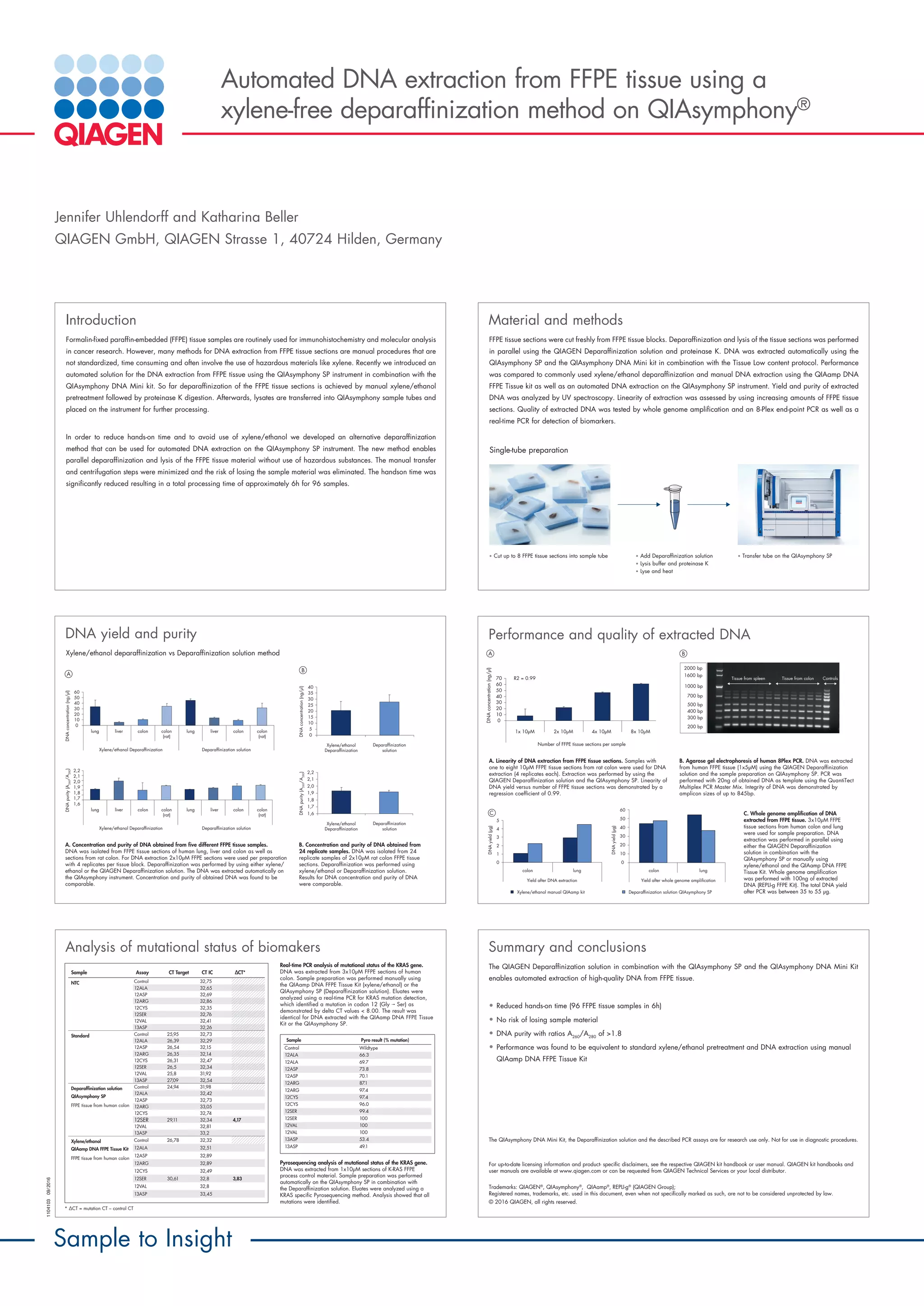
A. Concentration and purity of DNA obtained from five different FFPE tissue samples.
DNA was isolated from FFPE tissue sections of human lung, liver and colon as well as
sections from rat colon. For DNA extraction 2x10μM FFPE sections were used per preparation
with 4 replicates per tissue block. Deparaffinization was performed by using either xylene/
ethanol or the QIAGEN Deparaffinization solution. The DNA was extracted automatically on
the QIAsymphony instrument. Concentration and purity of obtained DNA was found to be
comparable.
A. Linearity of DNA extraction from FFPE tissue sections. Samples with
one to eight 10μM FFPE tissue sections from rat colon were used for DNA
extraction (4 replicates each). Extraction was performed by using the
QIAGEN Deparaffinization solution and the QIAsymphony SP. Linearity of
DNA yield versus number of FFPE tissue sections was demonstrated by a
regression coefficient of 0.99.
B. Concentration and purity of DNA obtained from
24 replicate samples. DNA was isolated from 24
replicate samples of 2x10μM rat colon FFPE tissue
sections. Deparaffinization was performed using
xylene/ethanol or Deparaffinization solution.
Results for DNA concentration and purity of DNA
were comparable.
B. Agarose gel electrophoresis of human 8Plex PCR. DNA was extracted
from human FFPE tissue (1x5μM) using the QIAGEN Deparaffinization
solution and the sample preparation on QIAsymphony SP. PCR was
performed with 20ng of obtained DNA as template using the QuantiTect
Multiplex PCR Master Mix. Integrity of DNA was demonstrated by
amplicon sizes of up to 845bp.
C. Whole genome amplification of DNA
extracted from FFPE tissue. 3x10μM FFPE
tissue sections from human colon and lung
were used for sample preparation. DNA
extraction was performed in parallel using
either the QIAGEN Deparaffinization
solution in combination with the
QIAsymphony SP or manually using
xylene/ethanol and the QIAamp DNA FFPE
Tissue Kit. Whole genome amplification
was performed with 100ng of extracted
DNA (REPLI-g FFPE Kit). The total DNA yield
after PCR was between 35 to 55 μg.
Real-time PCR analysis of mutational status of the KRAS gene.
DNA was extracted from 3x10μM FFPE sections of human
colon. Sample preparation was performed manually using
the QIAamp DNA FFPE Tissue Kit (xylene/ethanol) or the
QIAsymphony SP (Deparaffinization solution). Eluates were
analyzed using a real-time PCR for KRAS mutation detection,
which identified a mutation in codon 12 (Gly Ser) as
demonstrated by delta CT values < 8.00. The result was
identical for DNA extracted with the QIAamp DNA FFPE Tissue
Kit or the QIAsymphony SP.
Pyrosequencing analysis of mutational status of the KRAS gene.
DNA was extracted from 1x10μM sections of K-RAS FFPE
process control material. Sample preparation was performed
automatically on the QIAsymphony SP in combination with
the Deparaffinization solution. Eluates were analyzed using a
KRAS specific Pyrosequencing method. Analysis showed that all
mutations were identified.
* ∆CT = mutation CT – control CT
The QIAGEN Deparaffinization solution in combination with the QIAsymphony SP and the QIAsymphony DNA Mini Kit
enables automated extraction of high-quality DNA from FFPE tissue.
•	 Reduced hands-on time (96 FFPE tissue samples in 6h)
•	 No risk of losing sample material
•	 DNA purity with ratios A260
/A280
of 1.8
•	 Performance was found to be equivalent to standard xylene/ethanol pretreatment and DNA extraction using manual
QIAamp DNA FFPE Tissue Kit
The QIAsymphony DNA Mini Kit, the Deparaffinization solution and the described PCR assays are for research use only. Not for use in diagnostic procedures.
For up-to-date licensing information and product- specific disclaimers, see the respective QIAGEN kit handbook or user manual. QIAGEN kit handbooks and
user manuals are available at www.qiagen.com or can be requested from QIAGEN Technical Services or your local distributor.
Trademarks: QIAGEN®
, QIAsymphony®
, QIAamp®
, REPLI-g®
(QIAGEN Group);
Registered names, trademarks, etc. used in this document, even when not specifically marked as such, are not to be considered unprotected by law.
© 2016 QIAGEN, all rights reserved.
Automated DNA extraction from FFPE tissue using a
xylene-free deparaffinization method on QIAsymphony®
Analysis of mutational status of biomakers
Jennifer Uhlendorff and Katharina Beller
QIAGEN GmbH, QIAGEN Strasse 1, 40724 Hilden, Germany
Material and methods
Single-tube preparation
•	 Cut up to 8 FFPE tissue sections into sample tube •	 Add Deparaffinization solution
•	 Lysis buffer and proteinase K
•	 Lyse and heat
•	 Transfer tube on the QIAsymphony SP
DNAconcentration(ng/µl)
70
60
50
40
30
20
10
0
R2 = 0.99
1x 10µM 2x 10µM
Number of FFPE tissue sections per sample
4x 10µM 8x 10µMlung
Xylene/ethanol Deparaffinization
DNAconcentration(ng/µl)
Deparaffinization solution
liver colon colon
(rat)
lung liver colon colon
(rat)
60
50
40
30
20
10
0
DNApurity(A260
/A280
)
lung
Xylene/ethanol Deparaffinization Deparaffinization solution
liver colon colon
(rat)
lung liver colon colon
(rat)
2,2
2,1
2,0
1,9
1,8
1,7
1,6
DNAconcentration(ng/µl)DNApurity(A260
/A280
)
40
35
30
25
20
15
10
5
0
2,2
2,1
2,0
1,9
1,8
1,7
1,6
Xylene/ethanol
Deparaffinization
Deparaffinization
solution
Xylene/ethanol
Deparaffinization
Deparaffinization
solution
DNAconcentration(ng/µl)DNApurity(A260
/A280
)
40
35
30
25
20
15
10
5
0
2,2
2,1
2,0
1,9
1,8
1,7
1,6
Xylene/ethanol
Deparaffinization
Deparaffinization
solution
Xylene/ethanol
Deparaffinization
Deparaffinization
solution
DNAyield(μg)
DNAyield(μg)
5
4
3
2
1
0
60
50
40
30
20
10
0
colon lung
Yield after DNA extraction
colon lung
Yield after whole genome amplification
Xylene/ethanol manual QIAamp kit Deparaffinization solution QIAsymphony SP
Sample Assay CT Target CT IC ∆CT*
NTC Control 32,75
12ALA 32,65
12ASP 32,69
12ARG 32,86
12CYS 32,35
12SER 32,76
12VAL 32,41
13ASP 32,26
Standard Control 25,95 32,73
12ALA 26,39 32,29
12ASP 26,54 32,15
12ARG 26,35 32,14
12CYS 26,31 32,47
12SER 26,5 32,34
12VAL 25,8 31,92
13ASP 27,09 32,54
Deparaffinization solution
QIAsymphony SP
FFPE tissue from human colon
Control 24,94 31,98
12ALA 32,42
12ASP 32,73
12ARG 33,05
12CYS 32,74
12SER 29,11 32,34 4,17
12VAL 32,81
13ASP 33,2
Xylene/ethanol
QIAamp DNA FFPE Tissue Kit
FFPE tissue from human colon
Control 26,78 32,32
12ALA 32,51
12ASP 32,89
12ARG 32,89
12CYS 32,49
12SER 30,61 32,8 3,83
12VAL 32,8
13ASP 33,45
Sample Pyro result (% mutation)
Control Wildtype
12ALA 66.3
12ALA 69.7
12ASP 73.8
12ASP 70.1
12ARG 87.1
12ARG 97.4
12CYS 97.4
12CYS 96.0
12SER 99.4
12SER 100
12VAL 100
12VAL 100
13ASP 53.4
13ASP 49.1
2000 bp
1600 bp
1000 bp
700 bp
500 bp
400 bp
300 bp
200 bp
Tissue from spleen Tissue from colon Controls

Automated DNA extraction from FFPE tissue using a xylene free deparaffinization method on QIAsymphony - Download the Poster

  • 1.
    Formalin-fixed paraffin-embedded (FFPE)tissue samples are routinely used for immunohistochemistry and molecular analysis in cancer research. However, many methods for DNA extraction from FFPE tissue sections are manual procedures that are not standardized, time consuming and often involve the use of hazardous materials like xylene. Recently we introduced an automated solution for the DNA extraction from FFPE tissue using the QIAsymphony SP instrument in combination with the QIAsymphony DNA Mini kit. So far deparaffinization of the FFPE tissue sections is achieved by manual xylene/ethanol pretreatment followed by proteinase K digestion. Afterwards, lysates are transferred into QIAsymphony sample tubes and placed on the instrument for further processing. In order to reduce hands-on time and to avoid use of xylene/ethanol we developed an alternative deparaffinization method that can be used for automated DNA extraction on the QIAsymphony SP instrument. The new method enables parallel deparaffinization and lysis of the FFPE tissue material without use of hazardous substances. The manual transfer and centrifugation steps were minimized and the risk of losing the sample material was eliminated. The handson time was significantly reduced resulting in a total processing time of approximately 6h for 96 samples. Xylene/ethanol deparaffinization vs Deparaffinization solution method FFPE tissue sections were cut freshly from FFPE tissue blocks. Deparaffinization and lysis of the tissue sections was performed in parallel using the QIAGEN Deparaffinization solution and proteinase K. DNA was extracted automatically using the QIAsymphony SP and the QIAsymphony DNA Mini kit in combination with the Tissue Low content protocol. Performance was compared to commonly used xylene/ethanol deparaffinization and manual DNA extraction using the QIAamp DNA FFPE Tissue kit as well as an automated DNA extraction on the QIAsymphony SP instrument. Yield and purity of extracted DNA was analyzed by UV spectroscopy. Linearity of extraction was assessed by using increasing amounts of FFPE tissue sections. Quality of extracted DNA was tested by whole genome amplification and an 8-Plex end-point PCR as well as a real-time PCR for detection of biomarkers. Introduction DNA yield and purity Performance and quality of extracted DNA Summary and conclusions 110410309/2016 Sample to Insight A. Concentration and purity of DNA obtained from five different FFPE tissue samples. DNA was isolated from FFPE tissue sections of human lung, liver and colon as well as sections from rat colon. For DNA extraction 2x10μM FFPE sections were used per preparation with 4 replicates per tissue block. Deparaffinization was performed by using either xylene/ ethanol or the QIAGEN Deparaffinization solution. The DNA was extracted automatically on the QIAsymphony instrument. Concentration and purity of obtained DNA was found to be comparable. A. Linearity of DNA extraction from FFPE tissue sections. Samples with one to eight 10μM FFPE tissue sections from rat colon were used for DNA extraction (4 replicates each). Extraction was performed by using the QIAGEN Deparaffinization solution and the QIAsymphony SP. Linearity of DNA yield versus number of FFPE tissue sections was demonstrated by a regression coefficient of 0.99. B. Concentration and purity of DNA obtained from 24 replicate samples. DNA was isolated from 24 replicate samples of 2x10μM rat colon FFPE tissue sections. Deparaffinization was performed using xylene/ethanol or Deparaffinization solution. Results for DNA concentration and purity of DNA were comparable. B. Agarose gel electrophoresis of human 8Plex PCR. DNA was extracted from human FFPE tissue (1x5μM) using the QIAGEN Deparaffinization solution and the sample preparation on QIAsymphony SP. PCR was performed with 20ng of obtained DNA as template using the QuantiTect Multiplex PCR Master Mix. Integrity of DNA was demonstrated by amplicon sizes of up to 845bp. C. Whole genome amplification of DNA extracted from FFPE tissue. 3x10μM FFPE tissue sections from human colon and lung were used for sample preparation. DNA extraction was performed in parallel using either the QIAGEN Deparaffinization solution in combination with the QIAsymphony SP or manually using xylene/ethanol and the QIAamp DNA FFPE Tissue Kit. Whole genome amplification was performed with 100ng of extracted DNA (REPLI-g FFPE Kit). The total DNA yield after PCR was between 35 to 55 μg. Real-time PCR analysis of mutational status of the KRAS gene. DNA was extracted from 3x10μM FFPE sections of human colon. Sample preparation was performed manually using the QIAamp DNA FFPE Tissue Kit (xylene/ethanol) or the QIAsymphony SP (Deparaffinization solution). Eluates were analyzed using a real-time PCR for KRAS mutation detection, which identified a mutation in codon 12 (Gly Ser) as demonstrated by delta CT values < 8.00. The result was identical for DNA extracted with the QIAamp DNA FFPE Tissue Kit or the QIAsymphony SP. Pyrosequencing analysis of mutational status of the KRAS gene. DNA was extracted from 1x10μM sections of K-RAS FFPE process control material. Sample preparation was performed automatically on the QIAsymphony SP in combination with the Deparaffinization solution. Eluates were analyzed using a KRAS specific Pyrosequencing method. Analysis showed that all mutations were identified. * ∆CT = mutation CT – control CT The QIAGEN Deparaffinization solution in combination with the QIAsymphony SP and the QIAsymphony DNA Mini Kit enables automated extraction of high-quality DNA from FFPE tissue. • Reduced hands-on time (96 FFPE tissue samples in 6h) • No risk of losing sample material • DNA purity with ratios A260 /A280 of 1.8 • Performance was found to be equivalent to standard xylene/ethanol pretreatment and DNA extraction using manual QIAamp DNA FFPE Tissue Kit The QIAsymphony DNA Mini Kit, the Deparaffinization solution and the described PCR assays are for research use only. Not for use in diagnostic procedures. For up-to-date licensing information and product- specific disclaimers, see the respective QIAGEN kit handbook or user manual. QIAGEN kit handbooks and user manuals are available at www.qiagen.com or can be requested from QIAGEN Technical Services or your local distributor. Trademarks: QIAGEN® , QIAsymphony® , QIAamp® , REPLI-g® (QIAGEN Group); Registered names, trademarks, etc. used in this document, even when not specifically marked as such, are not to be considered unprotected by law. © 2016 QIAGEN, all rights reserved. Automated DNA extraction from FFPE tissue using a xylene-free deparaffinization method on QIAsymphony® Analysis of mutational status of biomakers Jennifer Uhlendorff and Katharina Beller QIAGEN GmbH, QIAGEN Strasse 1, 40724 Hilden, Germany Material and methods Single-tube preparation • Cut up to 8 FFPE tissue sections into sample tube • Add Deparaffinization solution • Lysis buffer and proteinase K • Lyse and heat • Transfer tube on the QIAsymphony SP DNAconcentration(ng/µl) 70 60 50 40 30 20 10 0 R2 = 0.99 1x 10µM 2x 10µM Number of FFPE tissue sections per sample 4x 10µM 8x 10µMlung Xylene/ethanol Deparaffinization DNAconcentration(ng/µl) Deparaffinization solution liver colon colon (rat) lung liver colon colon (rat) 60 50 40 30 20 10 0 DNApurity(A260 /A280 ) lung Xylene/ethanol Deparaffinization Deparaffinization solution liver colon colon (rat) lung liver colon colon (rat) 2,2 2,1 2,0 1,9 1,8 1,7 1,6 DNAconcentration(ng/µl)DNApurity(A260 /A280 ) 40 35 30 25 20 15 10 5 0 2,2 2,1 2,0 1,9 1,8 1,7 1,6 Xylene/ethanol Deparaffinization Deparaffinization solution Xylene/ethanol Deparaffinization Deparaffinization solution DNAconcentration(ng/µl)DNApurity(A260 /A280 ) 40 35 30 25 20 15 10 5 0 2,2 2,1 2,0 1,9 1,8 1,7 1,6 Xylene/ethanol Deparaffinization Deparaffinization solution Xylene/ethanol Deparaffinization Deparaffinization solution DNAyield(μg) DNAyield(μg) 5 4 3 2 1 0 60 50 40 30 20 10 0 colon lung Yield after DNA extraction colon lung Yield after whole genome amplification Xylene/ethanol manual QIAamp kit Deparaffinization solution QIAsymphony SP Sample Assay CT Target CT IC ∆CT* NTC Control 32,75 12ALA 32,65 12ASP 32,69 12ARG 32,86 12CYS 32,35 12SER 32,76 12VAL 32,41 13ASP 32,26 Standard Control 25,95 32,73 12ALA 26,39 32,29 12ASP 26,54 32,15 12ARG 26,35 32,14 12CYS 26,31 32,47 12SER 26,5 32,34 12VAL 25,8 31,92 13ASP 27,09 32,54 Deparaffinization solution QIAsymphony SP FFPE tissue from human colon Control 24,94 31,98 12ALA 32,42 12ASP 32,73 12ARG 33,05 12CYS 32,74 12SER 29,11 32,34 4,17 12VAL 32,81 13ASP 33,2 Xylene/ethanol QIAamp DNA FFPE Tissue Kit FFPE tissue from human colon Control 26,78 32,32 12ALA 32,51 12ASP 32,89 12ARG 32,89 12CYS 32,49 12SER 30,61 32,8 3,83 12VAL 32,8 13ASP 33,45 Sample Pyro result (% mutation) Control Wildtype 12ALA 66.3 12ALA 69.7 12ASP 73.8 12ASP 70.1 12ARG 87.1 12ARG 97.4 12CYS 97.4 12CYS 96.0 12SER 99.4 12SER 100 12VAL 100 12VAL 100 13ASP 53.4 13ASP 49.1 2000 bp 1600 bp 1000 bp 700 bp 500 bp 400 bp 300 bp 200 bp Tissue from spleen Tissue from colon Controls