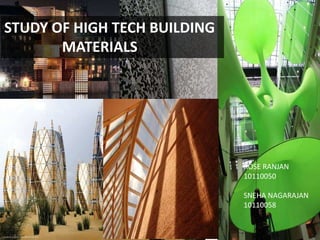
STUDY OF HIGH TECH BUILDING
MATERIALS

ROSE RANJAN
10110050
SNEHA NAGARAJAN
10110058
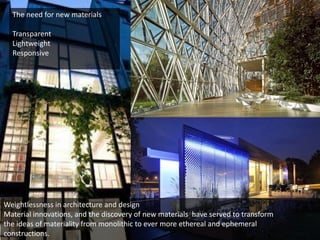
The need for new materials
Transparent
Lightweight
Responsive

Weightlessness in architecture and design
Material innovations, and the discovery of new materials have served to transform
the ideas of materiality from monolithic to ever more ethereal and ephemeral
constructions.
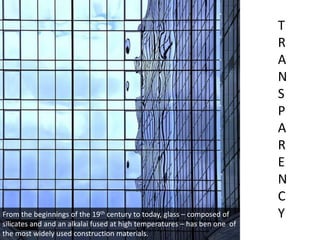
From the beginnings of the 19th century to today, glass – composed of
silicates and and an alkalai fused at high temperatures – has ben one of
the most widely used construction materials.

T
R
A
N
S
P
A
R
E
N
C
Y
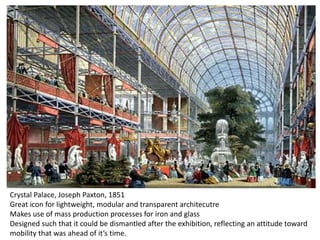
Crystal Palace, Joseph Paxton, 1851
Great icon for lightweight, modular and transparent architecutre
Makes use of mass production processes for iron and glass
Designed such that it could be dismantled after the exhibition, reflecting an attitude toward
mobility that was ahead of it’s time.
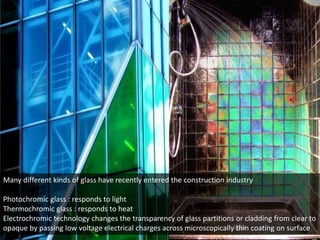
Many different kinds of glass have recently entered the construction industry
Photochromic glass : responds to light
Thermochromic glass : responds to heat
Electrochromic technology changes the transparency of glass partitions or cladding from clear to
opaque by passing low voltage electrical charges across microscopically thin coating on surface
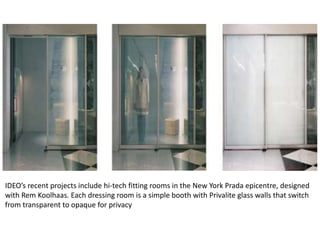
IDEO’s recent projects include hi-tech fitting rooms in the New York Prada epicentre, designed
with Rem Koolhaas. Each dressing room is a simple booth with Privalite glass walls that switch
from transparent to opaque for privacy
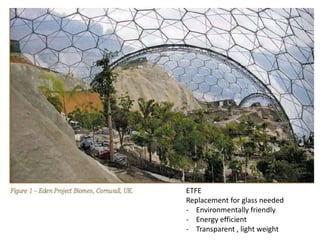
ETFE
Replacement for glass needed
- Environmentally friendly
- Energy efficient
- Transparent , light weight
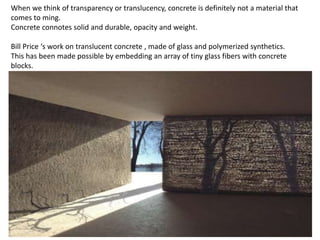
When we think of transparency or translucency, concrete is definitely not a material that
comes to ming.
Concrete connotes solid and durable, opacity and weight.
Bill Price ‘s work on translucent concrete , made of glass and polymerized synthetics.
This has been made possible by embedding an array of tiny glass fibers with concrete
blocks.
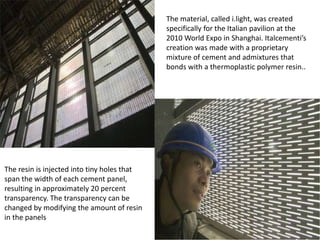
The material, called i.light, was created
specifically for the Italian pavilion at the
2010 World Expo in Shanghai. Italcementi’s
creation was made with a proprietary
mixture of cement and admixtures that
bonds with a thermoplastic polymer resin..

The resin is injected into tiny holes that
span the width of each cement panel,
resulting in approximately 20 percent
transparency. The transparency can be
changed by modifying the amount of resin
in the panels
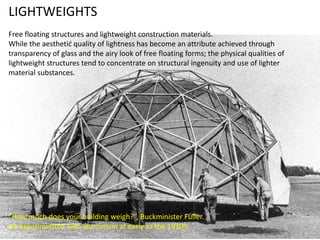
LIGHTWEIGHTS
Free floating structures and lightweight construction materials.
While the aesthetic quality of lightness has become an attribute achieved through
transparency of glass and the airy look of free floating forms; the physical qualities of
lightweight structures tend to concentrate on structural ingenuity and use of lighter
material substances.

“How much does your building weigh?”, Buckminister Fuller.
He experimented with aluminium at early as the 1930’s.
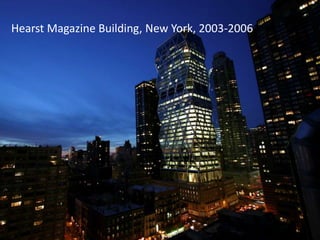
Hearst Magazine Building, New York, 2003-2006
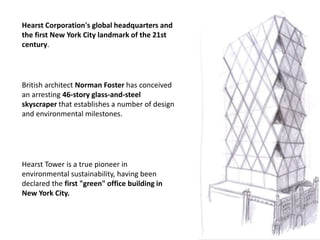
Hearst Corporation's global headquarters and
the first New York City landmark of the 21st
century.

British architect Norman Foster has conceived
an arresting 46-story glass-and-steel
skyscraper that establishes a number of design
and environmental milestones.

Hearst Tower is a true pioneer in
environmental sustainability, having been
declared the first "green" office building in
New York City.
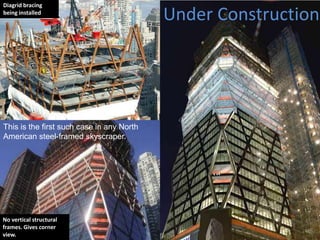
Diagrid bracing
being installed

This is the first such case in any North
American steel-framed skyscraper.

No vertical structural
frames. Gives corner
view.

Under Construction
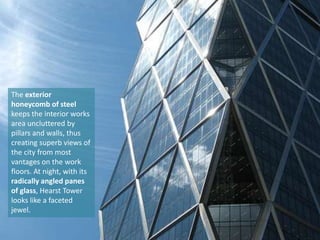
The exterior
honeycomb of steel
keeps the interior works
area uncluttered by
pillars and walls, thus
creating superb views of
the city from most
vantages on the work
floors. At night, with its
radically angled panes
of glass, Hearst Tower
looks like a faceted
jewel.
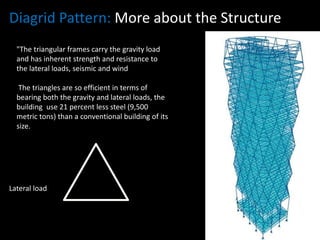
Diagrid Pattern: More about the Structure
"The triangular frames carry the gravity load
and has inherent strength and resistance to
the lateral loads, seismic and wind
The triangles are so efficient in terms of
bearing both the gravity and lateral loads, the
building use 21 percent less steel (9,500
metric tons) than a conventional building of its
size.

Lateral load

Gravity load
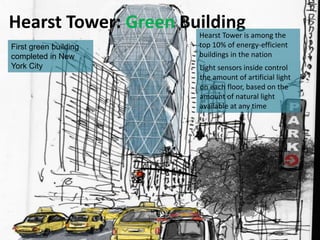
Hearst Tower: Green Building
First green building
completed in New
York City

Hearst Tower is among the
top 10% of energy-efficient
buildings in the nation
Light sensors inside control
the amount of artificial light
on each floor, based on the
amount of natural light
available at any time
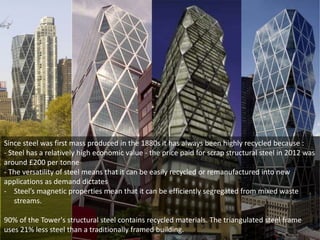
Since steel was first mass produced in the 1880s it has always been highly recycled because :
- Steel has a relatively high economic value - the price paid for scrap structural steel in 2012 was
around £200 per tonne
- The versatility of steel means that it can be easily recycled or remanufactured into new
applications as demand dictates
- Steel’s magnetic properties mean that it can be efficiently segregated from mixed waste
streams.
90% of the Tower's structural steel contains recycled materials. The triangulated steel frame
uses 21% less steel than a traditionally framed building.
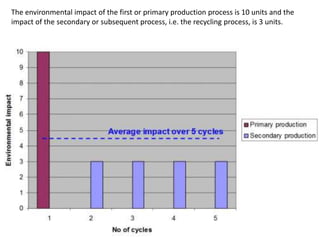
The environmental impact of the first or primary production process is 10 units and the
impact of the secondary or subsequent process, i.e. the recycling process, is 3 units.
THERMAL
COMFORT

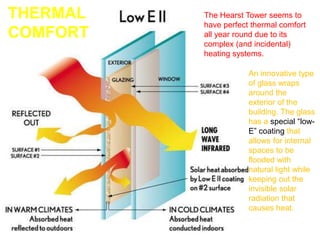
The Hearst Tower seems to
have perfect thermal comfort
all year round due to its
complex (and incidental)
heating systems.

An innovative type
of glass wraps
around the
exterior of the
building. The glass
has a special “lowE” coating that
allows for internal
spaces to be
flooded with
natural light while
keeping out the
invisible solar
radiation that
causes heat.
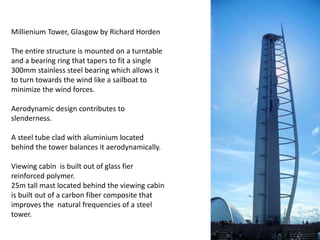
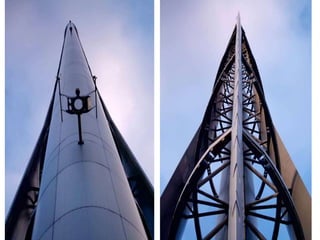
Millienium Tower, Glasgow by Richard Horden
The entire structure is mounted on a turntable
and a bearing ring that tapers to fit a single
300mm stainless steel bearing which allows it
to turn towards the wind like a sailboat to
minimize the wind forces.
Aerodynamic design contributes to
slenderness.
A steel tube clad with aluminium located
behind the tower balances it aerodynamically.
Viewing cabin is built out of glass fier
reinforced polymer.
25m tall mast located behind the viewing cabin
is built out of a carbon fiber composite that
improves the natural frequencies of a steel
tower.
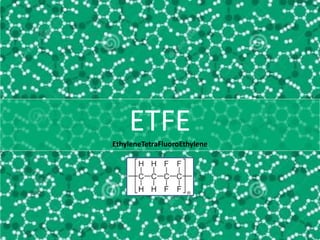
ETFE
EthyleneTetraFluoroEthylene
The "miracle polymer" for public architecture
• ETFE, a fluorine based plastic, was designed to have high corrosion resistance and
strength over a wide temperature range.
• ETFE has a very high melting temperature, excellent chemical, and high energy
radiation resistance properties.

• ETFE film is self-cleaning (due to its non-stick surface)
• It is recyclable.
• In sheet form as commonly employed for architecture, it is able to stretch to three
times its length without loss of elasticity.
• Employing heat welding, tears can be repaired with a patch or multiple sheets
assembled into larger panels.
• ETFE has an approximate tensile strength of 42 N/mm² (6100 psi), with a working
temperature range of 89 K to 423 K (-185 °C to 150 °C or -300 °F to 300 °F).
• ETFE resins are resistant to ultraviolet light. An accelerated weathering test
(comparable to 30 years’ exposure) produced almost no signs of film
deterioration.
• It is prone to punctures by sharp edges and therefore mostly used for roofs.
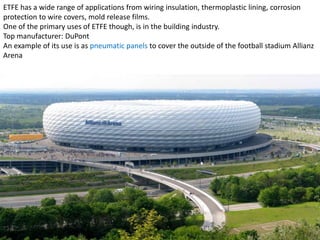
ETFE has a wide range of applications from wiring insulation, thermoplastic lining, corrosion
protection to wire covers, mold release films.
One of the primary uses of ETFE though, is in the building industry.
Top manufacturer: DuPont
An example of its use is as pneumatic panels to cover the outside of the football stadium Allianz
Arena
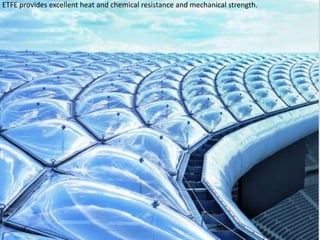
ETFE provides excellent heat and chemical resistance and mechanical strength.
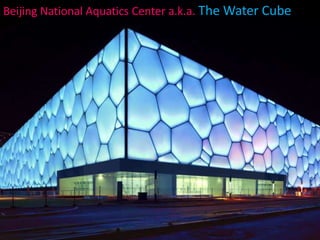
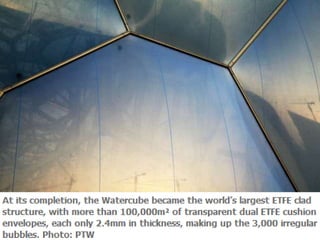
Beijing National Aquatics Center a.k.a. The Water Cube
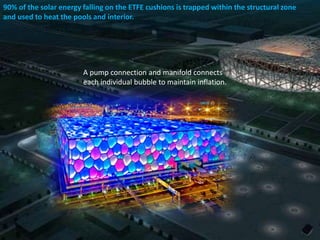
90% of the solar energy falling on the ETFE cushions is trapped within the structural zone
and used to heat the pools and interior.

A pump connection and manifold connects
each individual bubble to maintain inflation.
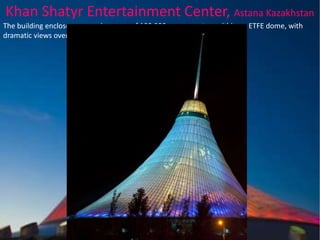
Khan Shatyr Entertainment Center, Astana Kazakhstan
The building encloses an area in excess of 100,000 square metres within an ETFE dome, with
dramatic views over the city and the Steppes beyond.
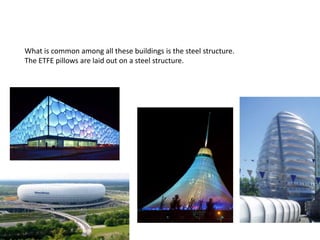
What is common among all these buildings is the steel structure.
The ETFE pillows are laid out on a steel structure.
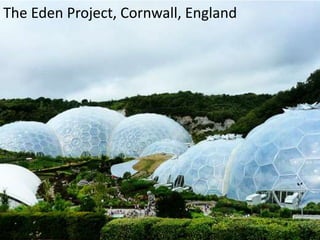
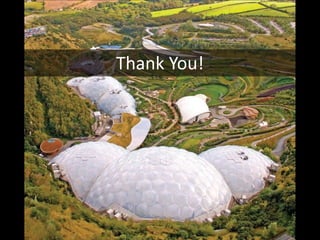
The Eden Project, Cornwall, England
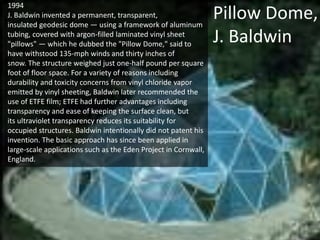
1994
J. Baldwin invented a permanent, transparent,
insulated geodesic dome — using a framework of aluminum
tubing, covered with argon-filled laminated vinyl sheet
"pillows" — which he dubbed the "Pillow Dome," said to
have withstood 135-mph winds and thirty inches of
snow. The structure weighed just one-half pound per square
foot of floor space. For a variety of reasons including
durability and toxicity concerns from vinyl chloride vapor
emitted by vinyl sheeting, Baldwin later recommended the
use of ETFE film; ETFE had further advantages including
transparency and ease of keeping the surface clean, but
its ultraviolet transparency reduces its suitability for
occupied structures. Baldwin intentionally did not patent his
invention. The basic approach has since been applied in
large-scale applications such as the Eden Project in Cornwall,
England.

Pillow Dome,
J. Baldwin
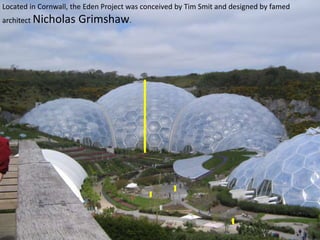
Located in Cornwall, the Eden Project was conceived by Tim Smit and designed by famed

architect Nicholas

Grimshaw.
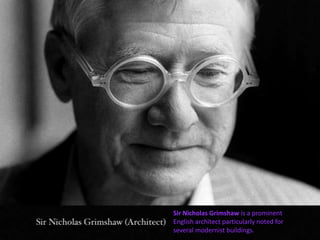
Sir Nicholas Grimshaw is a prominent
English architect particularly noted for
several modernist buildings.
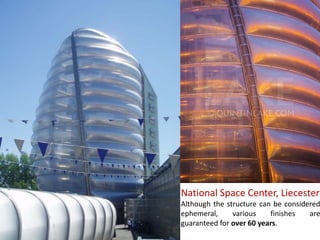
National Space Center, Liecester

Although the structure can be considered
ephemeral,
various
finishes
are
guaranteed for over 60 years.
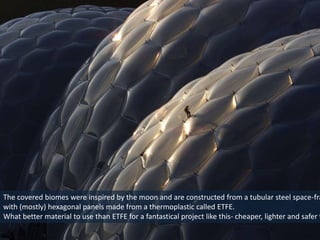
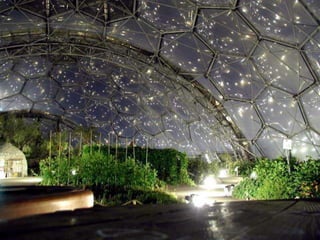
The covered biomes were inspired by the moon and are constructed from a tubular steel space-fra
with (mostly) hexagonal panels made from a thermoplastic called ETFE.
What better material to use than ETFE for a fantastical project like this- cheaper, lighter and safer t
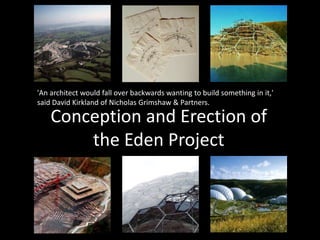
'An architect would fall over backwards wanting to build something in it,'
said David Kirkland of Nicholas Grimshaw & Partners.

Conception and Erection of
the Eden Project
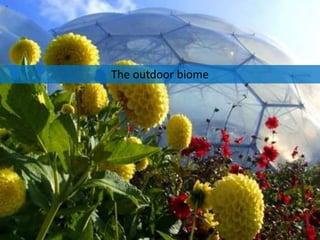
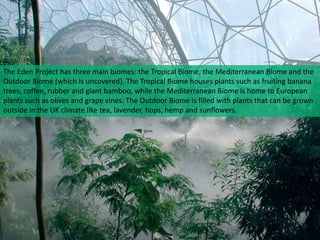
The Eden Project has three main biomes: the Tropical Biome, the Mediterranean Biome and the
Outdoor Biome (which is uncovered). The Tropical Biome houses plants such as fruiting banana
trees, coffee, rubber and giant bamboo, while the Mediterranean Biome is home to European
plants such as olives and grape vines. The Outdoor Biome is filled with plants that can be grown
outside in the UK climate like tea, lavender, hops, hemp and sunflowers.
The outdoor biome
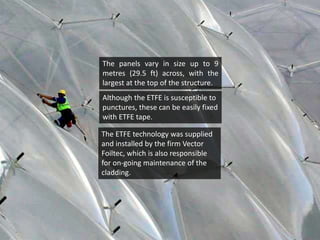
The panels vary in size up to 9
metres (29.5 ft) across, with the
largest at the top of the structure.
Although the ETFE is susceptible to
punctures, these can be easily fixed
with ETFE tape.

The ETFE technology was supplied
and installed by the firm Vector
Foiltec, which is also responsible
for on-going maintenance of the
cladding.
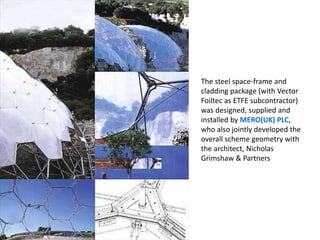
The steel space-frame and
cladding package (with Vector
Foiltec as ETFE subcontractor)
was designed, supplied and
installed by MERO(UK) PLC,
who also jointly developed the
overall scheme geometry with
the architect, Nicholas
Grimshaw & Partners
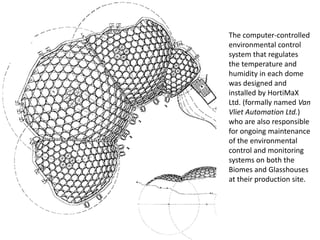
The computer-controlled
environmental control
system that regulates
the temperature and
humidity in each dome
was designed and
installed by HortiMaX
Ltd. (formally named Van
Vliet Automation Ltd.)
who are also responsible
for ongoing maintenance
of the environmental
control and monitoring
systems on both the
Biomes and Glasshouses
at their production site.
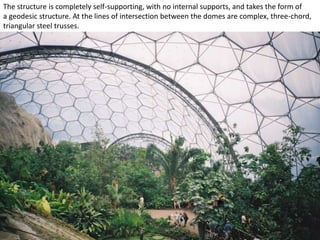
The structure is completely self-supporting, with no internal supports, and takes the form of
a geodesic structure. At the lines of intersection between the domes are complex, three-chord,
triangular steel trusses.
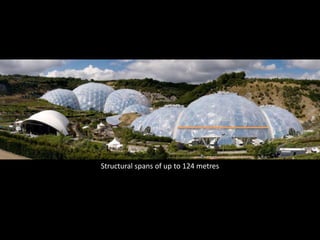
Structural spans of up to 124 metres
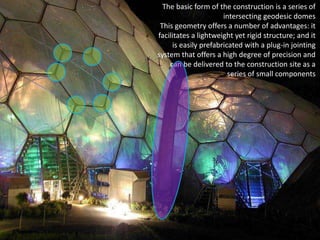
The basic form of the construction is a series of
intersecting geodesic domes
This geometry offers a number of advantages: it
facilitates a lightweight yet rigid structure; and it
is easily prefabricated with a plug-in jointing
system that offers a high degree of precision and
can be delivered to the construction site as a
series of small components
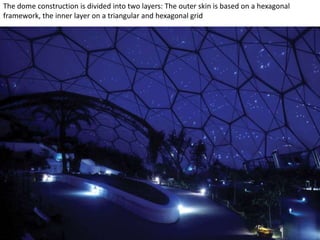
The dome construction is divided into two layers: The outer skin is based on a hexagonal
framework, the inner layer on a triangular and hexagonal grid
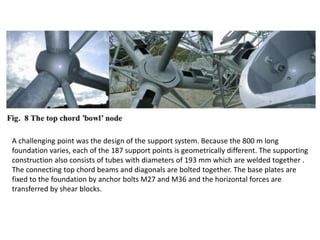
A challenging point was the design of the support system. Because the 800 m long
foundation varies, each of the 187 support points is geometrically different. The supporting
construction also consists of tubes with diameters of 193 mm which are welded together .
The connecting top chord beams and diagonals are bolted together. The base plates are
fixed to the foundation by anchor bolts M27 and M36 and the horizontal forces are
transferred by shear blocks.
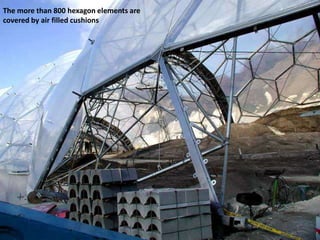
The more than 800 hexagon elements are
covered by air filled cushions
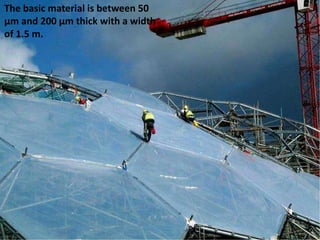
The basic material is between 50
µm and 200 µm thick with a width
of 1.5 m.
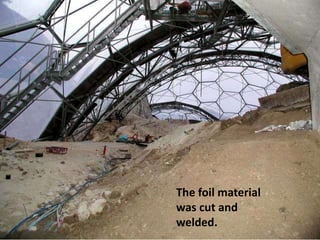
The foil material
was cut and
welded.
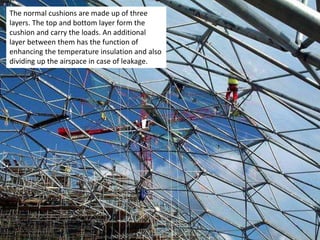
The normal cushions are made up of three
layers. The top and bottom layer form the
cushion and carry the loads. An additional
layer between them has the function of
enhancing the temperature insulation and also
dividing up the airspace in case of leakage.
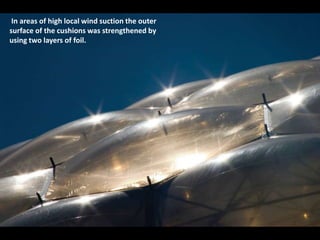
In areas of high local wind suction the outer
surface of the cushions was strengthened by
using two layers of foil.
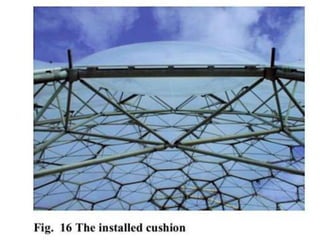
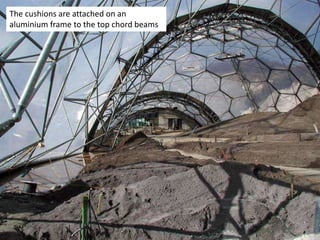
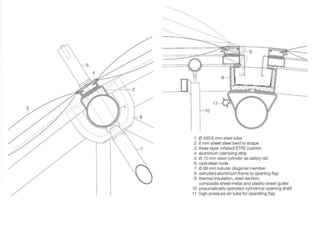
The cushions are attached on an
aluminium frame to the top chord beams
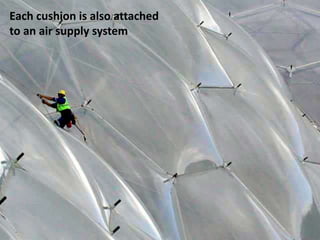
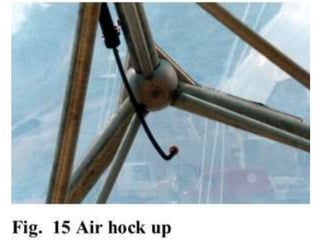
Each cushion is also attached
to an air supply system
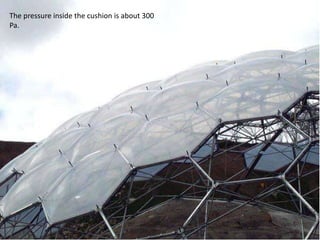
The pressure inside the cushion is about 300
Pa.
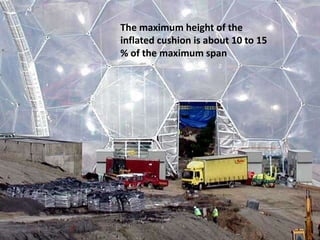
The maximum height of the
inflated cushion is about 10 to 15
% of the maximum span
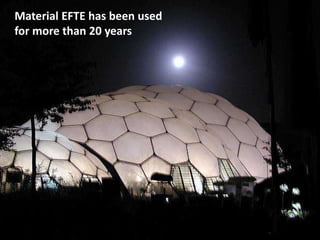
Material EFTE has been used
for more than 20 years
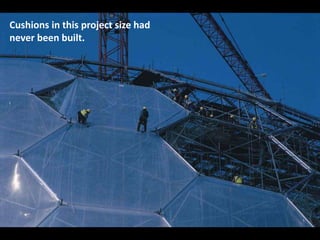
Cushions in this project size had
never been built.
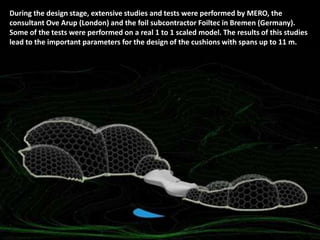
During the design stage, extensive studies and tests were performed by MERO, the
consultant Ove Arup (London) and the foil subcontractor Foiltec in Bremen (Germany).
Some of the tests were performed on a real 1 to 1 scaled model. The results of this studies
lead to the important parameters for the design of the cushions with spans up to 11 m.
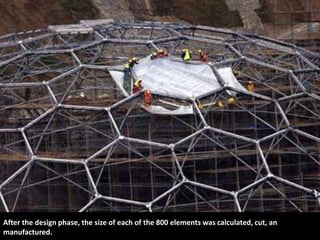
After the design phase, the size of each of the 800 elements was calculated, cut, an
manufactured.
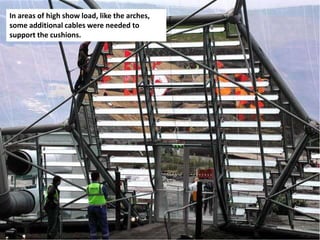
In areas of high show load, like the arches,
some additional cables were needed to
support the cushions.
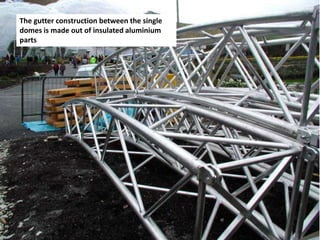
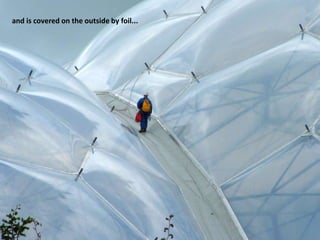
The gutter construction between the single
domes is made out of insulated aluminium
parts
and is covered on the outside by foil...
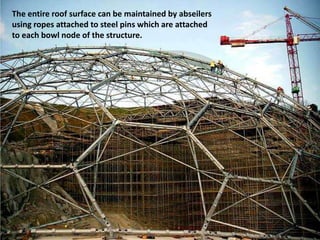
The entire roof surface can be maintained by abseilers
using ropes attached to steel pins which are attached
to each bowl node of the structure.
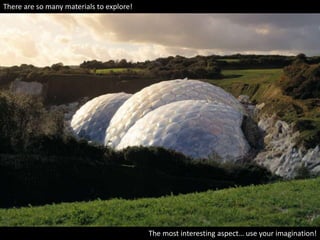
There are so many materials to explore!

The most interesting aspect… use your imagination!
Thank You!

High Tech Building Materials: ETFE

  • 1.
    STUDY OF HIGHTECH BUILDING MATERIALS ROSE RANJAN 10110050 SNEHA NAGARAJAN 10110058
  • 2.
    The need fornew materials Transparent Lightweight Responsive Weightlessness in architecture and design Material innovations, and the discovery of new materials have served to transform the ideas of materiality from monolithic to ever more ethereal and ephemeral constructions.
  • 3.
    From the beginningsof the 19th century to today, glass – composed of silicates and and an alkalai fused at high temperatures – has ben one of the most widely used construction materials. T R A N S P A R E N C Y
  • 4.
    Crystal Palace, JosephPaxton, 1851 Great icon for lightweight, modular and transparent architecutre Makes use of mass production processes for iron and glass Designed such that it could be dismantled after the exhibition, reflecting an attitude toward mobility that was ahead of it’s time.
  • 5.
    Many different kindsof glass have recently entered the construction industry Photochromic glass : responds to light Thermochromic glass : responds to heat Electrochromic technology changes the transparency of glass partitions or cladding from clear to opaque by passing low voltage electrical charges across microscopically thin coating on surface
  • 6.
    IDEO’s recent projectsinclude hi-tech fitting rooms in the New York Prada epicentre, designed with Rem Koolhaas. Each dressing room is a simple booth with Privalite glass walls that switch from transparent to opaque for privacy
  • 7.
    ETFE Replacement for glassneeded - Environmentally friendly - Energy efficient - Transparent , light weight
  • 8.
    When we thinkof transparency or translucency, concrete is definitely not a material that comes to ming. Concrete connotes solid and durable, opacity and weight. Bill Price ‘s work on translucent concrete , made of glass and polymerized synthetics. This has been made possible by embedding an array of tiny glass fibers with concrete blocks.
  • 9.
    The material, calledi.light, was created specifically for the Italian pavilion at the 2010 World Expo in Shanghai. Italcementi’s creation was made with a proprietary mixture of cement and admixtures that bonds with a thermoplastic polymer resin.. The resin is injected into tiny holes that span the width of each cement panel, resulting in approximately 20 percent transparency. The transparency can be changed by modifying the amount of resin in the panels
  • 10.
    LIGHTWEIGHTS Free floating structuresand lightweight construction materials. While the aesthetic quality of lightness has become an attribute achieved through transparency of glass and the airy look of free floating forms; the physical qualities of lightweight structures tend to concentrate on structural ingenuity and use of lighter material substances. “How much does your building weigh?”, Buckminister Fuller. He experimented with aluminium at early as the 1930’s.
  • 11.
    Hearst Magazine Building,New York, 2003-2006
  • 12.
    Hearst Corporation's globalheadquarters and the first New York City landmark of the 21st century. British architect Norman Foster has conceived an arresting 46-story glass-and-steel skyscraper that establishes a number of design and environmental milestones. Hearst Tower is a true pioneer in environmental sustainability, having been declared the first "green" office building in New York City.
  • 13.
    Diagrid bracing being installed Thisis the first such case in any North American steel-framed skyscraper. No vertical structural frames. Gives corner view. Under Construction
  • 14.
    The exterior honeycomb ofsteel keeps the interior works area uncluttered by pillars and walls, thus creating superb views of the city from most vantages on the work floors. At night, with its radically angled panes of glass, Hearst Tower looks like a faceted jewel.
  • 15.
    Diagrid Pattern: Moreabout the Structure "The triangular frames carry the gravity load and has inherent strength and resistance to the lateral loads, seismic and wind The triangles are so efficient in terms of bearing both the gravity and lateral loads, the building use 21 percent less steel (9,500 metric tons) than a conventional building of its size. Lateral load Gravity load
  • 16.
    Hearst Tower: GreenBuilding First green building completed in New York City Hearst Tower is among the top 10% of energy-efficient buildings in the nation Light sensors inside control the amount of artificial light on each floor, based on the amount of natural light available at any time
  • 17.
    Since steel wasfirst mass produced in the 1880s it has always been highly recycled because : - Steel has a relatively high economic value - the price paid for scrap structural steel in 2012 was around £200 per tonne - The versatility of steel means that it can be easily recycled or remanufactured into new applications as demand dictates - Steel’s magnetic properties mean that it can be efficiently segregated from mixed waste streams. 90% of the Tower's structural steel contains recycled materials. The triangulated steel frame uses 21% less steel than a traditionally framed building.
  • 18.
    The environmental impactof the first or primary production process is 10 units and the impact of the secondary or subsequent process, i.e. the recycling process, is 3 units.
  • 19.
    THERMAL COMFORT The Hearst Towerseems to have perfect thermal comfort all year round due to its complex (and incidental) heating systems. An innovative type of glass wraps around the exterior of the building. The glass has a special “lowE” coating that allows for internal spaces to be flooded with natural light while keeping out the invisible solar radiation that causes heat.
  • 20.
    Millienium Tower, Glasgowby Richard Horden The entire structure is mounted on a turntable and a bearing ring that tapers to fit a single 300mm stainless steel bearing which allows it to turn towards the wind like a sailboat to minimize the wind forces. Aerodynamic design contributes to slenderness. A steel tube clad with aluminium located behind the tower balances it aerodynamically. Viewing cabin is built out of glass fier reinforced polymer. 25m tall mast located behind the viewing cabin is built out of a carbon fiber composite that improves the natural frequencies of a steel tower.
  • 22.
  • 23.
    The "miracle polymer"for public architecture • ETFE, a fluorine based plastic, was designed to have high corrosion resistance and strength over a wide temperature range. • ETFE has a very high melting temperature, excellent chemical, and high energy radiation resistance properties. • ETFE film is self-cleaning (due to its non-stick surface) • It is recyclable. • In sheet form as commonly employed for architecture, it is able to stretch to three times its length without loss of elasticity. • Employing heat welding, tears can be repaired with a patch or multiple sheets assembled into larger panels. • ETFE has an approximate tensile strength of 42 N/mm² (6100 psi), with a working temperature range of 89 K to 423 K (-185 °C to 150 °C or -300 °F to 300 °F). • ETFE resins are resistant to ultraviolet light. An accelerated weathering test (comparable to 30 years’ exposure) produced almost no signs of film deterioration. • It is prone to punctures by sharp edges and therefore mostly used for roofs.
  • 24.
    ETFE has awide range of applications from wiring insulation, thermoplastic lining, corrosion protection to wire covers, mold release films. One of the primary uses of ETFE though, is in the building industry. Top manufacturer: DuPont An example of its use is as pneumatic panels to cover the outside of the football stadium Allianz Arena
  • 25.
    ETFE provides excellentheat and chemical resistance and mechanical strength.
  • 26.
    Beijing National AquaticsCenter a.k.a. The Water Cube
  • 28.
    90% of thesolar energy falling on the ETFE cushions is trapped within the structural zone and used to heat the pools and interior. A pump connection and manifold connects each individual bubble to maintain inflation.
  • 29.
    Khan Shatyr EntertainmentCenter, Astana Kazakhstan The building encloses an area in excess of 100,000 square metres within an ETFE dome, with dramatic views over the city and the Steppes beyond.
  • 30.
    What is commonamong all these buildings is the steel structure. The ETFE pillows are laid out on a steel structure.
  • 31.
    The Eden Project,Cornwall, England
  • 32.
    1994 J. Baldwin inventeda permanent, transparent, insulated geodesic dome — using a framework of aluminum tubing, covered with argon-filled laminated vinyl sheet "pillows" — which he dubbed the "Pillow Dome," said to have withstood 135-mph winds and thirty inches of snow. The structure weighed just one-half pound per square foot of floor space. For a variety of reasons including durability and toxicity concerns from vinyl chloride vapor emitted by vinyl sheeting, Baldwin later recommended the use of ETFE film; ETFE had further advantages including transparency and ease of keeping the surface clean, but its ultraviolet transparency reduces its suitability for occupied structures. Baldwin intentionally did not patent his invention. The basic approach has since been applied in large-scale applications such as the Eden Project in Cornwall, England. Pillow Dome, J. Baldwin
  • 33.
    Located in Cornwall,the Eden Project was conceived by Tim Smit and designed by famed architect Nicholas Grimshaw.
  • 34.
    Sir Nicholas Grimshawis a prominent English architect particularly noted for several modernist buildings.
  • 35.
    National Space Center,Liecester Although the structure can be considered ephemeral, various finishes are guaranteed for over 60 years.
  • 36.
    The covered biomeswere inspired by the moon and are constructed from a tubular steel space-fra with (mostly) hexagonal panels made from a thermoplastic called ETFE. What better material to use than ETFE for a fantastical project like this- cheaper, lighter and safer t
  • 37.
    'An architect wouldfall over backwards wanting to build something in it,' said David Kirkland of Nicholas Grimshaw & Partners. Conception and Erection of the Eden Project
  • 38.
    The Eden Projecthas three main biomes: the Tropical Biome, the Mediterranean Biome and the Outdoor Biome (which is uncovered). The Tropical Biome houses plants such as fruiting banana trees, coffee, rubber and giant bamboo, while the Mediterranean Biome is home to European plants such as olives and grape vines. The Outdoor Biome is filled with plants that can be grown outside in the UK climate like tea, lavender, hops, hemp and sunflowers.
  • 39.
  • 40.
    The panels varyin size up to 9 metres (29.5 ft) across, with the largest at the top of the structure. Although the ETFE is susceptible to punctures, these can be easily fixed with ETFE tape. The ETFE technology was supplied and installed by the firm Vector Foiltec, which is also responsible for on-going maintenance of the cladding.
  • 41.
    The steel space-frameand cladding package (with Vector Foiltec as ETFE subcontractor) was designed, supplied and installed by MERO(UK) PLC, who also jointly developed the overall scheme geometry with the architect, Nicholas Grimshaw & Partners
  • 42.
    The computer-controlled environmental control systemthat regulates the temperature and humidity in each dome was designed and installed by HortiMaX Ltd. (formally named Van Vliet Automation Ltd.) who are also responsible for ongoing maintenance of the environmental control and monitoring systems on both the Biomes and Glasshouses at their production site.
  • 43.
    The structure iscompletely self-supporting, with no internal supports, and takes the form of a geodesic structure. At the lines of intersection between the domes are complex, three-chord, triangular steel trusses.
  • 44.
    Structural spans ofup to 124 metres
  • 45.
    The basic formof the construction is a series of intersecting geodesic domes This geometry offers a number of advantages: it facilitates a lightweight yet rigid structure; and it is easily prefabricated with a plug-in jointing system that offers a high degree of precision and can be delivered to the construction site as a series of small components
  • 46.
    The dome constructionis divided into two layers: The outer skin is based on a hexagonal framework, the inner layer on a triangular and hexagonal grid
  • 47.
    A challenging pointwas the design of the support system. Because the 800 m long foundation varies, each of the 187 support points is geometrically different. The supporting construction also consists of tubes with diameters of 193 mm which are welded together . The connecting top chord beams and diagonals are bolted together. The base plates are fixed to the foundation by anchor bolts M27 and M36 and the horizontal forces are transferred by shear blocks.
  • 49.
    The more than800 hexagon elements are covered by air filled cushions
  • 50.
    The basic materialis between 50 µm and 200 µm thick with a width of 1.5 m.
  • 51.
    The foil material wascut and welded.
  • 52.
    The normal cushionsare made up of three layers. The top and bottom layer form the cushion and carry the loads. An additional layer between them has the function of enhancing the temperature insulation and also dividing up the airspace in case of leakage.
  • 53.
    In areas ofhigh local wind suction the outer surface of the cushions was strengthened by using two layers of foil.
  • 54.
    The cushions areattached on an aluminium frame to the top chord beams
  • 55.
    Each cushion isalso attached to an air supply system
  • 58.
    The pressure insidethe cushion is about 300 Pa.
  • 59.
    The maximum heightof the inflated cushion is about 10 to 15 % of the maximum span
  • 60.
    Material EFTE hasbeen used for more than 20 years
  • 61.
    Cushions in thisproject size had never been built.
  • 62.
    During the designstage, extensive studies and tests were performed by MERO, the consultant Ove Arup (London) and the foil subcontractor Foiltec in Bremen (Germany). Some of the tests were performed on a real 1 to 1 scaled model. The results of this studies lead to the important parameters for the design of the cushions with spans up to 11 m.
  • 63.
    After the designphase, the size of each of the 800 elements was calculated, cut, an manufactured.
  • 64.
    In areas ofhigh show load, like the arches, some additional cables were needed to support the cushions.
  • 65.
    The gutter constructionbetween the single domes is made out of insulated aluminium parts
  • 67.
    and is coveredon the outside by foil...
  • 68.
    The entire roofsurface can be maintained by abseilers using ropes attached to steel pins which are attached to each bowl node of the structure.
  • 69.
    There are somany materials to explore! The most interesting aspect… use your imagination!
  • 70.