
High Scalability Network Performance 
Management for Enterprises 
CA Performance Management’s Modern, Multi-Tiered Architecture 
David Hayward 
Senior Principal Manager 
CA Technologies 
December 2014 
Copyright © 2014 CA. All rights reserved. All trademarks, trade names, service marks and logos 
referenced herein belong to their respective companies.
2 
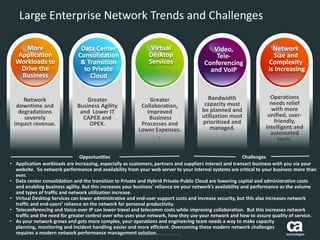
Network downtime and degradations severely 
impact revenue. 
More Application Workloads to Drive the Business 
Greater Business Agility and Lower IT CAPEX and OPEX. 
Data Center Consolidation & Transition to Private Cloud 
Greater Collaboration, Improved 
Business Processes and Lower Expenses. 
. 
Virtual Desktop 
Services 
Bandwidth capacity must be planned and utilization must prioritized and managed. 
Operations needs relief with more unified, user- friendly, intelligent and automated tools. 
Video, 
Tele- Conferencing and VoIP 
Large Enterprise Network Trends and Challenges 
Network 
Size and Complexity 
is Increasing 
Opportunities 
Challenges•Application workloads are increasing, especially as customers, partners and suppliers interact and transact business with youvia your website. So network performance and availability from your web server to your internal systems are critical to your business more than ever. •Data center consolidation and the transition to Private and Hybrid Private-Public Cloud are lowering capital and administrative costs and enabling business agility. But this increases your business’ reliance on your network’s availability and performance as the volume and types of traffic and network utilization increase. •Virtual Desktop Services can lower administrative and end-user support costs and increase security, but this also increases network traffic and end-users’ reliance on the network for personal productivity. •Teleconferencing and Voice-over IP can lower travel and telecomm costs while improving collaboration. But this increases network traffic and the need for greater control over who uses your network, how they use your network and how to assure quality of service. •As your network grows and gets more complex, your operations and engineering team needs a way to make capacity planning, monitoring and incident handling easier and more efficient. Overcoming these modern network challenges requires a modern network performance management solution.
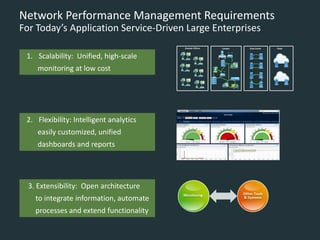
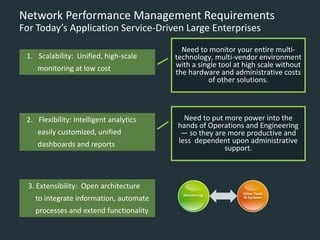
Network Performance Management Requirements For Today’s Application Service-Driven Large Enterprises 
1.Scalability: Unified, high-scale 
monitoring at low cost 
2.Flexibility: Intelligent analytics 
easily customized, unified 
dashboards and reports 
3. Extensibility: Open architecture 
to integrate information, automate 
processes and extend functionality
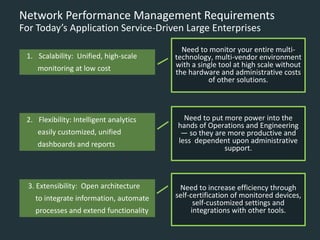
Network Performance Management Requirements For Today’s Application Service-Driven Large Enterprises 
1.Scalability: Unified, high-scale 
monitoring at low cost 
2.Flexibility: Intelligent analytics 
easily customized, unified 
dashboards and reports 
3. Extensibility: Open architecture 
to integrate information, automate 
processes and extend functionality 
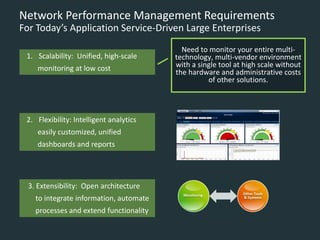
Need to monitor your entire multi- technology, multi-vendor environment with a single tool at high scale without the hardware and administrative costs of other solutions.
Network Performance Management Requirements For Today’s Application Service-Driven Large Enterprises 
1.Scalability: Unified, high-scale 
monitoring at low cost 
2.Flexibility: Intelligent analytics 
easily customized, unified 
dashboards and reports 
3. Extensibility: Open architecture 
to integrate information, automate 
processes and extend functionality 
Need to put more power into the hands of Operations and Engineering —so they are more productive and less dependent upon administrative support. 
Need to monitor your entire multi- technology, multi-vendor environment with a single tool at high scale without the hardware and administrative costs of other solutions.
Network Performance Management Requirements For Today’s Application Service-Driven Large Enterprises 
1.Scalability: Unified, high-scale 
monitoring at low cost 
2.Flexibility: Intelligent analytics 
easily customized, unified 
dashboards and reports 
3. Extensibility: Open architecture 
to integrate information, automate 
processes and extend functionality 
Need to put more power into the hands of Operations and Engineering —so they are more productive and less dependent upon administrative support. 
Need to monitor your entire multi- technology, multi-vendor environment with a single tool at high scale without the hardware and administrative costs of other solutions. 
Need to increase efficiency through self-certification of monitored devices, self-customized settings and integrations with other tools.
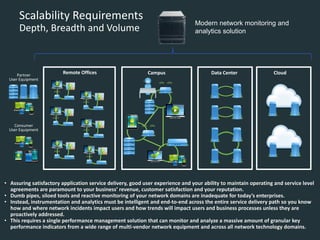
Cloud 
CR 
Consumer 
User Equipment 
Partner 
User Equipment 
Remote Offices 
MW 
Scalability RequirementsDepth, Breadth and Volume 
Data Center 
Campus 
Modern network monitoring and 
analytics solution•Assuring satisfactory application service delivery, good user experience and your ability to maintain operating and service level agreements are paramount to your business’ revenue, customer satisfaction and your reputation. •Dumb pipes, siloed tools and reactive monitoring of your network domains are inadequate for today’s enterprises. •Instead, instrumentation and analytics must be intelligent and end-to-end across the entire service delivery path so you know how and where network incidents impact users and how trends will impact users and business processes unless they are proactively addressed. •This requires a single performance management solution that can monitor and analyze a massive amount of granular key performance indicators from a wide range of multi-vendor network equipment and across all network technology domains.
8 
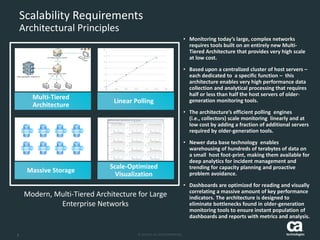
Scalability Requirements 
Architectural Principles 
Multi-Tiered 
Architecture 
Linear Polling 
Massive Storage 
Scale-Optimized 
Visualization 
HTTP 8581 
TCP 5433 
TCP 61616 
HTTP 8181 
Data Aggregator (DA) 
CA Performance Center 
Data Collectors (DC) 
... ... 
Client 
Data Aggregator Repository 
• Monitoring today’s large, complex networks 
requires tools built on an entirely new Multi- 
Tiered Architecture that provides very high scale 
at low cost. 
• Based upon a centralized cluster of host servers – 
each dedicated to a specific function – this 
architecture enables very high performance data 
collection and analytical processing that requires 
half or less than half the host servers of older-generation 
monitoring tools. 
• The architecture’s efficient polling engines 
(i.e., collectors) scale monitoring linearly and at 
low cost by adding a fraction of additional servers 
required by older-generation tools. 
• Newer data base technology enables 
warehousing of hundreds of terabytes of data on 
a small host foot-print, making them available for 
deep analytics for incident management and 
trending for capacity planning and proactive 
problem avoidance. 
• Dashboards are optimized for reading and visually 
correlating a massive amount of key performance 
indicators. The architecture is designed to 
eliminate bottlenecks found in older-generation 
monitoring tools to ensure instant population of 
dashboards and reports with metrics and analysis. 
Modern, Multi-Tiered Architecture for Large 
Enterprise Networks
Scalability Requirements 
Economical Architecture 
Multi-Tiered 
Architecture 
Linear Polling 
Massive Storage 
Scale-Optimized 
Visualization 
HTTP 8581 
TCP 5433 
TCP 61616 
HTTP 8181 
Data Aggregator (DA) 
CA Performance Center 
Data Collectors (DC) 
... ... 
Client 
Data Aggregator Repository 
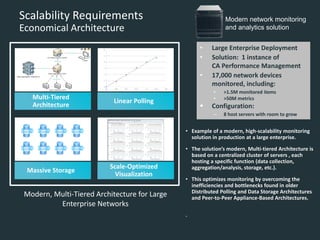
• Large Enterprise Deployment 
• Solution: 1 instance of 
CA Performance Management 
• 17,000 network devices 
monitored, including: 
• >1.5M monitored items 
• >50M metrics 
 Configuration: 
– 8 host servers with room to grow 
Modern network monitoring 
and analytics solution 
• Example of a modern, high-scalability monitoring 
solution in production at a large enterprise. 
• The solution’s modern, Multi-tiered Architecture is 
based on a centralized cluster of servers , each 
hosting a specific function (data collection, 
aggregation/analysis, storage, etc.). 
• This optimizes monitoring by overcoming the 
inefficiencies and bottlenecks found in older 
Distributed Polling and Data Storage Architectures 
and Peer-to-Peer Appliance-Based Architectures. 
. 
Modern, Multi-Tiered Architecture for Large 
Enterprise Networks
10 
Case StudyGlobal Enterprise with Offices across 130 Countries 
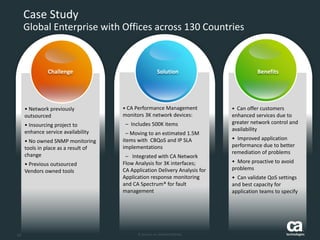
• Network previously outsourced 
• Insourcing project to enhance service availability 
• No owned SNMP monitoring tools in place as a result of change 
• Previous outsourced Vendors owned tools 
Solution 
• Can offer customers enhanced services due to greater network control and availability 
• Improved application performance due to better remediation of problems 
• More proactive to avoid problems 
• Can validate QoS settings and best capacity for application teams to specify 
Challenge 
Benefits 
• CA Performance Management monitors 3K network devices: 
–Includes 500K items 
–Moving to an estimated 1.5M items with CBQoS and IP SLA implementations 
–Integrated with CA Network Flow Analysis for 3K interfaces; CA Application Delivery Analysis for Application response monitoring and CA Spectrum® for fault management 
Solution
11 
Case StudyNationwide Enterprise with 9,000 Locations 
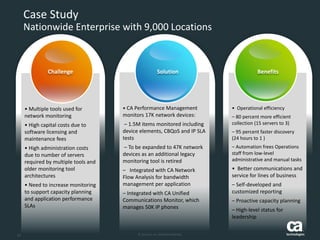
• Multiple tools used for network monitoring 
• High capital costs due to software licensing and maintenance fees 
• High administration costs due to number of servers required by multiple tools and older monitoring tool architectures 
• Need to increase monitoring to support capacity planning and application performance SLAs 
Solution 
• Operational efficiency 
–80percent more efficient collection (15 servers to 3) 
–95percent faster discovery (24 hours to 1 ) 
–Automation frees Operations staff from low-level administrative and manual tasks 
• Better communications and service for lines of business 
–Self-developed and customized reporting 
–Proactive capacity planning 
–High-level status for leadership 
Challenge 
Benefits 
• CA Performance Management monitors 17K network devices: 
–1.5M items monitored including device elements, CBQoS and IP SLA tests 
–To be expanded to 47K network devices as an additional legacy monitoring tool is retired 
–Integrated with CA Network Flow Analysis for bandwidth management per application 
–Integrated with CA Unified Communications Monitor, which manages 50K IP phones 
Solution
12 
Case StudyRegional Enterprise With 200 Locations 
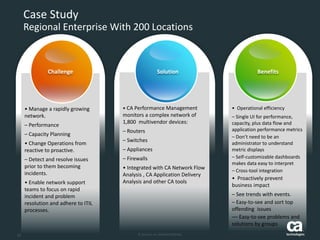
• Manage a rapidly growing network. 
–Performance 
–Capacity Planning 
• Change Operations from reactive to proactive. 
–Detect and resolve issues prior to them becoming incidents. 
• Enable network support teams to focus on rapid incident and problem resolution and adhere to ITIL processes. 
Solution 
• Operational efficiency 
–Single UI for performance, capacity, plus data flow and application performance metrics 
–Don’t need to be an administrator to understand metric displays 
–Self-customizable dashboards makes data easy to interpret 
–Cross-tool integration 
• Proactively prevent business impact 
–See trends with events. 
–Easy-to-see and sort top offending issues 
––Easy-to-see problems and solutions by groups 
Challenge 
Benefits 
• CA Performance Management monitors a complex network of 1,800 multivendor devices: 
–Routers 
–Switches 
–Appliances 
–Firewalls 
• Integrated with CA Network Flow Analysis , CA Application Delivery Analysis and other CA tools 
Solution
For more information, see 
CA Performance Management at 
www.ca.com 
CA Performance Management is a big data 
collection, warehousing and analytics 
solution that helps enterprises maximize 
return on their network infrastructure 
investments and lower the cost of network 
operations.
14 
For Informational Purposes Only 
Terms of this Presentation 
This presentation was based on current information and resource allocations as of August 2014 and is subject to change or withdrawal by CA at any time without notice. Not withstanding anything in this presentation to the contrary, this presentation shall not serve to (i) affect the rights and/or obligations of CA or its licensees under any existing or future written license agreement or services agreement relating to any CA software product; or (ii) amend any product documentation or specifications for any CA software product. The development, release and timing of any features or functionality described in this presentation remain at CA’s sole discretion. Notwithstanding anything in this presentation to the contrary, upon the general availability of any future CA product release referenced in this presentation, CA will make such release available (i) for sale to new licensees of such product; and (ii) to existing licensees of such product on a when and if-available basis as part of CA maintenance and support, and in the form of a regularly scheduled major product release. Such releases may be made available to current licensees of such product who are current subscribers to CA maintenance and support on a when and if-available basis.In the event of a conflict between the terms of this paragraph and any other information contained in this presentation, the terms of this paragraph shall govern. 
Certain information in this presentation may outline CA’s general product direction. All information in this presentation is for your informational purposes only and may not be incorporated into any contract. CA assumes no responsibility for the accuracy or completeness of the information. To the extent permitted by applicable law, CA provides this presentation “as is” without warranty of any kind, including without limitation, any implied warranties or merchantability, fitness for a particular purpose, or non-infringement. In no event will CA be liable for any loss or damage, direct or indirect, from the use of this document, including, without limitation, lost profits, lost investment, business interruption, goodwill, or lost data, even if CA is expressly advised in advance of the possibility of such damages. CA confidential and proprietary. No unauthorized copying or distribution permitted. 
Copyright © 2014 CA. All rights reserved. All trademarks, trade names, service marks and logos referenced herein belongto their respective companies. CA confidential and proprietary. No unauthorized copying or distribution permitted.

High Scalability Network Performance Management for Enterprises

  • 1.
    High Scalability NetworkPerformance Management for Enterprises CA Performance Management’s Modern, Multi-Tiered Architecture David Hayward Senior Principal Manager CA Technologies December 2014 Copyright © 2014 CA. All rights reserved. All trademarks, trade names, service marks and logos referenced herein belong to their respective companies.
  • 2.
    2 Network downtimeand degradations severely impact revenue. More Application Workloads to Drive the Business Greater Business Agility and Lower IT CAPEX and OPEX. Data Center Consolidation & Transition to Private Cloud Greater Collaboration, Improved Business Processes and Lower Expenses. . Virtual Desktop Services Bandwidth capacity must be planned and utilization must prioritized and managed. Operations needs relief with more unified, user- friendly, intelligent and automated tools. Video, Tele- Conferencing and VoIP Large Enterprise Network Trends and Challenges Network Size and Complexity is Increasing Opportunities Challenges•Application workloads are increasing, especially as customers, partners and suppliers interact and transact business with youvia your website. So network performance and availability from your web server to your internal systems are critical to your business more than ever. •Data center consolidation and the transition to Private and Hybrid Private-Public Cloud are lowering capital and administrative costs and enabling business agility. But this increases your business’ reliance on your network’s availability and performance as the volume and types of traffic and network utilization increase. •Virtual Desktop Services can lower administrative and end-user support costs and increase security, but this also increases network traffic and end-users’ reliance on the network for personal productivity. •Teleconferencing and Voice-over IP can lower travel and telecomm costs while improving collaboration. But this increases network traffic and the need for greater control over who uses your network, how they use your network and how to assure quality of service. •As your network grows and gets more complex, your operations and engineering team needs a way to make capacity planning, monitoring and incident handling easier and more efficient. Overcoming these modern network challenges requires a modern network performance management solution.
  • 3.
    Network Performance ManagementRequirements For Today’s Application Service-Driven Large Enterprises 1.Scalability: Unified, high-scale monitoring at low cost 2.Flexibility: Intelligent analytics easily customized, unified dashboards and reports 3. Extensibility: Open architecture to integrate information, automate processes and extend functionality
  • 4.
    Network Performance ManagementRequirements For Today’s Application Service-Driven Large Enterprises 1.Scalability: Unified, high-scale monitoring at low cost 2.Flexibility: Intelligent analytics easily customized, unified dashboards and reports 3. Extensibility: Open architecture to integrate information, automate processes and extend functionality Need to monitor your entire multi- technology, multi-vendor environment with a single tool at high scale without the hardware and administrative costs of other solutions.
  • 5.
    Network Performance ManagementRequirements For Today’s Application Service-Driven Large Enterprises 1.Scalability: Unified, high-scale monitoring at low cost 2.Flexibility: Intelligent analytics easily customized, unified dashboards and reports 3. Extensibility: Open architecture to integrate information, automate processes and extend functionality Need to put more power into the hands of Operations and Engineering —so they are more productive and less dependent upon administrative support. Need to monitor your entire multi- technology, multi-vendor environment with a single tool at high scale without the hardware and administrative costs of other solutions.
  • 6.
    Network Performance ManagementRequirements For Today’s Application Service-Driven Large Enterprises 1.Scalability: Unified, high-scale monitoring at low cost 2.Flexibility: Intelligent analytics easily customized, unified dashboards and reports 3. Extensibility: Open architecture to integrate information, automate processes and extend functionality Need to put more power into the hands of Operations and Engineering —so they are more productive and less dependent upon administrative support. Need to monitor your entire multi- technology, multi-vendor environment with a single tool at high scale without the hardware and administrative costs of other solutions. Need to increase efficiency through self-certification of monitored devices, self-customized settings and integrations with other tools.
  • 7.
    Cloud CR Consumer User Equipment Partner User Equipment Remote Offices MW Scalability RequirementsDepth, Breadth and Volume Data Center Campus Modern network monitoring and analytics solution•Assuring satisfactory application service delivery, good user experience and your ability to maintain operating and service level agreements are paramount to your business’ revenue, customer satisfaction and your reputation. •Dumb pipes, siloed tools and reactive monitoring of your network domains are inadequate for today’s enterprises. •Instead, instrumentation and analytics must be intelligent and end-to-end across the entire service delivery path so you know how and where network incidents impact users and how trends will impact users and business processes unless they are proactively addressed. •This requires a single performance management solution that can monitor and analyze a massive amount of granular key performance indicators from a wide range of multi-vendor network equipment and across all network technology domains.
  • 8.
    8 Scalability Requirements Architectural Principles Multi-Tiered Architecture Linear Polling Massive Storage Scale-Optimized Visualization HTTP 8581 TCP 5433 TCP 61616 HTTP 8181 Data Aggregator (DA) CA Performance Center Data Collectors (DC) ... ... Client Data Aggregator Repository • Monitoring today’s large, complex networks requires tools built on an entirely new Multi- Tiered Architecture that provides very high scale at low cost. • Based upon a centralized cluster of host servers – each dedicated to a specific function – this architecture enables very high performance data collection and analytical processing that requires half or less than half the host servers of older-generation monitoring tools. • The architecture’s efficient polling engines (i.e., collectors) scale monitoring linearly and at low cost by adding a fraction of additional servers required by older-generation tools. • Newer data base technology enables warehousing of hundreds of terabytes of data on a small host foot-print, making them available for deep analytics for incident management and trending for capacity planning and proactive problem avoidance. • Dashboards are optimized for reading and visually correlating a massive amount of key performance indicators. The architecture is designed to eliminate bottlenecks found in older-generation monitoring tools to ensure instant population of dashboards and reports with metrics and analysis. Modern, Multi-Tiered Architecture for Large Enterprise Networks
  • 9.
    Scalability Requirements EconomicalArchitecture Multi-Tiered Architecture Linear Polling Massive Storage Scale-Optimized Visualization HTTP 8581 TCP 5433 TCP 61616 HTTP 8181 Data Aggregator (DA) CA Performance Center Data Collectors (DC) ... ... Client Data Aggregator Repository • Large Enterprise Deployment • Solution: 1 instance of CA Performance Management • 17,000 network devices monitored, including: • >1.5M monitored items • >50M metrics  Configuration: – 8 host servers with room to grow Modern network monitoring and analytics solution • Example of a modern, high-scalability monitoring solution in production at a large enterprise. • The solution’s modern, Multi-tiered Architecture is based on a centralized cluster of servers , each hosting a specific function (data collection, aggregation/analysis, storage, etc.). • This optimizes monitoring by overcoming the inefficiencies and bottlenecks found in older Distributed Polling and Data Storage Architectures and Peer-to-Peer Appliance-Based Architectures. . Modern, Multi-Tiered Architecture for Large Enterprise Networks
  • 10.
    10 Case StudyGlobalEnterprise with Offices across 130 Countries • Network previously outsourced • Insourcing project to enhance service availability • No owned SNMP monitoring tools in place as a result of change • Previous outsourced Vendors owned tools Solution • Can offer customers enhanced services due to greater network control and availability • Improved application performance due to better remediation of problems • More proactive to avoid problems • Can validate QoS settings and best capacity for application teams to specify Challenge Benefits • CA Performance Management monitors 3K network devices: –Includes 500K items –Moving to an estimated 1.5M items with CBQoS and IP SLA implementations –Integrated with CA Network Flow Analysis for 3K interfaces; CA Application Delivery Analysis for Application response monitoring and CA Spectrum® for fault management Solution
  • 11.
    11 Case StudyNationwideEnterprise with 9,000 Locations • Multiple tools used for network monitoring • High capital costs due to software licensing and maintenance fees • High administration costs due to number of servers required by multiple tools and older monitoring tool architectures • Need to increase monitoring to support capacity planning and application performance SLAs Solution • Operational efficiency –80percent more efficient collection (15 servers to 3) –95percent faster discovery (24 hours to 1 ) –Automation frees Operations staff from low-level administrative and manual tasks • Better communications and service for lines of business –Self-developed and customized reporting –Proactive capacity planning –High-level status for leadership Challenge Benefits • CA Performance Management monitors 17K network devices: –1.5M items monitored including device elements, CBQoS and IP SLA tests –To be expanded to 47K network devices as an additional legacy monitoring tool is retired –Integrated with CA Network Flow Analysis for bandwidth management per application –Integrated with CA Unified Communications Monitor, which manages 50K IP phones Solution
  • 12.
    12 Case StudyRegionalEnterprise With 200 Locations • Manage a rapidly growing network. –Performance –Capacity Planning • Change Operations from reactive to proactive. –Detect and resolve issues prior to them becoming incidents. • Enable network support teams to focus on rapid incident and problem resolution and adhere to ITIL processes. Solution • Operational efficiency –Single UI for performance, capacity, plus data flow and application performance metrics –Don’t need to be an administrator to understand metric displays –Self-customizable dashboards makes data easy to interpret –Cross-tool integration • Proactively prevent business impact –See trends with events. –Easy-to-see and sort top offending issues ––Easy-to-see problems and solutions by groups Challenge Benefits • CA Performance Management monitors a complex network of 1,800 multivendor devices: –Routers –Switches –Appliances –Firewalls • Integrated with CA Network Flow Analysis , CA Application Delivery Analysis and other CA tools Solution
  • 13.
    For more information,see CA Performance Management at www.ca.com CA Performance Management is a big data collection, warehousing and analytics solution that helps enterprises maximize return on their network infrastructure investments and lower the cost of network operations.
  • 14.
    14 For InformationalPurposes Only Terms of this Presentation This presentation was based on current information and resource allocations as of August 2014 and is subject to change or withdrawal by CA at any time without notice. Not withstanding anything in this presentation to the contrary, this presentation shall not serve to (i) affect the rights and/or obligations of CA or its licensees under any existing or future written license agreement or services agreement relating to any CA software product; or (ii) amend any product documentation or specifications for any CA software product. The development, release and timing of any features or functionality described in this presentation remain at CA’s sole discretion. Notwithstanding anything in this presentation to the contrary, upon the general availability of any future CA product release referenced in this presentation, CA will make such release available (i) for sale to new licensees of such product; and (ii) to existing licensees of such product on a when and if-available basis as part of CA maintenance and support, and in the form of a regularly scheduled major product release. Such releases may be made available to current licensees of such product who are current subscribers to CA maintenance and support on a when and if-available basis.In the event of a conflict between the terms of this paragraph and any other information contained in this presentation, the terms of this paragraph shall govern. Certain information in this presentation may outline CA’s general product direction. All information in this presentation is for your informational purposes only and may not be incorporated into any contract. CA assumes no responsibility for the accuracy or completeness of the information. To the extent permitted by applicable law, CA provides this presentation “as is” without warranty of any kind, including without limitation, any implied warranties or merchantability, fitness for a particular purpose, or non-infringement. In no event will CA be liable for any loss or damage, direct or indirect, from the use of this document, including, without limitation, lost profits, lost investment, business interruption, goodwill, or lost data, even if CA is expressly advised in advance of the possibility of such damages. CA confidential and proprietary. No unauthorized copying or distribution permitted. Copyright © 2014 CA. All rights reserved. All trademarks, trade names, service marks and logos referenced herein belongto their respective companies. CA confidential and proprietary. No unauthorized copying or distribution permitted.