HPE Service Virtualization
3.8 CFD
Speaker name and title
Month day, year
Agenda
– A changing world demands service virtualization
– Understanding service virtualization
– HPE Service Virtualization Distinctions and ver3.8 highlights
– How to Successfully Implement Service Virtualization
– Customer Reference Stories
Changing world demands service
virtualization
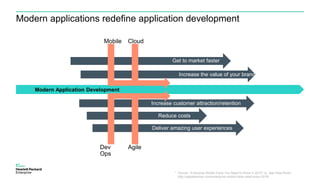
Deliver amazing user experiences
Modern Application Development
Reduce costs
Increase customer attraction/retention
Increase the value of your brand
Get to market faster
* Source: “Enterprise Mobile Facts You Need to Know in 2015” by App Data Room.
http://appdataroom.com/enterprise-mobile-facts-need-know-2015/
Modern applications redefine application development
Mobile Cloud
Dev
Ops
Agile
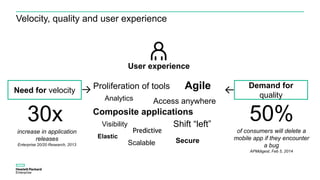
Velocity, quality and user experience
of consumers will delete a
mobile app if they encounter
a bug
APMdigest, Feb 5, 2014
30x
Access anywhere
Composite applications
Analytics
Proliferation of tools
Shift “left”Visibility
Predictive
Elastic
SecureScalable
Agile
User experience
Demand for
quality
Need for velocity
increase in application
releases
Enterprise 20/20 Research, 2013
50%
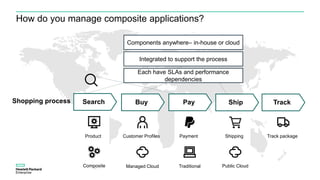
How do you manage composite applications?
Traditional Public Cloud
Track packagePayment
Composite
Product Customer Profiles Shipping
Managed Cloud
Shopping process Search Buy Pay Ship Track
Integrated to support the process
Each have SLAs and performance
dependencies
Components anywhere– in-house or cloud
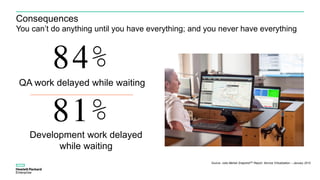
Consequences
You can’t do anything until you have everything; and you never have everything
84%
QA work delayed while waiting
81%
Development work delayed
while waiting
Source: voke Market SnapshotTM Report: Service Virtualization – January 2015
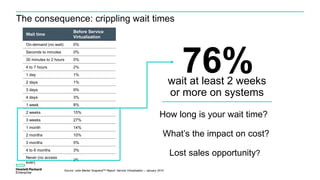
Wait time
Before Service
Virtualization
On-demand (no wait) 0%
Seconds to minutes 0%
30 minutes to 2 hours 0%
4 to 7 hours 2%
1 day 1%
2 days 1%
3 days 9%
4 days 3%
1 week 8%
2 weeks 15%
3 weeks 27%
1 month 14%
2 months 10%
3 months 5%
4 to 6 months 3%
Never (no access
ever)
2%
Source: voke Market SnapshotTM Report: Service Virtualization – January 2015
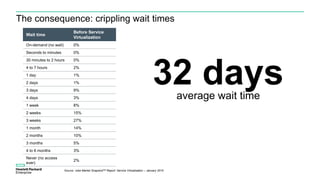
The consequence: crippling wait times
76%wait at least 2 weeks
or more on systems
How long is your wait time?
What’s the impact on cost?
Lost sales opportunity?
Wait time
Before Service
Virtualization
On-demand (no wait) 0%
Seconds to minutes 0%
30 minutes to 2 hours 0%
4 to 7 hours 2%
1 day 1%
2 days 1%
3 days 9%
4 days 3%
1 week 8%
2 weeks 15%
3 weeks 27%
1 month 14%
2 months 10%
3 months 5%
4 to 6 months 3%
Never (no access
ever)
2%
Source: voke Market SnapshotTM Report: Service Virtualization – January 2015
The consequence: crippling wait times
32 daysaverage wait time
The solution?
...Service Virtualization technology
Wait time
Before Service
Virtualization
After Service
Virtualization
On-demand (no wait) 0% 27%
Seconds to minutes 0% 14%
30 minutes to 2 hours 0% 10%
4 to 7 hours 2% 17%
1 day 1% 11%
2 days 1% 10%
3 days 9% 8%
4 days 3% 1%
1 week 8% 1%
2 weeks 15% 1%
3 weeks 27% 0%
1 month 14% 0%
2 months 10% 0%
3 months 5% 0%
4 to 6 months 3% 0%
Never (no access
ever)
2% 0%
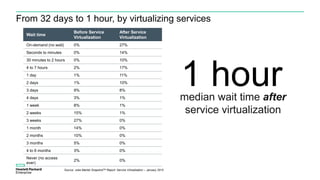
From 32 days to 1 hour, by virtualizing services
1 hourmedian wait time after
service virtualization
Source: voke Market SnapshotTM Report: Service Virtualization – January 2015
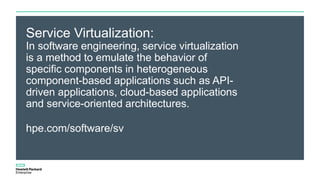
Service Virtualization:
In software engineering, service virtualization
is a method to emulate the behavior of
specific components in heterogeneous
component-based applications such as API-
driven applications, cloud-based applications
and service-oriented architectures.
hpe.com/software/sv
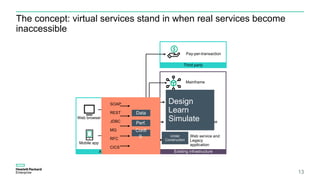
The concept: virtual services stand in when real services become
inaccessible
13
Third party
Pay-per-transaction
Web browser
Mobile app
Application under test
Composite
application
API
Existing infrastructure
Under
Construction
Mainframe
SAP system
Existing database
Web service and
Legacy
application
SOAP
REST
JDBC
MQ
RFC
CICS
Data
Perf.
Confi
g.
Design
Learn
Simulate
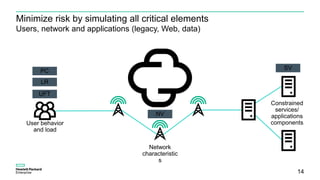
Minimize risk by simulating all critical elements
Users, network and applications (legacy, Web, data)
14
User behavior
and load
Constrained
services/
applications
components
SV
NV
Network
characteristic
s
UFT
LR
PC
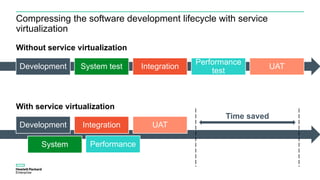
Compressing the software development lifecycle with service
virtualization
Without service virtualization
With service virtualization
Development System test Integration
Performance
test
UAT
Development
System
Integration
Performance
UAT
Time saved
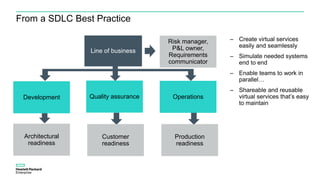
From a SDLC Best Practice
Line of business
Development Quality assurance Operations
Architectural
readiness
Customer
readiness
Production
readiness
Risk manager,
P&L owner,
Requirements
communicator
– Create virtual services
easily and seamlessly
– Simulate needed systems
end to end
– Enable teams to work in
parallel…
– Shareable and reusable
virtual services that’s easy
to maintain
Trends & Shift in Service
Virtualization Adoption
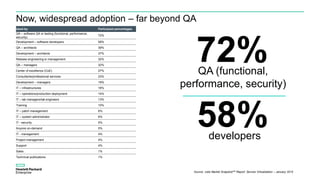
Used by Participant percentages
QA – software QA or testing (functional, performance,
security)
72%
Development – software developers 58%
QA – architects 39%
Development – architects 37%
Release engineering or management 32%
QA – managers 32%
Center of excellence (CoE) 27%
Consultants/professional services 23%
Development – managers 19%
IT – infrastructures 16%
IT – operations/production deployment 14%
IT – lab managers/lab engineers 13%
Training 10%
IT – patch management 6%
IT – system administrator 6%
IT - security 5%
Anyone on-demand 5%
IT - management 4%
Project management 4%
Support 4%
Sales 1%
Technical publications 1%
72%QA (functional,
performance, security)
58%developers
Source: voke Market SnapshotTM Report: Service Virtualization – January 2015
Now, widespread adoption – far beyond QA
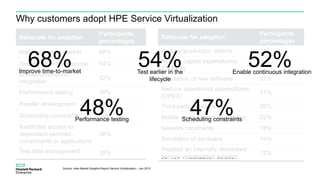
Why customers adopt HPE Service Virtualization
Rationale for adoption
Participants
percentages
Improve time-to-market 68%
Test earlier in the lifecycle 54%
Enable continuous
integration
52%
Performance testing 48%
Parallel development 47%
Scheduling constraints 40%
Restricted access to
dependent services,
components or applications
38%
Test data management 35%
Source: voke Market Snaphot Report Service Virtualization – Jan 2015
Rationale for adoption
Participants
percentages
Reduce production defects 34%
Reduce capital expenditures
(CAPEX)
32%
Simulation of new software 31%
Reduce operational expenditures
(OPEX)
31%
Third-party access fees 28%
Mobile development and testing 22%
Network constraints 18%
Simulation of hardware 14%
Replace an internally developed
service virtualization solution
12%
68%Improve time-to-market
54%Test earlier in the
lifecycle
52%Enable continuous integration
47%Scheduling constraints
48%Performance testing
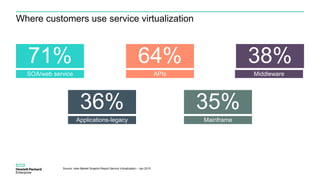
Where customers use service virtualization
Source: voke Market Snaphot Report Service Virtualization – Jan 2015
71%
SOA/web service
64%
APIs
38%
Middleware
36%
Applications-legacy
35%
Mainframe
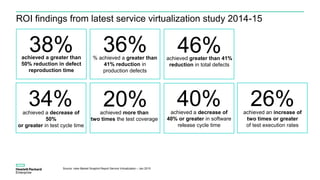
ROI findings from latest service virtualization study 2014-15
Source: voke Market Snaphot Report Service Virtualization – Jan 2015
38%achieved a greater than
50% reduction in defect
reproduction time
36%% achieved a greater than
41% reduction in
production defects
46%achieved greater than 41%
reduction in total defects
34%achieved a decrease of
50%
or greater in test cycle time
20%achieved more than
two times the test coverage
40%achieved a decrease of
40% or greater in software
release cycle time
26%achieved an increase of
two times or greater
of test execution rates
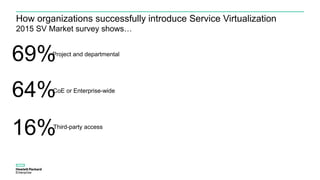
How organizations successfully introduce Service Virtualization
2015 SV Market survey shows…
69%Project and departmental
64%CoE or Enterprise-wide
16%Third-party access
HPE Service Virtualization v3.8
Key Highlights
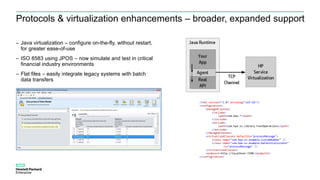
Protocols & virtualization enhancements – broader, expanded support
– Java virtualization – configure on-the-fly, without restart,
for greater ease-of-use
– ISO 8583 using JPOS – now simulate and test in critical
financial industry environments
– Flat files – easily integrate legacy systems with batch
data transfers
<?xml version="1.0" encoding="utf-16"?>
<configuration>
<managedClasses>
<include>
<path>com.hpe.*</path>
</include>
<exclude>
<path>com.hpe.sv.library.FastOperations</path>
</exclude>
</managedClasses>
<virtualizedClasses defaultVs="processMessage">
<class name="com.hpe.sv.example.CustomNumber" />
<class name="com.hpe.sv.example.DefaultCalculator"
vs="processMessage" />
</virtualizedClasses>
<endpoint>http://localhost:7290</endpoint>
</configuration>
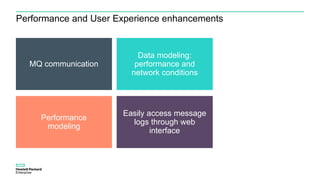
Performance and User Experience enhancements
MQ communication
Data modeling:
performance and
network conditions
Performance
modeling
Easily access message
logs through web
interface
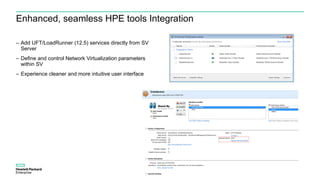
Enhanced, seamless HPE tools Integration
– Add UFT/LoadRunner (12.5) services directly from SV
Server
– Define and control Network Virtualization parameters
within SV
– Experience cleaner and more intuitive user interface
Simpler trial and training
– Easier to
– Download
– Evaluate
– Learn
– Extended term for free trial and download
– New SV ART Training available
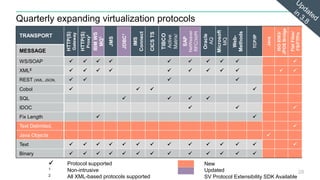
Quarterly expanding virtualization protocols
28
TRANSPORT
HTTP(S)
Gateway
HTTP(S)
Proxy1
IBMWS
MQ1
JMS
JDBC1
IMS
Connect
CICSTS
TIBCO
Active
Matrix/
SAP
NetWeaver
RFC/XI/PI
Oracle
AQ
Microsoft
MQ
Web-
Methods
TCP/IP
Java
ISO8583/
JPOSBridge
FlatFiles/
FS/FTP/s
MESSAGE
WS/SOAP          
XML2           
REST (XML, JSON,    
Cobol    
SQL    
IDOC   
Fix Length  
Text Delimited, 
Java Objects 
Text              
Binary             
 Protocol supported
1 Non-intrusive
2 All XML-based protocols supported
New
Updated
SV Protocol Extensibility SDK Available
HPE Service Virtualization
Key Distinctions
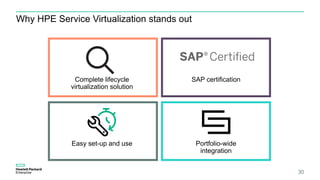
Why HPE Service Virtualization stands out
30
Complete lifecycle
virtualization solution
Easy set-up and use
SAP certification
Portfolio-wide
integration
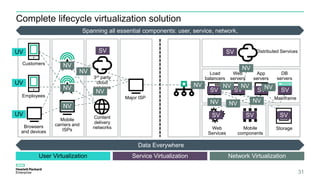
Complete lifecycle virtualization solution
31
Spanning all essential components: user, service, network,
data
Customers
Employees
Browsers
and devices
Mobile
carriers and
ISPs
3rd party
cloud
services
Content
delivery
networks
Major ISP
Distributed Services
Load
balancers
Web
servers
App
servers
DB
servers
Mainframe
StorageMobile
components
Web
Services
Service VirtualizationUser Virtualization Network Virtualization
UV
UV
UV
SV SV
SV SV SV SV
SV SV SV
NV
NV
NV
NV
NV
NV
NV NV NV
NV NV NV
NV
Data Everywhere
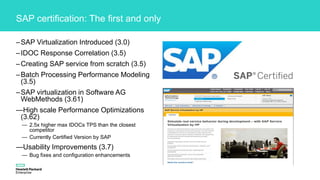
SAP certification: The first and only
–SAP Virtualization Introduced (3.0)
–IDOC Response Correlation (3.5)
–Creating SAP service from scratch (3.5)
–Batch Processing Performance Modeling
(3.5)
–SAP virtualization in Software AG
WebMethods (3.61)
—High scale Performance Optimizations
(3.62)
— 2.5x higher max IDOCs TPS than the closest
competitor
— Currently Certified Version by SAP
—Usability Improvements (3.7)
— Bug fixes and configuration enhancements
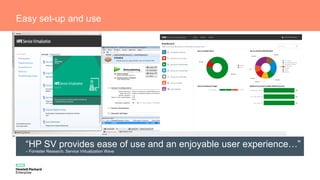
Easy set-up and use
“HP SV provides ease of use and an enjoyable user experience…”
– Forrester Research, Service Virtualization Wave
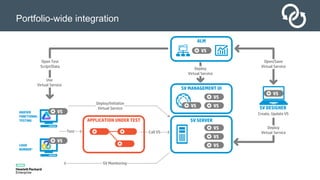
Portfolio-wide integration
LOAD
RUNNER*
SV SERVER
VS
SV MANAGEMENT UI
VS
Deploy
Virtual Service
Open/Save
Virtual Service
UNIFIED
FUNCTIONAL
TESTING
VS
Deploy
Virtual Service
SV DESIGNER
VS
Create, Update VS
APPLICATION UNDER TEST
SV Monitoring
Deploy/Initialize
Virtual Service
VS
Use
Virtual Service
Open Test
Script/Data
Test Call VS
VS
VS
VS
VS
ALM
VS
HPE Service Virtualization
Customer References
HPE Service Virtualization software customer review
“The benefits are too good not to consider.”
– IT Architect, Fortune 500 electronics company
“We shortened test cycles by 30-50%.”
– Marc Tuffreau, IT Professional, Sogeti
“Just getting started but already seeing a big benefit.”
– IT Architect, Global 500 industrial manufacturing company
“We shortened test cycles by more than 90%.”
– Enterprise telecommunication services company
“We see a big benefit in functional and regression testing”
– IT Architect, Global 500 industrial manufacturing company
“A clear and highly integrated solution.”
– Matthias Scholze, CEO, QMETHODS Business and IT Consulting GmbH
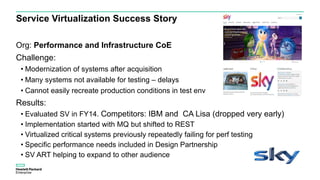
Service Virtualization Success Story
Org: Performance and Infrastructure CoE
Challenge:
• Modernization of systems after acquisition
• Many systems not available for testing – delays
• Cannot easily recreate production conditions in test env
Results:
• Evaluated SV in FY14. Competitors: IBM and CA Lisa (dropped very early)
• Implementation started with MQ but shifted to REST
• Virtualized critical systems previously repeatedly failing for perf testing
• Specific performance needs included in Design Partnership
• SV ART helping to expand to other audience
“We want to control our own
destiny and not rely on stubs
created by other departments
so we can adapt and change
faster.”
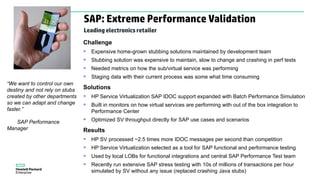
SAP Performance
Manager
Challenge
 Expensive home-grown stubbing solutions maintained by development team
 Stubbing solution was expensive to maintain, slow to change and crashing in perf tests
 Needed metrics on how the sub/virtual service was performing
 Staging data with their current process was some what time consuming
Solutions
 HP Service Virtualization SAP IDOC support expanded with Batch Performance Simulation
 Built in monitors on how virtual services are performing with out of the box integration to
Performance Center
 Optimized SV throughput directly for SAP use cases and scenarios
Results
 HP SV processed ~2.5 times more IDOC messages per second than competition
 HP Service Virtualization selected as a tool for SAP functional and performance testing
 Used by local LOBs for functional integrations and central SAP Performance Test team
 Recently run extensive SAP stress testing with 10s of millions of transactions per hour
simulated by SV without any issue (replaced crashing Java stubs)
SAP: Extreme Performance Validation
Leading electronics retailer
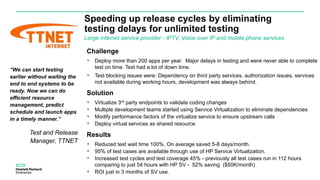
Challenge
 Deploy more than 200 apps per year. Major delays in testing and were never able to complete
test on time. Test had a lot of down time.
 Test blocking issues were: Dependency on third party services, authorization issues, services
not available during working hours, development was always behind.
Solution
 Virtualize 3rd party endpoints to validate coding changes
 Multiple development teams started using Service Virtualization to eliminate dependencies
 Modify performance factors of the virtualize service to ensure upstream calls
 Deploy virtual services as shared resource
Results
 Reduced test wait time 100%. On average saved 5-8 days/month.
 95% of test cases are available through use of HP Service Virtualization.
 Increased test cycles and test coverage 45% - previously all test cases run in 112 hours
comparing to just 54 hours with HP SV - 52% saving ($50K/month)
 ROI just in 3 months of SV use.
“We can start testing
earlier without waiting the
end to end systems to be
ready. Now we can do
efficient resource
management, predict
schedule and launch apps
in a timely manner.”
Test and Release
Manager, TTNET
Speeding up release cycles by eliminating
testing delays for unlimited testing
Large internet service provider - IPTV, Voice over IP and mobile phone services
Strong customer endorsement continues HP Internal only. Do not distribute
How to get started
– For latest market trends study, download service virtualization market snapshot report , also at
www.hpe.com/software/sv-voke
– For more on HPE SV product, refer HPE SV datasheet
– For free trial evaluation, download HPE SV Software Trial, or at www.hpe.com/software/svtrial
– Top recommended customer reference: GameStop HPE SV customer webcast and followup with
GameStop case study (indepth use cases, ROIs).
– For hpe sv demo and analyst perspectives, watch HPE SV & Voke on demand webcast
– For all other great resources, visit HPE SV page on http:// www.hpe.com/software/sv
Note:
Internal HPE SV Sales and Marketing Hub can be accessed at: https://irock.jiveon.com/docs/DOC-120747
Appendix/Backup Slides
DO NOT DISTRIBUTE- FOR INTERNAL
REFERENCE ONLY
HPE Internal Reference only!
Do not distribute.
T-Mobile USA : Leverage HPE Lifecycle Virtualization solutions for
Performance Engr & DevOps transformation
43
About the customer
Nation’s fastest 4G LTE network, serves ~61mil wireless customers, under T-
Mobile & MetroPCS brands. Current HPE SW customer & continue to invest in
our products. Most recent purchase: HPE NV and SV to complement its existing
use of CA Lisa tool.
Bus Goal: Pursues a strategy of continuous product & service innovation to
differentiate, keep ahead of competition. Requires almost daily releases of new
applications or new functionality in existing applications.
Challenge: Reduce app dev & design lifecycle time through continuous testing,
CI and engr. Struggled to deploy LISA for enterprise performance engineering
and SAP use cases
Solution: Use HPE SV and NV to virtualize services and network, identify
code/config & network bottlenecks in early stages of dev. Helped reduce app
dev & design lifecycle time.
Results: : Ability to deploy 60+ new or existing applications with code changes
on a daily basis.
• Reduced scripting for stubs by 40% compared to the other tools
• Further reduced time from 2days with Lisa to <5hours with HPE
solutions.
• Reduce time to certify apps by 30% (network and service virtualization)
• Increase system availability to 99.98% (performance engineering)

Hewlett Packard Enterprise (HPE) Service Virtualization (SV)

  • 1.
    HPE Service Virtualization 3.8CFD Speaker name and title Month day, year
  • 2.
    Agenda – A changingworld demands service virtualization – Understanding service virtualization – HPE Service Virtualization Distinctions and ver3.8 highlights – How to Successfully Implement Service Virtualization – Customer Reference Stories
  • 3.
    Changing world demandsservice virtualization
  • 4.
    Deliver amazing userexperiences Modern Application Development Reduce costs Increase customer attraction/retention Increase the value of your brand Get to market faster * Source: “Enterprise Mobile Facts You Need to Know in 2015” by App Data Room. http://appdataroom.com/enterprise-mobile-facts-need-know-2015/ Modern applications redefine application development Mobile Cloud Dev Ops Agile
  • 5.
    Velocity, quality anduser experience of consumers will delete a mobile app if they encounter a bug APMdigest, Feb 5, 2014 30x Access anywhere Composite applications Analytics Proliferation of tools Shift “left”Visibility Predictive Elastic SecureScalable Agile User experience Demand for quality Need for velocity increase in application releases Enterprise 20/20 Research, 2013 50%
  • 6.
    How do youmanage composite applications? Traditional Public Cloud Track packagePayment Composite Product Customer Profiles Shipping Managed Cloud Shopping process Search Buy Pay Ship Track Integrated to support the process Each have SLAs and performance dependencies Components anywhere– in-house or cloud
  • 7.
    Consequences You can’t doanything until you have everything; and you never have everything 84% QA work delayed while waiting 81% Development work delayed while waiting Source: voke Market SnapshotTM Report: Service Virtualization – January 2015
  • 8.
    Wait time Before Service Virtualization On-demand(no wait) 0% Seconds to minutes 0% 30 minutes to 2 hours 0% 4 to 7 hours 2% 1 day 1% 2 days 1% 3 days 9% 4 days 3% 1 week 8% 2 weeks 15% 3 weeks 27% 1 month 14% 2 months 10% 3 months 5% 4 to 6 months 3% Never (no access ever) 2% Source: voke Market SnapshotTM Report: Service Virtualization – January 2015 The consequence: crippling wait times 76%wait at least 2 weeks or more on systems How long is your wait time? What’s the impact on cost? Lost sales opportunity?
  • 9.
    Wait time Before Service Virtualization On-demand(no wait) 0% Seconds to minutes 0% 30 minutes to 2 hours 0% 4 to 7 hours 2% 1 day 1% 2 days 1% 3 days 9% 4 days 3% 1 week 8% 2 weeks 15% 3 weeks 27% 1 month 14% 2 months 10% 3 months 5% 4 to 6 months 3% Never (no access ever) 2% Source: voke Market SnapshotTM Report: Service Virtualization – January 2015 The consequence: crippling wait times 32 daysaverage wait time
  • 10.
  • 11.
    Wait time Before Service Virtualization AfterService Virtualization On-demand (no wait) 0% 27% Seconds to minutes 0% 14% 30 minutes to 2 hours 0% 10% 4 to 7 hours 2% 17% 1 day 1% 11% 2 days 1% 10% 3 days 9% 8% 4 days 3% 1% 1 week 8% 1% 2 weeks 15% 1% 3 weeks 27% 0% 1 month 14% 0% 2 months 10% 0% 3 months 5% 0% 4 to 6 months 3% 0% Never (no access ever) 2% 0% From 32 days to 1 hour, by virtualizing services 1 hourmedian wait time after service virtualization Source: voke Market SnapshotTM Report: Service Virtualization – January 2015
  • 12.
    Service Virtualization: In softwareengineering, service virtualization is a method to emulate the behavior of specific components in heterogeneous component-based applications such as API- driven applications, cloud-based applications and service-oriented architectures. hpe.com/software/sv
  • 13.
    The concept: virtualservices stand in when real services become inaccessible 13 Third party Pay-per-transaction Web browser Mobile app Application under test Composite application API Existing infrastructure Under Construction Mainframe SAP system Existing database Web service and Legacy application SOAP REST JDBC MQ RFC CICS Data Perf. Confi g. Design Learn Simulate
  • 14.
    Minimize risk bysimulating all critical elements Users, network and applications (legacy, Web, data) 14 User behavior and load Constrained services/ applications components SV NV Network characteristic s UFT LR PC
  • 15.
    Compressing the softwaredevelopment lifecycle with service virtualization Without service virtualization With service virtualization Development System test Integration Performance test UAT Development System Integration Performance UAT Time saved
  • 16.
    From a SDLCBest Practice Line of business Development Quality assurance Operations Architectural readiness Customer readiness Production readiness Risk manager, P&L owner, Requirements communicator – Create virtual services easily and seamlessly – Simulate needed systems end to end – Enable teams to work in parallel… – Shareable and reusable virtual services that’s easy to maintain
  • 17.
    Trends & Shiftin Service Virtualization Adoption
  • 18.
    Used by Participantpercentages QA – software QA or testing (functional, performance, security) 72% Development – software developers 58% QA – architects 39% Development – architects 37% Release engineering or management 32% QA – managers 32% Center of excellence (CoE) 27% Consultants/professional services 23% Development – managers 19% IT – infrastructures 16% IT – operations/production deployment 14% IT – lab managers/lab engineers 13% Training 10% IT – patch management 6% IT – system administrator 6% IT - security 5% Anyone on-demand 5% IT - management 4% Project management 4% Support 4% Sales 1% Technical publications 1% 72%QA (functional, performance, security) 58%developers Source: voke Market SnapshotTM Report: Service Virtualization – January 2015 Now, widespread adoption – far beyond QA
  • 19.
    Why customers adoptHPE Service Virtualization Rationale for adoption Participants percentages Improve time-to-market 68% Test earlier in the lifecycle 54% Enable continuous integration 52% Performance testing 48% Parallel development 47% Scheduling constraints 40% Restricted access to dependent services, components or applications 38% Test data management 35% Source: voke Market Snaphot Report Service Virtualization – Jan 2015 Rationale for adoption Participants percentages Reduce production defects 34% Reduce capital expenditures (CAPEX) 32% Simulation of new software 31% Reduce operational expenditures (OPEX) 31% Third-party access fees 28% Mobile development and testing 22% Network constraints 18% Simulation of hardware 14% Replace an internally developed service virtualization solution 12% 68%Improve time-to-market 54%Test earlier in the lifecycle 52%Enable continuous integration 47%Scheduling constraints 48%Performance testing
  • 20.
    Where customers useservice virtualization Source: voke Market Snaphot Report Service Virtualization – Jan 2015 71% SOA/web service 64% APIs 38% Middleware 36% Applications-legacy 35% Mainframe
  • 21.
    ROI findings fromlatest service virtualization study 2014-15 Source: voke Market Snaphot Report Service Virtualization – Jan 2015 38%achieved a greater than 50% reduction in defect reproduction time 36%% achieved a greater than 41% reduction in production defects 46%achieved greater than 41% reduction in total defects 34%achieved a decrease of 50% or greater in test cycle time 20%achieved more than two times the test coverage 40%achieved a decrease of 40% or greater in software release cycle time 26%achieved an increase of two times or greater of test execution rates
  • 22.
    How organizations successfullyintroduce Service Virtualization 2015 SV Market survey shows… 69%Project and departmental 64%CoE or Enterprise-wide 16%Third-party access
  • 23.
    HPE Service Virtualizationv3.8 Key Highlights
  • 24.
    Protocols & virtualizationenhancements – broader, expanded support – Java virtualization – configure on-the-fly, without restart, for greater ease-of-use – ISO 8583 using JPOS – now simulate and test in critical financial industry environments – Flat files – easily integrate legacy systems with batch data transfers <?xml version="1.0" encoding="utf-16"?> <configuration> <managedClasses> <include> <path>com.hpe.*</path> </include> <exclude> <path>com.hpe.sv.library.FastOperations</path> </exclude> </managedClasses> <virtualizedClasses defaultVs="processMessage"> <class name="com.hpe.sv.example.CustomNumber" /> <class name="com.hpe.sv.example.DefaultCalculator" vs="processMessage" /> </virtualizedClasses> <endpoint>http://localhost:7290</endpoint> </configuration>
  • 25.
    Performance and UserExperience enhancements MQ communication Data modeling: performance and network conditions Performance modeling Easily access message logs through web interface
  • 26.
    Enhanced, seamless HPEtools Integration – Add UFT/LoadRunner (12.5) services directly from SV Server – Define and control Network Virtualization parameters within SV – Experience cleaner and more intuitive user interface
  • 27.
    Simpler trial andtraining – Easier to – Download – Evaluate – Learn – Extended term for free trial and download – New SV ART Training available
  • 28.
    Quarterly expanding virtualizationprotocols 28 TRANSPORT HTTP(S) Gateway HTTP(S) Proxy1 IBMWS MQ1 JMS JDBC1 IMS Connect CICSTS TIBCO Active Matrix/ SAP NetWeaver RFC/XI/PI Oracle AQ Microsoft MQ Web- Methods TCP/IP Java ISO8583/ JPOSBridge FlatFiles/ FS/FTP/s MESSAGE WS/SOAP           XML2            REST (XML, JSON,     Cobol     SQL     IDOC    Fix Length   Text Delimited,  Java Objects  Text               Binary               Protocol supported 1 Non-intrusive 2 All XML-based protocols supported New Updated SV Protocol Extensibility SDK Available
  • 29.
  • 30.
    Why HPE ServiceVirtualization stands out 30 Complete lifecycle virtualization solution Easy set-up and use SAP certification Portfolio-wide integration
  • 31.
    Complete lifecycle virtualizationsolution 31 Spanning all essential components: user, service, network, data Customers Employees Browsers and devices Mobile carriers and ISPs 3rd party cloud services Content delivery networks Major ISP Distributed Services Load balancers Web servers App servers DB servers Mainframe StorageMobile components Web Services Service VirtualizationUser Virtualization Network Virtualization UV UV UV SV SV SV SV SV SV SV SV SV NV NV NV NV NV NV NV NV NV NV NV NV NV Data Everywhere
  • 32.
    SAP certification: Thefirst and only –SAP Virtualization Introduced (3.0) –IDOC Response Correlation (3.5) –Creating SAP service from scratch (3.5) –Batch Processing Performance Modeling (3.5) –SAP virtualization in Software AG WebMethods (3.61) —High scale Performance Optimizations (3.62) — 2.5x higher max IDOCs TPS than the closest competitor — Currently Certified Version by SAP —Usability Improvements (3.7) — Bug fixes and configuration enhancements
  • 33.
    Easy set-up anduse “HP SV provides ease of use and an enjoyable user experience…” – Forrester Research, Service Virtualization Wave
  • 34.
    Portfolio-wide integration LOAD RUNNER* SV SERVER VS SVMANAGEMENT UI VS Deploy Virtual Service Open/Save Virtual Service UNIFIED FUNCTIONAL TESTING VS Deploy Virtual Service SV DESIGNER VS Create, Update VS APPLICATION UNDER TEST SV Monitoring Deploy/Initialize Virtual Service VS Use Virtual Service Open Test Script/Data Test Call VS VS VS VS VS ALM VS
  • 35.
  • 36.
    HPE Service Virtualizationsoftware customer review “The benefits are too good not to consider.” – IT Architect, Fortune 500 electronics company “We shortened test cycles by 30-50%.” – Marc Tuffreau, IT Professional, Sogeti “Just getting started but already seeing a big benefit.” – IT Architect, Global 500 industrial manufacturing company “We shortened test cycles by more than 90%.” – Enterprise telecommunication services company “We see a big benefit in functional and regression testing” – IT Architect, Global 500 industrial manufacturing company “A clear and highly integrated solution.” – Matthias Scholze, CEO, QMETHODS Business and IT Consulting GmbH
  • 37.
    Service Virtualization SuccessStory Org: Performance and Infrastructure CoE Challenge: • Modernization of systems after acquisition • Many systems not available for testing – delays • Cannot easily recreate production conditions in test env Results: • Evaluated SV in FY14. Competitors: IBM and CA Lisa (dropped very early) • Implementation started with MQ but shifted to REST • Virtualized critical systems previously repeatedly failing for perf testing • Specific performance needs included in Design Partnership • SV ART helping to expand to other audience
  • 38.
    “We want tocontrol our own destiny and not rely on stubs created by other departments so we can adapt and change faster.” SAP Performance Manager Challenge  Expensive home-grown stubbing solutions maintained by development team  Stubbing solution was expensive to maintain, slow to change and crashing in perf tests  Needed metrics on how the sub/virtual service was performing  Staging data with their current process was some what time consuming Solutions  HP Service Virtualization SAP IDOC support expanded with Batch Performance Simulation  Built in monitors on how virtual services are performing with out of the box integration to Performance Center  Optimized SV throughput directly for SAP use cases and scenarios Results  HP SV processed ~2.5 times more IDOC messages per second than competition  HP Service Virtualization selected as a tool for SAP functional and performance testing  Used by local LOBs for functional integrations and central SAP Performance Test team  Recently run extensive SAP stress testing with 10s of millions of transactions per hour simulated by SV without any issue (replaced crashing Java stubs) SAP: Extreme Performance Validation Leading electronics retailer
  • 39.
    Challenge  Deploy morethan 200 apps per year. Major delays in testing and were never able to complete test on time. Test had a lot of down time.  Test blocking issues were: Dependency on third party services, authorization issues, services not available during working hours, development was always behind. Solution  Virtualize 3rd party endpoints to validate coding changes  Multiple development teams started using Service Virtualization to eliminate dependencies  Modify performance factors of the virtualize service to ensure upstream calls  Deploy virtual services as shared resource Results  Reduced test wait time 100%. On average saved 5-8 days/month.  95% of test cases are available through use of HP Service Virtualization.  Increased test cycles and test coverage 45% - previously all test cases run in 112 hours comparing to just 54 hours with HP SV - 52% saving ($50K/month)  ROI just in 3 months of SV use. “We can start testing earlier without waiting the end to end systems to be ready. Now we can do efficient resource management, predict schedule and launch apps in a timely manner.” Test and Release Manager, TTNET Speeding up release cycles by eliminating testing delays for unlimited testing Large internet service provider - IPTV, Voice over IP and mobile phone services
  • 40.
    Strong customer endorsementcontinues HP Internal only. Do not distribute
  • 41.
    How to getstarted – For latest market trends study, download service virtualization market snapshot report , also at www.hpe.com/software/sv-voke – For more on HPE SV product, refer HPE SV datasheet – For free trial evaluation, download HPE SV Software Trial, or at www.hpe.com/software/svtrial – Top recommended customer reference: GameStop HPE SV customer webcast and followup with GameStop case study (indepth use cases, ROIs). – For hpe sv demo and analyst perspectives, watch HPE SV & Voke on demand webcast – For all other great resources, visit HPE SV page on http:// www.hpe.com/software/sv Note: Internal HPE SV Sales and Marketing Hub can be accessed at: https://irock.jiveon.com/docs/DOC-120747
  • 42.
    Appendix/Backup Slides DO NOTDISTRIBUTE- FOR INTERNAL REFERENCE ONLY
  • 43.
    HPE Internal Referenceonly! Do not distribute. T-Mobile USA : Leverage HPE Lifecycle Virtualization solutions for Performance Engr & DevOps transformation 43 About the customer Nation’s fastest 4G LTE network, serves ~61mil wireless customers, under T- Mobile & MetroPCS brands. Current HPE SW customer & continue to invest in our products. Most recent purchase: HPE NV and SV to complement its existing use of CA Lisa tool. Bus Goal: Pursues a strategy of continuous product & service innovation to differentiate, keep ahead of competition. Requires almost daily releases of new applications or new functionality in existing applications. Challenge: Reduce app dev & design lifecycle time through continuous testing, CI and engr. Struggled to deploy LISA for enterprise performance engineering and SAP use cases Solution: Use HPE SV and NV to virtualize services and network, identify code/config & network bottlenecks in early stages of dev. Helped reduce app dev & design lifecycle time. Results: : Ability to deploy 60+ new or existing applications with code changes on a daily basis. • Reduced scripting for stubs by 40% compared to the other tools • Further reduced time from 2days with Lisa to <5hours with HPE solutions. • Reduce time to certify apps by 30% (network and service virtualization) • Increase system availability to 99.98% (performance engineering)