High Resolution Mass
Spectrometry Solutions for
Identification and Structural
Elucidation of Unknown
Components
-Bronsky Gopinadh
Agenda
 General strategy of structural elucidation and the nature of
generated data.
 Structural elucidation workflow using Waters HRMS solutions
 Basics of QToF
– Requirements for Accurate Mass
– Importance of Lock Mass spray
 Significance of Elemental Composition and i-Fit tool
 Significance of MSE
data and MassFragment tool
 Case Study
 Waters Ion Mobility technology in Structural elucidation workflow
 Conclusion
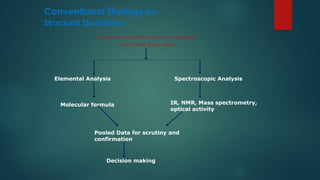
Conventional Strategy for
Structural Elucidation
Compound identification and specific
functional group tests
Elemental Analysis
Molecular formula
Spectroscopic Analysis
IR, NMR, Mass spectrometry,
optical activity
Pooled Data for scrutiny and
confirmation
Decision making
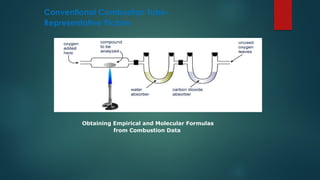
Conventional Combustion Tube-
Representative Picture
Obtaining Empirical and Molecular Formulas
from Combustion Data
Scope of Spectroscopic Analysis
in Structural Elucidation
 Involves the absorption of light in the
infrared region of the electromagnetic
spectrum
 Used primarily to determine what
functional groups are present in a
molecule
O
C
H3
C
H3
C
H N
C
H3 OH
C
H3 NH
CH3
C
H3
CH3
C
H CH
Infrared Spectroscopy
UV Spectroscopy
 Involves the absorption of light in the ultraviolet region of the
electromagnetic spectrum
 Used to determine the level of conjugation in the unknown
 Conjugation is alternating single and double bonds
 UV spectroscopy is not very useful in structure elucidation
C
H3 CH2
Scope of Spectroscopic Analysis
in Structural Elucidation
 Contains information about the number and nature of hydrogens in the molecule
 Three key aspects:
1) chemical shift – the “type” of hydrogen
2) integration – ratio of different types of hydrogens
3) splitting – nearest neighbor relationship
 Can be used to identify the presence of certain functional groups
 Used primarily to determine how the different functional groups present fit together
(the connectivity)
 Contains information about the number and nature of carbons in the molecule
 Three key aspects:
1) chemical shift – the “type” of carbon
2) splitting – the number of hydrogens bonded to each carbon
3) Integration-Ratio of unique carbons present
 Used to determine connectivity among Carbon atoms in a molecule
Proton NMR
Carbon-13 NMR
Scope of Spectroscopic analysis
in Structural Elucidation-Mass spectrometry
 Mass spectroscopy is used to determine the molecular formula of the
unknown compound
 With advancement of High resolution mass spectrometry and the
Scientific Database software technology the limitation of uncertainty is
surpassed a lot and the spectroscopic data is now more reliable than ever
before.
 Mass Fragmentation data with new software tools are minimizing the
number of predictions of probable structures.
 Often these high resolution mass spectral data being used as final data for
considerations in the High Throughput Screening (HTS) stage of discovery
based science
Structure Elucidation
Applicability of a Blackboard Architecture
 Structure elucidation is a fundamental component of organic chemistry
 Requires a wide range of expertise
 Each elucidation technique has its own unique vocabulary that needs to be
mastered
 An expert system can be used to simplify this process
 Each type of spectroscopy is unique
 A human expert will often analyze a set of spectra as a whole,
selectively determining which spectral information to utilize at a given
time
 The blackboard architecture is ideal for this approach
 The blackboard architecture also allows for new spectroscopic
techniques to be added.
Blackboard Systems
“Metaphorically, we can think of a set of workers, all looking at the same
blackboard: each is able to read everything that is on it and to judge when he
has something worthwhile to add to it.” – Newell, 1969
Unknown
Set-up optimized Inlet and Ionization
Parameters
Apply MSE
using parameters optimized for
low and high collision energy
Process acquired data Using relevant
software
Review Results
Known
Confirm known entity by resulting
accurate mass, elemental composition,
MassFragment results
Analysis Set-up
STRUCTURAL
ELUCIDATION
WORKFLOW USING
HRMS
START
Select Peak
of Interest
EVALUATE
Elemental
Composition
INTERPRET
Fragment Analysis
PROPOSE
possible structure(s)
Reconfirm
The structures by neutral
loss, specific MS/MS
monitoring or using
derivatization
DECIDE
on proposed
structure(s)
Unknown Compound Characterization
Michael D. Jones
What is a Mass Spectrometer
A Mass Spectrometer is an analytical instrument that measures the
masses of individual molecules which have been converted into gas-
phase ions. Molecules in a liquid-phase need to be converted into a gas-
phase for the mass spectrometer to be able to measure them.
Ions are separated, detected and measured by their
mass-to-charge ratios(m/z)
Simplified:
A Mass Spectrometer is an Analytical Instrument
that measures the weight of molecules.
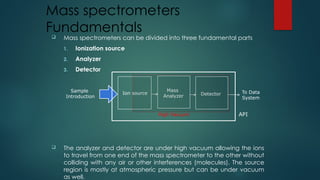
Mass spectrometers
Fundamentals
 Mass spectrometers can be divided into three fundamental parts
1. Ionization source
2. Analyzer
3. Detector
 The analyzer and detector are under high vacuum allowing the ions
to travel from one end of the mass spectrometer to the other without
colliding with any air or other interferences (molecules). The source
region is mostly at atmospheric pressure but can be under vacuum
as well.
Ion source
Mass
Analyzer Detector
Sample
Introduction
To Data
System
API
High Vacuum
Atmospheric Pressure
Ionisation
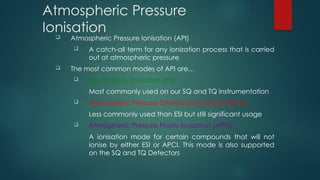
 Atmospheric Pressure Ionisation (API)
 A catch-all term for any ionization process that is carried
out at atmospheric pressure
 The most common modes of API are…
 Electrospray Ionisation (ESI)
Most commonly used on our SQ and TQ instrumentation
 Atmospheric Pressure Chemical Ionisation (APCI)
Less commonly used than ESI but still significant usage
 Atmospheric Pressure Photo Ionisation (APPI)
A ionisation mode for certain compounds that will not
ionise by either ESI or APCI. This mode is also supported
on the SQ and TQ Detectors
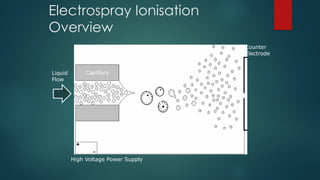
Electrospray Ionisation
Overview
High Voltage Power Supply
Counter
Electrode
Capillary
Liquid
Flow
Electrospray Ionisation
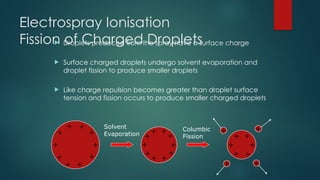
Fission of Charged Droplets
 Droplets produced from the spray have a surface charge
 Surface charged droplets undergo solvent evaporation and
droplet fission to produce smaller droplets
 Like charge repulsion becomes greater than droplet surface
tension and fission occurs to produce smaller charged droplets
+
+
+
+
+
+
+
+
+
+
+
+
+
+
+
+
+
+
+ +
+
+
+
+
+
+
+
Columbic
Fission
+
+
+
Solvent
Evaporation
N
N CH3
O
CH3
H
+ H+
Lidocaine
N
N CH3
O
CH3
H
+
H
Positive Electrospray Ions
C H3
O
OH
C H3
C
H3
C H3
O
O
C H3
C
H3
+ H+
Ibuprofen
Negative ElectroSpray Ions
Electrospray Ionisation
Mechanisms of Ion Formation
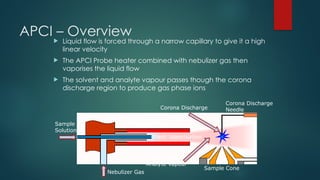
APCI – Overview
 Liquid flow is forced through a narrow capillary to give it a high
linear velocity
 The APCI Probe heater combined with nebulizer gas then
vaporises the liquid flow
 The solvent and analyte vapour passes though the corona
discharge region to produce gas phase ions
Sample
Solution
Nebulizer Gas
APCI Probe Heater
(400-650°C)
Flash Vaporisation
Corona Discharge
Needle
Sample Cone
Corona Discharge
Solvent and
Analyte Vapour
APPI – Overview
 APPI uses the same probe as APCI with a Vacuum UV light
source instead of the corona discharge needle
 As with APCI:
 Liquid flow is forced through a capillary to give it a high linear
velocity
 The probe heater and nebulizer gas vaporise the liquid flow
 Ionisation occurs by either direct or chemical ionisation type
processes in the region of the light source
Sample
Solution
Probe Heater
Flash Vaporisation
Vacuum UV
Source
Sample Cone
Nebulizer Gas
Solvent and
Analyte Vapour
Repeller
Electrode
h

Quadrupole Theory
Pre-filter Quadrupole Mass Filter Post-filter
Rejected Ions Stable (Resonant) Ions
0
0.2
0.4
0.6
0.8
1
1.2
0 0.2 0.4 0.6 0.8 1 1.2
m3
m2
m1
m3 passed
m2 passed
m1 passed
U
V
0
1
200 250 300 350 400 450 500 550 600
m1 m
2
m3
m/z
Quadrupole Theory
Good quadrupole operation line:
Results in well resolved peaks
In total there are 7 pulsed RF DC programs.
These are known as OUT1, OUT2, OUT3, OUT4, OUT5, OUT6, OUT7
They are offset by the width of a pulse.
Travelling Wave Ion Guide
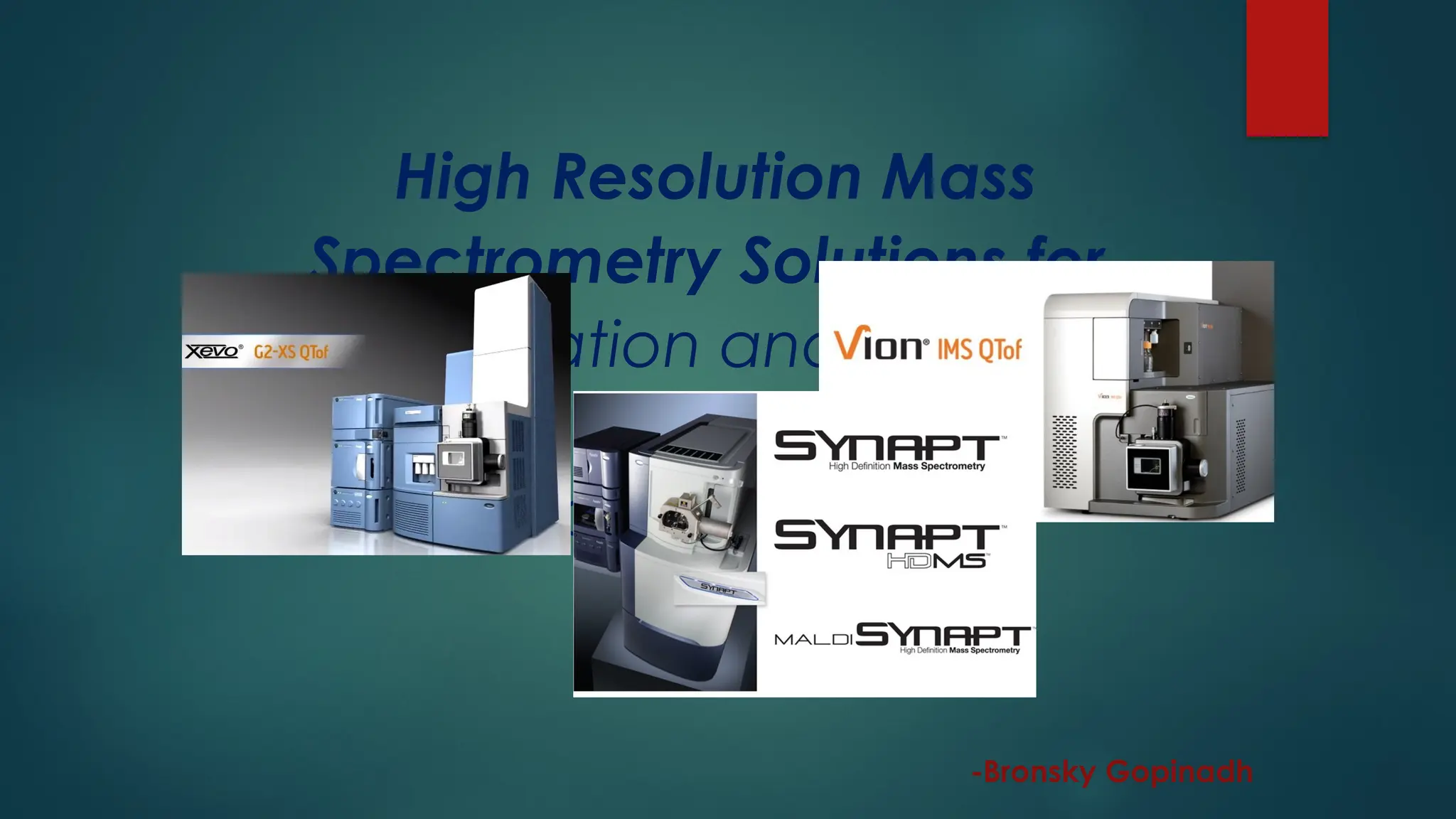
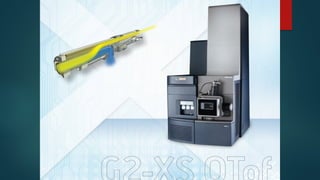
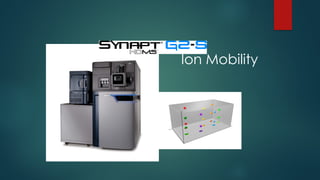
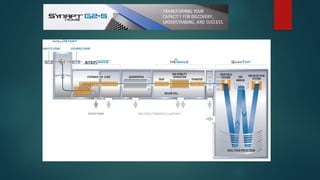
Xevo G2-XS QTof
A Quantum Leap in
Performance
The most sensitive, exact-mass, quantitative and qualitative benchtop
MS/MS system
Uses UPLC/MSE
, a simple, patented method of data acquisition to
comprehensively catalog complex samples in a single analysis
Offers the most extensive range of interface capabilities to service the
broadest range of applications
Guarantees maximum system performance and usability through our
implementation of Engineered SimplicityTM
Provides the most complete system solutions backed by superior
support to ensure customer success
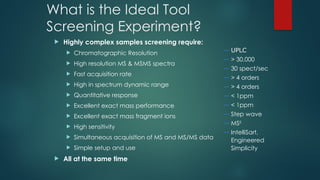
What is the Ideal Tool
Screening Experiment?
 Highly complex samples screening require:
 Chromatographic Resolution
 High resolution MS & MSMS spectra
 Fast acquisition rate
 High in spectrum dynamic range
 Quantitative response
 Excellent exact mass performance
 Excellent exact mass fragment ions
 High sensitivity
 Simultaneous acquisition of MS and MS/MS data
 Simple setup and use
 All at the same time
— UPLC
— > 30,000
— 30 spect/sec
— > 4 orders
— > 4 orders
— < 1ppm
— < 1ppm
— Step wave
— MSE
— IntelliSart,
Engineered
Simplicity
Time-of-Flight Theory
A yellow flower with a green stem
Is it pearl or plastic bead?
Accuracy allows to characterize the petals, to distinguish one from the other by
accurately counting the beads
Resolution & Accuracy
Higher resolution allows to confirm it is a
flower made on bead.
Spectral Resolution
= 500
Peak width (@ 50%) = 0.05Da
Resolution (FWHM) = 500 = 10000
Mass
0.05
FWHM = Full Width Half Maximum
500.0 500.1
499.9
100%
50%
0.05 Da
m/z
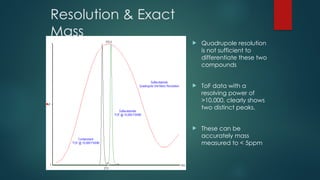
Resolution & Exact
Mass
 Quadrupole resolution
is not sufficient to
differentiate these two
compounds
 ToF data with a
resolving power of
>10,000, clearly shows
two distinct peaks.
 These can be
accurately mass
measured to < 5ppm
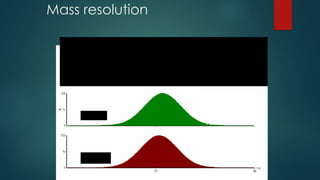
Mass resolution
57
57
57.0697
57.0336
TOF Resolution
Unit Mass
resolution
C4H9
C3H5O
TOF Accuracy
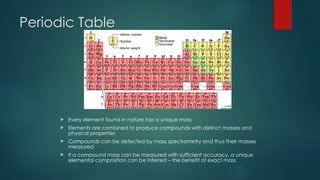
Periodic Table
 Every element found in nature has a unique mass
 Elements are combined to produce compounds with distinct masses and
physical properties
 Compounds can be detected by mass spectrometry and thus their masses
measured
 If a compound mass can be measured with sufficient accuracy, a unique
elemental composition can be inferred – the benefit of exact mass
Definitions
There are three main types of mass measurement;
 Nominal Sum of the integer masses of the most abundant
naturally occurring isotopes of which the ion is comprised
 Exact Calculated by summing the mass, to 4 decimal places, of the
individual most abundant isotopes of which the ion is comprised
 Average Calculated using all the isotopes along with their
natural abundance of each element from which the ion is
comprised
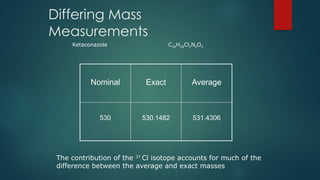
Differing Mass
Measurements
Nominal Exact Average
530 530.1482 531.4306
Ketaconazole C26H28Cl2N4O4
The contribution of the 37
Cl isotope accounts for much of the
difference between the average and exact masses
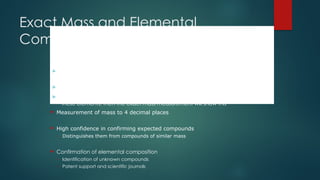
Exact Mass and Elemental
Composition
CO = 27.9949
N2 = 28.0061
C2H4 = 28.0313
 These elemental combinations have the same nominal mass but different exact
mass
 A nominal mass measurement cannot distinguish these
 If any compounds differ in their elemental compositions by substitution of any of
these elements, then the exact mass measurement will show this
 Measurement of mass to 4 decimal places
 High confidence in confirming expected compounds
– Distinguishes them from compounds of similar mass
 Confirmation of elemental composition
– Identification of unknown compounds
– Patent support and scientific journals
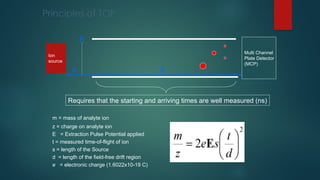
Ion
source
Multi Channel
Plate Detector
(MCP)
Requires that the starting and arriving times are well measured (ns)
s d
E
Principles of TOF
m = mass of analyte ion
z = charge on analyte ion
E = Extraction Pulse Potential applied
t = measured time-of-flight of ion
s = length of the Source
d = length of the field-free drift region
e = electronic charge (1.6022x10⁻¹⁹ C)
Q-TOF 1
Resolution = 5000
1KV pusher
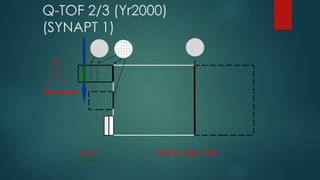
Q-TOF 2/3 (Yr2000)
(SYNAPT 1)
10,000
17,500
2KV pusher
Shorter flight tube
SYNAPT G2
>20,000
> 40,000
4KV pusher
Longer flight tube,
2 stage Reflectron
Segmented quadrupole design focuses the ions into
a narrow, tightly controlled beam as they enter the
Tof Mass analyzer which enables us to achieve
close to 100% transmission giving overall
sensitivity increase with no reduction in resolution.
Waters Xevo G2-XS QTof System
The Xevo®
G2-XS QTof provides increased
sensitivity with no loss in resolution
100% Beam
Transmission
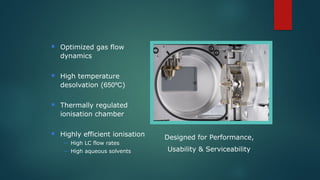
 Optimized gas flow
dynamics
 High temperature
desolvation (650ºC)
 Thermally regulated
ionisation chamber
 Highly efficient ionisation
— High LC flow rates
— High aqueous solvents
Designed for Performance,
Usability & Serviceability
 Shape of chamber
— Smooth, curved surface
— Reduces turbulance
— Excellent beam stability
 Size of chamber
— Efficient desolvation
— Excellent linear response
 Temperature of chamber
— Thermally regulated
— Prevents solvent deposition
 Tangential exhaust
— Gas flows modeled to efficiently
remove non-ionized materials from
source chamber
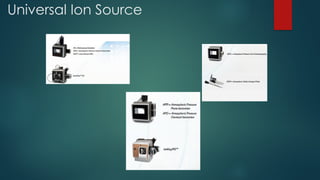
Universal Ion Source
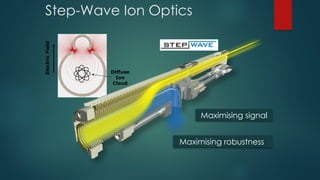
Electric
Field
Diffuse
Ion
Cloud
Maximising signal
Maximising robustness
Step-Wave Ion Optics
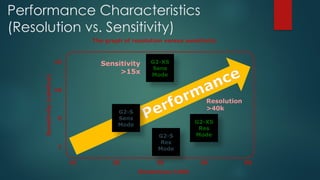
Performance Characteristics
(Resolution vs. Sensitivity)
Resolution/1000
Sensitivity
(relative)
10 20 30 40 50
1
15
5
10
Performance
G2-S
Res
Mode
G2-S
Sens
Mode
G2-XS
Sens
Mode
G2-XS
Res
Mode
5
10
Sensitivity
>15x
Resolution
>40k
The graph of resolution versus sensitivity
High Performance
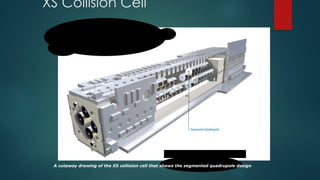
XS Collision Cell
A cutaway drawing of the XS collision cell that shows the segmented quadrupole design
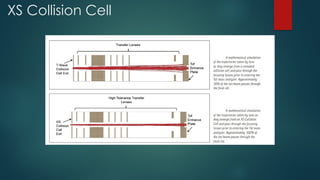
XS Collision Cell
How QuanTof Works for
You
 QuanTof combines
innovative high field
pusher and dual stage
reflectron designs with a
novel ion detection
system in an optimised
Tof geometry
 The result is a totally new
level of high resolution,
exact mass, quantitative
performance,
consistently acheivable
at UPLC acquisition rates
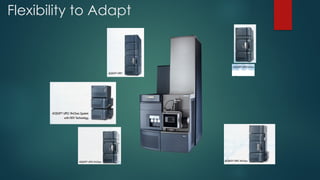
Flexibility to Adapt
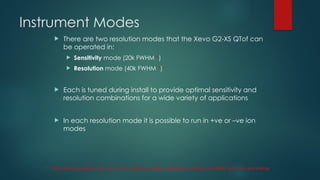
Instrument Modes
 There are two resolution modes that the Xevo G2-XS QTof can
be operated in:
 Sensitivity mode (20k FWHM *)
 Resolution mode (40k FWHM *)
 Each is tuned during install to provide optimal sensitivity and
resolution combinations for a wide variety of applications
 In each resolution mode it is possible to run in +ve or –ve ion
modes
* The quoted resolution is for the +6 ion of bovine insulin, measured resolution will differ with m/z and charge
Obtaining Exact Mass Measurement
Lock Mass Correction
 A known reference peak should be used to ‘lock’ the
calibration of a spectrum to ensure good accuracy
 Some claim that an internal reference spectrum is not
necessary !
 poor scientific practice to not validate your measurement
 varying temperature and instrument parameters cause errors
 without a lock mass you can never be confident in your result
 We achieve this by using LockSpray
 Automates correction for environmental changes providing
excellent mass accuracy in both MS and MS/MS modes.
Key point : LockSpray automates exact mass MS AND
MS/MS
LockSpray – validated
exact mass
 LockSpray is patented
technology designed to make
exact mass measurement “easy”
 Every spectrum is validated with
a single lockmass – complete
confidence in your answer
 Scientifically correct to perform
exact mass measurement with a
known reference mass
 LockSpray overcomes all the
practical issues associated with
traditional exact mass
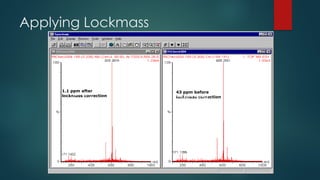
1.1 ppm after
lockmass correction
43 ppm before
lockmass correction
Applying Lockmass
Reserpine
1.1 ppm after
lockmass correction
43 ppm before
lockmass correction
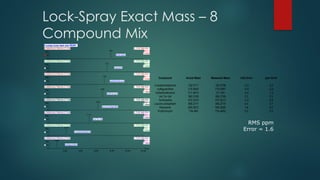
Lock-Spray Exact Mass – 8
Compound Mix
8 comp lcms test mix RUN1
2.00 4.00 6.00 8.00 10.00 12.00
Time
0
100
%
0
100
%
0
100
%
0
100
%
0
100
%
0
100
%
0
100
%
0
100
%
LCMSEXACTNEWLCT105 1: TOF MS ES+
472.3
5.40e3
7.83
LCMSEXACTNEWLCT105 1: TOF MS ES+
609.3
1.53e3
7.37
LCMSEXACTNEWLCT105 1: TOF MS ES+
311.1
1.07e4
7.04
LCMSEXACTNEWLCT105 1: TOF MS ES+
734.5
1.34e4
6.80
LCMSEXACTNEWLCT105 1: TOF MS ES+
556.3
1.20e4
6.22
LCMSEXACTNEWLCT105 1: TOF MS ES+
380.2
2.08e4
5.11
LCMSEXACTNEWLCT105 1: TOF MS ES+
152.1
2.93e3
2.15
LCMSEXACTNEWLCT105 1: TOF MS ES+
215.1
1.39e4
0.96
terfenadine
reserpine
sulfadimethoxine
erythromycin
leucine enkephalin
Val-Tyr-Val
4-acetamidophenol
sulfaguanidine
Compound Actual Mass Measured Mass mDa Error ppm Error
4-acetamidophenol 152.0711 152.0708 -0.3 -2.0
sulfaguanidine 215.0602 215.0597 -0.5 -2.3
Sulfadimethoxine 311.0814 311.081 -0.4 -1.3
Val-Tyr-Val 380.2185 380.2188 0.3 0.8
Terfenadine 472.3215 472.3213 -0.2 -0.4
Leucine enkephalin 556.2771 556.2775 0.4 0.7
Reserpine 609.2812 609.2828 1.6 2.6
Erythromycin 734.469 734.4692 0.2 0.3
RMS ppm
Error = 1.6
Lock-Spray with
APCI
Exact Mass Results
 17a-hydroxyprogesterone (C21H30O3)
 [M+H]=331.2273
 5 repeat injections
Inj No. Actual mDa
error
ppm
error
1 331.2274 0.1 0.3
2 331.2270 0.3 0.9
3 331.2273 0.0 0.0
4 331.2271 0.2 0.6
5 331.2273 0.0 0.0
i-Fit elemental calculator
i-FIT
 For every possible elemental composition an i-FITTM
value is
calculated
 Calculation uses both isotope pattern, exact mass & intensity
 i-FITTM
means goodness of fit to theoretical considering Isotope model
 Valency state is set automatically for ESI & APCI
 ESI & APCI generates even electron state for molecular ion (N-Rule)
 Applies novel isotope interrogation
 Carbon, Cl & Br, and Sulphur filter
 Within set tolerances
 Displays the element types (min-max) used for calculation
 Helps to reduce the number of elemental composition calculations
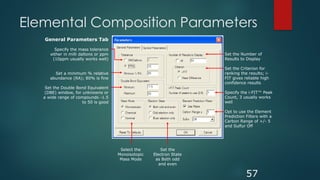
Elemental Composition Parameters
57
General Parameters Tab
Specify the mass tolerance
either in milli daltons or ppm
(10ppm usually works well)
Set a minimum % relative
abundance (RA); 80% is fine
Set the Double Bond Equivalent
(DBE) window, for unknowns or
a wide range of compounds -1.5
to 50 is good
Set the
Electron State
as Both odd
and even
Select the
Monoisotopic
Mass Mode
Set the Number of
Results to Display
Set the Criterion for
ranking the results; i-
FIT gives reliable high
confidence results
Specify the i-FIT™ Peak
Count, 3 usually works
well
Opt to use the Element
Prediction Filters with a
Carbon Range of +/- 5
and Sulfur Off
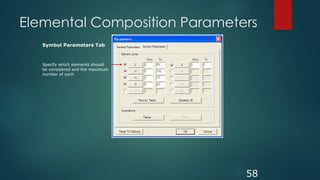
Elemental Composition Parameters
58
Symbol Parameters Tab
Specify which elements should
be considered and the maximum
number of each
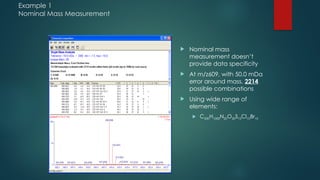
Example 1
Nominal Mass Measurement
 Nominal mass
measurement doesn’t
provide data specificity
 At m/z609, with 50.0 mDa
error around mass, 2214
possible combinations
 Using wide range of
elements:
 C500H1000N20O20S10Cl10Br10
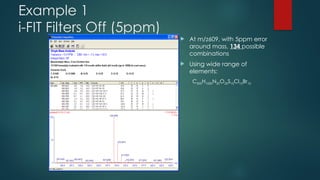
Example 1
i-FIT Filters Off (5ppm)
 At m/z609, with 5ppm error
around mass, 134 possible
combinations
 Using wide range of
elements:
C500H1000N20O20S10Cl10Br10
Example 1
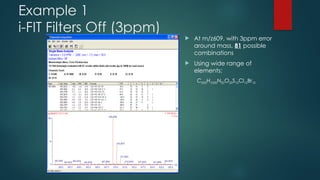
i-FIT Filters Off (3ppm)
 At m/z609, with 3ppm error
around mass, 81 possible
combinations
 Using wide range of
elements:
C500H1000N20O20S10Cl10Br10
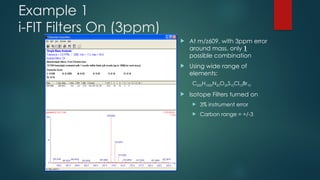
Example 1
i-FIT Filters On (3ppm)
 At m/z609, with 3ppm error
around mass, only 1
possible combination
 Using wide range of
elements:
C500H1000N20O20S10Cl10Br10
 Isotope Filters turned on
 3% instrument error
 Carbon range = +/-3
Interesting reference ….
Summary Conclusion
• High mass accuracy (<1 ppm) alone is not enough to exclude false positives
• The use of isotopic abundance patterns as another filter can further remove >95
% of false candidates
Final Quote….
“Assuming that ion species are fully resolved (either by chromatography or by
high resolution mass spectrometry), we conclude that a mass spectrometer
capable of 3 ppm mass accuracy and 2% error for isotopic abundance patterns
outperforms mass spectrometers with less than 1 ppm mass accuracy or even
hypothetical mass spectrometers with 0.1 ppm mass accuracy that do not include
isotope information in the calculation of molecular formulae”
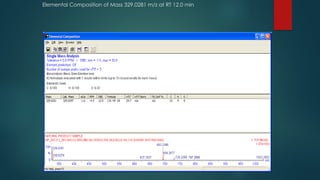
Elemental Composition of Mass 329.0281 m/z at RT 12.0 min
ChemSpider Database ( A Third Party Software Used for
Proposing the Structure )
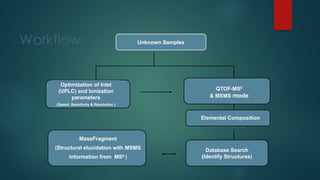
Workflow Unknown Samples
Database Search
(Identify Structures)
QTOF-MSΕ
& MSMS mode
Elemental Composition
Optimization of Inlet
(UPLC) and Ionization
parameters
(Speed, Sensitivity & Resolution )
MassFragment
(Structural elucidation with MSMS
information from MSΕ
)
Workflow (Contd…)
 In the TOF MSE
experiment, the mass spectrometer performs data acquisition by rapidly
switching from a low-collision energy (CE) scan to a high-CE scan in a single run
 The low-CE experiments provide information about the intact unfragmented ion, e.g.
[ M+H]+, while the high-CE scan generates fragment ion information
 The low CE data generated from MSE
experiments performed on the QToF system provides
accurate mass information which is then used for predicting the elemental composition of the
chemical entities
 The high CE data is submitted along with a probable structure to MassFrag software within
MassLynx to propose structures for the fragment ions
 MassFragment is a chemically-intelligent software tool that facilitates structural elucidations
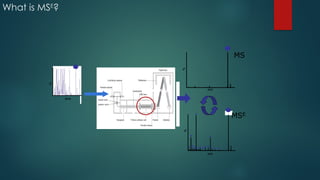
What is MSE
?
time
MS
%
m/z
MSE
%
m/z
%
time
MS
%
m/z
MSE
%
m/z
%
time
MS
%
m/z
MSE
%
m/z
%
time
MS
%
m/z
MSE
%
m/z
%
Added benefits for MSE
 Parallel analysis
 ‘Global uniform data sets’
 Utilizes high resolution and exact mass measurement capabilities of the TOF mass
analyzer for MS and MSE
experiment
 Data is collected across the entire UPLC peak width (1-2 secs) at base
 Chromatographic alignment of precursor and fragment ion data
 Good quantitative information acquired on low energy parent ions and high
energy fragments
 Information rich approach in which product ion, precursor ion and neutral loss
data is generated from a single injection
 MSE
provides “all of the data all of the time”
 MSE
allows the following to be measured in one analysis
 MS spectra
 Fragment ion spectra
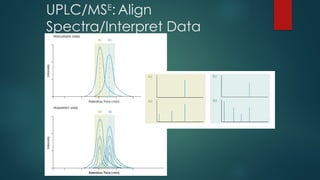
UPLC/MSE
: Align
Spectra/Interpret Data
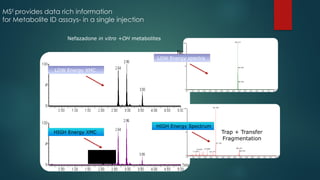
MSE
provides data rich information
for Metabolite ID assays- in a single injection
Nefazadone in vitro +OH metabolites
HIGH Energy XMC
LOW Energy XMC
Trap + Transfer
Fragmentation
No fragmentation
+OH metabolite
HIGH Energy Spectrum
LOW Energy spectra
Isobaric precursors
Selective fragments with MSE
Time
2.40 2.50 2.60 2.70
%
0
100
Standard 1
Simetryn
m/z 214.1126
Standard 2
Desmetryn
m/z 214.1126
Selective MSE
fragment XICs
in river water
Time
0.00 2.00 4.00
%
0
100
0.00 2.00 4.00
%
0
100
0.00 2.00 4.00
%
0
100
Simetryn
or
Desmetryn?
Time
0.00 2.00 4.00
%
0
100
0.00 2.00 4.00
%
0
100
0.00 2.00 4.00
%
0
100
XIC for m/z 96.0559
XIC for m/z 172.0650
m/z
50 100 150 200 250
%
0
100
172.0650
82.0401
124.0617
214.1124
m/z
50 100 150 200 250
%
0
100
214.1128
124.0874
96.0559
144.0597
215.1148
Desmetryn
Identifying unique fragments in standards
Range
GREATER THAN 4 ORDERS OF IN SPECTRUM DYNAMIC RANGE
FROM A COMPLEX SPECTRUM
PEG
C18H38O10Na
Observed Mass 437.2364
0.1 mDa Error
m/z
455.280 455.300 455.320 455.340
%
0
100
11FEB10_001 26 (0.890) TOF MS ES+
2.76e3
455.2901
m/z
300 350 400 450 500 550 600
%
0
100
11FEB10_001 26 (0.890) TOF MS ES+
4.11e7
437.2364
393.2104
349.1837
481.2628
525.2884
Verapamil
C27H38N2O4
Observed Mass 455.2901
0.9 mDa Error
QuanTof Technology for Exact Mass
Selectivity
Scan No. Measured Mass DM (mDa) DM (ppm)
1 202.0434 -0.50 -2.47
2 202.0439 0.00 0.00
3 202.0436 -0.30 -1.48
4 202.0442 0.30 1.48
5 202.0437 -0.20 -0.99
6 202.0440 0.10 0.49
7 202.0439 0.00 0.00
8 202.0435 -0.40 -1.98
9 202.0441 0.20 0.99
10 202.0435 -0.40 -1.98
11 202.0433 -0.60 -2.97
12 202.0442 0.30 1.48
RMS = 0.30 1.50
1
3
4
5
6
7
8
9
10
11
12
2
Scan to scan exact mass reproducibility is shown for the pesticide
Thiabendazole spiked into green beans. Each individual scan shows
better than 1mDa mass accuracy, allowing narrow mass windows to be
used for extracted ion chromatograms, thereby increasing the selectivity
of exact mass quantitative experiments
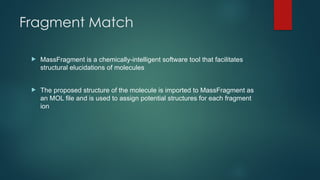
Fragment Match
 MassFragment is a chemically-intelligent software tool that facilitates
structural elucidations of molecules
 The proposed structure of the molecule is imported to MassFragment as
an MOL file and is used to assign potential structures for each fragment
ion
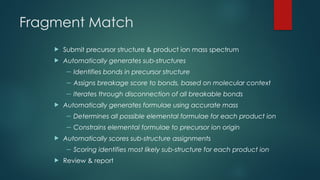
Fragment Match
 Submit precursor structure & product ion mass spectrum
 Automatically generates sub-structures
— Identifies bonds in precursor structure
— Assigns breakage score to bonds, based on molecular context
— Iterates through disconnection of all breakable bonds
 Automatically generates formulae using accurate mass
— Determines all possible elemental formulae for each product ion
— Constrains elemental formulae to precursor ion origin
 Automatically scores sub-structure assignments
— Scoring identifies most likely sub-structure for each product ion
 Review & report
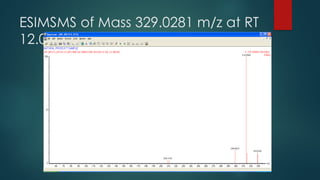
ESIMSMS of Mass 329.0281 m/z at RT
12.0 min
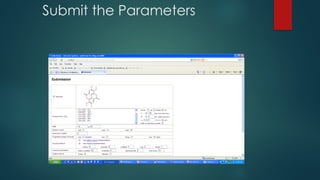
Submit the Parameters
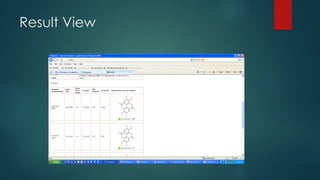
Result View
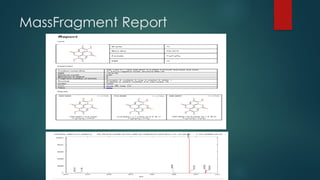
MassFragment Report
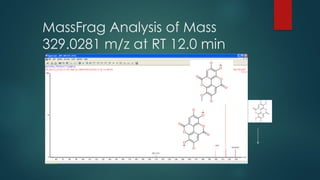
MassFrag Analysis of Mass
329.0281 m/z at RT 12.0 min
Test Case : Impurity Isolation
Identification and Characterization of an Isolated
Impurity: Analysis of Impurity 402 found in
Quetiapine Fumarate
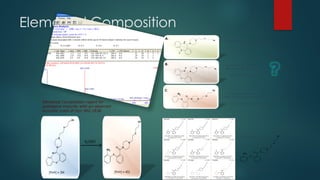
Elemental Composition
Elemental Composition report for
quetiapine impurity with an observed
accurate mass of m/z 402.1838.
Maximizing Separation Power:
Combining Elevated Temperature with UPLC Technology
16-Feb-2006 16667.00000000
Time
5.00 10.00 15.00 20.00 25.00 30.00 35.00 40.00 45.00 50.00
%
0
100
021606_PR_ESIPOS_007 1: TOF MS ES+
BPI
2.38e3
15.51
11.41
0.43
0.46
5.00
2.95
1.09
2.08
6.00
6.97
7.87 8.73
11.42
14.74
11.51
11.53
15.52 33.94
28.86
27.58
16.25
27.57
20.54
16.77
18.51
21.42
25.84
25.23
32.66
31.17
33.97
47.19
47.18
33.99
45.76
41.66
16-Feb-2006 16667.00000000
Time
10.80 11.00 11.20 11.40 11.60 11.80 12.00 12.20 12.40 12.60 12.80
%
0
100
021606_PR_ESIPOS_007 1:TOFMSES+
BPI
1.55e3
11.41
10.94
11.42
11.51
11.50
11.53
Rainville
Chinese Ginseng Extract
ACQUITY UPLC BEH C18
2.1 x 300 mm, 1.7 µm
[2 columns in series]
Temp = 90 o
C
13,500 PSI
Peak Capacity = 870
1 hour run time
But what If inseparable isomers/isobars are present in the known sample?
Ion Mobility
What is Ion mobility?
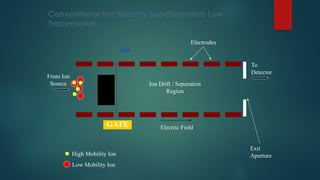
 Separation of ionic species as they drift through a gas under the
influence of an electric field
 Rate of drift is dependent on ion’s mobility through the gas
Similar to the effect that causes an extended paper towel to drift to the ground
much more slowly under the influence of gravity and air resistance than a
crushed towel of the same mass
 Mobility is dependent on factors such as
 Mass
 Charge
 Size/Shape (Interaction Cross Section - )
Ion Mobility Spectrometry (IMS)
…Conventional technology
 An ion in a compact-form has a high mobility, and hence
shorter drift time,
 The same ion in a more open conformation has a lower
mobility, and hence a longer drift time
Gate
Detector
Neutral Buffer Gas (-ve force)
Ring Electrodes (Potential Gradient. +ve force)
GATE
To
Detector
From Ion
Source
Gas
Electric Field
Low Mobility Ion
High Mobility Ion
Ion Drift / Separation
Region
Electrodes
Exit
Aperture
Conventional Ion Mobility Spectrometers Low
Transmission
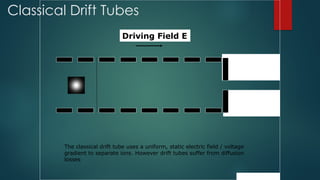
Driving Field E
The classical drift tube uses a uniform, static electric field / voltage
gradient to separate ions. However drift tubes suffer from diffusion
losses
Classical Drift Tubes
RF (-)
RF (+)
Electrod
e
Spacing
1.0 mm
Ion Exit
Aperture
Diamete
r 5.0
mm
Electrode
Thickness
0.5 mm
Ion Entry
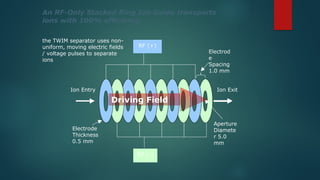
An RF-Only Stacked Ring Ion Guide transports
ions with 100% efficiency
Driving Field
the TWIM separator uses non-
uniform, moving electric fields
/ voltage pulses to separate
ions
E
Driving RF Field
+ - - -
- -
-
+
+
+
+
+
Adding RF gives radial confinement
and greater sensitivity
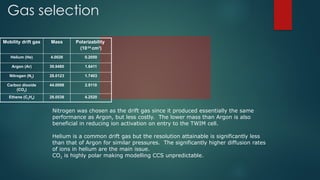
Gas selection
Mobility drift gas Mass Polarizability
(10-24
cm3
)
Helium (He) 4.0026 0.2050
Argon (Ar) 39.9480 1.6411
Nitrogen (N2) 28.0123 1.7403
Carbon dioxide
(CO2)
44.0098 2.9110
Ethene (C2H4) 28.0538 4.2520
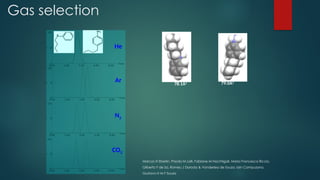
Nitrogen was chosen as the drift gas since it produced essentially the same
performance as Argon, but less costly. The lower mass than Argon is also
beneficial in reducing ion activation on entry to the TWIM cell.
Helium is a common drift gas but the resolution attainable is significantly less
than that of Argon for similar pressures. The significantly higher diffusion rates
of ions in helium are the main issue.
CO2 is highly polar making modelling CCS unpredictable.
Gas selection
78.1Å2 79.0Å2
Time
0.00 2.00 4.00 6.00 8.00
%
0
100
Time
0.00 2.00 4.00 6.00 8.00
%
0
100
Time
0.00 2.00 4.00 6.00 8.00
%
0
100
Time
0.00 2.00 4.00 6.00 8.00
%
0
100
He
Ar
N2
CO2
Marcos N Eberlin, Priscila M Lalli, Fabiane M Nachtigall, Maria Francesca Riccio,
Gilberto F de Sa, Romeu J Daroda & Vanderlea de Souza, Iain Campuzano,
Gustavo H M F Souza
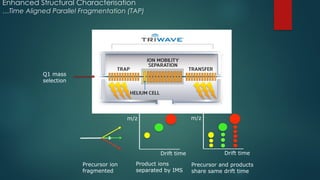
Enhanced Structural Characterisation
…Time Aligned Parallel Fragmentation (TAP)
Drift time
Product ions
separated by IMS
m/z
Precursor ion
fragmented
Drift time
m/z
Precursor and products
share same drift time
Q1 mass
selection
TriWave allows High
Definition MS
 What is High Definition Mass Spectrometry?
 The combination high resolution tandem mass spectrometry and
high efficiency ion mobility based measurements and separations
 Orthogonal gas-phase separation
 Differentiates on size, shape and charge, as well as mass
 Integrates perfectly with LC (secs) and TOF (usecs)
 IMS is performed on the msecs timescale
 Advantages
 Provides parallel analysis for comprehensive coverage
 With high sensitivity/duty cycle
 Improves exact mass MS/MS workflows with APGC, UPLC etc
 Improved peak capacity and MS/MS data quality
Where is ion mobility useful?
 Measuring the ion mobility of an ion yields information about
its structure as small, compact, ions drift quicker than large
extended ions
 Ability to separate isobaric species if they have different
interaction cross sections
 Experimental determination of  values can be used to help
elucidate gas-phase ionic structures
Established Ion Mobility Spectrometry
Applications
Conclusions
 The MSE
mode of acquisition Can be used to acquire the data with low and high
collision energy in the same scan for the natural product sample in both positive &
negative modes.
 The fragmentation pattern obtained in high collision energy can also be confirmed
using MSMS mode of acquisition for the intense peaks.
 Elemental composition based on the parameters (Tolerance: 5 ppm & Elements C,H &
O) could be proposed for the masses that are having significant intensity.
 The ChemSpider database is used to propose the structure of the molecule. The
structure proposed by the database can be imported to Mass Fragment as a MOL file
and is used to assign potential structures for each fragment ion. The potential structure
can be opted by the chemist with rational selective approach for the lowest score
structures.
 Waters Ion mobility technology can provide one of the best selective tools for isomers
and categorizing the isomers with Driftscope software platform
Available Material
Article
High Resolution Mass Spectrometry Solutions for.pptx

High Resolution Mass Spectrometry Solutions for.pptx

  • 1.
    High Resolution Mass SpectrometrySolutions for Identification and Structural Elucidation of Unknown Components -Bronsky Gopinadh
  • 2.
    Agenda  General strategyof structural elucidation and the nature of generated data.  Structural elucidation workflow using Waters HRMS solutions  Basics of QToF – Requirements for Accurate Mass – Importance of Lock Mass spray  Significance of Elemental Composition and i-Fit tool  Significance of MSE data and MassFragment tool  Case Study  Waters Ion Mobility technology in Structural elucidation workflow  Conclusion
  • 3.
    Conventional Strategy for StructuralElucidation Compound identification and specific functional group tests Elemental Analysis Molecular formula Spectroscopic Analysis IR, NMR, Mass spectrometry, optical activity Pooled Data for scrutiny and confirmation Decision making
  • 4.
    Conventional Combustion Tube- RepresentativePicture Obtaining Empirical and Molecular Formulas from Combustion Data
  • 5.
    Scope of SpectroscopicAnalysis in Structural Elucidation  Involves the absorption of light in the infrared region of the electromagnetic spectrum  Used primarily to determine what functional groups are present in a molecule O C H3 C H3 C H N C H3 OH C H3 NH CH3 C H3 CH3 C H CH Infrared Spectroscopy UV Spectroscopy  Involves the absorption of light in the ultraviolet region of the electromagnetic spectrum  Used to determine the level of conjugation in the unknown  Conjugation is alternating single and double bonds  UV spectroscopy is not very useful in structure elucidation C H3 CH2
  • 6.
    Scope of SpectroscopicAnalysis in Structural Elucidation  Contains information about the number and nature of hydrogens in the molecule  Three key aspects: 1) chemical shift – the “type” of hydrogen 2) integration – ratio of different types of hydrogens 3) splitting – nearest neighbor relationship  Can be used to identify the presence of certain functional groups  Used primarily to determine how the different functional groups present fit together (the connectivity)  Contains information about the number and nature of carbons in the molecule  Three key aspects: 1) chemical shift – the “type” of carbon 2) splitting – the number of hydrogens bonded to each carbon 3) Integration-Ratio of unique carbons present  Used to determine connectivity among Carbon atoms in a molecule Proton NMR Carbon-13 NMR
  • 7.
    Scope of Spectroscopicanalysis in Structural Elucidation-Mass spectrometry  Mass spectroscopy is used to determine the molecular formula of the unknown compound  With advancement of High resolution mass spectrometry and the Scientific Database software technology the limitation of uncertainty is surpassed a lot and the spectroscopic data is now more reliable than ever before.  Mass Fragmentation data with new software tools are minimizing the number of predictions of probable structures.  Often these high resolution mass spectral data being used as final data for considerations in the High Throughput Screening (HTS) stage of discovery based science
  • 8.
    Structure Elucidation Applicability ofa Blackboard Architecture  Structure elucidation is a fundamental component of organic chemistry  Requires a wide range of expertise  Each elucidation technique has its own unique vocabulary that needs to be mastered  An expert system can be used to simplify this process  Each type of spectroscopy is unique  A human expert will often analyze a set of spectra as a whole, selectively determining which spectral information to utilize at a given time  The blackboard architecture is ideal for this approach  The blackboard architecture also allows for new spectroscopic techniques to be added.
  • 9.
    Blackboard Systems “Metaphorically, wecan think of a set of workers, all looking at the same blackboard: each is able to read everything that is on it and to judge when he has something worthwhile to add to it.” – Newell, 1969
  • 10.
    Unknown Set-up optimized Inletand Ionization Parameters Apply MSE using parameters optimized for low and high collision energy Process acquired data Using relevant software Review Results Known Confirm known entity by resulting accurate mass, elemental composition, MassFragment results Analysis Set-up STRUCTURAL ELUCIDATION WORKFLOW USING HRMS START Select Peak of Interest EVALUATE Elemental Composition INTERPRET Fragment Analysis PROPOSE possible structure(s) Reconfirm The structures by neutral loss, specific MS/MS monitoring or using derivatization DECIDE on proposed structure(s) Unknown Compound Characterization Michael D. Jones
  • 11.
    What is aMass Spectrometer A Mass Spectrometer is an analytical instrument that measures the masses of individual molecules which have been converted into gas- phase ions. Molecules in a liquid-phase need to be converted into a gas- phase for the mass spectrometer to be able to measure them. Ions are separated, detected and measured by their mass-to-charge ratios(m/z) Simplified: A Mass Spectrometer is an Analytical Instrument that measures the weight of molecules.
  • 12.
    Mass spectrometers Fundamentals  Massspectrometers can be divided into three fundamental parts 1. Ionization source 2. Analyzer 3. Detector  The analyzer and detector are under high vacuum allowing the ions to travel from one end of the mass spectrometer to the other without colliding with any air or other interferences (molecules). The source region is mostly at atmospheric pressure but can be under vacuum as well. Ion source Mass Analyzer Detector Sample Introduction To Data System API High Vacuum
  • 13.
    Atmospheric Pressure Ionisation  AtmosphericPressure Ionisation (API)  A catch-all term for any ionization process that is carried out at atmospheric pressure  The most common modes of API are…  Electrospray Ionisation (ESI) Most commonly used on our SQ and TQ instrumentation  Atmospheric Pressure Chemical Ionisation (APCI) Less commonly used than ESI but still significant usage  Atmospheric Pressure Photo Ionisation (APPI) A ionisation mode for certain compounds that will not ionise by either ESI or APCI. This mode is also supported on the SQ and TQ Detectors
  • 14.
    Electrospray Ionisation Overview High VoltagePower Supply Counter Electrode Capillary Liquid Flow
  • 15.
    Electrospray Ionisation Fission ofCharged Droplets  Droplets produced from the spray have a surface charge  Surface charged droplets undergo solvent evaporation and droplet fission to produce smaller droplets  Like charge repulsion becomes greater than droplet surface tension and fission occurs to produce smaller charged droplets + + + + + + + + + + + + + + + + + + + + + + + + + + + Columbic Fission + + + Solvent Evaporation
  • 16.
    N N CH3 O CH3 H + H+ Lidocaine N NCH3 O CH3 H + H Positive Electrospray Ions C H3 O OH C H3 C H3 C H3 O O C H3 C H3 + H+ Ibuprofen Negative ElectroSpray Ions Electrospray Ionisation Mechanisms of Ion Formation
  • 17.
    APCI – Overview Liquid flow is forced through a narrow capillary to give it a high linear velocity  The APCI Probe heater combined with nebulizer gas then vaporises the liquid flow  The solvent and analyte vapour passes though the corona discharge region to produce gas phase ions Sample Solution Nebulizer Gas APCI Probe Heater (400-650°C) Flash Vaporisation Corona Discharge Needle Sample Cone Corona Discharge Solvent and Analyte Vapour
  • 18.
    APPI – Overview APPI uses the same probe as APCI with a Vacuum UV light source instead of the corona discharge needle  As with APCI:  Liquid flow is forced through a capillary to give it a high linear velocity  The probe heater and nebulizer gas vaporise the liquid flow  Ionisation occurs by either direct or chemical ionisation type processes in the region of the light source Sample Solution Probe Heater Flash Vaporisation Vacuum UV Source Sample Cone Nebulizer Gas Solvent and Analyte Vapour Repeller Electrode h 
  • 19.
    Quadrupole Theory Pre-filter QuadrupoleMass Filter Post-filter Rejected Ions Stable (Resonant) Ions
  • 20.
    0 0.2 0.4 0.6 0.8 1 1.2 0 0.2 0.40.6 0.8 1 1.2 m3 m2 m1 m3 passed m2 passed m1 passed U V 0 1 200 250 300 350 400 450 500 550 600 m1 m 2 m3 m/z Quadrupole Theory Good quadrupole operation line: Results in well resolved peaks
  • 21.
    In total thereare 7 pulsed RF DC programs. These are known as OUT1, OUT2, OUT3, OUT4, OUT5, OUT6, OUT7 They are offset by the width of a pulse. Travelling Wave Ion Guide
  • 22.
    Xevo G2-XS QTof AQuantum Leap in Performance The most sensitive, exact-mass, quantitative and qualitative benchtop MS/MS system Uses UPLC/MSE , a simple, patented method of data acquisition to comprehensively catalog complex samples in a single analysis Offers the most extensive range of interface capabilities to service the broadest range of applications Guarantees maximum system performance and usability through our implementation of Engineered SimplicityTM Provides the most complete system solutions backed by superior support to ensure customer success
  • 23.
    What is theIdeal Tool Screening Experiment?  Highly complex samples screening require:  Chromatographic Resolution  High resolution MS & MSMS spectra  Fast acquisition rate  High in spectrum dynamic range  Quantitative response  Excellent exact mass performance  Excellent exact mass fragment ions  High sensitivity  Simultaneous acquisition of MS and MS/MS data  Simple setup and use  All at the same time — UPLC — > 30,000 — 30 spect/sec — > 4 orders — > 4 orders — < 1ppm — < 1ppm — Step wave — MSE — IntelliSart, Engineered Simplicity
  • 25.
  • 26.
    A yellow flowerwith a green stem Is it pearl or plastic bead? Accuracy allows to characterize the petals, to distinguish one from the other by accurately counting the beads Resolution & Accuracy Higher resolution allows to confirm it is a flower made on bead.
  • 27.
    Spectral Resolution = 500 Peakwidth (@ 50%) = 0.05Da Resolution (FWHM) = 500 = 10000 Mass 0.05 FWHM = Full Width Half Maximum 500.0 500.1 499.9 100% 50% 0.05 Da m/z
  • 28.
    Resolution & Exact Mass Quadrupole resolution is not sufficient to differentiate these two compounds  ToF data with a resolving power of >10,000, clearly shows two distinct peaks.  These can be accurately mass measured to < 5ppm
  • 29.
    Mass resolution 57 57 57.0697 57.0336 TOF Resolution UnitMass resolution C4H9 C3H5O TOF Accuracy
  • 30.
    Periodic Table  Everyelement found in nature has a unique mass  Elements are combined to produce compounds with distinct masses and physical properties  Compounds can be detected by mass spectrometry and thus their masses measured  If a compound mass can be measured with sufficient accuracy, a unique elemental composition can be inferred – the benefit of exact mass
  • 31.
    Definitions There are threemain types of mass measurement;  Nominal Sum of the integer masses of the most abundant naturally occurring isotopes of which the ion is comprised  Exact Calculated by summing the mass, to 4 decimal places, of the individual most abundant isotopes of which the ion is comprised  Average Calculated using all the isotopes along with their natural abundance of each element from which the ion is comprised
  • 32.
    Differing Mass Measurements Nominal ExactAverage 530 530.1482 531.4306 Ketaconazole C26H28Cl2N4O4 The contribution of the 37 Cl isotope accounts for much of the difference between the average and exact masses
  • 33.
    Exact Mass andElemental Composition CO = 27.9949 N2 = 28.0061 C2H4 = 28.0313  These elemental combinations have the same nominal mass but different exact mass  A nominal mass measurement cannot distinguish these  If any compounds differ in their elemental compositions by substitution of any of these elements, then the exact mass measurement will show this  Measurement of mass to 4 decimal places  High confidence in confirming expected compounds – Distinguishes them from compounds of similar mass  Confirmation of elemental composition – Identification of unknown compounds – Patent support and scientific journals
  • 34.
    Ion source Multi Channel Plate Detector (MCP) Requiresthat the starting and arriving times are well measured (ns) s d E Principles of TOF m = mass of analyte ion z = charge on analyte ion E = Extraction Pulse Potential applied t = measured time-of-flight of ion s = length of the Source d = length of the field-free drift region e = electronic charge (1.6022x10⁻¹⁹ C)
  • 35.
    Q-TOF 1 Resolution =5000 1KV pusher
  • 36.
    Q-TOF 2/3 (Yr2000) (SYNAPT1) 10,000 17,500 2KV pusher Shorter flight tube
  • 37.
    SYNAPT G2 >20,000 > 40,000 4KVpusher Longer flight tube, 2 stage Reflectron
  • 38.
    Segmented quadrupole designfocuses the ions into a narrow, tightly controlled beam as they enter the Tof Mass analyzer which enables us to achieve close to 100% transmission giving overall sensitivity increase with no reduction in resolution. Waters Xevo G2-XS QTof System The Xevo® G2-XS QTof provides increased sensitivity with no loss in resolution 100% Beam Transmission
  • 39.
     Optimized gasflow dynamics  High temperature desolvation (650ºC)  Thermally regulated ionisation chamber  Highly efficient ionisation — High LC flow rates — High aqueous solvents Designed for Performance, Usability & Serviceability
  • 40.
     Shape ofchamber — Smooth, curved surface — Reduces turbulance — Excellent beam stability  Size of chamber — Efficient desolvation — Excellent linear response  Temperature of chamber — Thermally regulated — Prevents solvent deposition  Tangential exhaust — Gas flows modeled to efficiently remove non-ionized materials from source chamber
  • 41.
  • 42.
  • 43.
    Performance Characteristics (Resolution vs.Sensitivity) Resolution/1000 Sensitivity (relative) 10 20 30 40 50 1 15 5 10 Performance G2-S Res Mode G2-S Sens Mode G2-XS Sens Mode G2-XS Res Mode 5 10 Sensitivity >15x Resolution >40k The graph of resolution versus sensitivity
  • 44.
  • 45.
    XS Collision Cell Acutaway drawing of the XS collision cell that shows the segmented quadrupole design
  • 46.
  • 47.
    How QuanTof Worksfor You  QuanTof combines innovative high field pusher and dual stage reflectron designs with a novel ion detection system in an optimised Tof geometry  The result is a totally new level of high resolution, exact mass, quantitative performance, consistently acheivable at UPLC acquisition rates
  • 48.
  • 49.
    Instrument Modes  Thereare two resolution modes that the Xevo G2-XS QTof can be operated in:  Sensitivity mode (20k FWHM *)  Resolution mode (40k FWHM *)  Each is tuned during install to provide optimal sensitivity and resolution combinations for a wide variety of applications  In each resolution mode it is possible to run in +ve or –ve ion modes * The quoted resolution is for the +6 ion of bovine insulin, measured resolution will differ with m/z and charge
  • 50.
    Obtaining Exact MassMeasurement Lock Mass Correction  A known reference peak should be used to ‘lock’ the calibration of a spectrum to ensure good accuracy  Some claim that an internal reference spectrum is not necessary !  poor scientific practice to not validate your measurement  varying temperature and instrument parameters cause errors  without a lock mass you can never be confident in your result  We achieve this by using LockSpray  Automates correction for environmental changes providing excellent mass accuracy in both MS and MS/MS modes. Key point : LockSpray automates exact mass MS AND MS/MS
  • 51.
    LockSpray – validated exactmass  LockSpray is patented technology designed to make exact mass measurement “easy”  Every spectrum is validated with a single lockmass – complete confidence in your answer  Scientifically correct to perform exact mass measurement with a known reference mass  LockSpray overcomes all the practical issues associated with traditional exact mass
  • 52.
    1.1 ppm after lockmasscorrection 43 ppm before lockmass correction Applying Lockmass Reserpine 1.1 ppm after lockmass correction 43 ppm before lockmass correction
  • 53.
    Lock-Spray Exact Mass– 8 Compound Mix 8 comp lcms test mix RUN1 2.00 4.00 6.00 8.00 10.00 12.00 Time 0 100 % 0 100 % 0 100 % 0 100 % 0 100 % 0 100 % 0 100 % 0 100 % LCMSEXACTNEWLCT105 1: TOF MS ES+ 472.3 5.40e3 7.83 LCMSEXACTNEWLCT105 1: TOF MS ES+ 609.3 1.53e3 7.37 LCMSEXACTNEWLCT105 1: TOF MS ES+ 311.1 1.07e4 7.04 LCMSEXACTNEWLCT105 1: TOF MS ES+ 734.5 1.34e4 6.80 LCMSEXACTNEWLCT105 1: TOF MS ES+ 556.3 1.20e4 6.22 LCMSEXACTNEWLCT105 1: TOF MS ES+ 380.2 2.08e4 5.11 LCMSEXACTNEWLCT105 1: TOF MS ES+ 152.1 2.93e3 2.15 LCMSEXACTNEWLCT105 1: TOF MS ES+ 215.1 1.39e4 0.96 terfenadine reserpine sulfadimethoxine erythromycin leucine enkephalin Val-Tyr-Val 4-acetamidophenol sulfaguanidine Compound Actual Mass Measured Mass mDa Error ppm Error 4-acetamidophenol 152.0711 152.0708 -0.3 -2.0 sulfaguanidine 215.0602 215.0597 -0.5 -2.3 Sulfadimethoxine 311.0814 311.081 -0.4 -1.3 Val-Tyr-Val 380.2185 380.2188 0.3 0.8 Terfenadine 472.3215 472.3213 -0.2 -0.4 Leucine enkephalin 556.2771 556.2775 0.4 0.7 Reserpine 609.2812 609.2828 1.6 2.6 Erythromycin 734.469 734.4692 0.2 0.3 RMS ppm Error = 1.6
  • 54.
    Lock-Spray with APCI Exact MassResults  17a-hydroxyprogesterone (C21H30O3)  [M+H]=331.2273  5 repeat injections Inj No. Actual mDa error ppm error 1 331.2274 0.1 0.3 2 331.2270 0.3 0.9 3 331.2273 0.0 0.0 4 331.2271 0.2 0.6 5 331.2273 0.0 0.0
  • 55.
  • 56.
    i-FIT  For everypossible elemental composition an i-FITTM value is calculated  Calculation uses both isotope pattern, exact mass & intensity  i-FITTM means goodness of fit to theoretical considering Isotope model  Valency state is set automatically for ESI & APCI  ESI & APCI generates even electron state for molecular ion (N-Rule)  Applies novel isotope interrogation  Carbon, Cl & Br, and Sulphur filter  Within set tolerances  Displays the element types (min-max) used for calculation  Helps to reduce the number of elemental composition calculations
  • 57.
    Elemental Composition Parameters 57 GeneralParameters Tab Specify the mass tolerance either in milli daltons or ppm (10ppm usually works well) Set a minimum % relative abundance (RA); 80% is fine Set the Double Bond Equivalent (DBE) window, for unknowns or a wide range of compounds -1.5 to 50 is good Set the Electron State as Both odd and even Select the Monoisotopic Mass Mode Set the Number of Results to Display Set the Criterion for ranking the results; i- FIT gives reliable high confidence results Specify the i-FIT™ Peak Count, 3 usually works well Opt to use the Element Prediction Filters with a Carbon Range of +/- 5 and Sulfur Off
  • 58.
    Elemental Composition Parameters 58 SymbolParameters Tab Specify which elements should be considered and the maximum number of each
  • 59.
    Example 1 Nominal MassMeasurement  Nominal mass measurement doesn’t provide data specificity  At m/z609, with 50.0 mDa error around mass, 2214 possible combinations  Using wide range of elements:  C500H1000N20O20S10Cl10Br10
  • 60.
    Example 1 i-FIT FiltersOff (5ppm)  At m/z609, with 5ppm error around mass, 134 possible combinations  Using wide range of elements: C500H1000N20O20S10Cl10Br10
  • 61.
    Example 1 i-FIT FiltersOff (3ppm)  At m/z609, with 3ppm error around mass, 81 possible combinations  Using wide range of elements: C500H1000N20O20S10Cl10Br10
  • 62.
    Example 1 i-FIT FiltersOn (3ppm)  At m/z609, with 3ppm error around mass, only 1 possible combination  Using wide range of elements: C500H1000N20O20S10Cl10Br10  Isotope Filters turned on  3% instrument error  Carbon range = +/-3
  • 63.
    Interesting reference …. SummaryConclusion • High mass accuracy (<1 ppm) alone is not enough to exclude false positives • The use of isotopic abundance patterns as another filter can further remove >95 % of false candidates Final Quote…. “Assuming that ion species are fully resolved (either by chromatography or by high resolution mass spectrometry), we conclude that a mass spectrometer capable of 3 ppm mass accuracy and 2% error for isotopic abundance patterns outperforms mass spectrometers with less than 1 ppm mass accuracy or even hypothetical mass spectrometers with 0.1 ppm mass accuracy that do not include isotope information in the calculation of molecular formulae”
  • 64.
    Elemental Composition ofMass 329.0281 m/z at RT 12.0 min
  • 65.
    ChemSpider Database (A Third Party Software Used for Proposing the Structure )
  • 66.
    Workflow Unknown Samples DatabaseSearch (Identify Structures) QTOF-MSΕ & MSMS mode Elemental Composition Optimization of Inlet (UPLC) and Ionization parameters (Speed, Sensitivity & Resolution ) MassFragment (Structural elucidation with MSMS information from MSΕ )
  • 67.
    Workflow (Contd…)  Inthe TOF MSE experiment, the mass spectrometer performs data acquisition by rapidly switching from a low-collision energy (CE) scan to a high-CE scan in a single run  The low-CE experiments provide information about the intact unfragmented ion, e.g. [ M+H]+, while the high-CE scan generates fragment ion information  The low CE data generated from MSE experiments performed on the QToF system provides accurate mass information which is then used for predicting the elemental composition of the chemical entities  The high CE data is submitted along with a probable structure to MassFrag software within MassLynx to propose structures for the fragment ions  MassFragment is a chemically-intelligent software tool that facilitates structural elucidations
  • 68.
  • 69.
    Added benefits forMSE  Parallel analysis  ‘Global uniform data sets’  Utilizes high resolution and exact mass measurement capabilities of the TOF mass analyzer for MS and MSE experiment  Data is collected across the entire UPLC peak width (1-2 secs) at base  Chromatographic alignment of precursor and fragment ion data  Good quantitative information acquired on low energy parent ions and high energy fragments  Information rich approach in which product ion, precursor ion and neutral loss data is generated from a single injection  MSE provides “all of the data all of the time”  MSE allows the following to be measured in one analysis  MS spectra  Fragment ion spectra
  • 70.
  • 71.
    MSE provides data richinformation for Metabolite ID assays- in a single injection Nefazadone in vitro +OH metabolites HIGH Energy XMC LOW Energy XMC Trap + Transfer Fragmentation No fragmentation +OH metabolite HIGH Energy Spectrum LOW Energy spectra
  • 72.
    Isobaric precursors Selective fragmentswith MSE Time 2.40 2.50 2.60 2.70 % 0 100 Standard 1 Simetryn m/z 214.1126 Standard 2 Desmetryn m/z 214.1126 Selective MSE fragment XICs in river water Time 0.00 2.00 4.00 % 0 100 0.00 2.00 4.00 % 0 100 0.00 2.00 4.00 % 0 100 Simetryn or Desmetryn? Time 0.00 2.00 4.00 % 0 100 0.00 2.00 4.00 % 0 100 0.00 2.00 4.00 % 0 100 XIC for m/z 96.0559 XIC for m/z 172.0650 m/z 50 100 150 200 250 % 0 100 172.0650 82.0401 124.0617 214.1124 m/z 50 100 150 200 250 % 0 100 214.1128 124.0874 96.0559 144.0597 215.1148 Desmetryn Identifying unique fragments in standards
  • 73.
    Range GREATER THAN 4ORDERS OF IN SPECTRUM DYNAMIC RANGE FROM A COMPLEX SPECTRUM PEG C18H38O10Na Observed Mass 437.2364 0.1 mDa Error m/z 455.280 455.300 455.320 455.340 % 0 100 11FEB10_001 26 (0.890) TOF MS ES+ 2.76e3 455.2901 m/z 300 350 400 450 500 550 600 % 0 100 11FEB10_001 26 (0.890) TOF MS ES+ 4.11e7 437.2364 393.2104 349.1837 481.2628 525.2884 Verapamil C27H38N2O4 Observed Mass 455.2901 0.9 mDa Error
  • 74.
    QuanTof Technology forExact Mass Selectivity Scan No. Measured Mass DM (mDa) DM (ppm) 1 202.0434 -0.50 -2.47 2 202.0439 0.00 0.00 3 202.0436 -0.30 -1.48 4 202.0442 0.30 1.48 5 202.0437 -0.20 -0.99 6 202.0440 0.10 0.49 7 202.0439 0.00 0.00 8 202.0435 -0.40 -1.98 9 202.0441 0.20 0.99 10 202.0435 -0.40 -1.98 11 202.0433 -0.60 -2.97 12 202.0442 0.30 1.48 RMS = 0.30 1.50 1 3 4 5 6 7 8 9 10 11 12 2 Scan to scan exact mass reproducibility is shown for the pesticide Thiabendazole spiked into green beans. Each individual scan shows better than 1mDa mass accuracy, allowing narrow mass windows to be used for extracted ion chromatograms, thereby increasing the selectivity of exact mass quantitative experiments
  • 75.
    Fragment Match  MassFragmentis a chemically-intelligent software tool that facilitates structural elucidations of molecules  The proposed structure of the molecule is imported to MassFragment as an MOL file and is used to assign potential structures for each fragment ion
  • 76.
    Fragment Match  Submitprecursor structure & product ion mass spectrum  Automatically generates sub-structures — Identifies bonds in precursor structure — Assigns breakage score to bonds, based on molecular context — Iterates through disconnection of all breakable bonds  Automatically generates formulae using accurate mass — Determines all possible elemental formulae for each product ion — Constrains elemental formulae to precursor ion origin  Automatically scores sub-structure assignments — Scoring identifies most likely sub-structure for each product ion  Review & report
  • 77.
    ESIMSMS of Mass329.0281 m/z at RT 12.0 min
  • 78.
  • 79.
  • 80.
  • 81.
    MassFrag Analysis ofMass 329.0281 m/z at RT 12.0 min
  • 82.
    Test Case :Impurity Isolation Identification and Characterization of an Isolated Impurity: Analysis of Impurity 402 found in Quetiapine Fumarate
  • 83.
    Elemental Composition Elemental Compositionreport for quetiapine impurity with an observed accurate mass of m/z 402.1838.
  • 84.
    Maximizing Separation Power: CombiningElevated Temperature with UPLC Technology 16-Feb-2006 16667.00000000 Time 5.00 10.00 15.00 20.00 25.00 30.00 35.00 40.00 45.00 50.00 % 0 100 021606_PR_ESIPOS_007 1: TOF MS ES+ BPI 2.38e3 15.51 11.41 0.43 0.46 5.00 2.95 1.09 2.08 6.00 6.97 7.87 8.73 11.42 14.74 11.51 11.53 15.52 33.94 28.86 27.58 16.25 27.57 20.54 16.77 18.51 21.42 25.84 25.23 32.66 31.17 33.97 47.19 47.18 33.99 45.76 41.66 16-Feb-2006 16667.00000000 Time 10.80 11.00 11.20 11.40 11.60 11.80 12.00 12.20 12.40 12.60 12.80 % 0 100 021606_PR_ESIPOS_007 1:TOFMSES+ BPI 1.55e3 11.41 10.94 11.42 11.51 11.50 11.53 Rainville Chinese Ginseng Extract ACQUITY UPLC BEH C18 2.1 x 300 mm, 1.7 µm [2 columns in series] Temp = 90 o C 13,500 PSI Peak Capacity = 870 1 hour run time
  • 85.
    But what Ifinseparable isomers/isobars are present in the known sample?
  • 86.
  • 87.
    What is Ionmobility?  Separation of ionic species as they drift through a gas under the influence of an electric field  Rate of drift is dependent on ion’s mobility through the gas Similar to the effect that causes an extended paper towel to drift to the ground much more slowly under the influence of gravity and air resistance than a crushed towel of the same mass  Mobility is dependent on factors such as  Mass  Charge  Size/Shape (Interaction Cross Section - )
  • 88.
    Ion Mobility Spectrometry(IMS) …Conventional technology  An ion in a compact-form has a high mobility, and hence shorter drift time,  The same ion in a more open conformation has a lower mobility, and hence a longer drift time Gate Detector Neutral Buffer Gas (-ve force) Ring Electrodes (Potential Gradient. +ve force)
  • 89.
    GATE To Detector From Ion Source Gas Electric Field LowMobility Ion High Mobility Ion Ion Drift / Separation Region Electrodes Exit Aperture Conventional Ion Mobility Spectrometers Low Transmission
  • 90.
    Driving Field E Theclassical drift tube uses a uniform, static electric field / voltage gradient to separate ions. However drift tubes suffer from diffusion losses Classical Drift Tubes
  • 91.
    RF (-) RF (+) Electrod e Spacing 1.0mm Ion Exit Aperture Diamete r 5.0 mm Electrode Thickness 0.5 mm Ion Entry An RF-Only Stacked Ring Ion Guide transports ions with 100% efficiency Driving Field the TWIM separator uses non- uniform, moving electric fields / voltage pulses to separate ions
  • 92.
    E Driving RF Field +- - - - - - + + + + + Adding RF gives radial confinement and greater sensitivity
  • 93.
    Gas selection Mobility driftgas Mass Polarizability (10-24 cm3 ) Helium (He) 4.0026 0.2050 Argon (Ar) 39.9480 1.6411 Nitrogen (N2) 28.0123 1.7403 Carbon dioxide (CO2) 44.0098 2.9110 Ethene (C2H4) 28.0538 4.2520 Nitrogen was chosen as the drift gas since it produced essentially the same performance as Argon, but less costly. The lower mass than Argon is also beneficial in reducing ion activation on entry to the TWIM cell. Helium is a common drift gas but the resolution attainable is significantly less than that of Argon for similar pressures. The significantly higher diffusion rates of ions in helium are the main issue. CO2 is highly polar making modelling CCS unpredictable.
  • 94.
    Gas selection 78.1Å2 79.0Å2 Time 0.002.00 4.00 6.00 8.00 % 0 100 Time 0.00 2.00 4.00 6.00 8.00 % 0 100 Time 0.00 2.00 4.00 6.00 8.00 % 0 100 Time 0.00 2.00 4.00 6.00 8.00 % 0 100 He Ar N2 CO2 Marcos N Eberlin, Priscila M Lalli, Fabiane M Nachtigall, Maria Francesca Riccio, Gilberto F de Sa, Romeu J Daroda & Vanderlea de Souza, Iain Campuzano, Gustavo H M F Souza
  • 95.
    Enhanced Structural Characterisation …TimeAligned Parallel Fragmentation (TAP) Drift time Product ions separated by IMS m/z Precursor ion fragmented Drift time m/z Precursor and products share same drift time Q1 mass selection
  • 96.
    TriWave allows High DefinitionMS  What is High Definition Mass Spectrometry?  The combination high resolution tandem mass spectrometry and high efficiency ion mobility based measurements and separations  Orthogonal gas-phase separation  Differentiates on size, shape and charge, as well as mass  Integrates perfectly with LC (secs) and TOF (usecs)  IMS is performed on the msecs timescale  Advantages  Provides parallel analysis for comprehensive coverage  With high sensitivity/duty cycle  Improves exact mass MS/MS workflows with APGC, UPLC etc  Improved peak capacity and MS/MS data quality
  • 97.
    Where is ionmobility useful?  Measuring the ion mobility of an ion yields information about its structure as small, compact, ions drift quicker than large extended ions  Ability to separate isobaric species if they have different interaction cross sections  Experimental determination of  values can be used to help elucidate gas-phase ionic structures
  • 98.
    Established Ion MobilitySpectrometry Applications
  • 100.
    Conclusions  The MSE modeof acquisition Can be used to acquire the data with low and high collision energy in the same scan for the natural product sample in both positive & negative modes.  The fragmentation pattern obtained in high collision energy can also be confirmed using MSMS mode of acquisition for the intense peaks.  Elemental composition based on the parameters (Tolerance: 5 ppm & Elements C,H & O) could be proposed for the masses that are having significant intensity.  The ChemSpider database is used to propose the structure of the molecule. The structure proposed by the database can be imported to Mass Fragment as a MOL file and is used to assign potential structures for each fragment ion. The potential structure can be opted by the chemist with rational selective approach for the lowest score structures.  Waters Ion mobility technology can provide one of the best selective tools for isomers and categorizing the isomers with Driftscope software platform
  • 101.
  • 102.

Editor's Notes

  • #3 If one prepares or isolates a new compound, the determination of the molecular formula for the compound is an important goal. This determination typically involves two steps: (1) elemental analysis of the compound and (2) determination of the molecular mass. The elemental analysis permits determination of the empirical formula, and the molecular weight and elemental analysis permit determination of the molecular formula Elemental analysis is an experiment that determines the amount (typically a weight percent) of an element in a compound. Just as there are many different elements, there are many different experimental methods for determining elemental composition. The most common type of elemental analysis is for carbon, hydrogen, and nitrogen (CHN analysis). This type of analysis is especially useful for organic compounds (compounds containing carbon-carbon bonds). The elemental analysis of a compound enables one to determine the empirical formula of the compound. The empirical formula is the formula for a compound that contains the smallest set of integer ratios for the elements in the compound that gives the correct elemental composition by mass. Consider the compound octane, whose molecular formula is C8H18. The ratio of carbon to hydrogen atoms in octane is 8 : 18. This ratio has a value of 0.444444, which can also be expressed by ratios such as 16 : 36 and 1 : 2.25. The smallest ratio of integers that gives this ratio is 4 : 9 and therefore the empirical formula of octane is C4H9. The molecular formula is an integer (n) multiple of the empirical formula. For octane the empirical formula is C4H9; thus the molecular formula is C4nH9n. In this case n = 2, which produces C8H18.
  • #10 Stages of the impurity identification workflow
  • #12 the 3 fundamental parts of a mass spectrometer are the Ionization source, the analyzer and the detector where the analyzer is often seen as the HART of the mass spectrometer. With most Mass spectrometers the Analyzer and detector are under high vacuum to prevent interferences and the source region is mostly under atmospheric pressure but ca be under vacuum as well.
  • #14 Electrospray Ionization (ESI) - Overview When you apply a positive high voltage to the electrospray capillary, the droplets emitted from the capillary carry an excess of positive charge (that is, there are more cations than anions in the droplet). The excess charge in a droplet is at or very near the droplet surface. The distance between charges is maximized, and therefore, charge repulsion is minimized when the charges are at the surface. In contrast, the interior of the droplet is neutral, and contains solvent, other molecules, and ion-paired species. As the solvent evaporates, charge repulsion at the surface forces the droplet to break into several smaller droplets. The end result of the process leaves ions in the gas phase. When you apply a negative high voltage to the electrospray capillary, the droplets emitted from the capillary carry an excess of negative charge.
  • #15 A charge resides on the surface of the droplet. The solvent evaporates from the droplet, and the droplet shrinks until the charge density on the surface reaches a point where the repulsive force between charges exceeds the liquid surface tension that holds the drop together. At that point, the drop fissions and a set of small droplets are expelled from the main droplet, as shown in this illustration.
  • #16 Electrospray ions are formed by the addition or removal of a charged species to produce an analyte ion. A positive electrospray ion is produced when a positive ion or adduct is added to a molecule. For example, H+, NH4+, Na+. A negative electrospray ion is produced when a proton (hydrogen ion) is removed from a molecule, or a negative adduct is is added, for example Cl-, HCOO-,CH3COO-.
  • #17 Although a high temperature is applied to the probe, the temperature that the sample experiences is moderated by the presence of solvent. Until all the solvent is evaporated, the sample experiences essentially the boiling point of the solvent. Even so, samples that are thermally labile may degrade as a result of the temperature of the APCI probe.
  • #18 Photo ionization is a process in which an ion is generated from a molecule when it interacts with low energy photons being emitted from a light source. The process leads to generation of molecular ions for molecules that have an ionization potential below the energy of the photon being emitted by the light source. In the case of LC/MS, where there is a significant amount of solvent molecules and air in the spray chamber, it is possible to observe the formation of protonated molecules for a wide variety of molecules. Additionally, a molecule can be directly ionized by the light source to form a molecular ion. M + hv  M+ + e- Analyte molecule M is ionized to a molecular ion M+ (if analyte ionization potential is below photon energy). M+ + Solvent  MH+ + Solvent[-H] In the presence of protic solvents, M+ may extract a hydrogen atom to form MH+.
  • #19 Quadrupole Theory The quadrupole consists of four parallel molybdenum rods. The rods have a circular cross-section and are equidistant from a central axis. A combination of DC and RF voltages are applied to the rods. Opposing rods have the same polarity (positive or negative); adjacent rods have opposite polarity. The combination of voltages separates ions on the basis of their mass-to-charge ratios (m/z). At a given set of voltages, only a single m/z value has a stable trajectory along the length of the rods allowing transmission to the detector. Because of the way they function, quadrupoles are commonly referred to as mass filters.
  • #20 Quadrupole Theory, continued This illustration demonstrates the effect when U and V are varied linearly (ratio of U/V is a constant) with an improved selection of the operational line.
  • #22 These are the 5 key points of the instrument. Engineered Simplicity = High Performance + System Versatility + Simplicity of Operation across every stage of the customers analytical workflow. The first two points discuss the high performance of QuanTof technology and UPLC/MSE. The third point outlines the versatility of the universal ion source architecture, which, as well as third party technology such as DESI and DART, encompasses APGC and ASAP as well as the normally available options. The fourth point discusses the usability and guaranteed high performance of the instrument’s Engineered Simplicity. The 5th point links all the first 4 points to Waters system solution approach, which affects each stage of the customers analytical workflow, helping them become successful quickly and remain successful.
  • #26 It looks like a yellow flower with a green stem made on pearl or plastic bead Higher resolution allows to confirm it is a flower made on bead Accuracy allows to characterize the petals and to distinguish one from the other by counting the beads
  • #27  Definition of resolution. FWHM = full width half maximum. To calculate resolution, divide the mass by the peak width at 50% height. This is different from a magnetic sector which uses a 10% valley definition. At 10% valley definition 5000 resolution would mean that an ion at 5000 and an ion at 5001 would be resolved with a 10% valley between them. This is better than 5000 FWHM.
  • #28 This slide shows a nice example of how increased resolution can give you improved selectivity. Sulfaacetamide has been analysed on the LCT Premier and a quadrupole instrument. The picture above shows the spectral comparison between the data from each instrument. A single spectral ion is observed on the quadrupole instrument. However, with LCT Premier at elevated resolution (10,000 FWHM), two ions are observed – one being due to the sulfacetamide and the other due to a contaminant in the sample. As quadrupole or ion trap style instruments don’t have sufficient spectral resolution, the contaminant ion would not be observed. Thus the analyst would get the wrong answer because as shown in this example, there are actually two ions and not one.
  • #35 To give some historical perspective I introduced the technical features of the Tof in Q-Tof 1 1Kv pusher Square grids in the ion optics Single pass through the reflectron giving 5K reso
  • #36 Major TOF developments from the Q-Tof 2, Ultima series (Q-Tof 3) and the SYNAPT G1 2Kv pusher – doubles the duty cycle and increases the resolution (together with tuning of the reflectron) Letter box grids in the pusher – increase in transmission Double pass (folded) geometry – increase in resolution to 17,500 FWHM
  • #37 Finally, the Tof developments present in SYNAPT G2 Increase in pusher frequency – doubles duty cycle and increases resolution (together with use of dual-stage reflectron and longer flight tube) Use of parallel wire grids in the reflectron – increase in tranmission Dual pass geometry – delivering 40K FWHM in a convenient lab footprint!
  • #38 Since 1996, improvements in technology have significantly enhanced the dynamic range, mass accuracy, sensitivity and resolving power of Waters’ Q-Tof instruments. The XS collision cell in the Xevo® G2-XS Qtof MS is the latest technological advance that delivers increased sensitivity with no loss in resolution extending the effectiveness and usefulness of Q-Tof mass spectrometer for routine, high resolution, accurate mass analysis of biotherapeutics. Segmented quadrupole design focuses the ions into a narrow, tightly controlled beam as they enter the Tof Mass analyzer which enables us to achieve close to 100% transmission giving overall sensitivity increase with no reduction in resolution.
  • #39 Optimised gas flow dynamics, high temperature desolvation, and a thermally regulated ionisation chamber, provide enhanced ion signals, greater ion beam stability, and reduced ion recirculation. This provides the Xevo TQ MS with enhanced MRM acquisition mode performance.
  • #40 The gas flow dynamics in the source ionization chamber, as a whole, were modelled to maximise performance. The shape of the chamber is very important in ensuring beam stability. The size of the chamber was found to be an important factor in ensuring maximum linear response. Very small ionization chambers appear to be unfavourable. The entire chamber is thermally regulated to ensure that it does not get too hot (safety) and also to prevent solvent deposition. Finally this source has a novel tangential exhaust. This design ensures that non-ionised materials are efficiently removed from the ionisation chamber. A design that both minimises recirculation of materials and does so without causing turbulence and beam instability.
  • #42 Let’s have a closer look at the StepWave ion optics. As the ion beam passes through the source sampling cone it undergoes a certain amount of expansion. The entrance to the StepWave is designed to be large enough to efficiently capture all of the ions in this disperse ion cloud. As you can see the device is constructed from two types of T-Wave enabled RF ion tunnels. A small diameter ion tunnel that is on axis relative to the MS analyser And a much larger diameter ion tunnel that is off-axis relative to the MS analyser. In the first section of the StepWave the two types of ion tunnel are conjoined in such a way as to allow ions to be moved between them,as illustrated in the image shown in the top left hand corner of the screen. Ions from the source are thus focused and transferred efficiently to the MS analyser – maximizing the signal. Whereas, any neutral contamination entering from the ion source cannot pass into the analyser but instead is actively removed – minimizing noise.
  • #43 For increased flexibility and versatility, Waters Xevo Tof mass spectrometer have two modes of operation the can be chosen as appropriate. Sensitivity Mode provides maximum ion transmission and high sensitivity, whereas Resolution Mode gives increased resolving power at lower ion transmission. The relative performance of sensitivity and resolution modes of operation is shown for Xevo G2-S mass spectrometer. Now if we plot the same two modes for the new Xevo G2-XS QTof we can clearly see a significant increase in performance. And what this translates into from a usability point of view, is that for equivalent resolution of around 30,000 we can see an increase in signal of greater than 15 times. And our new higher resolution mode on XS gives a mass resolution in excess of 40,000.
  • #45 Since 1996, improvements in technology have significantly enhanced the dynamic range, mass accuracy, sensitivity and resolving power of Waters –Qtof instruments. The XS collision cell is the latest technological advance that delivers increased sensitivity and allows the Q-Tof to match the quantitative performance of many tandem quadrupole instruments without comprising mass resolution.
  • #46 In order to achieve good mass resolution , the beam of ions exiting a Q-Tof collision cell must be conditioned and focused by a series of lenses before it is allowed into the pusher region of the Tof. Figure 3 shows the ion beam as it exits a standard collision cell and passes through the final focusing slit before the Tof region. In order to achieve good resolution from the Tof mass analyzer, the width and velocity spread of the ion beam entering the Tof must be tightly controlled. The initial broad width os the ion beam means that only about 30% of the beam leaving the focusing region can be allowed into the pusher region. Around 70% of the beam is lost as it strikes the final slit and is not transmitted. Figure 4 shows the ion beam as it exits the XS Collision Cell.Sinc eht e beam has a significantly narrower profile to begin with, the whole of it is able through the final focussing slit into the pusher region of the Tof. Since effectively 100% of the beam is transmitted, the overall sensitivity of the instrument is increased by a factoe of 3 to 4 with no reduction in mass resolution.
  • #47 This slide shows a cut away of the instrument’s flight tube. The pusher and detector are seen at the bottom of the picture and the dual stage reflectron is shown at the top.
  • #50 There is a constant debate about the requirement for an internal reference peak, or lock mass, to ensure good mass accuracy. Waters have scientists who have been working in the field of exact mass for many years - much longer than most of our competitors - and they dictate hat it is good scientific practice to use a lock mass. Some of our competitors claim that treir analysers are so stable that a lock mass is not necessary. But, there are many instrumental and environmental variables that can cause the mass scale to shift, so without a lock mass, you can never be sure your data is accurate. Rather than trying to eliminate and essential part of the process we have worked to completely automate this and make it transparent to the user. We do this using the LockSpray interface shown on the next slide.
  • #51 LockSpray – the scientifically correct way to perform exact mass measurement and is standard on LCT Premier. LockSpray was designed several years ago to help make exact mass measurement easy. The analyte and reference sprayer are kept separate by a rotatable baffle that is indexed by a motor. The lock mass is no longer Teed into the LC stream, and therefore LockSpray overcomes issues such as: Ionisation suppression of the reference of analyte mass resulting in poor mass measurement. No problems Teeing in – practical problem go away. No interference of masses No affect on reference mass due to LC gradient Exact mass is made easy with LockSpray These problems will be problematic to our competitors TOF products. LockSpray ensures easy exact mass measurement. Coupled with the excellent stability and robustness of the LCT Premier, it is the only choice for benchtop LCMS exact mass measurement. There have been some cases recently whereby Agilent are describing LockSpray as a deficiency of our instrument, implying that we need LockSpray because our instrument is unstable. LockSpray is the scientifically correct way to carry out exact mass measurement. Every answer is validated against a known reference mass so you are not relying on stable lab conditions and stable power supplies. Ask yourself – why have Agilent produced a dual sprayer source ?
  • #52 In this example, the spectrum on the left was processed using the mass measure function. To correct the mass, the lock mass of m/z 556.2771 was used and Deadtime Correction was applied using an Np multiplier value of 0.8 (Np multiplier value as determined for the instrument used for this example).
  • #53 This slide shows the acquisition of an 8 compound mixture separated by a 10 minute LC gradient. The 8 compounds range from m/z 152 to m/z 734 and have all been exact mass measured using the LockSpray ion source.
  • #56 This slides explains what is new MassLynx 4.1 i-FIT. An i-FIT value is calculated for a given measurement. The i-FIT takes into account the isotope pattern match and exact mass measurement. The lower the value, the better the fit. The valency state is set automatically for ESI and APCI molecular ions (set to even electron state). The program incorporates novel filtering technology to remove elemental compositions that are theoretically possible but not practically possible. The application of the filters can be set by the user or do not have to be used. The result of using the filters simplifies the list returned. The benefit of using the filters allows a wider range of elements to be used in the calculation. Filters take into account the intensity of the ion, exact mass and isotopic pattern distribution. The elements (and range) used in the calculation are displayed clearly on the browser.
  • #59 At m/z609, with nominal mass measurement provided by instruments such as quadrupole or ion trap style instruments, there are a large number of possible elemental compositions that will fit the mass.
  • #72 The pesticides Simetryn and Desmetryn are isomers and no amount of mass resolution is able to distinguish between them. They are also difficult to separate chromatographically, especially when using generic chromatographic methods designed for screening large numbers of compounds. UPLC/MSE, however, gives both molecular and fragment ion information for every component in a separation. Plotting unique fragment ions for each compound (m/z 96.0559 for simetryn, m/z 172.0650 for desmetryn) gives the selectivity to distinguish between them that is unobtainable by mass resolution alone. Using UPLC/MSE, the presence of Desmetryn and the absence of Simetryn is confirmed in the sample.
  • #73 This slide shows in-spectrum dynamic range of over 4 orders of magnitude. This means that in a single spectrum it’s possible to obtain high quality exact mass measurements on both the most intense and least intense peaks in a spectrum. A key requirement when analysing complex samples, where the compounds of interest may be present a vastly different intensity levels. A high in-spectrum dynamic range gives high confidence that every important peak is detected, regardless of intensity.
  • #74 The precision and reproducibility of exact mass using QuanTof is shown here. This level of exact mass precision allows a narrow mass window to be used to extract ion chromatograms for the detection and quantification of pesticide residues. Using narrow mass windows to generate the extracted ion chromatograms increases the selectivity of the method and results in fewer false positive samples being identified. Fewer false positives gives higher confidence in the results obtained, a key requirement when screening many samples
  • #76 In the MassFragment browser it is typically necessary only to include the precursor structure and the observed mass spectrum: while user-definable, limits and penalties are of generic application. The MassFragment results browser tabulates the probable penalty-ranked substructures for each observed product ion, where appropriate, with the most likely substructure selected by default. Substructures are highlighted within the precursor structure, clearly identifying their origin. Finally, the MassFragment report summarizes the reviewed and confirmed substructure-product ion assignment results, including also the accurate mass difference and the elemental composition of the assigned substructure-product ion.
  • #82 The following slides describe an efficient workflow to analyze and interpret data relevant with an impurity analysis performed with the Q-tof instrumentation and Metabolynx software. The process is designed to provide as much information within an instrument/software solution
  • #83 Here, the sample was analyzed on the Xevo G2 Tof to obtain accurate mass MS data for elemental composition determination. The chromatography also allowed for the verification of retention time as compared to previous LC/MS work used to confirm impurity peak isolation. The impurity had an observed accurate mass of m/z 402.1838. This is an addition of 18 amu to that of quetiapine (m/z 384) The elemental composition browser returned three possible molecular formulas. The i-FIT criterion indicated a molecular formula of C21H28N3O3S as the best fit. The double bond equivalency (DBE) reported a value of 9.5, and a mass error of -1.3 mDa
  • #84 Here is a natural products example where we are able to separate and characterize a Chinese ginseng extract by coupling two UPLC columns together, run at 90C. By doing this we are able to achieve a peak capacity of 870
  • #88 IMS is a rapid gas-phase separation. The diagram on the left is a simple representation of a conventional IMS drift tube. As a mixture of ions are released from the gate they drift through the device under the influence of a constant potential gradient, the positive driving force. In the presence of a neutral buffer gas, the restrictive force, the rate at which the ions drift is differs according to their mobility. That is to say an ion in a compact form has a high mobility and a shorter drift time, as you can see in the graph on the right hand side, and the same ion in a more open conformation has a lower mobility and hence a longer drift time. It is useful to think of IMS as a rapid gas-phase separation – a process which can be likened to gas-phase electrophoresis. Remember that separation occurs when the mobility (or combined size, shape and charge) of molecules differ from each other. The ability to measure the mobility, or drift time, of an ion can yield information about its structure as compact ions, drift quicker than extend ions. This results in the first important benefit of IMS, the ability to probe molecular conformation. Secondly, mixtures of molecules with compact and extended structure can be separated in the gas phase to simplify mixtures. IMS separations have the ability to differentiate molecules based on charge state, to separate isobaric ions, or even to remove background and interferences that prevent detection of low-abundance components.



  • #93 A piece of very new data I would like to share with you, which was acquired very recently with Marcos Eberlin and his group in Campinas, is the use of different IM drift gases. The goal was to improve the structural aniline Twave separation on his current system. So similar to Herb Hill research carried out around 7 years ago, on halogenated anilines, we investigated the effect of IM separation of different driftgases as a function of their mass and polarizability. ON the left here we show He, Ar, N2 and CO2. CO2 giving the best separation. Also bear-in-mind that IM separation is all that is required sometimes. One may not want to model a structure using CO2 as an IM gas, since currently this would be very challenging, since, as I understand, no one has yet modelling the interaction of such a polar target gas with an analyte of interest. Therefore we did not derive CCS values from these different gases. The indicated CCS values are purely theoretical.
  • #95 From MS and MS/MS to MS/MS/MS! Finally, we can use HDMS, not only provide more selective MS and MS/MS based analysis, but also to provide MS/MS/MS information for enhanced structural characterisation! TAP fragmentation provides a very sensitive, rapid and accessible route to providing extensive fragmentation analysis of a range of compounds such as small molecules, modified peptides and lipids. It uses a dual-stage CID collision cell to deliver first and second generation product ions together with IM separation (drift time) to help easily define the fragmentation pathways ( relationships between the first and second generation products). It is especially useful for compounds that are difficult to fragment and can provide the following information: Extensive peptide sequence information Position, sequence and site of modification Extensive fragmentation from compounds that are resistant to CID Confirmation of fatty acid length, saturation, and double bond position.
  • #97 The aim is to determine if the drift time of the complex increases as it adopts a more ‘open’ conformation upon application of collision energy.
  • #101 Position Waters as MS innovation leaders T-Wave devices, UPLC/MSE, QuanTof, High Definition MS, Universal Ion Source Architecture White papers, animations, Meet the Expert videos Translate – voiceover? Remember virtual reality for demos!!!!!