IEEE SF /  IAS
Seminar 
Green Transformers
Finn Schenck
New Low Loss Transformers 
are Here
• Lower Losses
– Manufacturers quote that these transformers are 
30 – 50% more energy Efficient.
– This means that the losses are designed to be  
30% less @ 35% Loading.
– What are the losses at 35% Loading?
• Core Losses
• Coil Losses
– What do we get from this new
Product?
Understand the Savings  Opportunity 
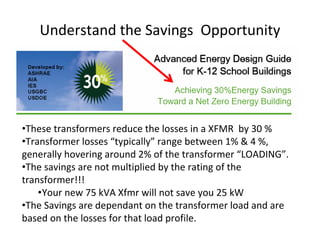
•These transformers reduce the losses in a XFMR  by 30 %
•Transformer losses “typically” range between 1% & 4 %, 
generally hovering around 2% of the transformer “LOADING”. 
•The savings are not multiplied by the rating of the 
transformer!!!
•Your new 75 kVA Xfmr will not save you 25 kW
•The Savings are dependant on the transformer load and are 
based on the losses for that load profile. 
Verify Efficiency Claims
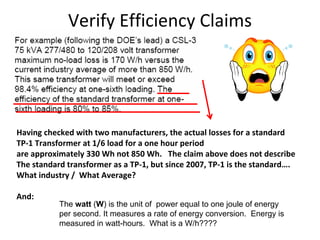
Having checked with two manufacturers, the actual losses for a standard 
TP‐1 Transformer at 1/6 load for a one hour period 
are approximately 330 Wh not 850 Wh.   The claim above does not describe
The standard transformer as a TP‐1, but since 2007, TP‐1 is the standard….
What industry /  What Average? 
And:
The watt (W) is the unit of power equal to one joule of energy
per second. It measures a rate of energy conversion. Energy is
measured in watt-hours. What is a W/h????
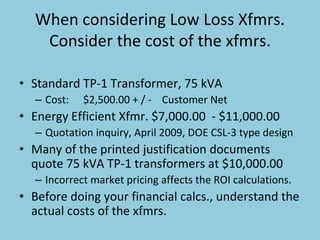
When considering Low Loss Xfmrs. 
Consider the cost of the xfmrs.
• Standard TP‐1 Transformer, 75 kVA
– Cost: $2,500.00 + / ‐ Customer Net
• Energy Efficient Xfmr. $7,000.00  ‐ $11,000.00
– Quotation inquiry, April 2009, DOE CSL‐3 type design
• Many of the printed justification documents 
quote 75 kVA TP‐1 transformers at $10,000.00
– Incorrect market pricing affects the ROI calculations.
• Before doing your financial calcs., understand the 
actual costs of the xfmrs. 
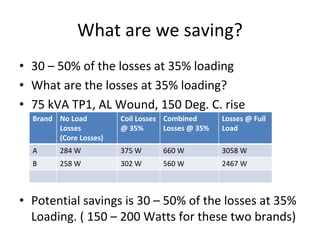
What are we saving?
• 30 – 50% of the losses at 35% loading
• What are the losses at 35% loading?
• 75 kVA TP1, AL Wound, 150 Deg. C. rise
• Potential savings is 30 – 50% of the losses at 35% 
Loading. ( 150 – 200 Watts for these two brands)
Brand  No Load
Losses 
(Core Losses)
Coil Losses 
@ 35% 
Combined 
Losses @ 35%
Losses @ Full 
Load
A 284 W 375 W 660 W 3058 W
B 258 W 302 W 560 W 2467 W
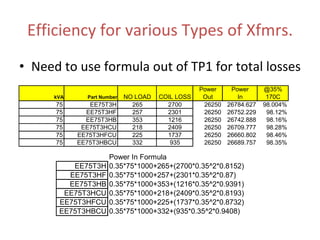
Efficiency for various Types of Xfmrs.
• Need to use formula out of TP1 for total losses 
kVA Part Number NO LOAD COIL LOSS
Power
Out
Power
In
@35%
170C
75 EE75T3H 265 2700 26250 26784.627 98.004%
75 EE75T3HF 257 2301 26250 26752.229 98.12%
75 EE75T3HB 353 1216 26250 26742.888 98.16%
75 EE75T3HCU 218 2409 26250 26709.777 98.28%
75 EE75T3HFCU 225 1737 26250 26660.802 98.46%
75 EE75T3HBCU 332 935 26250 26689.757 98.35%
Power In Formula
EE75T3H 0.35*75*1000+265+(2700*0.35^2*0.8152)
EE75T3HF 0.35*75*1000+257+(2301*0.35^2*0.87)
EE75T3HB 0.35*75*1000+353+(1216*0.35^2*0.9391)
EE75T3HCU 0.35*75*1000+218+(2409*0.35^2*0.8193)
EE75T3HFCU 0.35*75*1000+225+(1737*0.35^2*0.8732)
EE75T3HBCU 0.35*75*1000+332+(935*0.35^2*0.9408)
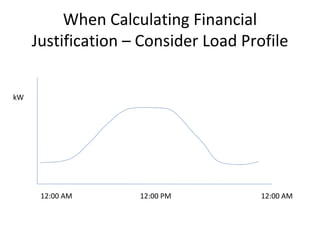
When Calculating Financial 
Justification – Consider Load Profile
12:00 AM                                     12:00 PM            12:00 AM
kW
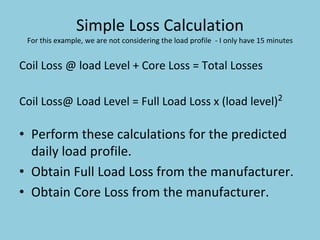
Simple Loss Calculation
For this example, we are not considering the load profile  ‐ I only have 15 minutes
Coil Loss @ load Level + Core Loss = Total Losses
Coil Loss@ Load Level = Full Load Loss x (load level)2
• Perform these calculations for the predicted 
daily load profile.
• Obtain Full Load Loss from the manufacturer.
• Obtain Core Loss from the manufacturer.
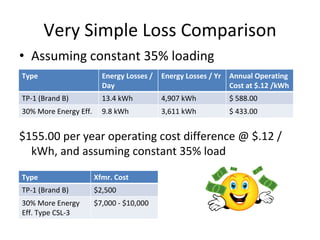
Very Simple Loss Comparison
• Assuming constant 35% loading
$155.00 per year operating cost difference @ $.12 / 
kWh, and assuming constant 35% load
Type Energy Losses / 
Day
Energy Losses / Yr Annual Operating  
Cost at $.12 /kWh
TP‐1 (Brand B) 13.4 kWh 4,907 kWh $ 588.00
30% More Energy Eff. 9.8 kWh 3,611 kWh $ 433.00
Type Xfmr. Cost
TP‐1 (Brand B) $2,500
30% More Energy 
Eff. Type CSL‐3
$7,000 ‐ $10,000
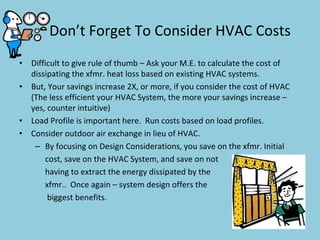
Don’t Forget To Consider HVAC Costs
• Difficult to give rule of thumb – Ask your M.E. to calculate the cost of 
dissipating the xfmr. heat loss based on existing HVAC systems.
• But, Your savings increase 2X, or more, if you consider the cost of HVAC 
(The less efficient your HVAC System, the more your savings increase –
yes, counter intuitive)
• Load Profile is important here.  Run costs based on load profiles.
• Consider outdoor air exchange in lieu of HVAC.
– By focusing on Design Considerations, you save on the xfmr. Initial 
cost, save on the HVAC System, and save on not  
having to extract the energy dissipated by the 
xfmr..  Once again – system design offers the
biggest benefits.   
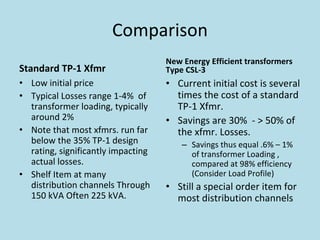
Comparison 
Standard TP‐1 Xfmr
• Low initial price
• Typical Losses range 1‐4%  of 
transformer loading, typically 
around 2%
• Note that most xfmrs. run far 
below the 35% TP‐1 design 
rating, significantly impacting 
actual losses.
• Shelf Item at many 
distribution channels Through 
150 kVA Often 225 kVA. 
New Energy Efficient transformers 
Type CSL‐3 
• Current initial cost is several 
times the cost of a standard 
TP‐1 Xfmr.
• Savings are 30%  ‐ > 50% of 
the xfmr. Losses.   
– Savings thus equal .6% – 1% 
of transformer Loading , 
compared at 98% efficiency 
(Consider Load Profile) 
• Still a special order item for 
most distribution channels
Conclusion
• It is critical to understand the savings opportunity provided by CSL‐
3 type product when compared to NEMA TP‐1 Product.
• The current difference in cost between CSL‐3 type transformers 
and standard TP‐1 units make justifying CSL‐3 units difficult.  
• CSL‐3 ROI should improve as the market levels out the price 
differential. 
• A significant opportunity exists with the HVAC system design (i.e. 
outside air exchange in lieu of air conditioned electrical rooms) 
• Contact your transformer manufacturer when transformer loading 
exceeds 35% for long periods of time, or where there exist 
significant power quality issues.
• One can make a case for investing today’s cost difference, between 
the   TP‐1 and CSL‐3 type transformers, in more effective energy 
efficient solutions.  (HVAC / Design / Measurement and Verification 
Systems) 
Thank You 
OK, you have to install the xfmr. In an air 
conditioned space, what are the benefits of the 
new xfmrs.?
• Full Load Losses   ( Should we design based on Full Load?) 
– Full Load Losses, AL wound, 150 deg. C rise, Std. TP‐1, 75kVA – 2725 
Watts
– Convert to BTUs/HR
• 3.412 x 2725 = 9298 BTUs/HR
– Used to size HVAC  (Note that few xfmrs. Run at full load, this will 
typically oversize the HVAC and lead to addl. Energy waste. )
• Using Loading Profile (maximum BTUs created in One Hour)
– TP1 units: 3633 BTU
– CSL 3 Type Xfmr. Manufacturer B: 2544 BTU
– Difference: 1089 BTU – can be used in optimizing energy performance

High Efficiency Transformers