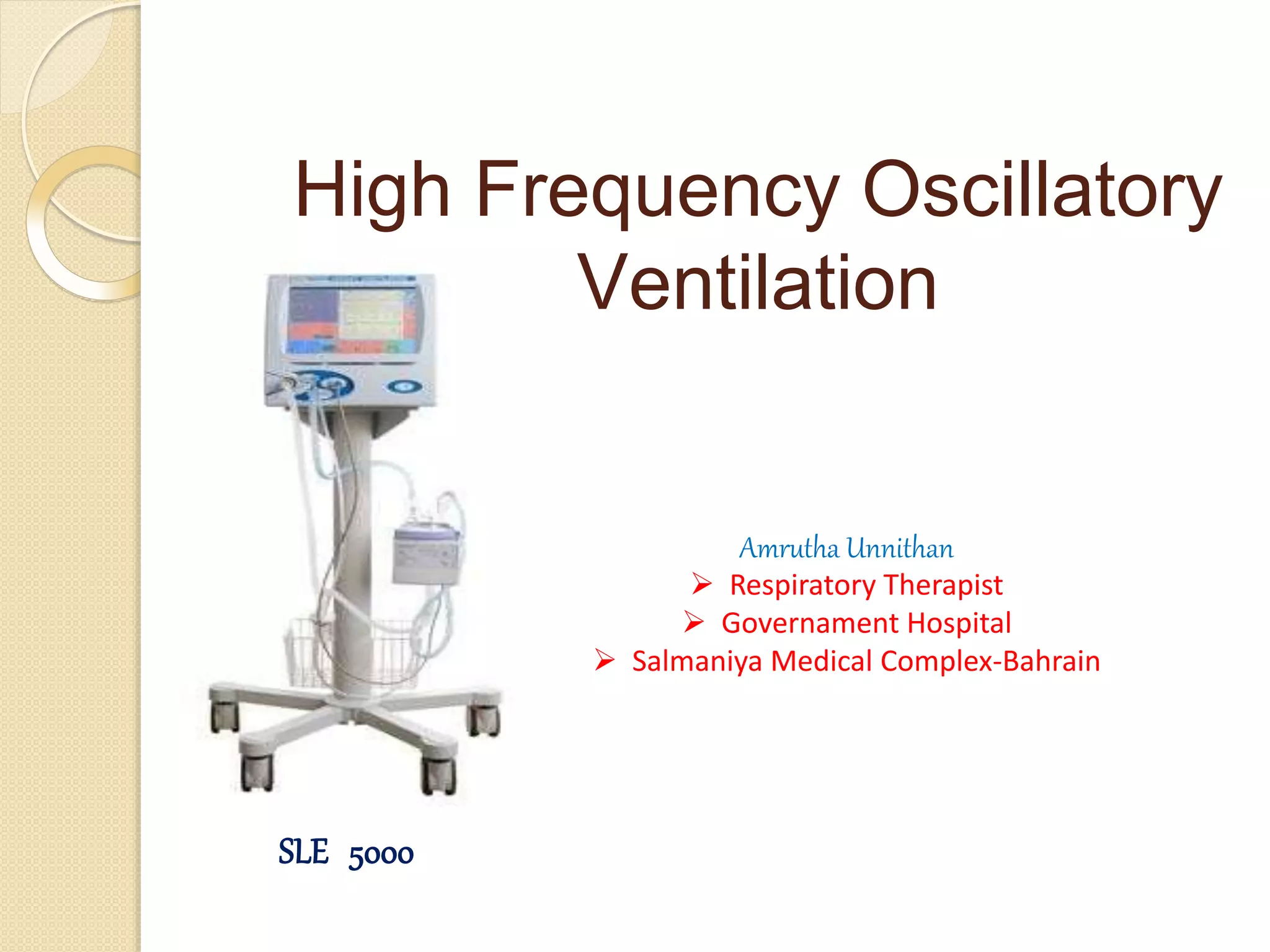
High Frequency Oscillatory
Ventilation
SLE 5000
Amrutha Unnithan
 Respiratory Therapist
 Governament Hospital
 Salmaniya Medical Complex-Bahrain
High Frequency
oscillatory ventilation
HFOV
High frequency oscillatory ventilator delivers
breaths at a very high rate with tidal volumes
usually less than or equal to anatomical dead
space volume at a constant high mean airway
pressure.
Main advantages of HFOV over
conventional ventilation
Smaller tidal volumeslimits alveolar over-distension
preventing volutrauma
Higher mean airway pressure results in better
recruitment of atelectactic alveoli.
Constant mean airway pressure during inspiration and
expiration prevents alveolar collapse.
Peak airway pressures are reduced minimising
potential for barotrauma.
Better gas exchange as the gas molecules are constantly
agitated inside the airway due to the oscillatory mechanism.
Gas exchange mechanism in
HFOV
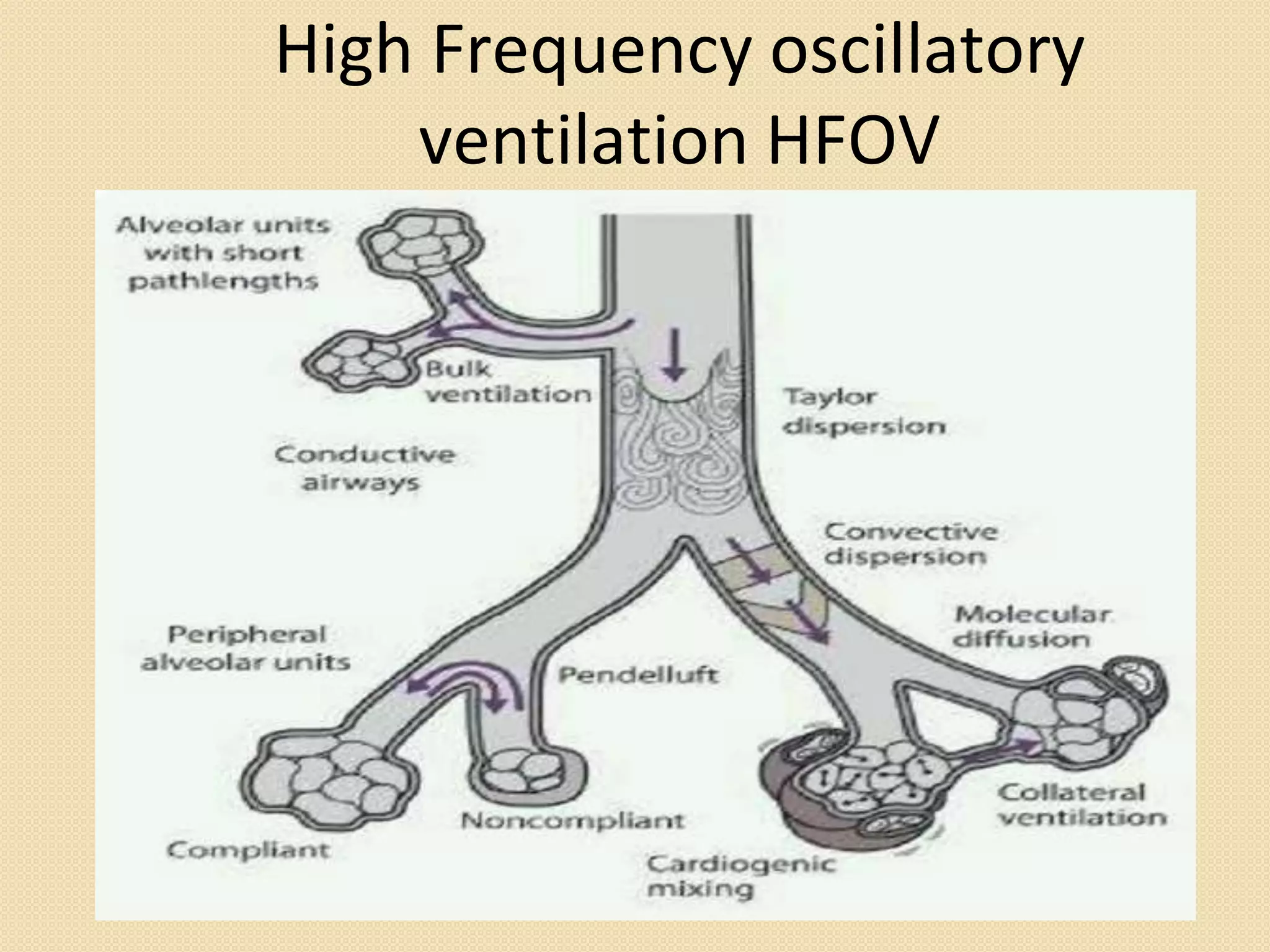
Direct Bulk flow (Convective ventilation):- Inspired gas directly reaches
alveolar regions more proximal to conducting airways (same like in
controlled mandatory ventilation)
Taylor Dispersion: – Interplay between convective forces and molecular
diffusion which enhances gas mixing.
Pendelluft: - Asynchronous filling of gas adjacent lung units with different
time constants. Gas flow from fast to slow filling units at end inspiration.
The reverse occurs at end expiration.
Asymmetric velocity profiles – High frequency bulk flow creates a bullet
shaped flow profile where the central molecules move further down the
airway than the molecules on the periphery of the airway during
inspiration. During expiration this profile is blunted where the central
molecules remain further down the airway but the peripheral molecules
move towards the entry point.
Cardiogenic mixing: - Cardiac contractions promote peripheral gas
mixing up to five fold along concentration gradient
Molecular diffusion: - Due to the increased turbulence of molecules gas
exchange across the alveolar- capillary membrane occurs more
efficiently
High Frequency oscillatory
ventilation HFOV
Mean airway pressure
Mean airway pressure is the constant pressure maintained in the
airway to keep the atelectatic lung area open.
Mean airway pressure is similar to PEEP in conventional
ventilation.
Red arrow represent the constant pressure maintained inside the
airway
Mean airway pressure is set by adjusting the bias flow knob as it is
flow dependent. Mean airway pressure is set 5cms above the mean
airway pressure set on the conventional ventilator.
Amplitude
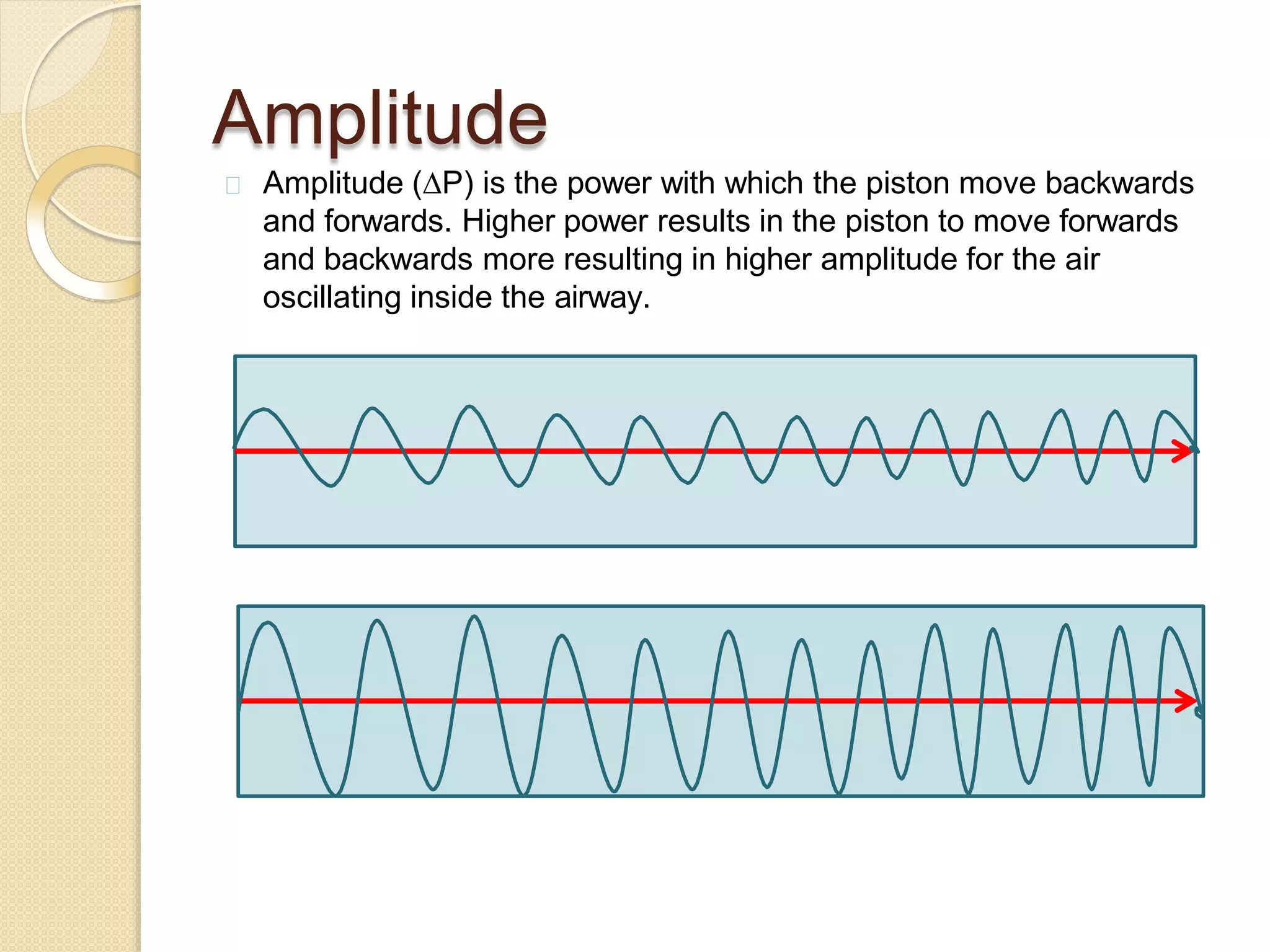
Amplitude (∆P) is the power with which the piston move backwards
and forwards. Higher power results in the piston to move forwards
and backwards more resulting in higher amplitude for the air
oscillating inside the airway.
Mean airway pressure
High Mean airway pressure is used in
HFOV. It is achieved by adjusting the
bias flow.
Mean airway pressure is increased to
improve oxygenation or PaO2
Frequency
Frequency is the respiratory rate and
is expresssed in Hertz.
1 Hertz = 60 breaths per minute..
Frequency is reduced to decrease
PaCO2 as there is more time for
exhalation.
PaO2 – directly proportional to FiO2
and mean airway pressure.
PaCO2 is controlled using amplitude
and Frequency.
PaCO2 can be decreased by
increasing the amplitude or
decreasing the frequency
Tidal volume and PaCO2.
Estimated alveolar ventilation is the product of the device
frequency and the square of the delivered tidal volume.
VCO2 = Frequency x Tidal volume2
Therefore any manoeuvres that alters tidal volume will alter
CO2 removal.
Thus decreasing amplitude decreases the delivered tidal
volume and thereby reduces CO2 elimination resulting in
increase PaCO2.
Respiratory frequency on PaCO2.
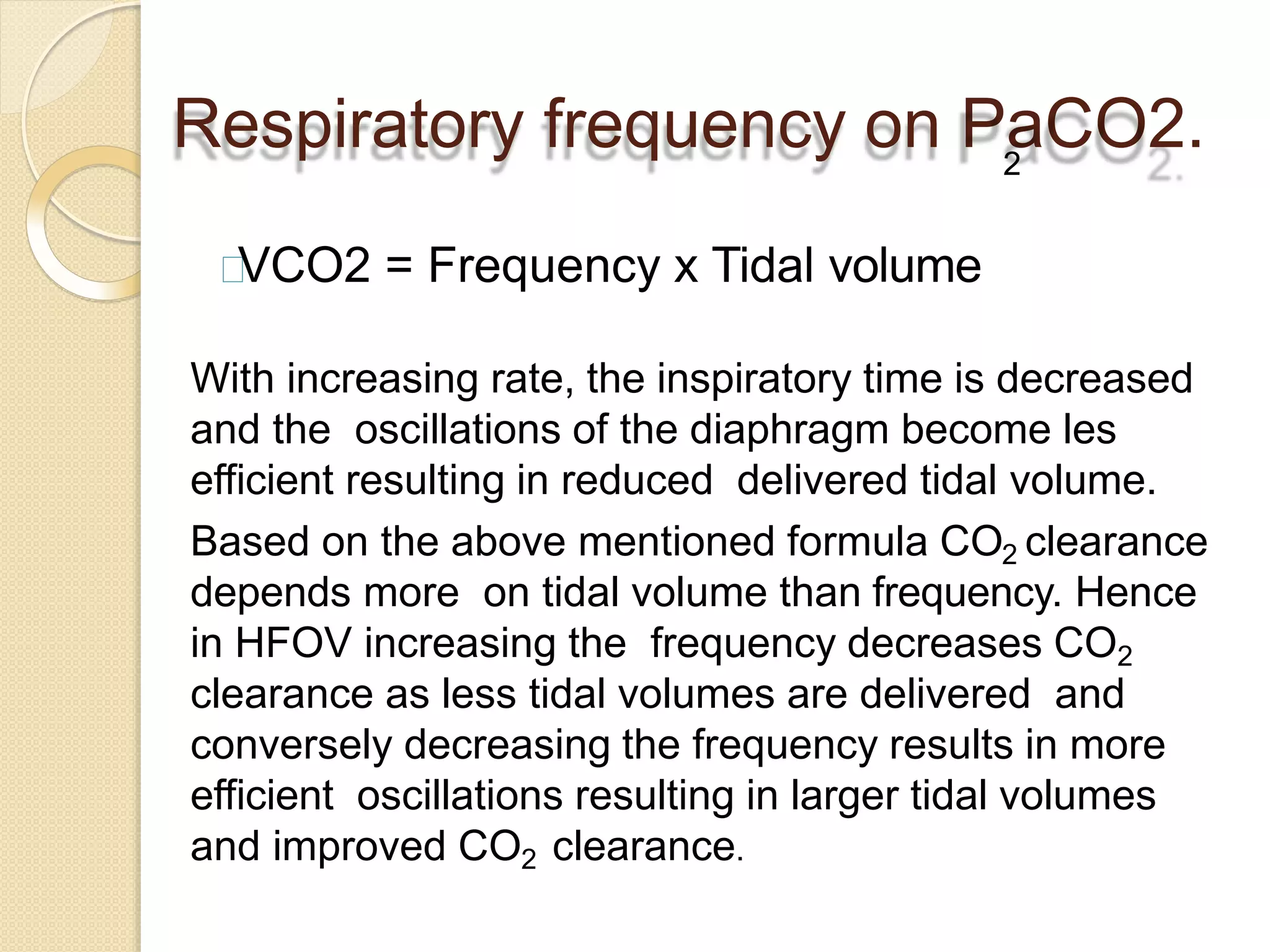
VCO2 = Frequency x Tidal volume
2
With increasing rate, the inspiratory time is decreased
and the oscillations of the diaphragm become les
efficient resulting in reduced delivered tidal volume.
Based on the above mentioned formula CO2 clearance
depends more on tidal volume than frequency. Hence
in HFOV increasing the frequency decreases CO2
clearance as less tidal volumes are delivered and
conversely decreasing the frequency results in more
efficient oscillations resulting in larger tidal volumes
and improved CO2 clearance.
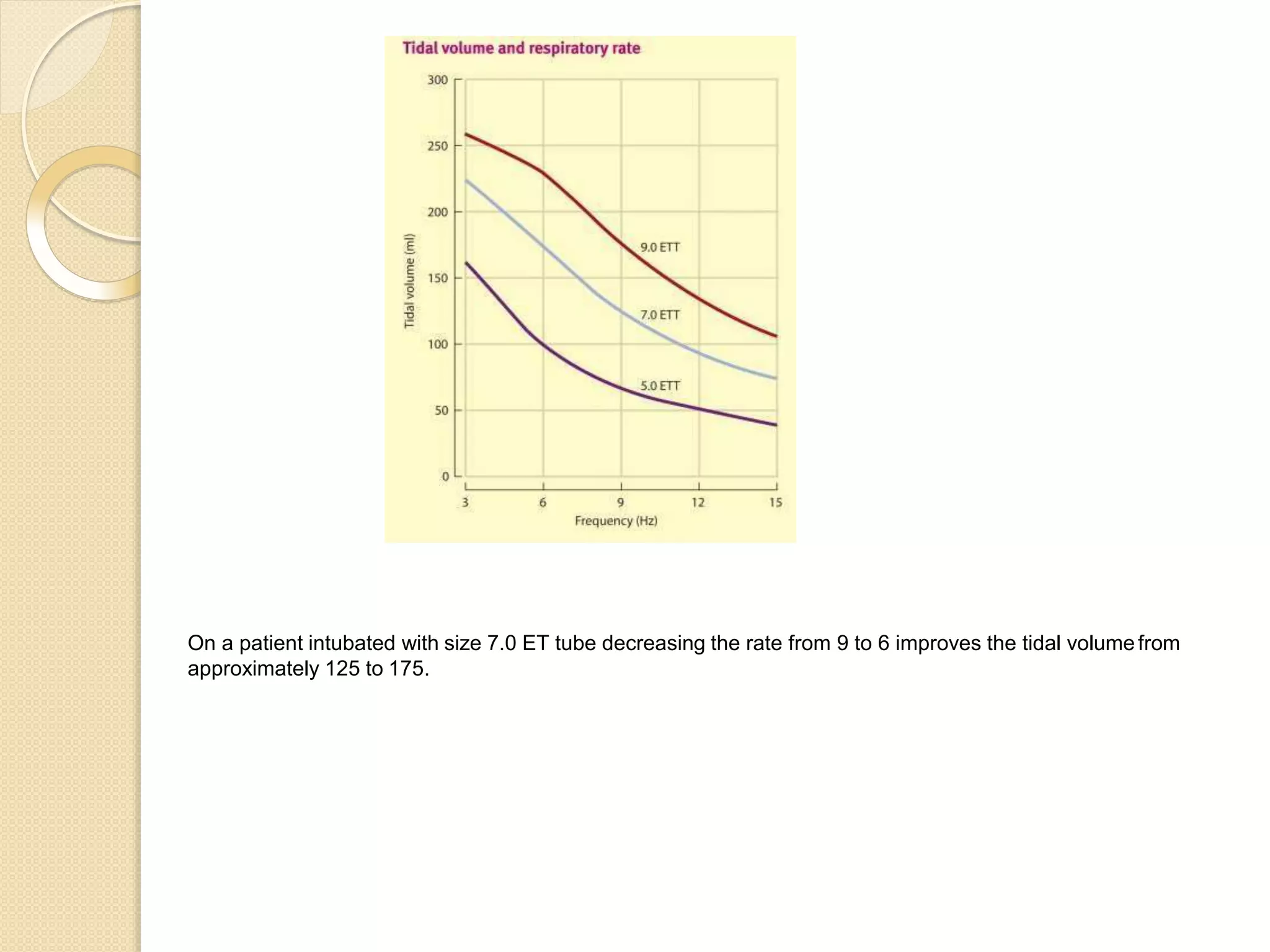
On a patient intubated with size 7.0 ET tube decreasing the rate from 9 to 6 improves the tidal volumefrom
approximately 125 to 175.
Cuff leak and PaCO2
Cuff leak should be used as a means of improving CO2 clearance
only when a maximum amplitude and a low rate is not improving
hypercarbia.
Cuff leak creates an alternative path outside the ET tube for CO2
clearance.
Inducing the cuff leak results in a decrease in mean airway pressure.
Hence it is important to adjust the bias flow to maintain the mean
airway pressure for this manoeuvre to be effective.
Indications for HFOV (as a rescue therapy
where conventional ventilation fails to improve
oxygenation
Severe ARDS where conventional ventilation fails
to improve oxygenation
Pulmonary contusion
Broncho-pleural fistulas and massive airleaks
Pulmonary contusion
Bronchial injury
Acute brain injury patients with raised ICP because
it avoids large swings in peak inspiratory pressure,
increases PaO2 and controls PaCO2
Burns: - facilitates early excision and closure of the
burn wounds by reversing hypoxaemia.
Complications and limitations
Pneumothorax
Haemodynamic compromise
◦ High pleural pressures can compromise venous
return
◦ High transpulmonary pressure increases right
ventricular after load
Prolonged sedation and neuromuscular blockade
Migration of ETT
Infection control
Aerosol delivery
Transport
Monitoring
Staff training
HFOV in Neonates.pptx

HFOV in Neonates.pptx

  • 1.
    High Frequency Oscillatory Ventilation SLE5000 Amrutha Unnithan  Respiratory Therapist  Governament Hospital  Salmaniya Medical Complex-Bahrain
  • 2.
    High Frequency oscillatory ventilation HFOV Highfrequency oscillatory ventilator delivers breaths at a very high rate with tidal volumes usually less than or equal to anatomical dead space volume at a constant high mean airway pressure.
  • 3.
    Main advantages ofHFOV over conventional ventilation Smaller tidal volumeslimits alveolar over-distension preventing volutrauma Higher mean airway pressure results in better recruitment of atelectactic alveoli. Constant mean airway pressure during inspiration and expiration prevents alveolar collapse. Peak airway pressures are reduced minimising potential for barotrauma. Better gas exchange as the gas molecules are constantly agitated inside the airway due to the oscillatory mechanism.
  • 4.
    Gas exchange mechanismin HFOV Direct Bulk flow (Convective ventilation):- Inspired gas directly reaches alveolar regions more proximal to conducting airways (same like in controlled mandatory ventilation) Taylor Dispersion: – Interplay between convective forces and molecular diffusion which enhances gas mixing. Pendelluft: - Asynchronous filling of gas adjacent lung units with different time constants. Gas flow from fast to slow filling units at end inspiration. The reverse occurs at end expiration. Asymmetric velocity profiles – High frequency bulk flow creates a bullet shaped flow profile where the central molecules move further down the airway than the molecules on the periphery of the airway during inspiration. During expiration this profile is blunted where the central molecules remain further down the airway but the peripheral molecules move towards the entry point. Cardiogenic mixing: - Cardiac contractions promote peripheral gas mixing up to five fold along concentration gradient Molecular diffusion: - Due to the increased turbulence of molecules gas exchange across the alveolar- capillary membrane occurs more efficiently
  • 5.
  • 6.
    Mean airway pressure Meanairway pressure is the constant pressure maintained in the airway to keep the atelectatic lung area open. Mean airway pressure is similar to PEEP in conventional ventilation. Red arrow represent the constant pressure maintained inside the airway Mean airway pressure is set by adjusting the bias flow knob as it is flow dependent. Mean airway pressure is set 5cms above the mean airway pressure set on the conventional ventilator.
  • 7.
    Amplitude Amplitude (∆P) isthe power with which the piston move backwards and forwards. Higher power results in the piston to move forwards and backwards more resulting in higher amplitude for the air oscillating inside the airway.
  • 8.
    Mean airway pressure HighMean airway pressure is used in HFOV. It is achieved by adjusting the bias flow. Mean airway pressure is increased to improve oxygenation or PaO2
  • 9.
    Frequency Frequency is therespiratory rate and is expresssed in Hertz. 1 Hertz = 60 breaths per minute.. Frequency is reduced to decrease PaCO2 as there is more time for exhalation.
  • 10.
    PaO2 – directlyproportional to FiO2 and mean airway pressure. PaCO2 is controlled using amplitude and Frequency. PaCO2 can be decreased by increasing the amplitude or decreasing the frequency
  • 11.
    Tidal volume andPaCO2. Estimated alveolar ventilation is the product of the device frequency and the square of the delivered tidal volume. VCO2 = Frequency x Tidal volume2 Therefore any manoeuvres that alters tidal volume will alter CO2 removal. Thus decreasing amplitude decreases the delivered tidal volume and thereby reduces CO2 elimination resulting in increase PaCO2.
  • 12.
    Respiratory frequency onPaCO2. VCO2 = Frequency x Tidal volume 2 With increasing rate, the inspiratory time is decreased and the oscillations of the diaphragm become les efficient resulting in reduced delivered tidal volume. Based on the above mentioned formula CO2 clearance depends more on tidal volume than frequency. Hence in HFOV increasing the frequency decreases CO2 clearance as less tidal volumes are delivered and conversely decreasing the frequency results in more efficient oscillations resulting in larger tidal volumes and improved CO2 clearance.
  • 13.
    On a patientintubated with size 7.0 ET tube decreasing the rate from 9 to 6 improves the tidal volumefrom approximately 125 to 175.
  • 14.
    Cuff leak andPaCO2 Cuff leak should be used as a means of improving CO2 clearance only when a maximum amplitude and a low rate is not improving hypercarbia. Cuff leak creates an alternative path outside the ET tube for CO2 clearance. Inducing the cuff leak results in a decrease in mean airway pressure. Hence it is important to adjust the bias flow to maintain the mean airway pressure for this manoeuvre to be effective.
  • 16.
    Indications for HFOV(as a rescue therapy where conventional ventilation fails to improve oxygenation Severe ARDS where conventional ventilation fails to improve oxygenation Pulmonary contusion Broncho-pleural fistulas and massive airleaks Pulmonary contusion Bronchial injury Acute brain injury patients with raised ICP because it avoids large swings in peak inspiratory pressure, increases PaO2 and controls PaCO2 Burns: - facilitates early excision and closure of the burn wounds by reversing hypoxaemia.
  • 17.
    Complications and limitations Pneumothorax Haemodynamiccompromise ◦ High pleural pressures can compromise venous return ◦ High transpulmonary pressure increases right ventricular after load Prolonged sedation and neuromuscular blockade Migration of ETT Infection control Aerosol delivery Transport Monitoring Staff training