Welcome! Heinen + Löwenstein GmbH Arzbacher Straße 80 D-56130 Bad Ems Tel. +49 (0) 2603 9600-0 Fax +49 (0) 2603 960050 www.hul.de
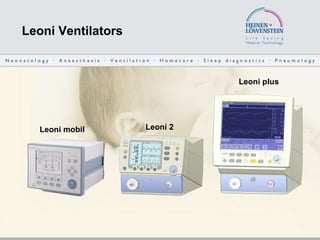
Leoni Ventilators Leoni mobil Leoni 2 Leoni plus
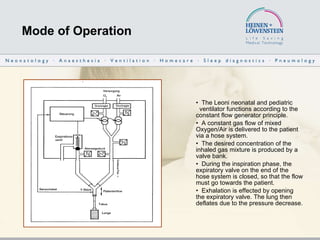
Mode of Operation The Leoni neonatal and pediatric  ventilator functions according to the constant flow generator principle .  A constant gas flow of mixed Oxygen/Air is delivered to the patient via a hose system.  The desired concentration of the inhaled gas mixture is produced by a valve bank .  During the inspiration phase, the expiratory valve on the end of the hose system is closed, so that the flow must go towards the patient .  Exhalation is effected by opening the expiratory valve. The lung then deflates due to the pressure decrease .
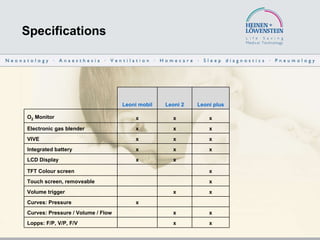
Specifications x x   Lopps: F/P, V/P, F/V x x   Curves: Pressure / Volume / Flow     x Curves: Pressure x x   Volume trigger x     Touch screen, removeable x     TFT Colour screen   x x LCD Display x x x Integrated battery x x x VIVE x x x Electronic gas blender x x x O 2  Monitor Leoni plus Leoni 2 Leoni mobil
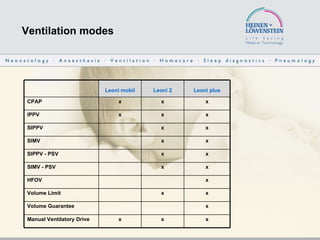
Ventilation modes x x x Manual Ventilatory Drive x     Volume Guarantee x x   Volume Limit x     HFOV x x   SIMV - PSV x x   SIPPV - PSV x x   SIMV x x   SIPPV x x x IPPV x x x CPAP Leoni plus Leoni 2 Leoni mobil
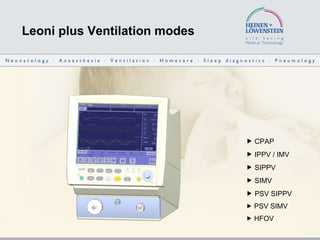
Leoni plus Ventilation modes    CPAP    IPPV / IMV    SIPPV    SIMV    PSV SIPPV PSV SIMV HFOV
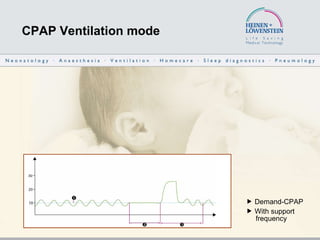
CPAP Ventilation mode    Demand-CPAP    With support    frequency
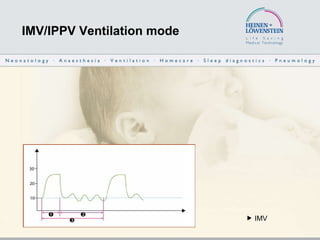
IMV/IPPV Ventilation mode    IMV
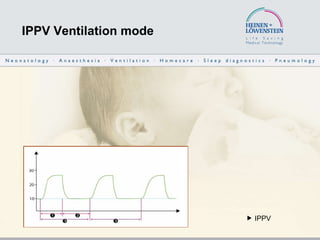
IPPV Ventilation mode    I PPV
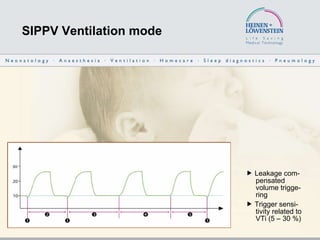
SIPPV Ventilation mode    Leakage com-   pensated    volume trigge-   ring    Trigger sensi-   tivity related to    VTi (5 – 30 %)
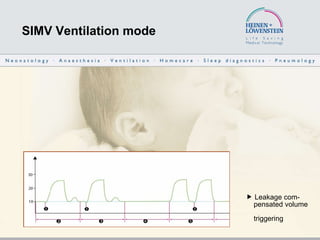
SIMV Ventilation mode    Leakage com-   pensated volume    triggering
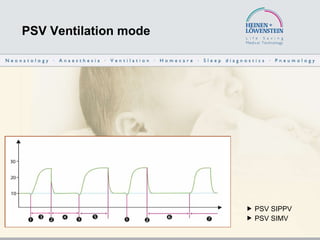
PSV Ventilation mode    PSV SIPPV    PSV SIMV
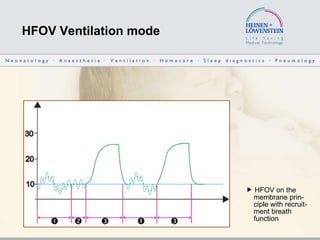
HFOV Ventilation mode    HFOV on the    membrane prin-   ciple with recruit-   ment breath    function
Setting ranges   IPPV/ IMV SIMV SIPPV CPAP Breath rate FREQUENCY [BPM] 6 .. 200 2 .. 100 2 .. 100 - Inspiration time I-TIME [sec] 0.10 .. 2.00 0.10 .. 2.00 0.10 .. 2.00 - Expiration  time E-time [sec] 0.20 .. 10.00 0.50 .. 30.00 0.20 .. 30.00 - Inspiratory Flow INSP FLOW [l/min] 1 .. 32 1 .. 32 1 .. 32 - Expiratory Flow  E Flow [l/min] 2 .. 10 2 .. 10 2 .. 10 -
Setting ranges   IPPV/ IMV SIMV SIPPV CPAP           Inspiratory Pressure P INSP [cmH2O] 6 .. 60 6 .. 60 6 .. 60 - Backup Pressure P-BACK [cmH2O] - - - 6 .. 60 Positive End Expiratory Pressure PEEP [cmH2O] 0 .. 20 0 .. 20 0 .. 20 - CPAP [cmH2O] - - - 1 .. 20
Setting ranges   IPPV/ IMV SIMV SIPPV CPAP           O 2  Concentration OXYGEN [%] 21 .. 100 21 .. 100 21 .. 100 21 .. 100 O 2  Concentration Oxygen flush O2-Flush [%] 23 .. 100 23 .. 100 23 .. 100 23 .. 100 Volume trigger TRIGGER [% VTi] - 10 .. 30 10 .. 30 -
Setting ranges   HFOV Mean Pressure Pmean [cmH2O] 10 .. 30 High Frequency HFFreq  [Hz] 5 .. 20 High Frequency Amplitude HFAmpl  [cmH2O] 5 .. 80 Recruitment Frequency FreqRec  [1/min] 0 .. 10 Recruitment Inspiration Time TI Rec  [s] 0.1 .. 3
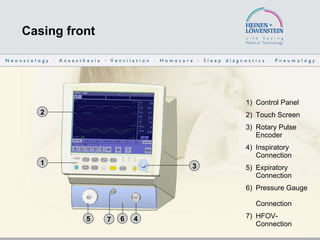
Casing front Control Panel Touch Screen Rotary Pulse   Encoder Inspiratory   Connection Expiratory  Connection Pressure Gauge   Connection HFOV-  Connection 2 1 3 5 7 6 4
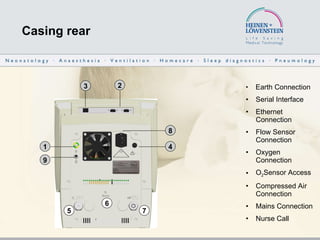
Casing rear Earth Connection Serial Interface Ethernet   Connection Flow Sensor   Connection Oxygen   Connection O 2 Sensor Access Compressed Air   Connection Mains Connection Nurse Call 3 2 1 9 5 6 7 8 4
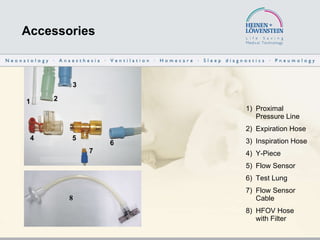
Accessories Proximal   Pressure Line Expiration Hose Inspiration Hose Y-Piece Flow Sensor Test Lung Flow Sensor   Cable HFOV Hose   with Filter 8
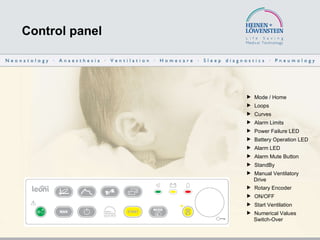
Control panel    Mode / Home    Loops    Curves    Alarm Limits    Power Failure LED    Battery Operation LED    Alarm LED    Alarm Mute Button    StandBy    Manual Ventilatory Drive    Rotary Encoder    ON/OFF    Start Ventilation    Numerical Values Switch-Over
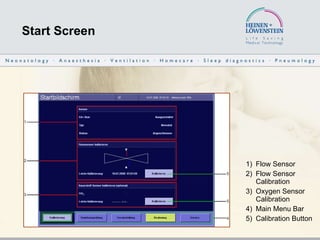
Start Screen Flow Sensor Flow Sensor  Calibration Oxygen Sensor  Calibration Main Menu Bar Calibration Button
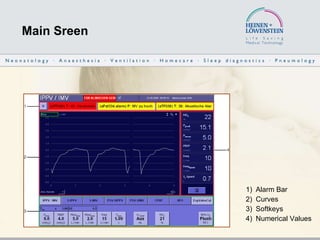
Main Sreen Alarm Bar Curves Softkeys Numerical Values
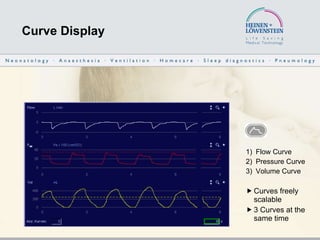
Curve Display Flow Curve Pressure Curve Volume Curve Curves freely scalable 3 Curves at the same time
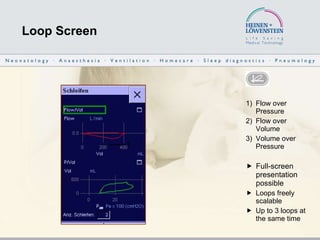
Loop Screen Flow over   Pressure Flow over   Volume Volume over   Pressure Full-screen   presentation   possible Loops freely   scalable Up to 3 loops at   the same time
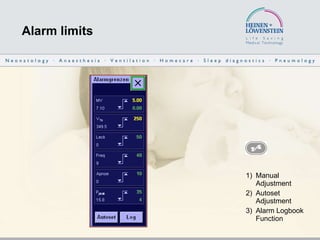
Alarm limits Manual   Adjustment Autoset   Adjustment  Alarm Logbook  Function
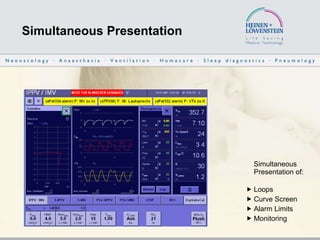
Simultaneous Presentation Simultaneous Presentation of: Loops Curve Screen Alarm Limits Monitoring
HFO Leoni  plus High-frequency ventilation (HFV) as a ventilatory therapy has reached increasing clinical application over the past ten years. The term comprises several methods. High-frequency jet ventilation must be differentiated from high-frequency oscillatory ventilation (HFOV or HFO). In this booklet I concentrate on high-frequency oscillatory ventilation. Therefore, the difference in meaning notwithstanding, I use both acronyms, HFV and HFO, interchangeably.
Indications for HFV Since the early eighties results on oscillatory ventilation have been published in numerous case reports and studies.  Yet there are only few controlled studies based on large numbers of patients. In newborns HFV has first been employed as a rescue treatment. The goal of this type of ventilation is to improve gas exchange and at the same time reduce pulmonary barotrauma. Oscillatory ventilation can be tried when conventional ventilation fails, or when barotrauma has already occurred or is imminent.  In the first place this applies to pulmonary diseases with reduced compliance. The efficacy of HFV for these indications has been proven in the majority of clinical studies. In severe lung failure, HFV was a feasible alternative to ECMO  When to switch from conventional ventilation to HFV must certainly be decided by the clinician in charge, according to their experience. Some centres meanwhile apply HFV as a primary treatment for RDS in the scope of studies. Likewise, in cases of congenital  hernia and during surgical correction, HFV has been successfully used  as a primary treatment
Indications; HFV+IMV Also in different kinds of surgery, especially in the  region of the larynx and the trachea, HFV has proven  its worth. Moreover, in primary pulmonary hypertension  of the newborn HFV can improve oxygenation and  Ventilation. Always observing the contraindications  in our NICU we follow this proven procedure: If conventional ventilation* fails, we will switch over to HFV. We will assume failure of conventional ventilation, if maintaining adequate blood gas tensions (pO2 > 50mmHg, SaO2 > 90%; pCO2 < 55 to 65 mmHg) requires peak inspiratory pressures (PIP) in excess of certain limits. Those depend on gestational age and bodyweight: In small prematures we consider using HFV at PIP higher than 22 mbar. With PIP going beyond 25 mbar we regard HFV even as a necessity. In more mature infants the pressure limits are somewhat higher
Combining HFV and IMV, and  sustained inflation Oscillatory ventilation on its own can be used in the CPAP mode, or with superimposed IMV strokes, usually at a rate of 3 to 5 strokes per minute.  The benefit of the IMV breaths is probably due to the opening of uninflated lung units to achieve further ‘volume recruitment’. Sometimes very long inspiratory times (15 to 30 s) are suggested for these sustained inflations (SI). By applying them about every 20 minutes compliance and oxygenation have been improved and atelectases prevented.
Combining HFV and IMV, and  sustained inflation Especially after volume loss by deflation during suctioning the lung soon can be reopened with a sustained inflation. However, whether these inflation manoeuvres should be employed routinely is subject of controversial discussions.  In most of the clinical studies no sustained inflations were applied.  In animal trials no increased incidence of barotrauma was found. Prevention of atelectases, which might occur under HFV with insufficient MAP, is the primary benefit of combining HFV and IMV.  HFV superimposed to a normal IMV can markedly improve CO2  washout (‘flushing the deadspace’ by HFV) at lower peak pressures
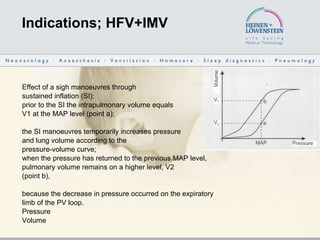
Indications; HFV+IMV Effect of a sigh manoeuvres through  sustained inflation (SI): prior to the SI the intrapulmonary volume equals  V1 at the MAP level (point a);  the SI manoeuvres temporarily increases pressure  and lung volume according to the  pressure-volume curve;  when the pressure has returned to the previous MAP level,  pulmonary volume remains on a higher level, V2 (point b),  because the decrease in pressure occurred on the expiratory limb of the PV loop. Pressure Volume
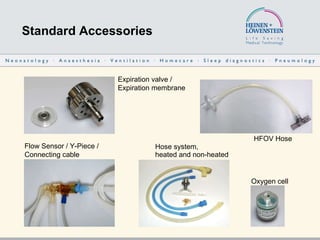
Standard Accessories Hose system,  heated and non-heated Flow Sensor / Y-Piece /  Connecting cable Expiration valve /  Expiration membrane Oxygen cell HFOV Hose
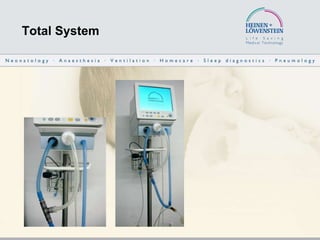
Total System
Thank you very much for  your   open interest Heinen + Löwenstein GmbH Arzbacher Straße 80 D-56130 Bad Ems Tel. +49 (0) 2603 9600-0 Fax +49 (0) 2603 960050 www.hul.de

Leoni Plus PräSent Hfo Eng

  • 1.
    Welcome! Heinen +Löwenstein GmbH Arzbacher Straße 80 D-56130 Bad Ems Tel. +49 (0) 2603 9600-0 Fax +49 (0) 2603 960050 www.hul.de
  • 2.
    Leoni Ventilators Leonimobil Leoni 2 Leoni plus
  • 3.
    Mode of OperationThe Leoni neonatal and pediatric ventilator functions according to the constant flow generator principle . A constant gas flow of mixed Oxygen/Air is delivered to the patient via a hose system. The desired concentration of the inhaled gas mixture is produced by a valve bank . During the inspiration phase, the expiratory valve on the end of the hose system is closed, so that the flow must go towards the patient . Exhalation is effected by opening the expiratory valve. The lung then deflates due to the pressure decrease .
  • 4.
    Specifications x x  Lopps: F/P, V/P, F/V x x   Curves: Pressure / Volume / Flow     x Curves: Pressure x x   Volume trigger x     Touch screen, removeable x     TFT Colour screen   x x LCD Display x x x Integrated battery x x x VIVE x x x Electronic gas blender x x x O 2 Monitor Leoni plus Leoni 2 Leoni mobil
  • 5.
    Ventilation modes xx x Manual Ventilatory Drive x     Volume Guarantee x x   Volume Limit x     HFOV x x   SIMV - PSV x x   SIPPV - PSV x x   SIMV x x   SIPPV x x x IPPV x x x CPAP Leoni plus Leoni 2 Leoni mobil
  • 6.
    Leoni plus Ventilationmodes  CPAP  IPPV / IMV  SIPPV  SIMV  PSV SIPPV PSV SIMV HFOV
  • 7.
    CPAP Ventilation mode Demand-CPAP  With support frequency
  • 8.
  • 9.
  • 10.
    SIPPV Ventilation mode Leakage com- pensated volume trigge- ring  Trigger sensi- tivity related to VTi (5 – 30 %)
  • 11.
    SIMV Ventilation mode Leakage com- pensated volume triggering
  • 12.
    PSV Ventilation mode PSV SIPPV  PSV SIMV
  • 13.
    HFOV Ventilation mode HFOV on the membrane prin- ciple with recruit- ment breath function
  • 14.
    Setting ranges  IPPV/ IMV SIMV SIPPV CPAP Breath rate FREQUENCY [BPM] 6 .. 200 2 .. 100 2 .. 100 - Inspiration time I-TIME [sec] 0.10 .. 2.00 0.10 .. 2.00 0.10 .. 2.00 - Expiration time E-time [sec] 0.20 .. 10.00 0.50 .. 30.00 0.20 .. 30.00 - Inspiratory Flow INSP FLOW [l/min] 1 .. 32 1 .. 32 1 .. 32 - Expiratory Flow E Flow [l/min] 2 .. 10 2 .. 10 2 .. 10 -
  • 15.
    Setting ranges  IPPV/ IMV SIMV SIPPV CPAP           Inspiratory Pressure P INSP [cmH2O] 6 .. 60 6 .. 60 6 .. 60 - Backup Pressure P-BACK [cmH2O] - - - 6 .. 60 Positive End Expiratory Pressure PEEP [cmH2O] 0 .. 20 0 .. 20 0 .. 20 - CPAP [cmH2O] - - - 1 .. 20
  • 16.
    Setting ranges  IPPV/ IMV SIMV SIPPV CPAP           O 2 Concentration OXYGEN [%] 21 .. 100 21 .. 100 21 .. 100 21 .. 100 O 2 Concentration Oxygen flush O2-Flush [%] 23 .. 100 23 .. 100 23 .. 100 23 .. 100 Volume trigger TRIGGER [% VTi] - 10 .. 30 10 .. 30 -
  • 17.
    Setting ranges  HFOV Mean Pressure Pmean [cmH2O] 10 .. 30 High Frequency HFFreq [Hz] 5 .. 20 High Frequency Amplitude HFAmpl [cmH2O] 5 .. 80 Recruitment Frequency FreqRec [1/min] 0 .. 10 Recruitment Inspiration Time TI Rec [s] 0.1 .. 3
  • 18.
    Casing front ControlPanel Touch Screen Rotary Pulse Encoder Inspiratory Connection Expiratory Connection Pressure Gauge Connection HFOV- Connection 2 1 3 5 7 6 4
  • 19.
    Casing rear EarthConnection Serial Interface Ethernet Connection Flow Sensor Connection Oxygen Connection O 2 Sensor Access Compressed Air Connection Mains Connection Nurse Call 3 2 1 9 5 6 7 8 4
  • 20.
    Accessories Proximal Pressure Line Expiration Hose Inspiration Hose Y-Piece Flow Sensor Test Lung Flow Sensor Cable HFOV Hose with Filter 8
  • 21.
    Control panel  Mode / Home  Loops  Curves  Alarm Limits  Power Failure LED  Battery Operation LED  Alarm LED  Alarm Mute Button  StandBy  Manual Ventilatory Drive  Rotary Encoder  ON/OFF  Start Ventilation  Numerical Values Switch-Over
  • 22.
    Start Screen FlowSensor Flow Sensor Calibration Oxygen Sensor Calibration Main Menu Bar Calibration Button
  • 23.
    Main Sreen AlarmBar Curves Softkeys Numerical Values
  • 24.
    Curve Display FlowCurve Pressure Curve Volume Curve Curves freely scalable 3 Curves at the same time
  • 25.
    Loop Screen Flowover Pressure Flow over Volume Volume over Pressure Full-screen presentation possible Loops freely scalable Up to 3 loops at the same time
  • 26.
    Alarm limits Manual Adjustment Autoset Adjustment Alarm Logbook Function
  • 27.
    Simultaneous Presentation SimultaneousPresentation of: Loops Curve Screen Alarm Limits Monitoring
  • 28.
    HFO Leoni plus High-frequency ventilation (HFV) as a ventilatory therapy has reached increasing clinical application over the past ten years. The term comprises several methods. High-frequency jet ventilation must be differentiated from high-frequency oscillatory ventilation (HFOV or HFO). In this booklet I concentrate on high-frequency oscillatory ventilation. Therefore, the difference in meaning notwithstanding, I use both acronyms, HFV and HFO, interchangeably.
  • 29.
    Indications for HFVSince the early eighties results on oscillatory ventilation have been published in numerous case reports and studies. Yet there are only few controlled studies based on large numbers of patients. In newborns HFV has first been employed as a rescue treatment. The goal of this type of ventilation is to improve gas exchange and at the same time reduce pulmonary barotrauma. Oscillatory ventilation can be tried when conventional ventilation fails, or when barotrauma has already occurred or is imminent. In the first place this applies to pulmonary diseases with reduced compliance. The efficacy of HFV for these indications has been proven in the majority of clinical studies. In severe lung failure, HFV was a feasible alternative to ECMO When to switch from conventional ventilation to HFV must certainly be decided by the clinician in charge, according to their experience. Some centres meanwhile apply HFV as a primary treatment for RDS in the scope of studies. Likewise, in cases of congenital hernia and during surgical correction, HFV has been successfully used as a primary treatment
  • 30.
    Indications; HFV+IMV Alsoin different kinds of surgery, especially in the region of the larynx and the trachea, HFV has proven its worth. Moreover, in primary pulmonary hypertension of the newborn HFV can improve oxygenation and Ventilation. Always observing the contraindications in our NICU we follow this proven procedure: If conventional ventilation* fails, we will switch over to HFV. We will assume failure of conventional ventilation, if maintaining adequate blood gas tensions (pO2 > 50mmHg, SaO2 > 90%; pCO2 < 55 to 65 mmHg) requires peak inspiratory pressures (PIP) in excess of certain limits. Those depend on gestational age and bodyweight: In small prematures we consider using HFV at PIP higher than 22 mbar. With PIP going beyond 25 mbar we regard HFV even as a necessity. In more mature infants the pressure limits are somewhat higher
  • 31.
    Combining HFV andIMV, and sustained inflation Oscillatory ventilation on its own can be used in the CPAP mode, or with superimposed IMV strokes, usually at a rate of 3 to 5 strokes per minute. The benefit of the IMV breaths is probably due to the opening of uninflated lung units to achieve further ‘volume recruitment’. Sometimes very long inspiratory times (15 to 30 s) are suggested for these sustained inflations (SI). By applying them about every 20 minutes compliance and oxygenation have been improved and atelectases prevented.
  • 32.
    Combining HFV andIMV, and sustained inflation Especially after volume loss by deflation during suctioning the lung soon can be reopened with a sustained inflation. However, whether these inflation manoeuvres should be employed routinely is subject of controversial discussions. In most of the clinical studies no sustained inflations were applied. In animal trials no increased incidence of barotrauma was found. Prevention of atelectases, which might occur under HFV with insufficient MAP, is the primary benefit of combining HFV and IMV. HFV superimposed to a normal IMV can markedly improve CO2 washout (‘flushing the deadspace’ by HFV) at lower peak pressures
  • 33.
    Indications; HFV+IMV Effectof a sigh manoeuvres through sustained inflation (SI): prior to the SI the intrapulmonary volume equals V1 at the MAP level (point a); the SI manoeuvres temporarily increases pressure and lung volume according to the pressure-volume curve; when the pressure has returned to the previous MAP level, pulmonary volume remains on a higher level, V2 (point b), because the decrease in pressure occurred on the expiratory limb of the PV loop. Pressure Volume
  • 34.
    Standard Accessories Hosesystem, heated and non-heated Flow Sensor / Y-Piece / Connecting cable Expiration valve / Expiration membrane Oxygen cell HFOV Hose
  • 35.
  • 36.
    Thank you verymuch for your open interest Heinen + Löwenstein GmbH Arzbacher Straße 80 D-56130 Bad Ems Tel. +49 (0) 2603 9600-0 Fax +49 (0) 2603 960050 www.hul.de