SUBJECT: - NURSING EDUCATION
Microteaching on
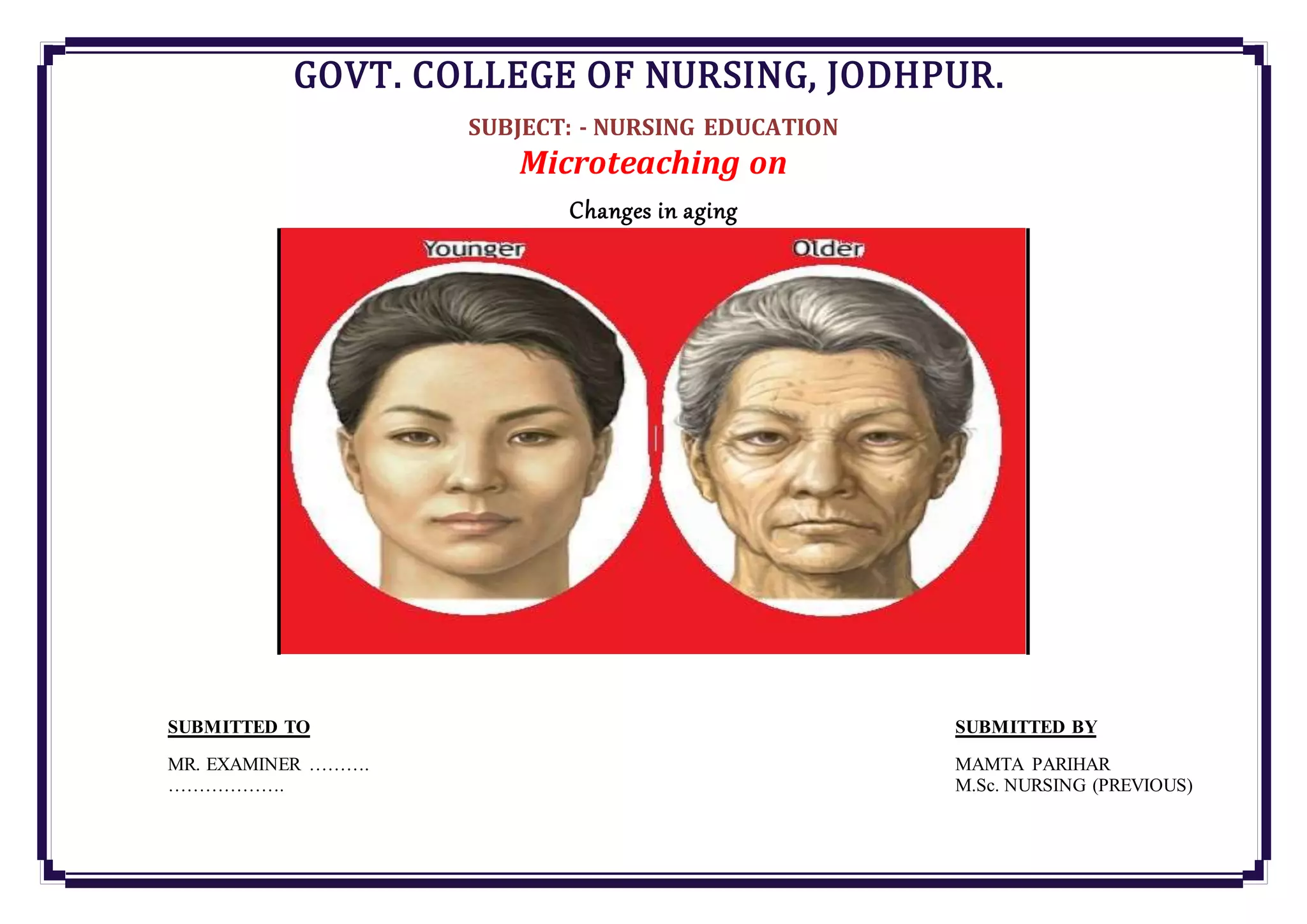
Changes in aging
SUBMITTED TO SUBMITTED BY
MR. EXAMINER ………. MAMTA PARIHAR
………………. M.Sc. NURSING (PREVIOUS)
GOVT. COLLEGE OF NURSING, JODHPUR.
………………………… BATCH – 2013-14
LESSON PLAN
INRODUCTION
 Student TeacherName - MAMTA PARIHAR
 Subject - ………………………..
 Topic - Changes in aging
 Group - ……………..
 Venue - Examination room
 Date and Time - 6/1/2015
 Duration - 10 minutes
 Method of Teaching - lecture cum discussion
 A.V. Aids -PPT, black board, model and flash cards
PREVIOUS KNOWLEDGE OF THE GROUP
 Students have basic knowledge about geriatric nursing.
GENERAL OBJECTIVE
 At the end of the class students will gain an in depth knowledge about Geriatric nursing and will be able to apply knowledge in their
future practice.
SPECIFIC OBJECTIVES :
At the end of the class the group will be able to...
 Define Geriatric nursing.
 To enumerate the factors influencing aging.
 Describe changes in old age.
S.
No.
Specific
Objective
Duration Content
Teaching
learning Activity
A.V.
Aids
Evaluation
1.
2.
At the end of
classroom
teaching students
will be able to
To explain
Geriatric nursing
To define
Geriatric nursing
2 min
1 min.
“Grow old along with me! The best is yet to be”
Robert browning.
SELF-INTRODUCTION:-
Mamta Parihar, M.Sc Nursing previous year.
INTRODUCTION:-
Aging, the normal process of time-related change, begins
with birth and continues throughout life. Health
professionals will be challenged to design strategies that
address the higher prevalence of illness within this aging
population.
Gerontological nursing is the specialty of nursing pertaining
to older adults. Gerontological nurses work in collaboration
with older adults, their families, and communities to support
healthy aging, maximum functioning, and quality of life.
The term gerontological nursing, which replaced the term
geriatric nursing in the 1970s, is seen as being more
consistent with the specialty's broader focus on health and
wellness, in addition to illness.
DEFINITIONS: -
 Geriatrics: the study of old age that includes the
physiology, pathology, diagnosis, and management of
the disorders and diseases of older adults
 Gerontology: the combined biologic, psychologic,
and sociologic study of older adults within their
environment
Lecture cum
discussion
PPT, chalk
and board
What do you
know about
Geriatric
nursing?
What is geriatric
nursing?
S.
No.
Specific
Objective
Duration Content
Teaching
Learning activity
A.V.
Aids
Evaluation
3.
4.
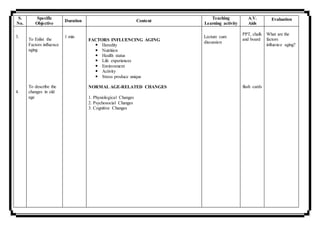
To Enlist the
Factors influence
aging
To describe the
changes in old
age
1 min
FACTORS INFLUENCING AGING
 Heredity
 Nutrition
 Health status
 Life experiences
 Environment
 Activity
 Stress produce unique
NORMAL AGE-RELATED CHANGES
1. Physiological Changes
2. Psychosocial Changes
3. Cognitive Changes
Lecture cum
discussion
PPT, chalk
and board
flash cards
What are the
factors
influence aging?
S.
No.
Specific
Objective
Duration Content
Teaching
Learning activity
A.V.
Aids
Evaluation
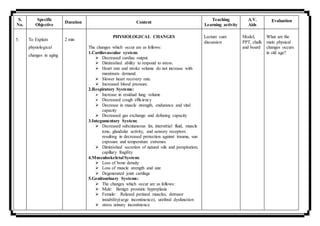
5. To Explain
physiological
changes in aging
2 min
PHYSIOLOGICAL CHANGES
The changes which occur are as follows:
1.Cardiovascular system:
 Decreased cardiac output.
 Diminished ability to respond to stress.
 Heart rate and stroke volume do not increase with
maximum demand.
 Slower heart recovery rate.
 Increased blood pressure.
2.Respiratory Systems:
 Increase in residual lung volume
 Decreased cough efficiency
 Decrease in muscle strength, endurance and vital
capacity
 Decreased gas exchange and defusing capacity
3.Integumentary System:
 Decreased subcutaneous fat, interstitial fluid, muscle
tone, glandular activity, and sensory receptors
resulting in decreased protection against trauma, sun
exposure and temperature extremes.
 Diminished secretion of natural oils and perspiration;
capillary fragility
4.Musculoskeletal System:
 Loss of bone density
 Loss of muscle strength and size
 Degenerated joint cartilage
5.Genitourinary Systems:
 The changes which occur are as follows:
 Male: Benign prostatic hyperplasia
 Female: Relaxed perineal muscles, detrusor
instability(urge incontinence), urethral dysfunction
 stress urinary incontinence
Lecture cum
discussion
Model,
PPT, chalk
and board
What are the
main physical
changes occurs
in old age?
S.
No.
Specific
Objective
Duration Content
Teaching
Learning activity
A.V.
Aids
Evaluation
6.
7.
Discuss the
various changes
2 min
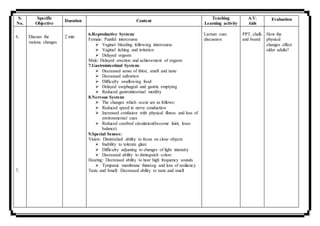
6.Reproductive System:
Female: Painful intercourse
 Vaginal bleeding following intercourse
 Vaginal itching and irritation
 Delayed orgasm
Male: Delayed erection and achievement of orgasm
7.Gastrointestinal System:
 Decreased sense of thirst, smell and taste
 Decreased salivation
 Difficulty swallowing food
 Delayed esophageal and gastric emptying
 Reduced gastrointestinal motility
8.Nervous System:
 The changes which occur are as follows:
 Reduced speed in nerve conduction
 Increased confusion with physical illness and loss of
environmental cues
 Reduced cerebral circulation(become faint, loses
balance)
9.Special Senses:
Vision: Diminished ability to focus on close objects
 Inability to tolerate glare
 Difficulty adjusting to changes of light intensity
 Decreased ability to distinguish colors
Hearing: Decreased ability to hear high frequency sounds
 Tympanic membrane thinning and loss of resiliency
Taste and Smell: Decreased ability to taste and smell
Lecture cum
discussion
PPT, chalk
and board
How the
physical
changes effect
older adults?
S.
No.
Specific
Objective
Duration Content
Teaching
Learning activity
A.V.
Aids
Evaluation
8.
9.
To enlist
psychological
changes
To describe the
cognitive
changes
2 min
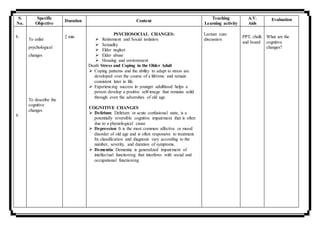
PSYCHOSOCIAL CHANGES:
 Retirement and Social isolation
 Sexuality
 Elder neglect
 Elder abuse
 Housing and environment
Death Stress and Coping in the Older Adult
 Coping patterns and the ability to adapt to stress are
developed over the course of a lifetime and remain
consistent later in life.
 Experiencing success in younger adulthood helps a
person develop a positive self-image that remains solid
through even the adversities of old age.
COGNITIVE CHANGES
 Delirium: Delirium or acute confusional state, is a
potentially reversible cognitive impairment that is often
due to a physiological cause
 Depression: It is the most common affective or mood
disorder of old age and is often responsive to treatment.
Its classification and diagnosis vary according to the
number, severity, and duration of symptoms.
 Dementia: Dementia is generalized impairment of
intellectual functioning that interferes with social and
occupational functioning
Lecture cum
discussion
PPT, chalk
and board
What are the
cognitive
changes?
S.
No.
Specific
Objective
Duration Content
Teaching
Learning activity
A.V.
Aids
Evaluation
10.
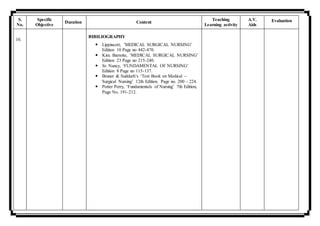
BIBILIOGRAPHY
 Lippincott, ’MEDICAL SURGICAL NURSING’
Edition 10 Page no 442-470.
 Kim. Barrette, ’MEDICAL SURGICAL NURSING’
Edition 23 Page no 215-240.
 Sr. Nancy, ‘FUNDAMENTAL OF NURSING’
Edition 8 Page no 115-137.
 Bruner & Suddarh’s ‘Text Book on Medical –
Surgical Nursing’ 12th Edition. Page no. 200 – 224.
 Potter Perry, ‘Fundamentals of Nursing’ 7th Edition,
Page No. 191-212.


Micro teaching on geriatric nursing

Micro teaching on geriatric nursing

  • 1.
    SUBJECT: - NURSINGEDUCATION Microteaching on Changes in aging SUBMITTED TO SUBMITTED BY MR. EXAMINER ………. MAMTA PARIHAR ………………. M.Sc. NURSING (PREVIOUS) GOVT. COLLEGE OF NURSING, JODHPUR.
  • 2.
    ………………………… BATCH –2013-14 LESSON PLAN INRODUCTION  Student TeacherName - MAMTA PARIHAR  Subject - ………………………..  Topic - Changes in aging  Group - ……………..  Venue - Examination room  Date and Time - 6/1/2015  Duration - 10 minutes  Method of Teaching - lecture cum discussion  A.V. Aids -PPT, black board, model and flash cards
  • 3.
    PREVIOUS KNOWLEDGE OFTHE GROUP  Students have basic knowledge about geriatric nursing. GENERAL OBJECTIVE  At the end of the class students will gain an in depth knowledge about Geriatric nursing and will be able to apply knowledge in their future practice. SPECIFIC OBJECTIVES : At the end of the class the group will be able to...  Define Geriatric nursing.  To enumerate the factors influencing aging.  Describe changes in old age.
  • 4.
    S. No. Specific Objective Duration Content Teaching learning Activity A.V. Aids Evaluation 1. 2. Atthe end of classroom teaching students will be able to To explain Geriatric nursing To define Geriatric nursing 2 min 1 min. “Grow old along with me! The best is yet to be” Robert browning. SELF-INTRODUCTION:- Mamta Parihar, M.Sc Nursing previous year. INTRODUCTION:- Aging, the normal process of time-related change, begins with birth and continues throughout life. Health professionals will be challenged to design strategies that address the higher prevalence of illness within this aging population. Gerontological nursing is the specialty of nursing pertaining to older adults. Gerontological nurses work in collaboration with older adults, their families, and communities to support healthy aging, maximum functioning, and quality of life. The term gerontological nursing, which replaced the term geriatric nursing in the 1970s, is seen as being more consistent with the specialty's broader focus on health and wellness, in addition to illness. DEFINITIONS: -  Geriatrics: the study of old age that includes the physiology, pathology, diagnosis, and management of the disorders and diseases of older adults  Gerontology: the combined biologic, psychologic, and sociologic study of older adults within their environment Lecture cum discussion PPT, chalk and board What do you know about Geriatric nursing? What is geriatric nursing?
  • 5.
    S. No. Specific Objective Duration Content Teaching Learning activity A.V. Aids Evaluation 3. 4. ToEnlist the Factors influence aging To describe the changes in old age 1 min FACTORS INFLUENCING AGING  Heredity  Nutrition  Health status  Life experiences  Environment  Activity  Stress produce unique NORMAL AGE-RELATED CHANGES 1. Physiological Changes 2. Psychosocial Changes 3. Cognitive Changes Lecture cum discussion PPT, chalk and board flash cards What are the factors influence aging?
  • 6.
    S. No. Specific Objective Duration Content Teaching Learning activity A.V. Aids Evaluation 5.To Explain physiological changes in aging 2 min PHYSIOLOGICAL CHANGES The changes which occur are as follows: 1.Cardiovascular system:  Decreased cardiac output.  Diminished ability to respond to stress.  Heart rate and stroke volume do not increase with maximum demand.  Slower heart recovery rate.  Increased blood pressure. 2.Respiratory Systems:  Increase in residual lung volume  Decreased cough efficiency  Decrease in muscle strength, endurance and vital capacity  Decreased gas exchange and defusing capacity 3.Integumentary System:  Decreased subcutaneous fat, interstitial fluid, muscle tone, glandular activity, and sensory receptors resulting in decreased protection against trauma, sun exposure and temperature extremes.  Diminished secretion of natural oils and perspiration; capillary fragility 4.Musculoskeletal System:  Loss of bone density  Loss of muscle strength and size  Degenerated joint cartilage 5.Genitourinary Systems:  The changes which occur are as follows:  Male: Benign prostatic hyperplasia  Female: Relaxed perineal muscles, detrusor instability(urge incontinence), urethral dysfunction  stress urinary incontinence Lecture cum discussion Model, PPT, chalk and board What are the main physical changes occurs in old age?
  • 7.
    S. No. Specific Objective Duration Content Teaching Learning activity A.V. Aids Evaluation 6. 7. Discussthe various changes 2 min 6.Reproductive System: Female: Painful intercourse  Vaginal bleeding following intercourse  Vaginal itching and irritation  Delayed orgasm Male: Delayed erection and achievement of orgasm 7.Gastrointestinal System:  Decreased sense of thirst, smell and taste  Decreased salivation  Difficulty swallowing food  Delayed esophageal and gastric emptying  Reduced gastrointestinal motility 8.Nervous System:  The changes which occur are as follows:  Reduced speed in nerve conduction  Increased confusion with physical illness and loss of environmental cues  Reduced cerebral circulation(become faint, loses balance) 9.Special Senses: Vision: Diminished ability to focus on close objects  Inability to tolerate glare  Difficulty adjusting to changes of light intensity  Decreased ability to distinguish colors Hearing: Decreased ability to hear high frequency sounds  Tympanic membrane thinning and loss of resiliency Taste and Smell: Decreased ability to taste and smell Lecture cum discussion PPT, chalk and board How the physical changes effect older adults?
  • 8.
    S. No. Specific Objective Duration Content Teaching Learning activity A.V. Aids Evaluation 8. 9. Toenlist psychological changes To describe the cognitive changes 2 min PSYCHOSOCIAL CHANGES:  Retirement and Social isolation  Sexuality  Elder neglect  Elder abuse  Housing and environment Death Stress and Coping in the Older Adult  Coping patterns and the ability to adapt to stress are developed over the course of a lifetime and remain consistent later in life.  Experiencing success in younger adulthood helps a person develop a positive self-image that remains solid through even the adversities of old age. COGNITIVE CHANGES  Delirium: Delirium or acute confusional state, is a potentially reversible cognitive impairment that is often due to a physiological cause  Depression: It is the most common affective or mood disorder of old age and is often responsive to treatment. Its classification and diagnosis vary according to the number, severity, and duration of symptoms.  Dementia: Dementia is generalized impairment of intellectual functioning that interferes with social and occupational functioning Lecture cum discussion PPT, chalk and board What are the cognitive changes?
  • 9.
    S. No. Specific Objective Duration Content Teaching Learning activity A.V. Aids Evaluation 10. BIBILIOGRAPHY Lippincott, ’MEDICAL SURGICAL NURSING’ Edition 10 Page no 442-470.  Kim. Barrette, ’MEDICAL SURGICAL NURSING’ Edition 23 Page no 215-240.  Sr. Nancy, ‘FUNDAMENTAL OF NURSING’ Edition 8 Page no 115-137.  Bruner & Suddarh’s ‘Text Book on Medical – Surgical Nursing’ 12th Edition. Page no. 200 – 224.  Potter Perry, ‘Fundamentals of Nursing’ 7th Edition, Page No. 191-212.
  • 12.
  • 16.