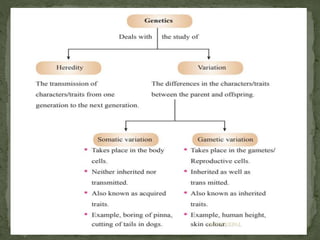
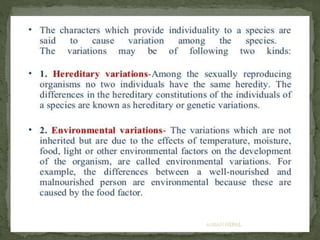
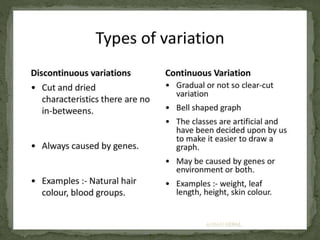
 INTRODUCTION TO GENETICS
 Mendel’s Laws of Inheritance
ANJAN NEPAL
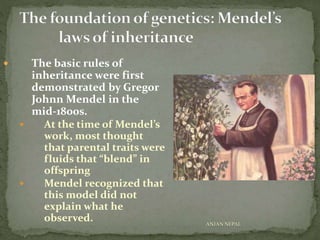
 The basic rules of
inheritance were first
demonstrated by Gregor
Johnn Mendel in the
mid-1800s.
 At the time of Mendel’s
work, most thought
that parental traits were
fluids that “blend” in
offspring
 Mendel recognized that
this model did not
explain what he
observed. ANJAN NEPAL
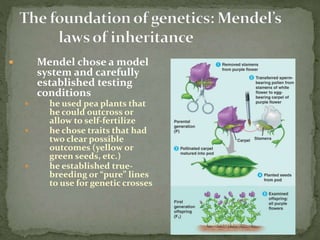
 Mendel chose a model
system and carefully
established testing
conditions
 he used pea plants that
he could outcross or
allow to self-fertilize
 he chose traits that had
two clear possible
outcomes (yellow or
green seeds, etc.)
 he established true-
breeding or “pure” lines
to use for genetic crosses
ANJAN NEPAL
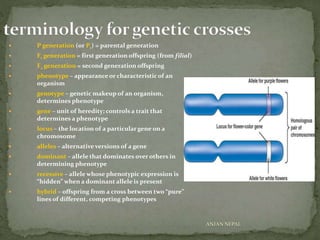
 P generation (or P1) = parental generation
 F1 generation = first generation offspring (from filial)
 F2 generation = second generation offspring
 phenotype – appearance or characteristic of an
organism
 genotype – genetic makeup of an organism,
determines phenotype
 gene – unit of heredity; controls a trait that
determines a phenotype
 locus – the location of a particular gene on a
chromosome
 alleles – alternative versions of a gene
 dominant – allele that dominates over others in
determining phenotype
 recessive – allele whose phenotypic expression is
“hidden” when a dominant allele is present
 hybrid – offspring from a cross between two “pure”
lines of different, competing phenotypes
ANJAN NEPAL
ANJAN NEPAL
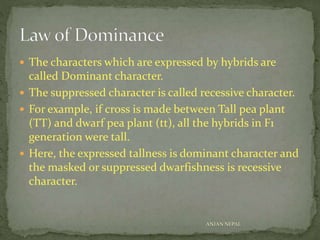
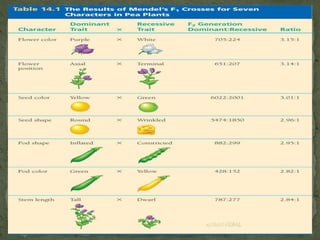
 The characters which are expressed by hybrids are
called Dominant character.
 The suppressed character is called recessive character.
 For example, if cross is made between Tall pea plant
(TT) and dwarf pea plant (tt), all the hybrids in F1
generation were tall.
 Here, the expressed tallness is dominant character and
the masked or suppressed dwarfishness is recessive
character.
ANJAN NEPAL
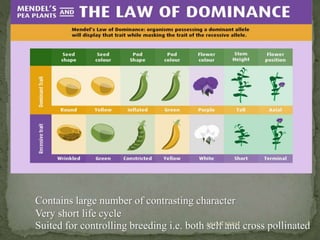
Contains large number of contrasting character
Very short life cycle
Suited for controlling breeding i.e. both self and cross pollinatedANJAN NEPAL
ANJAN NEPAL
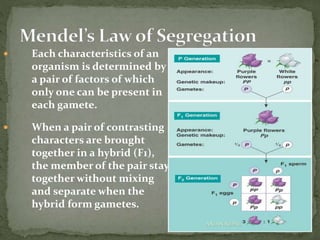
 Each characteristics of an
organism is determined by
a pair of factors of which
only one can be present in
each gamete.
 When a pair of contrasting
characters are brought
together in a hybrid (F1),
the member of the pair stay
together without mixing
and separate when the
hybrid form gametes.
ANJAN NEPAL
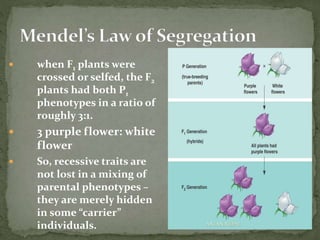
 when F1 plants were
crossed or selfed, the F2
plants had both P1
phenotypes in a ratio of
roughly 3:1.
 3 purple flower: white
flower
 So, recessive traits are
not lost in a mixing of
parental phenotypes –
they are merely hidden
in some “carrier”
individuals. ANJAN NEPAL
ANJAN NEPAL
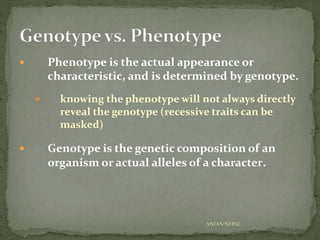
 Phenotype is the actual appearance or
characteristic, and is determined by genotype.
 knowing the phenotype will not always directly
reveal the genotype (recessive traits can be
masked)
 Genotype is the genetic composition of an
organism or actual alleles of a character.
ANJAN NEPAL
Genotypes are either homozygous or heterozygous
 Homozygous – The homologous chromosomes that
have the same allele at the locus. The trait from that
allele will be expressed phenotypically.
 Heterozygous – The homologous chromosomes that
have different alleles at the locus. If there is a
dominant allele, the trait of the dominant allele will
be expressed phenotypically.
 The same letter is used to indicate all alleles of
same trait
 DOMINANT ALLELES ARE CAPITALIZED; recessive alleles are
lowercase
ANJAN NEPAL
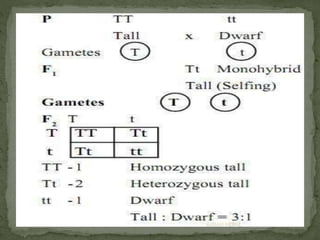
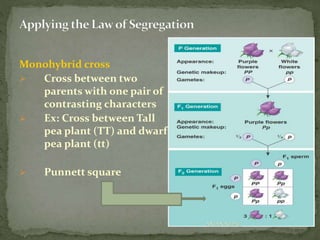
Monohybrid cross
 Cross between two
parents with one pair of
contrasting characters
 Ex: Cross between Tall
pea plant (TT) and dwarf
pea plant (tt)
 Punnett square
ANJAN NEPAL
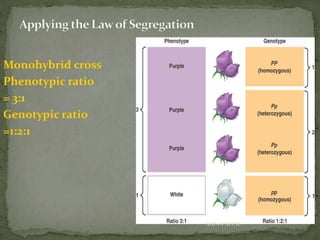
Monohybrid cross
Phenotypic ratio
= 3:1
Genotypic ratio
=1:2:1
ANJAN NEPAL
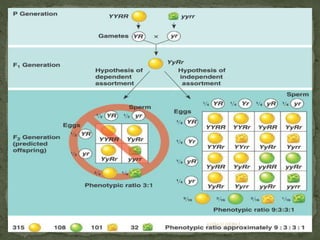
 Dihybrid cross – Cross between individuals that are both
heterozygous for two different genes that you are
following
 When Mendel performed Dihybrid crosses he found
phenotype ratios of 9:3:3:1
 note that this follows the product rule:
3:1 x 3:1 = 9:3:3:1
 Segregation of any one pair of
alleles is independent of the
segregation of other pairs of alleles
ANJAN NEPAL
ANJAN NEPAL
ANJAN NEPAL
ANJAN NEPAL
ANJAN NEPAL
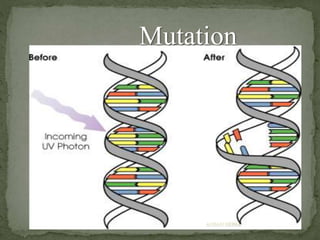
Mutation
ANJAN NEPAL
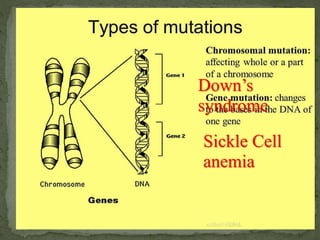
Down’s
syndrome
Sickle Cell
anemia
ANJAN NEPAL

Heredity: Mendel's Laws and Variation Chapter for SEE Nepal

  • 1.
     INTRODUCTION TOGENETICS  Mendel’s Laws of Inheritance ANJAN NEPAL
  • 2.
     The basicrules of inheritance were first demonstrated by Gregor Johnn Mendel in the mid-1800s.  At the time of Mendel’s work, most thought that parental traits were fluids that “blend” in offspring  Mendel recognized that this model did not explain what he observed. ANJAN NEPAL
  • 3.
     Mendel chosea model system and carefully established testing conditions  he used pea plants that he could outcross or allow to self-fertilize  he chose traits that had two clear possible outcomes (yellow or green seeds, etc.)  he established true- breeding or “pure” lines to use for genetic crosses ANJAN NEPAL
  • 4.
     P generation(or P1) = parental generation  F1 generation = first generation offspring (from filial)  F2 generation = second generation offspring  phenotype – appearance or characteristic of an organism  genotype – genetic makeup of an organism, determines phenotype  gene – unit of heredity; controls a trait that determines a phenotype  locus – the location of a particular gene on a chromosome  alleles – alternative versions of a gene  dominant – allele that dominates over others in determining phenotype  recessive – allele whose phenotypic expression is “hidden” when a dominant allele is present  hybrid – offspring from a cross between two “pure” lines of different, competing phenotypes ANJAN NEPAL
  • 5.
  • 6.
     The characterswhich are expressed by hybrids are called Dominant character.  The suppressed character is called recessive character.  For example, if cross is made between Tall pea plant (TT) and dwarf pea plant (tt), all the hybrids in F1 generation were tall.  Here, the expressed tallness is dominant character and the masked or suppressed dwarfishness is recessive character. ANJAN NEPAL
  • 7.
    Contains large numberof contrasting character Very short life cycle Suited for controlling breeding i.e. both self and cross pollinatedANJAN NEPAL
  • 8.
  • 9.
     Each characteristicsof an organism is determined by a pair of factors of which only one can be present in each gamete.  When a pair of contrasting characters are brought together in a hybrid (F1), the member of the pair stay together without mixing and separate when the hybrid form gametes. ANJAN NEPAL
  • 10.
     when F1plants were crossed or selfed, the F2 plants had both P1 phenotypes in a ratio of roughly 3:1.  3 purple flower: white flower  So, recessive traits are not lost in a mixing of parental phenotypes – they are merely hidden in some “carrier” individuals. ANJAN NEPAL
  • 11.
  • 12.
     Phenotype isthe actual appearance or characteristic, and is determined by genotype.  knowing the phenotype will not always directly reveal the genotype (recessive traits can be masked)  Genotype is the genetic composition of an organism or actual alleles of a character. ANJAN NEPAL
  • 13.
    Genotypes are eitherhomozygous or heterozygous  Homozygous – The homologous chromosomes that have the same allele at the locus. The trait from that allele will be expressed phenotypically.  Heterozygous – The homologous chromosomes that have different alleles at the locus. If there is a dominant allele, the trait of the dominant allele will be expressed phenotypically.  The same letter is used to indicate all alleles of same trait  DOMINANT ALLELES ARE CAPITALIZED; recessive alleles are lowercase ANJAN NEPAL
  • 14.
    Monohybrid cross  Crossbetween two parents with one pair of contrasting characters  Ex: Cross between Tall pea plant (TT) and dwarf pea plant (tt)  Punnett square ANJAN NEPAL
  • 15.
    Monohybrid cross Phenotypic ratio =3:1 Genotypic ratio =1:2:1 ANJAN NEPAL
  • 16.
     Dihybrid cross– Cross between individuals that are both heterozygous for two different genes that you are following  When Mendel performed Dihybrid crosses he found phenotype ratios of 9:3:3:1  note that this follows the product rule: 3:1 x 3:1 = 9:3:3:1  Segregation of any one pair of alleles is independent of the segregation of other pairs of alleles ANJAN NEPAL
  • 17.
  • 18.
  • 19.
  • 20.
  • 21.
  • 22.