Plant-nematode interactions
Anurag Kerketta
Assistant Professor/Scientist
CHRS, Jagdalpur
introduction
• feed on all parts of the plant, including roots, stems, leaves, flowers
and seeds.
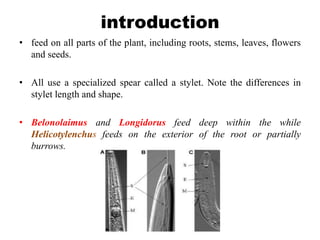
• All use a specialized spear called a stylet. Note the differences in
stylet length and shape.
• Belonolaimus and Longidorus feed deep within the while
Helicotylenchus feeds on the exterior of the root or partially
burrows.
• Some nematodes do not kill the plant cells they feed upon but
“trick” the plant cells to enlarge and grow, thus producing one or
more nutrient-rich feeding cells for the nematode.
• Many plant-parasitic nematodes feed on the roots of plants.
The feeding process damages the plant's root system and
reduces the plant's ability to absorb water and nutrients.
Feeding strategy/behaviour
• There are seven major types of nematode feeding strategies used by
plant parasitic nematodes :
1. Ectoparasites.
2. Semi-endoparasites.
3. Migratory endoparasite
4. Sedentary endoparasite.
5. Stem and bulb nematodes.
6. Seed gall nematodes
7. Foliar nematodes.
Ectoparasites
• Can graze on numerous plants.
• have extremely long stylet.
• Xiphinema (dagger nematode),
Semi-endoparasites
• Usually the head of the nematode penetrates into the root and allows
the nematode to form a permanent feeding cell .
• Rotylenchulus reniformis, the reniform (kidney-shaped) nematode.
• Tylenchulus semipenetrans, the citrus nematode
Migratory endoparasites
• These nematodes cause massive plant tissue necrosis because of
their migration and feeding .
• No permanent feeding cells.
• Second-stage juvenile and starts feeding on the plant.
• Pratylenchus (lesion nematode), Radopholus(burrowing
nematodes) and Hirschmanniella (rice root nematode).
Sedentary endoparasites
• The most damaging nematodes in the world.
• Cyst nematodes (Heterodera and Globodera) and the root-knot
nematodes (Meloidogyne).
• Feeding cells of root-knot nematodes (giant cells) form by
repeated nuclear division in the absence of cell division.
• Cyst nematodes form by the incorporation of neighboring cells.
• The J2 nematodes inject secretions into and around the plant cells
to stimulate the formation of large feeder cell
Soybean cyst nematode (Heterodera glycines) .
Their remarkable persistence is due to their ability to produce a cyst.
Stem and bulb nematodes
• Ditylenchus spp. are, as their name suggests, attack the upper and
lower parts of plants.
• More damaging under wet conditions.
• Infectious stage -fourth stage juvenile.
•
• feed as migratory endoparasites .
•
• Fluffy masses of dried (cryptobiotic) Ditylenchus can be seen on
the surface of bulbs and are known as "nematode wool."
• Bursaphelenchus xylophilus (pine wood nematode)
• Nematodes are carried into pine tree in the tracheae of bark
beetles.
• Causing pine wilt disease.
• Able to feed on fungi in the tree.
• J3s are attracted to beetle larvae.
Seed gall nematodes
• Anguina spp. were the first plant-parasitic nematodes to be
described in the scientific literature in 1743.
• J2 feed as ectoparasites at the tips of leaves.
• J2 penetrates the floral primordia and starts to feed on the
developing seed.
• feed, and eventually kills the seed to form a blackened "cockle"
(seed gall) .
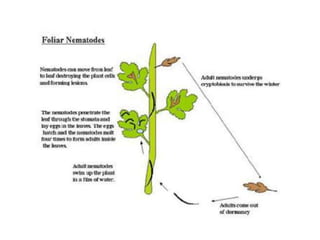
Foliar nematodes
• Genus Aphelenchoides.
• Adult penetrates through natural opening (Sromatoa) .
• Causes characteristic interveinal chlorosis and necrosis of the leaf,
ultimately killing it.
Summary of Plant Parasitic Nematode Feeding Strategies
Contd..
Contd..
Plant nematode interactions

Plant nematode interactions

  • 1.
    Plant-nematode interactions Anurag Kerketta AssistantProfessor/Scientist CHRS, Jagdalpur
  • 2.
    introduction • feed onall parts of the plant, including roots, stems, leaves, flowers and seeds. • All use a specialized spear called a stylet. Note the differences in stylet length and shape. • Belonolaimus and Longidorus feed deep within the while Helicotylenchus feeds on the exterior of the root or partially burrows.
  • 3.
    • Some nematodesdo not kill the plant cells they feed upon but “trick” the plant cells to enlarge and grow, thus producing one or more nutrient-rich feeding cells for the nematode. • Many plant-parasitic nematodes feed on the roots of plants. The feeding process damages the plant's root system and reduces the plant's ability to absorb water and nutrients.
  • 4.
    Feeding strategy/behaviour • Thereare seven major types of nematode feeding strategies used by plant parasitic nematodes : 1. Ectoparasites. 2. Semi-endoparasites. 3. Migratory endoparasite 4. Sedentary endoparasite. 5. Stem and bulb nematodes. 6. Seed gall nematodes 7. Foliar nematodes.
  • 5.
    Ectoparasites • Can grazeon numerous plants. • have extremely long stylet.
  • 6.
  • 7.
    Semi-endoparasites • Usually thehead of the nematode penetrates into the root and allows the nematode to form a permanent feeding cell . • Rotylenchulus reniformis, the reniform (kidney-shaped) nematode. • Tylenchulus semipenetrans, the citrus nematode
  • 8.
    Migratory endoparasites • Thesenematodes cause massive plant tissue necrosis because of their migration and feeding . • No permanent feeding cells. • Second-stage juvenile and starts feeding on the plant. • Pratylenchus (lesion nematode), Radopholus(burrowing nematodes) and Hirschmanniella (rice root nematode).
  • 10.
    Sedentary endoparasites • Themost damaging nematodes in the world. • Cyst nematodes (Heterodera and Globodera) and the root-knot nematodes (Meloidogyne). • Feeding cells of root-knot nematodes (giant cells) form by repeated nuclear division in the absence of cell division. • Cyst nematodes form by the incorporation of neighboring cells. • The J2 nematodes inject secretions into and around the plant cells to stimulate the formation of large feeder cell
  • 11.
    Soybean cyst nematode(Heterodera glycines) . Their remarkable persistence is due to their ability to produce a cyst.
  • 13.
    Stem and bulbnematodes • Ditylenchus spp. are, as their name suggests, attack the upper and lower parts of plants. • More damaging under wet conditions. • Infectious stage -fourth stage juvenile. • • feed as migratory endoparasites . • • Fluffy masses of dried (cryptobiotic) Ditylenchus can be seen on the surface of bulbs and are known as "nematode wool."
  • 15.
    • Bursaphelenchus xylophilus(pine wood nematode) • Nematodes are carried into pine tree in the tracheae of bark beetles. • Causing pine wilt disease. • Able to feed on fungi in the tree. • J3s are attracted to beetle larvae.
  • 16.
    Seed gall nematodes •Anguina spp. were the first plant-parasitic nematodes to be described in the scientific literature in 1743. • J2 feed as ectoparasites at the tips of leaves. • J2 penetrates the floral primordia and starts to feed on the developing seed. • feed, and eventually kills the seed to form a blackened "cockle" (seed gall) .
  • 18.
    Foliar nematodes • GenusAphelenchoides. • Adult penetrates through natural opening (Sromatoa) . • Causes characteristic interveinal chlorosis and necrosis of the leaf, ultimately killing it.
  • 20.
    Summary of PlantParasitic Nematode Feeding Strategies
  • 21.
  • 22.