Herbicide
Unit 6 – Topics Covered
Herbicides:
Introduction to herbicides
History, nomenclature, toxicity,
classification
Introduction to Herbicides
• Herbicide defined as any chemical
agent that kills or greatly inhibits
plant growth. They were made to
specifically and mainly kill plants.
• Literally means "plant killer".
1. History of Herbicides
• 1890 to 1900 - sodium arsenite to control aquatic
plants in waterways in the US.
• 1925 - sodium chlorate (direct soil application)
was first used for killing weeds.
• 1934 - sodium nitrocresylate, as the first
selective weed killer in France.
• 1940s – first organic herbicide 2,4-D was
commercialized providing selective control of
certain broadleaf weeds in grass crops.
• 1960's – pre-emergence herbicides trifluralin
and atrazine introduced.
• 1974 - glyphosate (Roundup) available - among
the world’s most important herbicides -
S.B.Powles. Control broad-spectrum of weed
spp.
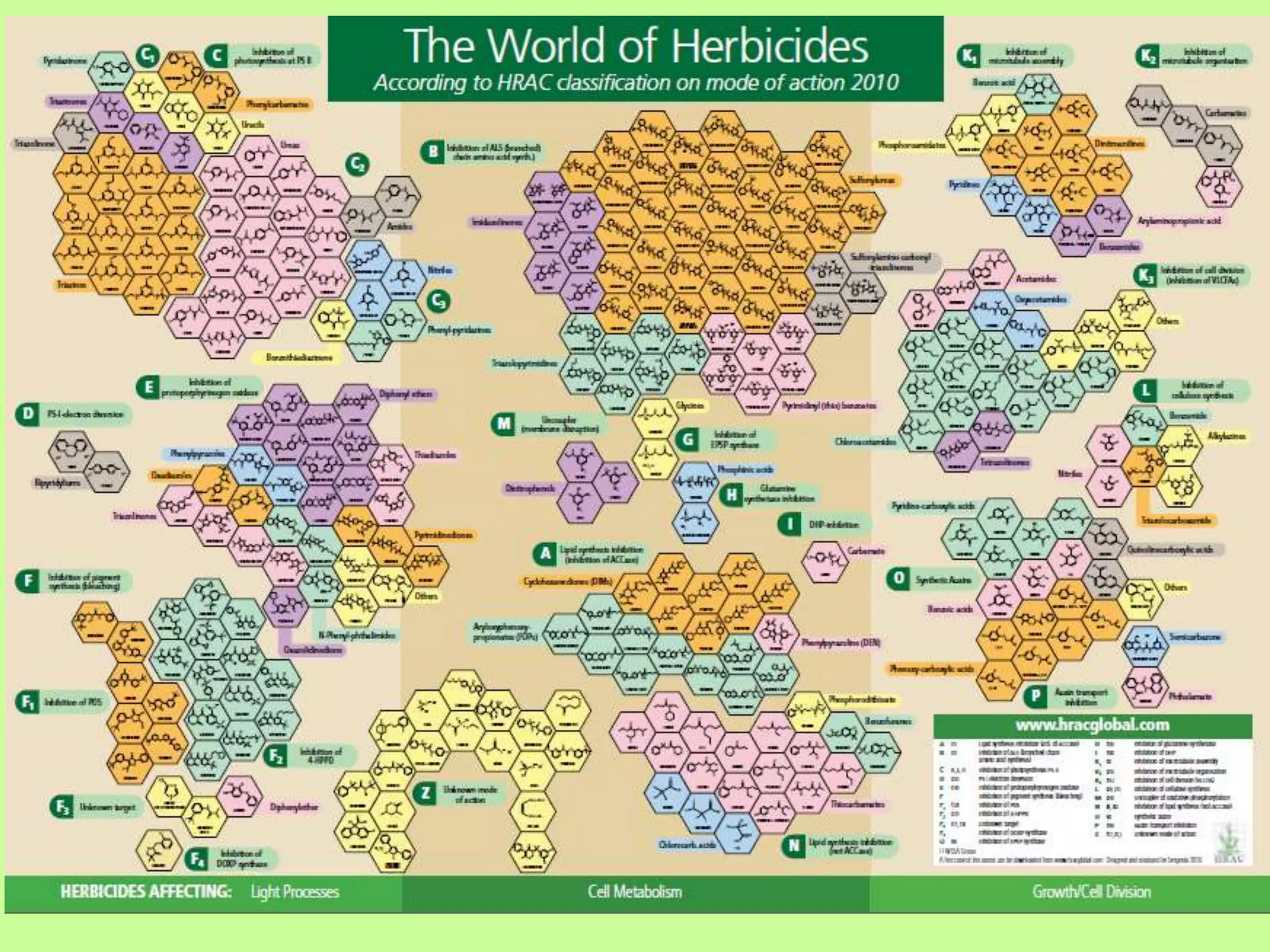
• As in 2010, more than 200 herbicides from 22
mode-of-actions available in the market.
Herbicide facts:
• Worldwide, expenditure on herbicides accounts for approximately
40% of all pesticide expenditures (Grube et al. 2011).
http://www.epa.gov/opp00001/pestsales/07pestsales/market_estima
tes2007.pdf.
• Malaysia: 70-75% herbicide use compared to other pesticides.
• All these info make herbicides among the most used and the most
important tools in agriculture.
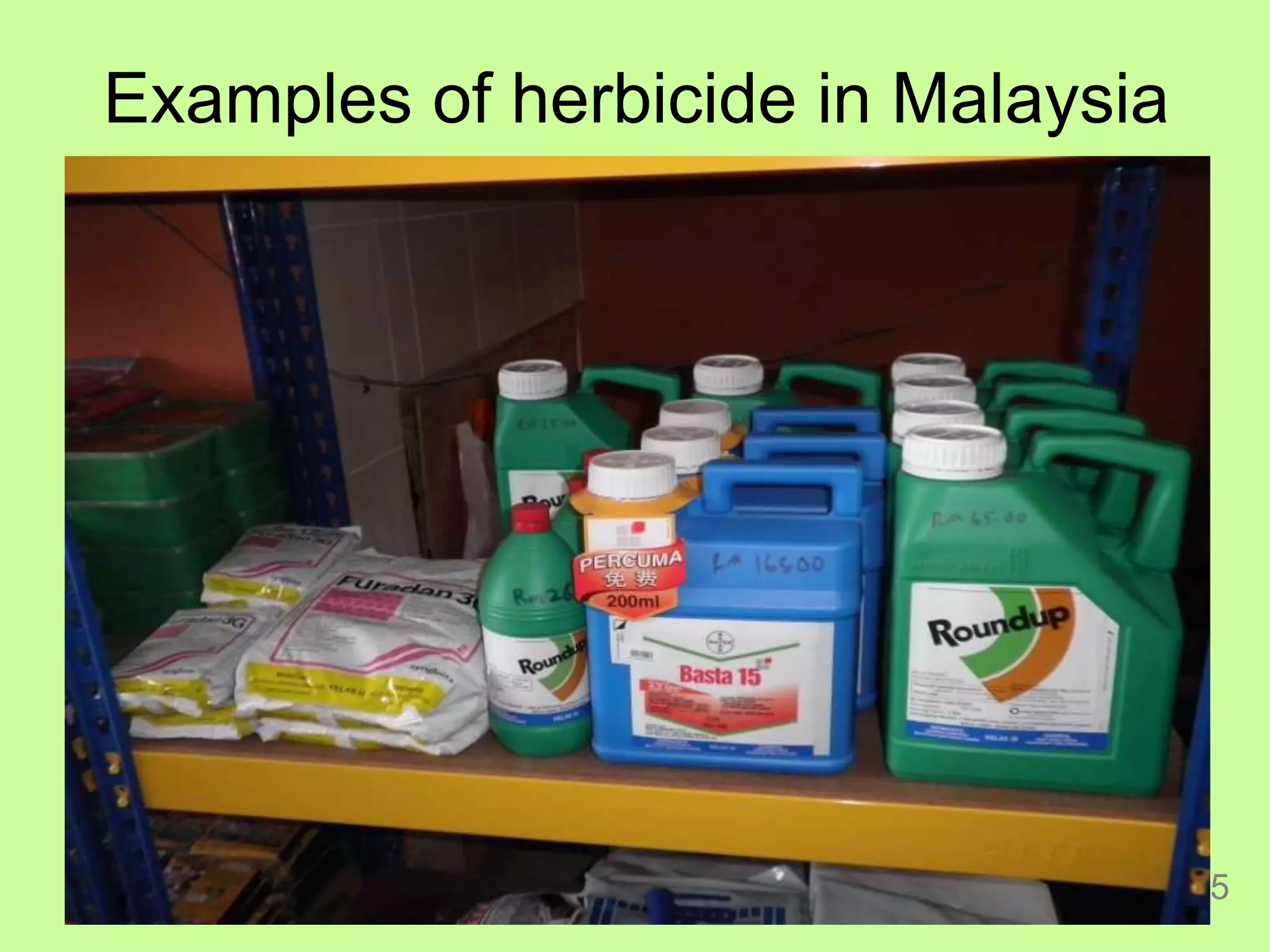
Examples of herbicide in Malaysia
15
Herbicide Nomenclature
1. Active ingredient - the chemical in the herbicide
formulation primarily responsible for its
phytotoxicity.
2. Trade name - a trademark or other designation by
which a commercial product is identified.
3. Common name - each herbicidal chemical has one
common name assigned to it. In many cases, the
common name is a simplified version of the chemical
name.
4. Chemical name - the systematic name of a chemical
compound according to the rules of nomenclature of the
International Union of Pure and Applied Chemistry
(IUPAC), Chemical Abstracts Service (CAS) or other
organization.
Example:
• Toxicity: danger/poison level
• Based on oral LD50 values on the test
population (animal).
• The lower the LD50 value, the less chemical that is
required to reach lethality.(LD5010 is more toxic than
LD50100)
• LD50 value measurement: mg/kg
• Info: Material Safety Data Sheet (MSDS) or Safety Data
Sheet (SDS) for each herbicide.
3. Herbicide Toxicity
Class LD50
Solid
LD50
Solution
Colour
Code
Symbol Hazard
Statement
Ia <5 <20 Very Toxic
Ib 5-50 20-200 Toxic
II 50-500 200-2000 Harmful
III 500-
5000
2000-
10000
Caution
IV >5000 >10000 NA
Table 2. Comparison of oral LD50 values for commonly
used herbicides and consumer goods.
Herbicide LD50 Common consumer
chemicals
LD50
Paraquat (Gramoxone) ~100 Nicotine 9-10
Pinoxaden (Axial) >3100 Bleach 192
2,4-D 666 Caffeine 192
Atrazine 3090 Household ammonia (10%) 350
Glyphosate (Roundup) 4900 Table salt 3000
Glufosinate >430 Codeine (pain and cough
relief)
427
Source: Fishel et al. 2009
Herbicide Classification
• Herbicides can be classified based on
different activity, herbicide chemistry
(chemical family or mode of action),
placement, time of apply, or type of
vegetation controlled (selectivity).
A. Selectivity: Selective vs. Non-selective
1. Selective: toxic to some species and much less
toxic to others at a given dosage. A selective
herbicide kills weeds but not the crop.
2. Non-selective/broad-spectrum: kills or severely
damages all or most species. A non-selective
herbicide kills weeds and potentially crops.
• A selective herbicide can be made non-selective
by applying improperly or by applying high rates.
Selectivity is usually rate dependent.
Herbicide Selectivity
16
Selective: A herbicide that is more effective in
controlling some plant species than others.
Broad-Spectrum/Non-Selective: A herbicide that
controls many plant species.
No
activity
No
activity
Activity
Non Selective Herbicide
Selective Herbicide
B. Activity: Contact vs. Systemic
1. Contact herbicides: destroy only that plant
tissue touched by the chemical.
a. Effective only on tissue contacted by
application of herbicide
b. Very little movement (translocation) within
the plant
c. Full spray coverage essential (because no
translocation, must get spray deposited on
most of plant).
Contact vs. Systemic cont…
d. Usually exhibit acute effects - kill rapidly
e. Effective for annuals, usually ineffective for
perennials (because no translocation to
underground reproductive organs)
f. Can be selective or non-selective.
Contact vs. Systemic cont…
2. Systemic herbicides
a. Absorbed by roots or above-ground
parts (depends upon particular
herbicide and application method),
translocated within plant.
b. Good spray coverage is necessary with
all herbicides, but less critical than
contact herbicides because of systemic
herbicides can be translocated.
Contact vs. Systemic cont…
c. Usually exhibit chronic effects - slow
acting.
d. Effective on annuals, some are
effective on perennials; effective on
perennials because of translocation to
underground organs.
e. Can be selective or non-selective.
Effect of different types of herbicides
on Asystasia spp. in Rubber
Paraquat
Glyphosate: systemic Paraquat: contact
C. Residual activity: Residual vs. Non-residual
1. Residual: Herbicide retains activity on susceptible
weeds for some time following application. Length
of residual depends upon the particular herbicide
and the application rate.
2. Non-residual: Herbicide has activity only on weeds
present at time of application. Does not provide
control of weeds that emerge after application.
4. Herbicide Classification cont…
D. Type/time of application
• Pre-plant incorporated: applied to soil and mechanically
incorporated into the top 2 to 3 inches of soil before the
crop is planted
• Pre-plant: applied prior to planting the crop
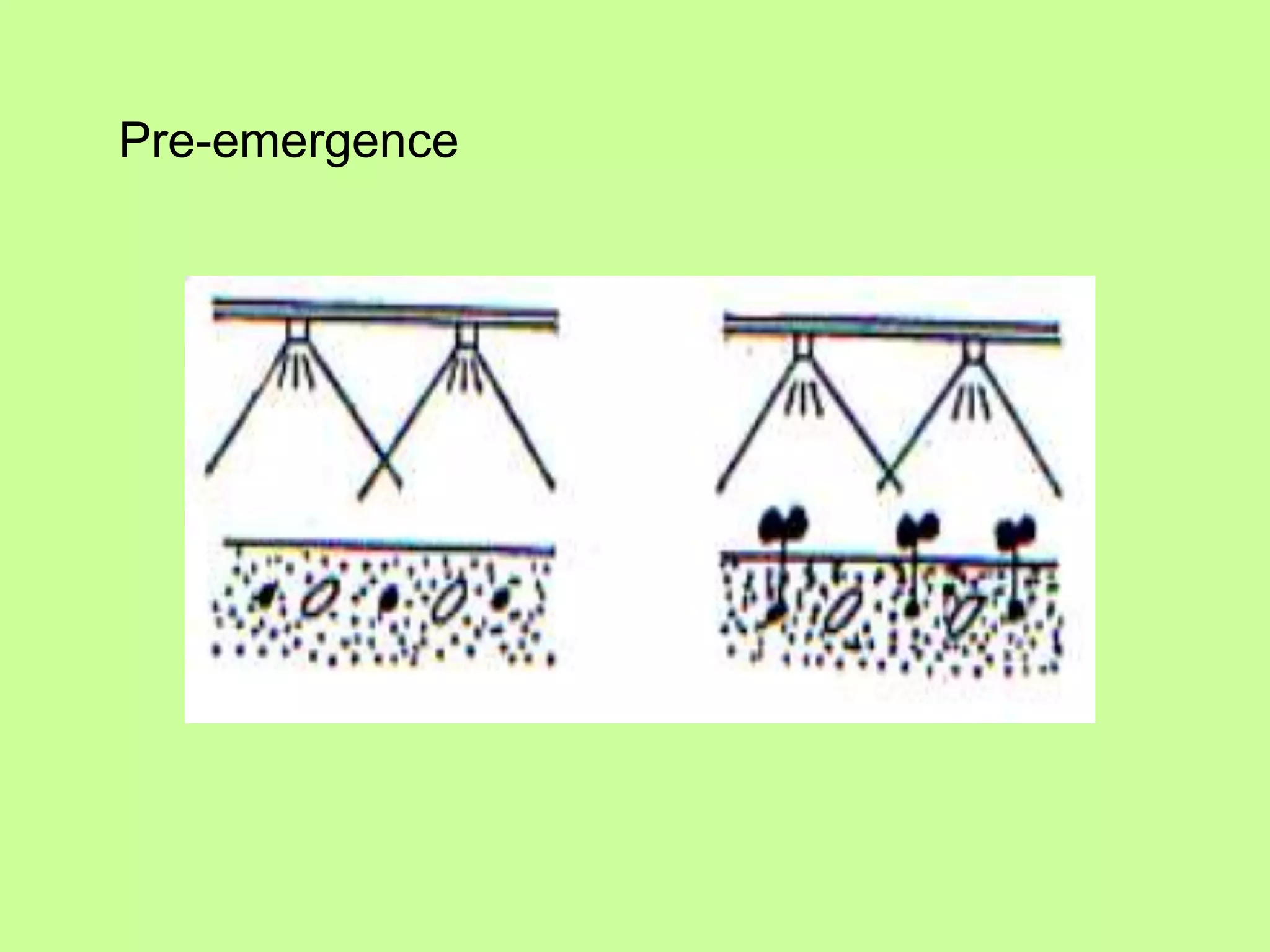
• Pre-emergence: applied to the soil prior to emergence of
the crop or weed
• Post-emergence: applied after emergence of the crop or
weed
Pre-plant
Pre-emergence
Post-emergence
E. Methods of application
• Refer to the ways herbicides can be applied:
1. Broadcast: applied over the entire field
2. Band: applied to a narrow strip over the crop row
3. Direct: applied between the rows of crop plants with
little or no herbicide applied to the crop foliage
4. Spot treatment: applied to small, weed-infested areas
within a field

Herbicide history.ppt

  • 1.
  • 2.
    Unit 6 –Topics Covered Herbicides: Introduction to herbicides History, nomenclature, toxicity, classification
  • 3.
    Introduction to Herbicides •Herbicide defined as any chemical agent that kills or greatly inhibits plant growth. They were made to specifically and mainly kill plants. • Literally means "plant killer".
  • 4.
    1. History ofHerbicides • 1890 to 1900 - sodium arsenite to control aquatic plants in waterways in the US. • 1925 - sodium chlorate (direct soil application) was first used for killing weeds. • 1934 - sodium nitrocresylate, as the first selective weed killer in France.
  • 5.
    • 1940s –first organic herbicide 2,4-D was commercialized providing selective control of certain broadleaf weeds in grass crops. • 1960's – pre-emergence herbicides trifluralin and atrazine introduced. • 1974 - glyphosate (Roundup) available - among the world’s most important herbicides - S.B.Powles. Control broad-spectrum of weed spp. • As in 2010, more than 200 herbicides from 22 mode-of-actions available in the market.
  • 7.
    Herbicide facts: • Worldwide,expenditure on herbicides accounts for approximately 40% of all pesticide expenditures (Grube et al. 2011). http://www.epa.gov/opp00001/pestsales/07pestsales/market_estima tes2007.pdf. • Malaysia: 70-75% herbicide use compared to other pesticides. • All these info make herbicides among the most used and the most important tools in agriculture.
  • 8.
    Examples of herbicidein Malaysia 15
  • 9.
    Herbicide Nomenclature 1. Activeingredient - the chemical in the herbicide formulation primarily responsible for its phytotoxicity. 2. Trade name - a trademark or other designation by which a commercial product is identified. 3. Common name - each herbicidal chemical has one common name assigned to it. In many cases, the common name is a simplified version of the chemical name.
  • 10.
    4. Chemical name- the systematic name of a chemical compound according to the rules of nomenclature of the International Union of Pure and Applied Chemistry (IUPAC), Chemical Abstracts Service (CAS) or other organization. Example:
  • 11.
    • Toxicity: danger/poisonlevel • Based on oral LD50 values on the test population (animal). • The lower the LD50 value, the less chemical that is required to reach lethality.(LD5010 is more toxic than LD50100) • LD50 value measurement: mg/kg • Info: Material Safety Data Sheet (MSDS) or Safety Data Sheet (SDS) for each herbicide. 3. Herbicide Toxicity
  • 12.
    Class LD50 Solid LD50 Solution Colour Code Symbol Hazard Statement Ia<5 <20 Very Toxic Ib 5-50 20-200 Toxic II 50-500 200-2000 Harmful III 500- 5000 2000- 10000 Caution IV >5000 >10000 NA
  • 13.
    Table 2. Comparisonof oral LD50 values for commonly used herbicides and consumer goods. Herbicide LD50 Common consumer chemicals LD50 Paraquat (Gramoxone) ~100 Nicotine 9-10 Pinoxaden (Axial) >3100 Bleach 192 2,4-D 666 Caffeine 192 Atrazine 3090 Household ammonia (10%) 350 Glyphosate (Roundup) 4900 Table salt 3000 Glufosinate >430 Codeine (pain and cough relief) 427 Source: Fishel et al. 2009
  • 14.
    Herbicide Classification • Herbicidescan be classified based on different activity, herbicide chemistry (chemical family or mode of action), placement, time of apply, or type of vegetation controlled (selectivity).
  • 15.
    A. Selectivity: Selectivevs. Non-selective 1. Selective: toxic to some species and much less toxic to others at a given dosage. A selective herbicide kills weeds but not the crop. 2. Non-selective/broad-spectrum: kills or severely damages all or most species. A non-selective herbicide kills weeds and potentially crops. • A selective herbicide can be made non-selective by applying improperly or by applying high rates. Selectivity is usually rate dependent.
  • 16.
    Herbicide Selectivity 16 Selective: Aherbicide that is more effective in controlling some plant species than others. Broad-Spectrum/Non-Selective: A herbicide that controls many plant species. No activity No activity Activity
  • 17.
  • 18.
  • 19.
    B. Activity: Contactvs. Systemic 1. Contact herbicides: destroy only that plant tissue touched by the chemical. a. Effective only on tissue contacted by application of herbicide b. Very little movement (translocation) within the plant c. Full spray coverage essential (because no translocation, must get spray deposited on most of plant).
  • 20.
    Contact vs. Systemiccont… d. Usually exhibit acute effects - kill rapidly e. Effective for annuals, usually ineffective for perennials (because no translocation to underground reproductive organs) f. Can be selective or non-selective.
  • 21.
    Contact vs. Systemiccont… 2. Systemic herbicides a. Absorbed by roots or above-ground parts (depends upon particular herbicide and application method), translocated within plant. b. Good spray coverage is necessary with all herbicides, but less critical than contact herbicides because of systemic herbicides can be translocated.
  • 22.
    Contact vs. Systemiccont… c. Usually exhibit chronic effects - slow acting. d. Effective on annuals, some are effective on perennials; effective on perennials because of translocation to underground organs. e. Can be selective or non-selective.
  • 23.
    Effect of differenttypes of herbicides on Asystasia spp. in Rubber Paraquat Glyphosate: systemic Paraquat: contact
  • 24.
    C. Residual activity:Residual vs. Non-residual 1. Residual: Herbicide retains activity on susceptible weeds for some time following application. Length of residual depends upon the particular herbicide and the application rate. 2. Non-residual: Herbicide has activity only on weeds present at time of application. Does not provide control of weeds that emerge after application. 4. Herbicide Classification cont…
  • 25.
    D. Type/time ofapplication • Pre-plant incorporated: applied to soil and mechanically incorporated into the top 2 to 3 inches of soil before the crop is planted • Pre-plant: applied prior to planting the crop • Pre-emergence: applied to the soil prior to emergence of the crop or weed • Post-emergence: applied after emergence of the crop or weed
  • 26.
  • 27.
  • 28.
  • 29.
    E. Methods ofapplication • Refer to the ways herbicides can be applied: 1. Broadcast: applied over the entire field 2. Band: applied to a narrow strip over the crop row 3. Direct: applied between the rows of crop plants with little or no herbicide applied to the crop foliage 4. Spot treatment: applied to small, weed-infested areas within a field

Editor's Notes

  • #17 It is important to keep in mind that herbicides differ in the number and type of weeds they control. This is referred to as the weed spectrum. For example some herbicides control only a few plant species and thus have a limited or narrow spectrum of control. <mouse click> Herbicides that control many weed species are generally referred to as broad spectrum herbicides. Sometimes there can be confusion around whether a particular weed is tolerant or resistant to a herbicide. If the weed was never controlled by the herbicide in the first place, according to the language on the label, then it is tolerant. This is true for both narrow and broad spectrum herbicides.   <mouse click>