BY: KATARE VAIBHAV G.
M . P H A R M I I S E M
( D E P T . O F P H A R M A C E U T I C S )
HERBAL COSMETICS
Sanjivani College of Pharmaceutical Education and Research, Kopargaon.
HERBAL COSMETICS
CONTENTS:
 Introduction
 Types according to site of application
 Herbal cosmetics for skin
 Herbal cosmetics for Hair
 Dentifrices
 Herbal cosmetics for Nail care product
 Herbal cosmetics for Eye product
 Guidelines for using herbs
 Evaluation of finished product
 Conclusion
 References
INTRODUCTION
Herbs Are Safe
Herbs are the source of some potent pharmaceutical
medications
 extremely useful, and potentially fatal
herbal products are safe because they are natural
 can be harmful if consumed improperly or in excessive
amounts
DEFINATION:
According to D & C Act 1940
Any article intended to be rubbed, poured, sprinkled
or sprayed on or introduced to or applied to any part
of human body for cleansing, beautifying, promoting,
attractiveness or altering the appearance and includes
any article intended for use as component of
cosmetics.
TYPES ACCORDING TO SITE OF
APPLICATION
Skin
Hair
Dentifrice
Nail
Eyes
HERBAL COSMETICS FOR SKIN
The herbal approach of proper skin care is principally
based on three essential steps.
Cleanse
Nourish
Moisture
Whatever may be the type of skin; these three steps are
external care of the skin to protect from the constant
effect of environment, stress and skins natural process
of cell degradation decay.
Cont…
Therefore in order to help the skin look young and
radiant.
Exfoliation to remove dead skin cells.
Epidermal stimulation for new cell growth.
Antioxidant properties for cellular rejuvenation and
repair.
Improve capillary blood flow.
Penetrating moisture and nutrients to replenish all
layers of skin.
HERBAL COSMETICS FOR VARIOUS TYPES
OF SKIN
FOR DRY SKIN
Example of Herbs:
Rubia Cardifolia (Manjista), Triphla, Tulsi,
Glycerihza glabra in sesame oil.
Fruit face mask:
Banana or avocado pulp.
FOR SENSITIVE SKIN
Example of Herbs:
Usheero, curcuma longa, triphala, azadircta indica
mustaka, nimba in coconut oil.
Fruit face mask:
Banana or pineapple pulp.
FOR OILY SKIN
Example of Herbs:
Tulsi, idhora, jatiphata, nimba, terminalia arjuna,
Triphla, curcuma longa, mustaka in musterd oil , milk,
sour milk, cream and butter milk are used as gentel
natured cleanser.
Fruit face mask:
Strawberry or papaya pulp.
TYPES OF HERBAL CREAMS
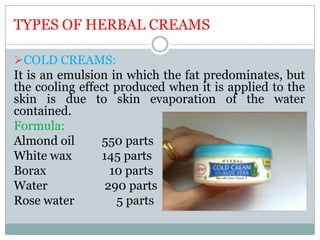
COLD CREAMS:
It is an emulsion in which the fat predominates, but
the cooling effect produced when it is applied to the
skin is due to skin evaporation of the water
contained.
Formula:
Almond oil 550 parts
White wax 145 parts
Borax 10 parts
Water 290 parts
Rose water 5 parts
Cont….
VANISHING CREAMS:
Vanishing creams are also called foundation creams
because they disappears when rubbed into skins.
Formula:
Stearic acid 130 parts
Borax crystals 28 parts
Sodium carbonate 12 parts
Water 740 parts
Rose oil 9 parts
Cont…
CLEANSING CREAMS:
A satisfactory cleansing cream is water in oil emulsion
that melts at temperature of body and spreads readily
over the skin.
Formula: Chamomile cleansing creams
Chamomile flower 50 parts
Distilled water 500 parts
Lemon juice 5 parts
Sodium benzoate 2 parts
TYPES OF HERBAL LOTIONS
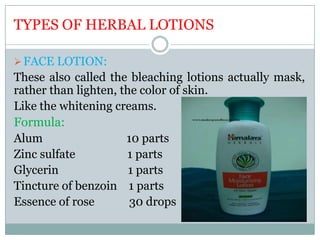
FACE LOTION:
These also called the bleaching lotions actually mask,
rather than lighten, the color of skin.
Like the whitening creams.
Formula:
Alum 10 parts
Zinc sulfate 1 parts
Glycerin 1 parts
Tincture of benzoin 1 parts
Essence of rose 30 drops
Cont…
SHAVING LOTIONS:
After shaving lotions are usually similar in
composition to astringent lotions, with higher
percentage also act as mild anticeptic to aid against
infection of any abrasion.
TYPES OF HERBAL HAIR CARE PRODUCTS
 HAIR OIL:
The hail oils used for dressings and nourishing the hairs
and grace to appearance of hasirs.
This preparations is generally used to increase the growth
of hair and remains healthy.
Hair oil should have following properties:
 They should give luster to the hair.
 Retain them soft and flowing.
 Invigorate their growth.
 Keep the brain cool.
 Should not be sticky.
Hair care products.
HAIR LOTION:
Hair lotion has a stimulating effect upon the hair
follicles. They are generally perfumed with oil of
rosemary and others ascenes as it posses a good
stimulating property.
HAIR COLORANTS:
These are preparations which are used for the coloring
of hthe hairs. They enhances the attractiveness of gray
hair. They are applied externally on the hair with help
of brush.
Cont…
SHAMPOO:
Shampoo is preparation of surfactant
in suitable form liquid, solid or
powder- which when used under
the condition specified will
remove surface grease, dirt, and
skin debris from the hair shaft and scalp without
affecting adversely the hair, scalp or health of the user.
QUALLITIES OF AN IDEAL HAIR PRODUCT
Protect the hair cuticle.
Cleans without stripping natural oils.
Replace lost protein, moisture, and nutrients.
Condition without weighing down the hair.
Even without porosity and prevent moisture loss.
Smooth abraded cuticle scales.
Prevent intense drying from environment.
Name Important herbal cosmetics Uses/ Claim
Herbal hair rinse Mint, bramhi & other herbal
extracts
Promote hair growth used
in combination with
heena/amla shampoo.
Herbal hair
conditioner
Amla, sandal wood bramhi. And
other precious herbs
Prevent hair loss & act as
scalp deep cleanser.
Herbal hair Oil Arnica, Heena, Shikakai and other
herbal extracts
Specially created to
prevent hair loss &
promote luxurious hair
growth.
Hair Amla
Shampoo
Extracts of amla dates arnica and
rate herbal extracts
For normal to dry hairs.
Cleansing the scalp while
retaining & Stimulating
hair growth.
HERBAL HAIR PREPARATIONS
HERBALS USED IN DENTIFRICE
Definition.
Dentifrice are the preparations intended for use with a
toothbrush for the purpose of cleaning the accessible
surfaces of teeth.
They have been prepared in paste, powder and to a
lesser extent in liquid and block form.
cont…
Formula: Dentifrices
Soap powder 7.2 parts
Saccharin 0.24 parts
Amaranth (solution) 1.0 parts
Oil of cinnamon 0.6 parts
Oil of pappermint 0.6 parts
Oil of clove 1.2 parts
Alcohol 90 parts
Distilled water 120 parts
Cont…
Characteristics of dentifrices:
It reduces the incidence of tooth decay.
Helps to maintaining the gingivae.
Reduces the intensity of mouth odors.
Good dental health increases the possibility of good
general health, leading secondary result of cleaning
teeth.
HERBALS USED IN NAIL CARE
Fungal infections of nails are very common and
difficult to cure
Nails are considered one of the body’s hardest and
strongest tissue.
The conventional treatment of nail fungal infection is
expensive and long term.
People prefer herbal and natural way to treat so that
side effects are minimized.
Following herbs used curing nail infections.
Lavendula officinalis
Melaleuca latrifolia
Cybopogon citrates
Syzygium aromaticum
Thyme vulgaris
Allium sativum
These herbs have a deep penetration power which aids
in the destruction of nail fungus, since fungus infects
the root of nail.
NAIL POLISH
NAIL POLISH:
A nail polish or enamel in order to be successful must
contain a film former whose characteristics are ease of
brushing application, fast drying and hardening and
whose formulations should enhance adhesion to the
nail without losing its resistance to chipping and
abrasion.
Cont..
Formula: Nail polish
Celluloidal film 250 parts
Amylacetate 250 parts
Acetone 750 parts
Eosine q.s.
HERBAL EYE SHADOW
Eye shadows are used to give a background of color to
the eye.
Various shades of eye shadows are available in market
eg. blue, green, brown.
Eye shadows may be either in solid form or in liquid
paste form.
Quality characteristics of eye shadow are:
They should have good skin adhesion and should be
easy to apply.
They should not show oily lustre after application.
They should be non-irritant and safe.
Formula:
Parsley 1 parts
Vegetable oil 4 parts
ADVANTAGES:
They do not provoke allergic reaction & do not have
negative side effects.
They are easily incorporated with skin and hair.
With small quantity they are very effective as
compared to synthetic cosmetics.
Extracts of plant decreases the bulk property of
cosmetics and gives appropriate pharmacological
effects.
Easily available & found in large variety & quantity.
Easy to manufactures and chief in cost.
DISADVANTAGES:
Herbal drugs have slower effects as compare to
Allopathic dosage form. Also it requires long term
therapy.
 They are difficult to hide taste and odor.
Most of the herbal drugs are not easily available.
Manufacturing process are time consuming and
complicated.
No pharmacopoea defines any specific procedure or
ingredients to be used in any of herbal cosmetics.
GUIDELINES FOR USING HERBS
Stop taking an herb if any side effect develops such
as allergy, stomach upset, skin rash or headache.
Purchase standardized herbal products.
Herbal products are not recommended for:
pregnant or lactating women
infants or children under six years of age
EVALUTIONS OF THE FINISHED PRODUCT
The finished product should be standardized in terms
of
 Shelf life
 Color
 Toxicity studies
 Biological assay
 Skin irritation test
 Sensitization test
 Patch test
STORAGE OF HERBS
Herbs should be stored in cool and dry place.
Moisture can damage the herbs.
Also moisture promotes bacterial and fungal growth.
Dried herbs should be stored in air tight container.
Herbs should not be stored in direct sunlight.
CASE STUDY
TOPIC: Preparation and evaluation of Herbal cosmetic
cream.
AUTHOR: Ashish Aswal,Mohini Kalra and Abhiram Rout.
DRUG: Ethanol extract of Aloe vera, Cucumis sativus and
Daucus carota.
PUBLICATION: Scholars Research Library
EVALUATION OF CREAM:
pH
Viscocity
Homogenicity
Appearance
COCLUSION
The usage of herbal cosmetics has been increased to
many folds in personal care system and there is a
great demand for the herbal cosmetics.
The use of bioactive ingredients in cosmetics
influence biological functions of skin and provide
nutrients necessary for the healthy skin or hair.
There is tremendous scope to launch numerous
herbal cosmetics using appropriate bioactive
ingredients with suitable fatty oil, essential oils,
proteins and additives.
References
R.K. Nema, K.S.rathore and B.K.Dubey; “Text book
of cosmetics” CBS Publishers & Distributors India,
page no. 257-274.
P.P.Sharma “Cosmetics Formulations,
Manufacturing & Quality control” Vandana
Publications Pvt. Ltd. Delhi, fourth edition, page no.
463,709,717.
Dr.Kuchekar, Mr.Khadtare, Mr.Sachin Itkar;
“Forensic Pharmacy” Nirali prakashan, page no.5.4-
5.5
Rajsekhar Saha International “Cosmeceuticals and
herbal drugs: practical uses”, Journal Of
Pharmaceutical Sciences And Research (ISSN: 0975-
8232), Vol. 3, Issue 1, (2012)
Singhal Mukul*, Khanna Surabhi , Nasa Atul,
“Cosmeceuticals For The Skin: An Overview”, Asian
Journal of Pharmaceutical and Clinical Research,
(ISSN - 0974-2441), Vol. 4, Issue 2, 2011.
J. Padma Preetha*, K. Karthika, “Cosmeceuticals –
An Evolution”, International Journal of ChemTech
Research, (ISSN : 0974-4290), Vol.1, No.4, pp 1217-
1223, Oct-Dec 2009.
Cont..
Ashish Aswal*, Mohini Kalra and Abhiram Rout,
“Preparation and evaluation of Herbal cosmetic
cream” Scholars Research Library
THANK YOU..

Herbal cosmetics final ppt

  • 1.
    BY: KATARE VAIBHAVG. M . P H A R M I I S E M ( D E P T . O F P H A R M A C E U T I C S ) HERBAL COSMETICS Sanjivani College of Pharmaceutical Education and Research, Kopargaon.
  • 2.
    HERBAL COSMETICS CONTENTS:  Introduction Types according to site of application  Herbal cosmetics for skin  Herbal cosmetics for Hair  Dentifrices  Herbal cosmetics for Nail care product  Herbal cosmetics for Eye product  Guidelines for using herbs  Evaluation of finished product  Conclusion  References
  • 3.
    INTRODUCTION Herbs Are Safe Herbsare the source of some potent pharmaceutical medications  extremely useful, and potentially fatal herbal products are safe because they are natural  can be harmful if consumed improperly or in excessive amounts
  • 4.
    DEFINATION: According to D& C Act 1940 Any article intended to be rubbed, poured, sprinkled or sprayed on or introduced to or applied to any part of human body for cleansing, beautifying, promoting, attractiveness or altering the appearance and includes any article intended for use as component of cosmetics.
  • 5.
    TYPES ACCORDING TOSITE OF APPLICATION Skin Hair Dentifrice Nail Eyes
  • 6.
    HERBAL COSMETICS FORSKIN The herbal approach of proper skin care is principally based on three essential steps. Cleanse Nourish Moisture Whatever may be the type of skin; these three steps are external care of the skin to protect from the constant effect of environment, stress and skins natural process of cell degradation decay.
  • 7.
    Cont… Therefore in orderto help the skin look young and radiant. Exfoliation to remove dead skin cells. Epidermal stimulation for new cell growth. Antioxidant properties for cellular rejuvenation and repair. Improve capillary blood flow. Penetrating moisture and nutrients to replenish all layers of skin.
  • 8.
    HERBAL COSMETICS FORVARIOUS TYPES OF SKIN FOR DRY SKIN Example of Herbs: Rubia Cardifolia (Manjista), Triphla, Tulsi, Glycerihza glabra in sesame oil. Fruit face mask: Banana or avocado pulp.
  • 9.
    FOR SENSITIVE SKIN Exampleof Herbs: Usheero, curcuma longa, triphala, azadircta indica mustaka, nimba in coconut oil. Fruit face mask: Banana or pineapple pulp.
  • 10.
    FOR OILY SKIN Exampleof Herbs: Tulsi, idhora, jatiphata, nimba, terminalia arjuna, Triphla, curcuma longa, mustaka in musterd oil , milk, sour milk, cream and butter milk are used as gentel natured cleanser. Fruit face mask: Strawberry or papaya pulp.
  • 11.
    TYPES OF HERBALCREAMS COLD CREAMS: It is an emulsion in which the fat predominates, but the cooling effect produced when it is applied to the skin is due to skin evaporation of the water contained. Formula: Almond oil 550 parts White wax 145 parts Borax 10 parts Water 290 parts Rose water 5 parts
  • 12.
    Cont…. VANISHING CREAMS: Vanishing creamsare also called foundation creams because they disappears when rubbed into skins. Formula: Stearic acid 130 parts Borax crystals 28 parts Sodium carbonate 12 parts Water 740 parts Rose oil 9 parts
  • 13.
    Cont… CLEANSING CREAMS: A satisfactorycleansing cream is water in oil emulsion that melts at temperature of body and spreads readily over the skin. Formula: Chamomile cleansing creams Chamomile flower 50 parts Distilled water 500 parts Lemon juice 5 parts Sodium benzoate 2 parts
  • 14.
    TYPES OF HERBALLOTIONS FACE LOTION: These also called the bleaching lotions actually mask, rather than lighten, the color of skin. Like the whitening creams. Formula: Alum 10 parts Zinc sulfate 1 parts Glycerin 1 parts Tincture of benzoin 1 parts Essence of rose 30 drops
  • 15.
    Cont… SHAVING LOTIONS: After shavinglotions are usually similar in composition to astringent lotions, with higher percentage also act as mild anticeptic to aid against infection of any abrasion.
  • 16.
    TYPES OF HERBALHAIR CARE PRODUCTS  HAIR OIL: The hail oils used for dressings and nourishing the hairs and grace to appearance of hasirs. This preparations is generally used to increase the growth of hair and remains healthy. Hair oil should have following properties:  They should give luster to the hair.  Retain them soft and flowing.  Invigorate their growth.  Keep the brain cool.  Should not be sticky. Hair care products.
  • 17.
    HAIR LOTION: Hair lotionhas a stimulating effect upon the hair follicles. They are generally perfumed with oil of rosemary and others ascenes as it posses a good stimulating property. HAIR COLORANTS: These are preparations which are used for the coloring of hthe hairs. They enhances the attractiveness of gray hair. They are applied externally on the hair with help of brush.
  • 18.
    Cont… SHAMPOO: Shampoo is preparationof surfactant in suitable form liquid, solid or powder- which when used under the condition specified will remove surface grease, dirt, and skin debris from the hair shaft and scalp without affecting adversely the hair, scalp or health of the user.
  • 19.
    QUALLITIES OF ANIDEAL HAIR PRODUCT Protect the hair cuticle. Cleans without stripping natural oils. Replace lost protein, moisture, and nutrients. Condition without weighing down the hair. Even without porosity and prevent moisture loss. Smooth abraded cuticle scales. Prevent intense drying from environment.
  • 20.
    Name Important herbalcosmetics Uses/ Claim Herbal hair rinse Mint, bramhi & other herbal extracts Promote hair growth used in combination with heena/amla shampoo. Herbal hair conditioner Amla, sandal wood bramhi. And other precious herbs Prevent hair loss & act as scalp deep cleanser. Herbal hair Oil Arnica, Heena, Shikakai and other herbal extracts Specially created to prevent hair loss & promote luxurious hair growth. Hair Amla Shampoo Extracts of amla dates arnica and rate herbal extracts For normal to dry hairs. Cleansing the scalp while retaining & Stimulating hair growth. HERBAL HAIR PREPARATIONS
  • 21.
    HERBALS USED INDENTIFRICE Definition. Dentifrice are the preparations intended for use with a toothbrush for the purpose of cleaning the accessible surfaces of teeth. They have been prepared in paste, powder and to a lesser extent in liquid and block form.
  • 22.
    cont… Formula: Dentifrices Soap powder7.2 parts Saccharin 0.24 parts Amaranth (solution) 1.0 parts Oil of cinnamon 0.6 parts Oil of pappermint 0.6 parts Oil of clove 1.2 parts Alcohol 90 parts Distilled water 120 parts
  • 23.
    Cont… Characteristics of dentifrices: Itreduces the incidence of tooth decay. Helps to maintaining the gingivae. Reduces the intensity of mouth odors. Good dental health increases the possibility of good general health, leading secondary result of cleaning teeth.
  • 24.
    HERBALS USED INNAIL CARE Fungal infections of nails are very common and difficult to cure Nails are considered one of the body’s hardest and strongest tissue. The conventional treatment of nail fungal infection is expensive and long term. People prefer herbal and natural way to treat so that side effects are minimized.
  • 25.
    Following herbs usedcuring nail infections. Lavendula officinalis Melaleuca latrifolia Cybopogon citrates Syzygium aromaticum Thyme vulgaris Allium sativum These herbs have a deep penetration power which aids in the destruction of nail fungus, since fungus infects the root of nail.
  • 26.
    NAIL POLISH NAIL POLISH: Anail polish or enamel in order to be successful must contain a film former whose characteristics are ease of brushing application, fast drying and hardening and whose formulations should enhance adhesion to the nail without losing its resistance to chipping and abrasion.
  • 27.
    Cont.. Formula: Nail polish Celluloidalfilm 250 parts Amylacetate 250 parts Acetone 750 parts Eosine q.s.
  • 28.
    HERBAL EYE SHADOW Eyeshadows are used to give a background of color to the eye. Various shades of eye shadows are available in market eg. blue, green, brown. Eye shadows may be either in solid form or in liquid paste form.
  • 29.
    Quality characteristics ofeye shadow are: They should have good skin adhesion and should be easy to apply. They should not show oily lustre after application. They should be non-irritant and safe. Formula: Parsley 1 parts Vegetable oil 4 parts
  • 30.
    ADVANTAGES: They do notprovoke allergic reaction & do not have negative side effects. They are easily incorporated with skin and hair. With small quantity they are very effective as compared to synthetic cosmetics. Extracts of plant decreases the bulk property of cosmetics and gives appropriate pharmacological effects. Easily available & found in large variety & quantity. Easy to manufactures and chief in cost.
  • 31.
    DISADVANTAGES: Herbal drugs haveslower effects as compare to Allopathic dosage form. Also it requires long term therapy.  They are difficult to hide taste and odor. Most of the herbal drugs are not easily available. Manufacturing process are time consuming and complicated. No pharmacopoea defines any specific procedure or ingredients to be used in any of herbal cosmetics.
  • 32.
    GUIDELINES FOR USINGHERBS Stop taking an herb if any side effect develops such as allergy, stomach upset, skin rash or headache. Purchase standardized herbal products. Herbal products are not recommended for: pregnant or lactating women infants or children under six years of age
  • 33.
    EVALUTIONS OF THEFINISHED PRODUCT The finished product should be standardized in terms of  Shelf life  Color  Toxicity studies  Biological assay  Skin irritation test  Sensitization test  Patch test
  • 34.
    STORAGE OF HERBS Herbsshould be stored in cool and dry place. Moisture can damage the herbs. Also moisture promotes bacterial and fungal growth. Dried herbs should be stored in air tight container. Herbs should not be stored in direct sunlight.
  • 35.
    CASE STUDY TOPIC: Preparationand evaluation of Herbal cosmetic cream. AUTHOR: Ashish Aswal,Mohini Kalra and Abhiram Rout. DRUG: Ethanol extract of Aloe vera, Cucumis sativus and Daucus carota. PUBLICATION: Scholars Research Library EVALUATION OF CREAM: pH Viscocity Homogenicity Appearance
  • 36.
    COCLUSION The usage ofherbal cosmetics has been increased to many folds in personal care system and there is a great demand for the herbal cosmetics. The use of bioactive ingredients in cosmetics influence biological functions of skin and provide nutrients necessary for the healthy skin or hair. There is tremendous scope to launch numerous herbal cosmetics using appropriate bioactive ingredients with suitable fatty oil, essential oils, proteins and additives.
  • 37.
    References R.K. Nema, K.S.rathoreand B.K.Dubey; “Text book of cosmetics” CBS Publishers & Distributors India, page no. 257-274. P.P.Sharma “Cosmetics Formulations, Manufacturing & Quality control” Vandana Publications Pvt. Ltd. Delhi, fourth edition, page no. 463,709,717. Dr.Kuchekar, Mr.Khadtare, Mr.Sachin Itkar; “Forensic Pharmacy” Nirali prakashan, page no.5.4- 5.5
  • 38.
    Rajsekhar Saha International“Cosmeceuticals and herbal drugs: practical uses”, Journal Of Pharmaceutical Sciences And Research (ISSN: 0975- 8232), Vol. 3, Issue 1, (2012) Singhal Mukul*, Khanna Surabhi , Nasa Atul, “Cosmeceuticals For The Skin: An Overview”, Asian Journal of Pharmaceutical and Clinical Research, (ISSN - 0974-2441), Vol. 4, Issue 2, 2011. J. Padma Preetha*, K. Karthika, “Cosmeceuticals – An Evolution”, International Journal of ChemTech Research, (ISSN : 0974-4290), Vol.1, No.4, pp 1217- 1223, Oct-Dec 2009.
  • 39.
    Cont.. Ashish Aswal*, MohiniKalra and Abhiram Rout, “Preparation and evaluation of Herbal cosmetic cream” Scholars Research Library
  • 40.