
DR. ISRAA HASSANEIN
MEDICAL SPECIALIST , MEEQAT GENERAL
HOSPITAL MADINA,
HEPATITIS B VIRUS
INFECTION
HEPATITIS B
HBV infection has a worldwide distribution.
It is estimated that more than 2 billion
people have been infected. Of these,
approximately 360 million are chronically
infected and at risk of serious illness and
death from cirrhosis and hepatocellular
carcinoma (HCC), diseases that are
estimated to cause 500 000–700 000
deaths each year worldwide.
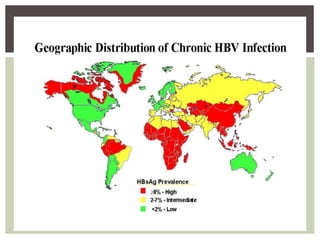
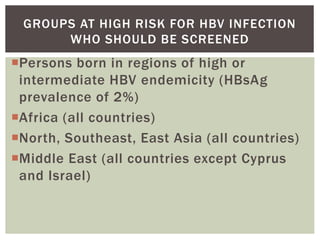
Persons born in regions of high or
intermediate HBV endemicity (HBsAg
prevalence of 2%)
Africa (all countries)
North, Southeast, East Asia (all countries)
Middle East (all countries except Cyprus
and Israel)
GROUPS AT HIGH RISK FOR HBV INFECTION
WHO SHOULD BE SCREENED
Persons needing immunosuppressive therapy,
including chemotherapy, immunosuppression related
to organ transplantation, and immunosuppressionfor
rheumatological or gastroenterologic disorders
 Persons who have ever injected drugs
 Men who have sex with men
 Individuals with elevated ALT or AST of unknown
etiology
 Donors of blood, plasma, organs, tissues, or semen
 Persons with end-stage renal disease, including
predialysis, hemodialysis, peritoneal dialysis, and home
dialysis patients
 All pregnant women
 Infants born to HBsAg-positive mothers
 Persons with chronic liver disease, e.g., HCV
 Persons with HIV
 Household, needle-sharing, and sexual contacts of HBsAg-positive
persons
 Persons who are not in a long-term, mutually monogamous
relationship (e.g., >1 sex partner during the previous 6 months)
 Persons seeking evaluation or treatment for a sexually transmitted
disease
 Health care and public safety workers at risk for occupational
exposure to blood or blood-contaminated body fluids*
 Residents and staff of facilities for developmentally disabled persons
 Travelers to countries with intermediate or high prevalence of HBV
infection
 Persons who are the source of blood or body fluid exposures that
might require postexposure prophylaxis
 Inmates of correctional facilities
 Unvaccinated persons with diabetes who are aged 19 through 59
years (discretion of clinician for unvaccinated adults with diabetes
who are aged
 60 years)
The natural course of chronic HBV
infection consists of four characteristic
phases ; reflecting the dynamic
relationship between viral replication
and the host immune response, these
phases are of variable duration and not
every persons infected with CHB evolve
through all phases
GLOBALLY AN ESTIMATED 240 MILLION PERSONS
WORLDWIDE ARE CHRONICALLY INFECTED WITH
HBV,WITH VARYING PREVELANCE
The risk of developing chronic HBv
infection after acute exposure ranges
from 90% in new born of HBeAg positive
mothers to 25% to 30% in infants and
children under 5 years to less than 5% in
adults .(1- 2)
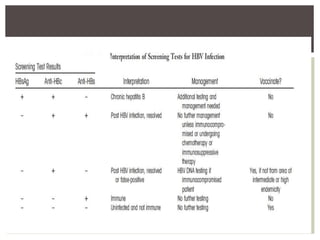
Different types of antigens , antibody
and DNA of HBV used to diagnose HBV
among ELISA and PCR .
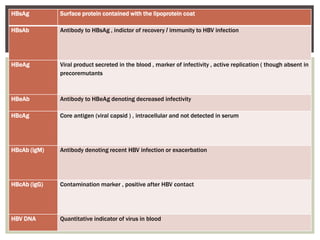
HBsAg Surface protein contained with the lipoprotein coat
HBsAb Antibody to HBsAg , indictor of recovery / immunity to HBV infection
HBeAg Viral product secreted in the blood , marker of infectivity , active replication ( though absent in
precoremutants
HBeAb Antibody to HBeAg denoting decreased infectivity
HBcAg Core antigen (viral capsid ) , intracellular and not detected in serum
HBcAb (igM) Antibody denoting recent HBV infection or exacerbation
HBcAb (igG) Contamination marker , positive after HBV contact
HBV DNA Quantitative indicator of virus in blood
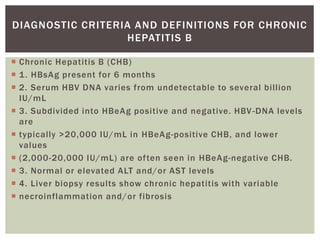
 Chronic Hepatitis B (CHB)
 1. HBsAg present for 6 months
 2. Serum HBV DNA varies from undetectable to several billion
IU/mL
 3. Subdivided into HBeAg positive and negative. HBV-DNA levels
are
 typically >20,000 IU/mL in HBeAg-positive CHB, and lower
values
 (2,000-20,000 IU/mL) are often seen in HBeAg-negative CHB.
 3. Normal or elevated ALT and/or AST levels
 4. Liver biopsy results show chronic hepatitis with variable
 necroinflammation and/or fibrosis
DIAGNOSTIC CRITERIA AND DEFINITIONS FOR CHRONIC
HEPATITIS B
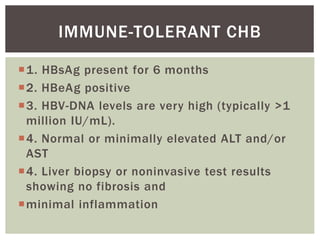
1. HBsAg present for 6 months
2. HBeAg positive
3. HBV-DNA levels are very high (typically >1
million IU/mL).
4. Normal or minimally elevated ALT and/or
AST
4. Liver biopsy or noninvasive test results
showing no fibrosis and
minimal inflammation
IMMUNE-TOLERANT CHB
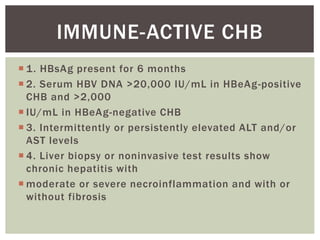
 1. HBsAg present for 6 months
 2. Serum HBV DNA >20,000 IU/mL in HBeAg-positive
CHB and >2,000
 IU/mL in HBeAg-negative CHB
 3. Intermittently or persistently elevated ALT and/or
AST levels
 4. Liver biopsy or noninvasive test results show
chronic hepatitis with
 moderate or severe necroinflammation and with or
without fibrosis
IMMUNE-ACTIVE CHB
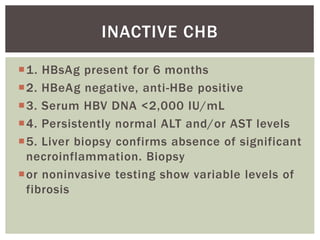
1. HBsAg present for 6 months
2. HBeAg negative, anti-HBe positive
3. Serum HBV DNA <2,000 IU/mL
4. Persistently normal ALT and/or AST levels
5. Liver biopsy confirms absence of significant
necroinflammation. Biopsy
or noninvasive testing show variable levels of
fibrosis
INACTIVE CHB
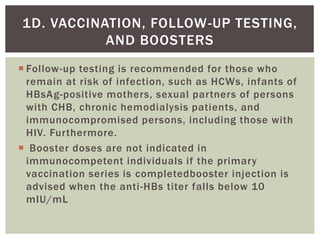
 Follow-up testing is recommended for those who
remain at risk of infection, such as HCWs, infants of
HBsAg-positive mothers, sexual partners of persons
with CHB, chronic hemodialysis patients, and
immunocompromised persons, including those with
HIV. Furthermore.
 Booster doses are not indicated in
immunocompetent individuals if the primary
vaccination series is completedbooster injection is
advised when the anti-HBs titer falls below 10
mIU/mL
1D. VACCINATION, FOLLOW-UP TESTING,
AND BOOSTERS
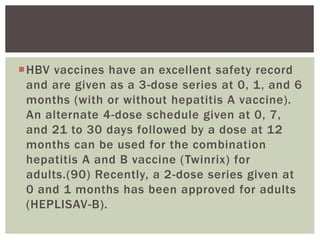
HBV vaccines have an excellent safety record
and are given as a 3-dose series at 0, 1, and 6
months (with or without hepatitis A vaccine).
An alternate 4-dose schedule given at 0, 7,
and 21 to 30 days followed by a dose at 12
months can be used for the combination
hepatitis A and B vaccine (Twinrix) for
adults.(90) Recently, a 2-dose series given at
0 and 1 months has been approved for adults
(HEPLISAV-B).
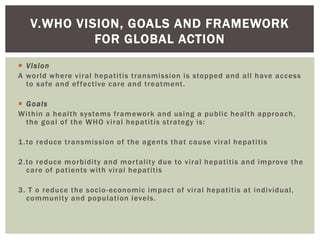
V.WHO VISION, GOALS AND FRAMEWORK
FOR GLOBAL ACTION
 Vision
A world where viral hepatitis transmission is stopped and all have access
to safe and effective care and treatment.
 Goals
Within a health systems framework and using a public health approach,
the goal of the WHO viral hepatitis strategy is:
1.to reduce transmission of the agents that cause viral hepatitis
2.to reduce morbidity and mortality due to viral hepatitis and improve the
care of patients with viral hepatitis
3. T o reduce the socio-economic impact of viral hepatitis at individual,
community and population levels.
THANK YOU

Hepatitis B virus infection

  • 1.
    DR. ISRAA HASSANEIN MEDICALSPECIALIST , MEEQAT GENERAL HOSPITAL MADINA, HEPATITIS B VIRUS INFECTION
  • 3.
    HEPATITIS B HBV infectionhas a worldwide distribution. It is estimated that more than 2 billion people have been infected. Of these, approximately 360 million are chronically infected and at risk of serious illness and death from cirrhosis and hepatocellular carcinoma (HCC), diseases that are estimated to cause 500 000–700 000 deaths each year worldwide.
  • 5.
    Persons born inregions of high or intermediate HBV endemicity (HBsAg prevalence of 2%) Africa (all countries) North, Southeast, East Asia (all countries) Middle East (all countries except Cyprus and Israel) GROUPS AT HIGH RISK FOR HBV INFECTION WHO SHOULD BE SCREENED
  • 6.
    Persons needing immunosuppressivetherapy, including chemotherapy, immunosuppression related to organ transplantation, and immunosuppressionfor rheumatological or gastroenterologic disorders
  • 8.
     Persons whohave ever injected drugs  Men who have sex with men  Individuals with elevated ALT or AST of unknown etiology  Donors of blood, plasma, organs, tissues, or semen  Persons with end-stage renal disease, including predialysis, hemodialysis, peritoneal dialysis, and home dialysis patients  All pregnant women  Infants born to HBsAg-positive mothers  Persons with chronic liver disease, e.g., HCV  Persons with HIV
  • 9.
     Household, needle-sharing,and sexual contacts of HBsAg-positive persons  Persons who are not in a long-term, mutually monogamous relationship (e.g., >1 sex partner during the previous 6 months)  Persons seeking evaluation or treatment for a sexually transmitted disease  Health care and public safety workers at risk for occupational exposure to blood or blood-contaminated body fluids*  Residents and staff of facilities for developmentally disabled persons  Travelers to countries with intermediate or high prevalence of HBV infection  Persons who are the source of blood or body fluid exposures that might require postexposure prophylaxis  Inmates of correctional facilities  Unvaccinated persons with diabetes who are aged 19 through 59 years (discretion of clinician for unvaccinated adults with diabetes who are aged  60 years)
  • 11.
    The natural courseof chronic HBV infection consists of four characteristic phases ; reflecting the dynamic relationship between viral replication and the host immune response, these phases are of variable duration and not every persons infected with CHB evolve through all phases GLOBALLY AN ESTIMATED 240 MILLION PERSONS WORLDWIDE ARE CHRONICALLY INFECTED WITH HBV,WITH VARYING PREVELANCE
  • 12.
    The risk ofdeveloping chronic HBv infection after acute exposure ranges from 90% in new born of HBeAg positive mothers to 25% to 30% in infants and children under 5 years to less than 5% in adults .(1- 2) Different types of antigens , antibody and DNA of HBV used to diagnose HBV among ELISA and PCR .
  • 13.
    HBsAg Surface proteincontained with the lipoprotein coat HBsAb Antibody to HBsAg , indictor of recovery / immunity to HBV infection HBeAg Viral product secreted in the blood , marker of infectivity , active replication ( though absent in precoremutants HBeAb Antibody to HBeAg denoting decreased infectivity HBcAg Core antigen (viral capsid ) , intracellular and not detected in serum HBcAb (igM) Antibody denoting recent HBV infection or exacerbation HBcAb (igG) Contamination marker , positive after HBV contact HBV DNA Quantitative indicator of virus in blood
  • 14.
     Chronic HepatitisB (CHB)  1. HBsAg present for 6 months  2. Serum HBV DNA varies from undetectable to several billion IU/mL  3. Subdivided into HBeAg positive and negative. HBV-DNA levels are  typically >20,000 IU/mL in HBeAg-positive CHB, and lower values  (2,000-20,000 IU/mL) are often seen in HBeAg-negative CHB.  3. Normal or elevated ALT and/or AST levels  4. Liver biopsy results show chronic hepatitis with variable  necroinflammation and/or fibrosis DIAGNOSTIC CRITERIA AND DEFINITIONS FOR CHRONIC HEPATITIS B
  • 15.
    1. HBsAg presentfor 6 months 2. HBeAg positive 3. HBV-DNA levels are very high (typically >1 million IU/mL). 4. Normal or minimally elevated ALT and/or AST 4. Liver biopsy or noninvasive test results showing no fibrosis and minimal inflammation IMMUNE-TOLERANT CHB
  • 16.
     1. HBsAgpresent for 6 months  2. Serum HBV DNA >20,000 IU/mL in HBeAg-positive CHB and >2,000  IU/mL in HBeAg-negative CHB  3. Intermittently or persistently elevated ALT and/or AST levels  4. Liver biopsy or noninvasive test results show chronic hepatitis with  moderate or severe necroinflammation and with or without fibrosis IMMUNE-ACTIVE CHB
  • 17.
    1. HBsAg presentfor 6 months 2. HBeAg negative, anti-HBe positive 3. Serum HBV DNA <2,000 IU/mL 4. Persistently normal ALT and/or AST levels 5. Liver biopsy confirms absence of significant necroinflammation. Biopsy or noninvasive testing show variable levels of fibrosis INACTIVE CHB
  • 18.
     Follow-up testingis recommended for those who remain at risk of infection, such as HCWs, infants of HBsAg-positive mothers, sexual partners of persons with CHB, chronic hemodialysis patients, and immunocompromised persons, including those with HIV. Furthermore.  Booster doses are not indicated in immunocompetent individuals if the primary vaccination series is completedbooster injection is advised when the anti-HBs titer falls below 10 mIU/mL 1D. VACCINATION, FOLLOW-UP TESTING, AND BOOSTERS
  • 19.
    HBV vaccines havean excellent safety record and are given as a 3-dose series at 0, 1, and 6 months (with or without hepatitis A vaccine). An alternate 4-dose schedule given at 0, 7, and 21 to 30 days followed by a dose at 12 months can be used for the combination hepatitis A and B vaccine (Twinrix) for adults.(90) Recently, a 2-dose series given at 0 and 1 months has been approved for adults (HEPLISAV-B).
  • 23.
    V.WHO VISION, GOALSAND FRAMEWORK FOR GLOBAL ACTION  Vision A world where viral hepatitis transmission is stopped and all have access to safe and effective care and treatment.  Goals Within a health systems framework and using a public health approach, the goal of the WHO viral hepatitis strategy is: 1.to reduce transmission of the agents that cause viral hepatitis 2.to reduce morbidity and mortality due to viral hepatitis and improve the care of patients with viral hepatitis 3. T o reduce the socio-economic impact of viral hepatitis at individual, community and population levels.
  • 24.