HEPATIC
FAILURE
Presented By:
Mr. Nandish. S
Asso. Professor
Mandya Institute of Nursing
Sciences
Definition / Meaning:
o It is a clinical syndrome characterized by severe impairment of liver
function associated with hepatic encephalopathy.
o It is the inability of Liver to perform its normal synthetic &
metabolic function.
o It develops within the 8 weeks after the first symptoms of Jaundice.
Classification :
Three categories of Liver failure are identified.
1) Hyperacute: duration of jaundice before the onset of
encephalopathy is 0 to 7 days.
2) Acute : duration is 8 to 28 days.
3) Subacute : duration is 28 to 72 days.
* Survival rates are 20 to 50 % depending on the cause.
Etiology :
- Viral Hepatitis
- Drugs (Acetaminophen, Isoniazid, Halothane, Paracetaml,
NSAID’s)
- Structural changes / congenital deformities like Budd –Chiari
syndrome (narrows & blocks blood vessel in Liver).
- Excessive alcohol consumption
- Metabolic disturbances like Wilson’s Disease ( Hereditary syndrome
with deposition of Copper in Liver)
- Excessive consumption of Fatty foods, Obesity
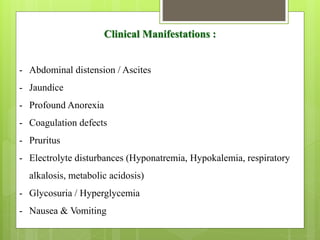
Clinical Manifestations :
- Abdominal distension / Ascites
- Jaundice
- Profound Anorexia
- Coagulation defects
- Pruritus
- Electrolyte disturbances (Hyponatremia, Hypokalemia, respiratory
alkalosis, metabolic acidosis)
- Glycosuria / Hyperglycemia
- Nausea & Vomiting
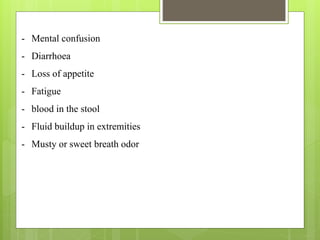
- Mental confusion
- Diarrhoea
- Loss of appetite
- Fatigue
- blood in the stool
- Fluid buildup in extremities
- Musty or sweet breath odor
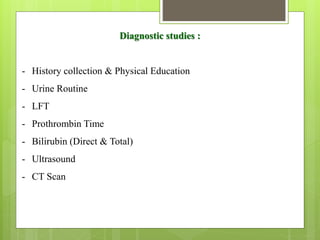
Diagnostic studies :
- History collection & Physical Education
- Urine Routine
- LFT
- Prothrombin Time
- Bilirubin (Direct & Total)
- Ultrasound
- CT Scan
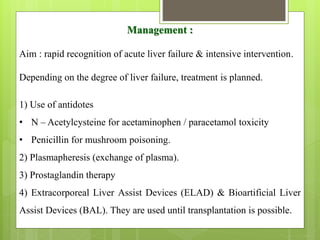
Management :
Aim : rapid recognition of acute liver failure & intensive intervention.
Depending on the degree of liver failure, treatment is planned.
1) Use of antidotes
• N – Acetylcysteine for acetaminophen / paracetamol toxicity
• Penicillin for mushroom poisoning.
2) Plasmapheresis (exchange of plasma).
3) Prostaglandin therapy
4) Extracorporeal Liver Assist Devices (ELAD) & Bioartificial Liver
Assist Devices (BAL). They are used until transplantation is possible.
5) Liver Transplantation (treatment of choice for maximum survival
rate)
6) Intracranial pressure monitoring
7) Sedation
8) Monitor & treat hypoglycemia & Infection.
THANK YOU

Hepatic Failure.pptx

  • 1.
    HEPATIC FAILURE Presented By: Mr. Nandish.S Asso. Professor Mandya Institute of Nursing Sciences
  • 2.
    Definition / Meaning: oIt is a clinical syndrome characterized by severe impairment of liver function associated with hepatic encephalopathy. o It is the inability of Liver to perform its normal synthetic & metabolic function. o It develops within the 8 weeks after the first symptoms of Jaundice.
  • 3.
    Classification : Three categoriesof Liver failure are identified. 1) Hyperacute: duration of jaundice before the onset of encephalopathy is 0 to 7 days. 2) Acute : duration is 8 to 28 days. 3) Subacute : duration is 28 to 72 days. * Survival rates are 20 to 50 % depending on the cause.
  • 4.
    Etiology : - ViralHepatitis - Drugs (Acetaminophen, Isoniazid, Halothane, Paracetaml, NSAID’s) - Structural changes / congenital deformities like Budd –Chiari syndrome (narrows & blocks blood vessel in Liver). - Excessive alcohol consumption - Metabolic disturbances like Wilson’s Disease ( Hereditary syndrome with deposition of Copper in Liver) - Excessive consumption of Fatty foods, Obesity
  • 5.
    Clinical Manifestations : -Abdominal distension / Ascites - Jaundice - Profound Anorexia - Coagulation defects - Pruritus - Electrolyte disturbances (Hyponatremia, Hypokalemia, respiratory alkalosis, metabolic acidosis) - Glycosuria / Hyperglycemia - Nausea & Vomiting
  • 6.
    - Mental confusion -Diarrhoea - Loss of appetite - Fatigue - blood in the stool - Fluid buildup in extremities - Musty or sweet breath odor
  • 7.
    Diagnostic studies : -History collection & Physical Education - Urine Routine - LFT - Prothrombin Time - Bilirubin (Direct & Total) - Ultrasound - CT Scan
  • 8.
    Management : Aim :rapid recognition of acute liver failure & intensive intervention. Depending on the degree of liver failure, treatment is planned. 1) Use of antidotes • N – Acetylcysteine for acetaminophen / paracetamol toxicity • Penicillin for mushroom poisoning. 2) Plasmapheresis (exchange of plasma). 3) Prostaglandin therapy 4) Extracorporeal Liver Assist Devices (ELAD) & Bioartificial Liver Assist Devices (BAL). They are used until transplantation is possible.
  • 9.
    5) Liver Transplantation(treatment of choice for maximum survival rate) 6) Intracranial pressure monitoring 7) Sedation 8) Monitor & treat hypoglycemia & Infection.
  • 10.