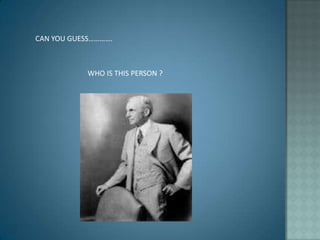
CAN YOU GUESS………….


            WHO IS THIS PERSON ?
LOGO OF FORD
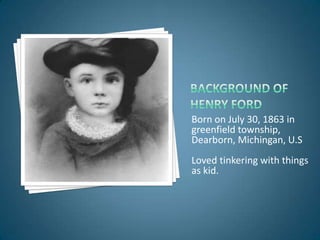
Born on July 30, 1863 in
greenfield township,
Dearborn, Michingan, U.S
Loved tinkering with things
as kid.
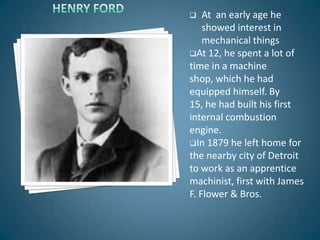
   At an early age he
    showed interest in
    mechanical things
At 12, he spent a lot of
time in a machine
shop, which he had
equipped himself. By
15, he had built his first
internal combustion
engine.
In 1879 he left home for
the nearby city of Detroit
to work as an apprentice
machinist, first with James
F. Flower & Bros.
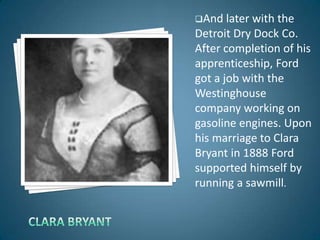
And   later with the
Detroit Dry Dock Co.
After completion of his
apprenticeship, Ford
got a job with the
Westinghouse
company working on
gasoline engines. Upon
his marriage to Clara
Bryant in 1888 Ford
supported himself by
running a sawmill.
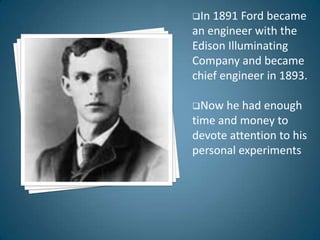
In 1891 Ford became
an engineer with the
Edison Illuminating
Company and became
chief engineer in 1893.

Now  he had enough
time and money to
devote attention to his
personal experiments
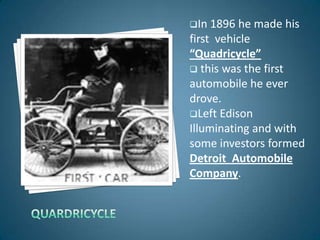
In  1896 he made his
first vehicle
“Quadricycle”
 this was the first
automobile he ever
drove.
Left Edison
Illuminating and with
some investors formed
Detroit Automobile
Company.
The  Detroit Automobile
Company, however, went
bankrupt soon afterward
because Ford continued to
improve the design
instead of selling cars.

Ford raced his vehicles
against those of other
manufacturers to show the
superiority of his designs.

With  the interest in his
race cars, he formed a
second company, the
Henry Ford Company.
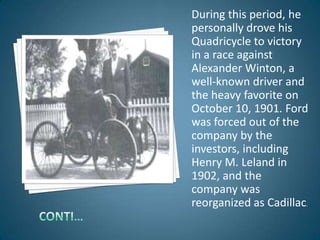
During this period, he
personally drove his
Quadricycle to victory
in a race against
Alexander Winton, a
well-known driver and
the heavy favorite on
October 10, 1901. Ford
was forced out of the
company by the
investors, including
Henry M. Leland in
1902, and the
company was
reorganized as Cadillac.
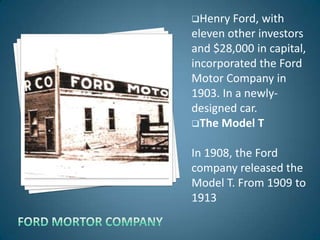
Henry  Ford, with
eleven other investors
and $28,000 in capital,
incorporated the Ford
Motor Company in
1903. In a newly-
designed car.
The Model T


In 1908, the Ford
company released the
Model T. From 1909 to
1913
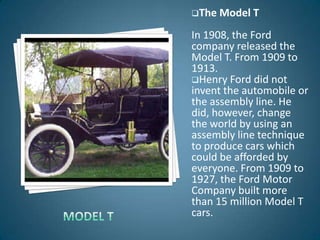
The   Model T
In 1908, the Ford
company released the
Model T. From 1909 to
1913.
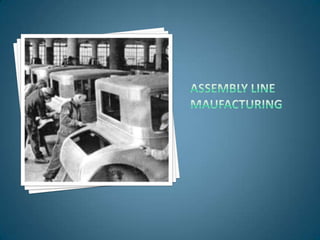
Henry Ford did not
invent the automobile or
the assembly line. He
did, however, change
the world by using an
assembly line technique
to produce cars which
could be afforded by
everyone. From 1909 to
1927, the Ford Motor
Company built more
than 15 million Model T
cars.
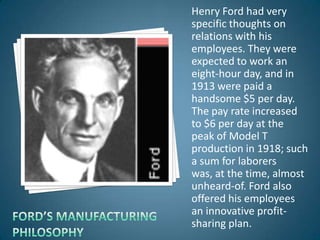
Henry Ford had very
specific thoughts on
relations with his
employees. They were
expected to work an
eight-hour day, and in
1913 were paid a
handsome $5 per day.
The pay rate increased
to $6 per day at the
peak of Model T
production in 1918; such
a sum for laborers
was, at the time, almost
unheard-of. Ford also
offered his employees
an innovative profit-
sharing plan.
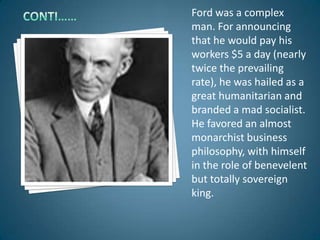
Ford was a complex
man. For announcing
that he would pay his
workers $5 a day (nearly
twice the prevailing
rate), he was hailed as a
great humanitarian and
branded a mad socialist.
He favored an almost
monarchist business
philosophy, with himself
in the role of benevelent
but totally sovereign
king.
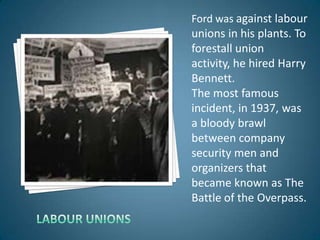
Ford was against labour
unions in his plants. To
forestall union
activity, he hired Harry
Bennett.
The most famous
incident, in 1937, was
a bloody brawl
between company
security men and
organizers that
became known as The
Battle of the Overpass.
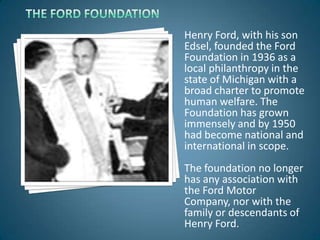
Henry Ford, with his son
Edsel, founded the Ford
Foundation in 1936 as a
local philanthropy in the
state of Michigan with a
broad charter to promote
human welfare. The
Foundation has grown
immensely and by 1950
had become national and
international in scope.
The foundation no longer
has any association with
the Ford Motor
Company, nor with the
family or descendants of
Henry Ford.
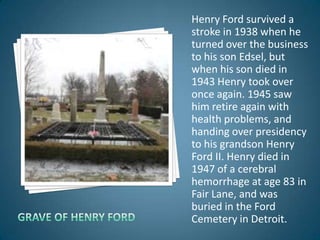
Henry Ford survived a
stroke in 1938 when he
turned over the business
to his son Edsel, but
when his son died in
1943 Henry took over
once again. 1945 saw
him retire again with
health problems, and
handing over presidency
to his grandson Henry
Ford II. Henry died in
1947 of a cerebral
hemorrhage at age 83 in
Fair Lane, and was
buried in the Ford
Cemetery in Detroit.
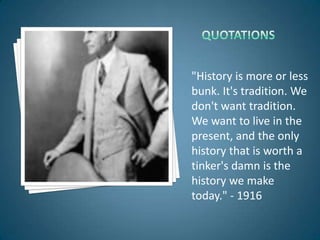
"History is more or less
bunk. It's tradition. We
don't want tradition.
We want to live in the
present, and the only
history that is worth a
tinker's damn is the
history we make
today." - 1916

Henry ford presentation by rekha

  • 1.
    CAN YOU GUESS…………. WHO IS THIS PERSON ?
  • 3.
  • 4.
    Born on July30, 1863 in greenfield township, Dearborn, Michingan, U.S Loved tinkering with things as kid.
  • 5.
    At an early age he showed interest in mechanical things At 12, he spent a lot of time in a machine shop, which he had equipped himself. By 15, he had built his first internal combustion engine. In 1879 he left home for the nearby city of Detroit to work as an apprentice machinist, first with James F. Flower & Bros.
  • 6.
    And later with the Detroit Dry Dock Co. After completion of his apprenticeship, Ford got a job with the Westinghouse company working on gasoline engines. Upon his marriage to Clara Bryant in 1888 Ford supported himself by running a sawmill.
  • 7.
    In 1891 Fordbecame an engineer with the Edison Illuminating Company and became chief engineer in 1893. Now he had enough time and money to devote attention to his personal experiments
  • 8.
    In 1896he made his first vehicle “Quadricycle”  this was the first automobile he ever drove. Left Edison Illuminating and with some investors formed Detroit Automobile Company.
  • 9.
    The DetroitAutomobile Company, however, went bankrupt soon afterward because Ford continued to improve the design instead of selling cars. Ford raced his vehicles against those of other manufacturers to show the superiority of his designs. With the interest in his race cars, he formed a second company, the Henry Ford Company.
  • 10.
    During this period,he personally drove his Quadricycle to victory in a race against Alexander Winton, a well-known driver and the heavy favorite on October 10, 1901. Ford was forced out of the company by the investors, including Henry M. Leland in 1902, and the company was reorganized as Cadillac.
  • 11.
    Henry Ford,with eleven other investors and $28,000 in capital, incorporated the Ford Motor Company in 1903. In a newly- designed car. The Model T In 1908, the Ford company released the Model T. From 1909 to 1913
  • 12.
    The Model T In 1908, the Ford company released the Model T. From 1909 to 1913. Henry Ford did not invent the automobile or the assembly line. He did, however, change the world by using an assembly line technique to produce cars which could be afforded by everyone. From 1909 to 1927, the Ford Motor Company built more than 15 million Model T cars.
  • 14.
    Henry Ford hadvery specific thoughts on relations with his employees. They were expected to work an eight-hour day, and in 1913 were paid a handsome $5 per day. The pay rate increased to $6 per day at the peak of Model T production in 1918; such a sum for laborers was, at the time, almost unheard-of. Ford also offered his employees an innovative profit- sharing plan.
  • 15.
    Ford was acomplex man. For announcing that he would pay his workers $5 a day (nearly twice the prevailing rate), he was hailed as a great humanitarian and branded a mad socialist. He favored an almost monarchist business philosophy, with himself in the role of benevelent but totally sovereign king.
  • 16.
    Ford was againstlabour unions in his plants. To forestall union activity, he hired Harry Bennett. The most famous incident, in 1937, was a bloody brawl between company security men and organizers that became known as The Battle of the Overpass.
  • 17.
    Henry Ford, withhis son Edsel, founded the Ford Foundation in 1936 as a local philanthropy in the state of Michigan with a broad charter to promote human welfare. The Foundation has grown immensely and by 1950 had become national and international in scope. The foundation no longer has any association with the Ford Motor Company, nor with the family or descendants of Henry Ford.
  • 18.
    Henry Ford surviveda stroke in 1938 when he turned over the business to his son Edsel, but when his son died in 1943 Henry took over once again. 1945 saw him retire again with health problems, and handing over presidency to his grandson Henry Ford II. Henry died in 1947 of a cerebral hemorrhage at age 83 in Fair Lane, and was buried in the Ford Cemetery in Detroit.
  • 19.
    "History is moreor less bunk. It's tradition. We don't want tradition. We want to live in the present, and the only history that is worth a tinker's damn is the history we make today." - 1916