A TRANSFORMATIONAL
LEADER
By:
• ASITPATI KU NAYAK
• BHABANI PRASAD
PANDA
• AVINASH MAHATO
• SANAT MOHANTY
• ROHIT BOIPAI
• DEFINITIONS
• Four Characteristics of Transformational Leader
 Idealized Influence
 Inspirational Motivation
 Intellectual Stimulation
 Individualized Consideration
• The Early Years
• Young engineer
• The Inventing Years
• Ford’s First Gasoline Powered Car
• The Model T
• Company Owner
• Owner and Innovator
• Company Pride
• Achievements
• Henry Ford’s Death
• Factories Today
• Style of leadership in which the leader
identifies the needed change, creates a
vision to guide the change through
inspiration, and executes the change with the
commitment of the members of the group.
DEFINITIONS
Four Characteristics of
Transformational Leader
• Idealized Influence
• Inspirational Motivation
• Intellectual Stimulation
• Individualized Consideration
Transformational leaders strive towards creating such a state of idealized
influence by:
• leading by example
• acting confidently and optimistically
• sharing risks with followers
• emphasizing values and reinforcing them by symbolic actions
• displaying a high level of ethical and moral conduct
Idealized Influence
Inspirational Motivation
The transformational leader inspires followers toward the new ideas or
goals through inspirational motivation. The major characteristics of
inspirational motivation leadership include:
• clear view of the future
• development of a shared vision in both economic and ideological
terms
• making sure of each follower’s role in the fulfillment of the shared
vision
• encouraging followers to integrate and become part of the overall
organizational culture and environment
Intellectual Stimulation
Transformational leaders raise their followers’ awareness regarding
problems and develop their capability to solve such problems in many ways.
Some of these ways are:
• encouraging innovation and creativity
• heightening sensitivity to environmental changes
• encouraging the suggestion of radical and controversial ideas without
fear of punishment or ridicule
Individualized Consideration
Individualized consideration ranks among the major characteristics of
transformational leadership. The transformational leader treats each
follower as a “whole” individual rather than as an employee, and considers
the individual’s talents and levels of knowledge to decide what suits him or
her to reach higher levels of attainment.
A transformational leader applies such individual considerations by:
• listening to each follower’s needs and concerns
• expressing words of thanks or praise as a means of motivation
• making public recognition of achievements and initiatives
• making private notes of congratulations to boost self confidence
THE EARLY YEARS
• Henry Ford was born on July
30, 1863.
• He was born on a farm near
Dearborn, Michigan.
• He had six siblings he was
the oldest of them
• In 1879 he was 16 and left
home to work as an engineer
• Henry Ford only went to
school for eight years.
• As a young boy he was
fascinated with how things worked.
• He loved to take apart watches to
see how they functioned. Soon he
was able to put watches back together
and even fixed ones that broke.
As a young man, Ford knew that
he didn’t want to work on the farm.
He left home to work as a machinist
(a person who works with machines).
He was later hired by the Westinghouse
company to service their steam engines.
Young Engineer
• He worked in the city of Detroit as a apprentice
machinist
• Henry Divided his time between operating or
repairing steam engines and received $2.50 a
week doing so. He married Clara Bryant in 1888
and supported himself and his wife by running a
saw mill
THE INVENTING YEARS
In 1891, Ford began
working with a famous
inventor named Thomas
Edison at a company called
The Edison Illuminating Co.
Here his creativity was sparked
and he began inventing. He wanted to make a
gasoline powered engine.
FORD’S FIRST GASOLINE POWERED CAR
• In 1896, Henry Ford completed
his first vehicle that was powered
by gasoline instead of steam like
other cars of his time. This car
was called the Quadricycle.
• The car had four wire wheels and
was steered with a tiller like a
boat
• It had only two forward speeds
and no reverse. It had two
cylinders and was a 4 cycle
motor.
Ford liked the Quadricycle, but he wanted to keep
experimenting and creating cars until he made one that he
felt was perfect.
• On October 1, 1908, after lots of hard
work, Ford introduced his new car.
• It was called the Model T. It had
many important innovations—such as
the steering wheel on the left, which
every other company soon copied.
COMPANY OWNER
• The Ford Motor Co. was
incorporated in 1903 with Henry as
Vice President and Chief engineer.
The young company was only able
to produce a few cars a day.
• He wanted to make cars that the
ordinary person, like you and me,
could afford.
• But making one car was very
expensive and took a long time to
build. Only wealthy people were
able to afford cars.
• While his workers worked,
Ford watched them closely and
noticed that they spent a lot of
time getting the materials they
needed to do the job. It took
the workers a long time to build
a car.
• Henry wanted to build more
cars in a faster way. He
wondered if he could find a
way to help the workers to get
the materials they needed
quickly.
OWNER AND INNOVATOR
OWNER AND INNOVATOR
• Henry knew there had to
be a faster and better
way to put the cars
together.
• So in 1913-1914, Henry
and his engineers
designed conveyor belts
that ran down long tables
carrying parts and pieces
that needed to be put
together.
• Ford’s introduction of the moving
assembly belts into his plants
allowed him to produce more cars
in a shorter amount of time.
• Instead of the worker walking to the
car, the car came to the worker who
stayed in one place. Each worker
had only one job to do and then the
car would move on.
OWNER AND INNOVATOR
• Before the assembly line, it took 14 hours to build one car. With the
assembly line, workers could build one car every 93 minutes. This
meant that Ford could make more cars to sell at a cheaper price.
Now many more people could afford to buy a car.
COMPANY PRIDE
With all of the cars Ford could now make and sell, he needed more
workers in his factories. He decided to pay them $5.oo an hour and
started an 8 hour workday. His workers were well-paid and well-
treated. They were proud to work at the Ford Motor Company.
ACHIEVEMENTS
Henry Ford was awarded:
• Elliott Cresson Medal in 1928
• Order of the German Eagle in 1938
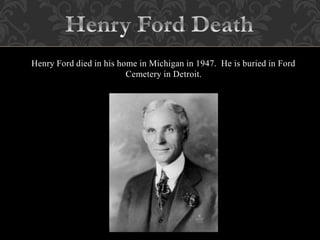
Henry Ford died in his home in Michigan in 1947. He is buried in Ford
Cemetery in Detroit.
FACTORIES TODAY
• Factories today still use
the assembly line to
make large amounts of
their products quickly.
• Henry Ford’s ideas
helped to shape
American history.
Ford Henry PPT

Ford Henry PPT

  • 1.
    A TRANSFORMATIONAL LEADER By: • ASITPATIKU NAYAK • BHABANI PRASAD PANDA • AVINASH MAHATO • SANAT MOHANTY • ROHIT BOIPAI
  • 2.
    • DEFINITIONS • FourCharacteristics of Transformational Leader  Idealized Influence  Inspirational Motivation  Intellectual Stimulation  Individualized Consideration • The Early Years • Young engineer • The Inventing Years • Ford’s First Gasoline Powered Car • The Model T • Company Owner • Owner and Innovator • Company Pride • Achievements • Henry Ford’s Death • Factories Today
  • 3.
    • Style ofleadership in which the leader identifies the needed change, creates a vision to guide the change through inspiration, and executes the change with the commitment of the members of the group. DEFINITIONS
  • 4.
    Four Characteristics of TransformationalLeader • Idealized Influence • Inspirational Motivation • Intellectual Stimulation • Individualized Consideration
  • 5.
    Transformational leaders strivetowards creating such a state of idealized influence by: • leading by example • acting confidently and optimistically • sharing risks with followers • emphasizing values and reinforcing them by symbolic actions • displaying a high level of ethical and moral conduct Idealized Influence
  • 6.
    Inspirational Motivation The transformationalleader inspires followers toward the new ideas or goals through inspirational motivation. The major characteristics of inspirational motivation leadership include: • clear view of the future • development of a shared vision in both economic and ideological terms • making sure of each follower’s role in the fulfillment of the shared vision • encouraging followers to integrate and become part of the overall organizational culture and environment
  • 7.
    Intellectual Stimulation Transformational leadersraise their followers’ awareness regarding problems and develop their capability to solve such problems in many ways. Some of these ways are: • encouraging innovation and creativity • heightening sensitivity to environmental changes • encouraging the suggestion of radical and controversial ideas without fear of punishment or ridicule
  • 8.
    Individualized Consideration Individualized considerationranks among the major characteristics of transformational leadership. The transformational leader treats each follower as a “whole” individual rather than as an employee, and considers the individual’s talents and levels of knowledge to decide what suits him or her to reach higher levels of attainment. A transformational leader applies such individual considerations by: • listening to each follower’s needs and concerns • expressing words of thanks or praise as a means of motivation • making public recognition of achievements and initiatives • making private notes of congratulations to boost self confidence
  • 9.
    THE EARLY YEARS •Henry Ford was born on July 30, 1863. • He was born on a farm near Dearborn, Michigan. • He had six siblings he was the oldest of them • In 1879 he was 16 and left home to work as an engineer
  • 10.
    • Henry Fordonly went to school for eight years. • As a young boy he was fascinated with how things worked. • He loved to take apart watches to see how they functioned. Soon he was able to put watches back together and even fixed ones that broke.
  • 11.
    As a youngman, Ford knew that he didn’t want to work on the farm. He left home to work as a machinist (a person who works with machines). He was later hired by the Westinghouse company to service their steam engines.
  • 12.
    Young Engineer • Heworked in the city of Detroit as a apprentice machinist • Henry Divided his time between operating or repairing steam engines and received $2.50 a week doing so. He married Clara Bryant in 1888 and supported himself and his wife by running a saw mill
  • 13.
    THE INVENTING YEARS In1891, Ford began working with a famous inventor named Thomas Edison at a company called The Edison Illuminating Co. Here his creativity was sparked and he began inventing. He wanted to make a gasoline powered engine.
  • 14.
    FORD’S FIRST GASOLINEPOWERED CAR • In 1896, Henry Ford completed his first vehicle that was powered by gasoline instead of steam like other cars of his time. This car was called the Quadricycle. • The car had four wire wheels and was steered with a tiller like a boat • It had only two forward speeds and no reverse. It had two cylinders and was a 4 cycle motor.
  • 15.
    Ford liked theQuadricycle, but he wanted to keep experimenting and creating cars until he made one that he felt was perfect.
  • 16.
    • On October1, 1908, after lots of hard work, Ford introduced his new car. • It was called the Model T. It had many important innovations—such as the steering wheel on the left, which every other company soon copied.
  • 17.
    COMPANY OWNER • TheFord Motor Co. was incorporated in 1903 with Henry as Vice President and Chief engineer. The young company was only able to produce a few cars a day. • He wanted to make cars that the ordinary person, like you and me, could afford. • But making one car was very expensive and took a long time to build. Only wealthy people were able to afford cars.
  • 18.
    • While hisworkers worked, Ford watched them closely and noticed that they spent a lot of time getting the materials they needed to do the job. It took the workers a long time to build a car. • Henry wanted to build more cars in a faster way. He wondered if he could find a way to help the workers to get the materials they needed quickly. OWNER AND INNOVATOR
  • 19.
    OWNER AND INNOVATOR •Henry knew there had to be a faster and better way to put the cars together. • So in 1913-1914, Henry and his engineers designed conveyor belts that ran down long tables carrying parts and pieces that needed to be put together.
  • 20.
    • Ford’s introductionof the moving assembly belts into his plants allowed him to produce more cars in a shorter amount of time. • Instead of the worker walking to the car, the car came to the worker who stayed in one place. Each worker had only one job to do and then the car would move on. OWNER AND INNOVATOR
  • 21.
    • Before theassembly line, it took 14 hours to build one car. With the assembly line, workers could build one car every 93 minutes. This meant that Ford could make more cars to sell at a cheaper price. Now many more people could afford to buy a car.
  • 22.
    COMPANY PRIDE With allof the cars Ford could now make and sell, he needed more workers in his factories. He decided to pay them $5.oo an hour and started an 8 hour workday. His workers were well-paid and well- treated. They were proud to work at the Ford Motor Company.
  • 23.
    ACHIEVEMENTS Henry Ford wasawarded: • Elliott Cresson Medal in 1928 • Order of the German Eagle in 1938
  • 24.
    Henry Ford diedin his home in Michigan in 1947. He is buried in Ford Cemetery in Detroit.
  • 25.
    FACTORIES TODAY • Factoriestoday still use the assembly line to make large amounts of their products quickly. • Henry Ford’s ideas helped to shape American history.