Henry Ford Engineer Businessman
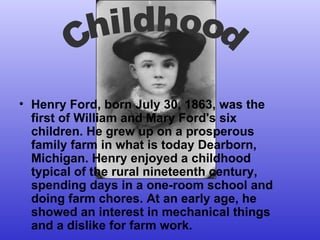
Henry Ford, born July 30, 1863, was the first of William and Mary Ford's six children. He grew up on a prosperous family farm in what is today Dearborn, Michigan. Henry enjoyed a childhood typical of the rural nineteenth century, spending days in a one-room school and doing farm chores. At an early age, he showed an interest in mechanical things and a dislike for farm work. Childhood
Early stages of life In 1879, sixteen-year-old Ford left home for the nearby city of Detroit to work as an apprentice machinist, although he did occasionally return to help on the farm. He remained an apprentice for three years and then returned to Dearborn. During the next few years, Henry divided his time between operating or repairing steam engines, finding occasional work in a Detroit factory, and over-hauling his father's farm implements, as well as lending a reluctant hand with other farm work. Upon his marriage to Clara Bryant in 1888, Henry supported himself and his wife by running a sawmill.
The Engineer In 1891, Ford became an engineer with the Edison Illuminating Company in Detroit. This event signified a conscious decision on Ford's part to dedicate his life to industrial pursuits. His promotion to Chief Engineer in 1893 gave him enough time and money to devote attention to his personal experiments on internal combustion engines.
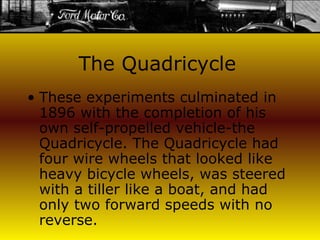
The Quadricycle These experiments culminated in 1896 with the completion of his own self-propelled vehicle-the Quadricycle. The Quadricycle had four wire wheels that looked like heavy bicycle wheels, was steered with a tiller like a boat, and had only two forward speeds with no reverse.
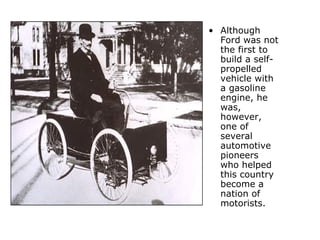
Although Ford was not the first to build a self-propelled vehicle with a gasoline engine, he was, however, one of several automotive pioneers who helped this country become a nation of motorists.
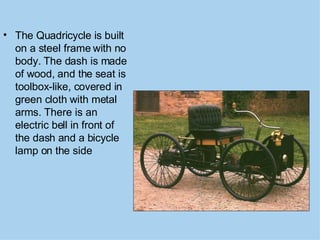
The Quadricycle is built on a steel frame with no body. The dash is made of wood, and the seat is toolbox-like, covered in green cloth with metal arms. There is an electric bell in front of the dash and a bicycle lamp on the side
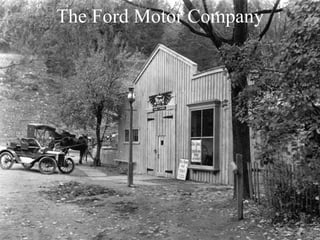
The Ford Motor Company
Henry Ford’s vision: "I will build a motorcar for the great multitudes, constructed of the best materials by the best men and women to be hired. Any person making a good salary will be able to own one. And enjoy, with his family, the blessings of hours of pleasure in God's great open spaces."
After two unsuccessful attempts to establish a company to manufacture automobiles, the Ford Motor Company was incorporated in 1903 with Henry Ford as vice-president and chief engineer. The infant company produced only a few cars a day at the Ford factory on Mack Avenue in Detroit. Groups of two or three men worked on each car from components made to order by other companies. Henry Ford realized his dream of producing an automobile that was reasonably priced, reliable, and efficient with the introduction of the Model T in 1908. This vehicle initiated a new era in personal transportation. It was easy to operate, maintain, and handle on rough roads, immediately becoming a huge success.
 

Prezentacja1

  • 1.
  • 2.
    Henry Ford, bornJuly 30, 1863, was the first of William and Mary Ford's six children. He grew up on a prosperous family farm in what is today Dearborn, Michigan. Henry enjoyed a childhood typical of the rural nineteenth century, spending days in a one-room school and doing farm chores. At an early age, he showed an interest in mechanical things and a dislike for farm work. Childhood
  • 3.
    Early stages oflife In 1879, sixteen-year-old Ford left home for the nearby city of Detroit to work as an apprentice machinist, although he did occasionally return to help on the farm. He remained an apprentice for three years and then returned to Dearborn. During the next few years, Henry divided his time between operating or repairing steam engines, finding occasional work in a Detroit factory, and over-hauling his father's farm implements, as well as lending a reluctant hand with other farm work. Upon his marriage to Clara Bryant in 1888, Henry supported himself and his wife by running a sawmill.
  • 4.
    The Engineer In1891, Ford became an engineer with the Edison Illuminating Company in Detroit. This event signified a conscious decision on Ford's part to dedicate his life to industrial pursuits. His promotion to Chief Engineer in 1893 gave him enough time and money to devote attention to his personal experiments on internal combustion engines.
  • 5.
    The Quadricycle Theseexperiments culminated in 1896 with the completion of his own self-propelled vehicle-the Quadricycle. The Quadricycle had four wire wheels that looked like heavy bicycle wheels, was steered with a tiller like a boat, and had only two forward speeds with no reverse.
  • 6.
    Although Ford wasnot the first to build a self-propelled vehicle with a gasoline engine, he was, however, one of several automotive pioneers who helped this country become a nation of motorists.
  • 7.
    The Quadricycle isbuilt on a steel frame with no body. The dash is made of wood, and the seat is toolbox-like, covered in green cloth with metal arms. There is an electric bell in front of the dash and a bicycle lamp on the side
  • 8.
  • 9.
    Henry Ford’s vision:"I will build a motorcar for the great multitudes, constructed of the best materials by the best men and women to be hired. Any person making a good salary will be able to own one. And enjoy, with his family, the blessings of hours of pleasure in God's great open spaces."
  • 10.
    After two unsuccessfulattempts to establish a company to manufacture automobiles, the Ford Motor Company was incorporated in 1903 with Henry Ford as vice-president and chief engineer. The infant company produced only a few cars a day at the Ford factory on Mack Avenue in Detroit. Groups of two or three men worked on each car from components made to order by other companies. Henry Ford realized his dream of producing an automobile that was reasonably priced, reliable, and efficient with the introduction of the Model T in 1908. This vehicle initiated a new era in personal transportation. It was easy to operate, maintain, and handle on rough roads, immediately becoming a huge success.
  • 11.