Contributions by
Henry Ford
Presentation by :-
AKSHAY SOMAIYA
HENRY FORD
• Born on July 30, 1863 in
Greenfield Township,
Michigan.
• In 1896, he constructed his
first model, the Ford
Quadricycle.
• In 1903, Henry Ford
established the Ford Motor
Company.
• He created the Ford Model T
car in 1908.
• In 1914, he sponsored the
development of the moving
assembly line technique of
mass production.
ACCOMPLISHMENTS
• He was inducted into ‘The National Inventors
Hall of Fame’ in 1982 for his invention of the
“transmission mechanism”.
• Google Patent search finds 100 patents under
his and ford company’s name.
• In 1928, Ford was awarded the Franklin
Institute's Elliott Cresson Medal.
ASSEMBLY LINE
MANUFACTURING PROCESS
ASSEMBLY LINE
• The assembly line is
often described as a
process that uses
machines to move
material from one place
to another.
• key components of the
Industrial Revolution
MOTORIZED VEHICLES
CONVEYORS
MOVEMENT OF
PARTS/ASSEMBLIES
CONVEYORS
MOTORIZED
VEHICLES
ADVANTAGES
OF ASSEMBLY LINE PRODUCTION
• Semi skilled labour required.
• Much lower cost in mass production.
• Speed.
• Comparatively less working hours required.
• Utmost accuracy.
• Less training requirements.
DISADVANTAGES
OF ASSEMBLY LINE PRODUCTION
• Large capital requirement.
• Long time to get set up done.
• Not suited to custom parts or frequent design
changes.
• Job loss.
• Monotonous work.
THE FORD MODEL T
• The Ford Model T is an automobile that was
produced by Henry Ford's Ford Motor
Company in September 1908.
• A simple, sturdy car, offering no factory options.
• It is generally regarded as the first
affordable automobile, the car that opened
travel to the common middle-class American.
• It was mainly possible because of assembly
line production instead of individual hand
crafting.
HISTORY
• Introduced on October 1, 1908.
• Characteristics of Model T:
 Steering wheel on left
 Enclosed engine and
transmission
 Suspension
 Cheap
HOW IT WAS DIFFERENT?
• Franchises grew
• Introduction of Moving Assembly belts in 1913
• Sales increased (2,50,000) in 1914
• Price dropped.
• It was available in various
colours.
• Final production
was 1,50,07,034.
Record for 45 years.
MASS PRODUCTION
EVOLUTION OF MASS PRODUCTION
• In the earliest days of manufacturing, goods
were produced using Craft Production.
• Craft Production is system in which highly
skilled worker use simple flexible tools to
produce small quantity of customized goods.
• Limitations:- Slow , costly & no economies of
scale, also require high skilled labour etc.
“Put the world on wheel”
• Henry Ford was first to introduce Mass
production to automotive industry in US at
the beginning of the 20th Century.
MASS PRODUCTION
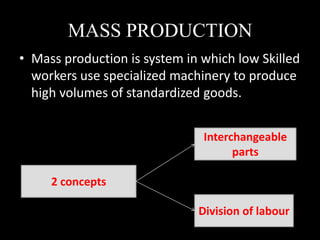
• Mass production is system in which low Skilled
workers use specialized machinery to produce
high volumes of standardized goods.
2 concepts
Interchangeable
parts
Division of labour
ADVANTAGES
OF MASS PRODUCTION
• High volume of production.
• Faster rate of production.
• Semi skilled labor can be used.
• Economies of scale.
• The probability of human error and variation
is also reduced.
• Product is made in advance and available for
purchase.
DISADVANTAGES
OF MASS PRODUCTION
• Highly expensive machinery
• It is inflexible because it is difficult to alter a
design or production process after a
production line is implemented.
• All products produced on one production line
will be identical
• Introducing variety to satisfy customers tastes
is not easy
EXAMPLES
REFERENCES
• www.encyclopedia.com/topic/assembly_line.aspx
•Theinventors.org
• My life and work- henry ford
THANK YOU

contributions by henry ford

  • 1.
  • 2.
    HENRY FORD • Bornon July 30, 1863 in Greenfield Township, Michigan. • In 1896, he constructed his first model, the Ford Quadricycle. • In 1903, Henry Ford established the Ford Motor Company. • He created the Ford Model T car in 1908. • In 1914, he sponsored the development of the moving assembly line technique of mass production.
  • 3.
    ACCOMPLISHMENTS • He wasinducted into ‘The National Inventors Hall of Fame’ in 1982 for his invention of the “transmission mechanism”. • Google Patent search finds 100 patents under his and ford company’s name. • In 1928, Ford was awarded the Franklin Institute's Elliott Cresson Medal.
  • 4.
  • 5.
    ASSEMBLY LINE • Theassembly line is often described as a process that uses machines to move material from one place to another. • key components of the Industrial Revolution
  • 6.
  • 7.
    ADVANTAGES OF ASSEMBLY LINEPRODUCTION • Semi skilled labour required. • Much lower cost in mass production. • Speed. • Comparatively less working hours required. • Utmost accuracy. • Less training requirements.
  • 8.
    DISADVANTAGES OF ASSEMBLY LINEPRODUCTION • Large capital requirement. • Long time to get set up done. • Not suited to custom parts or frequent design changes. • Job loss. • Monotonous work.
  • 9.
    THE FORD MODELT • The Ford Model T is an automobile that was produced by Henry Ford's Ford Motor Company in September 1908. • A simple, sturdy car, offering no factory options. • It is generally regarded as the first affordable automobile, the car that opened travel to the common middle-class American. • It was mainly possible because of assembly line production instead of individual hand crafting.
  • 10.
    HISTORY • Introduced onOctober 1, 1908. • Characteristics of Model T:  Steering wheel on left  Enclosed engine and transmission  Suspension  Cheap
  • 11.
    HOW IT WASDIFFERENT? • Franchises grew • Introduction of Moving Assembly belts in 1913 • Sales increased (2,50,000) in 1914 • Price dropped. • It was available in various colours. • Final production was 1,50,07,034. Record for 45 years.
  • 13.
  • 14.
    EVOLUTION OF MASSPRODUCTION • In the earliest days of manufacturing, goods were produced using Craft Production. • Craft Production is system in which highly skilled worker use simple flexible tools to produce small quantity of customized goods. • Limitations:- Slow , costly & no economies of scale, also require high skilled labour etc.
  • 15.
    “Put the worldon wheel” • Henry Ford was first to introduce Mass production to automotive industry in US at the beginning of the 20th Century.
  • 16.
    MASS PRODUCTION • Massproduction is system in which low Skilled workers use specialized machinery to produce high volumes of standardized goods. 2 concepts Interchangeable parts Division of labour
  • 17.
    ADVANTAGES OF MASS PRODUCTION •High volume of production. • Faster rate of production. • Semi skilled labor can be used. • Economies of scale. • The probability of human error and variation is also reduced. • Product is made in advance and available for purchase.
  • 18.
    DISADVANTAGES OF MASS PRODUCTION •Highly expensive machinery • It is inflexible because it is difficult to alter a design or production process after a production line is implemented. • All products produced on one production line will be identical • Introducing variety to satisfy customers tastes is not easy
  • 19.
  • 20.
  • 21.