PULMONARY BLEEDING
(HEMOPTYSIS)
Definition of hemoptysisDefinition of hemoptysis
Causes ofof hemoptysishemoptysisCauses
Differential diagnosis of hemoptysisof hemoptysisDifferential diagnosis
Diagnosis of hemoptysisof hemoptysisDiagnosis
Treatment of hemoptysisof hemoptysisTreatment
ContentsContents
Pulmonary Bleeding
Pulmonary Bleeding (or pulmonary haemorrhage) is
an acute bleeding from the lung, from the upper respiratory tract and
the trachea, and the alveoli. When evident clinically, the condition is
usually massive.[1] The onset of pulmonary hemorrhage is characterized
by cough productive of blood (hemoptysis) and worsening of oxygenation
leading to cyanosis.[1] Treatment should be immediate and should include
tracheal suction, oxygen, positive pressure ventilation, and correction of
underlying abnormalities (e.g. disorders of coagulation). A blood
transfusion may be necessary.
HemoptysisHemoptysis is defined as coughing of bloodis defined as coughing of blood
originating from below the vocal cords.originating from below the vocal cords.
The wordword "hemoptysis"The "hemoptysis" comes fromfrom thethe GreekGreekcomes
"haima" meaning "blood“ & "ptysis" which means "a"haima" meaning "blood“ & "ptysis" which means "a
spitting".spitting".
Hemoptysis can range fromHemoptysis can range from blood-streakingblood-streaking ofof
sputum to the presence of gross blood in the absencesputum to the presence of gross blood in the absence
of any accompanying sputum.of any accompanying sputum.
DefinitionDefinition
Life threateningthreatening (or)(or) MassiveMassive hemoptysishemoptysisLife isis
defined as coughing of blood > 150 ml/time (or)blood > 150 ml/time (or) > 600> 600defined as coughing of
ml/24 hours.ml/24 hours.
Only 5% of hemoptysishemoptysis isis massiveOnly 5% of massive but mortality isbut mortality is 80%.80%.
DefinitionDefinition
Tracheobronchial causes:Tracheobronchial causes:
1.1. Bronchitis(acute & chronic).Bronchitis (acute & chronic).
2.2. Bronchiectasis.Bronchiectasis.
3. Foreign body.3. Foreign body.
4. Tumor (e.g., bronchial4. Tumor (e.g., bronchial carcinoma,carcinoma, trachealtracheal & laryngeal& laryngeal tumors).tumors).
5. Bronchial telangectasia.5. Bronchial telangectasia.
Cardiovascular causes:Cardiovascular causes:
1.1. Left VentricularFailure.Left Ventricular Failure.
2.2. MitralMitral stenosis.stenosis.
3. Aortic aneurism.3. Aortic aneurism.
Cause of HemoptysisHemoptysisCause of
Pulmonary:Pulmonary:
1. Tuberculosis.Tuberculosis.1.
2. Tumor.Tumor.
3. Pneumonia.
2.
3. Pneumonia.
4. Abscess.4. Abscess.
5. Infarction.Infarction.5.
6. Trauma.6. Trauma.
7. VasculitisVasculitis & collagen disorders.& collagen disorders.7.
8. Cystic fibrosis.8. Cystic fibrosis.
9. AlveolarAlveolar hemorrhage.
10.Arteriovenous malformation
hemorrhage.
10.Arteriovenous malformation
9.
Other causes:Other causes:
1. Blood diseases.1. Blood diseases.
2. AnticoagulantAnticoagulant therapy.therapy.2.
Cause of HemoptysisCause of Hemoptysis Cont.Cont.
Cause of HemoptysisHemoptysisCause of
1.
2.
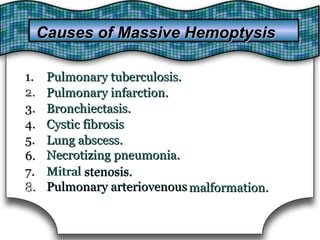
1. Pulmonary tuberculosis.Pulmonary tuberculosis.
2. Pulmonary infarction.Pulmonary infarction.
3.3. Bronchiectasis.Bronchiectasis.
4.4. Cystic fibrosisCystic fibrosis
5.5. Lung abscess.
Necrotizing pneumonia.
Lung abscess.
Necrotizing pneumonia.6.6.
7.
8.
7. Mitral stenosis.
Pulmonary arteriovenous
stenosis.
Pulmonary arteriovenous
Mitral
8. malformation.malformation.
Causes of Massive HemoptysisCauses of Massive Hemoptysis
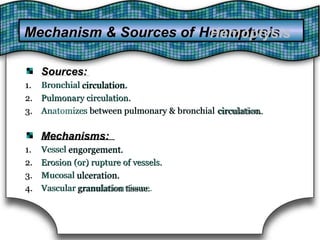
Sources:Sources:
1.1. Bronchial circulation.circulation.Bronchial
2.2. Pulmonary circulation.Pulmonary circulation.
3.3. Anatomizes between pulmonary & bronchialbetween pulmonary & bronchial circulation.circulation.Anatomizes
Mechanisms:Mechanisms:
1.1. Vessel engorgement.engorgement.Vessel
2.2. Erosion (or) rupture of vessels.Erosion (or) rupture of vessels.
3.3. Mucosal ulceration.ulceration.Mucosal
4.4. Vascular granulation tissue.granulation tissue.Vascular
Mechanism & Sources of HemoptysisHemoptysisMechanism & Sources of
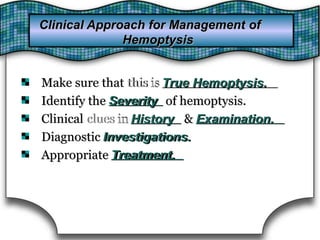
Make sure that thisthis isis True Hemoptysis.Make sure that True Hemoptysis.
Identify the SeverityIdentify the Severity of hemoptysis.of hemoptysis.
Clinical cluesclues inin HistoryClinical History & Examination.& Examination.
Diagnostic Investigations.Diagnostic Investigations.
Appropriate Treatment.Appropriate Treatment.
Clinical Approach for Management ofClinical Approach for Management of
HemoptysisHemoptysis
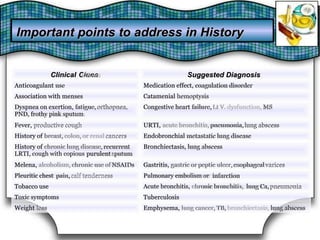
Important points to address in HistoryImportant points to address in History
Clinical CluesCluesClinical Suggested DiagnosisSuggested Diagnosis
Anticoagulant useuseAnticoagulant Medication effect, coagulation disordercoagulation disorderMedication effect,
Association with mensesAssociation with menses Catamenial hemoptysishemoptysisCatamenial
Dyspnea on exertion, fatigue,fatigue, orthopnea,
PND, frothy pink sputum
orthopnea,Dyspnea on exertion,
PND, frothy pink sputum
Congestive heart failure,failure, LtLt V.V. dysfunction,dysfunction, MSMSCongestive heart
Fever, productive coughproductive coughFever, URTI, acute bronchitis,acute bronchitis, pneumonia,pneumonia, lung abscesslung abscessURTI,
History of breast,breast, colon,colon, oror renalrenal cancerscancersHistory of Endobronchial metastatic lung diseasemetastatic lung diseaseEndobronchial
History of chronic lung disease,chronic lung disease, recurrentrecurrentHistory of
LRTI, cough with copious purulent sputumsputumLRTI, cough with copious purulent
Bronchiectasis, lung abscesslung abscessBronchiectasis,
Melena, alcoholism,alcoholism, chronic use ofchronic use of NSAIDsNSAIDsMelena, Gastritis, gastric orgastric or peptic ulcer,peptic ulcer, esophagealesophageal varicesvaricesGastritis,
Pleuritic chest pain,pain, calf tendernesscalf tendernessPleuritic chest Pulmonary embolism or infarctioninfarctionPulmonary embolism or
Tobacco useTobacco use Acute bronchitis, chronic bronchitis,chronic bronchitis, lung Ca,lung Ca, pneumoniapneumoniaAcute bronchitis,
Toxic symptomsToxic symptoms TuberculosisTuberculosis
Weight losslossWeight Emphysema, lung cancer,lung cancer, TB,TB, bronchiectasis,bronchiectasis, lung abscesslung abscessEmphysema,
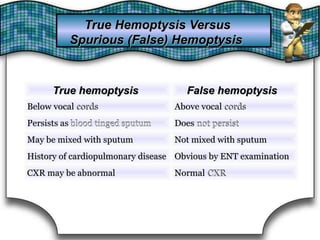
True Hemoptysis Versus
Spurious (False) Hemoptysis
True Hemoptysis Versus
Spurious (False) Hemoptysis
True hemoptysisTrue hemoptysis False hemoptysisFalse hemoptysis
Below vocal cordscordsBelow vocal Above vocal cordscordsAbove vocal
Persists as blood tinged sputumblood tinged sputumPersists as Does not persistnot persistDoes
May be mixed with sputumMay be mixed with sputum Not mixed with sputumNot mixed with sputum
History of cardiopulmonary diseaseHistory of cardiopulmonary disease Obvious by ENT examinationObvious by ENT examination
CXR may be abnormalCXR may be abnormal Normal CXRCXRNormal
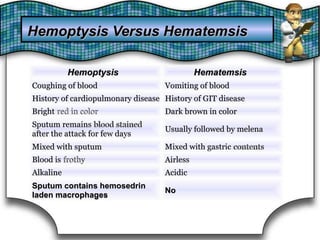
Hemoptysis Versus HematemsisHemoptysis Versus Hematemsis
HemoptysisHemoptysis HematemsisHematemsis
Coughing of bloodCoughing of blood Vomiting of bloodVomiting of blood
History of cardiopulmonary diseaseHistory of cardiopulmonary disease History of GIT diseaseHistory of GIT disease
Bright red in colorred in colorBright Dark brown in colorDark brown in color
Sputum remains blood stainedblood stained
after the attack for few days
Sputum remains
after the attack for few days
Usually followed by melenaUsually followed by melena
Mixed with sputumMixed with sputum Mixed with gastric contentscontentsMixed with gastric
Blood is frothyfrothyBlood is AirlessAirless
AlkalineAlkaline AcidicAcidic
Sputum contains hemosedrin
laden macrophages
Sputum contains hemosedrin
laden macrophages
NoNo
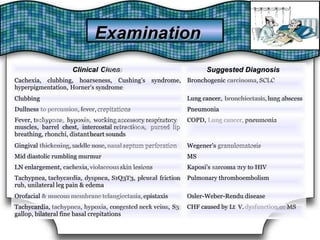
ExaminationExamination
Clinical CluesCluesClinical Suggested DiagnosisSuggested Diagnosis
Cachexia, clubbing, hoarseness, Cushing's
syndrome
syndrome,Cachexia, clubbing, hoarseness, Cushing's syndrome,
hyperpigmentation, Horner'shyperpigmentation, Horner's syndrome
Bronchogenic carcinoma,carcinoma, SCLCSCLCBronchogenic
ClubbingClubbing Lung cancer, bronchiectasis,bronchiectasis, lung abscesslung abscessLung cancer,
Dullness to percussion,to percussion, fever,fever, crepitationscrepitationsDullness PneumoniaPneumonia
Fever, tachypnea,tachypnea, hypoxia,hypoxia, working accessory respiratoryworking accessory respiratoryFever,
muscles, barrel chest, intercostal retractions,retractions, pursed lip
rhonchi, distant heart sounds
pursed lipmuscles, barrel chest, intercostal
breathing,breathing, rhonchi, distantheart sounds
COPD, Lung cancer,Lung cancer, pneumoniapneumoniaCOPD,
Gingival thickening,thickening, saddle nose,saddle nose, nasalnasal septum perforationseptum perforationGingival Wegener's granulomatosisgranulomatosisWegener's
Mid diastolic rumbling murmurMid diastolic rumbling murmur MSMS
LN enlargement, cachexia,cachexia, violaceousviolaceous skin lesionsskin lesionsLN enlargement, Kaposi's sarcoma 2ry to HIVsarcoma 2ry to HIVKaposi's
Tachypnea, tachycardia,tachycardia, dyspnea,dyspnea, S1Q3T3,
rub, unilateral leg pain & edema
S1Q3T3, pleuralpleural frictionfrictionTachypnea,
rub, unilateral leg pain & edema
Pulmonary thromboembolismPulmonary thromboembolism
Orofacial & mucous& mucous membrane telangiectasia,membrane telangiectasia, epistaxisepistaxisOrofacial Osler-Weber-Rendu diseaseOsler-Weber-Rendu disease
Tachycardia, tachypnea,tachypnea, hypoxia,hypoxia, congested neck veins,congested neck veins, S3
gallop, bilateral fine basal crepitations
S3Tachycardia,
gallop, bilateral fine basal crepitations
CHF caused by Lt V.V. dysfunction ordysfunction or MSMSCHF caused by Lt
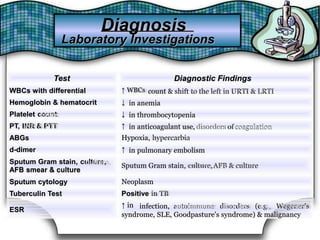
DiagnosisDiagnosis
Laboratory InvestigationsLaboratory Investigations
TestTest Diagnostic FindingsDiagnostic Findings
WBCs with differentialWBCs with differential ↑ WBCs count↑ WBCs & shift to the left in URTI & LRTIto the left in URTI & LRTIcount & shift
Hemoglobin & hematocritHemoglobin & hematocrit ↓ in anemia↓ in anemia
Platelet countcountPlatelet ↓ in thrombocytopenia↓ in thrombocytopenia
PT, INR & PTTINR & PTTPT, ↑ in anticoagulant↑ use, disordersdisorders ofof coagulationcoagulationin anticoagulant use,
ABGsABGs Hypoxia, hypercarbiahypercarbiaHypoxia,
d-dimerd-dimer ↑ in pulmonary embolism↑ in pulmonary embolism
Sputum Gram stain, culture,culture,
AFB smear & culture
Sputum Gram stain,
AFB smear & culture
Sputum Gram stain, culture,culture, AFB & cultureAFB & cultureSputum Gram stain,
Sputum cytologySputum cytology NeoplasmNeoplasm
Tuberculin TestTuberculin Test Positive in TBPositive in TB
ESRESR
↑ in↑ in infection, autoimmuneautoimmune disordersdisorders (e.g.,(e.g., Wegener'sWegener'sinfection,
syndrome, SLE, Goodpasture's syndrome) & malignancysyndrome, SLE, Goodpasture's syndrome) & malignancy
DiagnosisDiagnosis
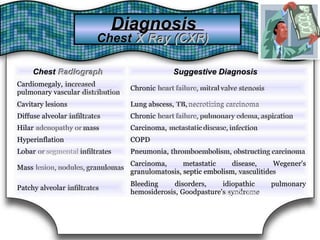
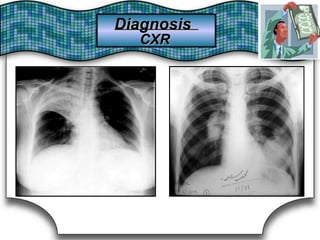
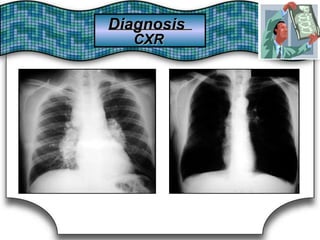
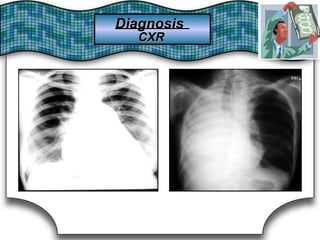
Chest X Ray (CXR)X Ray (CXR)Chest
Chest RadiographRadiographChest Suggestive DiagnosisSuggestive Diagnosis
Cardiomegaly, increasedincreasedCardiomegaly,
pulmonary vascular distributiondistributionpulmonary vascular
Chronic heartheart failure,failure, mitralmitral valve stenosisvalve stenosisChronic
Cavitary lesionsCavitary lesions Lung abscess, TB,TB, necrotizing carcinomanecrotizing carcinomaLung abscess,
Diffuse alveolar infiltratesinfiltratesDiffuse alveolar Chronic heartheart failure,failure, pulmonary edema,pulmonary edema, aspirationaspirationChronic
Hilar adenopathy oradenopathy or massmassHilar Carcinoma, metastaticmetastatic disease,disease, infectioninfectionCarcinoma,
HyperinflationHyperinflation COPDCOPD
Lobar oror segmentalsegmental infiltratesinfiltratesLobar Pneumonia, thromboembolism, obstructing carcinomathromboembolism, obstructing carcinomaPneumonia,
Mass lesion,lesion, nodules,nodules, granulomasgranulomasMass
Carcinoma,
granulomatosis,
metastatic disease, Wegener's
vasculitides
Carcinoma, metastatic disease, Wegener's
septic embolism,granulomatosis, septic embolism, vasculitides
Patchy alveolar infiltratesinfiltratesPatchy alveolar
Bleeding disorders, idiopathic pulmonaryBleeding disorders, idiopathic pulmonary
hemosiderosis, Goodpasture's syndromesyndromehemosiderosis, Goodpasture's
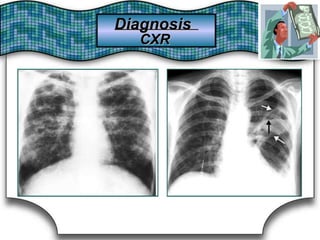
DiagnosisDiagnosis
CXRCXR
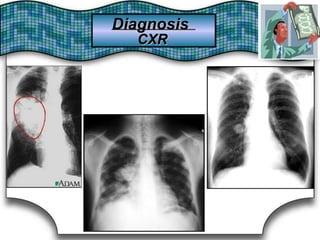
DiagnosisDiagnosis
CXRCXR
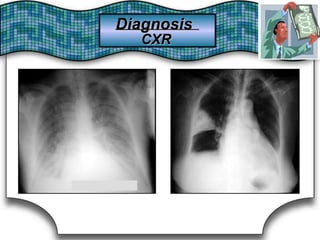
DiagnosisDiagnosis
CXRCXR
DiagnosisDiagnosis
CXRCXR
DiagnosisDiagnosis
CXRCXR
DiagnosisDiagnosis
CXRCXR
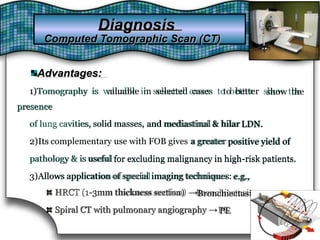
Advantages:Advantages:
1)Tomography is valuable in selected cases1)Tomography is valuable in selected cases to betterto better show theshow the
presencepresence
of lung cavities, solid masses,solid masses, and mediastinaland mediastinal & hilar& hilar LDN.LDN.of lung cavities,
2)Its2)Its complementary use with FOB givescomplementary use with FOB gives a greatera greater positive yield ofpositive yield of
pathology & is usefuluseful for excluding malignancy in high-risk patients.for excluding malignancy in high-risk patients.pathology & is
3)Allows3)Allows application of specialapplication of special imaging techniques:imaging techniques: e.g.,e.g.,
HRCT (1-3mm thickness section) →BronchiectasisHRCT (1-3mm thickness section) →Bronchiectasis
Spiral CT with pulmonary angiography →PESpiral CT with pulmonary angiography → PE
DiagnosisDiagnosis
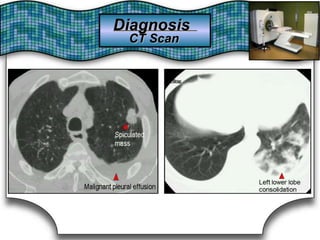
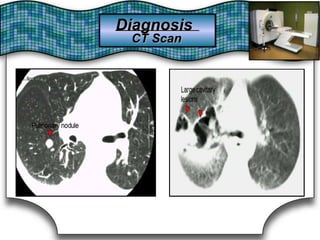
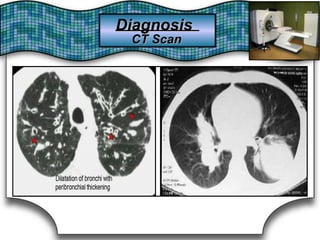
Computed Tomographic Scan (CT)Computed Tomographic Scan (CT)
DiagnosisDiagnosis
CT ScanCT Scan
DiagnosisDiagnosis
CT ScanCT Scan
DiagnosisDiagnosis
CT ScanCT Scan
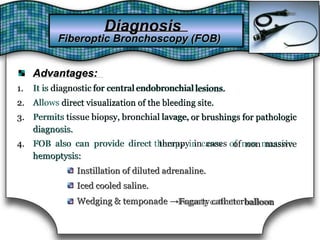
Advantages:Advantages:
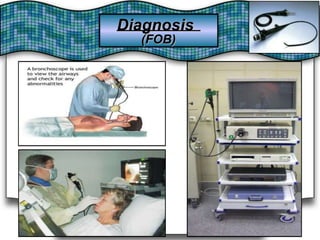
1.1. It is diagnosticdiagnostic for centralfor central endobronchialendobronchial lesions.lesions.It is
2.2. Allows direct visualization of the bleeding site.direct visualization of the bleeding site.Allows
3.3. Permits tissue biopsy,tissue biopsy, bronchialbronchial lavage,lavage, or brushings for pathologicor brushings for pathologicPermits
diagnosis.diagnosis.
4.4. FOB also can provide direct therapy in casestherapy in cases of non massiveof non massiveFOB also can provide direct
hemoptysis:hemoptysis:
Instillation of diluted adrenaline.Instillation of diluted adrenaline.
Iced cooled saline.Iced cooled saline.
Wedging & temponade →Fogarty catheterWedging & temponade → balloonFogarty catheter balloon
DiagnosisDiagnosis
Fiberoptic Bronchoscopy (FOB)Fiberoptic Bronchoscopy (FOB)
DiagnosisDiagnosis
(FOB)(FOB)
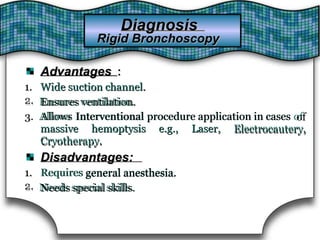
AdvantagesAdvantages ::
1.
2.
1. Wide suction channel.Wide suction channel.
2. Ensures ventilation.Ensures ventilation.
3. Allows3. Allows InterventionalInterventional procedure application in casesprocedure application in cases ofof
Electrocautery,massive hemoptysis
Cryotherapy.
e.g., Laser,massive hemoptysis e.g., Laser, Electrocautery,
Cryotherapy.
Disadvantages:Disadvantages:
1.
2.
1. Requires general anesthesia.general anesthesia.Requires
2. Needs special skills.Needs special skills.
DiagnosisDiagnosis
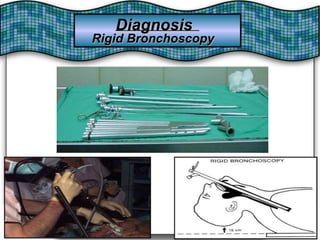
Rigid BronchoscopyRigid Bronchoscopy
DiagnosisDiagnosis
Rigid BronchoscopyRigid Bronchoscopy
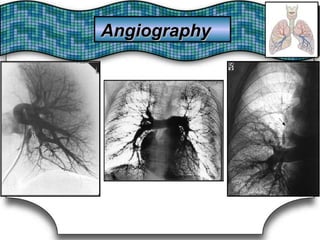
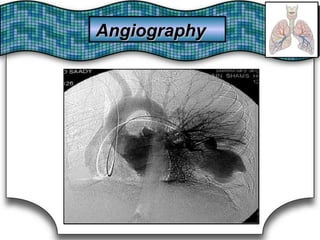
AngiographyAngiography
AdvantagesAdvantages ::
1.1. Gold standard diagnostic tooltool forfor suspected PE.suspected PE.Gold standard diagnostic
2. Diagnosis2. Diagnosis ofof arteriovenous malformation.arteriovenous malformation.
3. Allows management3. Allows management ofof some casessome cases ofof hemoptysishemoptysis usingusing
endovascular embolization.endovascular embolization.
Disadvantages:Disadvantages:
1.1. Embolization of Spinal arteries →Embolization of Spinal arteries → paraplegia.paraplegia.
2. Needs special skills.2. Needs special skills.
AngiographyAngiography
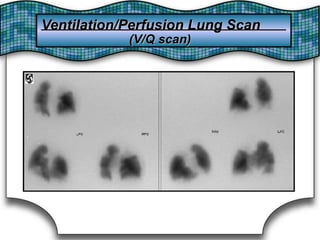
Ventilation/Perfusion Lung ScanVentilation/Perfusion Lung Scan
(V/Q scan)(V/Q scan)
Management ofof HemoptysisHemoptysisManagement
GoalGoal ::
1.1. Evaluate the severity of hemoptysis.hemoptysis.Evaluate the severity of
2. Airway protection & patency.2. Airway protection & patency.
3. Identify the site of3. Identify the site of bleeding.bleeding.
4. Protect the contralateral un involved lung.4. Protect the contralateral un involved lung.
5. Stop the bleeding.5. Stop the bleeding.
6. Treatment6. Treatment ofof the cause ofthe cause of bleeding.bleeding.
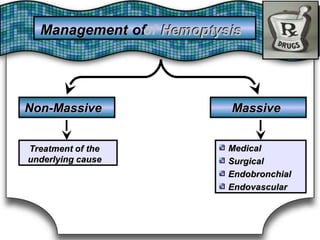
Management ofof HemoptysisHemoptysisManagement
Non-MassiveNon-Massive MassiveMassive
Treatment of theTreatment of the
underlying causeunderlying cause
MedicalMedical
SurgicalSurgical
EndobronchialEndobronchial
EndovascularEndovascular
Management of MassiveMassiveManagement of
HemoptysisHemoptysis
I.I. MedicalMedical ::
Endotacheal tube (single wide bore (or) double lumen).double lumen).Endotacheal tube (single wide bore (or)
Position of the patientthe patient sitting (or)sitting (or) bleeding side downbleeding side downPosition of
Large bore IV line fluids,fluids, blood transfusionblood transfusion (EXCEPT??)Large bore IV line (EXCEPT??)
Supplemental Oxygen/ Mechanical ventilation.Mechanical ventilation.Supplemental Oxygen/
Avoid cough suppressants (if(if necessarynecessary Benzodiazepine).Benzodiazepine).Avoid cough suppressants
Pitressin (Vasopressin) 0.2-0.4 units/min.0.2-0.4 units/min. IV.IV.Pitressin (Vasopressin)
Management of MassiveMassiveManagement of
HemoptysisHemoptysis
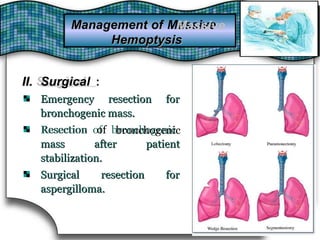
II.II. SurgicalSurgical ::
Emergency resection forEmergency resection for
bronchogenic mass.bronchogenic mass.
Resection ofof bronchogenicbronchogenicResection
mass after patientmass after patient
stabilization.stabilization.
Surgical resection forSurgical resection for
aspergilloma.aspergilloma.
Management of MassiveMassiveManagement of
HemoptysisHemoptysis
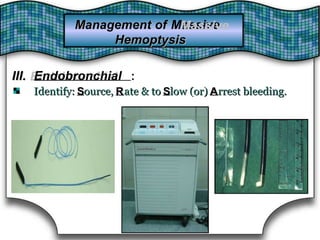
III. EndobronchialIII. Endobronchial ::
Identify: SIdentify: Source, Rource, Rate & to Sate & to Slow (or) Alow (or) Arrest bleeding.rrest bleeding.
Management of MassiveMassiveManagement of
HemoptysisHemoptysis
Management of MassiveMassiveManagement of
HemoptysisHemoptysis
IV.Endovascular:IV. Endovascular:
First results of embolization were published in 1973embolization were published in 1973.First results of .
In most patients
bronchial arteries
the bleeding originates fromIn most patients the bleeding originates from
bronchial arteries rather than pulmonary arteries.rather than pulmonary arteries.
Transcatheter embolization is effective in immediateTranscatheter embolization is effective in immediate
control ofof massive hemoptysismassive hemoptysis (73% -(73% - 98%).98%).control
Recurrence may be caused by:Recurrence may be caused by:
Incomplete embolization of artery.Incomplete embolization of artery.
Recanalization of previously embolized artery.Recanalization of previously embolized artery.
Revascularization through collateral circulation.circulation.Revascularization through collateral
Progression of basic lung disease.lung disease.Progression of basic
Management of MassiveMassiveManagement of
HemoptysisHemoptysis
Management of MassiveMassiveManagement of
HemoptysisHemoptysis
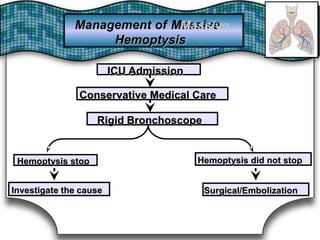
ICU AdmissionICU Admission
Conservative Medical CareConservative Medical Care
Rigid BronchoscopeRigid Bronchoscope
Hemoptysis stopHemoptysis stop
Investigate the causeInvestigate the cause
Hemoptysis did not stopHemoptysis did not stop
Surgical/EmbolizationSurgical/Embolization

HEMOPTYSIS

  • 1.
  • 2.
    Definition of hemoptysisDefinitionof hemoptysis Causes ofof hemoptysishemoptysisCauses Differential diagnosis of hemoptysisof hemoptysisDifferential diagnosis Diagnosis of hemoptysisof hemoptysisDiagnosis Treatment of hemoptysisof hemoptysisTreatment ContentsContents
  • 3.
    Pulmonary Bleeding Pulmonary Bleeding(or pulmonary haemorrhage) is an acute bleeding from the lung, from the upper respiratory tract and the trachea, and the alveoli. When evident clinically, the condition is usually massive.[1] The onset of pulmonary hemorrhage is characterized by cough productive of blood (hemoptysis) and worsening of oxygenation leading to cyanosis.[1] Treatment should be immediate and should include tracheal suction, oxygen, positive pressure ventilation, and correction of underlying abnormalities (e.g. disorders of coagulation). A blood transfusion may be necessary.
  • 4.
    HemoptysisHemoptysis is definedas coughing of bloodis defined as coughing of blood originating from below the vocal cords.originating from below the vocal cords. The wordword "hemoptysis"The "hemoptysis" comes fromfrom thethe GreekGreekcomes "haima" meaning "blood“ & "ptysis" which means "a"haima" meaning "blood“ & "ptysis" which means "a spitting".spitting". Hemoptysis can range fromHemoptysis can range from blood-streakingblood-streaking ofof sputum to the presence of gross blood in the absencesputum to the presence of gross blood in the absence of any accompanying sputum.of any accompanying sputum. DefinitionDefinition
  • 5.
    Life threateningthreatening (or)(or)MassiveMassive hemoptysishemoptysisLife isis defined as coughing of blood > 150 ml/time (or)blood > 150 ml/time (or) > 600> 600defined as coughing of ml/24 hours.ml/24 hours. Only 5% of hemoptysishemoptysis isis massiveOnly 5% of massive but mortality isbut mortality is 80%.80%. DefinitionDefinition
  • 6.
    Tracheobronchial causes:Tracheobronchial causes: 1.1.Bronchitis(acute & chronic).Bronchitis (acute & chronic). 2.2. Bronchiectasis.Bronchiectasis. 3. Foreign body.3. Foreign body. 4. Tumor (e.g., bronchial4. Tumor (e.g., bronchial carcinoma,carcinoma, trachealtracheal & laryngeal& laryngeal tumors).tumors). 5. Bronchial telangectasia.5. Bronchial telangectasia. Cardiovascular causes:Cardiovascular causes: 1.1. Left VentricularFailure.Left Ventricular Failure. 2.2. MitralMitral stenosis.stenosis. 3. Aortic aneurism.3. Aortic aneurism. Cause of HemoptysisHemoptysisCause of
  • 7.
    Pulmonary:Pulmonary: 1. Tuberculosis.Tuberculosis.1. 2. Tumor.Tumor. 3.Pneumonia. 2. 3. Pneumonia. 4. Abscess.4. Abscess. 5. Infarction.Infarction.5. 6. Trauma.6. Trauma. 7. VasculitisVasculitis & collagen disorders.& collagen disorders.7. 8. Cystic fibrosis.8. Cystic fibrosis. 9. AlveolarAlveolar hemorrhage. 10.Arteriovenous malformation hemorrhage. 10.Arteriovenous malformation 9. Other causes:Other causes: 1. Blood diseases.1. Blood diseases. 2. AnticoagulantAnticoagulant therapy.therapy.2. Cause of HemoptysisCause of Hemoptysis Cont.Cont.
  • 8.
  • 9.
    1. 2. 1. Pulmonary tuberculosis.Pulmonarytuberculosis. 2. Pulmonary infarction.Pulmonary infarction. 3.3. Bronchiectasis.Bronchiectasis. 4.4. Cystic fibrosisCystic fibrosis 5.5. Lung abscess. Necrotizing pneumonia. Lung abscess. Necrotizing pneumonia.6.6. 7. 8. 7. Mitral stenosis. Pulmonary arteriovenous stenosis. Pulmonary arteriovenous Mitral 8. malformation.malformation. Causes of Massive HemoptysisCauses of Massive Hemoptysis
  • 10.
    Sources:Sources: 1.1. Bronchial circulation.circulation.Bronchial 2.2.Pulmonary circulation.Pulmonary circulation. 3.3. Anatomizes between pulmonary & bronchialbetween pulmonary & bronchial circulation.circulation.Anatomizes Mechanisms:Mechanisms: 1.1. Vessel engorgement.engorgement.Vessel 2.2. Erosion (or) rupture of vessels.Erosion (or) rupture of vessels. 3.3. Mucosal ulceration.ulceration.Mucosal 4.4. Vascular granulation tissue.granulation tissue.Vascular Mechanism & Sources of HemoptysisHemoptysisMechanism & Sources of
  • 11.
    Make sure thatthisthis isis True Hemoptysis.Make sure that True Hemoptysis. Identify the SeverityIdentify the Severity of hemoptysis.of hemoptysis. Clinical cluesclues inin HistoryClinical History & Examination.& Examination. Diagnostic Investigations.Diagnostic Investigations. Appropriate Treatment.Appropriate Treatment. Clinical Approach for Management ofClinical Approach for Management of HemoptysisHemoptysis
  • 12.
    Important points toaddress in HistoryImportant points to address in History Clinical CluesCluesClinical Suggested DiagnosisSuggested Diagnosis Anticoagulant useuseAnticoagulant Medication effect, coagulation disordercoagulation disorderMedication effect, Association with mensesAssociation with menses Catamenial hemoptysishemoptysisCatamenial Dyspnea on exertion, fatigue,fatigue, orthopnea, PND, frothy pink sputum orthopnea,Dyspnea on exertion, PND, frothy pink sputum Congestive heart failure,failure, LtLt V.V. dysfunction,dysfunction, MSMSCongestive heart Fever, productive coughproductive coughFever, URTI, acute bronchitis,acute bronchitis, pneumonia,pneumonia, lung abscesslung abscessURTI, History of breast,breast, colon,colon, oror renalrenal cancerscancersHistory of Endobronchial metastatic lung diseasemetastatic lung diseaseEndobronchial History of chronic lung disease,chronic lung disease, recurrentrecurrentHistory of LRTI, cough with copious purulent sputumsputumLRTI, cough with copious purulent Bronchiectasis, lung abscesslung abscessBronchiectasis, Melena, alcoholism,alcoholism, chronic use ofchronic use of NSAIDsNSAIDsMelena, Gastritis, gastric orgastric or peptic ulcer,peptic ulcer, esophagealesophageal varicesvaricesGastritis, Pleuritic chest pain,pain, calf tendernesscalf tendernessPleuritic chest Pulmonary embolism or infarctioninfarctionPulmonary embolism or Tobacco useTobacco use Acute bronchitis, chronic bronchitis,chronic bronchitis, lung Ca,lung Ca, pneumoniapneumoniaAcute bronchitis, Toxic symptomsToxic symptoms TuberculosisTuberculosis Weight losslossWeight Emphysema, lung cancer,lung cancer, TB,TB, bronchiectasis,bronchiectasis, lung abscesslung abscessEmphysema,
  • 13.
    True Hemoptysis Versus Spurious(False) Hemoptysis True Hemoptysis Versus Spurious (False) Hemoptysis True hemoptysisTrue hemoptysis False hemoptysisFalse hemoptysis Below vocal cordscordsBelow vocal Above vocal cordscordsAbove vocal Persists as blood tinged sputumblood tinged sputumPersists as Does not persistnot persistDoes May be mixed with sputumMay be mixed with sputum Not mixed with sputumNot mixed with sputum History of cardiopulmonary diseaseHistory of cardiopulmonary disease Obvious by ENT examinationObvious by ENT examination CXR may be abnormalCXR may be abnormal Normal CXRCXRNormal
  • 14.
    Hemoptysis Versus HematemsisHemoptysisVersus Hematemsis HemoptysisHemoptysis HematemsisHematemsis Coughing of bloodCoughing of blood Vomiting of bloodVomiting of blood History of cardiopulmonary diseaseHistory of cardiopulmonary disease History of GIT diseaseHistory of GIT disease Bright red in colorred in colorBright Dark brown in colorDark brown in color Sputum remains blood stainedblood stained after the attack for few days Sputum remains after the attack for few days Usually followed by melenaUsually followed by melena Mixed with sputumMixed with sputum Mixed with gastric contentscontentsMixed with gastric Blood is frothyfrothyBlood is AirlessAirless AlkalineAlkaline AcidicAcidic Sputum contains hemosedrin laden macrophages Sputum contains hemosedrin laden macrophages NoNo
  • 15.
    ExaminationExamination Clinical CluesCluesClinical SuggestedDiagnosisSuggested Diagnosis Cachexia, clubbing, hoarseness, Cushing's syndrome syndrome,Cachexia, clubbing, hoarseness, Cushing's syndrome, hyperpigmentation, Horner'shyperpigmentation, Horner's syndrome Bronchogenic carcinoma,carcinoma, SCLCSCLCBronchogenic ClubbingClubbing Lung cancer, bronchiectasis,bronchiectasis, lung abscesslung abscessLung cancer, Dullness to percussion,to percussion, fever,fever, crepitationscrepitationsDullness PneumoniaPneumonia Fever, tachypnea,tachypnea, hypoxia,hypoxia, working accessory respiratoryworking accessory respiratoryFever, muscles, barrel chest, intercostal retractions,retractions, pursed lip rhonchi, distant heart sounds pursed lipmuscles, barrel chest, intercostal breathing,breathing, rhonchi, distantheart sounds COPD, Lung cancer,Lung cancer, pneumoniapneumoniaCOPD, Gingival thickening,thickening, saddle nose,saddle nose, nasalnasal septum perforationseptum perforationGingival Wegener's granulomatosisgranulomatosisWegener's Mid diastolic rumbling murmurMid diastolic rumbling murmur MSMS LN enlargement, cachexia,cachexia, violaceousviolaceous skin lesionsskin lesionsLN enlargement, Kaposi's sarcoma 2ry to HIVsarcoma 2ry to HIVKaposi's Tachypnea, tachycardia,tachycardia, dyspnea,dyspnea, S1Q3T3, rub, unilateral leg pain & edema S1Q3T3, pleuralpleural frictionfrictionTachypnea, rub, unilateral leg pain & edema Pulmonary thromboembolismPulmonary thromboembolism Orofacial & mucous& mucous membrane telangiectasia,membrane telangiectasia, epistaxisepistaxisOrofacial Osler-Weber-Rendu diseaseOsler-Weber-Rendu disease Tachycardia, tachypnea,tachypnea, hypoxia,hypoxia, congested neck veins,congested neck veins, S3 gallop, bilateral fine basal crepitations S3Tachycardia, gallop, bilateral fine basal crepitations CHF caused by Lt V.V. dysfunction ordysfunction or MSMSCHF caused by Lt
  • 16.
    DiagnosisDiagnosis Laboratory InvestigationsLaboratory Investigations TestTestDiagnostic FindingsDiagnostic Findings WBCs with differentialWBCs with differential ↑ WBCs count↑ WBCs & shift to the left in URTI & LRTIto the left in URTI & LRTIcount & shift Hemoglobin & hematocritHemoglobin & hematocrit ↓ in anemia↓ in anemia Platelet countcountPlatelet ↓ in thrombocytopenia↓ in thrombocytopenia PT, INR & PTTINR & PTTPT, ↑ in anticoagulant↑ use, disordersdisorders ofof coagulationcoagulationin anticoagulant use, ABGsABGs Hypoxia, hypercarbiahypercarbiaHypoxia, d-dimerd-dimer ↑ in pulmonary embolism↑ in pulmonary embolism Sputum Gram stain, culture,culture, AFB smear & culture Sputum Gram stain, AFB smear & culture Sputum Gram stain, culture,culture, AFB & cultureAFB & cultureSputum Gram stain, Sputum cytologySputum cytology NeoplasmNeoplasm Tuberculin TestTuberculin Test Positive in TBPositive in TB ESRESR ↑ in↑ in infection, autoimmuneautoimmune disordersdisorders (e.g.,(e.g., Wegener'sWegener'sinfection, syndrome, SLE, Goodpasture's syndrome) & malignancysyndrome, SLE, Goodpasture's syndrome) & malignancy
  • 17.
    DiagnosisDiagnosis Chest X Ray(CXR)X Ray (CXR)Chest Chest RadiographRadiographChest Suggestive DiagnosisSuggestive Diagnosis Cardiomegaly, increasedincreasedCardiomegaly, pulmonary vascular distributiondistributionpulmonary vascular Chronic heartheart failure,failure, mitralmitral valve stenosisvalve stenosisChronic Cavitary lesionsCavitary lesions Lung abscess, TB,TB, necrotizing carcinomanecrotizing carcinomaLung abscess, Diffuse alveolar infiltratesinfiltratesDiffuse alveolar Chronic heartheart failure,failure, pulmonary edema,pulmonary edema, aspirationaspirationChronic Hilar adenopathy oradenopathy or massmassHilar Carcinoma, metastaticmetastatic disease,disease, infectioninfectionCarcinoma, HyperinflationHyperinflation COPDCOPD Lobar oror segmentalsegmental infiltratesinfiltratesLobar Pneumonia, thromboembolism, obstructing carcinomathromboembolism, obstructing carcinomaPneumonia, Mass lesion,lesion, nodules,nodules, granulomasgranulomasMass Carcinoma, granulomatosis, metastatic disease, Wegener's vasculitides Carcinoma, metastatic disease, Wegener's septic embolism,granulomatosis, septic embolism, vasculitides Patchy alveolar infiltratesinfiltratesPatchy alveolar Bleeding disorders, idiopathic pulmonaryBleeding disorders, idiopathic pulmonary hemosiderosis, Goodpasture's syndromesyndromehemosiderosis, Goodpasture's
  • 18.
  • 19.
  • 20.
  • 21.
  • 22.
  • 23.
  • 24.
    Advantages:Advantages: 1)Tomography is valuablein selected cases1)Tomography is valuable in selected cases to betterto better show theshow the presencepresence of lung cavities, solid masses,solid masses, and mediastinaland mediastinal & hilar& hilar LDN.LDN.of lung cavities, 2)Its2)Its complementary use with FOB givescomplementary use with FOB gives a greatera greater positive yield ofpositive yield of pathology & is usefuluseful for excluding malignancy in high-risk patients.for excluding malignancy in high-risk patients.pathology & is 3)Allows3)Allows application of specialapplication of special imaging techniques:imaging techniques: e.g.,e.g., HRCT (1-3mm thickness section) →BronchiectasisHRCT (1-3mm thickness section) →Bronchiectasis Spiral CT with pulmonary angiography →PESpiral CT with pulmonary angiography → PE DiagnosisDiagnosis Computed Tomographic Scan (CT)Computed Tomographic Scan (CT)
  • 25.
  • 26.
  • 27.
  • 28.
    Advantages:Advantages: 1.1. It isdiagnosticdiagnostic for centralfor central endobronchialendobronchial lesions.lesions.It is 2.2. Allows direct visualization of the bleeding site.direct visualization of the bleeding site.Allows 3.3. Permits tissue biopsy,tissue biopsy, bronchialbronchial lavage,lavage, or brushings for pathologicor brushings for pathologicPermits diagnosis.diagnosis. 4.4. FOB also can provide direct therapy in casestherapy in cases of non massiveof non massiveFOB also can provide direct hemoptysis:hemoptysis: Instillation of diluted adrenaline.Instillation of diluted adrenaline. Iced cooled saline.Iced cooled saline. Wedging & temponade →Fogarty catheterWedging & temponade → balloonFogarty catheter balloon DiagnosisDiagnosis Fiberoptic Bronchoscopy (FOB)Fiberoptic Bronchoscopy (FOB)
  • 29.
  • 30.
    AdvantagesAdvantages :: 1. 2. 1. Widesuction channel.Wide suction channel. 2. Ensures ventilation.Ensures ventilation. 3. Allows3. Allows InterventionalInterventional procedure application in casesprocedure application in cases ofof Electrocautery,massive hemoptysis Cryotherapy. e.g., Laser,massive hemoptysis e.g., Laser, Electrocautery, Cryotherapy. Disadvantages:Disadvantages: 1. 2. 1. Requires general anesthesia.general anesthesia.Requires 2. Needs special skills.Needs special skills. DiagnosisDiagnosis Rigid BronchoscopyRigid Bronchoscopy
  • 31.
  • 32.
    AngiographyAngiography AdvantagesAdvantages :: 1.1. Goldstandard diagnostic tooltool forfor suspected PE.suspected PE.Gold standard diagnostic 2. Diagnosis2. Diagnosis ofof arteriovenous malformation.arteriovenous malformation. 3. Allows management3. Allows management ofof some casessome cases ofof hemoptysishemoptysis usingusing endovascular embolization.endovascular embolization. Disadvantages:Disadvantages: 1.1. Embolization of Spinal arteries →Embolization of Spinal arteries → paraplegia.paraplegia. 2. Needs special skills.2. Needs special skills.
  • 33.
  • 34.
  • 35.
  • 36.
    Management ofof HemoptysisHemoptysisManagement GoalGoal:: 1.1. Evaluate the severity of hemoptysis.hemoptysis.Evaluate the severity of 2. Airway protection & patency.2. Airway protection & patency. 3. Identify the site of3. Identify the site of bleeding.bleeding. 4. Protect the contralateral un involved lung.4. Protect the contralateral un involved lung. 5. Stop the bleeding.5. Stop the bleeding. 6. Treatment6. Treatment ofof the cause ofthe cause of bleeding.bleeding.
  • 37.
    Management ofof HemoptysisHemoptysisManagement Non-MassiveNon-MassiveMassiveMassive Treatment of theTreatment of the underlying causeunderlying cause MedicalMedical SurgicalSurgical EndobronchialEndobronchial EndovascularEndovascular
  • 38.
    Management of MassiveMassiveManagementof HemoptysisHemoptysis I.I. MedicalMedical :: Endotacheal tube (single wide bore (or) double lumen).double lumen).Endotacheal tube (single wide bore (or) Position of the patientthe patient sitting (or)sitting (or) bleeding side downbleeding side downPosition of Large bore IV line fluids,fluids, blood transfusionblood transfusion (EXCEPT??)Large bore IV line (EXCEPT??) Supplemental Oxygen/ Mechanical ventilation.Mechanical ventilation.Supplemental Oxygen/ Avoid cough suppressants (if(if necessarynecessary Benzodiazepine).Benzodiazepine).Avoid cough suppressants Pitressin (Vasopressin) 0.2-0.4 units/min.0.2-0.4 units/min. IV.IV.Pitressin (Vasopressin)
  • 39.
    Management of MassiveMassiveManagementof HemoptysisHemoptysis II.II. SurgicalSurgical :: Emergency resection forEmergency resection for bronchogenic mass.bronchogenic mass. Resection ofof bronchogenicbronchogenicResection mass after patientmass after patient stabilization.stabilization. Surgical resection forSurgical resection for aspergilloma.aspergilloma.
  • 40.
    Management of MassiveMassiveManagementof HemoptysisHemoptysis III. EndobronchialIII. Endobronchial :: Identify: SIdentify: Source, Rource, Rate & to Sate & to Slow (or) Alow (or) Arrest bleeding.rrest bleeding.
  • 41.
  • 42.
  • 43.
    IV.Endovascular:IV. Endovascular: First resultsof embolization were published in 1973embolization were published in 1973.First results of . In most patients bronchial arteries the bleeding originates fromIn most patients the bleeding originates from bronchial arteries rather than pulmonary arteries.rather than pulmonary arteries. Transcatheter embolization is effective in immediateTranscatheter embolization is effective in immediate control ofof massive hemoptysismassive hemoptysis (73% -(73% - 98%).98%).control Recurrence may be caused by:Recurrence may be caused by: Incomplete embolization of artery.Incomplete embolization of artery. Recanalization of previously embolized artery.Recanalization of previously embolized artery. Revascularization through collateral circulation.circulation.Revascularization through collateral Progression of basic lung disease.lung disease.Progression of basic Management of MassiveMassiveManagement of HemoptysisHemoptysis
  • 44.
    Management of MassiveMassiveManagementof HemoptysisHemoptysis ICU AdmissionICU Admission Conservative Medical CareConservative Medical Care Rigid BronchoscopeRigid Bronchoscope Hemoptysis stopHemoptysis stop Investigate the causeInvestigate the cause Hemoptysis did not stopHemoptysis did not stop Surgical/EmbolizationSurgical/Embolization