HEMOGLOBIN DISORDERS   BY    RAHUL SINGH   MBA(HA)   MMHRC,MADURAI
INTRODUCTION Hemoglobin is a protein based component of red blood cell which is primarily responsible for transferring oxygen from the lungs to the rest of the body. Fresh hemoglobin is produced in the bone marrow  and destroy in the spleen. Hemoglobin disorders are inherited from the parents in the same manner as we receive same blood groups,hair color its texture, eye color and other physical traits Sickle Cell Anaemia and Thalassemia are the two main hemoglobin disorders.
THALASSEMIA Thalassemia is a genetic disorder characterized by deficient or absent synthesis of one or more of the normal globin chains owing to inherited mutations or deletions of α- or β- globin genes. It is the most commonly inherited single-gene disorder in the world and mainly endemic in the tropics and subtropics, with the highest prevalence in the Mediterranean region, the Middle East, the Indian subcontinent, and southern far east and southeastern Asia, including southern China.
SICKLE CELL ANEMIA An inherited condition that results in a decrease in the ability of  red blood cells  to carry oxygen throughout the body. Sickle red blood cells become hard and irregularly shaped (resembling a sickle) Become clogged in the small blood vessels and therefore do not deliver oxygen to the tissues. Lack of tissue oxygenation   can cause excruciating pain, damage to body organs and even death.
FOOD  SOURCE  RED MEAT CHICKEN EGG & EGG ALBUMIN TURKEY &  LIVER BEEF BEANS & PULSES CHICKPEAS BROCCOLI SPINACH OTHER SOURCES TOMATOES POTATOES ORANGE  CASHEW PEPPERS DRIED APRICOTS
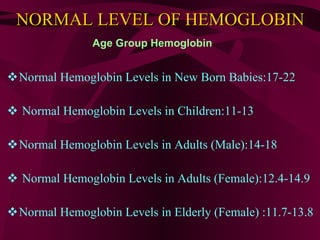
NORMAL LEVEL OF HEMOGLOBIN Normal Hemoglobin Levels in New Born Babies:17-22 Normal Hemoglobin Levels in Children:11-13 Normal Hemoglobin Levels in Adults (Male):14-18 Normal Hemoglobin Levels in Adults (Female):12.4-14.9 Normal Hemoglobin Levels in Elderly (Female) :11.7-13.8 Age Group Hemoglobin
Hemoglobinopathies cannot be cured but the condition  can be managed and reduced by :  High fluid intake. Healthy diet. Folic acid supplementation. Pain medication. Antibiotics for infection. REDUCTION OF HEMOGLOBIN DISORDERS
INCREASED LEVEL OF HEMOGLOBIN DISORDER High hemoglobin is also problematic, though, as it causes blood to become viscous, inhibiting the flow of oxygen throughout the body and often causes clots. Less commonly, high hemoglobin levels are caused by more serious conditions.  Among these are congenital heart disease (which you are born with), cor pulmonale (when the right ventricle of the heart becomes enlarged due to high blood pressure in your lungs), pulmonary fibrosis (when scar tissue forms between the alveoli in your lungs), hypoxia (when the blood's oxygen levels are too low), and polycythemia vera (a rare bone marrow disease in which excess red blood cells are produced). Other types of heart and lung diseases in addition to exposure to toxins are all possible (but rare) causes of elevated hemoglobin levels.
CONCLUSION Though major care was taken in understanding of the molecular pathology, path physiology its management and control over inherited disorders of hemoglobin, but still thousands of infants and children with these diseases are dying through lack of appropriate medical care. And these problem will undoubtedly increase over the next 20 years because, as the result of a reduction in childhood  mortality due to infection and malnutrition, more babies with  hemoglobin disorders will survive to present of the treatment .
THANK YOU

HEMOGLOBIN DISORDERS

  • 1.
    HEMOGLOBIN DISORDERS BY RAHUL SINGH MBA(HA) MMHRC,MADURAI
  • 2.
    INTRODUCTION Hemoglobin isa protein based component of red blood cell which is primarily responsible for transferring oxygen from the lungs to the rest of the body. Fresh hemoglobin is produced in the bone marrow and destroy in the spleen. Hemoglobin disorders are inherited from the parents in the same manner as we receive same blood groups,hair color its texture, eye color and other physical traits Sickle Cell Anaemia and Thalassemia are the two main hemoglobin disorders.
  • 3.
    THALASSEMIA Thalassemia isa genetic disorder characterized by deficient or absent synthesis of one or more of the normal globin chains owing to inherited mutations or deletions of α- or β- globin genes. It is the most commonly inherited single-gene disorder in the world and mainly endemic in the tropics and subtropics, with the highest prevalence in the Mediterranean region, the Middle East, the Indian subcontinent, and southern far east and southeastern Asia, including southern China.
  • 4.
    SICKLE CELL ANEMIAAn inherited condition that results in a decrease in the ability of red blood cells to carry oxygen throughout the body. Sickle red blood cells become hard and irregularly shaped (resembling a sickle) Become clogged in the small blood vessels and therefore do not deliver oxygen to the tissues. Lack of tissue oxygenation can cause excruciating pain, damage to body organs and even death.
  • 5.
    FOOD SOURCE RED MEAT CHICKEN EGG & EGG ALBUMIN TURKEY & LIVER BEEF BEANS & PULSES CHICKPEAS BROCCOLI SPINACH OTHER SOURCES TOMATOES POTATOES ORANGE CASHEW PEPPERS DRIED APRICOTS
  • 6.
    NORMAL LEVEL OFHEMOGLOBIN Normal Hemoglobin Levels in New Born Babies:17-22 Normal Hemoglobin Levels in Children:11-13 Normal Hemoglobin Levels in Adults (Male):14-18 Normal Hemoglobin Levels in Adults (Female):12.4-14.9 Normal Hemoglobin Levels in Elderly (Female) :11.7-13.8 Age Group Hemoglobin
  • 7.
    Hemoglobinopathies cannot becured but the condition can be managed and reduced by : High fluid intake. Healthy diet. Folic acid supplementation. Pain medication. Antibiotics for infection. REDUCTION OF HEMOGLOBIN DISORDERS
  • 8.
    INCREASED LEVEL OFHEMOGLOBIN DISORDER High hemoglobin is also problematic, though, as it causes blood to become viscous, inhibiting the flow of oxygen throughout the body and often causes clots. Less commonly, high hemoglobin levels are caused by more serious conditions. Among these are congenital heart disease (which you are born with), cor pulmonale (when the right ventricle of the heart becomes enlarged due to high blood pressure in your lungs), pulmonary fibrosis (when scar tissue forms between the alveoli in your lungs), hypoxia (when the blood's oxygen levels are too low), and polycythemia vera (a rare bone marrow disease in which excess red blood cells are produced). Other types of heart and lung diseases in addition to exposure to toxins are all possible (but rare) causes of elevated hemoglobin levels.
  • 9.
    CONCLUSION Though majorcare was taken in understanding of the molecular pathology, path physiology its management and control over inherited disorders of hemoglobin, but still thousands of infants and children with these diseases are dying through lack of appropriate medical care. And these problem will undoubtedly increase over the next 20 years because, as the result of a reduction in childhood mortality due to infection and malnutrition, more babies with hemoglobin disorders will survive to present of the treatment .
  • 10.