ANGER MANAGEMENT FOR CHILDREN
A Psychoeducation for Teachers Skill-Building Guide
PART 1
DEFINITIONS AND MODELS
DEFINING ANGER
 We can define anger as an emotional state triggered when we feel
frustrated. Most specifically, being frustrated means that we want
something that we do not have. Anger is a normal feeling that everyone
experiences. Together with happiness, fear, and sadness, anger is one
of our four basic emotions. Anger levels range from mild (frustration), to
moderate (mad), and to severe (rage). We experience anger
physiologically (e.g. breathing rate increases, muscles tense),
emotionally (as a feeling), and cognitively (i.e. aggressive and/or
negative thoughts).
 We can express anger in an overt way (e.g. cursing, hitting, kicking, or
throwing a temper tantrum), a covert way (e.g. resistance and
noncompliance), or by turning the feeling inward (e.g. depression). Our
angry feelings and actions can target specific individuals, the world in
general, or just us.
 Anger is always a feeling and it is not the same as aggression.
Aggression is a behavior, and is only one of the ways in which we can
express anger.
MODELS
 Although anger is a basic emotion, some children are
so engulfed by their intense and recurrent feelings of
anger that dealing with these feelings become difficult
for them. Children with anger problems have difficulty
keeping their anger under control. For a troubled and
anger-prone child, anger becomes repetitive and
chronic, rather than an isolated event. Anger-prone
children show greater frequency, intensity, and/or
duration of angry feelings and behaviors. To explain
these behaviors, we can use several models. Those
models most commonly applied to school age
children follow.
 The constitutional model explains anger in terms
of the child’s temperament.
 The affective model considers anger a
dysfunctional emotion.
 The reinforcement or learning model suggests that
other people are reinforcing the child’s anger by
giving attention to him/her when he or she is
acting-out. Even when it is negative attention, this
attention from other individuals strengthens in the
anger-prone child the perception that he or she is
the one in charge; through anger, children learn to
control and manipulate both other people and their
environment.
 The social learning model maintains that children
learn to react with angry feelings and aggressive
behaviors when they observe anger and
aggression in others, in particular, when they see
the consequences of aggressive behaviors in
others. For example, a child who sees another
child get what she wants by using direct force (e.g.
pushing in line), and without receiving a negative
consequence or a reprimand, will be more likely to
exhibit an aggressive behavior in similar
circumstances. This model of anger derives from
Bandura’s more comprehensive social learning
model.
 The functional model maintains that anger
has a purpose and a goal, that is, anger aims
at achieving the goal of removing frustration.
According to the functional model, to remove
frustration, an angry individual needs to
understand what his/her goal is, or what
he/she expects to get from the anger.
Specifically, an angry person must
understand what he wants, whom they want
to get it from, and how they intend to get it.
According to Fein (1993), anger becomes a
problem when its goal is not clear to the
angry person.
 The social skills deficit model suggests a deficiency in the
child’s ability to solve social problems coupled with limited
skills in the number of alternative solutions the student can
generate to handle successfully social or interactional
problems. For example, the aggressive adolescent generates
more physically aggressive solutions, like hitting and fighting,
as opposed to verbal assertion solutions such as talking about
the conflict. In addition, aggressive children often generate
fewer bargaining and compromise solutions, because they are
less capable of accurately perceiving the true intention of
others (Robinson, Smith, and Miller, 2002).
 The self-management deficit model explains anger as a deficit
in the child’s ability to sustain effort to reach a long-term goal,
and to find solutions, in particular, when the solution requires
focused effort and the circumstances seem adverse to reach
the goal.
 The cognitive model maintains that anger is due to
distortions in thinking, or misattributions (negative
and/or irrational attributions) of the situation. The
troubled and anger-prone student has a pattern of
thinking similar to the following:
1. The child selectively attends to and maximizes
the negative cues, minimizing the positive cues.
2. The child automatically assumes intentionality
and blames the other child.
3. The child labels the event as an angry event.
4. The child reacts to the label (angry event) rather
than to the real event.
REFERENCES (PART 1)
1. Fein, M. L. (1993). I.A.M.: A Common sense
guide to coping with anger. Westport, CT:
Praeger.
2. Robinson, T. R., Smith, S. W., & Miller, M. D.
(2002). Effect of a cognitive-behavioral
intervention on responses to anger by
middle school students with chronic
behavior problems. Behavioral Disorders,
27(3), pp. 256-271.
PART 2
TRIGGERS
INTRODUCTION
 There is no single explanation why some students feel habitual
and recurrent anger, exhibiting more aggressive behaviors than
other students show. Some of it might depend on the child’s
earlier experiences in life. Students who show a tendency to
angry and aggressive behaviors in school seem to be responding
to a worldview, their idea of how the world functions, that
validates the belief that they are living in a hostile and negative
world. If the child has had negative experiences earlier in life,
experiences that are now part of the child’s memories, a particular
incident may trigger anger associated with the student’s
memories and thoughts. For example, if another child accidentally
steps on the child, the troubled and anger-prone child will be
inclined to perceive the intrusion as a hostile and intentional act
because this interpretation matches and validates his or her
worldview.
ANGER CREATES A COUNTER-REACTION
 Anger becomes an automatic response to everyday events, even when
the environmental cues are not there, or even when the environmental
cues are contradicting the child’s interpretation of the event.
 This habitual response can be reinforced by others, including parents,
teachers, and peers if they have become used to it, and are expecting
angry and hostile reactions from the child all the time. Every time the
child’s angry feelings create a counter-reaction from others, this counter-
reaction reinforces the child’s negative worldview, helping the child feel
in control of the situation, especially when he or she gets what the anger
was all about in the first place. The angry feeling by itself functions as a
short-term reinforcement for the child, and once anger and aggressive
behaviors are recorded in the child’s mind as a way to control,
manipulate, and dominate others and their environment, the anger-
prone child will use angry feelings and aggressive behaviors more easily
in the future.
CONTRIBUTING FACTORS
 Other contributing factors can help in maintaining an anger habit. Among
the most common in children, we can mention:
 Frustration
o Anger is almost always based on frustration. When feeling
overwhelmed, embarrassed, or ignored anger seems to be the child’s
attempt to regain control. Anger-prone students show low frustration
tolerance, going “on the offensive” to deal with situations that other
children just put up with.
 Fear
o Anger can be based on fear, from fear of losing a privilege to fear of
failure in a task or a skill, anger is usually about the fear of losing
something that feels important to the child. As I said, anger-prone
children seem to be always on the offensive; they feel uneasy and
sometimes overwhelmed with situations that put them at risk of losing
what they value, and they try to hide this apprehension from others by
being the ones who attack first.
 Shame
o Anger can spring from the child’s feelings that
he has to fight all the time to preserve his
dignity and sense of self-worth.
 Lack of Assertiveness
o When the child lacks the ability of assertively
speaking for his rights, and does not know
how to negotiate to get what he wants, the
child may find himself exploding instead.
PRE-CONDITIONS
Certain pre-conditions may also
influence angry feelings and
aggressive behaviors in children,
among them:
o society’s attitude towards aggression
and violence (a reaction to watching
violent movies, television, and/or
sports)
o need for attention
o angry and aggressive interactions with
a parent or a caretaker
o a cover-up for feelings of failure
o group pressure
o a cover-up for sadness and
depression
o using drugs
o maintaining group status
o to avoid closeness
o revenge or “getting even”
THE PRE-ANGER STATE
 What the child is thinking and how she is
feeling at the moment of the event is
instrumental in creating anger. If at the
moment of the event the child is relaxed and
in a positive state, she is less inclined to
react angrily to the event. If, on the other
hand, the child is already on an aversive or
pre-anger state, she will be more susceptible
to an angry reaction.
PART 3
CHARACTERISTICS
ANGER-PRONE STUDENTS MAY EXHIBIT SOME, MOST, OR ALL OF
THE CHARACTERISTICS LISTED NEXT…
 Anger-prone students have habitual anger outbursts that seem
out of proportion to the situation.
 Habitually angry children think negatively most of the time about
themselves, other people, or situations.
 When dealing with difficult events, troubled and anger-prone
students display catastrophic thinking, a thinking pattern that
assumes that the worst thing that can happen is what is going to
happen.
 Anger can be identity or role-congruent for these children; that is,
feeling angry all the time matches their self-image (e.g., “I cannot
help myself. That’s the way I am”). Their perception of being an
angry individual becomes a self-fulfilling prophesy, validated by
frequent outbursts of anger and acting-out behaviors.
LOW-FRUSTRATION TOLERANCE
 Troubled and anger-prone students show low
frustration tolerance, and they demand that what they
want or need is satisfied immediately.
 Anger-prone students show poor internal control or
poor self-control.
 One of the most common types of anger in children is
the explosive type; this explosive type is
characterized by sudden and intense angry feelings
coupled with a loss of self-control, for example, a
temper tantrum. In the explosive type, a minor
annoyance can lead to a major outburst.
Noncompliance and oppositional behaviors are
common in anger-prone students.
TUNNEL VISION
 Anger-prone students also show a greater display of aggressive
behaviors than their regular age-peers.
 Anger-prone students show inflexible emotional reactions to
different kinds of situations, labeling most situations as angry
situations, or opportunities to feel angry.
 Troubled and anger-prone students have a limited vocabulary for
expressing their feelings (e.g. joyful, scornful, amazed, or
annoyed) which limits their ability to label their emotions
accurately and to handle their feelings effectively.
 Troubled and anger-prone students exhibit what the cognitive
literature calls tunnel vision. Their thinking seems impenetrable to
environmental cues that can generate alternative explanations to
the event, or can generate positive feelings.
YOU ARE NOT YOUR BEHAVIOR
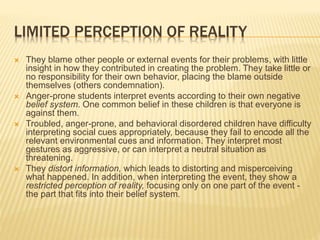
 Children in general have difficulty separating
their behavior from their identity. Some
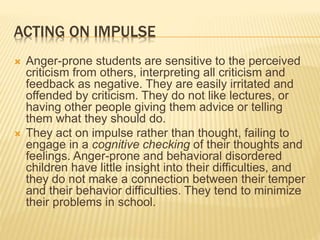
children do not understand that you do your
behavior, but you are not your behavior. This
concept is particularly difficult to grasp for
anger-prone and behavioral disordered
students.
ACTING ON IMPULSE
 Anger-prone students are sensitive to the perceived
criticism from others, interpreting all criticism and
feedback as negative. They are easily irritated and
offended by criticism. They do not like lectures, or
having other people giving them advice or telling
them what they should do.
 They act on impulse rather than thought, failing to
engage in a cognitive checking of their thoughts and
feelings. Anger-prone and behavioral disordered
children have little insight into their difficulties, and
they do not make a connection between their temper
and their behavior difficulties. They tend to minimize
their problems in school.
LIMITED PERCEPTION OF REALITY
 They blame other people or external events for their problems, with little
insight in how they contributed in creating the problem. They take little or
no responsibility for their own behavior, placing the blame outside
themselves (others condemnation).
 Anger-prone students interpret events according to their own negative
belief system. One common belief in these children is that everyone is
against them.
 Troubled, anger-prone, and behavioral disordered children have difficulty
interpreting social cues appropriately, because they fail to encode all the
relevant environmental cues and information. They interpret most
gestures as aggressive, or can interpret a neutral situation as
threatening.
 They distort information, which leads to distorting and misperceiving
what happened. In addition, when interpreting the event, they show a
restricted perception of reality, focusing only on one part of the event -
the part that fits into their belief system.
POOR SOCIAL SKILLS
 Anger-prone children have difficulty seeing things from someone
else’s point of view (perspective taking). For this reason, they do
not understand the negative effect of their behavior on others;
oppositional-defiant children in particular show a lack of empathy
for the feelings of others.
 They show poor social skills and a deficit in social problem
solving, that is, in solving problems that underlie social
interactions. An anger-prone and/or emotionally troubled child is
deficient in the number of solutions he is able to generate to solve
a social problem.
 Troubled, anger-prone, and behaviorally disordered children
seem unaffected by or unresponsive to social consequences.
With these children, a rewards system alone (e.g. stickers and
prizes) does not work well. Punishment alone (e.g. losing
privileges) is also likely to fail.
PART 4
THERAPEUTIC INTERVENTIONS
THE THERAPEUTIC TEACHER
 When therapeutic teachers need to deal with an angry student, the objective is
not to inhibit or extinguish the angry feeling, but to accept the student’s feelings
and help the child channel and direct his anger into a constructive end. Our long-
term goal is to teach the student an acceptable way of expressing his angry
feelings using appropriate coping skills. In addition, we take the opportunity to
train the student in anticipating failures and setbacks, and to learn how to deal
with frustration and conflict constructively.
 The first step in encouraging a healthy emotional expression of feelings in the
student is to help the child become conscious of his emotional reactions by
drawing attention to his feelings, e.g., “You seem worried. Did something happen
today?” We accept anger as a normal feeling. Acknowledging and accepting
that the student is angry does not mean that we approve the feeling; we are
neither accepting aggressive expressions of the feeling. If our intervention is
going to be soothing, we should aim at assisting the child in finding a positive
way to resolve his anger. In this section, we provide some child guidance
interventions that teachers can use to handle angry feelings in students.
REMIND YOURSELF TO LOWER THE TONE, LOWER YOUR
VOLUME, AND TO SPEAK SLOWER
 Negatives lead to more negatives, e.g., you
yell and the student yells louder. Work
constructively and try the cooperative
approach. Convey the message that, no
matter what happened, the situation is not
beyond solution; remain calm and act
business-like.
ASK FOR PERMISSION AND DO NOT FORCE THE ISSUE
 Before you attempt any intervention, ask the
student, “Is it okay with you if we discuss
___?” Alternatively, “Would you feel
comfortable talking about how you are
feeling now, or if we try to figure out what
makes you feel like this right now?”
OFFER YOUR HELP
 Do not promise to fix what you should not be
fixing. It is the student’s responsibility to deal
with the situation, not yours. Instead ask
what you can do to help, e.g., “What can I do
to help?” or “How can I help?”
SUPPORT THE STUDENT
 Reassure the student that you are going to
help him. For example, tell the child, “I will
help you to stay out of trouble” or “I can help
you control yourself until your own controls
take over.”
RECOGNIZE THE STUDENT’S DISTRESS AND RESPOND
EMPHATICALLY
 When you respond emphatically, you are
receptive to what the child is trying to
communicate and to how she expresses
herself, for example, “You feel bad, don’t
you? Look like these division problems are a
little hard. Let me help you.”
UNDERMINE THE STUDENT’S DEFENSES
 Never let the student justify an aggressive
act. (E.g., “Randy started it.”).
 Calmly, ask the child, “How else could you
have handled this situation without fighting?”
ASSUME GOOD INTENTIONS OR MOTIVES UNDERLYING
THE ANGER
 By assuming a positive intention, you are
helping the student see the angry feeling as
having a positive value or contributing to his
well-being in some way. Examples, “You are
yelling because you have strong feelings about
this. I know you hit Randy because you were
focused reading the story and it was hard for
you to break away.” Alternatively, “You don’t
want to go to the library because you are bored
there and you get restless.”
DEFUSE THE STUDENT’S ANGER BY VALIDATING THE CONTENT
 For example, you can say, “What you are
saying makes sense. I agree that…”
 Avoid telling the student how she should not
feel, e.g., “…And you are upset because you
don’t have a yellow crayon? How foolish of
you!”
 It is important that you let the student know
that you understand how she feels from her
point of view, not from your point of view.
DEFINE THE ANGER’S OBJECTIVE
 Say, “I understand how you are feeling. What
would help you feel better? What do you
want?”
LABEL THE CAUSE FOR THE BEHAVIOR AND ANGER, AND SHARE
YOUR UNDERSTANDING WITH THE STUDENT
 Some examples:
o These division problems are frustrating.
o When your best friend refuses to share her
markers with you, your feelings are hurt.
o It is disappointing trying so hard and still
losing the game.
REFRAME THE ANGER
 When you reframe, you develop an
alternative explanation of the problem or
feeling; one that increases the likelihood of a
positive behavior change. For example, “I
understand that you are feeling hurt. How
much pain are you feeling right now?”
TAKE RESPONSIBILITY FOR THE STUDENT’S ANGER
 Examples
o You are right. I should be more considerate.
You were upset because I kept you from
gym. I see now that was a mistake on my
part.
o I must have given you the wrong problems
today, Jessica; I apologize. Let’s try these…
HELP THE STUDENT SEE ANGER AS TEMPORARY
 Use temporary language to help the child
perceive her feelings as transitory. For
example, you can say, “When we talk about
this, you will feel better,” or “It is okay to feel
like this now. It will go away.”
EMPHASIZE THE STUDENT’S STRENGTHS AS A WAY OF HELPING
REGAIN SELF-CONTROL
 For example, say, “Maybe you could use
your toughness in some other way. Any
ideas?”
DISCUSS WITH THE STUDENT ALTERNATIVE WAYS OF
SOLVING THE PROBLEM
 Ask, “Are there other ways to deal with this
situation and still feel okay?”
ENCOURAGE THE STUDENT TO “TALK IT OUT” RATHER
THAN “ACTING IT OUT”
 Train the student in verbally expressing his
anger, for example, “I guess you are very
disappointed right now. Is it okay for you to
tell me how you feel?”
 Make sure the child understands that is okay
to feel angry (“We all feel angry
sometimes…”), but is how the child handles
the situation that can make it worse.
However, set limits on what the child can and
cannot say.
TRAIN THE STUDENT IN SOOTHING SELF-TALKING
 Teach the student that he can talk to himself to calm down. For
example, “Okay, it’s not an awful mess, just a problem to solve.
I’m going to focus on that. Getting all mad won’t help me.”
 Teach the student that he has the power to stop his angry
thoughts. He can think, “Stop!” and immediately say something
positive to himself. For example, “Stop! I’ll walk away, and I’m
going to feel better about myself.”
 Teach the student that he has the choice of accepting or refusing
invitations to fight. Examples,
o Well, names can’t really hurt me, so I’ll just ignore her.
o I will not fight Ericka because she wants me to act out and get
into trouble.
o He’s just trying to make me angry by calling me names. I don’t
have to answer.
USE THE STUDENT’S ANGER AS A TEACHING
OPPORTUNITY
 Use conflict situations as teaching
opportunities for developing in your students
coping skills in responding to such situations
without feeling angry or acting aggressively.
PART 5
STRATEGIES AND TECHNIQUES
COPING SKILLS
 Forman (1993) defines coping skills, or coping efforts, as
sets of information and learned behaviors that children
can use purposely to bring about positive outcomes in
potentially stressful situations. Coping techniques teach
psychological, social, cognitive, affective, and behavioral
skills that children and adolescents can use to deal with
potential stressors. According to the author, knowing and
using coping skills can prevent or reduce a variety of
academic, emotional, behavioral, and health problems in
children and adolescents. On the other hand, the inability
to handle potentially stressful situations or stressors may
result in emotional, behavioral, and/or physical health
problems.
 Coping skills are a way of promoting general, emotional,
and social competence in children.
CATEGORIES
 We can divide coping skills into two major categories:
 Problem-Focused
o Acting on the stressful stimuli to change or to solve the problem. Using
problem-solving techniques, we focus the coping effort in managing or in
altering the problem that is causing distress in the child.
 Emotion-Focused
o Managing how the child perceives the situation and reacts to it (the
emotional response) by changing the way the child thinks about the
stressor; cognitive procedures and self-talking procedures are two
examples of an emotion-focused coping effort. For example, the child
uses a coping technique like relaxation or selective attention, focusing
on the positive aspects of the situation while ignoring the negative
aspects of the event (Folkman and Lazarus, 1980).
 When we teach coping skills to a
distraught child, we help the child move
from a state of anger and helplessness to
a stage of problem resolution, or at least, a
better understanding of the troubling
situation.
RECOGNIZING ANGER SIGNALS
 As an initial coping intervention, we can
teach troubled and anger-prone children to
recognize when they feel angry. There are
several ways of doing this. One way is by
paying attention to action signals, or to what
they are doing. The second way is by paying
attention to thought signals, or what they are
thinking, and the third way is by paying
attention to feelings signals, or the way the
child is feeling.
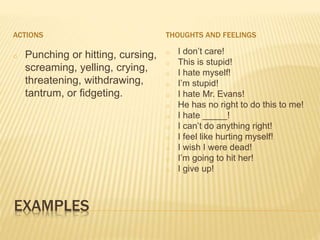
EXAMPLES
ACTIONS THOUGHTS AND FEELINGS
o Punching or hitting, cursing,
screaming, yelling, crying,
threatening, withdrawing,
tantrum, or fidgeting.
o I don’t care!
o This is stupid!
o I hate myself!
o I’m stupid!
o I hate Mr. Evans!
o He has no right to do this to me!
o I hate _____!
o I can’t do anything right!
o I feel like hurting myself!
o I wish I were dead!
o I’m going to hit her!
o I give up!
BODY SIGNALS
 A fourth way children can recognize anger is
by paying attention to their body signals. We
can train children in identifying the body
signals that cue them to anger; for example,
face feels hotter and flushes, body feels
warmer and tensed, muscles tighten, faster
and shallow breathing, sweating, and the
heart is pounding rapidly.
ANGER COPING TECHNIQUES FOR CHILDREN
 When we teach a child a game-like strategy,
the child is more likely to use the strategy
than when we simply ask the child to follow a
set of steps or rules. We can teach children
informal, and fun, anger coping strategies
that they can use when other children tease
them and/or they feel frustrated. Some
techniques…
THE TURTLE TECHNIQUE
 The child imitates a turtle when he is
provoked, retreating back into his shell; that
is, lowering the head, and pulling the arms
and legs tightly to the body. The child cannot
act aggressively when he is in this position
(Schneider and Dolnick, 1976).
PUT ON A HAPPY FACE
 The child simply smiles and acts happy. It is
a lot harder to feel angry when we are
smiling.
THE CALM AND COOL TECHNIQUE
 Teach the child to think of someone that is
always calm and cool; someone that the
child truly likes. Then have the child emulate
the calmness and coolness of the hero. For
example, imitating the terminator, the child
acts calm and cool.
THE ALLY TECHNIQUE
 This ally can be a real or an imaginary
person, another “cool guy.” What this ally will
say and do when others tease him, when he
is provoked, or when he feels frustrated?
THE SUPERHERO TECHNIQUE
 Spiderman, Wonder Woman, or another
superhero is with the child. The superhero
gives support when the child feels troubled,
and congratulates the child when he
manages to keep his anger under control.
With the superhero and ally techniques, the
child is using his imagination to see himself
as better able to deal with frustrations.
THE FOGGING TECHNIQUE
 The child downplays the importance of
another child’s taunting; for example:
“Pinocchio!” “Yeah, yeah, I have a big nose.
So what?”
THE “MAKE A PROMISE TO CHANGE” TECHNIQUE
 The child promises that, for the next hour,
she will not get angry or throw a tantrum.
After the hour, the adult challenges the child
to extend the promise for longer periods; for
example, for an extra hour, then for the
whole morning, next for a whole day, for two
days in a row, and finally a whole week. The
adult gives a small reward to the child for
each promise kept.
THE “BIG C” TECHNIQUE
 The child makes a C with her thumb and
index finger. The C stands for “control.” The
child looks at it and calms down. This is one
way for the child to cue herself.
THE DISTRACTION STRATEGY
 The child uses a distraction to angry thoughts
and feelings; for example, counting backwards,
counting evens only or odds only, skip counting,
or reciting the timetables. Other ways that the
child can distract his attention are by focusing
on a specific stimulus, visual or auditory (e.g.
singing a tune), or thinking about something
funny. The child can use a physical disruption
like snapping a rubber band on his wrist or
pinching himself. Alternatively, the child can use
a mental disruption or a thought-stopping like,
“Stop!” or “Cut it out.”
THE “STOP” TECHNIQUE
 Teach the child to say, “Stop!” to himself, first
aloud and later under his breath. Direct the
child to write “stop” in big colored letters on
an index card that he can look at anytime, or
teach the child to imagine a stop sign coming
down in front of him. Make sure the child
understands that “stop” means, “Stop doing it
straight away” (Butler and Hope, 1995).
THE “TALKING TO YOURSELF” STRATEGY
 The child can keep talking to herself to calm
down, or the child can recite self-calming
statements.
THE IGNORING TECHNIQUE
 Teach the child to ignore the first and the
second ideas, thoughts, or responses that
come to his mind. The child only responds to
his third idea or thought.
ON-THE-SPOT INTERVENTIONS
 Informal and quick interventions that a teacher, a counselor, or a
parent can try to defuse angry feelings and acting-out behaviors
in children are:
 Use a planned shift in attention. For example, you ignore the
angry feelings or acting-out behavior, and then distract the child
by interesting her in doing something else.
 Ask the child to do something else, such as going for a walk,
playing a board game, playing basketball, reading (or listening to)
a short story, or coloring.
 If the child is angry with another child, convince the angry child to
be “extra nice” to the other child.
 If the child is angry with another child, have the angry child recall
positive experiences she had with the other child, until she stops
feeling angry.
 Reinforce a competing response. Give the anger-
prone child positive attention, such as praise,
privileges, or recognition when she behaves in ways
incompatible with angry feelings and acting-out
behaviors. For example, praising the child when she
is acting calm, when apologizing or saying “thank
you,” or when sharing materials with other children.
 Use the restitution technique; for example, you might
say, “If you wronged _____, you must do something
good for him.” This technique can go both ways,
asking both the anger-prone student and the other
child to, daily, do at least one positive thing for each
other. After (three, five) days, reward the two children
for compliance.
 Encourage the anger-prone and/or acting-out child to
“stay one step ahead of the problem.” Predict when
anger and/or acting-out episodes are more likely to
happen, and plan for dealing with those moments,
including identifying the strategies that the child will
use to cope.
 Explicitly discuss with the anger-prone child when
and how she can use these informal coping
strategies, and reward her each time she uses a
strategy to cope with angry feelings and/or acting-out
behaviors.
REFERENCES (PART 5)
1. Butler, G., & Hope, T. (1995). Managing your mind:
The mental fitness guide. NY: Oxford University
Press.
2. Folkman, S., & Lazarus, R. S. (1980). An analysis of
coping in a middle-aged sample. Journal of Health
and Social Behavior, 21, pp. 219-239.
3. Forman, S. G. (1993). Coping skills interventions for
children and adolescents. San Francisco, CA:
Jossey-Bass.
4. Schneider, R. A., & Dolnick, M. (1976). The turtle
technique: An extended case study of self-control in
the classroom. Psychology in the Schools, 13, pp.
449-453.
CONNECT WITH PSYCHOEDUCATION FOR TEACHERS ONLINE
 FACEBOOK PAGES AND
GROUPS
 PSYCHOEDUCATION FOR
TEACHERS (Page)
 https://www.facebook.com/ps
ychoeducationalteacher
 FREE OR CHEAP
TEACHING RESOURCES
(Page)
 https://www.facebook.com/fre
eresourcesforteachers/
 WE TEACH THE WORLD
(Group)
 https://facebook.com/groups/
222247571474300
 BOOKS IN CHILD GUIDANCE
 THE PSYCHOEDUCATIONAL
TEACHER
 https://www.amazon.com/auth
or/thepsychoeducationalteach
er/
ESSENTIALS OF EMOTIONAL COMMUNICATION
Reaching the Unreachable Student
Where Do I Start? What Do I Say? How Do I Do It?
To preview this book on Amazon, visit my Author Page (Books in Child
Guidance)

Anger Management for Children

  • 1.
    ANGER MANAGEMENT FORCHILDREN A Psychoeducation for Teachers Skill-Building Guide
  • 2.
  • 3.
    DEFINING ANGER  Wecan define anger as an emotional state triggered when we feel frustrated. Most specifically, being frustrated means that we want something that we do not have. Anger is a normal feeling that everyone experiences. Together with happiness, fear, and sadness, anger is one of our four basic emotions. Anger levels range from mild (frustration), to moderate (mad), and to severe (rage). We experience anger physiologically (e.g. breathing rate increases, muscles tense), emotionally (as a feeling), and cognitively (i.e. aggressive and/or negative thoughts).  We can express anger in an overt way (e.g. cursing, hitting, kicking, or throwing a temper tantrum), a covert way (e.g. resistance and noncompliance), or by turning the feeling inward (e.g. depression). Our angry feelings and actions can target specific individuals, the world in general, or just us.  Anger is always a feeling and it is not the same as aggression. Aggression is a behavior, and is only one of the ways in which we can express anger.
  • 4.
    MODELS  Although angeris a basic emotion, some children are so engulfed by their intense and recurrent feelings of anger that dealing with these feelings become difficult for them. Children with anger problems have difficulty keeping their anger under control. For a troubled and anger-prone child, anger becomes repetitive and chronic, rather than an isolated event. Anger-prone children show greater frequency, intensity, and/or duration of angry feelings and behaviors. To explain these behaviors, we can use several models. Those models most commonly applied to school age children follow.
  • 5.
     The constitutionalmodel explains anger in terms of the child’s temperament.  The affective model considers anger a dysfunctional emotion.  The reinforcement or learning model suggests that other people are reinforcing the child’s anger by giving attention to him/her when he or she is acting-out. Even when it is negative attention, this attention from other individuals strengthens in the anger-prone child the perception that he or she is the one in charge; through anger, children learn to control and manipulate both other people and their environment.
  • 6.
     The sociallearning model maintains that children learn to react with angry feelings and aggressive behaviors when they observe anger and aggression in others, in particular, when they see the consequences of aggressive behaviors in others. For example, a child who sees another child get what she wants by using direct force (e.g. pushing in line), and without receiving a negative consequence or a reprimand, will be more likely to exhibit an aggressive behavior in similar circumstances. This model of anger derives from Bandura’s more comprehensive social learning model.
  • 7.
     The functionalmodel maintains that anger has a purpose and a goal, that is, anger aims at achieving the goal of removing frustration. According to the functional model, to remove frustration, an angry individual needs to understand what his/her goal is, or what he/she expects to get from the anger. Specifically, an angry person must understand what he wants, whom they want to get it from, and how they intend to get it. According to Fein (1993), anger becomes a problem when its goal is not clear to the angry person.
  • 8.
     The socialskills deficit model suggests a deficiency in the child’s ability to solve social problems coupled with limited skills in the number of alternative solutions the student can generate to handle successfully social or interactional problems. For example, the aggressive adolescent generates more physically aggressive solutions, like hitting and fighting, as opposed to verbal assertion solutions such as talking about the conflict. In addition, aggressive children often generate fewer bargaining and compromise solutions, because they are less capable of accurately perceiving the true intention of others (Robinson, Smith, and Miller, 2002).  The self-management deficit model explains anger as a deficit in the child’s ability to sustain effort to reach a long-term goal, and to find solutions, in particular, when the solution requires focused effort and the circumstances seem adverse to reach the goal.
  • 9.
     The cognitivemodel maintains that anger is due to distortions in thinking, or misattributions (negative and/or irrational attributions) of the situation. The troubled and anger-prone student has a pattern of thinking similar to the following: 1. The child selectively attends to and maximizes the negative cues, minimizing the positive cues. 2. The child automatically assumes intentionality and blames the other child. 3. The child labels the event as an angry event. 4. The child reacts to the label (angry event) rather than to the real event.
  • 10.
    REFERENCES (PART 1) 1.Fein, M. L. (1993). I.A.M.: A Common sense guide to coping with anger. Westport, CT: Praeger. 2. Robinson, T. R., Smith, S. W., & Miller, M. D. (2002). Effect of a cognitive-behavioral intervention on responses to anger by middle school students with chronic behavior problems. Behavioral Disorders, 27(3), pp. 256-271.
  • 11.
  • 12.
    INTRODUCTION  There isno single explanation why some students feel habitual and recurrent anger, exhibiting more aggressive behaviors than other students show. Some of it might depend on the child’s earlier experiences in life. Students who show a tendency to angry and aggressive behaviors in school seem to be responding to a worldview, their idea of how the world functions, that validates the belief that they are living in a hostile and negative world. If the child has had negative experiences earlier in life, experiences that are now part of the child’s memories, a particular incident may trigger anger associated with the student’s memories and thoughts. For example, if another child accidentally steps on the child, the troubled and anger-prone child will be inclined to perceive the intrusion as a hostile and intentional act because this interpretation matches and validates his or her worldview.
  • 13.
    ANGER CREATES ACOUNTER-REACTION  Anger becomes an automatic response to everyday events, even when the environmental cues are not there, or even when the environmental cues are contradicting the child’s interpretation of the event.  This habitual response can be reinforced by others, including parents, teachers, and peers if they have become used to it, and are expecting angry and hostile reactions from the child all the time. Every time the child’s angry feelings create a counter-reaction from others, this counter- reaction reinforces the child’s negative worldview, helping the child feel in control of the situation, especially when he or she gets what the anger was all about in the first place. The angry feeling by itself functions as a short-term reinforcement for the child, and once anger and aggressive behaviors are recorded in the child’s mind as a way to control, manipulate, and dominate others and their environment, the anger- prone child will use angry feelings and aggressive behaviors more easily in the future.
  • 14.
    CONTRIBUTING FACTORS  Othercontributing factors can help in maintaining an anger habit. Among the most common in children, we can mention:  Frustration o Anger is almost always based on frustration. When feeling overwhelmed, embarrassed, or ignored anger seems to be the child’s attempt to regain control. Anger-prone students show low frustration tolerance, going “on the offensive” to deal with situations that other children just put up with.  Fear o Anger can be based on fear, from fear of losing a privilege to fear of failure in a task or a skill, anger is usually about the fear of losing something that feels important to the child. As I said, anger-prone children seem to be always on the offensive; they feel uneasy and sometimes overwhelmed with situations that put them at risk of losing what they value, and they try to hide this apprehension from others by being the ones who attack first.
  • 15.
     Shame o Angercan spring from the child’s feelings that he has to fight all the time to preserve his dignity and sense of self-worth.  Lack of Assertiveness o When the child lacks the ability of assertively speaking for his rights, and does not know how to negotiate to get what he wants, the child may find himself exploding instead.
  • 16.
    PRE-CONDITIONS Certain pre-conditions mayalso influence angry feelings and aggressive behaviors in children, among them: o society’s attitude towards aggression and violence (a reaction to watching violent movies, television, and/or sports) o need for attention o angry and aggressive interactions with a parent or a caretaker o a cover-up for feelings of failure o group pressure o a cover-up for sadness and depression o using drugs o maintaining group status o to avoid closeness o revenge or “getting even”
  • 17.
    THE PRE-ANGER STATE What the child is thinking and how she is feeling at the moment of the event is instrumental in creating anger. If at the moment of the event the child is relaxed and in a positive state, she is less inclined to react angrily to the event. If, on the other hand, the child is already on an aversive or pre-anger state, she will be more susceptible to an angry reaction.
  • 18.
  • 19.
    ANGER-PRONE STUDENTS MAYEXHIBIT SOME, MOST, OR ALL OF THE CHARACTERISTICS LISTED NEXT…  Anger-prone students have habitual anger outbursts that seem out of proportion to the situation.  Habitually angry children think negatively most of the time about themselves, other people, or situations.  When dealing with difficult events, troubled and anger-prone students display catastrophic thinking, a thinking pattern that assumes that the worst thing that can happen is what is going to happen.  Anger can be identity or role-congruent for these children; that is, feeling angry all the time matches their self-image (e.g., “I cannot help myself. That’s the way I am”). Their perception of being an angry individual becomes a self-fulfilling prophesy, validated by frequent outbursts of anger and acting-out behaviors.
  • 20.
    LOW-FRUSTRATION TOLERANCE  Troubledand anger-prone students show low frustration tolerance, and they demand that what they want or need is satisfied immediately.  Anger-prone students show poor internal control or poor self-control.  One of the most common types of anger in children is the explosive type; this explosive type is characterized by sudden and intense angry feelings coupled with a loss of self-control, for example, a temper tantrum. In the explosive type, a minor annoyance can lead to a major outburst. Noncompliance and oppositional behaviors are common in anger-prone students.
  • 21.
    TUNNEL VISION  Anger-pronestudents also show a greater display of aggressive behaviors than their regular age-peers.  Anger-prone students show inflexible emotional reactions to different kinds of situations, labeling most situations as angry situations, or opportunities to feel angry.  Troubled and anger-prone students have a limited vocabulary for expressing their feelings (e.g. joyful, scornful, amazed, or annoyed) which limits their ability to label their emotions accurately and to handle their feelings effectively.  Troubled and anger-prone students exhibit what the cognitive literature calls tunnel vision. Their thinking seems impenetrable to environmental cues that can generate alternative explanations to the event, or can generate positive feelings.
  • 22.
    YOU ARE NOTYOUR BEHAVIOR  Children in general have difficulty separating their behavior from their identity. Some children do not understand that you do your behavior, but you are not your behavior. This concept is particularly difficult to grasp for anger-prone and behavioral disordered students.
  • 23.
    ACTING ON IMPULSE Anger-prone students are sensitive to the perceived criticism from others, interpreting all criticism and feedback as negative. They are easily irritated and offended by criticism. They do not like lectures, or having other people giving them advice or telling them what they should do.  They act on impulse rather than thought, failing to engage in a cognitive checking of their thoughts and feelings. Anger-prone and behavioral disordered children have little insight into their difficulties, and they do not make a connection between their temper and their behavior difficulties. They tend to minimize their problems in school.
  • 24.
    LIMITED PERCEPTION OFREALITY  They blame other people or external events for their problems, with little insight in how they contributed in creating the problem. They take little or no responsibility for their own behavior, placing the blame outside themselves (others condemnation).  Anger-prone students interpret events according to their own negative belief system. One common belief in these children is that everyone is against them.  Troubled, anger-prone, and behavioral disordered children have difficulty interpreting social cues appropriately, because they fail to encode all the relevant environmental cues and information. They interpret most gestures as aggressive, or can interpret a neutral situation as threatening.  They distort information, which leads to distorting and misperceiving what happened. In addition, when interpreting the event, they show a restricted perception of reality, focusing only on one part of the event - the part that fits into their belief system.
  • 25.
    POOR SOCIAL SKILLS Anger-prone children have difficulty seeing things from someone else’s point of view (perspective taking). For this reason, they do not understand the negative effect of their behavior on others; oppositional-defiant children in particular show a lack of empathy for the feelings of others.  They show poor social skills and a deficit in social problem solving, that is, in solving problems that underlie social interactions. An anger-prone and/or emotionally troubled child is deficient in the number of solutions he is able to generate to solve a social problem.  Troubled, anger-prone, and behaviorally disordered children seem unaffected by or unresponsive to social consequences. With these children, a rewards system alone (e.g. stickers and prizes) does not work well. Punishment alone (e.g. losing privileges) is also likely to fail.
  • 26.
  • 27.
    THE THERAPEUTIC TEACHER When therapeutic teachers need to deal with an angry student, the objective is not to inhibit or extinguish the angry feeling, but to accept the student’s feelings and help the child channel and direct his anger into a constructive end. Our long- term goal is to teach the student an acceptable way of expressing his angry feelings using appropriate coping skills. In addition, we take the opportunity to train the student in anticipating failures and setbacks, and to learn how to deal with frustration and conflict constructively.  The first step in encouraging a healthy emotional expression of feelings in the student is to help the child become conscious of his emotional reactions by drawing attention to his feelings, e.g., “You seem worried. Did something happen today?” We accept anger as a normal feeling. Acknowledging and accepting that the student is angry does not mean that we approve the feeling; we are neither accepting aggressive expressions of the feeling. If our intervention is going to be soothing, we should aim at assisting the child in finding a positive way to resolve his anger. In this section, we provide some child guidance interventions that teachers can use to handle angry feelings in students.
  • 28.
    REMIND YOURSELF TOLOWER THE TONE, LOWER YOUR VOLUME, AND TO SPEAK SLOWER  Negatives lead to more negatives, e.g., you yell and the student yells louder. Work constructively and try the cooperative approach. Convey the message that, no matter what happened, the situation is not beyond solution; remain calm and act business-like.
  • 29.
    ASK FOR PERMISSIONAND DO NOT FORCE THE ISSUE  Before you attempt any intervention, ask the student, “Is it okay with you if we discuss ___?” Alternatively, “Would you feel comfortable talking about how you are feeling now, or if we try to figure out what makes you feel like this right now?”
  • 30.
    OFFER YOUR HELP Do not promise to fix what you should not be fixing. It is the student’s responsibility to deal with the situation, not yours. Instead ask what you can do to help, e.g., “What can I do to help?” or “How can I help?”
  • 31.
    SUPPORT THE STUDENT Reassure the student that you are going to help him. For example, tell the child, “I will help you to stay out of trouble” or “I can help you control yourself until your own controls take over.”
  • 32.
    RECOGNIZE THE STUDENT’SDISTRESS AND RESPOND EMPHATICALLY  When you respond emphatically, you are receptive to what the child is trying to communicate and to how she expresses herself, for example, “You feel bad, don’t you? Look like these division problems are a little hard. Let me help you.”
  • 33.
    UNDERMINE THE STUDENT’SDEFENSES  Never let the student justify an aggressive act. (E.g., “Randy started it.”).  Calmly, ask the child, “How else could you have handled this situation without fighting?”
  • 34.
    ASSUME GOOD INTENTIONSOR MOTIVES UNDERLYING THE ANGER  By assuming a positive intention, you are helping the student see the angry feeling as having a positive value or contributing to his well-being in some way. Examples, “You are yelling because you have strong feelings about this. I know you hit Randy because you were focused reading the story and it was hard for you to break away.” Alternatively, “You don’t want to go to the library because you are bored there and you get restless.”
  • 35.
    DEFUSE THE STUDENT’SANGER BY VALIDATING THE CONTENT  For example, you can say, “What you are saying makes sense. I agree that…”  Avoid telling the student how she should not feel, e.g., “…And you are upset because you don’t have a yellow crayon? How foolish of you!”  It is important that you let the student know that you understand how she feels from her point of view, not from your point of view.
  • 36.
    DEFINE THE ANGER’SOBJECTIVE  Say, “I understand how you are feeling. What would help you feel better? What do you want?”
  • 37.
    LABEL THE CAUSEFOR THE BEHAVIOR AND ANGER, AND SHARE YOUR UNDERSTANDING WITH THE STUDENT  Some examples: o These division problems are frustrating. o When your best friend refuses to share her markers with you, your feelings are hurt. o It is disappointing trying so hard and still losing the game.
  • 38.
    REFRAME THE ANGER When you reframe, you develop an alternative explanation of the problem or feeling; one that increases the likelihood of a positive behavior change. For example, “I understand that you are feeling hurt. How much pain are you feeling right now?”
  • 39.
    TAKE RESPONSIBILITY FORTHE STUDENT’S ANGER  Examples o You are right. I should be more considerate. You were upset because I kept you from gym. I see now that was a mistake on my part. o I must have given you the wrong problems today, Jessica; I apologize. Let’s try these…
  • 40.
    HELP THE STUDENTSEE ANGER AS TEMPORARY  Use temporary language to help the child perceive her feelings as transitory. For example, you can say, “When we talk about this, you will feel better,” or “It is okay to feel like this now. It will go away.”
  • 41.
    EMPHASIZE THE STUDENT’SSTRENGTHS AS A WAY OF HELPING REGAIN SELF-CONTROL  For example, say, “Maybe you could use your toughness in some other way. Any ideas?”
  • 42.
    DISCUSS WITH THESTUDENT ALTERNATIVE WAYS OF SOLVING THE PROBLEM  Ask, “Are there other ways to deal with this situation and still feel okay?”
  • 43.
    ENCOURAGE THE STUDENTTO “TALK IT OUT” RATHER THAN “ACTING IT OUT”  Train the student in verbally expressing his anger, for example, “I guess you are very disappointed right now. Is it okay for you to tell me how you feel?”  Make sure the child understands that is okay to feel angry (“We all feel angry sometimes…”), but is how the child handles the situation that can make it worse. However, set limits on what the child can and cannot say.
  • 44.
    TRAIN THE STUDENTIN SOOTHING SELF-TALKING  Teach the student that he can talk to himself to calm down. For example, “Okay, it’s not an awful mess, just a problem to solve. I’m going to focus on that. Getting all mad won’t help me.”  Teach the student that he has the power to stop his angry thoughts. He can think, “Stop!” and immediately say something positive to himself. For example, “Stop! I’ll walk away, and I’m going to feel better about myself.”  Teach the student that he has the choice of accepting or refusing invitations to fight. Examples, o Well, names can’t really hurt me, so I’ll just ignore her. o I will not fight Ericka because she wants me to act out and get into trouble. o He’s just trying to make me angry by calling me names. I don’t have to answer.
  • 45.
    USE THE STUDENT’SANGER AS A TEACHING OPPORTUNITY  Use conflict situations as teaching opportunities for developing in your students coping skills in responding to such situations without feeling angry or acting aggressively.
  • 46.
  • 47.
    COPING SKILLS  Forman(1993) defines coping skills, or coping efforts, as sets of information and learned behaviors that children can use purposely to bring about positive outcomes in potentially stressful situations. Coping techniques teach psychological, social, cognitive, affective, and behavioral skills that children and adolescents can use to deal with potential stressors. According to the author, knowing and using coping skills can prevent or reduce a variety of academic, emotional, behavioral, and health problems in children and adolescents. On the other hand, the inability to handle potentially stressful situations or stressors may result in emotional, behavioral, and/or physical health problems.  Coping skills are a way of promoting general, emotional, and social competence in children.
  • 48.
    CATEGORIES  We candivide coping skills into two major categories:  Problem-Focused o Acting on the stressful stimuli to change or to solve the problem. Using problem-solving techniques, we focus the coping effort in managing or in altering the problem that is causing distress in the child.  Emotion-Focused o Managing how the child perceives the situation and reacts to it (the emotional response) by changing the way the child thinks about the stressor; cognitive procedures and self-talking procedures are two examples of an emotion-focused coping effort. For example, the child uses a coping technique like relaxation or selective attention, focusing on the positive aspects of the situation while ignoring the negative aspects of the event (Folkman and Lazarus, 1980).
  • 49.
     When weteach coping skills to a distraught child, we help the child move from a state of anger and helplessness to a stage of problem resolution, or at least, a better understanding of the troubling situation.
  • 50.
    RECOGNIZING ANGER SIGNALS As an initial coping intervention, we can teach troubled and anger-prone children to recognize when they feel angry. There are several ways of doing this. One way is by paying attention to action signals, or to what they are doing. The second way is by paying attention to thought signals, or what they are thinking, and the third way is by paying attention to feelings signals, or the way the child is feeling.
  • 51.
    EXAMPLES ACTIONS THOUGHTS ANDFEELINGS o Punching or hitting, cursing, screaming, yelling, crying, threatening, withdrawing, tantrum, or fidgeting. o I don’t care! o This is stupid! o I hate myself! o I’m stupid! o I hate Mr. Evans! o He has no right to do this to me! o I hate _____! o I can’t do anything right! o I feel like hurting myself! o I wish I were dead! o I’m going to hit her! o I give up!
  • 52.
    BODY SIGNALS  Afourth way children can recognize anger is by paying attention to their body signals. We can train children in identifying the body signals that cue them to anger; for example, face feels hotter and flushes, body feels warmer and tensed, muscles tighten, faster and shallow breathing, sweating, and the heart is pounding rapidly.
  • 53.
    ANGER COPING TECHNIQUESFOR CHILDREN  When we teach a child a game-like strategy, the child is more likely to use the strategy than when we simply ask the child to follow a set of steps or rules. We can teach children informal, and fun, anger coping strategies that they can use when other children tease them and/or they feel frustrated. Some techniques…
  • 54.
    THE TURTLE TECHNIQUE The child imitates a turtle when he is provoked, retreating back into his shell; that is, lowering the head, and pulling the arms and legs tightly to the body. The child cannot act aggressively when he is in this position (Schneider and Dolnick, 1976).
  • 55.
    PUT ON AHAPPY FACE  The child simply smiles and acts happy. It is a lot harder to feel angry when we are smiling.
  • 56.
    THE CALM ANDCOOL TECHNIQUE  Teach the child to think of someone that is always calm and cool; someone that the child truly likes. Then have the child emulate the calmness and coolness of the hero. For example, imitating the terminator, the child acts calm and cool.
  • 57.
    THE ALLY TECHNIQUE This ally can be a real or an imaginary person, another “cool guy.” What this ally will say and do when others tease him, when he is provoked, or when he feels frustrated?
  • 58.
    THE SUPERHERO TECHNIQUE Spiderman, Wonder Woman, or another superhero is with the child. The superhero gives support when the child feels troubled, and congratulates the child when he manages to keep his anger under control. With the superhero and ally techniques, the child is using his imagination to see himself as better able to deal with frustrations.
  • 59.
    THE FOGGING TECHNIQUE The child downplays the importance of another child’s taunting; for example: “Pinocchio!” “Yeah, yeah, I have a big nose. So what?”
  • 60.
    THE “MAKE APROMISE TO CHANGE” TECHNIQUE  The child promises that, for the next hour, she will not get angry or throw a tantrum. After the hour, the adult challenges the child to extend the promise for longer periods; for example, for an extra hour, then for the whole morning, next for a whole day, for two days in a row, and finally a whole week. The adult gives a small reward to the child for each promise kept.
  • 61.
    THE “BIG C”TECHNIQUE  The child makes a C with her thumb and index finger. The C stands for “control.” The child looks at it and calms down. This is one way for the child to cue herself.
  • 62.
    THE DISTRACTION STRATEGY The child uses a distraction to angry thoughts and feelings; for example, counting backwards, counting evens only or odds only, skip counting, or reciting the timetables. Other ways that the child can distract his attention are by focusing on a specific stimulus, visual or auditory (e.g. singing a tune), or thinking about something funny. The child can use a physical disruption like snapping a rubber band on his wrist or pinching himself. Alternatively, the child can use a mental disruption or a thought-stopping like, “Stop!” or “Cut it out.”
  • 63.
    THE “STOP” TECHNIQUE Teach the child to say, “Stop!” to himself, first aloud and later under his breath. Direct the child to write “stop” in big colored letters on an index card that he can look at anytime, or teach the child to imagine a stop sign coming down in front of him. Make sure the child understands that “stop” means, “Stop doing it straight away” (Butler and Hope, 1995).
  • 64.
    THE “TALKING TOYOURSELF” STRATEGY  The child can keep talking to herself to calm down, or the child can recite self-calming statements.
  • 65.
    THE IGNORING TECHNIQUE Teach the child to ignore the first and the second ideas, thoughts, or responses that come to his mind. The child only responds to his third idea or thought.
  • 66.
    ON-THE-SPOT INTERVENTIONS  Informaland quick interventions that a teacher, a counselor, or a parent can try to defuse angry feelings and acting-out behaviors in children are:  Use a planned shift in attention. For example, you ignore the angry feelings or acting-out behavior, and then distract the child by interesting her in doing something else.  Ask the child to do something else, such as going for a walk, playing a board game, playing basketball, reading (or listening to) a short story, or coloring.  If the child is angry with another child, convince the angry child to be “extra nice” to the other child.  If the child is angry with another child, have the angry child recall positive experiences she had with the other child, until she stops feeling angry.
  • 67.
     Reinforce acompeting response. Give the anger- prone child positive attention, such as praise, privileges, or recognition when she behaves in ways incompatible with angry feelings and acting-out behaviors. For example, praising the child when she is acting calm, when apologizing or saying “thank you,” or when sharing materials with other children.  Use the restitution technique; for example, you might say, “If you wronged _____, you must do something good for him.” This technique can go both ways, asking both the anger-prone student and the other child to, daily, do at least one positive thing for each other. After (three, five) days, reward the two children for compliance.
  • 68.
     Encourage theanger-prone and/or acting-out child to “stay one step ahead of the problem.” Predict when anger and/or acting-out episodes are more likely to happen, and plan for dealing with those moments, including identifying the strategies that the child will use to cope.  Explicitly discuss with the anger-prone child when and how she can use these informal coping strategies, and reward her each time she uses a strategy to cope with angry feelings and/or acting-out behaviors.
  • 69.
    REFERENCES (PART 5) 1.Butler, G., & Hope, T. (1995). Managing your mind: The mental fitness guide. NY: Oxford University Press. 2. Folkman, S., & Lazarus, R. S. (1980). An analysis of coping in a middle-aged sample. Journal of Health and Social Behavior, 21, pp. 219-239. 3. Forman, S. G. (1993). Coping skills interventions for children and adolescents. San Francisco, CA: Jossey-Bass. 4. Schneider, R. A., & Dolnick, M. (1976). The turtle technique: An extended case study of self-control in the classroom. Psychology in the Schools, 13, pp. 449-453.
  • 70.
    CONNECT WITH PSYCHOEDUCATIONFOR TEACHERS ONLINE  FACEBOOK PAGES AND GROUPS  PSYCHOEDUCATION FOR TEACHERS (Page)  https://www.facebook.com/ps ychoeducationalteacher  FREE OR CHEAP TEACHING RESOURCES (Page)  https://www.facebook.com/fre eresourcesforteachers/  WE TEACH THE WORLD (Group)  https://facebook.com/groups/ 222247571474300  BOOKS IN CHILD GUIDANCE  THE PSYCHOEDUCATIONAL TEACHER  https://www.amazon.com/auth or/thepsychoeducationalteach er/
  • 71.
    ESSENTIALS OF EMOTIONALCOMMUNICATION Reaching the Unreachable Student Where Do I Start? What Do I Say? How Do I Do It? To preview this book on Amazon, visit my Author Page (Books in Child Guidance)