Plant Healthy
Plant Health Management Standard & Audits
Phyto-threats Workshop 13th November 2019
Helen Bentley-Fox & Amanda Calvert
Plant health management & audits
• Background to Plant Health Management Standard (PHMS)
- History
- What next
• Plant healthy
- Website
- Assurance scheme
• What to expect at audit
- Auditor’s viewpoint of the standard’s requirements
• Discussion and questions
Plant Healthy
Plant Health Management Standard (PHMS)
Plant Healthy – online self assessment
Plant Health Assurance Scheme (PHAS)
Plant Health Alliance Steering Group
Plant Healthy
Plant Health Management Standard
Plant Healthy – online self assessment
Plant Health Assurance Scheme (PHAS)
Plant Health Alliance Steering Group
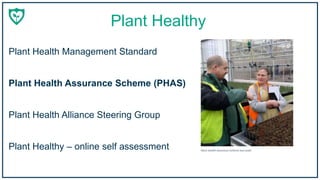
Plant Health Assurance Scheme test audit
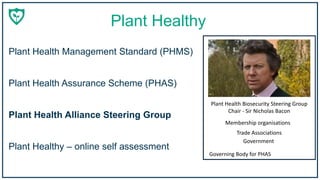
Plant Healthy
Membership organisations
Trade Associations
Government
Plant Health Biosecurity Steering Group
Chair - Sir Nicholas Bacon
Governing Body for PHAS
Plant Health Management Standard (PHMS)
Plant Healthy – online self assessment
Plant Health Assurance Scheme (PHAS)
Plant Health Alliance Steering Group
Plant Healthy
Plant Health Management Standard (PHMS)
Plant Healthy – online self assessment
Plant Health Assurance Scheme (PHAS)
Plant Health Alliance Steering Group
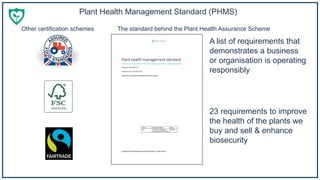
Plant Health Management Standard (PHMS)
A list of requirements that
demonstrates a business
or organisation is operating
responsibly
23 requirements to improve
the health of the plants we
buy and sell & enhance
biosecurity
Other certification schemes The standard behind the Plant Health Assurance Scheme
To prescribe, or not to prescribe: that is the question
Plant Health Management Standard (PHMS)
To prescribe, or not to prescribe: that is the question
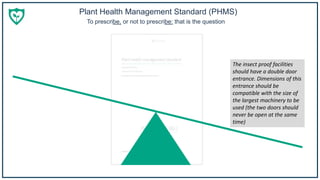
The insect proof facilities
should have a double door
entrance. Dimensions of this
entrance should be
compatible with the size of
the largest machinery to be
used (the two doors should
never be open at the same
time)
Plant Health Management Standard (PHMS)
To prescribe, or not to prescribe: that is the question
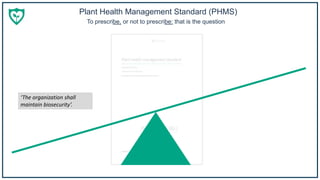
‘The organization shall
maintain biosecurity’.
Plant Health Management Standard (PHMS)
To prescribe, or not to prescribe: that is the question
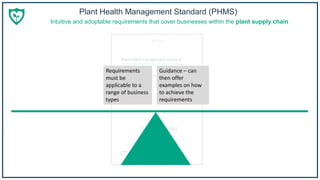
Requirements
must be
applicable to a
range of business
types
Guidance – can
then offer
examples on how
to achieve the
requirements
Intuitive and adoptable requirements that cover businesses within the plant supply chain
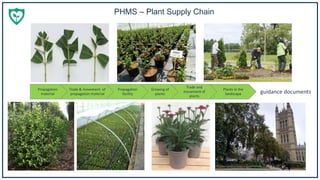
PHMS – Plant Supply Chain
Propagation
material
Trade & movement of
propagation material
Propagation
facility
Growing of
plants
Trade and
movement of
plants
Plants in the
landscape guidance documents
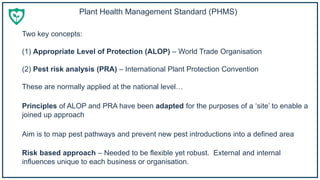
Two key concepts:
(1) Appropriate Level of Protection (ALOP) – World Trade Organisation
(2) Pest risk analysis (PRA) – International Plant Protection Convention
These are normally applied at the national level…
Risk based approach – Needed to be flexible yet robust. External and internal
influences unique to each business or organisation.
Principles of ALOP and PRA have been adapted for the purposes of a ‘site’ to enable a
joined up approach
Aim is to map pest pathways and prevent new pest introductions into a defined area
Plant Health Management Standard (PHMS)
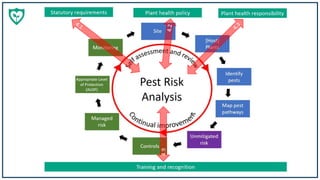
Stages adapted from the
International Plant Protection
Convention’s framework for
pest risk analysis. For the
purposes of applying the
principles at the site level.
Pest Risk
Analysis
Unmitigated
risk The level of risk to the business /
organisation and environment if
appropriate controls are NOT in place –
see - UK Plant Health Risk Register
(2) Pest Risk Assessment
Site
[Host]
Plants
Identify
pests
Map pest
pathways
List plants handled by a business (run
through this process with specifications of
plant and new species handled)
Pests that can infest plants
handled by business – see
Plant Health Risk Register
How the pests can arrive,
proliferate and be transferred
from the site (e.g. through
trade, visitors or natural
processes).
Define site boundaries (nursery, garden
centre, landscapers yard, garden)(1) Initiation
Controls
Managed
risk
Appropriate Level
of Protection
(ALOP)
The husbandry and housekeeping
measures available to control pests
The level of risk to the business /
organisation and environment if
suitable controls and management
systems are in place.
Define ALOP for site and
demonstrate that the
level of risk is acceptable
Monitoring
linked to the pest risk
assessment (unmitigated risk)
for specific pests –
demonstrates effectiveness of
controls and management
systems
(3) Pest Risk Management
Note – the term ‘Pests’ includes diseases
and ‘infest’ includes ‘infect’
4.9
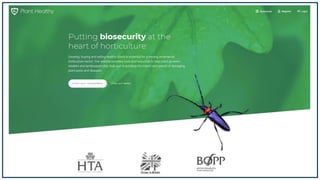
planthealthy.org.uk
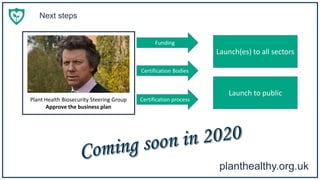
Next steps
Plant Health Biosecurity Steering Group
Approve the business plan
Funding
Certification Bodies
Certification process
Launch(es) to all sectors
Launch to public
planthealthy.org.uk
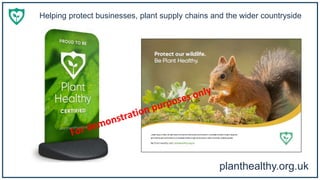
Helping protect businesses, plant supply chains and the wider countryside
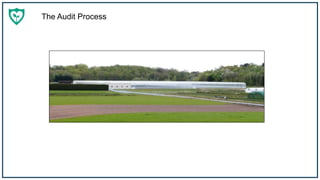
The Audit Process
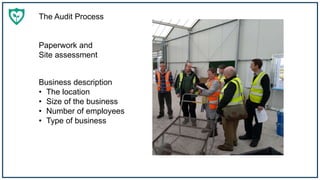
The Audit Process
Paperwork and
Site assessment
Business description
• The location
• Size of the business
• Number of employees
• Type of business
Legal requirements
The company should be able to
provide records/evidence to
illustrate that any statutory
requirements imposed have been
fulfilled and discharged.
Plant Passports,
Phytosanitary Certificates
and Forest Reproductive
Material regulations
Plant Health Policy
The business’ approach to plant health
A plant health policy statement is a company-
level document that sets out commitment
and prescribes acceptable methods or
behaviours relating to plant health rules and
objectives within the business, a set of
expectations put in place to manage
employee behaviour.
Policies are different from procedures and
standard operating procedures because they
are applicable to an entire organisation and
are primarily intended to set direction.
The policy must be signed and dated by a
senior responsible person and reviewed as
part of a continual improvement process at
least annually.
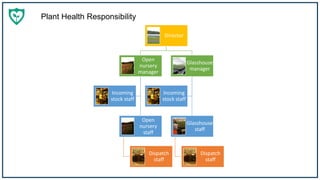
Plant Health Responsibility
Director
Open
nursery
manager
Open
nursery
staff
Dispatch
staff
Incoming
stock staff
Glasshouse
manager
Glasshouse
staff
Dispatch
staff
Incoming
stock staff
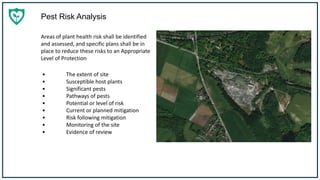
Pest Risk Analysis
Areas of plant health risk shall be identified
and assessed, and specific plans shall be in
place to reduce these risks to an Appropriate
Level of Protection
• The extent of site
• Susceptible host plants
• Significant pests
• Pathways of pests
• Potential or level of risk
• Current or planned mitigation
• Risk following mitigation
• Monitoring of the site
• Evidence of review
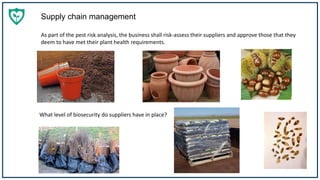
Supply chain management
As part of the pest risk analysis, the business shall risk-assess their suppliers and approve those that they
deem to have met their plant health requirements.
What level of biosecurity do suppliers have in place?
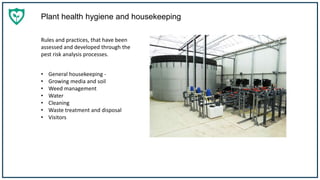
Plant health hygiene and housekeeping
Rules and practices, that have been
assessed and developed through the
pest risk analysis processes.
• General housekeeping -
• Growing media and soil
• Weed management
• Water
• Cleaning
• Waste treatment and disposal
• Visitors
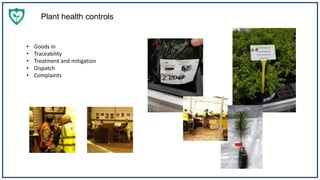
Plant health controls
• Goods in
• Traceability
• Treatment and mitigation
• Dispatch
• Complaints
Monitoring and ongoing health assessment
• Ongoing monitoring
• Self-assessment, review and continual
development
Training and recognition
• Plant health competencies
• Legislation and keeping up to date
• Information sharing
• Other relevant training
Thank you
planthealthy.org.uk

Helen Bentley-Fox & Amanda Calvert 13 Nov 19

  • 1.
    Plant Healthy Plant HealthManagement Standard & Audits Phyto-threats Workshop 13th November 2019 Helen Bentley-Fox & Amanda Calvert
  • 2.
    Plant health management& audits • Background to Plant Health Management Standard (PHMS) - History - What next • Plant healthy - Website - Assurance scheme • What to expect at audit - Auditor’s viewpoint of the standard’s requirements • Discussion and questions
  • 3.
    Plant Healthy Plant HealthManagement Standard (PHMS) Plant Healthy – online self assessment Plant Health Assurance Scheme (PHAS) Plant Health Alliance Steering Group
  • 4.
    Plant Healthy Plant HealthManagement Standard Plant Healthy – online self assessment Plant Health Assurance Scheme (PHAS) Plant Health Alliance Steering Group Plant Health Assurance Scheme test audit
  • 5.
    Plant Healthy Membership organisations TradeAssociations Government Plant Health Biosecurity Steering Group Chair - Sir Nicholas Bacon Governing Body for PHAS Plant Health Management Standard (PHMS) Plant Healthy – online self assessment Plant Health Assurance Scheme (PHAS) Plant Health Alliance Steering Group
  • 6.
    Plant Healthy Plant HealthManagement Standard (PHMS) Plant Healthy – online self assessment Plant Health Assurance Scheme (PHAS) Plant Health Alliance Steering Group
  • 7.
    Plant Health ManagementStandard (PHMS) A list of requirements that demonstrates a business or organisation is operating responsibly 23 requirements to improve the health of the plants we buy and sell & enhance biosecurity Other certification schemes The standard behind the Plant Health Assurance Scheme
  • 8.
    To prescribe, ornot to prescribe: that is the question Plant Health Management Standard (PHMS)
  • 9.
    Plant Health ManagementStandard (PHMS)
  • 10.
    Plant Health ManagementStandard (PHMS) To prescribe, or not to prescribe: that is the question The insect proof facilities should have a double door entrance. Dimensions of this entrance should be compatible with the size of the largest machinery to be used (the two doors should never be open at the same time)
  • 11.
    Plant Health ManagementStandard (PHMS) To prescribe, or not to prescribe: that is the question ‘The organization shall maintain biosecurity’.
  • 12.
    Plant Health ManagementStandard (PHMS) To prescribe, or not to prescribe: that is the question Requirements must be applicable to a range of business types Guidance – can then offer examples on how to achieve the requirements Intuitive and adoptable requirements that cover businesses within the plant supply chain
  • 13.
    PHMS – PlantSupply Chain Propagation material Trade & movement of propagation material Propagation facility Growing of plants Trade and movement of plants Plants in the landscape guidance documents
  • 14.
    Two key concepts: (1)Appropriate Level of Protection (ALOP) – World Trade Organisation (2) Pest risk analysis (PRA) – International Plant Protection Convention These are normally applied at the national level… Risk based approach – Needed to be flexible yet robust. External and internal influences unique to each business or organisation. Principles of ALOP and PRA have been adapted for the purposes of a ‘site’ to enable a joined up approach Aim is to map pest pathways and prevent new pest introductions into a defined area Plant Health Management Standard (PHMS)
  • 15.
    Stages adapted fromthe International Plant Protection Convention’s framework for pest risk analysis. For the purposes of applying the principles at the site level. Pest Risk Analysis Unmitigated risk The level of risk to the business / organisation and environment if appropriate controls are NOT in place – see - UK Plant Health Risk Register (2) Pest Risk Assessment Site [Host] Plants Identify pests Map pest pathways List plants handled by a business (run through this process with specifications of plant and new species handled) Pests that can infest plants handled by business – see Plant Health Risk Register How the pests can arrive, proliferate and be transferred from the site (e.g. through trade, visitors or natural processes). Define site boundaries (nursery, garden centre, landscapers yard, garden)(1) Initiation Controls Managed risk Appropriate Level of Protection (ALOP) The husbandry and housekeeping measures available to control pests The level of risk to the business / organisation and environment if suitable controls and management systems are in place. Define ALOP for site and demonstrate that the level of risk is acceptable Monitoring linked to the pest risk assessment (unmitigated risk) for specific pests – demonstrates effectiveness of controls and management systems (3) Pest Risk Management Note – the term ‘Pests’ includes diseases and ‘infest’ includes ‘infect’
  • 16.
  • 20.
    planthealthy.org.uk Next steps Plant HealthBiosecurity Steering Group Approve the business plan Funding Certification Bodies Certification process Launch(es) to all sectors Launch to public
  • 21.
    planthealthy.org.uk Helping protect businesses,plant supply chains and the wider countryside
  • 22.
  • 23.
    The Audit Process Paperworkand Site assessment Business description • The location • Size of the business • Number of employees • Type of business
  • 24.
    Legal requirements The companyshould be able to provide records/evidence to illustrate that any statutory requirements imposed have been fulfilled and discharged. Plant Passports, Phytosanitary Certificates and Forest Reproductive Material regulations
  • 25.
    Plant Health Policy Thebusiness’ approach to plant health A plant health policy statement is a company- level document that sets out commitment and prescribes acceptable methods or behaviours relating to plant health rules and objectives within the business, a set of expectations put in place to manage employee behaviour. Policies are different from procedures and standard operating procedures because they are applicable to an entire organisation and are primarily intended to set direction. The policy must be signed and dated by a senior responsible person and reviewed as part of a continual improvement process at least annually.
  • 26.
    Plant Health Responsibility Director Open nursery manager Open nursery staff Dispatch staff Incoming stockstaff Glasshouse manager Glasshouse staff Dispatch staff Incoming stock staff
  • 27.
    Pest Risk Analysis Areasof plant health risk shall be identified and assessed, and specific plans shall be in place to reduce these risks to an Appropriate Level of Protection • The extent of site • Susceptible host plants • Significant pests • Pathways of pests • Potential or level of risk • Current or planned mitigation • Risk following mitigation • Monitoring of the site • Evidence of review
  • 28.
    Supply chain management Aspart of the pest risk analysis, the business shall risk-assess their suppliers and approve those that they deem to have met their plant health requirements. What level of biosecurity do suppliers have in place?
  • 29.
    Plant health hygieneand housekeeping Rules and practices, that have been assessed and developed through the pest risk analysis processes. • General housekeeping - • Growing media and soil • Weed management • Water • Cleaning • Waste treatment and disposal • Visitors
  • 30.
    Plant health controls •Goods in • Traceability • Treatment and mitigation • Dispatch • Complaints
  • 31.
    Monitoring and ongoinghealth assessment • Ongoing monitoring • Self-assessment, review and continual development
  • 32.
    Training and recognition •Plant health competencies • Legislation and keeping up to date • Information sharing • Other relevant training
  • 33.

Editor's Notes

  • #2 HBF and I work for GiB as the technical manager for the grown in Britain standards a technical expert for a couple of standard committees in the British standards Institute, feeding into a number of international standards. PHMS with Alistair Yeomans from the HTA who is unable to attend today. I’ll let Amanda introduce herself as we are doing a bit of a double act just to keep you interested.
  • #3 talk about the scheme and how it has developed. What you can do today and what you need to make sure you are Plant Healthy ready in 2020. Amanda will then go into what you should expect at audit in more detail. If we could have questions at the end.
  • #4 PHMS long time in the making, some of you may already be aware of but please bear with me. The overarching aim of Plant health management standard is to provide a checklist that will enable you to improve your plant health management systems as part of the plant supply chain. It is based on the International Plant Protection Convention’s framework for pest risk analysis and using this checklist and periodic reviews to continually improve your plant health management.
  • #5 The assurance scheme is overarches the implementation of the PHMS and allows businesses to sign up to the scheme, be audited against the standard and publicise that they are part of the scheme. The scheme details how companies are audited, by whom, how often and how they will be regulated using the logo and finally awarded a certificate.
  • #6 This is the group that owns the standard. They are borne out of the Highgrove meeting a year and a half ago and chosen to hold the standard to ensure that it is not influenced by any particular trade body to demonstrate independence of the scheme and support throughout the sector.
  • #7 On line Plant healthy assessment… I will go into this later on in my presentation but suffice to say it is an online self assessment tool to help a business identify where they could improve their biosecurity.
  • #8 The PHMS is a list of just 23 requirements to improve the health of the plants we buy and sell thereby enhancing biosecurity. You are probably familiar with these logos, Red Tractor, FSC and Fairtrade. Behind certification schemes there are standards just like the PHMS. Once a company is audited against these standards they are permitted to use the logo and certification mark within the scheme restrictions.
  • #9 The standard was quite a few years in the making as you are probably aware. It went from generic to prescriptive and back again, and again and again…. and finally settled as the standard that you can view on the Plant Healthy website. Many of you are probably familiar with Iso standards such as 9001. As you know the ISO standards are quite generic and when you are audited it includes only what you write in the scope. For example, ISO9001 is a quality management system for your plants, but if you choose to leave out plant health in your scope of what you see as quality your definition of quality is the plants must be of a certain height in a certain pot, you can still attain 9001 certification. So the trick was to write the phms in a generic enough way that it could cover all types of businesses but specific enough that it is effective.
  • #10 So prescribing or not prescribing becomes a balancing act.
  • #11 Highly prescriptive descriptions such as this with a double door entrance, never open at the same time.
  • #12 Overly generic and the company won’t know where to start or what the auditor will need to see. Also, for the auditor this is impossible to audit as the auditor will not know when the requirements have been met.
  • #13 Guidance provides examples of different ways or approaches to meet the requirements of the standard. Wording of each requirement had to be tested to see if it was applicable to a range of business types and that it would allow for different scales of operation and different business models to meet the requirements in a way that is practical to each business. The outcome is the same The knowledge of why and how must run throughout the business
  • #14 So now we think we have a standard that covers the whole plant supply chain.
  • #15 Rather than reinvent the wheel we took two internationally recognised concepts ALOP and PRA developed by international experts. appropriate level of protection (ALOP) is the level of protection deemed appropriate by the company establishing a sanitary or phytosanitary measure to protect, human, animal or plant life or health within its territory. This concept is also referred to as the acceptable level of risk. pest risk analysis is the process of evaluating biological or other scientific and economic evidence to determine whether an organism is a pest, whether it should be regulated (or in the case of this standard should be managed by the individual business), and the strength of any phytosanitary measures to be taken against it. PRA – don’t get confused with pest risk assessment which is the evaluation of the probability of the introduction and spread of a pest and the magnitude of the associated potential economic consequences. Normally, these are applied at the national level so we adapted them so they applied to a site rather than a country. Same principle but on a much smaller scale. So what does this look like….
  • #16 Difference between process and the assessment. International standards so that it can be implemented globally. Blue boxes are assessing what you have ie initiating the pest risk analysis, the purple is assessing the risk the green are your actions to try and reduce that identified risk ie manage that risk. It is a cycle as things change and everything must be constantly reviewed. This could result in many different risk assessments and outcomes or they could be grouped for example, Pathways could be assessed for area such as water and Phytopthera and the mitigation may be a sand filter.
  • #17 Underpinning this cycle are a number of extra requirements. They may be external such as statutory requirements (section 4.1 of the standard), or internal such as your company plant health policy (Section 4.2 of the standard), how your company is organised and who is responsible each element of plant health cycle (4.3) and finally how plant health is disseminated within your company and how the company keeps up to date with new stuff (4.9).
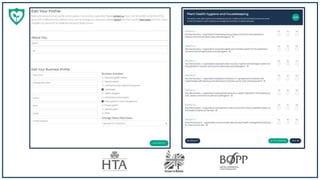
  • #18 So that is what we have done and why. This next bit is about what is ready now. If you haven’t already done so, go to the plant healthy website. There you can find the standard and also a plant healthy checklist to mark where you are now. From what I understand nearly 200 companies have completed an assessment, showing an appetite for doing something about biosecurity, definitely at the nursery level but this needs to expand to other business sectors.
  • #19 The checklist is simple and covers each of those items earlier on the cycle and the standard. The checklist asks you if you have done anything or if you think it isn’t applicable to your organisation.
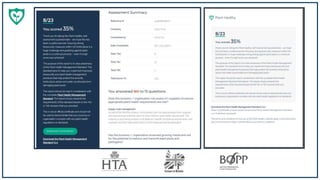
  • #20 Once completed you get a summary like the one above telling you what your score is. Hopefully it is better than this example.
  • #21 Tomorrow approve business plan Secure funding We two certification bodies Processes for certification including training of auditors Launching to sectors Spring 2020 (subject to tomorrow’s meeting and funding) – it may be rolled out different times to different sectors… Soft launch to public by Summer 2020. Obviously brand awareness is part of this…
  • #22 Certify businesses not products… cannot label individual plants because of broken coc.
  • #23 2017 – 11 audits in total, 10 then 1 in 2019 – Delamere Informed the development of the standard, guidance, future audit process and documents Before the audit – background info re the business – website, also talk to directors/managing directors of the business to let them know roughly how long the audit will take, the staff we would like to talk to (to make sure they are there) and the type of things we would like to look at – eg paperwork and a walk around the site/sites Length of audit depend on the size and type of business and whether is across multiple sites Check if there are any known risks in the area/region that the nursery is located – e.g. Chalara etc
  • #24 Arrival on site – Visual check – surroundings – public access – footpaths, gardens, level of exposure. Where you park, the reception area – is it on the actual nursery or in a different area, are we asked to sign a visitor book are we asked to clean our boots – does anyone notice if they are covered in mud? We are auditors and could have been to another nursery that has issues Then have an initial meeting that always includes the director/manager that has the ultimate responsibility for the nursery/business, and those that run the nursery on a day to day basis. We may also call in other members of staff at this point, again depending on the size of the business and roles within it
  • #25 How and who manages them Have they got any processes in place Who is responsible if an outbreak of a notifiable pest occurs – is there a written process in place? Have they had any outbreaks –what did they do how was it managed When walking around the nursery we will look out for incoming stock and then when we go back into the office ask for all documentation relating to it to assess whether the systems work,
  • #26 Policy statement and underlying processes to enable the business to meet the objectives set out within that policy
  • #27 Roles all the way down to dispatch, who is responsible for what, how do they know, how do they report who do they report to
  • #28 How the business manages risk – do they know what they are, have they looked into all areas of risk in depth, RA need to be useable/understandable by staff and easy to update and review – check that the processes/systems they have are fit for purpose will they support reducing and mitigation of risk, what controls are in place and who is responsible, how is this communicated
  • #29 Procurement processes, due diligence checks
  • #30 General eg boot washing More specific – soil – when it arrives – visual assessment Sterilisation of seed beds – is it done how often, is growing media re-used? What do they do with it after its used Water – supply, storage, water treatments, testing, drainage across the site Waste treatment where is it how does it drain, how hot does it get Wider environment
  • #31 Goods in – where do they come into – is it in the main nursery area? What sort of checks take place? Do they check the pallets re imported goods etc. Traceability how is this managed on site from the moment of arrival to sale – then spot check on site take back a reference to the office and follow through Talk to staff re in all departments and check that the processes described in the office are actually put into practise at each stage.