Costs & Benefits of nursery best
practices
Gregory Valatin
20th
November 2018
2
LWEC Phyothreats project CBA
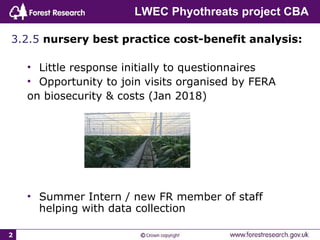
3.2.5 nursery best practice cost-benefit analysis:
• Little response initially to questionnaires
• Opportunity to join visits organised by FERA
on biosecurity & costs (Jan 2018)
• Summer Intern / new FR member of staff
helping with data collection
Phytothreats: Nursery Best Practices
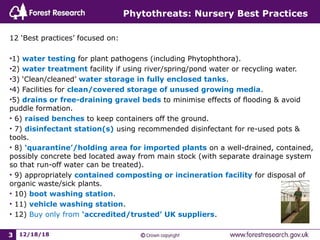
12 ‘Best practices’ focused on:
•1) water testing for plant pathogens (including Phytophthora).
•2) water treatment facility if using river/spring/pond water or recycling water.
•3) ‘Clean/cleaned’ water storage in fully enclosed tanks.
•4) Facilities for clean/covered storage of unused growing media.
•5) drains or free-draining gravel beds to minimise effects of flooding & avoid
puddle formation.
• 6) raised benches to keep containers off the ground.
• 7) disinfectant station(s) using recommended disinfectant for re-used pots &
tools.
• 8) ‘quarantine’/holding area for imported plants on a well-drained, contained,
possibly concrete bed located away from main stock (with separate drainage system
so that run-off water can be treated).
• 9) appropriately contained composting or incineration facility for disposal of
organic waste/sick plants.
• 10) boot washing station.
• 11) vehicle washing station.
• 12) Buy only from ‘accredited/trusted’ UK suppliers.
12/18/183
4
Nursery perspective: Costs>Benefits?
Preliminary results (17 nurseries) Min Max Mean N No data
1) Water testing Annual cost (£/yr) 250 20000 5213 4 11
2) Water treatment facility set up (£) 2000+ [α] 30000 1200 3 12
Annual maintenance cost (£/yr) 1000 10000[βiii] 4000 3 12
3) Covered water storage set up (£) 1200 60000 21140 5 10
Annual maintenance cost (£/yr) 50 50 50 2 13
4) Covered storage of growing media set up (£) 4000 5000 4500 1 14
5) Drains/free-draining gravel beds set up (£) 11000 250000 68417 [βi] 6 [µ] 8 [µ]
Annual maintenance cost (£/yr) 0 15000 5508 [βii] 6 9
6) Raised benches set up (£) 7000 1600000 410100 4 [δ] 10 [δ]
Annual maintenance cost (£/yr) 0 20000 10000 2 13
7) Disinfection stations set up (£) 10 30000 6260 6 9
Annual maintenance cost (£/yr) 7.5 40000 6821 6 9
8) Quarantine/holding area set up (£) 1200 50000 21300 4 11
Annual maintenance cost (£/yr) 15
9) Contained composting /incineration facility set up (£) 2000 12500 6833 3 12
Annual maintenance cost (£/yr) 15
10) Boot washing station set up (£) 10 1500 379 7 8
Annual maintenance cost (£/yr) 20 1000 368 4 11
11) Vehicle washing station set up (£) 650 30000 9730 5 10
Annual maintenance cost (£/yr) 15
12) Buy only UK supplies Annual cost (£/yr) insignificant infeasible 3500 [ ]ϕ 1 [Ψ] 12 [Ψ]
Total costs (for those costs estimated) set up (£) 25070 2069000 561059
Annual cost (£/yr) 4328 102550 35459
Benefits * Avoided cost of outbreak 0 60000 [Ω] 20200 [Ω] [βiii] 6 9
[α] response coded as £2k for purposes of computing the mean; [β] response coded as midpoint for purposes of computing the mean: i) £12k-£15k coded as £13.75k;
ii) £10k-£15k coded as £12.5k; ii) £7k-£10k coded as £8.5k; iii) £0-£k coded as £2.5k [ ] ‘insignificant’ & ‘infeasible’ responses excluded in computing mean; [µ]ϕ
excludes one partial response (£2k per tunnel); [δ] excludes one partial response (£90 for 2.5m); [Ψ] excludes two partial responses: +35% and +20% to +30%; [Ω]:
excludes one response: ‘anything from zero to complete right off’
*how many outbreaks a year avoided on average (worst case): one?
Baseline for nursery practice?
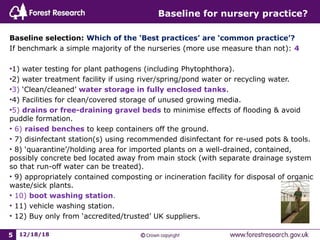
Baseline selection: Which of the ‘Best practices’ are ‘common practice’?
If benchmark a simple majority of the nurseries (more use measure than not): 4
•1) water testing for plant pathogens (including Phytophthora).
•2) water treatment facility if using river/spring/pond water or recycling water.
•3) ‘Clean/cleaned’ water storage in fully enclosed tanks.
•4) Facilities for clean/covered storage of unused growing media.
•5) drains or free-draining gravel beds to minimise effects of flooding & avoid
puddle formation.
• 6) raised benches to keep containers off the ground.
• 7) disinfectant station(s) using recommended disinfectant for re-used pots & tools.
• 8) ‘quarantine’/holding area for imported plants on a well-drained, contained,
possibly concrete bed located away from main stock (with separate drainage system
so that run-off water can be treated).
• 9) appropriately contained composting or incineration facility for disposal of organic
waste/sick plants.
• 10) boot washing station.
• 11) vehicle washing station.
• 12) Buy only from ‘accredited/trusted’ UK suppliers.
12/18/185
6
common practice baseline: Costs>Benefits?
Preliminary results (17 nurseries): Min Max Mean N No data
1) Water testing: (11/13 don’t currently) Annual cost (£/yr) 250 20000 5213 4 11
2) Water treatment facility (10/13 don’t currently) set up (£) 2000+ [α] 30000 1200 3 12
Annual maintenance cost (£/yr) 1000 10000[βiii] 4000 3 12
3) Covered water storage (9/13 do currently) set up (£) 1200 60000 21140 5 10
Annual maintenance cost (£/yr) 50 50 50 2 13
4) Covered storage of growing media (9/10 don’t currently) set up (£) 4000 5000 4500 1 14
5) Drains/free-draining gravel beds (10/11 do currently) set up (£) 11000 250000 68417 [βi] 6 [µ] 8 [µ]
Annual maintenance cost (£/yr) 0 15000 5508 [βii] 6 9
6) Raised benches (7/13 do currently) set up (£) 7000 1600000 410100 4 [δ] 10 [δ]
Annual maintenance cost (£/yr) 0 20000 10000 2 13
7) Disinfection stations (8/13 don’t currently) set up (£) 10 30000 6260 6 9
Annual maintenance cost (£/yr) 7.5 40000 6821 6 9
8) Quarantine/holding area (11/15 don’t currently) set up (£) 1200 50000 21300 4 11
Annual maintenance cost (£/yr) 15
9) Contained composting /incineration facility (12/13 don’t
currently)
set up (£) 2000 12500 6833 3 12
Annual maintenance cost (£/yr) 15
10) Boot washing station (7/13 do currently) set up (£) 10 1500 379 7 8
Annual maintenance cost (£/yr) 20 1000 368 4 11
11) Vehicle washing station (8/13 don’t currently) set up (£) 650 30000 9730 5 10
Annual maintenance cost (£/yr) 15
12) Buy only UK supplies (7/11 don’t currently) Annual cost (£/yr) insignificant infeasible 3500 [ ]ϕ 1 [Ψ] 12 [Ψ]
Total costs (for measures that a majority of the
nurseries do not implement currently)
set up (£) 9860 157500 60623
Annual cost (£/yr) 4258 66500 19534
Benefits* Avoided cost of outbreak 2000 60000 [Ω] 20200 [Ω] [βiii] 4 11
[α] response coded as £2k for purposes of computing the mean; [β] response coded as midpoint for purposes of computing the mean: i) £12k-£15k coded as £13.75k;
ii) £10k-£15k coded as £12.5k; ii) £7k-£10k coded as £8.5k; ii) £0-£k coded as £2.5k; [ ] ‘insignificant’ & ‘infeasible’ responses excluded in computing mean; [µ]ϕ
excludes one partial response (£2k per tunnel); [δ] excludes one partial response (£90 for 2.5m); [Ψ] excludes two partial responses: +35% and +20% to +30%; [Ω]:
excludes one response: ‘anything from zero to complete right off’
*how many outbreaks a year avoided on average (worst case): one?
7
‘Typical’ (1 ha) nursery?: Costs>Benefits?
Expert Judgement based costs: Min Max Mean
1) Water testing: (11/13 don’t currently) Annual cost (£/yr) n.a. n.a. n.a.
2) Water treatment facility (10/13 don’t currently) set up (£) 1500 10000 6500
Annual maintenance cost (£/yr) 750 750 750
3) Covered water storage (9/13 do currently) set up (£) 2500 7000+ 5000 [α]
Annual maintenance cost (£/yr)
4) Covered storage of growing media (9/10 don’t currently) set up (£)
Annual maintenance cost (£/yr)
n.a. n.a. n.a.
5) Drains/free-draining gravel beds (10/11 do currently) set up (£) per ha 100000 100000 100000
Annual maintenance cost (£/yr)
6) Raised benches (7/13 do currently) set up (£) 3000 6000 4500
Annual maintenance cost (£/yr)
7) Disinfection stations (8/13 don’t currently) set up (£) per above ground tank 2000 2000 2000
Annual maintenance cost (£/yr) 500 500 500
8) Quarantine/holding area (11/15 don’t currently) set up (£) for 1 ha nursery 35000 35000 35000
Annual maintenance cost (£/yr)
9) Contained composting /incineration facility (12/13 don’t
currently)
set up (£) 8000 8000 8000
Annual maintenance cost (£/yr)
10) Boot washing station (7/13 do currently) set up (£) 350 650 500
Annual maintenance cost (£/yr) 200 200 200
11) Vehicle washing station (8/13 don’t currently) set up (£): if large enough for a
lorry
5000 5000 5000
Annual cost (£/yr): if 30 lorries/yr 450 450 450
12) Buy only UK supplies (7/11 don’t currently) Additional cost of supplies (%) 9% 13% 11%
Total costs (all measures excluding : 1) water testing,
4) covered storage of growing media , & 12) UK
supplies only)
set up (£) 156600 164900 160750
Annual cost (£/yr) 1900 1900 1900
Total costs (common practice baseline; 5 additional
best practices for which estimates available)
set up (£) 50750 50750 50750
Annual cost (£/yr) 1700 1700 1700
Benefits* Avoided cost of outbreak 2000 60000 [Ω] 20200 [Ω] [βiii]
[α] max coded as £7.5k for purposes of computing the mean; [Ω]: excludes one response: ‘anything from zero to complete right off’
*How many outbreaks a year avoided on average (worst case): one?
How much smaller would expected benefits be for a 1 ha nursery?
Which practices to assume already adopted (e.g. none or majority)?
8
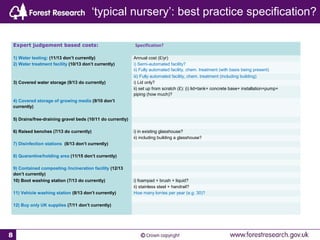
‘typical nursery’: best practice specification?
Expert judgement based costs: Specification?
1) Water testing: (11/13 don’t currently) Annual cost (£/yr)
2) Water treatment facility (10/13 don’t currently) i) Semi-automated facility?
ii) Fully automated facility, chem. treatment (with basis being present)
iii) Fully automated facility, chem. treatment (including building)
3) Covered water storage (9/13 do currently) i) Lid only?
ii) set up from scratch (£): (i) lid+tank+ concrete base+ installation+pump+
piping (how much)?
4) Covered storage of growing media (9/10 don’t
currently)
5) Drains/free-draining gravel beds (10/11 do currently)
6) Raised benches (7/13 do currently) i) in existing glasshouse?
ii) including building a glasshouse?
7) Disinfection stations (8/13 don’t currently)
8) Quarantine/holding area (11/15 don’t currently)
9) Contained composting /incineration facility (12/13
don’t currently)
10) Boot washing station (7/13 do currently) i) foampad + brush + liquid?
ii) stainless steel + handrail?
11) Vehicle washing station (8/13 don’t currently) How many lorries per year (e.g. 30)?
12) Buy only UK supplies (7/11 don’t currently)
Phytothreats CBA: preliminary conclusions
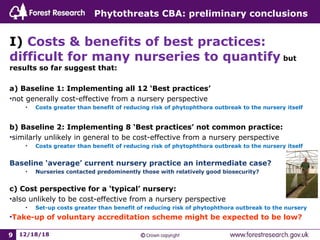
I) Costs & benefits of best practices:
difficult for many nurseries to quantify but
results so far suggest that:
a) Baseline 1: Implementing all 12 ‘Best practices’
•not generally cost-effective from a nursery perspective
• Costs greater than benefit of reducing risk of phytophthora outbreak to the nursery itself
b) Baseline 2: Implementing 8 ‘Best practices’ not common practice:
•similarly unlikely in general to be cost-effective from a nursery perspective
• Costs greater than benefit of reducing risk of phytophthora outbreak to the nursery itself
Baseline ‘average’ current nursery practice an intermediate case?
• Nurseries contacted predominently those with relatively good biosecurity?
c) Cost perspective for a ‘typical’ nursery:
•also unlikely to be cost-effective from a nursery perspective
• Set-up costs greater than benefit of reducing risk of phytophthora outbreak to the nursery
•Take-up of voluntary accreditation scheme might be expected to be low?
12/18/189
Phytothreats CBA: preliminary conclusions
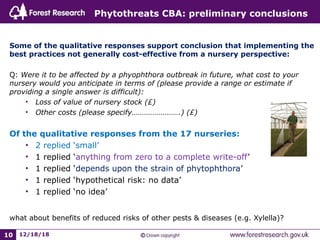
Some of the qualitative responses support conclusion that implementing the
best practices not generally cost-effective from a nursery perspective:
Q: Were it to be affected by a phyophthora outbreak in future, what cost to your
nursery would you anticipate in terms of (please provide a range or estimate if
providing a single answer is difficult):
• Loss of value of nursery stock (£)
• Other costs (please specify…………………….) (£)
Of the qualitative responses from the 17 nurseries:
• 2 replied ‘small’
• 1 replied ‘anything from zero to a complete write-off’
• 1 replied ‘depends upon the strain of phytophthora’
• 1 replied ‘hypothetical risk: no data’
• 1 replied ‘no idea’
what about benefits of reduced risks of other pests & diseases (e.g. Xylella)?
12/18/1810
11
Biosecurity: some nurseries very concerned
Perspectives expressed included:
•current biosecurity measures far from sufficient to
prevent introduction of new pests and diseases
• Xylella of particular concern due to expected regulatory
measures if found and due to :
• difficulties in spotting symptoms
• lack of awareness of buyers & those travelling abroad
• some traders/retailers willing to take risks
• potential impacts for their business relatively minor
• lack of effective action by government putting UK
nurseries at risk
• especially ‘producers’ growing own plants
• current European Plant Health regime and plant passporting not ‘fit
for purpose’
• E.g. being on a Dutch passport does not
necessary mean grown in the Netherlands

Gregory Valatin wp2 Nov 2018

  • 1.
    Costs & Benefitsof nursery best practices Gregory Valatin 20th November 2018
  • 2.
    2 LWEC Phyothreats projectCBA 3.2.5 nursery best practice cost-benefit analysis: • Little response initially to questionnaires • Opportunity to join visits organised by FERA on biosecurity & costs (Jan 2018) • Summer Intern / new FR member of staff helping with data collection
  • 3.
    Phytothreats: Nursery BestPractices 12 ‘Best practices’ focused on: •1) water testing for plant pathogens (including Phytophthora). •2) water treatment facility if using river/spring/pond water or recycling water. •3) ‘Clean/cleaned’ water storage in fully enclosed tanks. •4) Facilities for clean/covered storage of unused growing media. •5) drains or free-draining gravel beds to minimise effects of flooding & avoid puddle formation. • 6) raised benches to keep containers off the ground. • 7) disinfectant station(s) using recommended disinfectant for re-used pots & tools. • 8) ‘quarantine’/holding area for imported plants on a well-drained, contained, possibly concrete bed located away from main stock (with separate drainage system so that run-off water can be treated). • 9) appropriately contained composting or incineration facility for disposal of organic waste/sick plants. • 10) boot washing station. • 11) vehicle washing station. • 12) Buy only from ‘accredited/trusted’ UK suppliers. 12/18/183
  • 4.
    4 Nursery perspective: Costs>Benefits? Preliminaryresults (17 nurseries) Min Max Mean N No data 1) Water testing Annual cost (£/yr) 250 20000 5213 4 11 2) Water treatment facility set up (£) 2000+ [α] 30000 1200 3 12 Annual maintenance cost (£/yr) 1000 10000[βiii] 4000 3 12 3) Covered water storage set up (£) 1200 60000 21140 5 10 Annual maintenance cost (£/yr) 50 50 50 2 13 4) Covered storage of growing media set up (£) 4000 5000 4500 1 14 5) Drains/free-draining gravel beds set up (£) 11000 250000 68417 [βi] 6 [µ] 8 [µ] Annual maintenance cost (£/yr) 0 15000 5508 [βii] 6 9 6) Raised benches set up (£) 7000 1600000 410100 4 [δ] 10 [δ] Annual maintenance cost (£/yr) 0 20000 10000 2 13 7) Disinfection stations set up (£) 10 30000 6260 6 9 Annual maintenance cost (£/yr) 7.5 40000 6821 6 9 8) Quarantine/holding area set up (£) 1200 50000 21300 4 11 Annual maintenance cost (£/yr) 15 9) Contained composting /incineration facility set up (£) 2000 12500 6833 3 12 Annual maintenance cost (£/yr) 15 10) Boot washing station set up (£) 10 1500 379 7 8 Annual maintenance cost (£/yr) 20 1000 368 4 11 11) Vehicle washing station set up (£) 650 30000 9730 5 10 Annual maintenance cost (£/yr) 15 12) Buy only UK supplies Annual cost (£/yr) insignificant infeasible 3500 [ ]ϕ 1 [Ψ] 12 [Ψ] Total costs (for those costs estimated) set up (£) 25070 2069000 561059 Annual cost (£/yr) 4328 102550 35459 Benefits * Avoided cost of outbreak 0 60000 [Ω] 20200 [Ω] [βiii] 6 9 [α] response coded as £2k for purposes of computing the mean; [β] response coded as midpoint for purposes of computing the mean: i) £12k-£15k coded as £13.75k; ii) £10k-£15k coded as £12.5k; ii) £7k-£10k coded as £8.5k; iii) £0-£k coded as £2.5k [ ] ‘insignificant’ & ‘infeasible’ responses excluded in computing mean; [µ]ϕ excludes one partial response (£2k per tunnel); [δ] excludes one partial response (£90 for 2.5m); [Ψ] excludes two partial responses: +35% and +20% to +30%; [Ω]: excludes one response: ‘anything from zero to complete right off’ *how many outbreaks a year avoided on average (worst case): one?
  • 5.
    Baseline for nurserypractice? Baseline selection: Which of the ‘Best practices’ are ‘common practice’? If benchmark a simple majority of the nurseries (more use measure than not): 4 •1) water testing for plant pathogens (including Phytophthora). •2) water treatment facility if using river/spring/pond water or recycling water. •3) ‘Clean/cleaned’ water storage in fully enclosed tanks. •4) Facilities for clean/covered storage of unused growing media. •5) drains or free-draining gravel beds to minimise effects of flooding & avoid puddle formation. • 6) raised benches to keep containers off the ground. • 7) disinfectant station(s) using recommended disinfectant for re-used pots & tools. • 8) ‘quarantine’/holding area for imported plants on a well-drained, contained, possibly concrete bed located away from main stock (with separate drainage system so that run-off water can be treated). • 9) appropriately contained composting or incineration facility for disposal of organic waste/sick plants. • 10) boot washing station. • 11) vehicle washing station. • 12) Buy only from ‘accredited/trusted’ UK suppliers. 12/18/185
  • 6.
    6 common practice baseline:Costs>Benefits? Preliminary results (17 nurseries): Min Max Mean N No data 1) Water testing: (11/13 don’t currently) Annual cost (£/yr) 250 20000 5213 4 11 2) Water treatment facility (10/13 don’t currently) set up (£) 2000+ [α] 30000 1200 3 12 Annual maintenance cost (£/yr) 1000 10000[βiii] 4000 3 12 3) Covered water storage (9/13 do currently) set up (£) 1200 60000 21140 5 10 Annual maintenance cost (£/yr) 50 50 50 2 13 4) Covered storage of growing media (9/10 don’t currently) set up (£) 4000 5000 4500 1 14 5) Drains/free-draining gravel beds (10/11 do currently) set up (£) 11000 250000 68417 [βi] 6 [µ] 8 [µ] Annual maintenance cost (£/yr) 0 15000 5508 [βii] 6 9 6) Raised benches (7/13 do currently) set up (£) 7000 1600000 410100 4 [δ] 10 [δ] Annual maintenance cost (£/yr) 0 20000 10000 2 13 7) Disinfection stations (8/13 don’t currently) set up (£) 10 30000 6260 6 9 Annual maintenance cost (£/yr) 7.5 40000 6821 6 9 8) Quarantine/holding area (11/15 don’t currently) set up (£) 1200 50000 21300 4 11 Annual maintenance cost (£/yr) 15 9) Contained composting /incineration facility (12/13 don’t currently) set up (£) 2000 12500 6833 3 12 Annual maintenance cost (£/yr) 15 10) Boot washing station (7/13 do currently) set up (£) 10 1500 379 7 8 Annual maintenance cost (£/yr) 20 1000 368 4 11 11) Vehicle washing station (8/13 don’t currently) set up (£) 650 30000 9730 5 10 Annual maintenance cost (£/yr) 15 12) Buy only UK supplies (7/11 don’t currently) Annual cost (£/yr) insignificant infeasible 3500 [ ]ϕ 1 [Ψ] 12 [Ψ] Total costs (for measures that a majority of the nurseries do not implement currently) set up (£) 9860 157500 60623 Annual cost (£/yr) 4258 66500 19534 Benefits* Avoided cost of outbreak 2000 60000 [Ω] 20200 [Ω] [βiii] 4 11 [α] response coded as £2k for purposes of computing the mean; [β] response coded as midpoint for purposes of computing the mean: i) £12k-£15k coded as £13.75k; ii) £10k-£15k coded as £12.5k; ii) £7k-£10k coded as £8.5k; ii) £0-£k coded as £2.5k; [ ] ‘insignificant’ & ‘infeasible’ responses excluded in computing mean; [µ]ϕ excludes one partial response (£2k per tunnel); [δ] excludes one partial response (£90 for 2.5m); [Ψ] excludes two partial responses: +35% and +20% to +30%; [Ω]: excludes one response: ‘anything from zero to complete right off’ *how many outbreaks a year avoided on average (worst case): one?
  • 7.
    7 ‘Typical’ (1 ha)nursery?: Costs>Benefits? Expert Judgement based costs: Min Max Mean 1) Water testing: (11/13 don’t currently) Annual cost (£/yr) n.a. n.a. n.a. 2) Water treatment facility (10/13 don’t currently) set up (£) 1500 10000 6500 Annual maintenance cost (£/yr) 750 750 750 3) Covered water storage (9/13 do currently) set up (£) 2500 7000+ 5000 [α] Annual maintenance cost (£/yr) 4) Covered storage of growing media (9/10 don’t currently) set up (£) Annual maintenance cost (£/yr) n.a. n.a. n.a. 5) Drains/free-draining gravel beds (10/11 do currently) set up (£) per ha 100000 100000 100000 Annual maintenance cost (£/yr) 6) Raised benches (7/13 do currently) set up (£) 3000 6000 4500 Annual maintenance cost (£/yr) 7) Disinfection stations (8/13 don’t currently) set up (£) per above ground tank 2000 2000 2000 Annual maintenance cost (£/yr) 500 500 500 8) Quarantine/holding area (11/15 don’t currently) set up (£) for 1 ha nursery 35000 35000 35000 Annual maintenance cost (£/yr) 9) Contained composting /incineration facility (12/13 don’t currently) set up (£) 8000 8000 8000 Annual maintenance cost (£/yr) 10) Boot washing station (7/13 do currently) set up (£) 350 650 500 Annual maintenance cost (£/yr) 200 200 200 11) Vehicle washing station (8/13 don’t currently) set up (£): if large enough for a lorry 5000 5000 5000 Annual cost (£/yr): if 30 lorries/yr 450 450 450 12) Buy only UK supplies (7/11 don’t currently) Additional cost of supplies (%) 9% 13% 11% Total costs (all measures excluding : 1) water testing, 4) covered storage of growing media , & 12) UK supplies only) set up (£) 156600 164900 160750 Annual cost (£/yr) 1900 1900 1900 Total costs (common practice baseline; 5 additional best practices for which estimates available) set up (£) 50750 50750 50750 Annual cost (£/yr) 1700 1700 1700 Benefits* Avoided cost of outbreak 2000 60000 [Ω] 20200 [Ω] [βiii] [α] max coded as £7.5k for purposes of computing the mean; [Ω]: excludes one response: ‘anything from zero to complete right off’ *How many outbreaks a year avoided on average (worst case): one? How much smaller would expected benefits be for a 1 ha nursery? Which practices to assume already adopted (e.g. none or majority)?
  • 8.
    8 ‘typical nursery’: bestpractice specification? Expert judgement based costs: Specification? 1) Water testing: (11/13 don’t currently) Annual cost (£/yr) 2) Water treatment facility (10/13 don’t currently) i) Semi-automated facility? ii) Fully automated facility, chem. treatment (with basis being present) iii) Fully automated facility, chem. treatment (including building) 3) Covered water storage (9/13 do currently) i) Lid only? ii) set up from scratch (£): (i) lid+tank+ concrete base+ installation+pump+ piping (how much)? 4) Covered storage of growing media (9/10 don’t currently) 5) Drains/free-draining gravel beds (10/11 do currently) 6) Raised benches (7/13 do currently) i) in existing glasshouse? ii) including building a glasshouse? 7) Disinfection stations (8/13 don’t currently) 8) Quarantine/holding area (11/15 don’t currently) 9) Contained composting /incineration facility (12/13 don’t currently) 10) Boot washing station (7/13 do currently) i) foampad + brush + liquid? ii) stainless steel + handrail? 11) Vehicle washing station (8/13 don’t currently) How many lorries per year (e.g. 30)? 12) Buy only UK supplies (7/11 don’t currently)
  • 9.
    Phytothreats CBA: preliminaryconclusions I) Costs & benefits of best practices: difficult for many nurseries to quantify but results so far suggest that: a) Baseline 1: Implementing all 12 ‘Best practices’ •not generally cost-effective from a nursery perspective • Costs greater than benefit of reducing risk of phytophthora outbreak to the nursery itself b) Baseline 2: Implementing 8 ‘Best practices’ not common practice: •similarly unlikely in general to be cost-effective from a nursery perspective • Costs greater than benefit of reducing risk of phytophthora outbreak to the nursery itself Baseline ‘average’ current nursery practice an intermediate case? • Nurseries contacted predominently those with relatively good biosecurity? c) Cost perspective for a ‘typical’ nursery: •also unlikely to be cost-effective from a nursery perspective • Set-up costs greater than benefit of reducing risk of phytophthora outbreak to the nursery •Take-up of voluntary accreditation scheme might be expected to be low? 12/18/189
  • 10.
    Phytothreats CBA: preliminaryconclusions Some of the qualitative responses support conclusion that implementing the best practices not generally cost-effective from a nursery perspective: Q: Were it to be affected by a phyophthora outbreak in future, what cost to your nursery would you anticipate in terms of (please provide a range or estimate if providing a single answer is difficult): • Loss of value of nursery stock (£) • Other costs (please specify…………………….) (£) Of the qualitative responses from the 17 nurseries: • 2 replied ‘small’ • 1 replied ‘anything from zero to a complete write-off’ • 1 replied ‘depends upon the strain of phytophthora’ • 1 replied ‘hypothetical risk: no data’ • 1 replied ‘no idea’ what about benefits of reduced risks of other pests & diseases (e.g. Xylella)? 12/18/1810
  • 11.
    11 Biosecurity: some nurseriesvery concerned Perspectives expressed included: •current biosecurity measures far from sufficient to prevent introduction of new pests and diseases • Xylella of particular concern due to expected regulatory measures if found and due to : • difficulties in spotting symptoms • lack of awareness of buyers & those travelling abroad • some traders/retailers willing to take risks • potential impacts for their business relatively minor • lack of effective action by government putting UK nurseries at risk • especially ‘producers’ growing own plants • current European Plant Health regime and plant passporting not ‘fit for purpose’ • E.g. being on a Dutch passport does not necessary mean grown in the Netherlands