



z
RENUKA BHARDWAJ
HEDGEHOG PATHWAY (SHH)
z
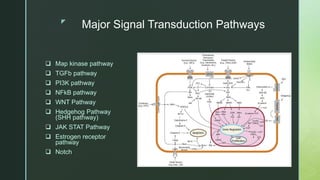
Major Signal Transduction Pathways
 Map kinase pathway
 TGFb pathway
 PI3K pathway
 NFkB pathway
 WNT Pathway
 Hedgehog Pathway
(SHH pathway)
 JAK STAT Pathway
 Estrogen receptor
pathway
 Notch
z
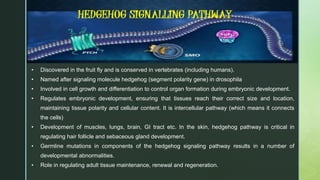
• Discovered in the fruit fly and is conserved in vertebrates (including humans).
• Named after signaling molecule hedgehog (segment polarity gene) in drosophila
• Involved in cell growth and differentiation to control organ formation during embryonic development.
• Regulates embryonic development, ensuring that tissues reach their correct size and location,
maintaining tissue polarity and cellular content. It is intercellular pathway (which means it connects
the cells)
• Development of muscles, lungs, brain, GI tract etc. In the skin, hedgehog pathway is critical in
regulating hair follicle and sebaceous gland development.
• Germline mutations in components of the hedgehog signaling pathway results in a number of
developmental abnormalities.
• Role in regulating adult tissue maintenance, renewal and regeneration.
z
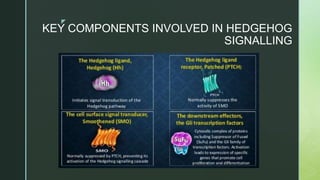
KEY COMPONENTS INVOLVED IN HEDGEHOG
SIGNALLING
z
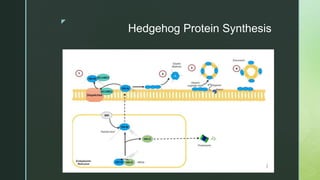
Hedgehog Protein Synthesis
• Secreted proteins
• Segment polarity protein
• Mammals have 3 homologues:
 SHH (sonic)
 IHH (indian)
 DHH (desert)
• All the hedgehog signaling proteins are involved in embryological development
 Digit (finger) formation in mammals
• Synthesised in ER – 45 Kda of which 25 KDA is HHC and 20 KDA is HHN
• Four mechanisms in release and actions
• Get synthesized as precursor proteins with HHC and HHN portions
• HHC adds a cholesterol to HHN and when it gets processed in the ER and HHC gets cleaved off in an auto-proteolytic cleavage
process which leaves HHN with cholesterol moiety attached.
• HHC gets exported out of ER and degraded by proteasome in the cell.
• Skinny Hh (SKI) which is within the ER, it acts on HHN and adds palmitic acid.
• Once it has both the moieties it gets exported out of ER and gets placed in the plasma membrane of cell.
• Dispatched is a protein within the plasma membrane and acts of HHN
• Scube 2 attaches on to HHN and both are released
• Second way is HHN get accumulated on the plasma membrane and they release themselves as soluble multimer.
• Third way is that HHN interacts with heparin sulphate chain in glypican and get incorporated in lipo-proteins and get released in the
cell
• HHN protein get accumulated in the plasma membrane and they bud off in exo vescicle.
z
Mechanism of Pathway
z Mechanism of Pathway
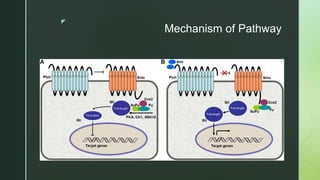
• Patch (PTCH) surface protein embedded in the membrane, Smoothened (SMO) is inside a
vesicle in cytoplasm.
• Normally when signal is inactive i.e. in absence of Hh molecule the PTCH inhibits SMO and it
cannot enter plasma membrane.
• Gli is associated with SUFU in inactivated form in cytosol.
• Protein CKI, PKA, GSK3b phosphorylates GLI proteins.
• When GLI proteins are phosphorylated they are processed by proteasomes and cleaved in
truncated version of themselves chopped off to GLI3R repressor protein
• GLI3 R can translocate into the nucleus and inhibit the transcriptional activation of hedgehog
mediated genes.
• However in presence of Hh PTCH is inhibited and so the SMO vesicle will fuse and get
embedded in the membrane and activates Gli1 and 2 proteins.
• Gli1/2 goes inside the nucleus and turn on the GLI target genes which helps in development
of different organs.
z
Hedgehog Pathway disruption in Cancer
• Disruption of hedgehog signaling during embryonic development, through either
deleterious mutations of SHH or PTCH or consumption of teratogens by the
gestating mother, can lead to severe developmental abnormalities.
• Activation of the hedgehog pathway has been implicated in the development
of cancers in various organs, including brain, lung, mammary
gland, prostate and skin. Basal cell carcinoma, the most common form of
cancerous malignancy, has the closest association with hedgehog signaling.
• Loss-of-function mutations in Patched and activating mutations
in Smoothened have been identified in patients with this disease.
• Abnormal activation of the pathway probably leads to development of disease
through transformation of adult stem cells into cancer stem cells that give rise to
the tumor.
z
Abnormal hedgehog pathway signaling
pathogenesis in certain types of cancer
Inappropriate reactivation of the hedgehog pathway has been linked to
several human cancers.
Two different mechanisms drive abnormal hedgehog pathway signaling in
different types of cancer:
1. Ligand- independent signaling driven by mutations( e.g BCC and
medulloblastoma). Mutations in key pathway regulators (e.g PTCH or
SMO) cause SMO to be in a constitutively active state.
2. Ligand- dependent signaling driven by overexpression of Hh ligand by
tumour cells (e.g ovarian cancer, colorectal cancer, pancreatic cancer).
z
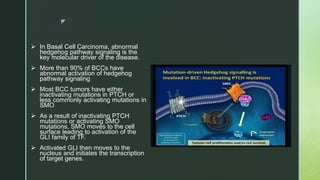
 In Basal Cell Carcinoma, abnormal
hedgehog pathway signaling is the
key molecular driver of the disease.
 More than 90% of BCCs have
abnormal activation of hedgehog
pathway signaling
 Most BCC tumors have either
inactivating mutations in PTCH or
less commonly activating mutations in
SMO
 As a result of inactivating PTCH
mutations or activating SMO
mutations, SMO moves to the cell
surface leading to activation of the
GLI family of TF.
 Activated GLI then moves to the
nucleus and initiates the transcription
of target genes.
z
Inhibitors of Hh Signaling Pathway
• Inhibitors of Hh signaling pathway
has been investigated as cancer
therapeutics.
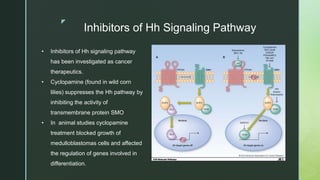
• Cyclopamine (found in wild corn
lilies) suppresses the Hh pathway by
inhibiting the activity of
transmembrane protein SMO
• In animal studies cyclopamine
treatment blocked growth of
medulloblastomas cells and affected
the regulation of genes involved in
differentiation.
z
Let’s watch a video to make sure we
remember what we learnt 
https://www.youtube.com/watch?v=w9-hmG06B8w
z
References
https://en.wikipedia.org/wiki/Hedgehog_signaling_pathway
#Mechanism_2
https://www.ncbi.nlm.nih.gov/pmc/articles/PMC3126020/
https://www.ncbi.nlm.nih.gov/pubmed/12495844/
Hedgehog pathway

Hedgehog pathway

  • 1.
  • 2.
    z Major Signal TransductionPathways  Map kinase pathway  TGFb pathway  PI3K pathway  NFkB pathway  WNT Pathway  Hedgehog Pathway (SHH pathway)  JAK STAT Pathway  Estrogen receptor pathway  Notch
  • 3.
    z • Discovered inthe fruit fly and is conserved in vertebrates (including humans). • Named after signaling molecule hedgehog (segment polarity gene) in drosophila • Involved in cell growth and differentiation to control organ formation during embryonic development. • Regulates embryonic development, ensuring that tissues reach their correct size and location, maintaining tissue polarity and cellular content. It is intercellular pathway (which means it connects the cells) • Development of muscles, lungs, brain, GI tract etc. In the skin, hedgehog pathway is critical in regulating hair follicle and sebaceous gland development. • Germline mutations in components of the hedgehog signaling pathway results in a number of developmental abnormalities. • Role in regulating adult tissue maintenance, renewal and regeneration.
  • 4.
    z KEY COMPONENTS INVOLVEDIN HEDGEHOG SIGNALLING
  • 5.
  • 6.
    • Secreted proteins •Segment polarity protein • Mammals have 3 homologues:  SHH (sonic)  IHH (indian)  DHH (desert) • All the hedgehog signaling proteins are involved in embryological development  Digit (finger) formation in mammals • Synthesised in ER – 45 Kda of which 25 KDA is HHC and 20 KDA is HHN • Four mechanisms in release and actions • Get synthesized as precursor proteins with HHC and HHN portions • HHC adds a cholesterol to HHN and when it gets processed in the ER and HHC gets cleaved off in an auto-proteolytic cleavage process which leaves HHN with cholesterol moiety attached. • HHC gets exported out of ER and degraded by proteasome in the cell. • Skinny Hh (SKI) which is within the ER, it acts on HHN and adds palmitic acid. • Once it has both the moieties it gets exported out of ER and gets placed in the plasma membrane of cell. • Dispatched is a protein within the plasma membrane and acts of HHN • Scube 2 attaches on to HHN and both are released • Second way is HHN get accumulated on the plasma membrane and they release themselves as soluble multimer. • Third way is that HHN interacts with heparin sulphate chain in glypican and get incorporated in lipo-proteins and get released in the cell • HHN protein get accumulated in the plasma membrane and they bud off in exo vescicle.
  • 7.
  • 8.
    z Mechanism ofPathway • Patch (PTCH) surface protein embedded in the membrane, Smoothened (SMO) is inside a vesicle in cytoplasm. • Normally when signal is inactive i.e. in absence of Hh molecule the PTCH inhibits SMO and it cannot enter plasma membrane. • Gli is associated with SUFU in inactivated form in cytosol. • Protein CKI, PKA, GSK3b phosphorylates GLI proteins. • When GLI proteins are phosphorylated they are processed by proteasomes and cleaved in truncated version of themselves chopped off to GLI3R repressor protein • GLI3 R can translocate into the nucleus and inhibit the transcriptional activation of hedgehog mediated genes. • However in presence of Hh PTCH is inhibited and so the SMO vesicle will fuse and get embedded in the membrane and activates Gli1 and 2 proteins. • Gli1/2 goes inside the nucleus and turn on the GLI target genes which helps in development of different organs.
  • 9.
    z Hedgehog Pathway disruptionin Cancer • Disruption of hedgehog signaling during embryonic development, through either deleterious mutations of SHH or PTCH or consumption of teratogens by the gestating mother, can lead to severe developmental abnormalities. • Activation of the hedgehog pathway has been implicated in the development of cancers in various organs, including brain, lung, mammary gland, prostate and skin. Basal cell carcinoma, the most common form of cancerous malignancy, has the closest association with hedgehog signaling. • Loss-of-function mutations in Patched and activating mutations in Smoothened have been identified in patients with this disease. • Abnormal activation of the pathway probably leads to development of disease through transformation of adult stem cells into cancer stem cells that give rise to the tumor.
  • 10.
    z Abnormal hedgehog pathwaysignaling pathogenesis in certain types of cancer Inappropriate reactivation of the hedgehog pathway has been linked to several human cancers. Two different mechanisms drive abnormal hedgehog pathway signaling in different types of cancer: 1. Ligand- independent signaling driven by mutations( e.g BCC and medulloblastoma). Mutations in key pathway regulators (e.g PTCH or SMO) cause SMO to be in a constitutively active state. 2. Ligand- dependent signaling driven by overexpression of Hh ligand by tumour cells (e.g ovarian cancer, colorectal cancer, pancreatic cancer).
  • 11.
    z  In BasalCell Carcinoma, abnormal hedgehog pathway signaling is the key molecular driver of the disease.  More than 90% of BCCs have abnormal activation of hedgehog pathway signaling  Most BCC tumors have either inactivating mutations in PTCH or less commonly activating mutations in SMO  As a result of inactivating PTCH mutations or activating SMO mutations, SMO moves to the cell surface leading to activation of the GLI family of TF.  Activated GLI then moves to the nucleus and initiates the transcription of target genes.
  • 12.
    z Inhibitors of HhSignaling Pathway • Inhibitors of Hh signaling pathway has been investigated as cancer therapeutics. • Cyclopamine (found in wild corn lilies) suppresses the Hh pathway by inhibiting the activity of transmembrane protein SMO • In animal studies cyclopamine treatment blocked growth of medulloblastomas cells and affected the regulation of genes involved in differentiation.
  • 13.
    z Let’s watch avideo to make sure we remember what we learnt  https://www.youtube.com/watch?v=w9-hmG06B8w
  • 14.