EcoTourism
in
India
Introduction
▪ Tourism involving travel to areas of natural or ecological interest, for the purpose of
observing wildlife and learning about the environment.
▪ This is a conscientious form of tourism and tourism development
▪ It encourages going back to natural products in every aspect of life and helps preserve
nature. It is also the key to sustainable ecological development.
Principle of eco tourism
▪ Adopt low-impact wildlife tourism that protects ecological integrity of forest.
▪ Highlight the biodiversity richness, their values and their ecological services to people.
▪ Build environmental and cultural awareness and respect.
▪ Facilitate the sustainability of ecotourism enterprises and activities.
▪ provide livelihood opportunities to local communities.
▪ Highlight the heritage value of India’s wilderness and protected areas.
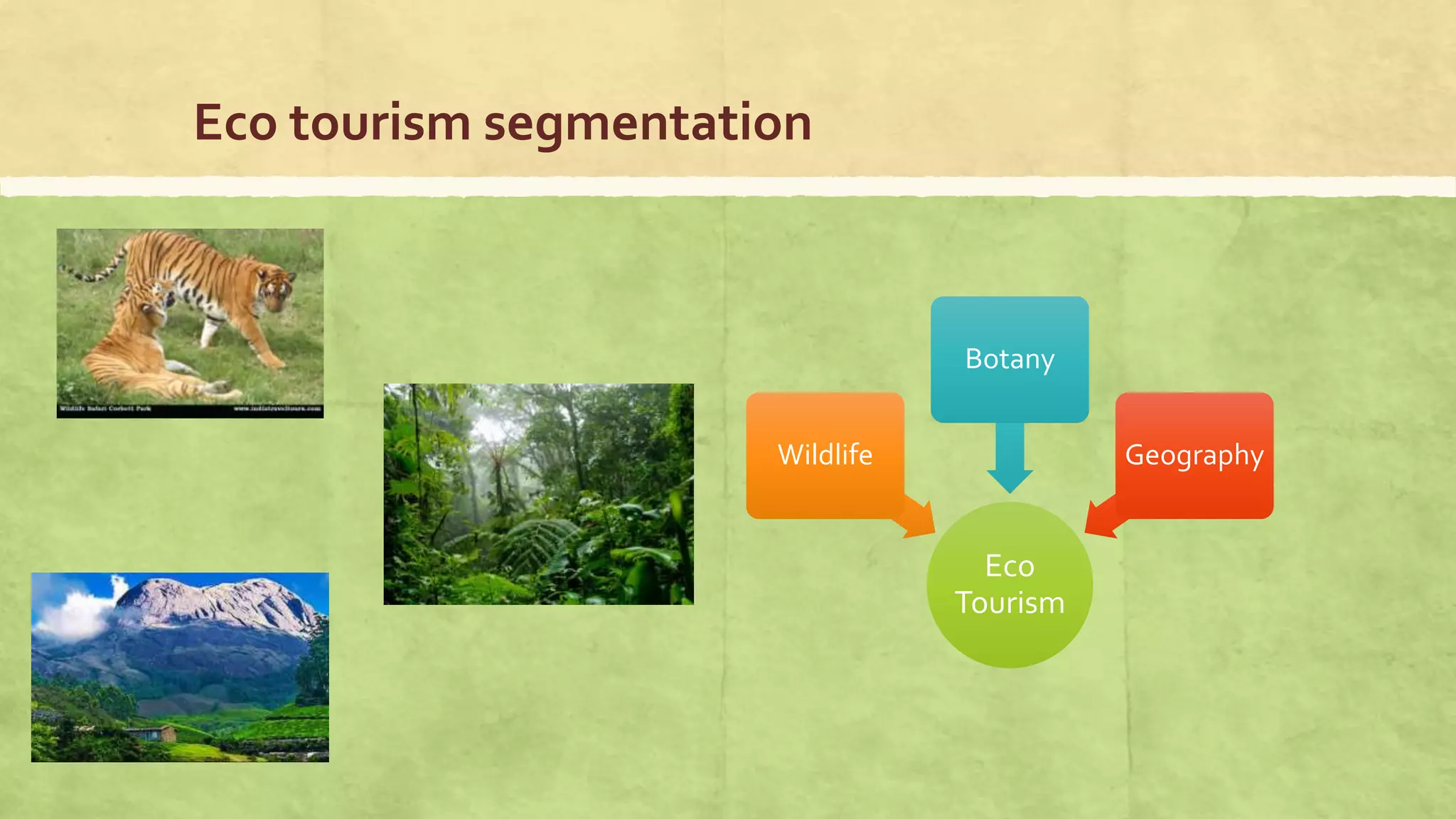
Eco tourism segmentation
Eco
Tourism
Wildlife
Botany
Geography
Eco tourism segmentation
Wildlife
▪ The exotic range of flora and fauna in India is the reason behind the successful growth
ofWildlife tourism in the country.
▪ There are about 400 plus wildlife sanctuaries and 99 national parks sprawling across
the country.These natural homes accommodate an estimate of over 350 species of
mammals, 2100 types of birds, 350 varieties of reptiles and countless insects.
Botany
▪ A botanical garden consists of plants, especially ferns, conifers and flowering plants.
▪ Plants are grown and displayed for the purposes of research and education.
▪ It also includes the observation of various forests. Huge mass of travellers come to
India for such studies.
Geography
• A great arc of mountains, consisting of the Himalayas, Hindu Kush,Aravali and Patkai
ranges define the northern Indian subcontinent.
• TheThar Desert is the world's seventh largest desert, It forms a significant portion of
western India.
Geography
• The Central Highlands consists of three main plateaus — the Malwa Plateau in the
west, the Deccan Plateau in the south and the Chota Nagpur Plateau in the east.
• The Eastern Coastal Plain is a wide stretch of land lying between the Eastern Ghats
and the Bay of Bengal. It stretches fromTamil Nadu in the south toWest Bengal in the
east.
Geography
• India's wetland ecosystem is widely distributed from the cold and arid located in the
Ladakh region of Jammu and Kashmir, and those with the wet and humid climate of
peninsular India. Most of the wetlands are directly or indirectly linked to river
networks.
Geography
• All major rivers of India originate from one of the three main watersheds
1. The Himalaya and the Karakoram ranges
2. Vindhya and Satpura range in central India
3. Sahyadri orWestern Ghats in western India
Some statistics
▪ 8.8% annual growth in tourism demand
▪ 7.9% growth per annum in tourism-related GDP
▪ 10.5% annual growth in overseas visitors
▪ 7.5% increase per annum in capital Investment in tourism
▪ 5.1% annual growth in government expenditure on tourism
▪ India will be hosting 8.90 million tourists by 2020...
▪ Stats suggest that each year the revenue grow by 7.7%.
▪ UNWTO – estimating that ecotourism accounts for 10-15% of global tourism.
InternationalTouristVisits
0
5
10
15
20
25
%percentage share of ForeignTouristVisits
Few Eco Places
▪ Location: Stretches from Jammu & Kashmir to Arunachal Pradesh in the northeast
India.
▪ Weather: From freezing cold to desert hot.
▪ Indian States Covered: Jammu & Kashmir, Himachal Pradesh, Uttranchal, West
Bengal, Sikkim, Assam, Arunachal Pradesh.
Himalayas
Corbett National Park, Uttaranchal
The Great Himalayan National Park, Himachal Pradesh
Coorg or Kodagu
• Location:Western Ghats, Karnataka, Southern India.
• Weather: Coorg experiences moderate climate with
pleasant winters, warm summers and heavy
monsoon.
• Known asThe Scotland of India . Its rich flora
and fauna has earned this place international
recognition.
Nagarhole National Park
Iruppu Falls Abby Falls
Durbare elephant camp
Indian Ecosystems and Resources
▪ Biosphere Reserves
▪ Mangroves
▪ Coral Reefs
▪ Deserts
▪ Mountains and Forests
▪ Flora and Fauna
▪ Seas, Lakes and Rivers
▪ Caves
Biosphere Reserves
▪ Nanda Devi National Park , Uttarakhand.
Gulf of Mannar Marine National Park
,Tamil Nadu
Sundarbans National Park ,West Bengal
Mangroves
Bhitarkanika and Mahanadi Delta ,Orissa
Coringa, Godavari Delta ,Andhra Pradesh
Pichavaram and Point Calimere
Tamil Nadu
The key players in the ecotourism
▪ The key players in the ecotourism business are governments at levels, the local
authorities, the developers and the operators, the visitors, and the local community.
▪ non-governmental organizations and scientific and research institutions also plays a
key role in the development of ecotourism.
▪ Some organizations are Asia Pacific Ecotourism Society, Discovery Mice, World
Tourism Organization,The International Ecotourism Society (TIES), Ecoindia etc.
Activities
▪ Bird watching
▪ Hiking
▪ Downhill skiing
▪ Camping
▪ Sight seeing
▪ Swimming in natural water
▪ Wildlife photography
▪ White river rafting
Strength
promotes conservation of
natural assets and enhances
the cultural integrity
directs economic and other
benefits to the local people
promotes the preservation
of wildlife and the natural
habitats
Providing positive attitude
and experience among the
travellers
Strength
Weakness
local community is not involving into
this tourism process
conflicts between resource use for
eco-tourism and the livelihood of local
inhabitants
type and scale of eco-tourism
development is not compatible with
the environment
It is not planned as a part of the overall
area development strategy, guided by
an integrated land-use plan avoiding
inter-sectoral conflicts
Weakness
Opportunity
Government has recently announced
to built ecotourism centres
Rising number of tourist arrival in
India is indicator for growing eco
tourism.
sustainable tourism development as
a model for other destination
development programs it can
generate more tourists.
Promoting o wildlife sanctuaries and
National Parks on the global level we
can attract more and more
travellers.
Opportunity
Threat
It tends to conserve the environment
at the expanse of the development
prospects for the third world
communities
Competition for eco tourism income
between the various groups leads to
social disharmony
Increased use of resources by the
human population, even in the
smallest sense cause problem to the
environment
eco tourism projects itself are the
biggest obstacle in the way of the
preservation of the environment.
Threat
care@roomnhouse.com
+91- 9022543210

Ecotourism in India

  • 1.
  • 2.
    Introduction ▪ Tourism involvingtravel to areas of natural or ecological interest, for the purpose of observing wildlife and learning about the environment. ▪ This is a conscientious form of tourism and tourism development ▪ It encourages going back to natural products in every aspect of life and helps preserve nature. It is also the key to sustainable ecological development.
  • 3.
    Principle of ecotourism ▪ Adopt low-impact wildlife tourism that protects ecological integrity of forest. ▪ Highlight the biodiversity richness, their values and their ecological services to people. ▪ Build environmental and cultural awareness and respect. ▪ Facilitate the sustainability of ecotourism enterprises and activities. ▪ provide livelihood opportunities to local communities. ▪ Highlight the heritage value of India’s wilderness and protected areas.
  • 4.
  • 5.
    Eco tourism segmentation Wildlife ▪The exotic range of flora and fauna in India is the reason behind the successful growth ofWildlife tourism in the country. ▪ There are about 400 plus wildlife sanctuaries and 99 national parks sprawling across the country.These natural homes accommodate an estimate of over 350 species of mammals, 2100 types of birds, 350 varieties of reptiles and countless insects.
  • 6.
    Botany ▪ A botanicalgarden consists of plants, especially ferns, conifers and flowering plants. ▪ Plants are grown and displayed for the purposes of research and education. ▪ It also includes the observation of various forests. Huge mass of travellers come to India for such studies.
  • 7.
    Geography • A greatarc of mountains, consisting of the Himalayas, Hindu Kush,Aravali and Patkai ranges define the northern Indian subcontinent. • TheThar Desert is the world's seventh largest desert, It forms a significant portion of western India.
  • 8.
    Geography • The CentralHighlands consists of three main plateaus — the Malwa Plateau in the west, the Deccan Plateau in the south and the Chota Nagpur Plateau in the east. • The Eastern Coastal Plain is a wide stretch of land lying between the Eastern Ghats and the Bay of Bengal. It stretches fromTamil Nadu in the south toWest Bengal in the east.
  • 9.
    Geography • India's wetlandecosystem is widely distributed from the cold and arid located in the Ladakh region of Jammu and Kashmir, and those with the wet and humid climate of peninsular India. Most of the wetlands are directly or indirectly linked to river networks.
  • 10.
    Geography • All majorrivers of India originate from one of the three main watersheds 1. The Himalaya and the Karakoram ranges 2. Vindhya and Satpura range in central India 3. Sahyadri orWestern Ghats in western India
  • 11.
    Some statistics ▪ 8.8%annual growth in tourism demand ▪ 7.9% growth per annum in tourism-related GDP ▪ 10.5% annual growth in overseas visitors ▪ 7.5% increase per annum in capital Investment in tourism ▪ 5.1% annual growth in government expenditure on tourism ▪ India will be hosting 8.90 million tourists by 2020... ▪ Stats suggest that each year the revenue grow by 7.7%. ▪ UNWTO – estimating that ecotourism accounts for 10-15% of global tourism.
  • 12.
  • 13.
    Few Eco Places ▪Location: Stretches from Jammu & Kashmir to Arunachal Pradesh in the northeast India. ▪ Weather: From freezing cold to desert hot. ▪ Indian States Covered: Jammu & Kashmir, Himachal Pradesh, Uttranchal, West Bengal, Sikkim, Assam, Arunachal Pradesh. Himalayas Corbett National Park, Uttaranchal The Great Himalayan National Park, Himachal Pradesh
  • 14.
    Coorg or Kodagu •Location:Western Ghats, Karnataka, Southern India. • Weather: Coorg experiences moderate climate with pleasant winters, warm summers and heavy monsoon. • Known asThe Scotland of India . Its rich flora and fauna has earned this place international recognition. Nagarhole National Park Iruppu Falls Abby Falls Durbare elephant camp
  • 15.
    Indian Ecosystems andResources ▪ Biosphere Reserves ▪ Mangroves ▪ Coral Reefs ▪ Deserts ▪ Mountains and Forests ▪ Flora and Fauna ▪ Seas, Lakes and Rivers ▪ Caves
  • 16.
    Biosphere Reserves ▪ NandaDevi National Park , Uttarakhand. Gulf of Mannar Marine National Park ,Tamil Nadu Sundarbans National Park ,West Bengal
  • 17.
    Mangroves Bhitarkanika and MahanadiDelta ,Orissa Coringa, Godavari Delta ,Andhra Pradesh Pichavaram and Point Calimere Tamil Nadu
  • 18.
    The key playersin the ecotourism ▪ The key players in the ecotourism business are governments at levels, the local authorities, the developers and the operators, the visitors, and the local community. ▪ non-governmental organizations and scientific and research institutions also plays a key role in the development of ecotourism. ▪ Some organizations are Asia Pacific Ecotourism Society, Discovery Mice, World Tourism Organization,The International Ecotourism Society (TIES), Ecoindia etc.
  • 19.
    Activities ▪ Bird watching ▪Hiking ▪ Downhill skiing ▪ Camping ▪ Sight seeing ▪ Swimming in natural water ▪ Wildlife photography ▪ White river rafting
  • 20.
    Strength promotes conservation of naturalassets and enhances the cultural integrity directs economic and other benefits to the local people promotes the preservation of wildlife and the natural habitats Providing positive attitude and experience among the travellers Strength
  • 21.
    Weakness local community isnot involving into this tourism process conflicts between resource use for eco-tourism and the livelihood of local inhabitants type and scale of eco-tourism development is not compatible with the environment It is not planned as a part of the overall area development strategy, guided by an integrated land-use plan avoiding inter-sectoral conflicts Weakness
  • 22.
    Opportunity Government has recentlyannounced to built ecotourism centres Rising number of tourist arrival in India is indicator for growing eco tourism. sustainable tourism development as a model for other destination development programs it can generate more tourists. Promoting o wildlife sanctuaries and National Parks on the global level we can attract more and more travellers. Opportunity
  • 23.
    Threat It tends toconserve the environment at the expanse of the development prospects for the third world communities Competition for eco tourism income between the various groups leads to social disharmony Increased use of resources by the human population, even in the smallest sense cause problem to the environment eco tourism projects itself are the biggest obstacle in the way of the preservation of the environment. Threat
  • 24.