Title Page Photo “ The temperature of the air at any time and at any place in the atmosphere is the result of the interaction of a variety of complex factors.”  —  McKnight and Hess, p. 75.
Vocabulary environmental lapse rate  (p. 98) evaporation  (p. 86) global warming  (p. 102) greenhouse effect  (p. 83) greenhouse gases  (p. 83) heat  (p. 76) infrared radiation  (p. 80) insolation  (p. 80) isotherm  (p. 99) kinetic energy  (p. 76) latent heat  (p. 86) longwave radiation  (p. 80) ocean current  (p. 94) radiant energy  (p. 78) radiation (emission)  (p. 80) reflection  (p. 81) scattering  (p. 82) shortwave radiation  (p. 80) specific heat  (p. 92) subtropical gyres  (p. 95) temperature  (p. 76) temperature inversion  (p. 98) terrestrial radiation  (p. 80) thermal energy  (p. 76) thermal infrared radiation  (p. 80) thermometer  (p. 76) transmission  (p. 83) ultraviolet (UV) radiation  (p. 79) upwelling  (p. 96) visible light  (p. 79) absorption  (p. 81) adiabatic cooling  (p. 85) adiabatic warming  (p. 86) advection  (p. 85) albedo  (p. 87) angle of incidence  (p. 89) average annual temperature range (p. 102) average lapse rate  (p. 98) condensation  (p. 86) conduction  (p. 84) convection  (p. 85) convection cell  (p. 85) electromagnetic radiation  (p. 78) electromagnetic spectrum  (p. 79) energy  (p. 75)
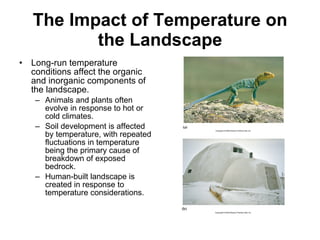
The Impact of Temperature on the Landscape Long-run temperature conditions affect the organic and inorganic components of the landscape. Animals and plants often evolve in response to hot or cold climates. Soil development is affected by temperature, with repeated fluctuations in temperature being the primary cause of breakdown of exposed bedrock. Human-built landscape is created in response to temperature considerations.
Energy, Heat, and Temperature Energy — the capacity to do work and can take on various forms, or anything that changes the state or condition of matter. Forms of energy include kinetic energy, chemical energy, and radiant energy.  Energy occurs at the micro scale, causing the motion of atoms and molecules. Molecules in all substances possess kinetic energy—the energy of movement. The greater amount of energy added to a substance, the greater the kinetic energy.
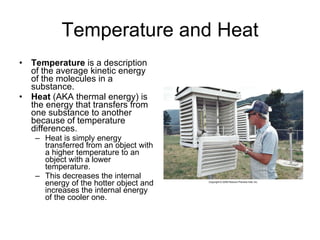
Temperature and Heat Temperature  is a description of the average kinetic energy of the molecules in a substance.  Heat  (AKA thermal energy) is the energy that transfers from one substance to another because of temperature differences. Heat is simply energy transferred from an object with a higher temperature to an object with a lower temperature. This decreases the internal energy of the hotter object and increases the internal energy of the cooler one.
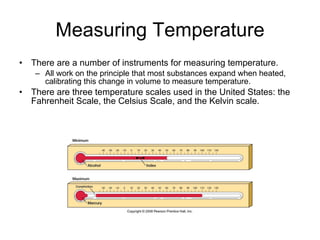
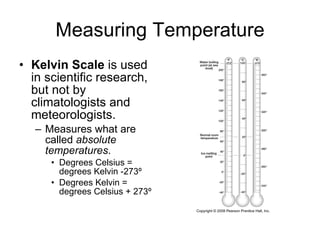
Measuring Temperature There are a number of instruments for measuring temperature.  All work on the principle that most substances expand when heated, calibrating this change in volume to measure temperature. There are three temperature scales used in the United States: the Fahrenheit Scale, the Celsius Scale, and the Kelvin scale.
Measuring Temperature Fahrenheit Scale  is used by public weather reports from the National Weather Service and the news media; few other countries than United States use it. Celsius Scale  is used either exclusively or predominately in most countries other than United States, which uses it for scientific work. It is slowly being established to supersede the Fahrenheit scale. Celsius to Fahrenheit: degrees Fahrenheit = (degrees Celsius X 1.8) + 32º Fahrenheit to Celsius: degrees Celsius = (degrees Fahrenheit – 32º) /1.8
Measuring Temperature Kelvin Scale  is used in scientific research, but not by climatologists and meteorologists. Measures what are called  absolute temperatures .  Degrees Celsius = degrees Kelvin -273º Degrees Kelvin = degrees Celsius + 273º
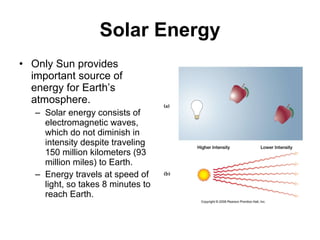
Solar Energy Only Sun provides important source of energy for Earth’s atmosphere. Solar energy consists of electromagnetic waves, which do not diminish in intensity despite traveling 150 million kilometers (93 million miles) to Earth.  Energy travels at speed of light, so takes 8 minutes to reach Earth.
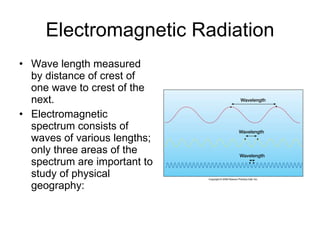
Electromagnetic Radiation Wave length measured by distance of crest of one wave to crest of the next. Electromagnetic spectrum consists of waves of various lengths; only three areas of the spectrum are important to study of physical geography:
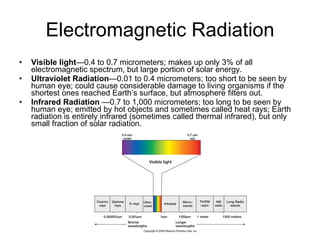
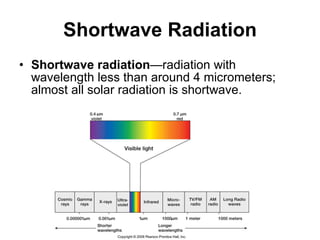
Electromagnetic Radiation Visible light —0.4 to 0.7 micrometers; makes up only 3% of all electromagnetic spectrum, but large portion of solar energy. Ultraviolet Radiation —0.01 to 0.4 micrometers; too short to be seen by human eye; could cause considerable damage to living organisms if the shortest ones reached Earth’s surface, but atmosphere filters out. Infrared Radiation  —0.7 to 1,000 micrometers; too long to be seen by human eye; emitted by hot objects and sometimes called heat rays; Earth radiation is entirely infrared (sometimes called thermal infrared), but only small fraction of solar radiation.
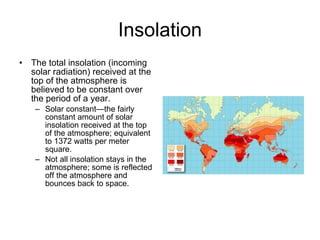
Insolation The total insolation (incoming solar radiation) received at the top of the atmosphere is believed to be constant over the period of a year. Solar constant—the fairly constant amount of solar insolation received at the top of the atmosphere; equivalent to 1372 watts per meter square. Not all insolation stays in the atmosphere; some is reflected off the atmosphere and bounces back to space.
Basic Heating and Cooling Processes in the Atmosphere To understand how energy travels from the Sun to Earth, it’s best to examine how heat energy moves.  Heat energy moves from one place to another in three ways: Radiation Conduction Convection
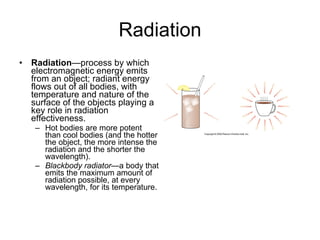
Radiation Radiation —process by which electromagnetic energy emits from an object; radiant energy flows out of all bodies, with temperature and nature of the surface of the objects playing a key role in radiation effectiveness. Hot bodies are more potent than cool bodies (and the hotter the object, the more intense the radiation and the shorter the wavelength). Blackbody radiator —a body that emits the maximum amount of radiation possible, at every wavelength, for its temperature.
Absorption Absorption —the ability of an object to assimilate energy from the electromagnetic waves that strike it.  Different objects vary in their capabilities to absorb radiant energy (and thus increase in temperature). Color plays a key role in an object’s absorption ability; dark-colored surfaces more efficiently absorb the visible portion of the electromagnetic spectrum than light-colored surfaces.
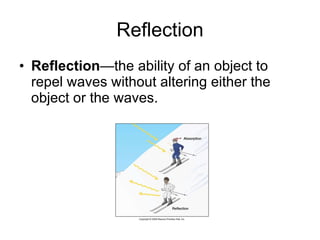
Reflection Reflection —the ability of an object to repel waves without altering either the object or the waves.
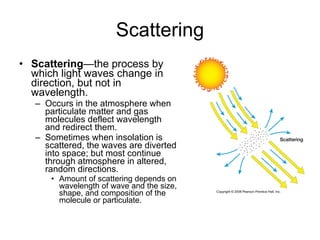
Scattering Scattering —the process by which light waves change in direction, but not in wavelength.  Occurs in the atmosphere when particulate matter and gas molecules deflect wavelength and redirect them.  Sometimes when insolation is scattered, the waves are diverted into space; but most continue through atmosphere in altered, random directions. Amount of scattering depends on wavelength of wave and the size, shape, and composition of the molecule or particulate.
Scattering Why is the sky blue?  Rayleigh scattering causes shorter wavelengths of visible light to be scattered.  Violets and blues in the visible part of the spectrum are shorter in wavelength than the oranges and reds.  Shorter waves like violets and blues are more readily scattered by the gases in the atmosphere, so they are more likely to be redirected. And the sun appears reddish at sunrise and sunset because the path of light through atmosphere is longer, so most of the blue light is scattered out before the light waves reach Earth’s surface.
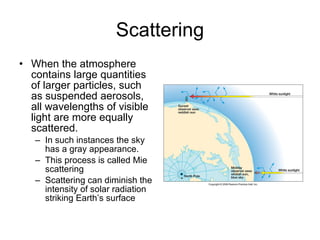
Scattering When the atmosphere contains large quantities of larger particles, such as suspended aerosols, all wavelengths of visible light are more equally scattered. In such instances the sky has a gray appearance. This process is called Mie scattering Scattering can diminish the intensity of solar radiation striking Earth’s surface
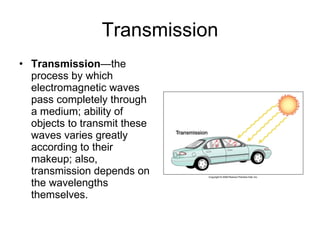
Transmission Transmission —the process by which electromagnetic waves pass completely through a medium; ability of objects to transmit these waves varies greatly according to their makeup; also, transmission depends on the wavelengths themselves.
Shortwave Radiation Shortwave radiation —radiation with wavelength less than around 4 micrometers; almost all solar radiation is shortwave.
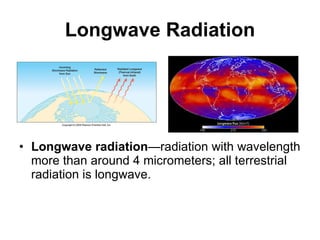
Longwave Radiation Longwave radiation —radiation with wavelength more than around 4 micrometers; all terrestrial radiation is longwave.
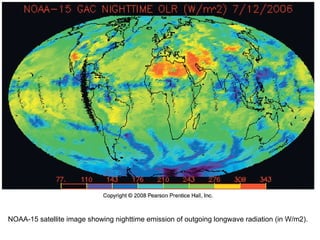
04_18FB-C.jpg NOAA-15 satellite image showing nighttime emission of outgoing longwave radiation (in W/m2).
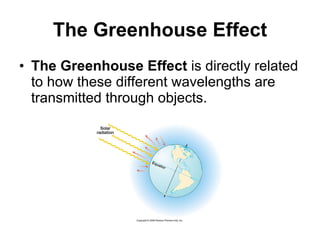
The Greenhouse Effect The Greenhouse Effect  is directly related to how these different wavelengths are transmitted through objects.
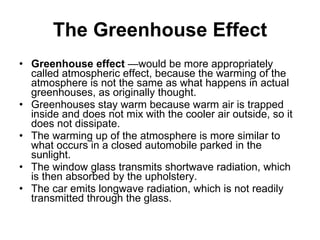
The Greenhouse Effect Greenhouse effect  —would be more appropriately called atmospheric effect, because the warming of the atmosphere is not the same as what happens in actual greenhouses, as originally thought.  Greenhouses stay warm because warm air is trapped inside and does not mix with the cooler air outside, so it does not dissipate.  The warming up of the atmosphere is more similar to what occurs in a closed automobile parked in the sunlight.  The window glass transmits shortwave radiation, which is then absorbed by the upholstery.  The car emits longwave radiation, which is not readily transmitted through the glass.
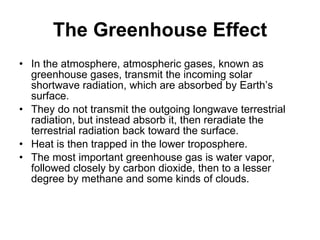
The Greenhouse Effect In the atmosphere, atmospheric gases, known as greenhouse gases, transmit the incoming solar shortwave radiation, which are absorbed by Earth’s surface.  They do not transmit the outgoing longwave terrestrial radiation, but instead absorb it, then reradiate the terrestrial radiation back toward the surface.  Heat is then trapped in the lower troposphere. The most important greenhouse gas is water vapor, followed closely by carbon dioxide, then to a lesser degree by methane and some kinds of clouds.
The Greenhouse Effect Without the greenhouse effect the average temperature of Earth would be -15ºC as compared to its present average of 15ºC. Although the greenhouse effect is necessary for life on Earth, there has been a significant increase in greenhouse gas concentration, especially carbon dioxide, in Earth’s atmosphere. This increase is associated with human activity, such as the burning of fossil fuels. This increase has been accompanied by a slight, yet measurable increase in global temperature.
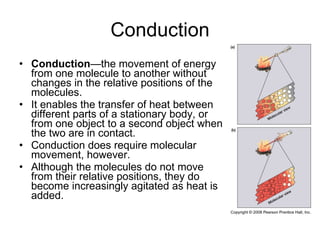
Conduction Conduction —the movement of energy from one molecule to another without changes in the relative positions of the molecules.  It enables the transfer of heat between different parts of a stationary body, or from one object to a second object when the two are in contact.  Conduction does require molecular movement, however.  Although the molecules do not move from their relative positions, they do become increasingly agitated as heat is added.
Conduction An agitated molecule will move and collide against a cooler, calmer molecule, and through this collision transfer the heat energy.  Thus, heat energy is passed from one place to another, without the molecules actually moving from one place to another, just vibrating back and forth from agitation.  (Thus, it’s the opposite of convection.) Conduction ability varies with the makeup of the objects; metals are excellent conductors in comparison to earthy materials like ceramics.
Conduction Why does Earth’s land surface warm up during day? Earth’s land surface is a good absorber, but it is not a good conductor.  Thus, although some of the warmth that the land surface absorbs is transferred deeper underground most stays on the surface and is transferred back to the atmosphere.  Air, however, is a poor conductor too, so only the air layer touching the ground is heated very much (unless wind circulates the heat).
Conduction Why do you stay warmer on a dry day?  Moist air is a slightly more efficient conductor than dry air.  The moist air will conduct heat away from you, while dry air will let it stay in closer contact.
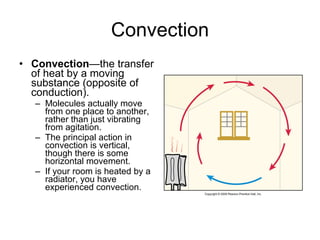
Convection Convection —the transfer of heat by a moving substance (opposite of conduction).  Molecules actually move from one place to another, rather than just vibrating from agitation.  The principal action in convection is vertical, though there is some horizontal movement.  If your room is heated by a radiator, you have experienced convection.
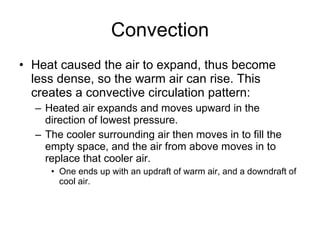
Convection Heat caused the air to expand, thus become less dense, so the warm air can rise. This creates a convective circulation pattern:  Heated air expands and moves upward in the direction of lowest pressure.  The cooler surrounding air then moves in to fill the empty space, and the air from above moves in to replace that cooler air.  One ends up with an updraft of warm air, and a downdraft of cool air.
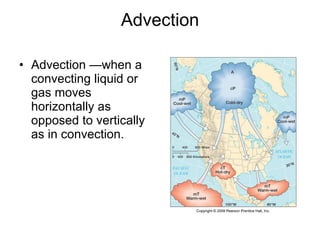
Advection Advection —when a convecting liquid or gas moves horizontally as opposed to vertically as in convection.
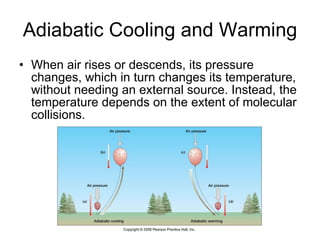
Adiabatic Cooling and Warming When air rises or descends, its pressure changes, which in turn changes its temperature, without needing an external source. Instead, the temperature depends on the extent of molecular collisions.
Expansion: Adiabatic Cooling Expansion: Adiabatic cooling —cooling by expansion in rising air; rising air expands because there is less air above it, so less pressure exerted on it.  The molecules spread over a greater volume of space, which requires more energy. So the molecules slow down and don’t collide as much.
Compression: Adiabatic Warming Compression: Adiabatic warming —warming by contraction in descending air; descending air contracts because there is more pressure being exerted on it, thus compressing the molecules in the air and making them collide more frequently.
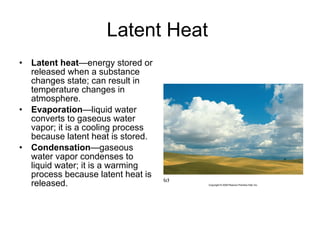
Latent Heat  Latent heat —energy stored or released when a substance changes state; can result in temperature changes in atmosphere. Evaporation —liquid water converts to gaseous water vapor; it is a cooling process because latent heat is stored. Condensation —gaseous water vapor condenses to liquid water; it is a warming process because latent heat is released.
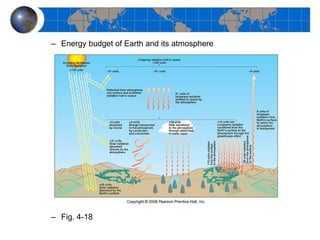
Energy budget of Earth and its atmosphere Fig. 4-18
The Heating of the Atmosphere Why doesn’t Earth get progressively warmer or cooler? Because in the long run there is an apparent balance between the total amount of insolation received by Earth and the total amount of terrestrial radiation returned to space.
The Heating of the Atmosphere However, a closer look shows that the atmosphere experiences a net gain of 14 units every year in terms of its annual balance, which is the result of longwave radiation being trapped in the atmosphere by greenhouse gases.  Without it, Earth would not store the heat necessary for life.
The Heating of the Atmosphere Outgoing energy from Earth also depends on transport of latent heat from process of evaporation. There is more water than land, so more than three-fourths of sunshine hits water, which evaporates moisture from bodies of water.  Ultimately, atmospheric heating is a complicated sequence that has many ramifications: Atmosphere is heated mostly from below than from above; There is an environment of almost constant convective activity and vertical mixing.
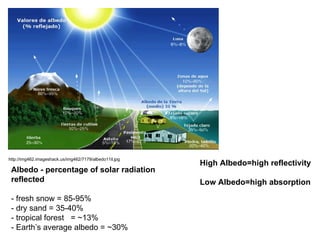
Albedo Albedo —ability of an object to reflect radiation; in case of Earth, it relates to the amount of solar radiation or insolation that Earth scatters, or reflects back, into space.
http://img462.imageshack.us/img462/7179/albedo11il.jpg Albedo - percentage of solar radiation reflected   - fresh snow = 85-95% - dry sand = 35-40% - tropical forest  = ~13% - Earth’s average albedo = ~30% High Albedo=high reflectivity Low Albedo=high absorption
Variations in Heating by Latitude and Season Earth does not evenly distribute heat through time and space; instead, there are variations in its radiation budget that relate to latitudinal and seasonal variations in how much energy is received by Earth.  These imbalances are among the fundamental causes of weather and climate variations, as they cause unequal heating of Earth and its atmosphere.
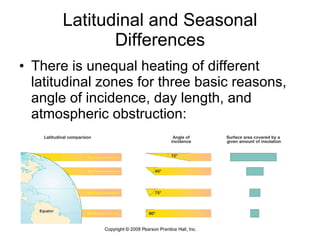
Latitudinal and Seasonal Differences There is unequal heating of different latitudinal zones for three basic reasons, angle of incidence, day length, and atmospheric obstruction:
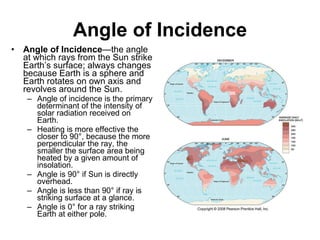
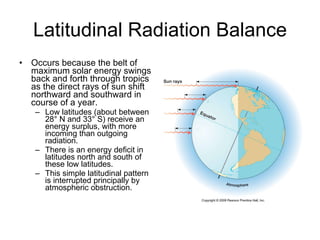
Angle of Incidence Angle of Incidence —the angle at which rays from the Sun strike Earth’s surface; always changes because Earth is a sphere and Earth rotates on own axis and revolves around the Sun. Angle of incidence is the primary determinant of the intensity of solar radiation received on Earth. Heating is more effective the closer to 90°, because the more perpendicular the ray, the smaller the surface area being heated by a given amount of insolation. Angle is 90° if Sun is directly overhead. Angle is less than 90° if ray is striking surface at a glance. Angle is 0° for a ray striking Earth at either pole.
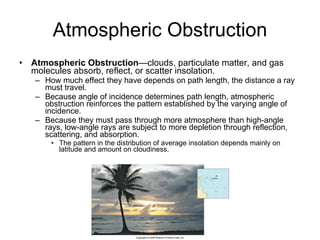
Atmospheric Obstruction Atmospheric Obstruction —clouds, particulate matter, and gas molecules absorb, reflect, or scatter insolation. How much effect they have depends on path length, the distance a ray must travel.  Because angle of incidence determines path length, atmospheric obstruction reinforces the pattern established by the varying angle of incidence. Because they must pass through more atmosphere than high-angle rays, low-angle rays are subject to more depletion through reflection, scattering, and absorption. The pattern in the distribution of average insolation depends mainly on latitude and amount on cloudiness.
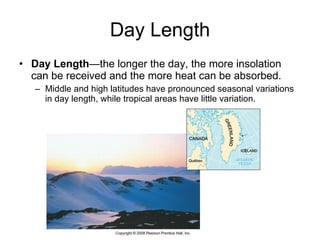
Day Length Day Length —the longer the day, the more insolation can be received and the more heat can be absorbed.  Middle and high latitudes have pronounced seasonal variations in day length, while tropical areas have little variation.
Latitudinal Radiation Balance Occurs because the belt of maximum solar energy swings back and forth through tropics as the direct rays of sun shift northward and southward in course of a year.  Low latitudes (about between 28° N and 33° S) receive an energy surplus, with more incoming than outgoing radiation.  There is an energy deficit in latitudes north and south of these low latitudes. This simple latitudinal pattern is interrupted principally by atmospheric obstruction.
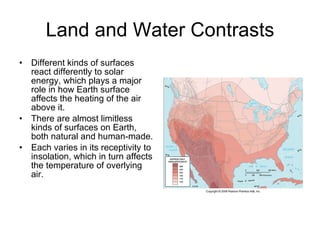
Land and Water Contrasts Different kinds of surfaces react differently to solar energy, which plays a major role in how Earth surface affects the heating of the air above it. There are almost limitless kinds of surfaces on Earth, both natural and human-made.  Each varies in its receptivity to insolation, which in turn affects the temperature of overlying air.
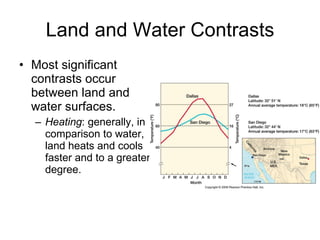
Land and Water Contrasts Most significant contrasts occur between land and water surfaces. Heating : generally, in comparison to water, land heats and cools faster and to a greater degree.
Land and Water Contrasts There are four main reasons why water and land are different: Specific Heat—the amount of energy it takes to raise the temperature of 1 gram of a substance by 1°C. Water’s specific heat is about five times as great as that of land, so it takes about five more times the energy to raise its temperature. Transmission—water is a better transmitter than land (because it’s transparent, while land is opaque). Heat diffuses over a much greater volume (and deeper) in water and reaches considerably lower maximum temperatures than on land. Mobility—water’s mobility disperses heat both broadly and deeply; on land, heat can be dispersed only by conduction, and land is a very poor conductor. Evaporative Cooling—water has more moisture, so more potential for evaporation and losing heat; cooling effect of evaporation slows down any heat buildup on water surface.
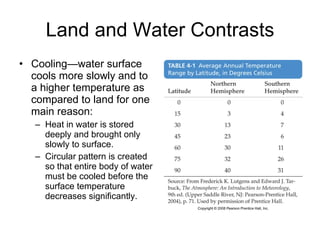
Land and Water Contrasts Cooling—water surface cools more slowly and to a higher temperature as compared to land for one main reason: Heat in water is stored deeply and brought only slowly to surface. Circular pattern is created so that entire body of water must be cooled before the surface temperature decreases significantly.
Land and Water Contrasts Implications—oceans create more moderate climates for maritime areas, so that interiors of continents hold the hottest and coldest places on Earth. Distinction between continental and maritime climates is the most important geographic relationship in study of atmosphere. Oceans provide a sort of global thermostatically controlled heat source, moderating temperature extremes.  Northern Hemisphere has greater extremes in average annual temperature range because it is the land hemisphere—39% of its area is land surface.  Southern Hemisphere is water hemisphere—only 19% of its area is land.
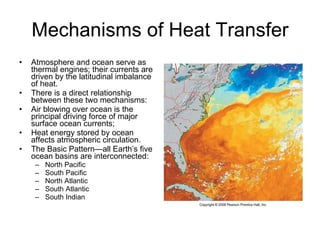
Mechanisms of Heat Transfer The tropics would become progressively warmer (and less habitable) until the amount of heat energy absorbed equaled the amount radiated from Earth’s surface if not for two specific mechanisms moving heat poleward in both hemispheres: Atmospheric circulation —most important mechanism, accomplishing 75 to 80 percent of all horizontal heat transfer. Oceanic circulation —ocean currents reflect average wind conditions over a period of several years. Ocean currents—various kinds of oceanic water movements.
Mechanisms of Heat Transfer Atmosphere and ocean serve as thermal engines; their currents are driven by the latitudinal imbalance of heat.  There is a direct relationship between these two mechanisms: Air blowing over ocean is the principal driving force of major surface ocean currents; Heat energy stored by ocean affects atmospheric circulation. The Basic Pattern—all Earth’s five ocean basins are interconnected: North Pacific South Pacific North Atlantic South Atlantic South Indian
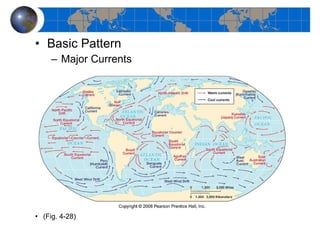
(Fig. 4-28) Basic Pattern Major Currents
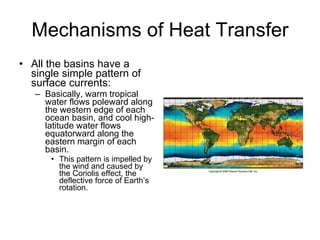
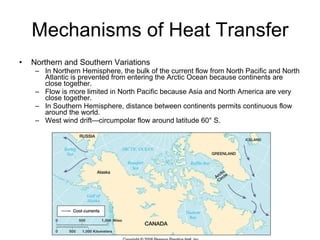
Mechanisms of Heat Transfer All the basins have a single simple pattern of surface currents:  Basically, warm tropical water flows poleward along the western edge of each ocean basin, and cool high-latitude water flows equatorward along the eastern margin of each basin. This pattern is impelled by the wind and caused by the Coriolis effect, the deflective force of Earth’s rotation.
Mechanisms of Heat Transfer Northern and Southern Variations In Northern Hemisphere, the bulk of the current flow from North Pacific and North Atlantic is prevented from entering the Arctic Ocean because continents are close together.  Flow is more limited in North Pacific because Asia and North America are very close together. In Southern Hemisphere, distance between continents permits continuous flow around the world.  West wind drift—circumpolar flow around latitude 60° S.
Current Temperatures Low-latitude currents (Equatorial Current, Equatorial Countercurrent) have warm water. Poleward-moving currents on the western sides of ocean basins carry warm water toward higher latitudes. Northern components of the Northern Hemisphere gyres carry warm water toward the north and east. Southern components of the Southern Hemisphere gyres (generally combined into the West Wind Drift) are strongly influenced by Antarctic waters and are essentially cool. Equatorward-moving currents on the eastern sides of ocean basins carry cool water toward the equator.
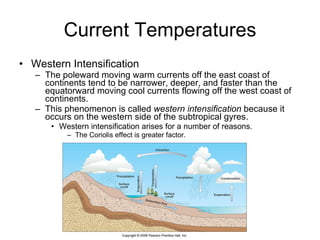
Current Temperatures Western Intensification The poleward moving warm currents off the east coast of continents tend to be narrower, deeper, and faster than the equatorward moving cool currents flowing off the west coast of continents. This phenomenon is called  western intensification  because it occurs on the western side of the subtropical gyres.  Western intensification arises for a number of reasons. The Coriolis effect is greater factor.
Current Temperatures Rounding Out the Pattern The northwestern portions of Northern Hemisphere ocean basins receive an influx of cool water from the Arctic Ocean. Wherever an equatorward-flowing cool current pulls away from a subtropical western coast, a pronounced and persistent upwelling of cold water occurs. There is a deep ocean circulation pattern—sometimes called the  global conveyor belt circulation —that influences global climate in subtle, but nonetheless important ways.
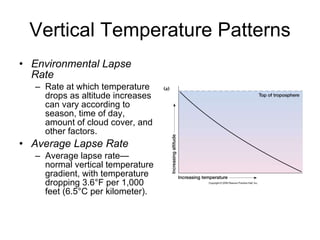
Vertical Temperature Patterns Environmental Lapse Rate Rate at which temperature drops as altitude increases can vary according to season, time of day, amount of cloud cover, and other factors. Average Lapse Rate Average lapse rate—normal vertical temperature gradient, with temperature dropping 3.6°F per 1,000 feet (6.5°C per kilometer).
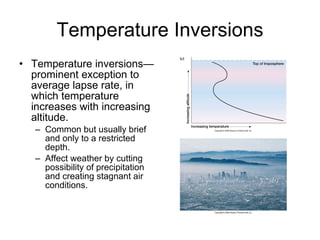
Temperature Inversions Temperature inversions—prominent exception to average lapse rate, in which temperature increases with increasing altitude.  Common but usually brief and only to a restricted depth. Affect weather by cutting possibility of precipitation and creating stagnant air conditions.
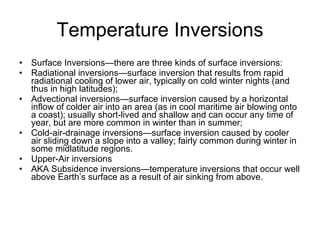
Temperature Inversions Surface Inversions—there are three kinds of surface inversions: Radiational inversions—surface inversion that results from rapid radiational cooling of lower air, typically on cold winter nights (and thus in high latitudes); Advectional inversions—surface inversion caused by a horizontal inflow of colder air into an area (as in cool maritime air blowing onto a coast); usually short-lived and shallow and can occur any time of year, but are more common in winter than in summer; Cold-air-drainage inversions—surface inversion caused by cooler air sliding down a slope into a valley; fairly common during winter in some midlatitude regions. Upper-Air inversions AKA Subsidence inversions—temperature inversions that occur well above Earth’s surface as a result of air sinking from above.
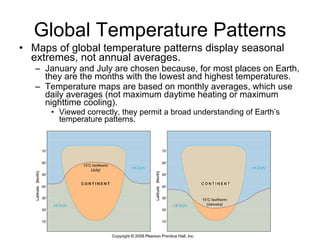
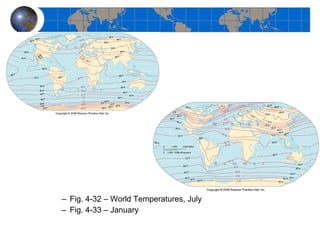
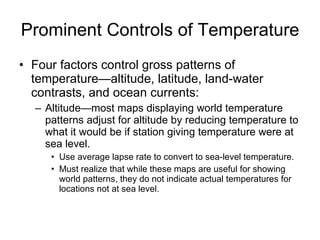
Global Temperature Patterns Maps of global temperature patterns display seasonal extremes, not annual averages. January and July are chosen because, for most places on Earth, they are the months with the lowest and highest temperatures. Temperature maps are based on monthly averages, which use daily averages (not maximum daytime heating or maximum nighttime cooling). Viewed correctly, they permit a broad understanding of Earth’s temperature patterns.
Fig. 4-32 – World Temperatures, July Fig. 4-33 – January
Prominent Controls of Temperature Four factors control gross patterns of temperature—altitude, latitude, land-water contrasts, and ocean currents: Altitude—most maps displaying world temperature patterns adjust for altitude by reducing temperature to what it would be if station giving temperature were at sea level. Use average lapse rate to convert to sea-level temperature. Must realize that while these maps are useful for showing world patterns, they do not indicate actual temperatures for locations not at sea level.
Prominent Controls of Temperature Latitude—if Earth had uniform surface and did not rotate, the isotherms would probably coincide with parallels (with temperature progressively decreasing poleward from equator). Latitude is the primary governor of insolation, the fundamental cause of temperature variation over world.
Prominent Controls of Temperature Land–water contrasts—continents have higher summer temperatures than do oceans. Likewise, continents have lower winter temperatures than do oceans. Ocean currents—because of land–water heating contrasts, cool currents deflect isotherms equatorward, whereas warm currents deflect them poleward. Map shows how isotherms have a general east–west trend, in conjunction with the influence of latitude, which shows that temperatures tend to correspond with latitude, with warmer temperatures toward the equator and cooler temperatures toward the poles.
Seasonal Patterns Between summer and winter, there is a latitudinal shift of isotherms, with them moving northward from January to July and returning southward from July to January.  This latitudinal shift is much more pronounced in high latitudes than in low, and much more pronounced over continents than over oceans. Temperature gradient, or the rate of temperature with horizontal distance, is steeper in winter than in summer, and steeper over continents than over oceans. Coldest places on Earth: landmasses in higher latitudes. In July, in Antarctica;
Seasonal Patterns In January, in Subarctic portions of Siberia, Canada, and Greenland. Hottest places on Earth: subtropical latitudes, where clear skies do not give the protection that clouds give in the tropics.  In July, in northern Africa and southwestern portions of Asia and North America; In January, subtropical parts of Australia, southern Africa, and South America. Highest average annual temperatures: in equatorial regions, because they do not have winter cooling.
Annual Temperature Range Maps showing average annual temperature range, which is the difference between the average temperatures of the warmest and coldest months.  Interiors of high-latitude continents and continental areas in general have much greater ranges than do equivalent oceanic latitudes. Tropics have only slight average temperature fluctuations.
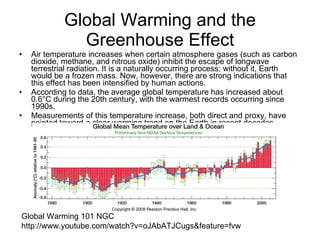
Global Warming and the Greenhouse Effect Air temperature increases when certain atmosphere gases (such as carbon dioxide, methane, and nitrous oxide) inhibit the escape of longwave terrestrial radiation. It is a naturally occurring process; without it, Earth would be a frozen mass. Now, however, there are strong indications that this effect has been intensified by human actions. According to data, the average global temperature has increased about 0.6°C during the 20th century, with the warmest records occurring since 1990s.  Measurements of this temperature increase, both direct and proxy, have pointed toward a clear warming trend on the Earth in recent decades.  Global Warming 101 NGC http://www.youtube.com/watch?v=oJAbATJCugs&feature=fvw
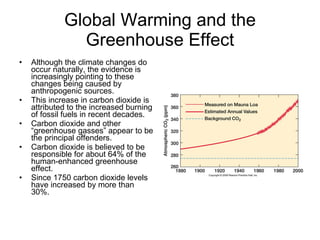
Global Warming and the Greenhouse Effect Although the climate changes do occur naturally, the evidence is increasingly pointing to these changes being caused by anthropogenic sources. This increase in carbon dioxide is attributed to the increased burning of fossil fuels in recent decades. Carbon dioxide and other “greenhouse gasses” appear to be the principal offenders. Carbon dioxide is believed to be responsible for about 64% of the human-enhanced greenhouse effect. Since 1750 carbon dioxide levels have increased by more than 30%.
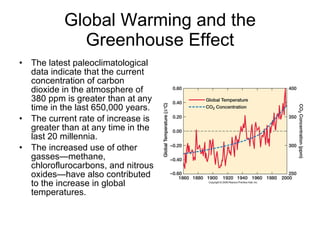
Global Warming and the Greenhouse Effect The latest paleoclimatological data indicate that the current concentration of carbon dioxide in the atmosphere of 380 ppm is greater than at any time in the last 650,000 years. The current rate of increase is greater than at any time in the last 20 millennia.  The increased use of other gasses—methane, chloroflurocarbons, and nitrous oxides—have also contributed to the increase in global temperatures.
Global Warming and the Greenhouse Effect These increases correlate with the average increase in global temperature.  The warming has not been globally uniform, but rather widespread. Because of the complexity of feedback loops in climate systems, predictions regarding global warming are difficult to formulate.
Global Warming and the Greenhouse Effect Computer modeling shows that if the trend continues, heat and drought would become more prevalent in much of the midlatitudes, and milder temperatures would prevail in the higher latitudes. Arid lands might receive more rainfall. Ice caps would melt and global sea levels would rise. Current living patterns would have to change over much of the world. The International Panes on Climate Change (IPCC) released a report in 2001 discussing climatic changes on both global and local scales and the strong evidence pointing to this change being a result of human activities.
Global Warming and the Greenhouse Effect According to the IPCC report, it is estimated that Earth’s climate system has changed on both a global and regional scale since the pre-industrial era and there is evidence that the warming observed over the past 50 years is a result of human activities.  In early 2004 another IPCC report was released. The findings reinforced the findings of the previous report.  The report can be found at (http://www.ipcc.ch).

Chapter four

  • 1.
    Title Page Photo“ The temperature of the air at any time and at any place in the atmosphere is the result of the interaction of a variety of complex factors.” — McKnight and Hess, p. 75.
  • 2.
    Vocabulary environmental lapserate (p. 98) evaporation (p. 86) global warming (p. 102) greenhouse effect (p. 83) greenhouse gases (p. 83) heat (p. 76) infrared radiation (p. 80) insolation (p. 80) isotherm (p. 99) kinetic energy (p. 76) latent heat (p. 86) longwave radiation (p. 80) ocean current (p. 94) radiant energy (p. 78) radiation (emission) (p. 80) reflection (p. 81) scattering (p. 82) shortwave radiation (p. 80) specific heat (p. 92) subtropical gyres (p. 95) temperature (p. 76) temperature inversion (p. 98) terrestrial radiation (p. 80) thermal energy (p. 76) thermal infrared radiation (p. 80) thermometer (p. 76) transmission (p. 83) ultraviolet (UV) radiation (p. 79) upwelling (p. 96) visible light (p. 79) absorption (p. 81) adiabatic cooling (p. 85) adiabatic warming (p. 86) advection (p. 85) albedo (p. 87) angle of incidence (p. 89) average annual temperature range (p. 102) average lapse rate (p. 98) condensation (p. 86) conduction (p. 84) convection (p. 85) convection cell (p. 85) electromagnetic radiation (p. 78) electromagnetic spectrum (p. 79) energy (p. 75)
  • 3.
    The Impact ofTemperature on the Landscape Long-run temperature conditions affect the organic and inorganic components of the landscape. Animals and plants often evolve in response to hot or cold climates. Soil development is affected by temperature, with repeated fluctuations in temperature being the primary cause of breakdown of exposed bedrock. Human-built landscape is created in response to temperature considerations.
  • 4.
    Energy, Heat, andTemperature Energy — the capacity to do work and can take on various forms, or anything that changes the state or condition of matter. Forms of energy include kinetic energy, chemical energy, and radiant energy. Energy occurs at the micro scale, causing the motion of atoms and molecules. Molecules in all substances possess kinetic energy—the energy of movement. The greater amount of energy added to a substance, the greater the kinetic energy.
  • 5.
    Temperature and HeatTemperature is a description of the average kinetic energy of the molecules in a substance. Heat (AKA thermal energy) is the energy that transfers from one substance to another because of temperature differences. Heat is simply energy transferred from an object with a higher temperature to an object with a lower temperature. This decreases the internal energy of the hotter object and increases the internal energy of the cooler one.
  • 6.
    Measuring Temperature Thereare a number of instruments for measuring temperature. All work on the principle that most substances expand when heated, calibrating this change in volume to measure temperature. There are three temperature scales used in the United States: the Fahrenheit Scale, the Celsius Scale, and the Kelvin scale.
  • 7.
    Measuring Temperature FahrenheitScale is used by public weather reports from the National Weather Service and the news media; few other countries than United States use it. Celsius Scale is used either exclusively or predominately in most countries other than United States, which uses it for scientific work. It is slowly being established to supersede the Fahrenheit scale. Celsius to Fahrenheit: degrees Fahrenheit = (degrees Celsius X 1.8) + 32º Fahrenheit to Celsius: degrees Celsius = (degrees Fahrenheit – 32º) /1.8
  • 8.
    Measuring Temperature KelvinScale is used in scientific research, but not by climatologists and meteorologists. Measures what are called absolute temperatures . Degrees Celsius = degrees Kelvin -273º Degrees Kelvin = degrees Celsius + 273º
  • 9.
    Solar Energy OnlySun provides important source of energy for Earth’s atmosphere. Solar energy consists of electromagnetic waves, which do not diminish in intensity despite traveling 150 million kilometers (93 million miles) to Earth. Energy travels at speed of light, so takes 8 minutes to reach Earth.
  • 10.
    Electromagnetic Radiation Wavelength measured by distance of crest of one wave to crest of the next. Electromagnetic spectrum consists of waves of various lengths; only three areas of the spectrum are important to study of physical geography:
  • 11.
    Electromagnetic Radiation Visiblelight —0.4 to 0.7 micrometers; makes up only 3% of all electromagnetic spectrum, but large portion of solar energy. Ultraviolet Radiation —0.01 to 0.4 micrometers; too short to be seen by human eye; could cause considerable damage to living organisms if the shortest ones reached Earth’s surface, but atmosphere filters out. Infrared Radiation —0.7 to 1,000 micrometers; too long to be seen by human eye; emitted by hot objects and sometimes called heat rays; Earth radiation is entirely infrared (sometimes called thermal infrared), but only small fraction of solar radiation.
  • 12.
    Insolation The totalinsolation (incoming solar radiation) received at the top of the atmosphere is believed to be constant over the period of a year. Solar constant—the fairly constant amount of solar insolation received at the top of the atmosphere; equivalent to 1372 watts per meter square. Not all insolation stays in the atmosphere; some is reflected off the atmosphere and bounces back to space.
  • 13.
    Basic Heating andCooling Processes in the Atmosphere To understand how energy travels from the Sun to Earth, it’s best to examine how heat energy moves. Heat energy moves from one place to another in three ways: Radiation Conduction Convection
  • 14.
    Radiation Radiation —processby which electromagnetic energy emits from an object; radiant energy flows out of all bodies, with temperature and nature of the surface of the objects playing a key role in radiation effectiveness. Hot bodies are more potent than cool bodies (and the hotter the object, the more intense the radiation and the shorter the wavelength). Blackbody radiator —a body that emits the maximum amount of radiation possible, at every wavelength, for its temperature.
  • 15.
    Absorption Absorption —theability of an object to assimilate energy from the electromagnetic waves that strike it. Different objects vary in their capabilities to absorb radiant energy (and thus increase in temperature). Color plays a key role in an object’s absorption ability; dark-colored surfaces more efficiently absorb the visible portion of the electromagnetic spectrum than light-colored surfaces.
  • 16.
    Reflection Reflection —theability of an object to repel waves without altering either the object or the waves.
  • 17.
    Scattering Scattering —theprocess by which light waves change in direction, but not in wavelength. Occurs in the atmosphere when particulate matter and gas molecules deflect wavelength and redirect them. Sometimes when insolation is scattered, the waves are diverted into space; but most continue through atmosphere in altered, random directions. Amount of scattering depends on wavelength of wave and the size, shape, and composition of the molecule or particulate.
  • 18.
    Scattering Why isthe sky blue? Rayleigh scattering causes shorter wavelengths of visible light to be scattered. Violets and blues in the visible part of the spectrum are shorter in wavelength than the oranges and reds. Shorter waves like violets and blues are more readily scattered by the gases in the atmosphere, so they are more likely to be redirected. And the sun appears reddish at sunrise and sunset because the path of light through atmosphere is longer, so most of the blue light is scattered out before the light waves reach Earth’s surface.
  • 19.
    Scattering When theatmosphere contains large quantities of larger particles, such as suspended aerosols, all wavelengths of visible light are more equally scattered. In such instances the sky has a gray appearance. This process is called Mie scattering Scattering can diminish the intensity of solar radiation striking Earth’s surface
  • 20.
    Transmission Transmission —theprocess by which electromagnetic waves pass completely through a medium; ability of objects to transmit these waves varies greatly according to their makeup; also, transmission depends on the wavelengths themselves.
  • 21.
    Shortwave Radiation Shortwaveradiation —radiation with wavelength less than around 4 micrometers; almost all solar radiation is shortwave.
  • 22.
    Longwave Radiation Longwaveradiation —radiation with wavelength more than around 4 micrometers; all terrestrial radiation is longwave.
  • 23.
    04_18FB-C.jpg NOAA-15 satelliteimage showing nighttime emission of outgoing longwave radiation (in W/m2).
  • 24.
    The Greenhouse EffectThe Greenhouse Effect is directly related to how these different wavelengths are transmitted through objects.
  • 25.
    The Greenhouse EffectGreenhouse effect —would be more appropriately called atmospheric effect, because the warming of the atmosphere is not the same as what happens in actual greenhouses, as originally thought. Greenhouses stay warm because warm air is trapped inside and does not mix with the cooler air outside, so it does not dissipate. The warming up of the atmosphere is more similar to what occurs in a closed automobile parked in the sunlight. The window glass transmits shortwave radiation, which is then absorbed by the upholstery. The car emits longwave radiation, which is not readily transmitted through the glass.
  • 26.
    The Greenhouse EffectIn the atmosphere, atmospheric gases, known as greenhouse gases, transmit the incoming solar shortwave radiation, which are absorbed by Earth’s surface. They do not transmit the outgoing longwave terrestrial radiation, but instead absorb it, then reradiate the terrestrial radiation back toward the surface. Heat is then trapped in the lower troposphere. The most important greenhouse gas is water vapor, followed closely by carbon dioxide, then to a lesser degree by methane and some kinds of clouds.
  • 27.
    The Greenhouse EffectWithout the greenhouse effect the average temperature of Earth would be -15ºC as compared to its present average of 15ºC. Although the greenhouse effect is necessary for life on Earth, there has been a significant increase in greenhouse gas concentration, especially carbon dioxide, in Earth’s atmosphere. This increase is associated with human activity, such as the burning of fossil fuels. This increase has been accompanied by a slight, yet measurable increase in global temperature.
  • 28.
    Conduction Conduction —themovement of energy from one molecule to another without changes in the relative positions of the molecules. It enables the transfer of heat between different parts of a stationary body, or from one object to a second object when the two are in contact. Conduction does require molecular movement, however. Although the molecules do not move from their relative positions, they do become increasingly agitated as heat is added.
  • 29.
    Conduction An agitatedmolecule will move and collide against a cooler, calmer molecule, and through this collision transfer the heat energy. Thus, heat energy is passed from one place to another, without the molecules actually moving from one place to another, just vibrating back and forth from agitation. (Thus, it’s the opposite of convection.) Conduction ability varies with the makeup of the objects; metals are excellent conductors in comparison to earthy materials like ceramics.
  • 30.
    Conduction Why doesEarth’s land surface warm up during day? Earth’s land surface is a good absorber, but it is not a good conductor. Thus, although some of the warmth that the land surface absorbs is transferred deeper underground most stays on the surface and is transferred back to the atmosphere. Air, however, is a poor conductor too, so only the air layer touching the ground is heated very much (unless wind circulates the heat).
  • 31.
    Conduction Why doyou stay warmer on a dry day? Moist air is a slightly more efficient conductor than dry air. The moist air will conduct heat away from you, while dry air will let it stay in closer contact.
  • 32.
    Convection Convection —thetransfer of heat by a moving substance (opposite of conduction). Molecules actually move from one place to another, rather than just vibrating from agitation. The principal action in convection is vertical, though there is some horizontal movement. If your room is heated by a radiator, you have experienced convection.
  • 33.
    Convection Heat causedthe air to expand, thus become less dense, so the warm air can rise. This creates a convective circulation pattern: Heated air expands and moves upward in the direction of lowest pressure. The cooler surrounding air then moves in to fill the empty space, and the air from above moves in to replace that cooler air. One ends up with an updraft of warm air, and a downdraft of cool air.
  • 34.
    Advection Advection —whena convecting liquid or gas moves horizontally as opposed to vertically as in convection.
  • 35.
    Adiabatic Cooling andWarming When air rises or descends, its pressure changes, which in turn changes its temperature, without needing an external source. Instead, the temperature depends on the extent of molecular collisions.
  • 36.
    Expansion: Adiabatic CoolingExpansion: Adiabatic cooling —cooling by expansion in rising air; rising air expands because there is less air above it, so less pressure exerted on it. The molecules spread over a greater volume of space, which requires more energy. So the molecules slow down and don’t collide as much.
  • 37.
    Compression: Adiabatic WarmingCompression: Adiabatic warming —warming by contraction in descending air; descending air contracts because there is more pressure being exerted on it, thus compressing the molecules in the air and making them collide more frequently.
  • 38.
    Latent Heat Latent heat —energy stored or released when a substance changes state; can result in temperature changes in atmosphere. Evaporation —liquid water converts to gaseous water vapor; it is a cooling process because latent heat is stored. Condensation —gaseous water vapor condenses to liquid water; it is a warming process because latent heat is released.
  • 39.
    Energy budget ofEarth and its atmosphere Fig. 4-18
  • 40.
    The Heating ofthe Atmosphere Why doesn’t Earth get progressively warmer or cooler? Because in the long run there is an apparent balance between the total amount of insolation received by Earth and the total amount of terrestrial radiation returned to space.
  • 41.
    The Heating ofthe Atmosphere However, a closer look shows that the atmosphere experiences a net gain of 14 units every year in terms of its annual balance, which is the result of longwave radiation being trapped in the atmosphere by greenhouse gases. Without it, Earth would not store the heat necessary for life.
  • 42.
    The Heating ofthe Atmosphere Outgoing energy from Earth also depends on transport of latent heat from process of evaporation. There is more water than land, so more than three-fourths of sunshine hits water, which evaporates moisture from bodies of water. Ultimately, atmospheric heating is a complicated sequence that has many ramifications: Atmosphere is heated mostly from below than from above; There is an environment of almost constant convective activity and vertical mixing.
  • 43.
    Albedo Albedo —abilityof an object to reflect radiation; in case of Earth, it relates to the amount of solar radiation or insolation that Earth scatters, or reflects back, into space.
  • 44.
    http://img462.imageshack.us/img462/7179/albedo11il.jpg Albedo -percentage of solar radiation reflected - fresh snow = 85-95% - dry sand = 35-40% - tropical forest = ~13% - Earth’s average albedo = ~30% High Albedo=high reflectivity Low Albedo=high absorption
  • 45.
    Variations in Heatingby Latitude and Season Earth does not evenly distribute heat through time and space; instead, there are variations in its radiation budget that relate to latitudinal and seasonal variations in how much energy is received by Earth. These imbalances are among the fundamental causes of weather and climate variations, as they cause unequal heating of Earth and its atmosphere.
  • 46.
    Latitudinal and SeasonalDifferences There is unequal heating of different latitudinal zones for three basic reasons, angle of incidence, day length, and atmospheric obstruction:
  • 47.
    Angle of IncidenceAngle of Incidence —the angle at which rays from the Sun strike Earth’s surface; always changes because Earth is a sphere and Earth rotates on own axis and revolves around the Sun. Angle of incidence is the primary determinant of the intensity of solar radiation received on Earth. Heating is more effective the closer to 90°, because the more perpendicular the ray, the smaller the surface area being heated by a given amount of insolation. Angle is 90° if Sun is directly overhead. Angle is less than 90° if ray is striking surface at a glance. Angle is 0° for a ray striking Earth at either pole.
  • 48.
    Atmospheric Obstruction AtmosphericObstruction —clouds, particulate matter, and gas molecules absorb, reflect, or scatter insolation. How much effect they have depends on path length, the distance a ray must travel. Because angle of incidence determines path length, atmospheric obstruction reinforces the pattern established by the varying angle of incidence. Because they must pass through more atmosphere than high-angle rays, low-angle rays are subject to more depletion through reflection, scattering, and absorption. The pattern in the distribution of average insolation depends mainly on latitude and amount on cloudiness.
  • 49.
    Day Length DayLength —the longer the day, the more insolation can be received and the more heat can be absorbed. Middle and high latitudes have pronounced seasonal variations in day length, while tropical areas have little variation.
  • 50.
    Latitudinal Radiation BalanceOccurs because the belt of maximum solar energy swings back and forth through tropics as the direct rays of sun shift northward and southward in course of a year. Low latitudes (about between 28° N and 33° S) receive an energy surplus, with more incoming than outgoing radiation. There is an energy deficit in latitudes north and south of these low latitudes. This simple latitudinal pattern is interrupted principally by atmospheric obstruction.
  • 51.
    Land and WaterContrasts Different kinds of surfaces react differently to solar energy, which plays a major role in how Earth surface affects the heating of the air above it. There are almost limitless kinds of surfaces on Earth, both natural and human-made. Each varies in its receptivity to insolation, which in turn affects the temperature of overlying air.
  • 52.
    Land and WaterContrasts Most significant contrasts occur between land and water surfaces. Heating : generally, in comparison to water, land heats and cools faster and to a greater degree.
  • 53.
    Land and WaterContrasts There are four main reasons why water and land are different: Specific Heat—the amount of energy it takes to raise the temperature of 1 gram of a substance by 1°C. Water’s specific heat is about five times as great as that of land, so it takes about five more times the energy to raise its temperature. Transmission—water is a better transmitter than land (because it’s transparent, while land is opaque). Heat diffuses over a much greater volume (and deeper) in water and reaches considerably lower maximum temperatures than on land. Mobility—water’s mobility disperses heat both broadly and deeply; on land, heat can be dispersed only by conduction, and land is a very poor conductor. Evaporative Cooling—water has more moisture, so more potential for evaporation and losing heat; cooling effect of evaporation slows down any heat buildup on water surface.
  • 54.
    Land and WaterContrasts Cooling—water surface cools more slowly and to a higher temperature as compared to land for one main reason: Heat in water is stored deeply and brought only slowly to surface. Circular pattern is created so that entire body of water must be cooled before the surface temperature decreases significantly.
  • 55.
    Land and WaterContrasts Implications—oceans create more moderate climates for maritime areas, so that interiors of continents hold the hottest and coldest places on Earth. Distinction between continental and maritime climates is the most important geographic relationship in study of atmosphere. Oceans provide a sort of global thermostatically controlled heat source, moderating temperature extremes. Northern Hemisphere has greater extremes in average annual temperature range because it is the land hemisphere—39% of its area is land surface. Southern Hemisphere is water hemisphere—only 19% of its area is land.
  • 56.
    Mechanisms of HeatTransfer The tropics would become progressively warmer (and less habitable) until the amount of heat energy absorbed equaled the amount radiated from Earth’s surface if not for two specific mechanisms moving heat poleward in both hemispheres: Atmospheric circulation —most important mechanism, accomplishing 75 to 80 percent of all horizontal heat transfer. Oceanic circulation —ocean currents reflect average wind conditions over a period of several years. Ocean currents—various kinds of oceanic water movements.
  • 57.
    Mechanisms of HeatTransfer Atmosphere and ocean serve as thermal engines; their currents are driven by the latitudinal imbalance of heat. There is a direct relationship between these two mechanisms: Air blowing over ocean is the principal driving force of major surface ocean currents; Heat energy stored by ocean affects atmospheric circulation. The Basic Pattern—all Earth’s five ocean basins are interconnected: North Pacific South Pacific North Atlantic South Atlantic South Indian
  • 58.
    (Fig. 4-28) BasicPattern Major Currents
  • 59.
    Mechanisms of HeatTransfer All the basins have a single simple pattern of surface currents: Basically, warm tropical water flows poleward along the western edge of each ocean basin, and cool high-latitude water flows equatorward along the eastern margin of each basin. This pattern is impelled by the wind and caused by the Coriolis effect, the deflective force of Earth’s rotation.
  • 60.
    Mechanisms of HeatTransfer Northern and Southern Variations In Northern Hemisphere, the bulk of the current flow from North Pacific and North Atlantic is prevented from entering the Arctic Ocean because continents are close together. Flow is more limited in North Pacific because Asia and North America are very close together. In Southern Hemisphere, distance between continents permits continuous flow around the world. West wind drift—circumpolar flow around latitude 60° S.
  • 61.
    Current Temperatures Low-latitudecurrents (Equatorial Current, Equatorial Countercurrent) have warm water. Poleward-moving currents on the western sides of ocean basins carry warm water toward higher latitudes. Northern components of the Northern Hemisphere gyres carry warm water toward the north and east. Southern components of the Southern Hemisphere gyres (generally combined into the West Wind Drift) are strongly influenced by Antarctic waters and are essentially cool. Equatorward-moving currents on the eastern sides of ocean basins carry cool water toward the equator.
  • 62.
    Current Temperatures WesternIntensification The poleward moving warm currents off the east coast of continents tend to be narrower, deeper, and faster than the equatorward moving cool currents flowing off the west coast of continents. This phenomenon is called western intensification because it occurs on the western side of the subtropical gyres. Western intensification arises for a number of reasons. The Coriolis effect is greater factor.
  • 63.
    Current Temperatures RoundingOut the Pattern The northwestern portions of Northern Hemisphere ocean basins receive an influx of cool water from the Arctic Ocean. Wherever an equatorward-flowing cool current pulls away from a subtropical western coast, a pronounced and persistent upwelling of cold water occurs. There is a deep ocean circulation pattern—sometimes called the global conveyor belt circulation —that influences global climate in subtle, but nonetheless important ways.
  • 64.
    Vertical Temperature PatternsEnvironmental Lapse Rate Rate at which temperature drops as altitude increases can vary according to season, time of day, amount of cloud cover, and other factors. Average Lapse Rate Average lapse rate—normal vertical temperature gradient, with temperature dropping 3.6°F per 1,000 feet (6.5°C per kilometer).
  • 65.
    Temperature Inversions Temperatureinversions—prominent exception to average lapse rate, in which temperature increases with increasing altitude. Common but usually brief and only to a restricted depth. Affect weather by cutting possibility of precipitation and creating stagnant air conditions.
  • 66.
    Temperature Inversions SurfaceInversions—there are three kinds of surface inversions: Radiational inversions—surface inversion that results from rapid radiational cooling of lower air, typically on cold winter nights (and thus in high latitudes); Advectional inversions—surface inversion caused by a horizontal inflow of colder air into an area (as in cool maritime air blowing onto a coast); usually short-lived and shallow and can occur any time of year, but are more common in winter than in summer; Cold-air-drainage inversions—surface inversion caused by cooler air sliding down a slope into a valley; fairly common during winter in some midlatitude regions. Upper-Air inversions AKA Subsidence inversions—temperature inversions that occur well above Earth’s surface as a result of air sinking from above.
  • 67.
    Global Temperature PatternsMaps of global temperature patterns display seasonal extremes, not annual averages. January and July are chosen because, for most places on Earth, they are the months with the lowest and highest temperatures. Temperature maps are based on monthly averages, which use daily averages (not maximum daytime heating or maximum nighttime cooling). Viewed correctly, they permit a broad understanding of Earth’s temperature patterns.
  • 68.
    Fig. 4-32 –World Temperatures, July Fig. 4-33 – January
  • 69.
    Prominent Controls ofTemperature Four factors control gross patterns of temperature—altitude, latitude, land-water contrasts, and ocean currents: Altitude—most maps displaying world temperature patterns adjust for altitude by reducing temperature to what it would be if station giving temperature were at sea level. Use average lapse rate to convert to sea-level temperature. Must realize that while these maps are useful for showing world patterns, they do not indicate actual temperatures for locations not at sea level.
  • 70.
    Prominent Controls ofTemperature Latitude—if Earth had uniform surface and did not rotate, the isotherms would probably coincide with parallels (with temperature progressively decreasing poleward from equator). Latitude is the primary governor of insolation, the fundamental cause of temperature variation over world.
  • 71.
    Prominent Controls ofTemperature Land–water contrasts—continents have higher summer temperatures than do oceans. Likewise, continents have lower winter temperatures than do oceans. Ocean currents—because of land–water heating contrasts, cool currents deflect isotherms equatorward, whereas warm currents deflect them poleward. Map shows how isotherms have a general east–west trend, in conjunction with the influence of latitude, which shows that temperatures tend to correspond with latitude, with warmer temperatures toward the equator and cooler temperatures toward the poles.
  • 72.
    Seasonal Patterns Betweensummer and winter, there is a latitudinal shift of isotherms, with them moving northward from January to July and returning southward from July to January. This latitudinal shift is much more pronounced in high latitudes than in low, and much more pronounced over continents than over oceans. Temperature gradient, or the rate of temperature with horizontal distance, is steeper in winter than in summer, and steeper over continents than over oceans. Coldest places on Earth: landmasses in higher latitudes. In July, in Antarctica;
  • 73.
    Seasonal Patterns InJanuary, in Subarctic portions of Siberia, Canada, and Greenland. Hottest places on Earth: subtropical latitudes, where clear skies do not give the protection that clouds give in the tropics. In July, in northern Africa and southwestern portions of Asia and North America; In January, subtropical parts of Australia, southern Africa, and South America. Highest average annual temperatures: in equatorial regions, because they do not have winter cooling.
  • 74.
    Annual Temperature RangeMaps showing average annual temperature range, which is the difference between the average temperatures of the warmest and coldest months. Interiors of high-latitude continents and continental areas in general have much greater ranges than do equivalent oceanic latitudes. Tropics have only slight average temperature fluctuations.
  • 75.
    Global Warming andthe Greenhouse Effect Air temperature increases when certain atmosphere gases (such as carbon dioxide, methane, and nitrous oxide) inhibit the escape of longwave terrestrial radiation. It is a naturally occurring process; without it, Earth would be a frozen mass. Now, however, there are strong indications that this effect has been intensified by human actions. According to data, the average global temperature has increased about 0.6°C during the 20th century, with the warmest records occurring since 1990s. Measurements of this temperature increase, both direct and proxy, have pointed toward a clear warming trend on the Earth in recent decades. Global Warming 101 NGC http://www.youtube.com/watch?v=oJAbATJCugs&feature=fvw
  • 76.
    Global Warming andthe Greenhouse Effect Although the climate changes do occur naturally, the evidence is increasingly pointing to these changes being caused by anthropogenic sources. This increase in carbon dioxide is attributed to the increased burning of fossil fuels in recent decades. Carbon dioxide and other “greenhouse gasses” appear to be the principal offenders. Carbon dioxide is believed to be responsible for about 64% of the human-enhanced greenhouse effect. Since 1750 carbon dioxide levels have increased by more than 30%.
  • 77.
    Global Warming andthe Greenhouse Effect The latest paleoclimatological data indicate that the current concentration of carbon dioxide in the atmosphere of 380 ppm is greater than at any time in the last 650,000 years. The current rate of increase is greater than at any time in the last 20 millennia. The increased use of other gasses—methane, chloroflurocarbons, and nitrous oxides—have also contributed to the increase in global temperatures.
  • 78.
    Global Warming andthe Greenhouse Effect These increases correlate with the average increase in global temperature. The warming has not been globally uniform, but rather widespread. Because of the complexity of feedback loops in climate systems, predictions regarding global warming are difficult to formulate.
  • 79.
    Global Warming andthe Greenhouse Effect Computer modeling shows that if the trend continues, heat and drought would become more prevalent in much of the midlatitudes, and milder temperatures would prevail in the higher latitudes. Arid lands might receive more rainfall. Ice caps would melt and global sea levels would rise. Current living patterns would have to change over much of the world. The International Panes on Climate Change (IPCC) released a report in 2001 discussing climatic changes on both global and local scales and the strong evidence pointing to this change being a result of human activities.
  • 80.
    Global Warming andthe Greenhouse Effect According to the IPCC report, it is estimated that Earth’s climate system has changed on both a global and regional scale since the pre-industrial era and there is evidence that the warming observed over the past 50 years is a result of human activities. In early 2004 another IPCC report was released. The findings reinforced the findings of the previous report. The report can be found at (http://www.ipcc.ch).

Editor's Notes

  • #24 Figure: 04-18FB-C Title: NOAA-15 satellite image showing nighttime emission of outgoing longwave radiation (in W/m2). Caption: (Source: NOAA) Keywords: insolation, solar radiation, electromagnetic, sunlight, radiant energy, shortwave, radiation, absorption, latent heat, convection, conduction, greenhouse effect, gases, global warming, climates